Silicone decorative film is a surface material with a silicone functional face on a PET support film, laminated to boards with PUR adhesive. Puremorfilm manufactures silicone decorative film in China as rolls without self-adhesive backing, or as laminated panels quoted per project, for furniture fronts, cabinet doors and wall panels, not floors or countertops.
What is the film made of?
The silicone face provides the surface you touch and clean; the PET support gives the film a carrier for lamination. Calling the product “PET-backed” describes its support, rather than the exposed decorative surface.
Our construction uses silicone surface, structural and bonding layers over the support film, with an optional silicone touch layer. Anchoring components bond the silicone to the plastic support, while adjacent silicone layers form a continuous crosslinked network. The optional touch layer changes the specified feel; it is not a separate self-adhesive backing.
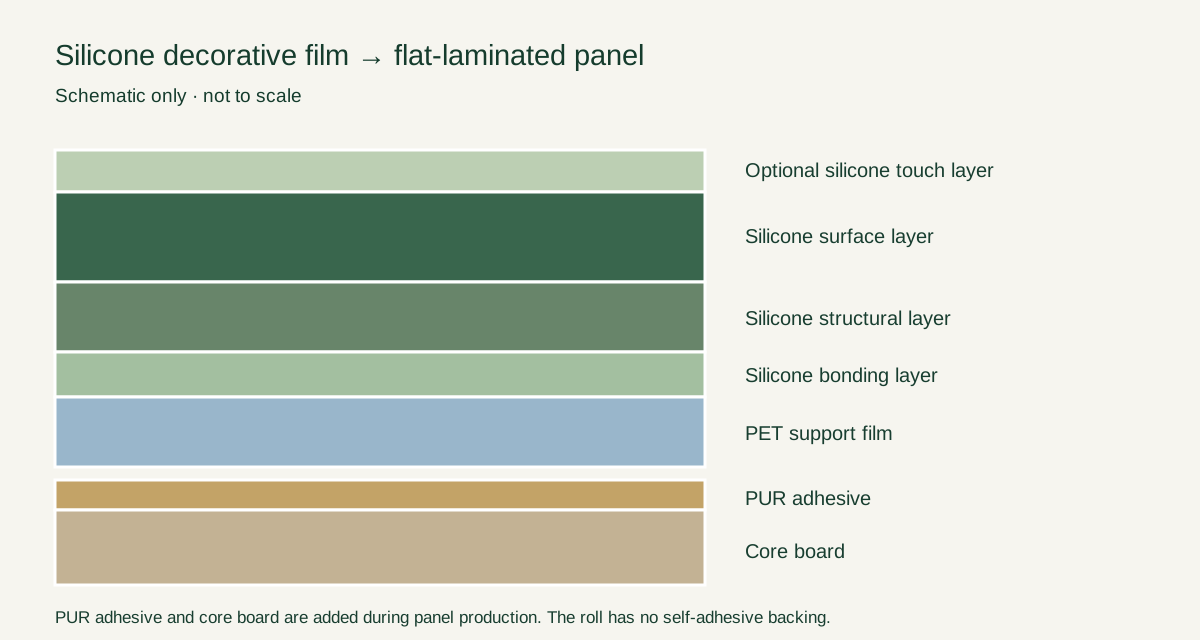
The schematic separates the supplied film from the PUR adhesive and board added during panel production. Layer thicknesses are not drawn to scale. An assembled panel also depends on its core, adhesive, edge treatment and processing; a film test does not establish the performance of all those parts.
On the production line, the back of the PET support is bonded to the board with PUR adhesive in a flat-lamination process. The supplied roll has no pressure-sensitive backing for peel-and-stick installation. Our furniture decorative film page covers the current furniture-facing range and supply options.
How does it compare with PVC, PET and melamine paper?
Choose the surface construction and processing route first, then compare the specified grades. The table covers our current silicone film, conventional furniture-grade PVC and PET films, and melamine-impregnated decorative paper after pressing onto a board. A coated PET film, an uncoated PET film and a film engineered for forming can give different results.
| Selection point | Puremorfilm silicone decorative film (current product) | PVC decorative film | PET decorative film | Melamine-impregnated decorative paper (pressed onto board) |
|---|---|---|---|---|
| Feel | Soft and leather-like, with slight give. | Smooth or embossed; dedicated matt finishes can also feel soft. | Smooth gloss or matt; soft-touch coated finishes are also available. | Hard, cured resin face, with smooth or deep-textured finishes. |
| Scratch resistance | No obvious scratches in the submitted sample's pencil test; see the conditions below. | Scratch-resistant lacquered surfaces are available; resistance varies with the finish. | A hard coat improves surface scratch resistance; performance depends on the coating and grade. | The cured resin creates a hard, wear-resistant face; scratch resistance varies with the surface grade. |
| Cleaning | Listed stains wiped off without obvious change in the manufacturer's laboratory tests; see the conditions below. | Wipe-clean finishes; mild, non-abrasive cleaners suit the documented example grades. | Easy-care coated surfaces; cleaning tolerance depends on the surface finish. | Easy-care faced surface; moisture service also depends on the core and edge details. |
| Composition | Silicone functional layers on a PET support; the film is PVC-free and contains no plasticizers or formaldehyde. | PVC thermoplastic decorative film, with the surface finish varying by grade. | PET polyester decorative film; coated constructions add lacquer or a hard coat. | Decor paper with thermosetting melamine resin, commonly melamine-formaldehyde, cured onto a board. |
| Flame retardancy | Flame-retardant film as standard; this does not establish a rated panel assembly. | Grade- and assembly-dependent; the PVC name alone supplies no project fire rating. | Grade- and assembly-dependent; the PET name alone does not establish flame retardancy. | Dedicated fire-retardant panel constructions exist; the finished construction needs its own applicable rating. |
| Forming and processing | Specified for PUR flat lamination, supplied without an adhesive backing. | 3D thermoforming over routed fronts is an established route for suitable film grades. | Flat lamination and specialist 3D thermoforming grades are both available. | Direct hot pressing produces the board face; it is a different process from thermoplastic 3D vacuum wrapping. |
| Suitable positions | Furniture fronts, cabinet doors, wall panels and other vertical or low-wear surfaces; exclude floors, countertops and stovetops. | Routed doors, furniture fronts and interior panels, with a surface and forming grade matched to the part. | Cabinet fronts and furniture panels; shaped fronts need a specified 3D grade. | Furniture fronts, carcasses and wall panels; suitable finished grades also serve moderate-wear tabletops. |
These are selection tendencies, not a ranking from a shared test. Surface coatings can change scratch resistance, feel and cleaning behaviour. Test the proposed finish, adhesive and core together when those differences affect your decision. For the two conventional film families, the PET and PVC furniture-film guide explains their different processing choices.
The melamine column describes paper after direct pressing onto a board. It does not describe loose decorative paper or an HPL sheet with its own laminated paper core. The resin name alone does not establish the emissions of a finished board. The decorative laminate and surface-materials overview separates these constructions.
Where can you use silicone decorative film?
Use our current film on interior vertical or low-wear surfaces where a soft, leather-like face and wipe-clean finish suit the design. Furniture fronts, cabinet and wardrobe doors, and wall panels are the main application areas.
For a cabinet door, assess the appearance and feel on the actual board, then check the bond and edge detail made by your production route. For an interior wall panel, check the finish against the project's cleaning routine and any required assembly-level documentation. Our decorative wall film page covers the wall-facing application.
Keep the current product off floors, stair treads, shower floors and other walking surfaces. It is also unsuitable for countertops, desktops used as worktops, stovetops and cooktop surrounds used as working surfaces. A film's abrasion or heat-related test result does not turn it into a suitable worktop or flooring material.
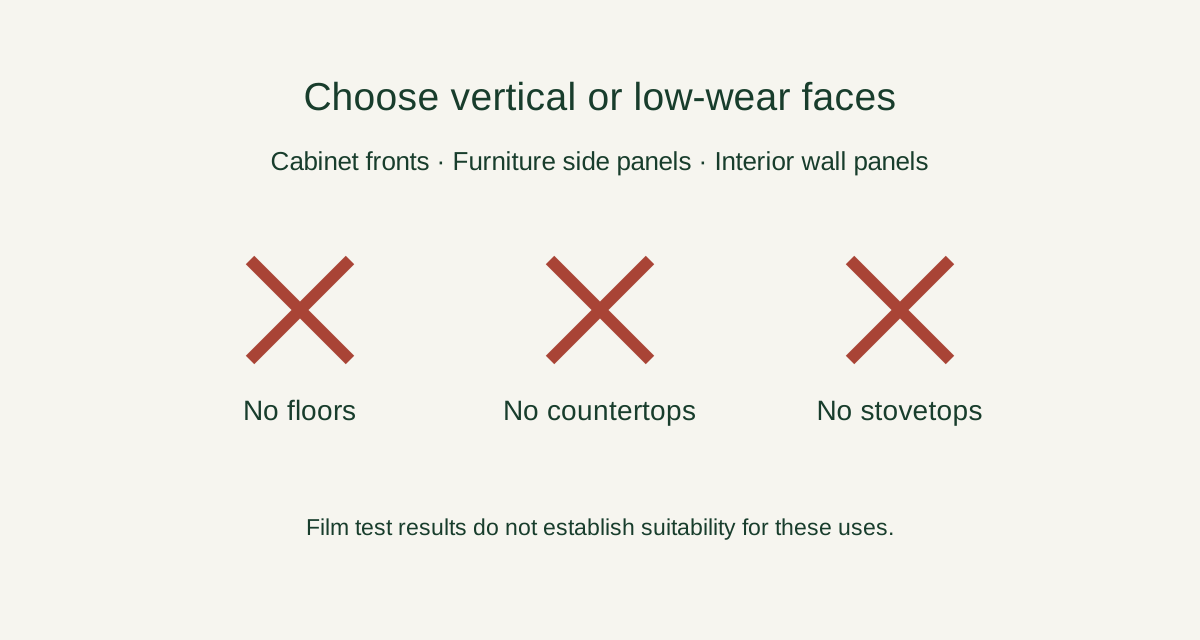
The current supply route is flat lamination. Plan a separate edge treatment or a suitable panel construction rather than assuming the film can be vacuum-formed around a routed door. PUR application and cure conditions must match the chosen film back, adhesive and board; the panel lamination adhesive guide explains that bonding context.
What do the recorded performance tests show?
The available results support specific statements about tested film samples under stated conditions. Three records below come from SGS testing; the stain record comes from the manufacturer's laboratory. They do not constitute a comparative test against PVC, PET or melamine, or a certification of a finished panel.
| Property | Sample, method and conditions | Recorded result | Scope |
|---|---|---|---|
| Pencil scratch | Submitted film sample; Mitsubishi Uni 2H pencil, 500 gf, 45°, three lines each longer than 20 mm. SGS report SZIN2608002405PL02, dated 2026-08-26. | No obvious scratches. | Pencil scratch under these conditions, not resistance to every sharp object. |
| Abrasion | Submitted film sample; ASTM D4060-25, CS-10 wheels, 1,000 g per wheel, 60 rpm, 2,000 cycles. SGS report SZIN2608002405PL04, dated 2026-08-27. | Slight matting only; no concentrated scratches, exposed substrate, coating peeling or obvious gloss loss. | Film abrasion result; it does not validate flooring or worktop use. |
| Dimensional stability | Submitted film sample held at 100°C for 600 minutes, then recovered at room temperature for 14 hours. SGS report SZIN2608002405PL01, dated 2026-08-26. | Length change 0.06%; width change 0.10%. | Dimensional change after this exposure and recovery, not a continuous service-temperature rating. |
| Stain wiping | Manufacturer's laboratory tests; coffee, red wine, ice cream, soy sauce and lipstick at 25°C for 24 hours before wiping. | No obvious change after wiping. | The listed stains and conditions; not a third-party result or compatibility claim for every cleaner. |
For procurement, ask for the relevant report and confirm how the submitted sample relates to the film being offered. Keep film, adhesive, core and assembly evidence separate when evaluating silicone-faced laminated MDF panels.
Our furniture and wall films are PVC-free and contain no plasticizers. The film itself is formaldehyde-free; an assembled board or furniture item also contains a core and adhesive whose emissions need separate assessment. Flame retardancy is a standard film property, while antibacterial functionality is an optional formulation with an additional cost. Neither statement establishes a medical claim or a specific fire classification for the completed panel.
How can you order film, panels and samples?
Order film rolls for your own PUR flat-lamination line, or silicone laminated panels for the project. Film rolls are our main supply; panels are quoted per project, with the core, thickness, one- or two-sided facing, packing and delivery terms agreed in the quotation.
| Supply form | Production minimum | Size and order basis |
|---|---|---|
| Film rolls | 500 m. | Confirm the film model, width, roll arrangement and finish for the order. |
| Silicone laminated panels | 200 sheets. | Panel size: 1220 × 2440 mm; core, thickness and facing configuration are quoted per project. |
The MOQ applies to production orders. A sample request is separate from a production order. Ask for the film or panel sample relevant to your application, and agree the sample format, any charge, freight and dispatch timing before it is sent. Custom-pattern development has separate order conditions; request the applicable terms with your brief.
Compare your selected finish with the current patterns and finishes, then send the application, supply form, pattern, estimated quantity and destination. Include the board and adhesive if you will laminate the film, or the core and thickness if you need finished panels. You can start a sample or project discussion with Puremorfilm.
Frequently Asked Questions
Is silicone decorative film the same as PET decorative film?
No. The exposed surfaces are different. Our film uses a silicone functional face on a PET support; a conventional PET decorative film presents PET or its specified top coating at the surface. The support-film name alone does not describe the face you touch and clean.
Is the film self-adhesive?
No. Our current rolls have no self-adhesive backing. They are intended for PUR flat lamination to a compatible board, rather than peel-and-stick installation on a finished wall or cabinet.
Can you vacuum-form it around a routed cabinet door?
No. The current supply route is flat lamination. Profile wrapping and 3D vacuum forming are outside that route; choose a construction and edge treatment that suit a flat-laminated face.
Is it scratch-proof?
No. No surface should be selected on that assumption. The SGS record is a 2H pencil result at 500 gf and 45°, with three lines longer than 20 mm and no obvious scratches. Sharp-tool and abrasive service can differ from that test.
Does formaldehyde-free film make the whole panel formaldehyde-free?
No. The declaration applies to the film. The board core and adhesive also affect the assembled panel and need their own emissions evidence; the film statement does not establish a board or furniture emissions grade.
Is antibacterial performance included in every film?
No. Antibacterial functionality is an optional formulation and carries an additional cost. Specify it during sampling; the standard film is not automatically an antibacterial grade.
Does the film give a wall panel a fire rating?
No. Flame retardancy is a standard property of our film, but a finished wall panel includes adhesive, core and installation details. Use evidence for the required panel or assembly rather than extending a film property to the whole construction.
What are the MOQ and panel size?
Film rolls start at 500 m. Silicone laminated panels are 1220 × 2440 mm and start at 200 sheets. Sample requests are separate; custom-pattern development has separate order conditions.