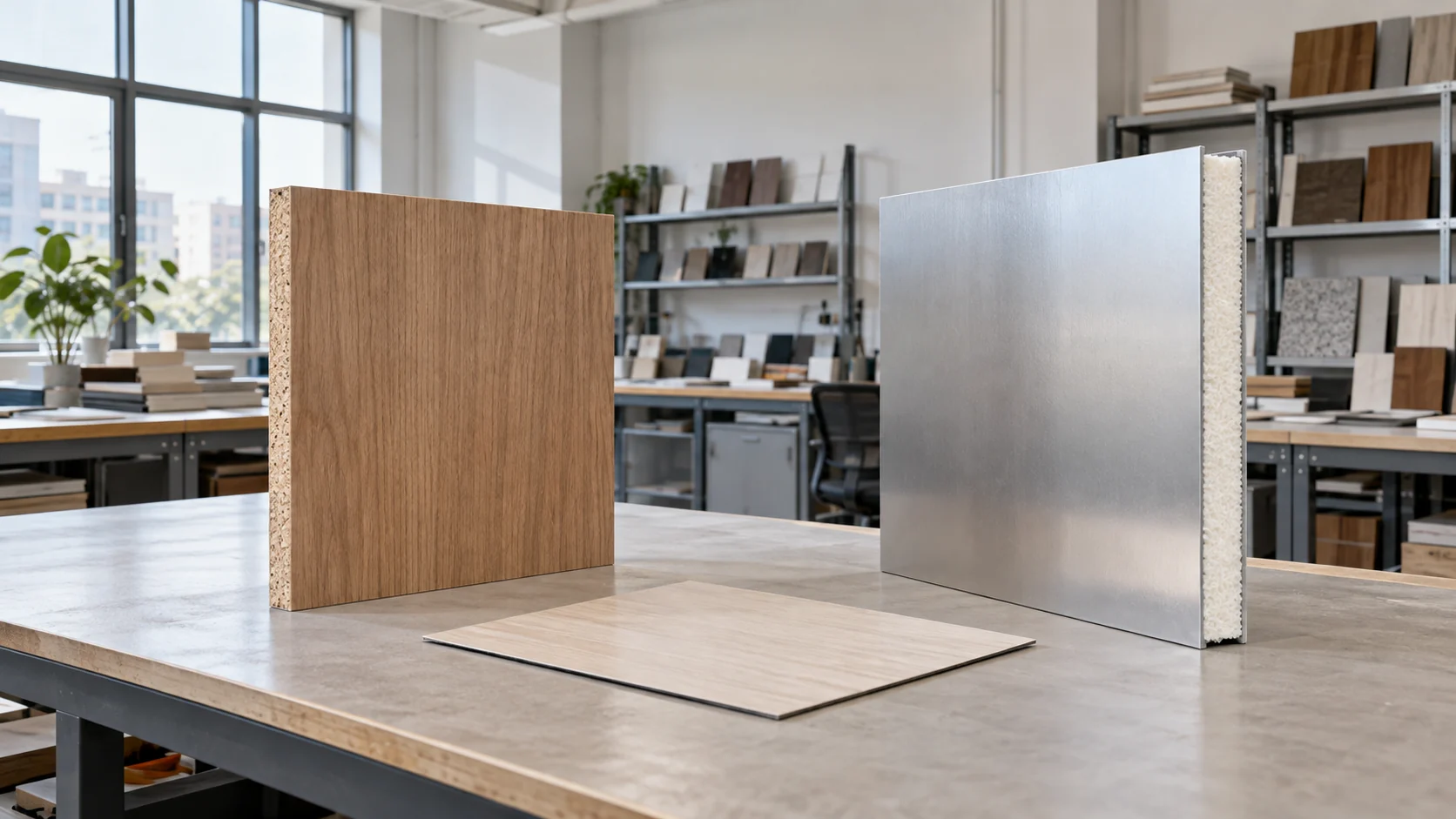
For decorative film on a flat board, choose a panel lamination adhesive specified for the film back and your coating equipment; reactive PUR is one established route. Compatible HPL and veneer can use dedicated waterborne or contact systems. Sandwich panels need skin-to-core qualification, so one adhesive family cannot answer all three constructions.
What is panel lamination?
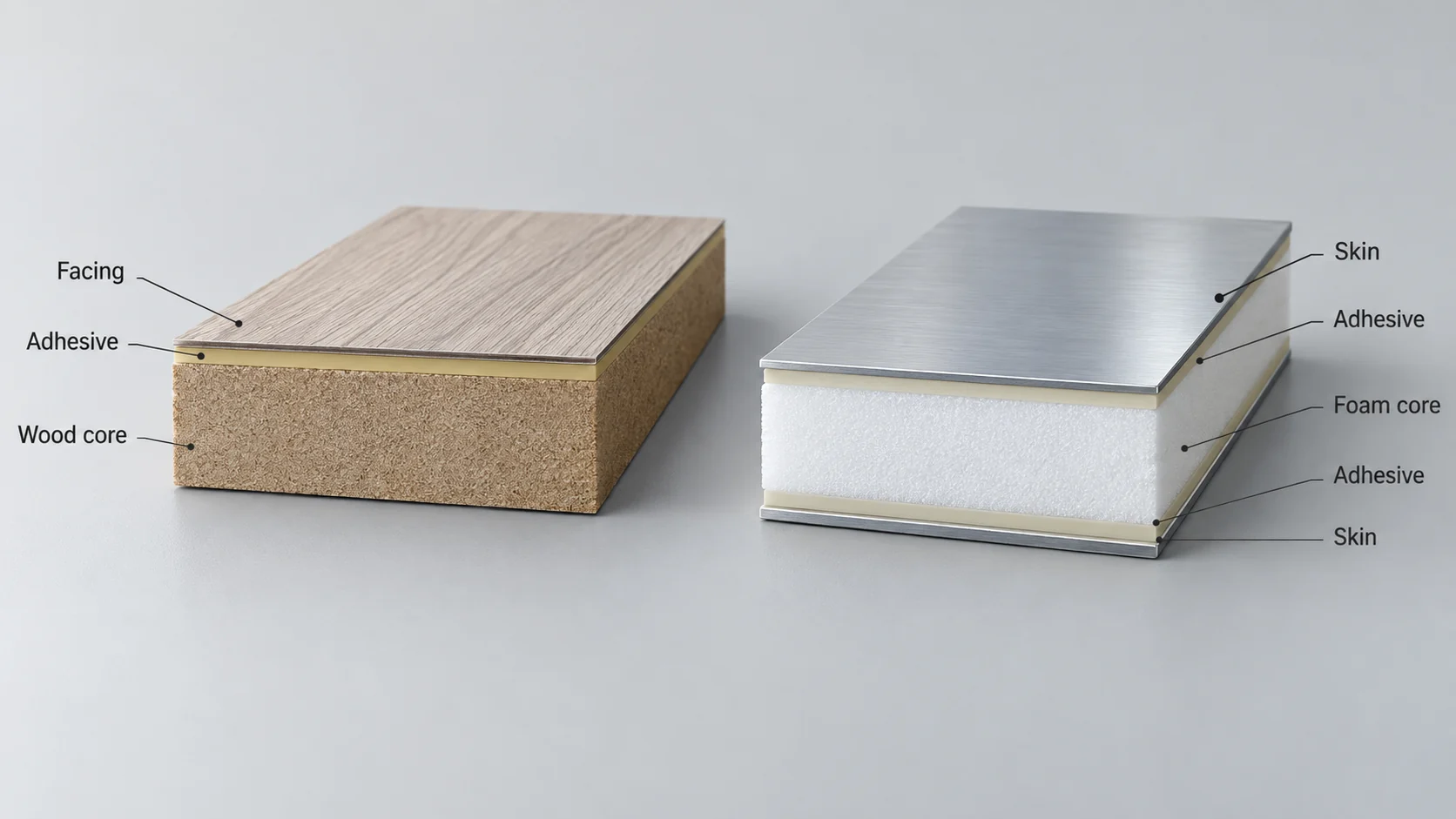
Panel lamination is bonding a facing layer to a flat board or core to make one finished panel. In furniture and interiors that usually means a decorative film, paper, HPL or veneer bonded to MDF, particleboard or plywood. In building and transport it also covers sandwich panels, where metal or composite skins are bonded to an insulating or honeycomb core. The adhesive has to suit both materials, the press or line, and the conditions the finished panel will see.
Which bond does panel lamination adhesive need to make?
Either a decorative facing to a board or structural skins to a sandwich core. Work out which one you have first, because they make different demands on wetting, pressure, stiffness and long-term durability.
In a faced wood-based panel, the adhesive joins a separately supplied facing to a finished board. HPL, wood veneer and decorative film have different backs and react differently to heat and water. Our guide to laminated MDF construction explains what the facing and the core each contribute.
| Panel construction | Surfaces being joined | Adhesive routes to investigate | Main qualification question |
|---|---|---|---|
| HPL-faced wood board | Laminate back to MDF, particleboard, or plywood | Suitable waterborne wood adhesive or contact adhesive | Can the line achieve continuous contact and a stable, balanced panel? |
| Veneer-faced wood board | Wood veneer to a wood-based core | Wood-laminating adhesive matched to hot or cold pressing | Will moisture, cure, and species affect appearance or flatness? |
| Decorative-film-faced board | The selected film’s bonding side to the board | Film-compatible reactive hot melt, another qualified coating system, or a supplied adhesive layer | Does the actual film back bond without distortion or visible defects? |
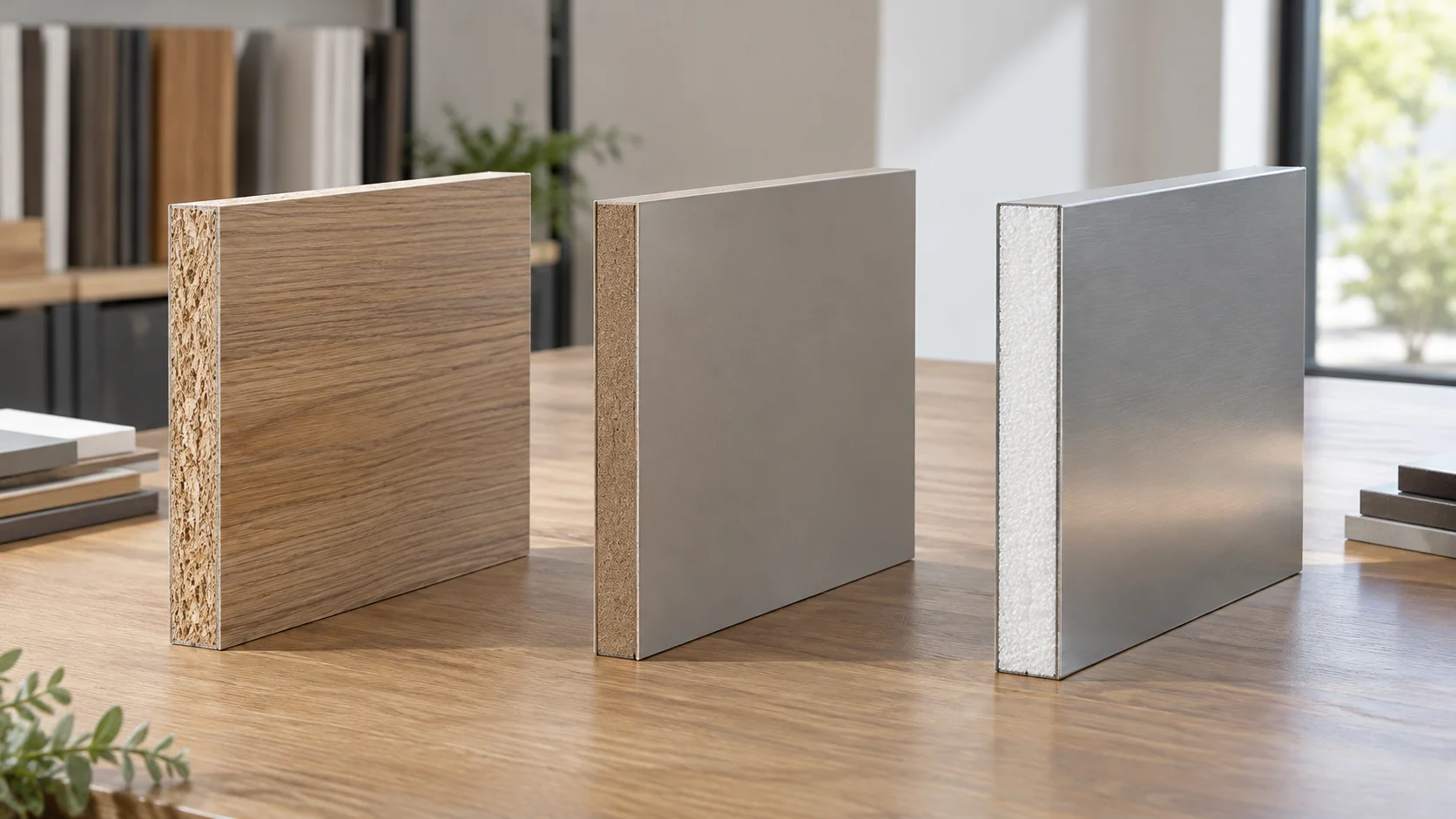
| Sandwich panel | Metal, composite, or other skins to foam, honeycomb, or another core | Qualified polyurethane, epoxy, or other engineered panel adhesive | Can the bonded assembly meet its load and exposure requirements? |
Thermally fused laminate, or TFL, is a different route altogether: resin-impregnated décor paper is fused straight onto the substrate with no adhesive layer between them. Glue bought for a separate HPL sheet won’t reproduce that process; melamine versus laminate covers the surface difference.
For the full sequence from board preparation to bonding and inspection, see how to laminate MDF.
Which adhesive families fit wood and decorative facings?
Pick the family only after you’ve confirmed the facing back, the board surface and your lamination equipment. A glue that works between two absorbent wood surfaces may need a different formulation or process once one face is nonabsorbent.
Waterborne polyvinyl acetate, often called PVA or PVAc, is an established wood-laminating option. Franklin’s panel-laminating range includes grades for veneer and HPL in hot-press and cold-press versions, so the grade and pressing route are part of the choice; ordinary woodworking glue isn’t a laminator’s product. The water has to leave the bond, and the board’s moisture content affects how it does.
Contact adhesives are another route for compatible decorative sheets. Both faces are coated and brought to the specified condition before they meet. The Wood Handbook chapter on adhesives explains this contact mechanism and the difference between thermoplastic and thermosetting adhesives, which matters where heat or a constant load can cause creep.
With a thin decorative film, confirm its bonding side, coating compatibility and how it reacts to the process. Reactive PUR hot melt can suit a qualified flat-lamination system, while a thermoplastic hot melt sets in a different way. A pressure-sensitive adhesive layer is a construction of its own and should be named as such; an uncoated film isn’t self-adhesive.
The visible finish doesn’t tell you the bonding face. A veneer, an HPL sheet and a printed film can all imitate the same oak grain and still need different adhesives. Wood veneer versus laminate helps you identify the material the glue will actually touch.
PUR vs PVAc adhesive for film lamination: how do they differ?
Reactive PUR is a useful starting route for thin plastic film on a qualified board line; a dedicated PVAc grade can suit absorbent wood-facing systems when water removal and pressing fit the materials. The grade and backing decide the joint.
| Dimension | Reactive PUR hot melt | Dedicated PVAc laminating grade |
|---|---|---|
| Bond formation | Cooling provides initial grip; moisture reaction builds the cured network. | Water removal and film formation are part of setting; grade-specific chemistry may add crosslinking. |
| Nonabsorbent decorative back | Commonly evaluated for compatible plastic films; verify the actual coating or treatment. | Do not assume a wood-glue grade bonds an impermeable film; use a grade explicitly approved for the facing. |
| Flatness and appearance | No added water from the adhesive, but core balance, smooth coverage and contact remain necessary. | Added water, the board’s absorption and pressing/drying can affect flatness or a thin face. |
| Equipment and timing | Reactive-hotmelt melter/coater and a usable open window; handling grip is separate from cure release. | The specified hot/cold press route and sufficient assembly/drying conditions; no universal press time. |
Franklin’s laminating systems include grades for HPL and veneer. KLEIBERIT’s surface-lamination explanation discusses water removal and reactive PUR. Neither source qualifies an unspecified film, board or line.
What is the best adhesive for laminating film to particleboard?
For plastic or silicone-faced decorative film on particleboard, reactive hot-melt PUR is usually the best starting choice: it bonds non-absorbent film backs, tolerates the board’s surface variation, and gains heat and moisture resistance as it cures. Water-based PVAc or EVA systems suit paper foils and absorbent facings better. Whatever the adhesive, the board needs a fine, closed surface layer.
- Board surface: particleboard is more porous and less uniform than MDF, so use fine-surface boards, sand and clean them, and expect to set a higher glue weight on trial panels.
- Telegraphing: thin or glossy films can show chips through the face; check finished panels under raking light.
- Moisture: keep board moisture within the adhesive maker’s range, because excess moisture causes bubbles with PUR and slow drying with PVAc.
- Edges: particleboard edges are open, so plan edge banding after lamination and the PUR cure time.
Confirm the choice with peel tests on your own board and film before production; the adhesive maker’s data sheet sets the starting temperature, open time and glue weight.
How does adhesive choice change for sandwich panels?
Substantially. Choose around the skin, the core, the manufacturing process and the panel’s required performance, because a wood-facing shortlist won’t carry over to metal skins or insulating foam.
Sika’s vehicle-panel application guide treats moisture-curing polyurethane, mixed polyurethane systems and reactive hot melts as distinct lamination options, and its building-element guidance covers different skins and insulation cores. Each is a route to test on your materials and with the preparation they need.
A moisture-curing system needs access to moisture for its reaction. A mixed system adds proportioning and mixing control, and some can be tuned to the assembly sequence. With impermeable steel skins, large bond areas or uneven core surfaces, those differences can decide whether an otherwise suitable adhesive works on your line.
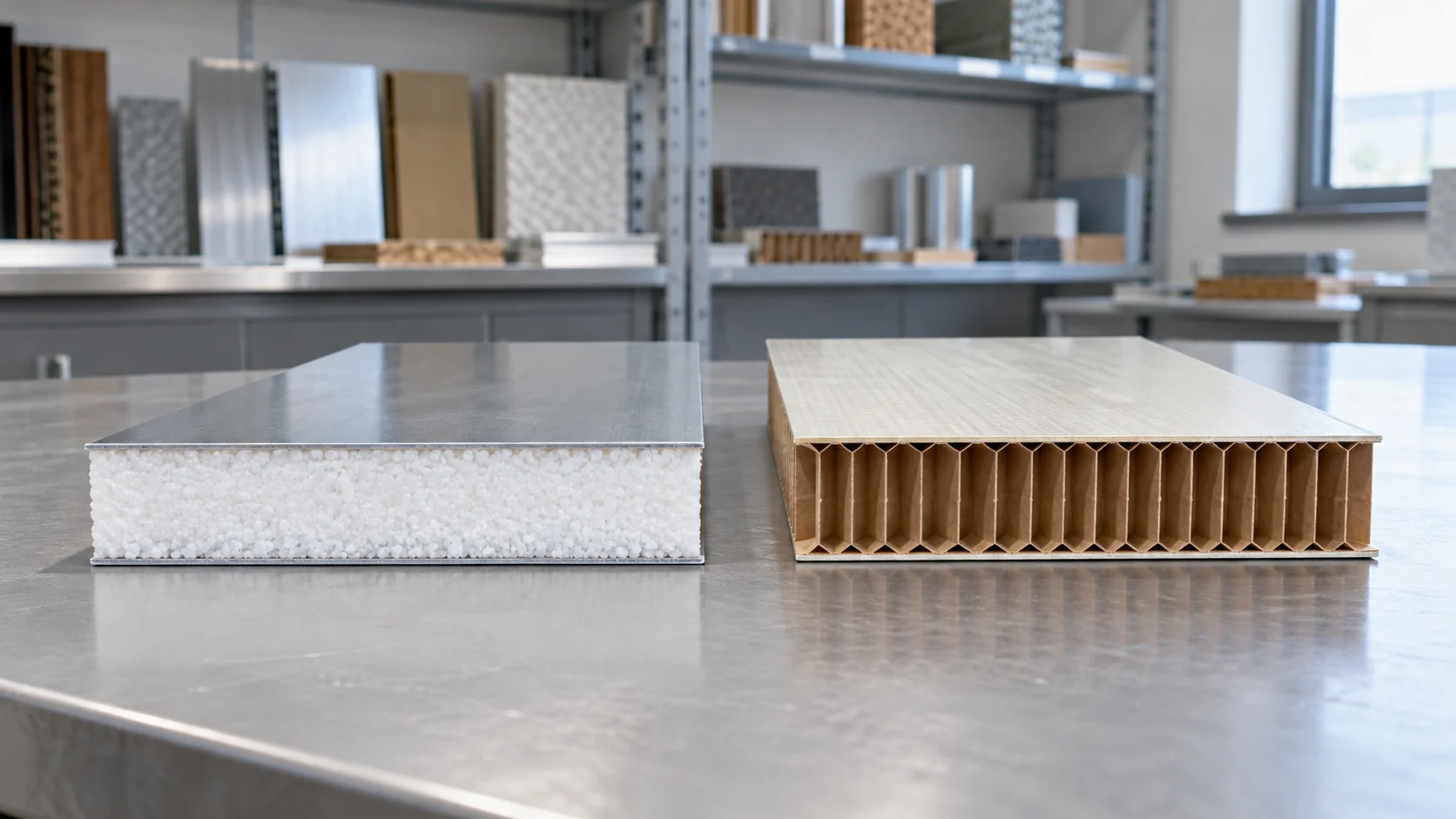
The SikaForce-712 L7 data sheet describes a mixed polyurethane for combinations of skins and insulating cores, and still requires trials with the actual substrates and conditions. It also requires press pressure to stay below the core’s compressive-strength limit: a crushed foam core or damaged honeycomb changes the panel even when the adhesive has cured.
Ask the adhesive supplier to separate wetting problems, core damage and bond failure. For a structural assembly, agree the panel-level qualification with the responsible engineer; a good skin-to-core coupon is useful evidence, but it does not cover every load case of the finished panel.
What makes a laminated bond strong and durable?
Clean, compatible bonding surfaces and a panel built for its service environment. Adhesive strength can’t make up for a loose surface layer, and it can’t stop every kind of distortion.
Adhesive needs intimate contact with sound material to form a useful bond. Dust, release agents, contamination and damaged fibers break that contact, and a smooth plastic back can still be hard to wet. Check whether the specified preparation includes cleaning, treatment or a primer, and prove it on the material you are actually supplied.
Moisture belongs in the construction decision. Water from the adhesive and differences between facing and core can change dimensions. For wood-based panels, flatness depends on face-and-back balance, conditioning and the service environment, so check that both faces expand and stiffen compatibly, whatever their color.
Spell out the real exposure: seasonal indoor humidity, regular cleaning, heat near equipment or outdoor use. Check the adhesive, facing, core and exposed edges against it. A water-resistant glue won’t turn an unsuitable wood-based core into a wet-area panel; MDF’s water limitations still apply.
Note where a failed specimen separates. Clean release at the facing back points to an interface problem; fibers left on the adhesive point somewhere else. Define the required load, conditioning, appearance and acceptable failure mode before testing so you know what counts as a pass.
How should factory timing and pressing be specified?
As three separate stages: assembly, pressing and release for further processing, each taken from the selected adhesive’s current data sheet and your actual plant conditions.
Franklin’s Laminating 25 is a useful cold-press HPL example. Its data sheet, revised 12/08/2022 and linked from the current product page, gives a suggested minimum use temperature of 45°F/7°C and a spread of 170–250 g/m² of glue line. Those are instructions for that adhesive, not settings for decorative-film PUR lamination.
At 70°F and 50% relative humidity, with about 6 wet mils of adhesive, the same sheet gives 5 minutes of open assembly and 15 minutes of total assembly. Press times run from a minimum of 30 minutes to more than two hours depending on stock and conditions, and it recommends 24 hours of cure before further machining. Go by the full data sheet, not the short press-time example in the product description.
Your production spec should say when each clock starts and stops. Open assembly runs while the coated faces are apart; total assembly includes the wait before consolidation. Mixed adhesives may also have a working life measured from mixing, and a warm mixed batch can shorten it. Define those events at the coater, the layup table and the press instead of giving operators one vague “open time.”
Set pressure to consolidate the panel without starving the bond or crushing the core; too much pressure can drive adhesive out of a wood joint or too deep into it. For release checks, pick a suitable bond test, such as ASTM D903 for applicable peel specimens, and agree when the specimen is tested. Log material temperature, coverage, delay, consolidation and cure for every trial.
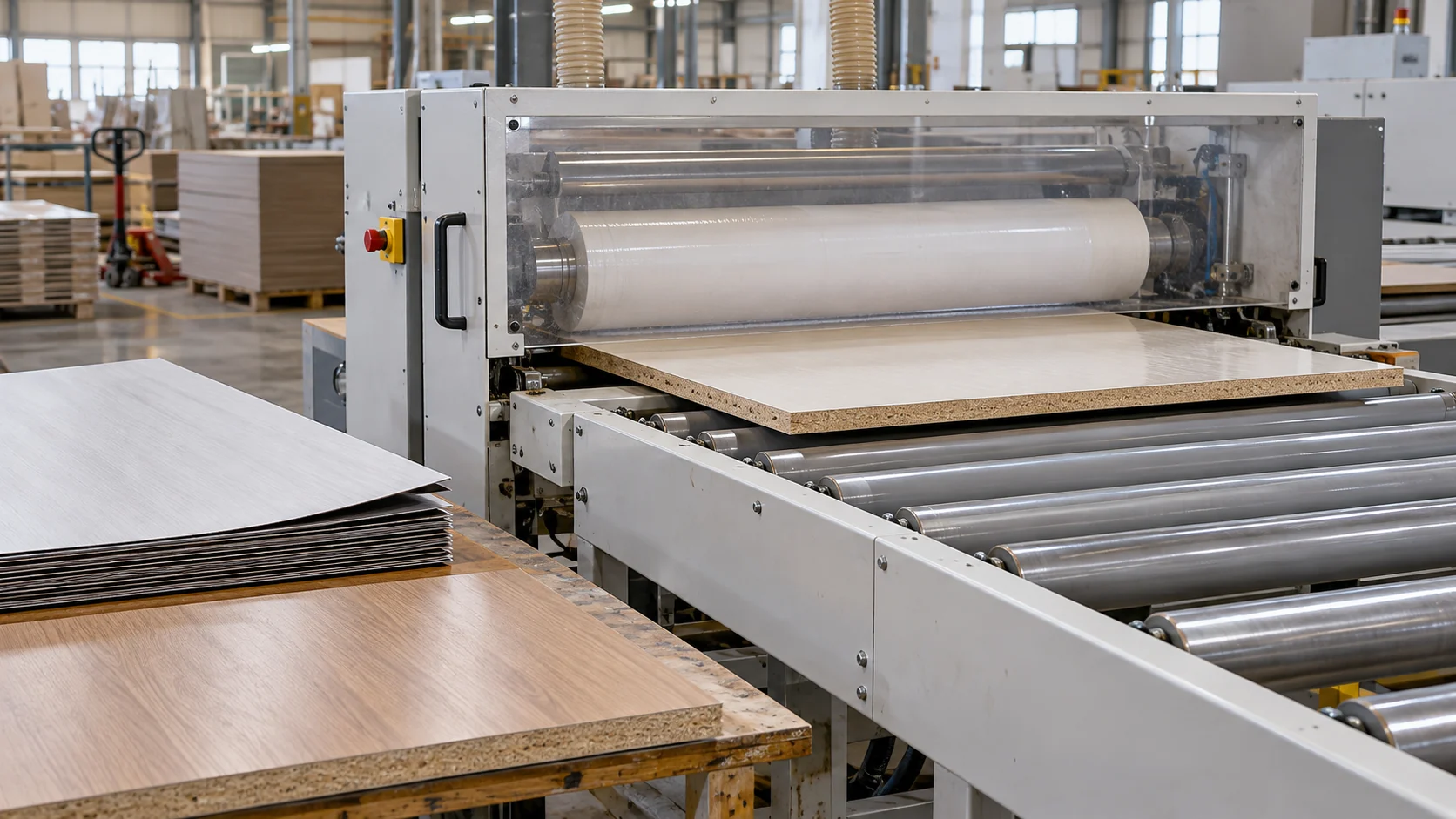
What should you test before approving production?
The actual facing, adhesive grade, core and production sequence, compared under one written conditioning and test protocol so every supplier’s sample is tested the same way.
ASTM D903-98(2025) covers comparative peel or stripping characteristics under defined specimen and test conditions, where the construction can form a suitable peel specimen. Record preparation, conditioning, peel arrangement, test speed, result and failure location, and keep the same protocol for every candidate.
The D905-08(2021) compression-shear method compares shear strengths of bonds in wood and similar materials under compression loading. Wood failure and specimen behavior affect the result, and the measured values are not directly design shear strengths, so use them to compare qualified specimens and then check the loads on the specified panel.
Run service checks once the bond has reached its specified cure. Look for edge lifting, blisters, telegraphing and flatness alongside the mechanical result. A thin film can stay attached and still show roller marks or surface distortion, and a panel that looks good at press exit can move as moisture redistributes.
Then run the winning construction through a pilot, including normal stops, restarts and the longest planned layup delay, and keep traceable samples and records. For wood-core fabrication beyond adhesive choice, our MDF lamination guide covers preparation and assembly.
If an appearance or bond fault appears, use the decorative-film defect and failure-plane table before changing adhesive families. Bubbles, orange peel, wrinkles and edge lift can result from coverage, substrate or handling faults that another glue family alone will not resolve.
What belongs in a panel-adhesive specification?
The complete bonding system and its acceptance criteria, written before you compare quotes. A family name and a drum price leave too much open for a production decision.
| Item | What to specify | Why |
|---|---|---|
| Bonding materials | Exact facing back, core grade, skin or core treatment, and approved substitutions | A changed surface can alter adhesion even when the visible finish matches |
| Adhesive identity | Manufacturer, grade, components, data-sheet revision, and shelf-life controls | Family names do not define a usable production product |
| Application route | Coater, hot or cold process, coating side, and validated coverage | Connects the adhesive to the available equipment and bond area |
| Process window | Material conditions, assembly events, mixing controls where applicable, pressure, and cure release | Makes the trial reproducible and exposes line constraints |
| Service and acceptance | Required exposure, test method, conditioning, thresholds, failure modes, and appearance limits | Gives candidate products the same qualification target |
| Panel construction | Face-and-back balance, edges, core compression limits, and storage conditions | Keeps the completed panel within its intended use |
| Change control | Requalification triggers, batch traceability, and responsibilities | Prevents an untested material or process change reaching production |
Work out cost per accepted panel, including adhesive use, labor, press time, rejects, equipment cleaning and inventory losses. A faster-setting adhesive may ease a bottleneck but leave too little layup time for a large panel, so estimate the effect from your pilot records instead of counting on nominal cure speed.
Get the safety data sheets and set controls for mixing, application and cleanup. Isocyanate exposure is a known concern in polyurethane work, so choose workplace controls for the actual formulation and application method as part of the line setup.
How do you choose a panel lamination adhesive supplier?
Most adhesive problems on a lamination line trace back to a mismatch between the glue, the facing, the board and the equipment, not to the brand. Use this checklist when comparing suppliers:
- Technical data sheet (TDS) and safety data sheet: application temperature, open time, recommended glue weight, cure time and storage life.
- Compatibility evidence: bonding results on your exact facing (film back, primer or paper) and your board grade, not a generic substrate.
- Equipment fit: whether the adhesive suits your roll coater or nozzle, line speed and press type, and what cleaning or purging it needs.
- Performance tests: peel or bond strength, heat and humidity resistance, and edge behavior after cutting, ideally on panels aged for the full cure time.
- Batch consistency: how lots are tested and traced, and how quickly technical support can respond to a line problem.
- Line trial: a supervised trial on your own line before you approve production, with retained samples from each run.
Ask the facing supplier and the adhesive supplier to agree the bonding window together. For our silicone film, we provide trial material so you can run that check on your own line before ordering.
Where does our PUR flat-lamination route fit?
Puremorfilm manufactures silicone decorative film in China with a silicone functional face on a PET support. We supply rolls without self-adhesive backing for PUR flat lamination to boards, or silicone laminated panels quoted per project. Use the current product for furniture fronts, cabinet doors, wall panels and other vertical or low-wear faces; exclude floors, countertops and stovetops.
The bond inside the supplied film and the PUR joint added by your laminating line are separate. In worked examples described in the patent application, a 125 μm BOPET construction reached at least 3 N/15 mm in a 180° peel test. This is an interlayer result for the film construction, not an acceptance value for film bonded to MDF; qualify that joint on the actual adhesive and board.
Standard furniture and wall-film rolls start at 500 m. Laminated panels are 1220 × 2440 mm and start at 200 sheets; the core and facing configuration are quoted per project. Compare the furniture decorative film and wall-film application with your component.
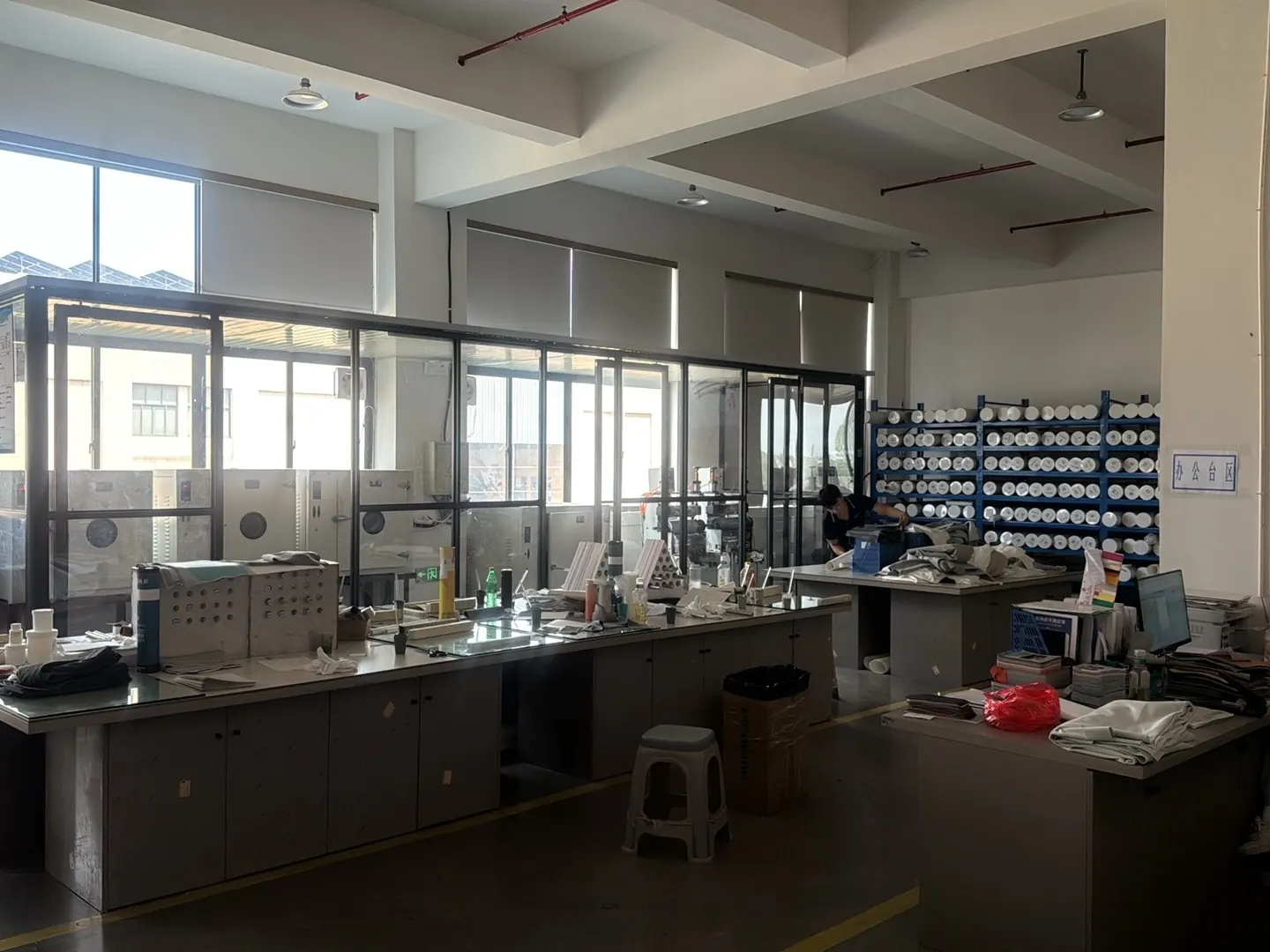
Illustrative equipment image; not a record of testing this finished panel.
Which adhesive route should you choose?
The grade that passes the required checks on your actual panel and fits your line’s usable process window. Start from your construction below, then narrow it down with the supplier and trials.
| Your panel | Start the evaluation with | Resolve before production approval |
|---|---|---|
| HPL or veneer on a wood-based core | A grade specified for that facing and the intended hot, cold, or contact process | Moisture balance, assembly time, continuous contact, and finished appearance |
| Thin decorative film on a flat board | A film-compatible flat-lamination system | Bonding-side compatibility, distortion, coverage, and cured adhesion |
| Skins on foam or honeycomb | An engineered sandwich-panel adhesive system | Actual skin/core interfaces, core compression, cure, and panel-level requirements |
For a flat-faced furniture or wall-panel project, contact us with your construction and process details so we can prepare a relevant sample.
Frequently Asked Questions
What is the best adhesive for laminate?
For HPL on MDF, particleboard or plywood, a waterborne PVA laminating adhesive or a contact adhesive. For thin decorative film on flat boards, reactive PUR hot melt is the usual flat-lamination route. Match the grade to the laminate back and your pressing method.
What is the best panel adhesive?
PVA or contact adhesive for compatible HPL-faced wood boards, PUR hot melt for decorative-film flat lamination, and qualified polyurethane systems for metal-skinned sandwich panels. The best candidate is the one that passes your agreed checks and allows consistent assembly and cure on your line.
What is the strongest panel adhesive available?
No single adhesive is the strongest for every panel. Peel and shear results measure different things, and the facing or core may fail before the adhesive, so compare candidates on the same panel test.
What glue works on lamination?
Waterborne wood-laminating adhesives, contact adhesives, reactive hot melts and engineered polyurethane or epoxy systems, each on the materials it is specified for. Thermally fused laminate is different: its resin-treated paper is fused to the board without a separate glue.
Which adhesives are used for sandwich panel lamination?
Polyurethane systems, either moisture-curing or mixed, are the established options, with the grade chosen for the actual skins and core; some constructions use epoxy or another engineered adhesive. Confirm surface preparation, assembly window, core pressure limits and panel requirements with the supplier.