
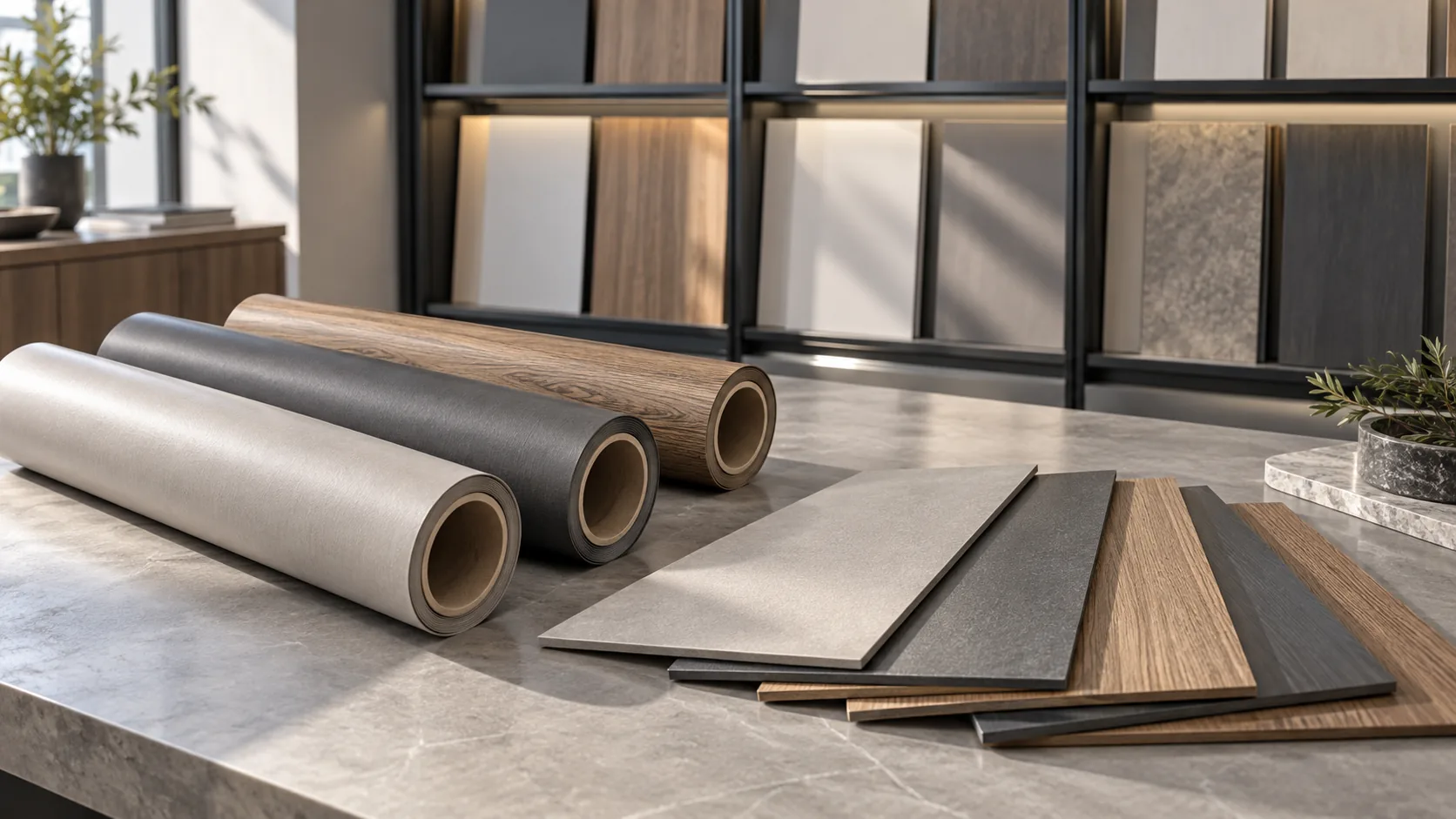
For a PET vs PVC decorative film choice, start with a stable PET construction for flat furniture panels and a validated forming-grade PVC for routed fronts. Surface coatings and the finished panel, including its adhesive and edges, decide cleaning, scratch and heat performance; the polymer name alone cannot rank those properties.
How do PET, PVC and organosilicon decorative films compare?
PET and PVC identify plastic families; silicone identifies the exposed functional face in our construction. A coated PET or PVC film therefore has to be compared by its working surface as well as by its carrier.
PET is polyethylene terephthalate, a polyester. BOPET is biaxially oriented PET, stretched in both directions during manufacture. PVC is polyvinyl chloride, made in rigid and flexible formulations, with plasticizers softening the flexible grades. PETRA’s material explanation and the European vinyl industry’s plasticizer guide cover those distinctions.
How do the three constructions compare?
| Dimension | PET decorative film | PVC decorative film | Puremorfilm silicone decorative film |
|---|---|---|---|
| Material and exposed surface | Polyester carrier or film; a coating may supply the working face | PVC film with a specified formulation and exposed finish | Silicone functional face on a PET support film; the working face is silicone |
| Flat slab doors and panels | A stable flat-lamination grade is a suitable starting choice | A specified 2D lamination grade is also suitable; PVC is not limited to formed doors | Supported route: PUR flat lamination to board, supplied without self-adhesive backing |
| Routed or recessed door faces | Only a construction declared for the required forming process; do not assume oriented PET can stretch into a recess | A validated 3D thermoforming grade is the direct route for contoured fronts | Outside our supported route; do not vacuum-form this film over routed fronts |
| Feel, gloss and scratch response | The exposed coating and texture decide; PET alone supplies no scratch ranking | The exposed coating and texture decide; plasticizer choice also changes flexibility | A tactile silicone face; its sample results cannot rank it against untested PET or PVC finishes |
| Heat and cleaning | Use results for the named finish, carrier and bonded panel; no polymer-wide temperature or cleaner permission | Use results for the named formulation, finish and bond; no polymer-wide temperature or cleaner permission | The film-level dimensional-stability result is stated below. Assess cleaning with the intended agents on the supplied finish; the film result sets no assembled-panel service limit |
| PVC-free material brief | PET polymer contains no PVC; verify the complete coated construction | A PVC film cannot meet a PVC-free requirement | Our furniture and wall film is PVC-free and contains no plasticizer |
The silicone column describes our own construction rather than a third base polymer. The Composite Panel Association’s 2D and 3D guidance places PET among 2D film routes and PVC or PETG among thermoformable 3D routes. A named grade and the actual door geometry decide whether a proposed construction can form.
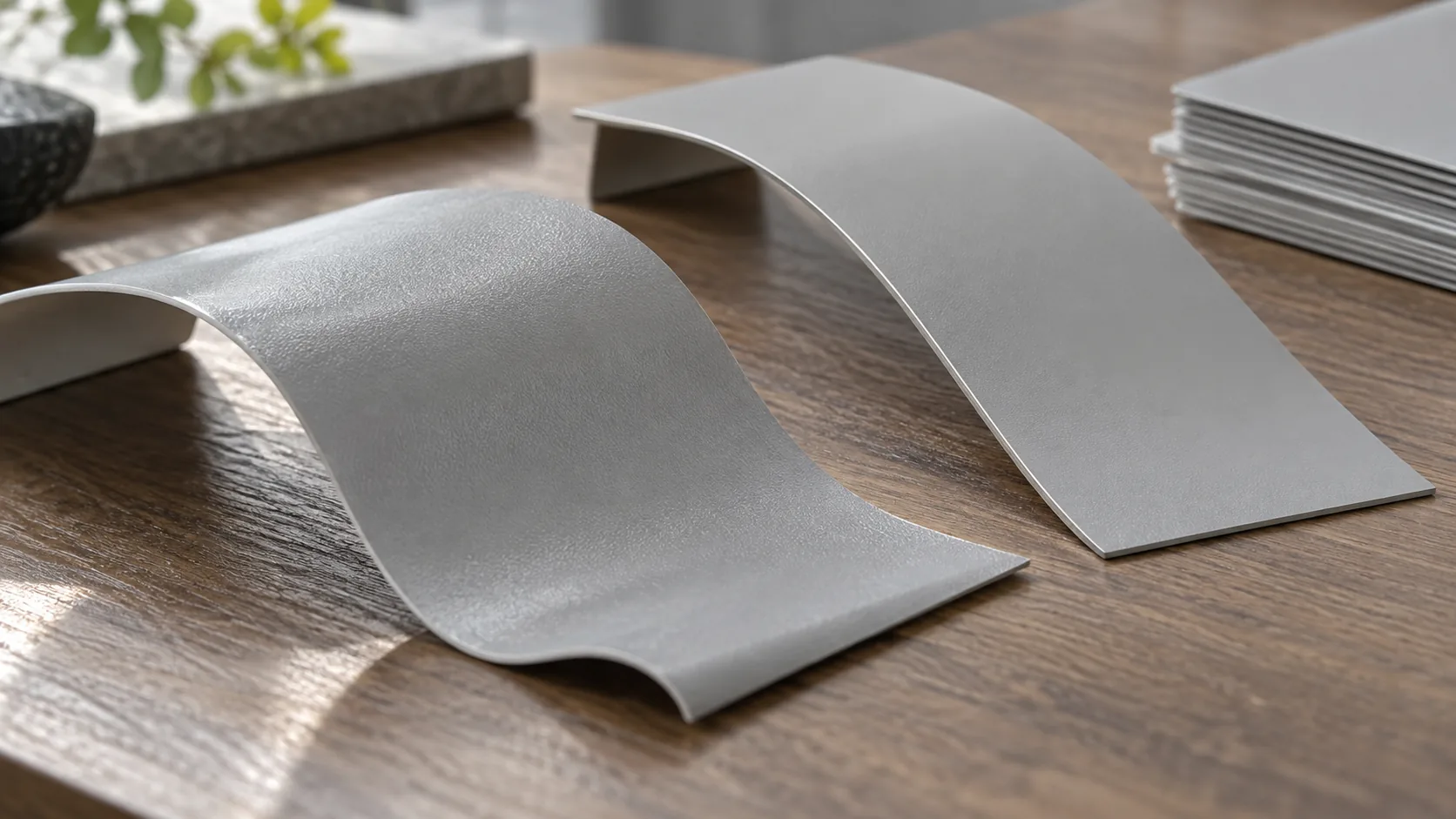
Compare these films with HPL, melamine and other furniture faces in the decorative laminate overview.
Is PETG the same material as PET film?
No. PETG is a glycol-modified polyester, so specify the exact grade separately from PET.
An oriented PET carrier and a PETG forming film are different specifications. CPA identifies PETG as a thermoformable 3D film material; that does not make every film sold as PET a 3D grade. Record the exact polymer, orientation, coating and process rather than accepting a combined “PET/PETG” description.
Write the exact polymer and grade on your comparison sheet, then add orientation, coating and the conversion route. A PETG candidate meant for forming needs its own trial and paperwork. Swapping an oriented PET film for PETG because both are polyester can change how a door profile forms even when the pattern matches.
How does PP film compare with PVC film for wood panels?
PP film and PVC film can both provide decorative faces for wood panels, but they need a grade matched to the bonding and shaping process. Polypropylene is a polyolefin; PVC is a vinyl polymer available in different formulations. Compare the coating, bond and completed panel rather than assigning durability from the polymer name.
| Decision point | PP decorative film | PVC decorative film |
|---|---|---|
| Material identity | Polypropylene-based film; confirm the complete coated construction. | Polyvinyl chloride-based film; confirm the grade, additives and exposed finish. |
| Flat panels | PP appears among 2DL film options; validate the supplied grade and bonding route. | A suitable 2DL grade can also face a flat panel. |
| Routed doors | Do not substitute a flat-lamination grade for a forming grade. | A validated 3DL thermoforming grade can cover contoured components. |
| Wear and care | Ask for topcoat-specific abrasion, scratch and cleaning evidence. | Ask for the same evidence under comparable conditions. |
The polypropylene material guide explains the polymer family, and CPA’s 2DL/3DL definitions place PP and PVC in their processing context. Neither supplies a universal ranking for finished furniture panels.
Which layer controls scratches, gloss and the printed design?
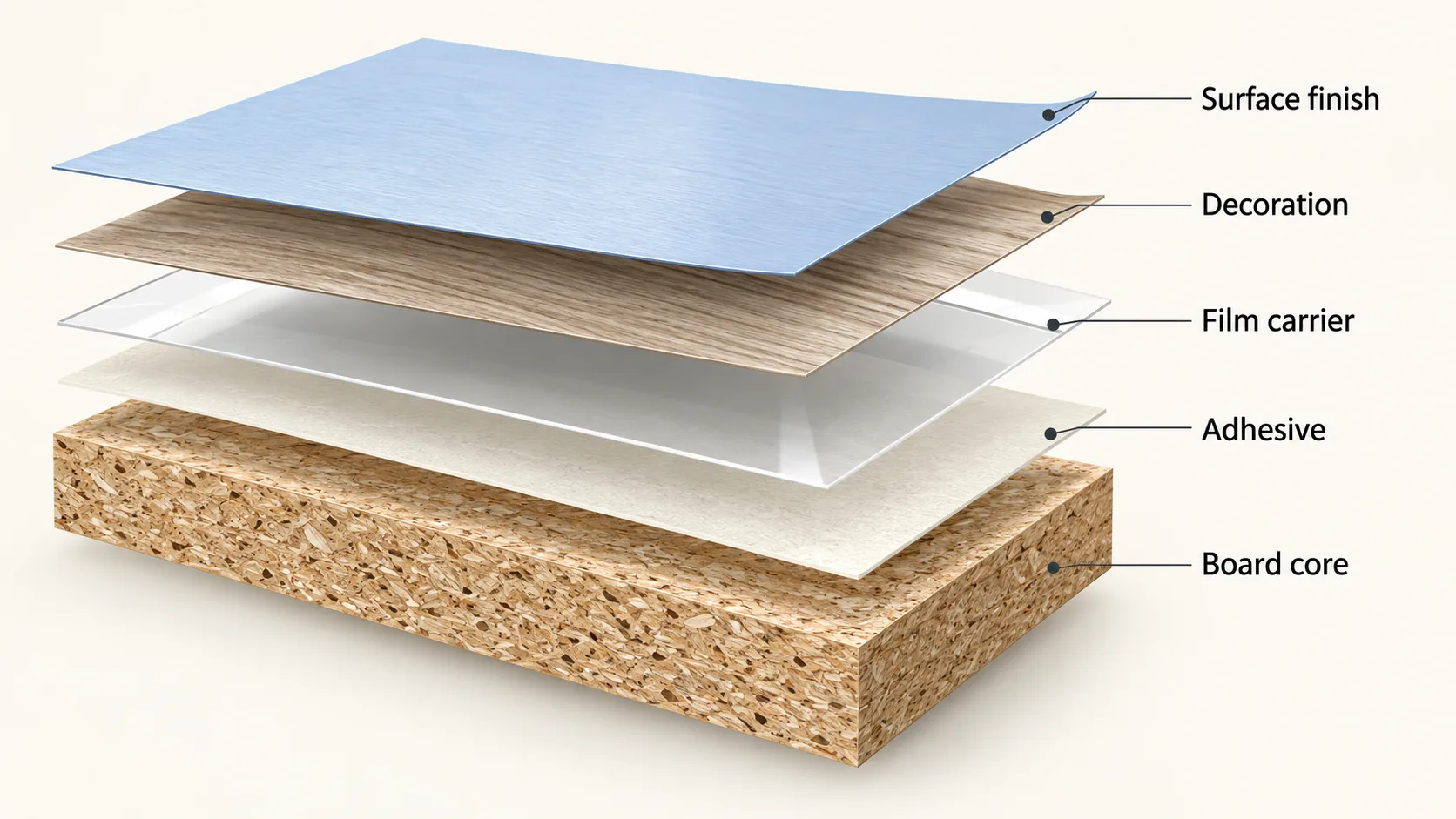
The top finish. The outermost layer takes the contact, the decoration supplies the design, and the film carrier supports both.
A typical construction puts a protective coating over printed décor, with the carrier below and an adhesive bonding the film to a board; some functions share a layer. That is why two PET-based films can feel, shine and scratch differently, and why a coated PVC face can behave unlike an uncoated PVC film.
For scratches, ask what surface was tested and what sat under it. ASTM D3363-22 covers pencil hardness of organic coatings on metal or similarly hard substrates, and a softer wood substrate can change the result by deforming. Read any pencil grade together with its coating, substrate and procedure.
Abrasion is a different kind of damage. ASTM D4060-25 rates organic coatings with a Taber abraser on a flat, rigid surface. Compare reports only when wheels, loads, endpoints and specimen builds match; a hard pencil grade says nothing about the wear on a busy drawer front.
The laminated MDF guide explains the face-and-core distinction, and the melamine vs laminate comparison helps when you weigh film against resin-treated paper. Write the purchase description tightly enough that any change of carrier or topcoat triggers a new sample approval.
Which film suits flat panels and shaped cabinet doors?
A flat-lamination film for a flat face, and a documented forming grade for a shaped one. Pick the production route before the polymer label.
A flat panel only asks the film to lie evenly on a board. A recessed or profiled door also asks it to stretch, bend and wrap around features, which can change the film, adhesive and finish you need. A film that behaves on a flat sample can wrinkle, whiten or lose its look once shaped.
A formable copolyester can be a different candidate from an oriented PET flat-lamination film. The declared 3D grade, adhesive system and draw geometry must match. Furniture-film processing guidance describes 3D forming with heat, pressure and vacuum as a distinct route from continuous flat lamination.
Make the trial part look like the real door. Include the tightest corner, the deepest recess, an exposed edge and the final finish. Check for color or gloss change where the film stretches and for bond failure around features, and record the build so the next trial uses the same candidate.
The thermofoil vs laminate guide covers cabinet-face routes, and the broader kitchen cabinet materials guide links the door design to its board and finish.
How should heat, moisture and cleaning affect the choice?
Through test data on the finished panel. Thermal movement, surface damage and water getting into the board are three different failures, and each needs its own evidence.
For heat, look for dimensional change at the temperature and duration the part will see. A PET-film application note (TA420) shows how thermomechanical analysis measures that change in oriented PET films. On a decorative panel, the heat check also has to cover the adhesive, the edge and the appearance.
Compare by location, not by a blanket “heat-resistant” label. A cabinet facing a sunny window, a door next to an oven and a shaded bedroom panel see very different conditions. For long light exposure, the fluorescent-UV practice G154-23 sets out controlled UV and moisture cycles; read the lamp, cycle and evaluation conditions alongside any result quoted against it.
| Exposure | Examine on the candidate panel | Decision evidence |
|---|---|---|
| Heat | Shrinkage, warping, blistering and bond changes | Temperature, duration and actual specimen construction |
| Water or humidity | Face, exposed edges, joints and core response | Exposure method and changes in the assembled panel |
| Daylight | Color, gloss and surface change | Light source, exposure cycle and evaluation endpoint |
| Cleaning | Staining, haze, gloss change and softening | Cleaner, concentration, contact time and surface grade |
Treat exposed edges as part of the moisture design. Our MDF water-resistance guide covers the board and edge questions a film comparison leaves open. For upkeep, compare each candidate’s care instructions with the laminate-cabinet cleaning guide, and only use a cleaner on the finish it was approved for.
Why does PVC film become brittle over time?
Flexible PVC film can become brittle when plasticizer loss reduces flexibility or when heat and ultraviolet exposure degrade the polymer. These mechanisms depend on the formulation and exposure history. A brittle cabinet film therefore calls for inspection of the actual finish and bond; age alone cannot predict its remaining life.
| Mechanism | What it changes | What to check |
|---|---|---|
| Plasticizer migration and loss in plasticized PVC | The material can become stiffer and less extensible | Film formulation, exposure history and whether cracking is widespread. |
| Heat and light aging | Polymer degradation can accompany discoloration and loss of ductility | Heat sources, sunlit areas and differences from sheltered retained material. |
| Mechanical stress on an aged film | Bending or edge movement may expose reduced flexibility | Crack locations and bond/core condition before deciding on repair. |
Research on UV-aged PVC films describes plasticizer migration alongside polymer degradation under controlled exposure. The study explains possible mechanisms; its test conditions do not establish a service life for furniture film.
Which eco-friendly materials are replacing PVC in furniture?
Materials considered as PVC replacements in furniture include PET, PP, resin-paper laminates, wood veneer and silicone-faced films. Most are established material families, and none is automatically eco-friendly. Define the benefit you need, such as eliminating PVC from a specified face, then verify composition, emissions, service requirements and the actual disposal route.
| Environmental question | Evidence needed | Keep the claim this specific |
|---|---|---|
| Is the component PVC-free? | Composition statement for the complete face and relevant layers | Name the component covered; do not imply a PVC-free whole kitchen from one film. |
| Does it emit less? | Comparable emissions evidence for the specified panel or furniture | Film composition does not establish emissions from the core or adhesive. |
| Will it last or be repairable? | Use-specific durability, cleaning and replacement evidence | Compare the actual construction and expected exposure. |
| Can it be recycled locally? | A collection and processing route accepting the laminated construction | A recyclable base polymer does not establish acceptance of a bonded furniture panel. |
The Green Claims Code calls for evidence and consideration of the product’s life cycle. Specify a verifiable change rather than treating the material name or a PVC-free statement as proof of overall environmental superiority.
What does a PVC-free claim establish?
Rigid and flexible PVC use different formulations, and plasticizer choice varies too, as the UK Environment Agency’s PVC-additives review describes. Ask for composition evidence on the grade you are considering instead of assuming every PVC film carries the same additives.
PET names the polymer only; the pigments, inks, coating, adhesive and board still need checking. For indoor air quality, ask for emissions data on the supplied construction and its intended use. The EPA’s building-material guidance lists adhesives, coatings, cabinets and composite wood among possible sources of indoor contaminants. “PVC-free” answers a composition question; “low-emission” needs its own test.
Recycling needs a real route too. PET bottles have established collection, but a coated film bonded to a wood board is a different article. Find out who will take the actual waste: clean roll offcuts, coated film scrap and old panels may each need a different outlet, and the receiver has to accept the coating, adhesive residue and mixed build.
For US marketing, the FTC Green Guides summary asks for specific, supported environmental claims, qualified where recycling facilities are scarce. That applies to both materials: a documented PVC exclusion, a measured emissions result or an accepted scrap stream beats an unsupported “eco-friendly” label.
What should a decorative film order specify?
The full film construction, the conversion route and the acceptance evidence, so both candidates are quoted for the same job.
Start with a retained physical sample and a written description that names the board, part shape, look and exposure. Then compare the cost of the supplied film plus its conversion, including waste and finishing. Compare the square-meter price only after the supplied scope matches, because a cheaper raw film can need a different route or extra work.
| Specification item | What to specify | Why it helps |
|---|---|---|
| Polymer and structure | PET, oriented PET, PETG or the identified PVC formulation; layer description and grade | Prevents substitution based only on a family name |
| Surface and decoration | Topcoat, color reference, texture, gloss reference and retained sample | Makes the visible face part of the order |
| Dimensions | Film thickness, usable width, roll length and agreed tolerances | Matches the material to the part and line |
| Conversion route | Flat lamination or the specific validated forming process; adhesive and board combination | Connects material selection with production |
| Performance evidence | Specimen construction, test method, conditions and agreed acceptance criteria | Allows a meaningful comparison of results |
| Composition and emissions | The required substance declarations and applicable emissions documentation | Defines the claims needed for the intended market |
| Supply and waste | Roll or panel format, protection, change-control terms and actual scrap outlet | Covers handling and the material’s end of use |
Approve the look under the lighting where the part will live. For a textured or directional design, record the pattern direction and how neighboring pieces line up; that turns an attractive loose sample into a repeatable order.
Give edges their own line. The MDF edge-banding guide explains the edge component, which has to work with the chosen face and board. Order the approved face, edge and board as one combination instead of matching the face and edge by color alone.
Where does a silicone surface fit in the comparison?
A silicone face is a separate surface choice on a PET support, so compare the exposed face and the conversion route as well as the carrier.
Puremorfilm manufactures silicone decorative film in China with a silicone functional face on a PET support film. We supply rolls without self-adhesive backing for PUR flat lamination, or silicone laminated panels quoted per project. The supported applications are furniture fronts, cabinet doors and wall panels on vertical or low-wear faces; floors, all countertops, cooktops, shower floors and other walked-on areas are excluded.
One film-sample result is relevant to thermal movement. In SGS report SZIN2608002405PL01, dated August 26, 2026, the submitted film sample was held at 100°C for 600 minutes and recovered at room temperature for 14 hours; length changed by 0.06% and width by 0.10%. This film result supplies no maximum service temperature or bond rating for your finished panel.
Furniture and wall film rolls start at 500 m. Laminated panels are 1220 × 2440 mm with a minimum of 200 sheets and are quoted per project. For a timber look within the flat-panel route, see our wood grain decorative film.
Learn more about silicone decorative film and its flat-panel supply options. Bring your part drawing and service conditions to a sample discussion.
What is the best alternative to PVC decorative film?
The best alternative to PVC decorative film depends on the component: PET or PP film can suit a validated flat-panel route, melamine or HPL changes the facing system, and veneer supplies real wood. Silicone-faced film offers another functional surface. A routed door needs a separately validated forming solution before any substitution.
| Alternative | Where to investigate it | Main change to confirm |
|---|---|---|
| PET decorative film | Flat furniture fronts with a specified coating | Lamination grade, surface properties, edges and bond. |
| PP decorative film | A validated 2DL panel-facing route | Adhesion, coating and suitability for the required geometry. |
| Melamine/TFL or HPL | Resin-paper-faced components or a separate laminate sheet | Panel-making or sheet-bonding process, machining and edge construction. |
| Wood veneer | Furniture where real grain and a finished wood face are wanted | Leaf matching, coating and the repair allowance. |
| Silicone-faced decorative film | Flat-laminated furniture or wall faces | Puremorfilm’s supported route is PUR flat lamination; it is not a thermoforming replacement. |
Use the decorative laminate overview for resin-paper faces and the veneer and laminate comparison for real wood. Our silicone furniture film has a silicone functional surface; stable production uses PET support film. Select it by its supported process and supplied-grade evidence.
Which decorative film should you choose?
Start with a stable flat-lamination PET construction for flat parts and a validated forming-grade PVC or formable polyester for routed parts. For a silicone face on PET support, use our PUR flat-lamination route. In each case, the finish, bond and edges must meet the actual service conditions.
- On a flat face, evaluate a stable PET carrier with the required coating and decoration.
- A shaped face needs a forming-grade PVC or identified formable polyester construction tested against the actual geometry.
- With a PVC-free brief, require a verified composition and compare emissions and waste routes separately.
- To get a leather-like feel on a flat furniture or wall face, evaluate the supported organosilicon-faced construction.
For a flat silicone-faced furniture or wall panel, contact Puremorfilm with the part drawing, intended exposure and finish reference. We can discuss rolls for your PUR line or laminated panels quoted per project.
Frequently Asked Questions
Can you substitute PET for PVC on a routed-door line?
No. A flat-lamination PET grade is not a substitute for a forming-grade PVC film. A declared formable polyester construction needs its own film, adhesive and actual-door trial before you change the production specification.
Is PET decorative film better than PVC for every use?
No. Start with a stable PET construction for flat panels and a validated forming-grade PVC for routed fronts. Compare the supplied finishes and completed parts for wear, cleaning and heat exposure.
Can PVC decorative film be matte or glossy?
Yes. The exposed finish and texture set the appearance, so PVC films can be supplied in matte or gloss finishes. Judge the physical sample against the specified gloss and texture.
Does a PET label prove that a decorative panel resists heat?
No. A polymer name gives no service-temperature rating for a coated and bonded panel. The carrier, finish, adhesive, board and edges must suit the actual temperature and exposure time.
Is decorative film automatically recyclable with PET bottles?
No. A bottle collection stream does not establish an outlet for coated film or film bonded to board. Clean offcuts and old panels need a receiver that accepts their actual coating, adhesive and mixed construction.