
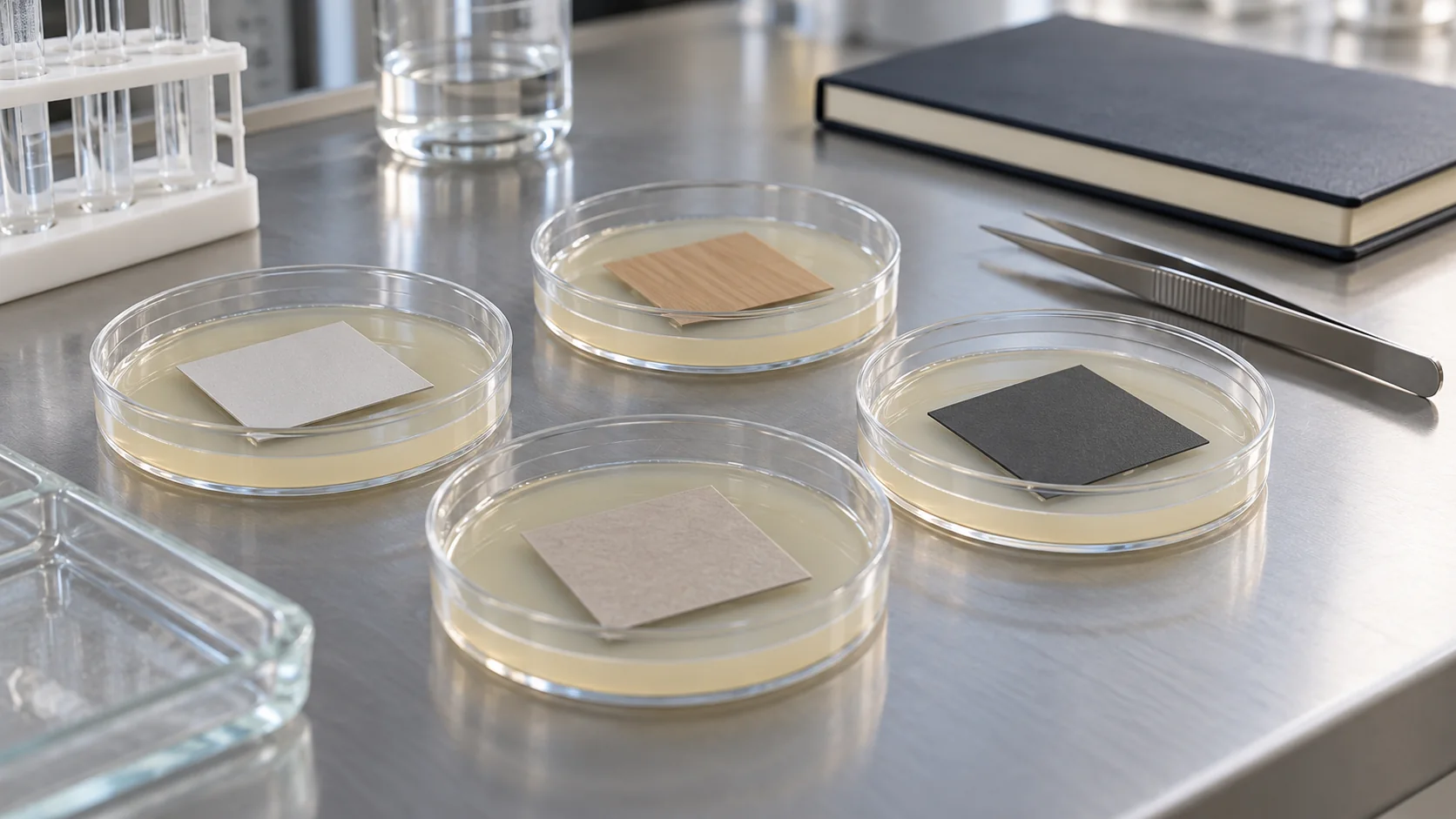
ASTM G21 challenges synthetic polymeric materials, including sheets and films, with fungi and records their response. Laboratory summaries commonly report visible growth on a 0–4 scale, with 0 indicating no growth. Before choosing a decorative finish for a humid room, read the specimen identity, exposure conditions and rating together.
A useful report identifies the actual formulation and surface that were tested. It also says whether the sample arrived as supplied or after conditioning. Those details help you compare materials and understand what a result means for the finish you intend to order.
What does ASTM G21 evaluate?
G21 evaluates the effects of fungi on synthetic polymeric materials, including films and sheets. Visible growth is one observation, and the practice also describes assessing changes in material properties using appropriate test methods. Read which observation or property the report actually records before treating two fungal-resistance results as equivalent evidence.
The official standard description lists G21-15(2021)e1 as active. Its public scope explains that other suitable methods can be used to determine changes in optical, mechanical or electrical properties after exposure. A growth score and a later property measurement therefore answer different questions within a material evaluation.
The public significance notes discuss surface attack, discoloration, reduced light transmission and physical changes. For a decorative face, visible growth and appearance may lead the assessment. A component with another function may need an additional property test after exposure.
Start by finding the stated purpose of the test in the report. If a specification asks for a growth rating, a photograph without a rating leaves the requirement open. If it asks whether a property changed, a growth rating needs the corresponding before-and-after property evidence.
Keep the material’s application in view. A film, an exposed coating and a complete bonded panel are different test objects. Identify which one the submitted specimen represents before using the document in a wall-finish approval.
What happens during an ASTM G21 test?
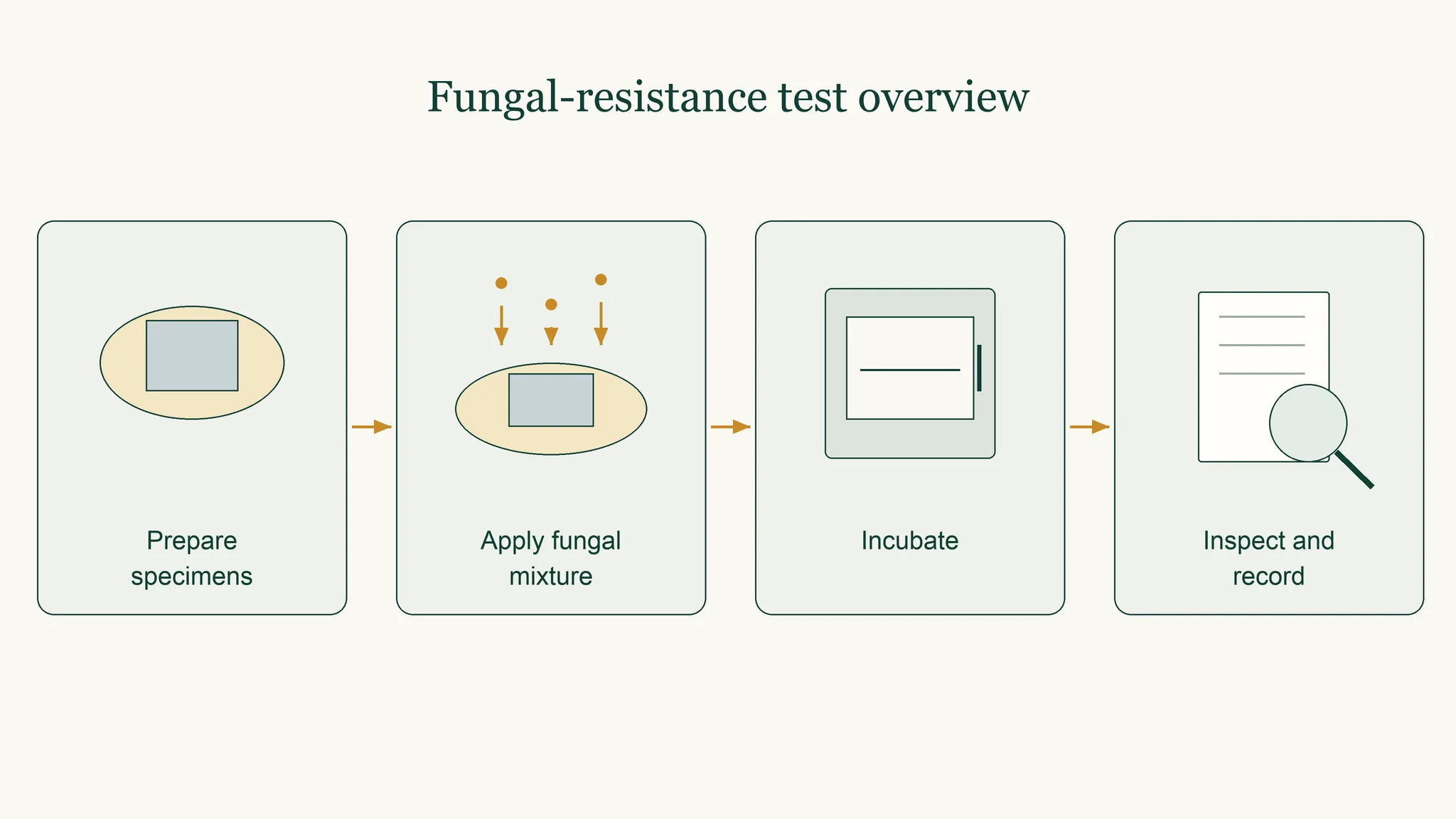
A laboratory exposes prepared specimens to a mixture of fungal spores on a mineral-salts growth medium, maintains warm and humid conditions, and observes the response. The test uses controls to check the exposure. Read the laboratory’s stated specimen preparation, chamber conditions and observation schedule as part of the result.
| Laboratory summary | Specimens or challenge | Stated exposure details | Control information |
|---|---|---|---|
| Microchem Laboratory | Mixed inoculum representing five fungal genera; testing in triplicate | Its published summary describes assessment after a 28-day exposure | Positive and negative controls are described |
| Biosan Laboratories | Three specimens, each 50 × 50 mm | Its published procedure describes 28–30°C and humidity above 85% RH during incubation | Read the issued report for the actual control results |
The Microchem method summary describes the inoculation and controls. The Biosan test description supplies the specimen and chamber example shown above. These are attributed laboratory summaries, not a reconstruction of every clause in the complete standard.
When checking a report, find the actual start and final observation dates as well as the stated duration. Ask whether the method was modified for the material and whether any added nutrient source was used. Record a modification with the result so a later comparison does not silently mix different challenges.
Photographs are useful when they identify the specimen and observation time. A cropped image of a clean patch gives less information than a record showing each specimen and its scored area. Keep those images with the report and its sample identification.
What does the 0–4 growth rating mean?
A zero growth rating indicates no observed fungal growth under the reported exposure; higher categories describe increasing visible coverage. The coverage bands provide a way to classify the observation. Read the rating with its observation date and the project’s acceptance requirement, because a reported category does not set the project’s pass criterion.
One published fungal-testing summary gives the following visual categories:
| Rating | Description in the summary | Reported visible coverage |
|---|---|---|
| 0 | None | No growth |
| 1 | Traces | Less than 10% |
| 2 | Light | 10–30% |
| 3 | Medium | 30–60% |
| 4 | Heavy | 60% to complete coverage |
The same summary explains that the method does not supply a universal pass-or-fail threshold. Put the required category in the project specification, and check whether the laboratory is reporting the final observation or an earlier endpoint.
A rating is a visual classification. Read the laboratory’s assessment and supporting photographs together, especially when specimens differ within a set.
The decision you can make from the score is narrower and more useful: whether the tested material met the stated growth requirement under the documented conditions. If the document says only “pass,” request the category, exposure and acceptance basis behind that word.
Why do formulation and film construction change the result?
Formulation matters because additives can supply nutrients even when the polymer itself resists fungal attack. Film construction also affects the exposed area and the movement of ingredients toward the surface. Match the report to the supplied formulation and external face, including any pretreatment, so the tested object represents the finish being selected.
The standard’s public significance notes identify plasticizers, cellulosic ingredients, lubricants, stabilizers and colorants as possible sources that fungi can use. They also discuss the relatively large surface-to-volume ratio of films and coatings and the movement of additives toward the exposed surface.
For a buyer, the useful follow-up is a specimen description that names the material and formulation or grade. A general polymer name such as silicone or PET leaves the rest of the formulation unidentified. A composition statement such as No DOP also answers a different ingredient question from a fungal-growth test.
Check the face presented to the challenge. A decorative film can have several layers, while a finished wall panel also includes its core, adhesive and edges. If only the exposed film face was tested, record that scope when using the result in a panel submittal.
A revised formulation needs an evidence review even when the color and trade name remain familiar. Ask what the laboratory sample code represents and whether it corresponds to the current supply. This creates a traceable comparison without assigning resistance from the material name.
Does a G21 result prove an installed wall will stay mold-free?
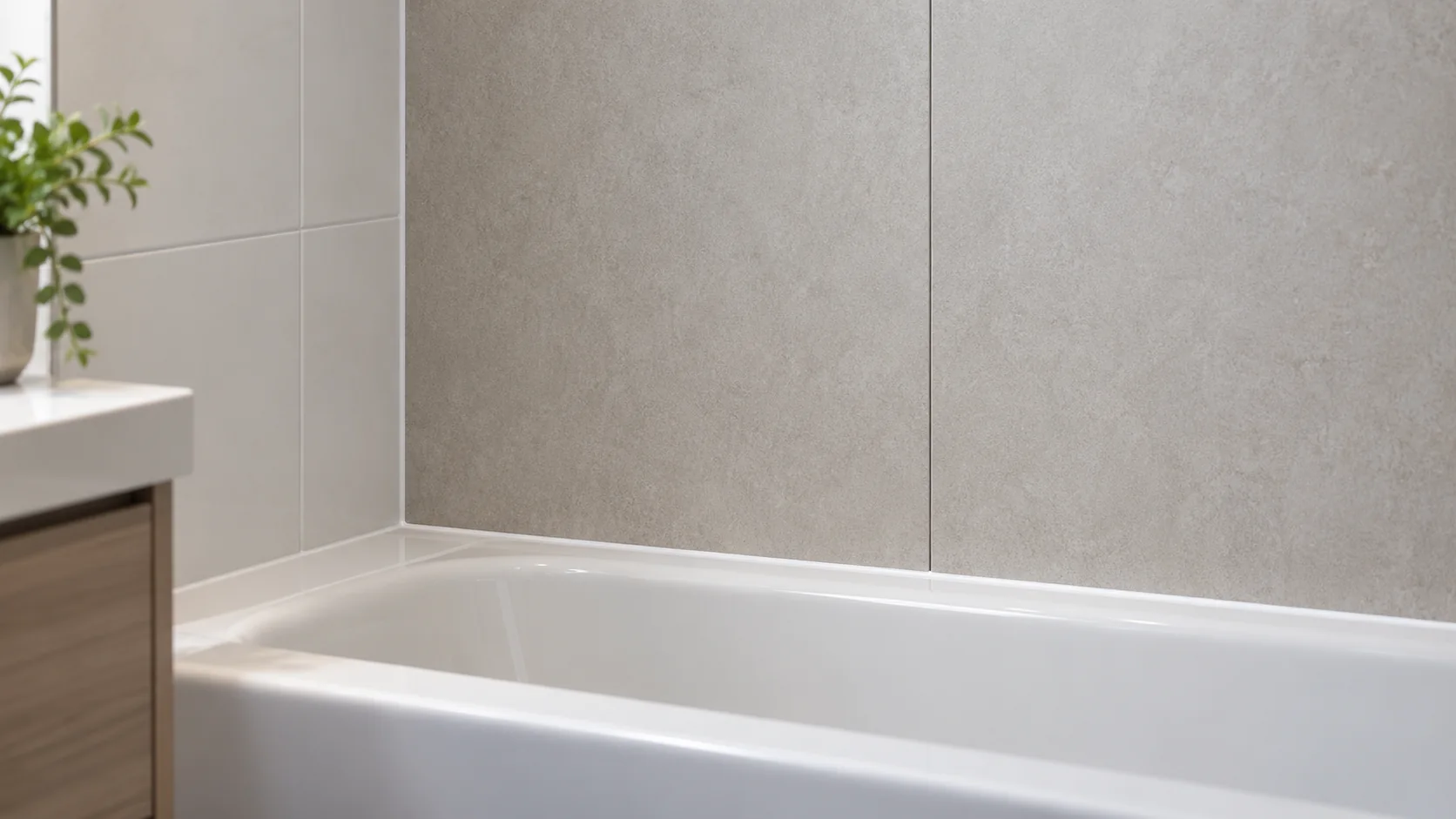
No, a G21 result does not prove an installed wall will stay mold-free. It records the tested material’s response to a laboratory challenge. In use, moisture, deposits and material history can differ, so a humid-room decision also needs the wall construction, moisture control and care conditions to be considered.
The public standard notes that leaching, aging and heat treatment can affect fungal resistance and need to be considered in the evaluation. A test on the material as received and a test after a specified treatment describe different histories. Retain that history with the result.
A bathroom wall also includes joints, edges and adjoining components. Find out which of those, if any, are represented by the specimen. A score for a small film face supplies evidence about that face under the stated conditions; it cannot supply missing evidence for a concealed damp substrate or an untested joint.
For an existing damp area, address the moisture source and the proposed maintenance conditions alongside material selection. The healthy interior materials guide provides a broader framework for matching evidence to a complete interior finish.
How do you choose an ASTM G21 test lab?
Choose an ASTM G21 test lab that can test your supplied material and report its exposed face, conditioning, controls and growth rating. Send the laboratory your film or panel construction and acceptance requirement before booking, so its sample preparation and quotation address the same object.
The Microchem method summary describes control specimens, repeat specimens and photographs. Use those deliverables to compare laboratory quotations, then settle three points before sending samples:
- What to send: identify loose film, a coating or a bonded panel; mark the test face and ask for the laboratory’s required dimensions, quantity and packaging.
- What to test: agree whether the material is tested as supplied or after specified conditioning, and record any modified preparation.
- What you will receive: confirm the reported growth rating, control observations and dated photographs. Ask for preparation, incubation and reporting time separately.
The common incubation period is covered in the FAQ below. A laboratory’s booking date and report delivery date still need confirmation; the incubation period is only one part of the service.
What should you check in a fungal-resistance report?
Check the specimen identity, conditioning history, exposure, controls, observations and reported rating. Read the individual specimens and the greatest deterioration, not only the headline conclusion. Then compare the test with the actual finish and project requirement, including any stated method modification that changes the challenge or interpretation.
| Report item | What to check | Why it matters |
|---|---|---|
| Sample identity | Formulation or grade, exposed face and specimen code | Connects the result to the intended supply |
| Construction | Film, coating or bonded panel, with tested surfaces identified | Defines which parts the evidence covers |
| Conditioning | As-received material or documented leaching, aging or heat treatment | Preserves the sample’s history |
| Method and exposure | Method edition, laboratory conditions and observation dates | Makes the challenge identifiable |
| Controls | The reported response of the control materials | Supports interpretation of the exposure |
| Individual observations | Ratings, photographs and greatest deterioration | Prevents a summary from hiding variation |
| Acceptance and changes | Project criterion and declared method modifications | Explains why the result was accepted |
The supplier evaluation checklist can help organize those documents when they come from several parties. Keep the test report and the material identification together, so a later order can be checked against the same evidence.
Where does a silicone decorative surface fit?
Puremorfilm makes decorative film with a silicone functional surface for furniture and interior walls, and our wall film contains no PVC. We supply mainly rolls for PUR flat lamination, with laminated panels available on request. For a fungal-resistance requirement, request evidence for the actual supplied face and formulation.
Our decorative wall film uses a No DOP formulation. Flame retardancy is a standard property of the film; UL 94 V-1 or V-0 grades are optional upgrades, so ask for the grade-specific test report. In the manufacturer’s laboratory tests, coffee, red wine and soy sauce left at 25°C for 24 hours wiped off with no obvious change. These are stain-exposure observations, not fungal-growth results.
The material has a leather-like feel and some elasticity, and is unsuitable for floors, all countertops, stovetops, shower floors or other areas that people walk on. Our paint-free material uses a silicone functional face, distinct from PVC, melamine, PP and PETG decorative faces.
How should you compare G21 results when choosing a material?
Compare results for the actual proposed material using matching methods, conditioning histories and observation periods. For a humid application, request the exposed-face evidence and review the complete wall design. If reports differ in setup, clarify those differences before ranking materials by the growth score or accepting a general “pass” statement.
| Your decision | Evidence to request |
|---|---|
| Choosing between formulations | Reports identifying each formulation and comparable exposures |
| Specifying a wall finish in a humid room | The supplied-face report plus the construction and moisture-control plan |
| Reviewing a changed or aged material | The relevant conditioning history and specimen observations |
| Evaluating bacterial performance | Evidence from the separately specified bacterial test method |
Keep the agreed material identity and growth requirement in the specification, and retain the report with the approved finish. The cabinet surface durability test guide covers other surface properties that may also matter to a furniture or panel selection.
For a project discussion, contact us with the application, expected moisture conditions and required test method and rating.
Frequently Asked Questions
How long does an ASTM G21 test take?
A commonly described G21 incubation lasts 28 days. Read the issued report for the actual exposure and observation dates, including any earlier endpoint. The time needed for sample preparation and reporting is additional laboratory scheduling information, which should be confirmed with the laboratory.
Is ASTM G21 a certification?
No, ASTM G21 is a standard practice, not a product certification. A test report describes the submitted material and result under its stated conditions. Check the project’s acceptance criterion and the actual rating behind any claim that a sample “passed.”
Does ASTM G21 test bacteria?
No, ASTM G21 addresses fungi. Bacterial performance requires a separately selected method appropriate to the material and question, such as ISO 22196 where applicable. A bacterial result cannot be substituted for the fungal-growth observation.
Does ASTM G21 mean a material is mold proof?
No, a G21 result does not make a material mold proof. It describes a laboratory exposure of identified specimens. Installed conditions, material history and additional deposits can change the circumstances, so keep the test claim tied to the reported sample and setup.
What size sample is needed for ASTM G21?
Published laboratory summaries commonly describe 50 mm square specimens, with Biosan listing a set of three. Confirm the laboratory’s required form, quantity and exposed faces before sending a decorative film or finished panel. The submission should represent the material the project intends to use.