
A supplier evaluation checklist scores candidates against the same criteria: quality systems and test evidence, capacity and outsourced steps, delivery, total cost, financial stability, technical support and communication, with proof recorded beside each answer. Three ways to gather that proof are desk appraisal, field research and third-party appraisal. Evaluation continues after selection, as actual orders reveal how the supplier performs.
For decorative film and film-faced panels, the checklist should end in an approval with a written scope: which material, which production route, and who may authorize a change.
What should a supplier evaluation checklist include?
It should cover about a dozen areas, and every area needs an evidence column next to the question. Ask every candidate the same questions and record the gaps before you compare prices.
| Area | Questions to ask | Evidence that answers it | Red flag |
|---|---|---|---|
| Products and track record | Has this supplier made comparable products? | Product history, relevant samples and verifiable references | Only unrelated examples |
| Capacity and equipment | Can the proposed factory handle this order alongside existing work? | Equipment list, production schedule and delivery history | A maximum-capacity figure with no schedule |
| Quality system and certificates | Does the scope cover the supplying site and activity? | Current certificate, address and scope | Certificate belongs to another site |
| Product test evidence | Does the report identify the offered material? | Complete report, sample code and test conditions | Cropped result without sample identity |
| Outsourced processes | Who prints, coats, laminates and slits? | Process map and named subcontractors | Production steps left unexplained |
| Delivery record | How reliably are agreed dates met? | Order and dispatch records, with exceptions explained | Repeated delays without corrective action |
| Total cost | What will the usable delivered material cost? | Quotation scope, freight, inspection, waste and rework assumptions | Low unit price omits major costs |
| Financial stability | Can the supplier support the commitment? | Appropriate financial information and agreed credit checks | Unexplained payment or ownership changes |
| Technical support | Who resolves a material or application problem? | Named technical contact and documented response process | No owner for technical questions |
| Communication | How are delays and defects escalated? | Contact list, escalation route and written responses | Conflicting answers from different teams |
| Health, safety and labor practices | How are relevant obligations managed? | Applicable policies, records and audit evidence | Claims unsupported by records |
| Change notification | Which changes require buyer approval? | Proposed notice and approval clauses | Unrestricted substitutions |
ASQ’s supplier-quality guidance supports considering capability, quality systems, delivery, financial standing, technical support and total cost. The table turns those areas into questions a team can reuse.
Send the same checklist to three quoting suppliers. If the cheapest one leaves the outsourcing row blank, you cannot tell which factory or process its price covers, so the quotes are not yet comparable.

How do you collect proof instead of taking answers on trust?
Match questionnaire answers to desk appraisal, field research or third-party appraisal, choosing the depth of investigation for the purchase risk. CIPS describes these three methods, including visits and audits for suppliers carrying high risk or high value.
A questionnaire tells you where to look. A certificate then needs a scope and address check, a test report needs a sample identity, and a capacity answer needs a production schedule. Record who examined each document, when it was checked and which question it resolves.
For a critical door-face material, a site visit may be justified by the consequences of inconsistent production or an opaque subcontracting route. A lower-risk packaging purchase may need a lighter review. Set that decision in the evaluation plan, with a reason the team can explain.
Ask how much capacity is actually free after existing commitments. Equipment counts, maintenance records and historical dispatch performance help test the answer. For the product evidence itself, the cabinet surface durability test guide explains what the test file should identify.
How can you confirm who actually makes the product?
Identify the contracting company, actual manufacturing site, outsourced processors and test-report commissioner, then document the relationships between them. A distributor or affiliated company can be a legitimate contracting or testing party when its role is clear.
Trace the proposed production route from printing and coating through film lamination, slitting and any panel conversion. Put a name against each operation and identify who controls its specifications. The ISO/IAF guidance on external providers includes suppliers and associated organizations and addresses control of externally provided processes.
When the report commissioner differs from the seller, request a written explanation connecting the tested sample to the offered material. Useful identifiers include the sample code, product designation and the manufacturing site. An unexplained relationship leaves the evidence incomplete even when the test result looks favorable.
Material identity belongs in that check too. A comparison such as PET vs PVC decorative film helps define what is being purchased; the quotation and approval file must then use the same material description.
What are the REACH requirements for furniture surface materials?
REACH requirements for furniture surface materials depend on composition, article status and applicable restrictions. Buyers should request a dated substance declaration for the supplied film and relevant components. Candidate List communication duties and Annex XVII restrictions are separate checks; a generic REACH certificate cannot replace a review of the actual product.
| REACH check | Buyer’s evidence request | Scope to retain |
|---|---|---|
| Candidate List substances | A declaration identifying the Candidate List version and assessed articles/components | For an SVHC above 0.1% by weight in an article, Article 33 requires safe-use information, including at least the substance name. |
| Annex XVII restrictions | A statement or test evidence for restrictions relevant to the formulation and intended use | Check individual restriction entries; Candidate List inclusion is not itself a universal ban. |
| Formaldehyde release | Evidence relevant to the finished furniture or wood-based article | Entry 77 applies after 6 August 2026: 0.062 mg/m³ for furniture and wood-based articles under Appendix 14 conditions, subject to stated exemptions. |
Use REACH Article 33 and Annex XVII, the ECHA communication explanation, and Regulation (EU) 2023/1464 for the legal scope. A film statement cannot establish the formaldehyde release of the assembled furniture.
Which test reports can you compare across suppliers?
Only reports whose test object, method and conditions match can sit side by side. Check the standard and edition, the sample identity and thickness, and the load, cycles, temperature and exposure time the method uses.
A film-only abrasion result and a result for film bonded to a panel describe different test objects. Different wheels or loads also change the abrasion comparison. For a pencil hardness test, the pencil grade belongs beside the load and angle; the grade without those conditions gives an incomplete comparison.
Label the evidence category before scoring it: independent laboratory testing, manufacturer laboratory testing, or a worked example in a patent application. Each can answer a specific question, but a patent example does not establish independent verification of the material on the quotation.
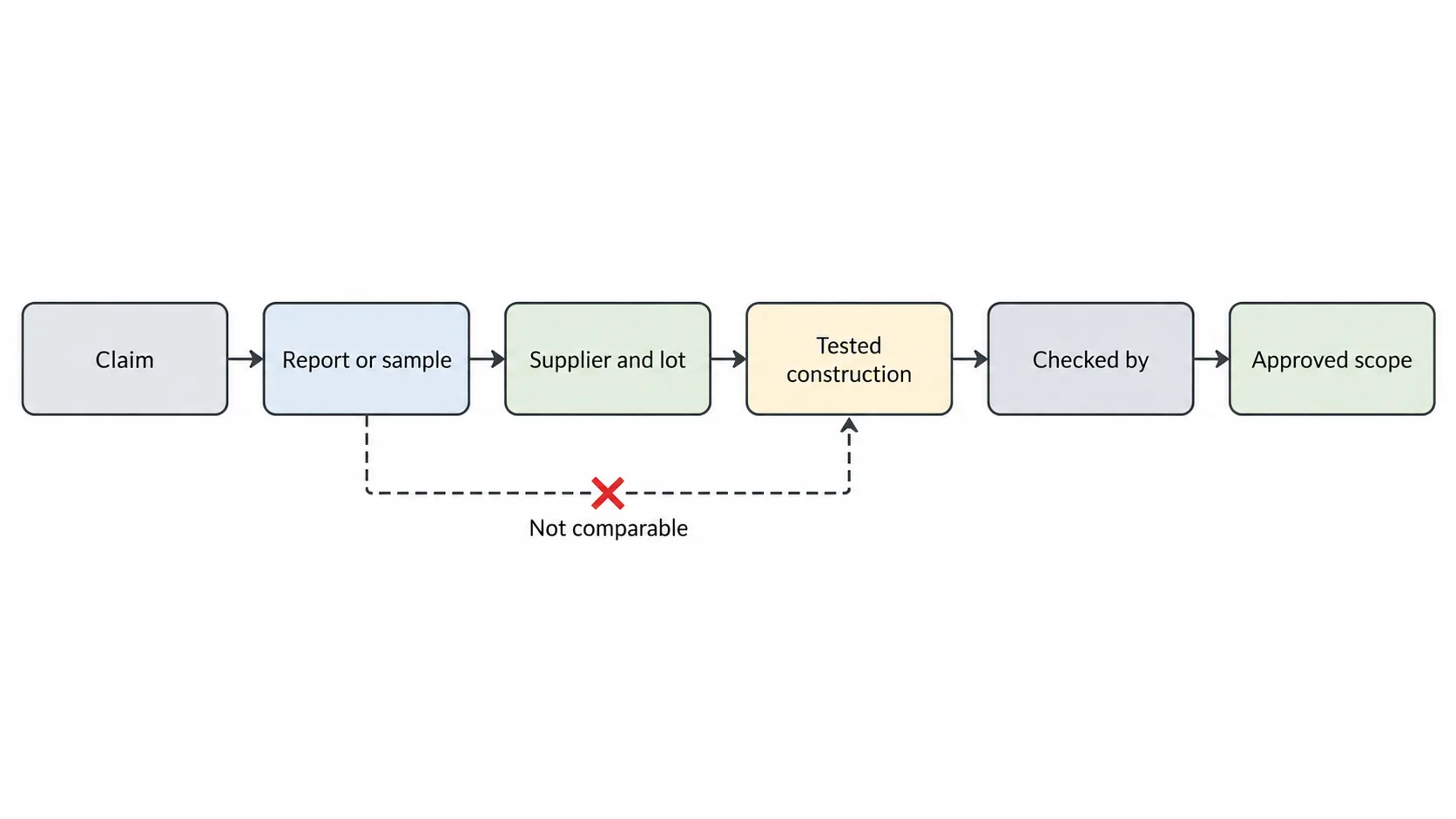
Build a short evidence chain: claim, report or sample, supplier and lot, tested construction, checker, approved scope. If a report has a sample code that nobody can connect to the supplied grade, return it for clarification. Preserve the complete report and the explanation together so another reviewer can follow the same chain.
What certifications should decorative film have for EU buyers?
EU buyers should request documents that match the decorative film’s composition, intended use and finished assembly. Start with applicable REACH evidence, then separate wood-panel formaldehyde testing from reaction-to-fire classification. There is no single certificate covering every film and use; the report must identify the tested construction and relevant conditions.
| Document | What it can establish | What it does not establish |
|---|---|---|
| Dated REACH declaration and relevant tests | Composition assessment against the current legal requirements | A universal approval for every market or application. |
| EN 717-1 chamber report for wood-based panels | Formaldehyde release of the tested panel under that method | Automatic compliance of all furniture with REACH Entry 77; check the Appendix 14 test conditions. |
| EN 13501-1 classification where required | Reaction-to-fire class for the described construction and mounting | A film-only result covering any board, adhesive or wall assembly. |
| Puremorfilm film test reports | SGS sample results for the methods and conditions supplied | REACH certification, a medical approval or a European wall-system fire classification. |
The formaldehyde restriction sets its own test conditions; an older panel class needs checking against that requirement. Use the EN 13501-1 guide to read a fire classification’s construction limits, then check the reports available for the exact supplied grade.
Who should approve a sample, and what does approval cover?
A cross-functional team should approve the sample within a written scope covering the material, appearance reference, construction and project. Procurement, quality and engineering bring different checks; include sales or the end user when appearance or the application requires their judgment.
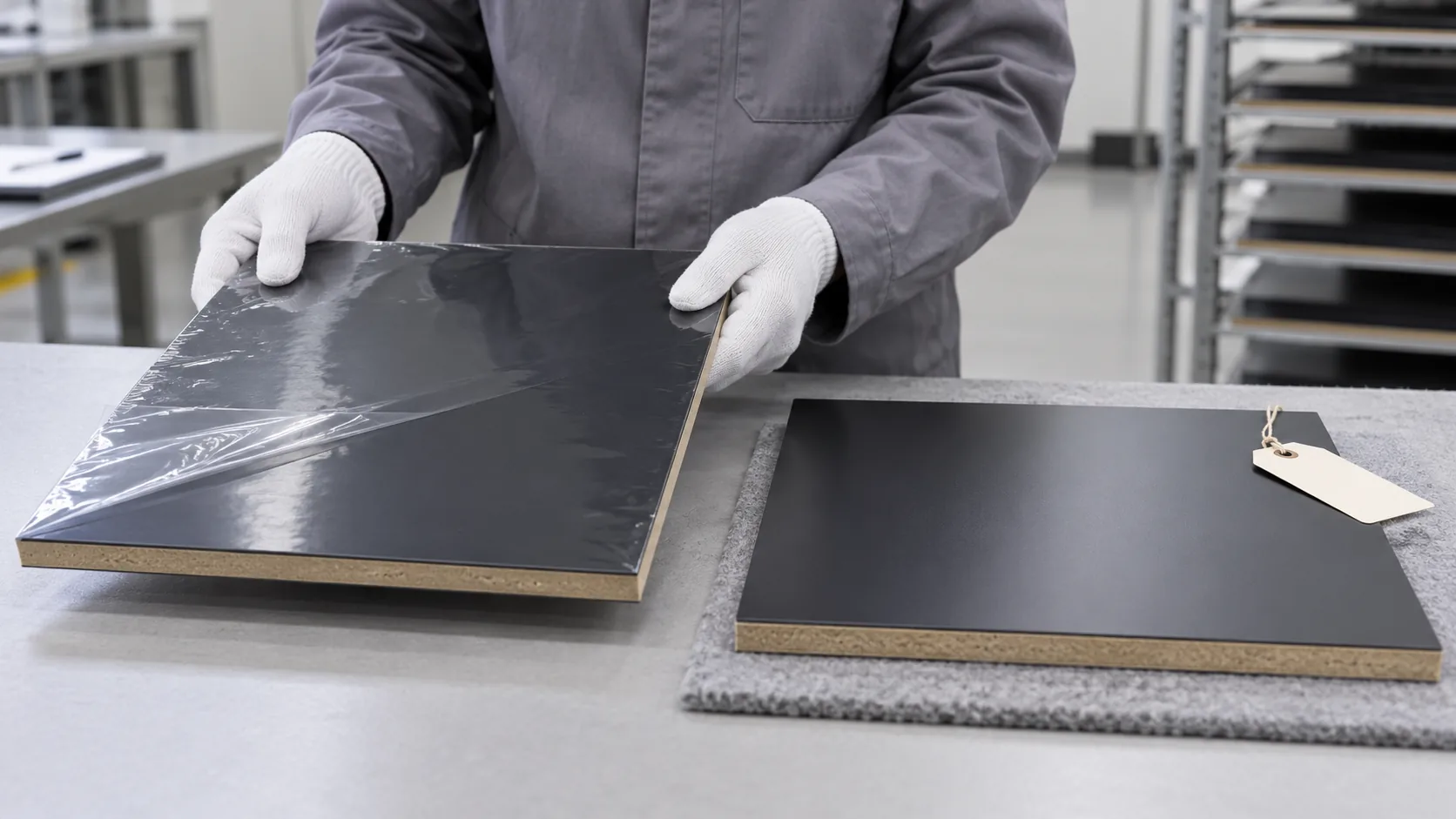
The approval record should identify the film grade, color and gloss reference, adhesive, substrate, edge treatment, order or project and specification revision. Preserve a signed reference sample with that record. Our wood grain decorative film guide covers appearance choices that need a common reference.
For example, a door factory might approve film bonded to 18 mm MDF with a named PUR adhesive. That is an illustrative construction: changing the substrate creates a new scope for the team to assess. An acceptable sample supports the specified construction and order, while factory approval requires the wider supplier evidence.
Give each approver a defined task. Engineering checks suitability for the intended construction, quality checks the acceptance evidence, and procurement checks that the purchase description matches the approval. This prevents a signed color swatch from being treated as approval of an untested production route.
What should release a trial order into full production?
Release production when the first-batch evidence matches the approved material code, factory and construction, and inspection confirms the agreed acceptance criteria against the reference sample. Record any difference as a new approval or an authorized concession with a defined scope.
| Party | Responsibility to agree | Record to retain |
|---|---|---|
| Film supplier | Identified film grade, appearance reference and notified changes | Material specification, lot identity and supplied evidence |
| Adhesive supplier | Suitability information for the proposed bonding system | Adhesive identification and technical recommendation |
| Panel laminator | Trial construction, process control and first-batch inspection | Trial record, production route and inspection results |
| Buyer | Acceptance criteria, scope of approval and concessions | Signed approval, reference sample and release decision |
These are proposed responsibilities to agree for the order. The parties should resolve overlaps before production begins, especially where a material supplier and a separate laminator each control part of the result.
If the trial used line A and production moves to line B, assess that move through the agreed change process. The PUR adhesive guide for PET film lamination and the guide to decorative film delamination causes help frame the bonding questions without replacing the release record.
How should suppliers notify you of changes?
Agree which changes require advance written notice and renewed buyer approval, including formulation, production location, subcontractors, critical equipment or processes, packaging and identification. The clauses below are purchasing recommendations to negotiate for the project.
| Item | What to specify | What to recheck | Who signs |
|---|---|---|---|
| Raw material or formulation | Proposed change, affected grades and first affected lot | Relevant appearance and performance evidence | Engineering and quality |
| Factory or subcontractor | New site, operation and intended switch date | Capability, control arrangements and sample identity | Supplier quality and procurement |
| Critical equipment or process | Changed operation and proposed validation | Trial construction and affected acceptance criteria | Engineering and production quality |
| Packaging or labeling | Revised protection and identification | Transit protection and lot traceability | Logistics and quality |
| Implementation | Notice timing, approval route and affected orders | Closure of open questions before shipment | Named buyer representative |
A color designation may stay the same while the source of a surface ingredient changes. The visible match can remain acceptable while other performance needs rechecking. Ask the supplier to identify affected requirements, then agree the evidence needed for release.
Put notice timing and authority in the contract. A routine email to a sales contact is useful communication, but the approval file should show whether the authorized reviewer accepted the change and which lots that decision covers.
How should you score suppliers and resolve red flags?
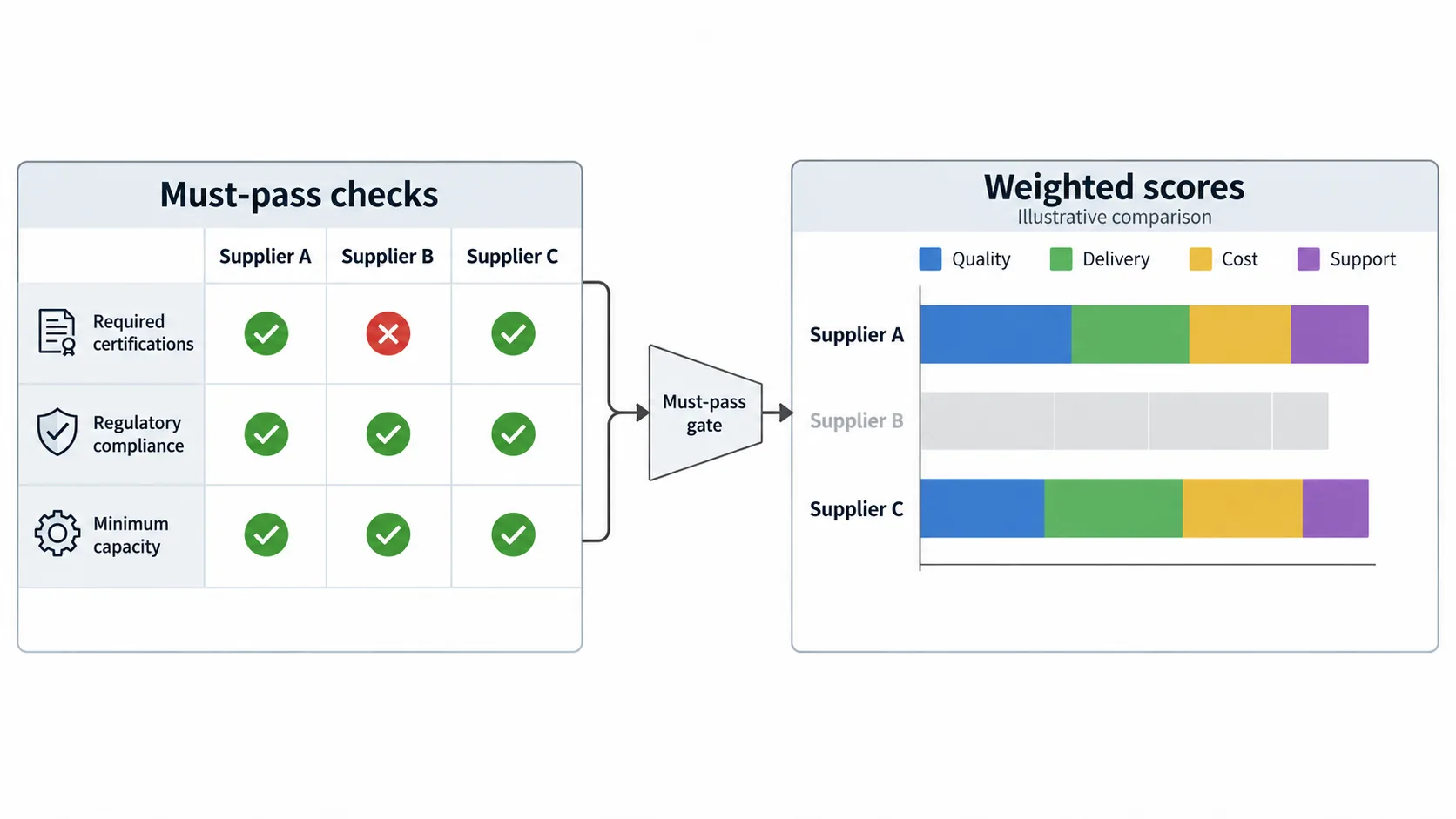
Apply mandatory checks first, then score the remaining comparable criteria using project-defined weights. An unresolved critical report, required certificate-scope gap or undisclosed outsourcing route should hold the decision until the evidence is resolved.
For the following illustrative example, use a 1–5 scale, with 5 strongest. The weights are quality 40%, delivery 30%, total cost 20% and technical support 10%. They are example purchasing choices, not a prescribed industry model.
| Example candidate | Mandatory checks | Quality | Delivery | Total cost | Support | Weighted result |
|---|---|---|---|---|---|---|
| Supplier A | Resolved | 4 | 4 | 3 | 5 | 3.9 |
| Supplier B | Outsourced coating unexplained | 5 | 4 | 5 | 4 | Hold; do not rank |
| Supplier C | Resolved | 3 | 5 | 4 | 3 | 3.8 |
Supplier A’s result is 4 × 0.40 + 4 × 0.30 + 3 × 0.20 + 5 × 0.10 = 3.9. Supplier B remains on hold despite attractive scores because its mandatory evidence is incomplete. Revisit the weights when the purchase priorities change; a project with a tight installation date may value delivery differently.
Keep the scores, supporting documents and unresolved questions in one supplier file. The next reviewer should be able to see the evidence and reasoning behind every number.
What evidence can you request from Puremorfilm?
We distinguish independent test reports, manufacturer laboratory results and patent-application examples when supplying evidence. Puremorfilm makes furniture decorative film with a silicone functional surface for cabinet doors, furniture fronts and wall panels.
The silicone surface is inherently flame-retardant, and higher grades up to UL 94 V-0 are available on request. In the manufacturer’s laboratory tests, coffee, red wine and soy sauce left at 25°C for 24 hours wiped off with no obvious change. The film is PVC-free and formaldehyde-free, with a No DOP formulation.
For the submitted sample, SGS recorded no obvious scratches with a Mitsubishi Uni 2H pencil at 500 gf and 45°, drawing three lines at least 20 mm long. That result covers the submitted sample under those conditions. The SGS reports were commissioned by our sister company and we can explain how the tested sample relates to the film you order.
Free samples and technical guidance are available, with sample requests handled separately from production orders. Production MOQ: standard film 500 m; panels 200 sheets at 1220 × 2440 mm. We supply film rolls for panel and door makers to flat-laminate with PUR adhesive; the panel lamination adhesive guide explains the bonding context.
Our film is a new paint-free finish with a silicone functional face, distinct from PVC, melamine, PP and PETG decorative faces.
When should you re-evaluate or stop using a supplier?
Re-evaluate according to purchase risk and whenever quality, delivery, production changes or certificate status call the approval into question. Set the routine review frequency by material category and criticality, then add event-triggered reviews.
- Continue approval when evidence remains current and performance meets the agreed requirements.
- Set corrective actions and a defined review point when a recoverable gap has an accountable owner.
- Pause affected orders when essential evidence has expired or an unauthorized substitution leaves the approved scope uncertain. Record the reason, affected material and authority to resume.
Judge the supplier on real orders as well as the original qualification file. Handling one sample well says little about how steady the production deliveries will be.
To assess a decorative-film project, contact us with the door, wall-panel or furniture application, proposed substrate and adhesive, appearance reference and expected volume.
Frequently Asked Questions
What are the 5 key supplier evaluation criteria?
A practical core five is quality, delivery, total cost, capability and financial stability. No body mandates a single five, so add technical support and anything else the purchase needs.
What are the 10 C’s of supplier evaluation?
The 10 C’s are Ray Carter’s checklist: competency, capacity, commitment, control, cash, cost, consistency, culture, clean and communication. He first presented seven C’s in 1995 and later expanded the model to ten.
What are the 7 steps of the supplier selection process?
The CIPS sequence is to set a high-level plan, plan the process, gather data, evaluate candidates, select suppliers, put the project into practice, and measure performance through continuing evaluation. Selection therefore leads into ongoing assessment of the chosen supplier.
What are the 10 qualities of a good supplier?
Ten useful qualities are consistent quality, transparent manufacturing, controlled outsourcing, adequate capacity, reliable delivery, competitive total cost, financial stability, technical competence, clear communication and responsible operating practices. Evidence for each quality should relate to the product and supplying site.
What is supplier evaluation and selection?
Supplier evaluation is the assessment and approval of potential suppliers and the continuing measurement of existing suppliers’ performance. Selection is the decision to use a supplier based on that assessment and the needs of the purchase.