
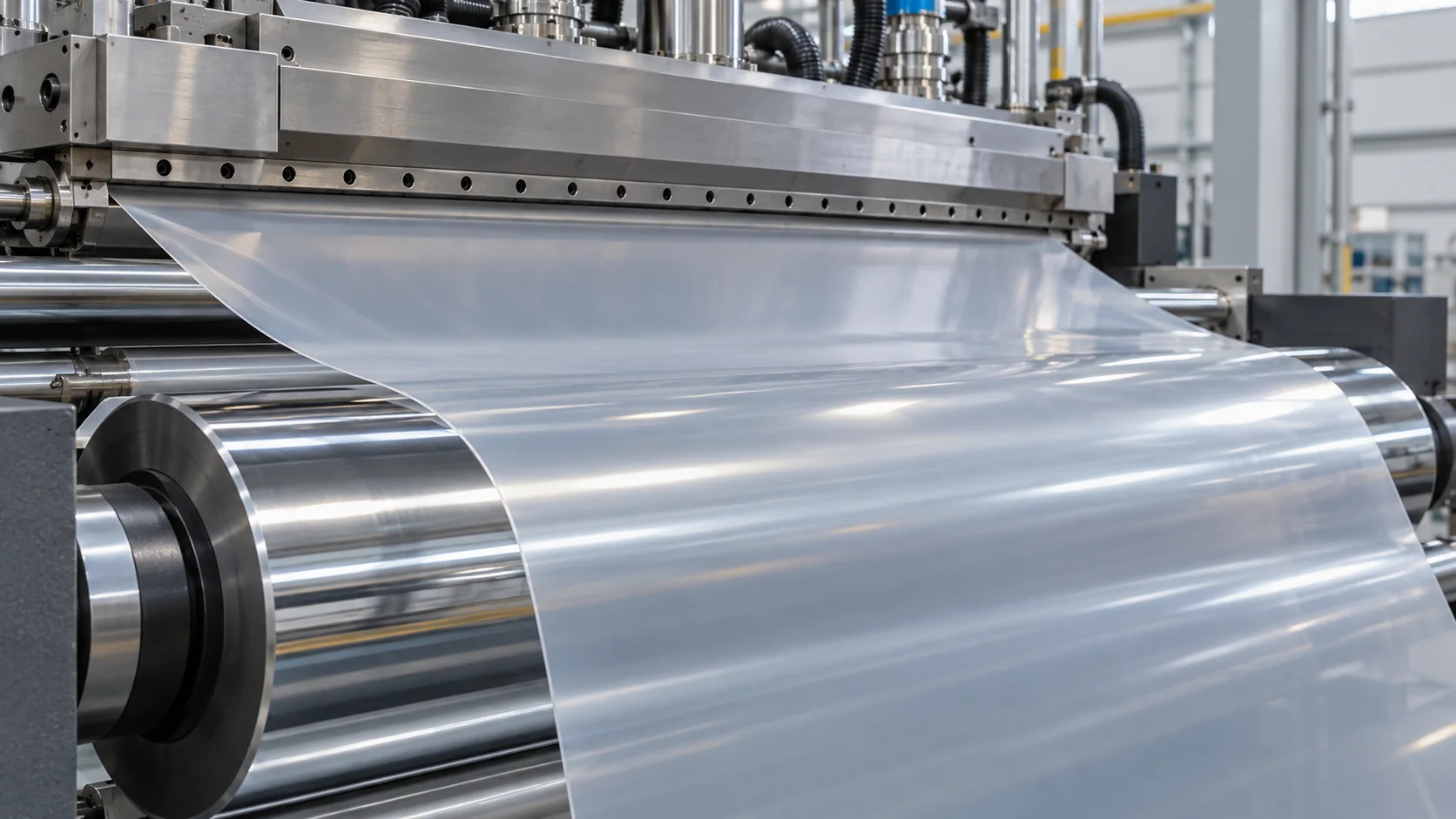
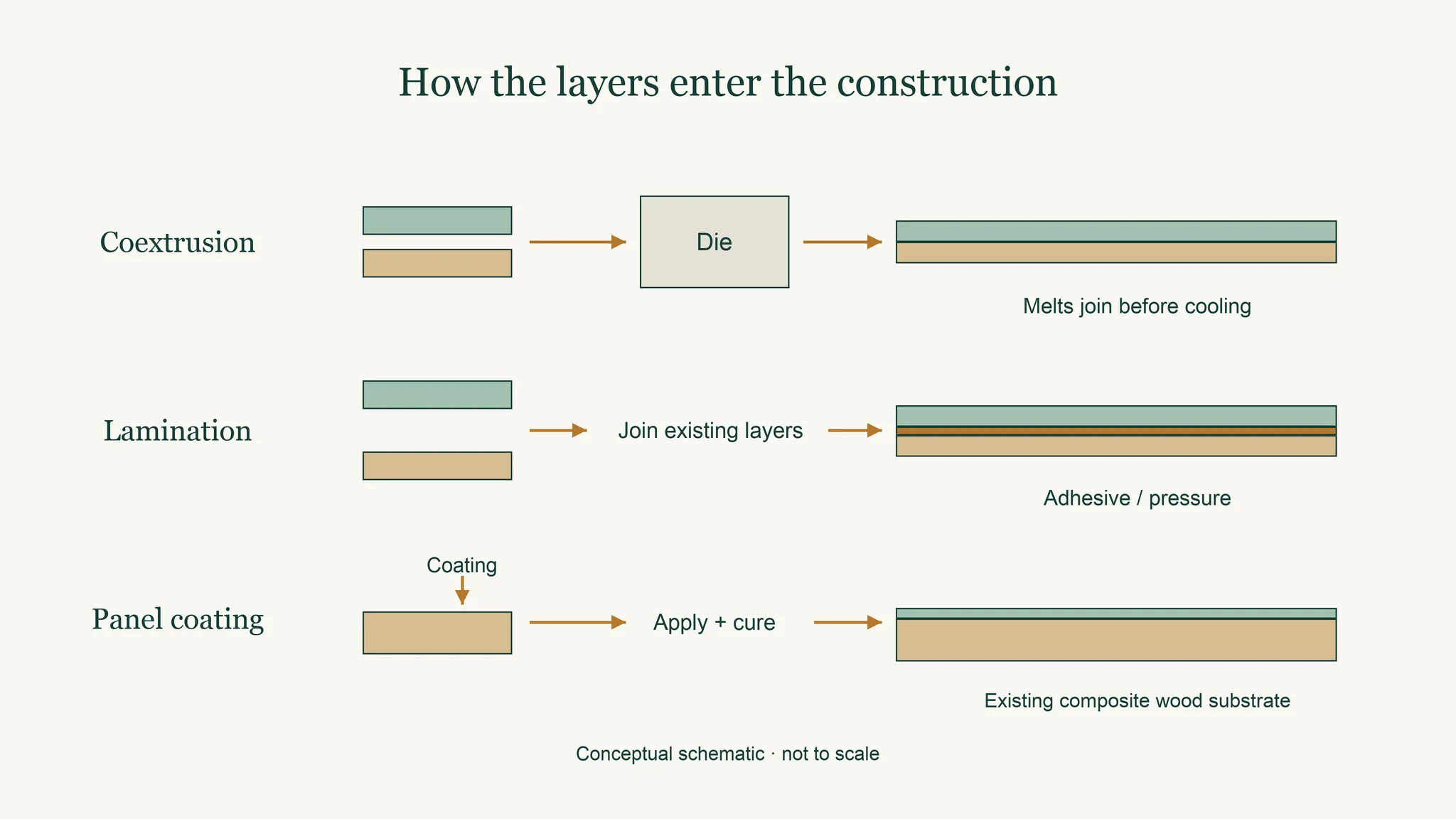
Coextrusion is an extrusion process in which two or more polymer melts pass through one die and join into a layered film, sheet or tube before the material cools; lamination instead bonds layers that already exist, usually with adhesive or pressure. When you compare films, ask which layers met as melts and which interfaces were added later, because each needs its own evidence.
A decorative panel can involve both processes. The film may contain melt-formed layers, yet still need an adhesive bond to the board. A coating can add another surface. For a furniture or interior-wall project, the useful comparison starts with that construction, then follows the interfaces through to the finished part.
What is coextrusion, and how does it differ from lamination?
Coextrusion joins polymer melts within one die before cooling, while lamination joins layers that have already been formed. Both can produce a layered construction, but their incoming materials and joining stages differ. A process name identifies how an interface was made; finished-part performance needs evidence for the actual construction.
The Polymer Science Learning Center’s flat-film explanation, copyright 2005, describes coextrusion as a subset of extrusion. In extrusion, molten plastic is pushed through a shaping die and then cooled. Adding melt streams makes a layered extrusion possible.
In its process comparison, Bausano describes lamination as joining distinct layers, often using adhesive or pressure, after those layers exist.
| Item | Coextrusion | Lamination |
|---|---|---|
| What enters | Polymer melts | Layers that already exist |
| When layers join | Within the die, before cooling | After the separate layers have formed |
| How they join | Contact between the melt streams | Adhesive or pressure joining the layers |
| Interface to check | The boundary formed between melts | The added bond line |
| What the name leaves open | Bond integrity and finished-part durability | Bond integrity and finished-part durability |
Ask the supplier to mark the joining stage on a layer drawing. A drawing of the finished cross-section alone can show the same broad arrangement for different manufacturing routes.
Is a coated surface layer the same as a coextruded layer?
No. A coating applied to an existing substrate is a different operation from forming layers together as melts in a die. In composite wood panels, liquid or powder coatings are applied and then cured. A finished panel may combine a coated surface, a layered film and a later adhesive bond.
The Composite Panel Association’s coatings explanation concerns coatings on composite wood substrates. It describes liquid and powder forms and notes that formulations can be tailored to the prefinisher’s line. Its discussion of ultraviolet coatings concerns the curing route.
That context gives a useful question for a panel specification: what was applied, to which existing substrate, and how was it cured? The word “coated” by itself leaves these details open.
Keep a separate entry for each operation in the construction drawing. For example, “surface applied and cured” and “film bonded to board” describe different interfaces. The coating description above applies to the panel industry; the supplier’s actual route is still needed for any particular film surface.
Which layer functions should you identify before comparing films?
Identify the exposed face, any supporting carrier, the bonding side and intermediate layers before comparing process names. Each layer should have a stated job and evidence relevant to that job. This makes it possible to compare constructions that use different materials without assuming that the same manufacturing label means the same performance.
A 2021 tubing example from Optinova assigns different functions to inner and outer layers: an inner material can provide chemical inertness while the outer material provides mechanical properties. This illustrates the division of functions in tubing; a decorative film needs evidence for its own layer functions.
For a furniture-facing film, record the roles in a form that the supplier can confirm:
| Layer | Role to state | Evidence to ask for |
|---|---|---|
| Exposed face | The surface that the user touches and cleans | Results for that actual face and intended exposure |
| Support or carrier | Support for the face and later handling | Identified material and construction |
| Bonding side | Contact with the next adhesive or layer | The proposed bonding route and interface evidence |
| Any intermediate layer | Its stated function between adjacent materials | Its position and evidence for the relevant interfaces |
A layer need not perform every task. Record the reason for selecting the carrier alongside the properties claimed for the exposed face. The PET and PVC decorative-film comparison explains why the named plastic also needs to be read in the context of the full construction.
Can any two polymers be coextruded together?
No. The polymers need adequate adhesion at their interface, and their melt behavior must allow the intended layers to form. Differences in viscosity, density and flow can affect that structure. A list of resin names is therefore insufficient evidence that a particular combination will produce the required layered film.
Bausano’s comparison identifies poor adhesion between some polymers as a limitation. Even a material pair with useful individual properties needs a workable interface.
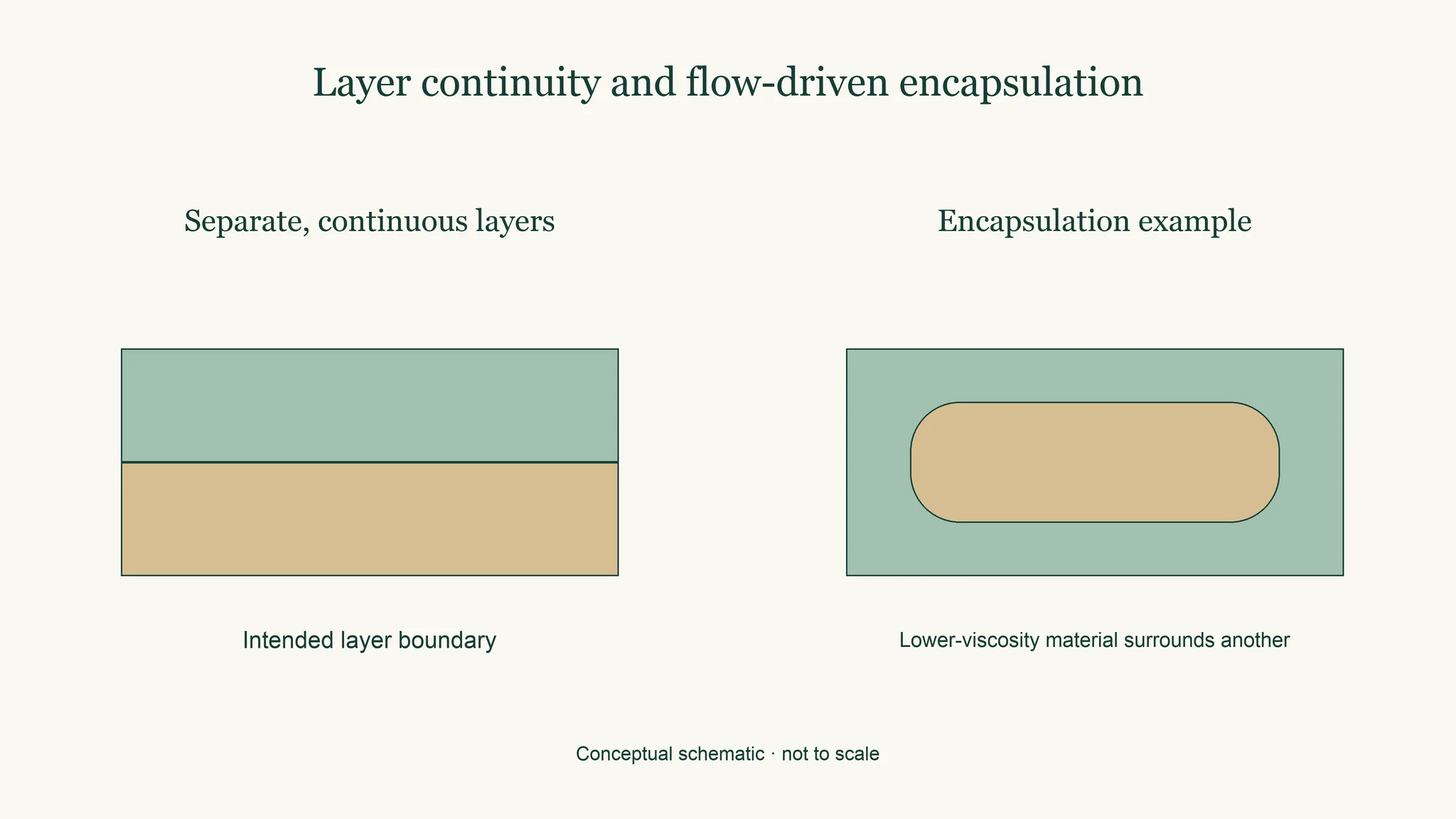
The Sandia report SAND2013-7671J, published in 2013, studies layered polymer composites and the flow conditions that affect their formation. It explains that a lower-viscosity component can tend to encapsulate a higher-viscosity component. Its modeling considers density and viscosity relationships in maintaining stable layers.
The report also describes successful coextrusion of its studied materials despite an imperfect viscosity match when the streams had different flow rates. That is a result for the studied pair and conditions, not a universal setting for decorative films.
For procurement, ask which actual materials form the interface and what evidence supports that combination. A cross-section from the proposed construction is more informative than a catalogue list of polymers that the equipment can process separately.
Does coextrusion prevent delamination or other layer defects?
No. Coextrusion can remove a separate adhesive step between the melt-formed layers, but it does not guarantee layer continuity or interface adhesion. Flow defects can alter the intended structure, while insufficient adhesion can compromise a boundary between materials. These are separate questions that need different observations.
The same Sandia research discusses layer breakup and encapsulation as defects associated with flow instability. A layer that breaks up or moves around another layer has not retained the intended cross-section. Calling every such defect “delamination” hides the distinction between forming the layer and maintaining a bond.
Ask first whether the intended structure exists. Request a representative cross-section or other suitable evidence of layer continuity for the actual film. Then ask whether the interfaces remain intact under the conditions relevant to the part, using appropriate bond or peel results where applicable.
Lamination introduces its own bond line to evaluate. The equipment maker’s comparison identifies adhesive strength and differences in thermal expansion as relevant limitations for laminated layers. Neither process name supplies an acceptance result: a sound comparison identifies which interface was evaluated, on what construction, and after which exposure.
Does a coextruded film still need lamination to a board?
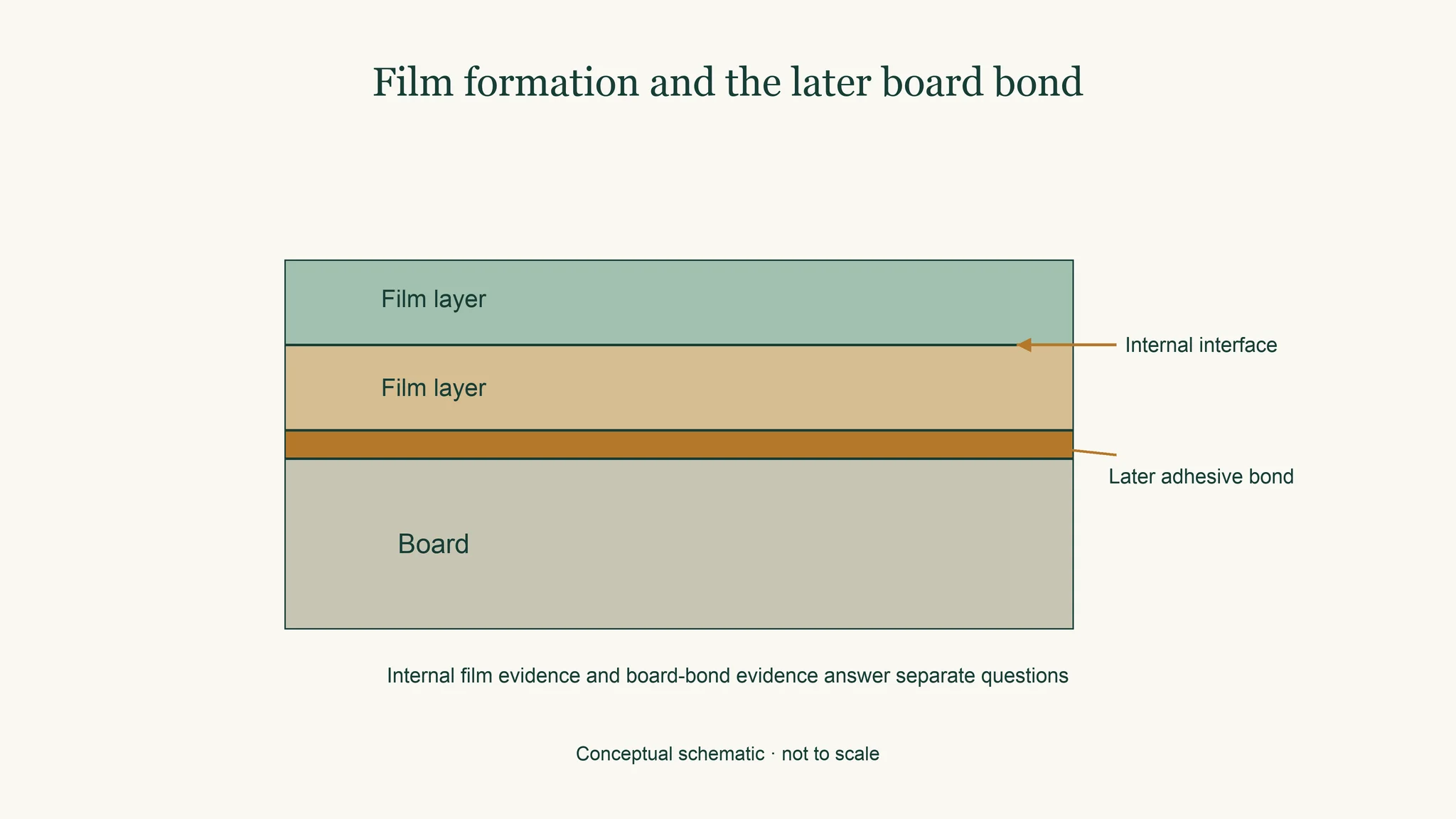
Yes, when the film is supplied separately and then bonded to a board. Coextrusion determines how layers inside the film were formed. The film-to-board bond is a later interface, with its own adhesive, processing route and finished-part evidence. The quality of that board bond depends on the later assembly.
Mark these boundaries separately on the part drawing: the interfaces within the film, then the film–adhesive–board assembly. A report about one boundary should identify it clearly enough that the buyer can tell which part of the construction it covers.
The shape of the finished component also matters. A flat panel and a contoured component lead to different finishing decisions. The profile-wrapping and flat-lamination guide addresses that route choice, while the panel-lamination adhesive guide covers the later bonding decision.
For the proposed board assembly, request evidence for the selected film, adhesive and board together. Store the internal-layer evaluation alongside it, with the boundary covered by each result clearly identified. This avoids accepting a film manufacturer’s internal-interface result as proof of a bond that will only be created on the panel line.
Where does a silicone-faced film for flat lamination fit?
Puremorfilm makes decorative film with a silicone functional surface on a PET film carrier for furniture and interior walls, supplied mainly as rolls for PUR flat lamination, with laminated panels available on request. Anchoring components chemically bond the silicone face to its plastic base; the later film-to-board bond remains a separate interface.
The silicone surface is inherently flame-retardant, with higher grades up to UL 94 V-0 available on request. In the manufacturer’s laboratory tests, coffee, red wine and soy sauce left at 25°C for 24 hours wiped off with no obvious change. We use a No DOP formulation.
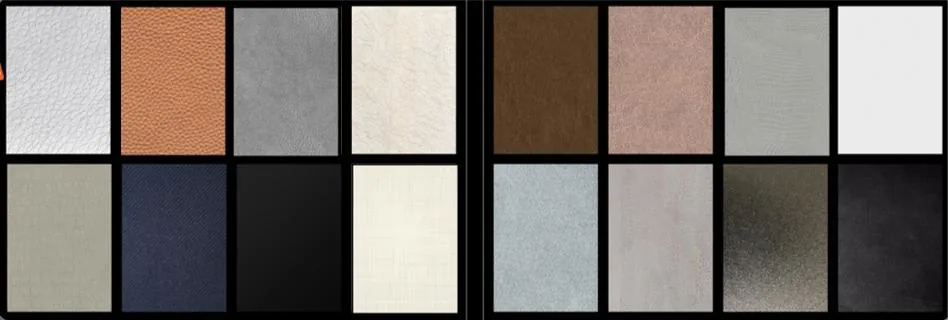
Our furniture decorative film is a paint-free material with a silicone functional face, distinct from PVC, melamine, PP and PETG decorative faces. The standard film has no backing adhesive; it can be added on request. This route is for flat parts, with contoured or wrapped parts requiring a separate route assessment. Free samples are available.
How should you compare film processes for your part?
Compare the layer roles first, then the joining stage at each boundary, the route for making the finished part and the evidence for its interfaces. Ask suppliers to quote the same defined construction and quantity. This creates a useful comparison of proposed parts instead of a ranking based only on manufacturing labels.
Put these items in the inquiry so that a supplier can answer against the same drawing:
| Item | What to specify | Why |
|---|---|---|
| Layer stack and roles | Each layer’s position and function | Shows the job of the face, carrier and bonding side |
| How each layer was joined | Melt-formed, laminated or applied and cured | Identifies the relevant interface and operation |
| Material pair and interface evidence | Actual adjacent materials and the evidence offered | Avoids substituting individual resin properties for a bond result |
| Film-to-board route and adhesive | The proposed assembly and finishing route | Covers the interface created after film manufacture |
| Finished-part evidence scope | Construction, conditions and observed result | Shows which part of the inquiry the evidence answers |
| Quote basis | Matching structure and quantity | Makes the commercial comparison interpretable |
A practical review can follow four steps:
- Write the job of each layer on the drawing, including the exposed face and bonding side.
- Mark where each layer joined the construction and whether that happened as a melt, a separate layer or an applied coating.
- Confirm the finishing route for the actual part shape and identify the later board bond.
- Review the interface and finished-part evidence, then compare quotations on the agreed construction.
If an offered result concerns a different carrier, adhesive or substrate, identify that difference before accepting it for the project. The process description helps locate the question; the actual construction and evidence answer it.
To discuss a flat silicone-faced part, contact us with its drawing, desired color, texture and gloss, roll or panel format, expected quantity, and the proposed board and lamination line for review.
Frequently Asked Questions
What does co-extruded mean?
Co-extruded means that layers were formed together from polymer melts through a common die before cooling. The term describes those layers’ formation. Any later film-to-board adhesive bond remains a separate part of the construction.
What’s the difference between extrusion and co-extrusion?
Extrusion shapes molten material through a die; co-extrusion is a form of extrusion that brings multiple melt streams together in the die. Extrusion is the broader category, and co-extrusion is the form used when separate melts must become distinct layers.
How many layers can be co-extruded?
There is no universal layer limit given by the process name. The 2013 research discussed above used an initial eight-layer structure. Its equipment design included splitting and stacking to multiply layers, but the reported work produced only that initial structure; using the multiplying elements remained future work.
What materials can be used in co-extrusion?
Melt-processable thermoplastics can be candidates when their flow behavior and interface adhesion work together. The cited research used filled polystyrene composites. The tubing example paired a fluoropolymer inner layer with another thermoplastic outside. Neither example provides a general compatibility table for decorative films.
Is co-extrusion more expensive than single-layer extrusion?
No, not always. In its August 23, 2021 example, Optinova described groundwater-sampling tubing with a premium FEP inner layer and a less expensive outer polymer as costing less than tubing made entirely from FEP. This qualitative cost example applies to that tube construction; matching furniture-film quotations still need the same materials, structure and quantity.