
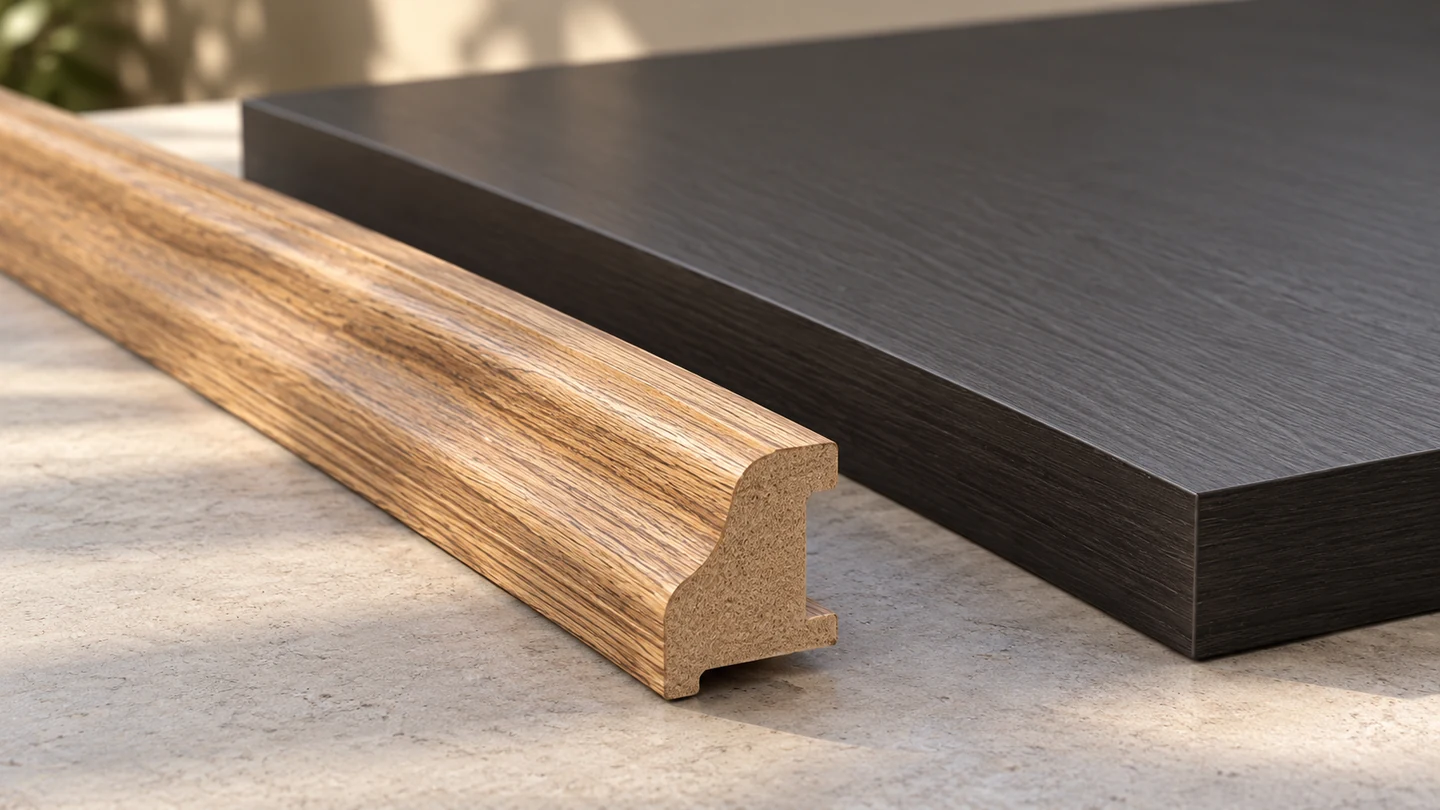
Profile wrapping vs flat lamination is a choice between covering a long, shaped member and facing a broad, flat panel. Wrapping guides flexible foil or veneer around the profile through pressure rollers or shoes. A door with three-dimensional face relief generally needs membrane or vacuum pressing.
Start with the part drawing, then match the facing, adhesive, edge finish and equipment to that shape.
What is the difference between profile wrapping and flat lamination?
Profile wrapping follows the cross-section of a long component, while flat lamination covers a panel face. Shape determines how the overlay is guided and pressed into contact with the core.
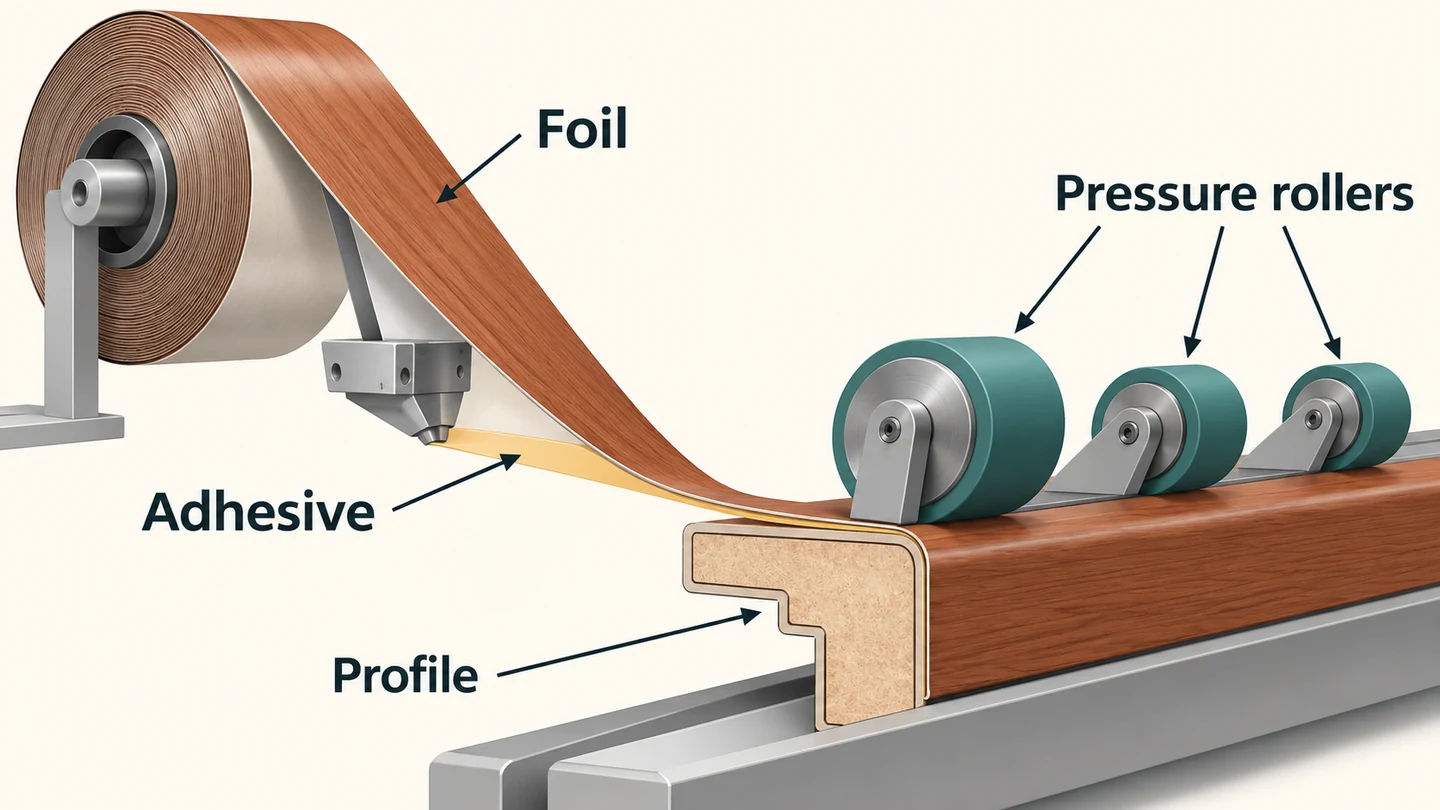
The September 2024 industry briefing on profile wrapping defines a profile as a bar with the same cross-section along its length. The flexible facing can cover all or part of that section. The line applies hot-melt adhesive and presses the facing against the profile through arranged rollers or shoes.
| Selection point | Profile wrapping | Flat lamination | Membrane or vacuum pressing |
|---|---|---|---|
| Part shape | Long component with a constant shaped cross-section | Broad, flat panel face | Individual component with a contoured or routed face |
| Typical parts | Mouldings, frame members, rails and stiles | Cabinet sides, slab doors, drawer fronts and wall panels | Routed one-piece doors and raised-panel fronts |
| Facing requirement | Flexible enough to follow the whole section | Suitable for bonding across the panel face | Thermoformable film able to follow the face relief |
| Feeding and pressure | Continuous feed through a shaped pressure zone | Panel-face bonding using a suitable roller or pressing line | Explained as a separate forming route below |
| Adhesive choice | Matched hot-melt system | Matched panel-lamination system | Matched to the specified forming system |
| Edge completion | Full or partial section coverage; end details remain | Separate edging or an integrated edge station | Face and formed-edge coverage depend on the component design |
A wide part is not automatically a flat-lamination job, and a narrow part is not automatically a wrapping job. Engineered lines can combine operations. The cross-section and face relief explain the decision more reliably than a width label.
For bonding and trimming a flat MDF panel, the step-by-step MDF lamination article covers the practical work. Here, the decision is which route the component needs before that work begins.
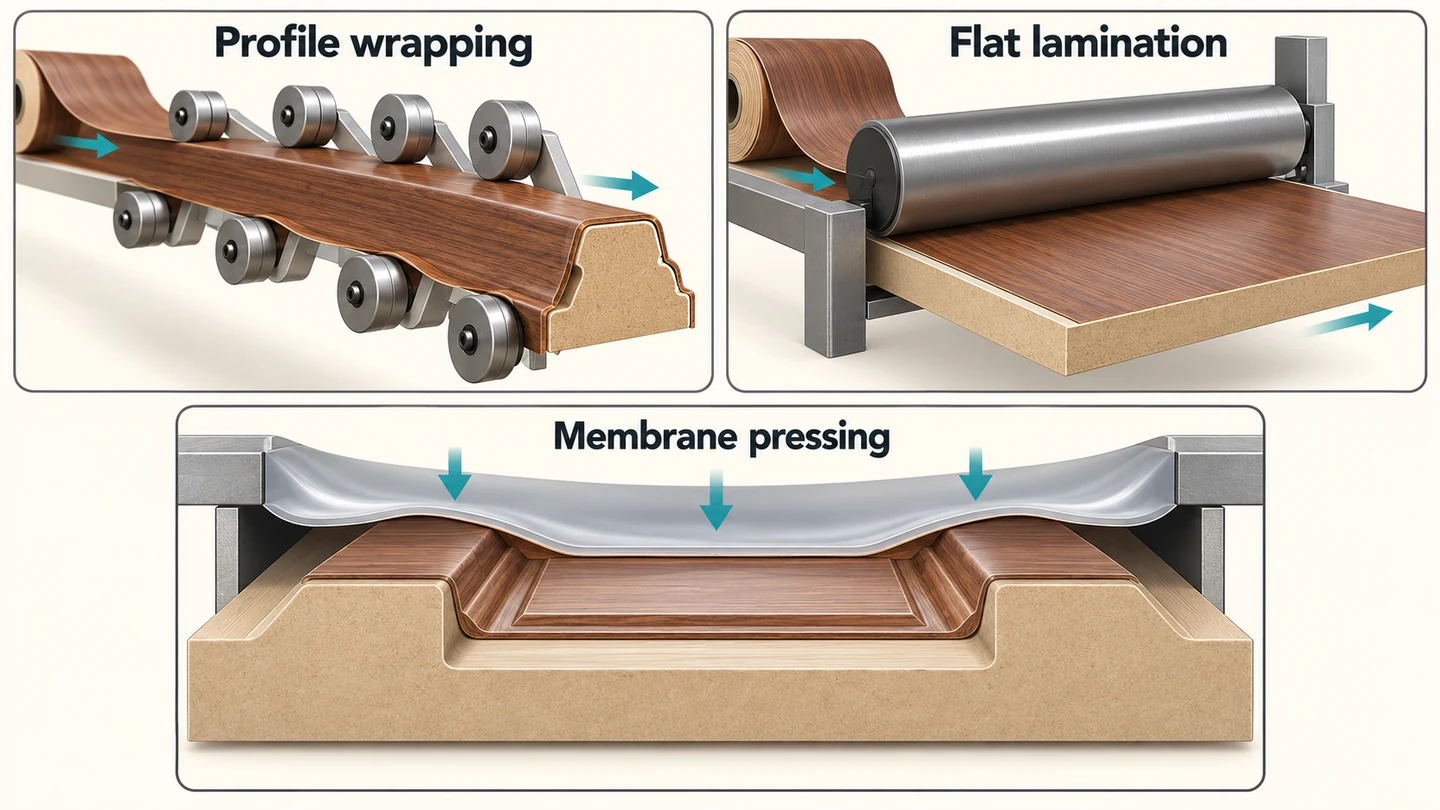
Where does membrane or vacuum pressing fit?
Membrane or vacuum pressing forms a heated, thermoformable film over a three-dimensional face and its edges. It suits routed one-piece fronts with relief extending across the face, including recessed corners that a linear wrapping arrangement cannot follow continuously.
The Surface & Panel account of 2D and 3D laminates distinguishes the uses. Two-dimensional laminates can be used for flat lamination and wrapping trim or mouldings. Three-dimensional laminates are formed over contoured components in a vacuum or membrane press. It identifies PVC and PETG among the rigid thermoformable film materials.
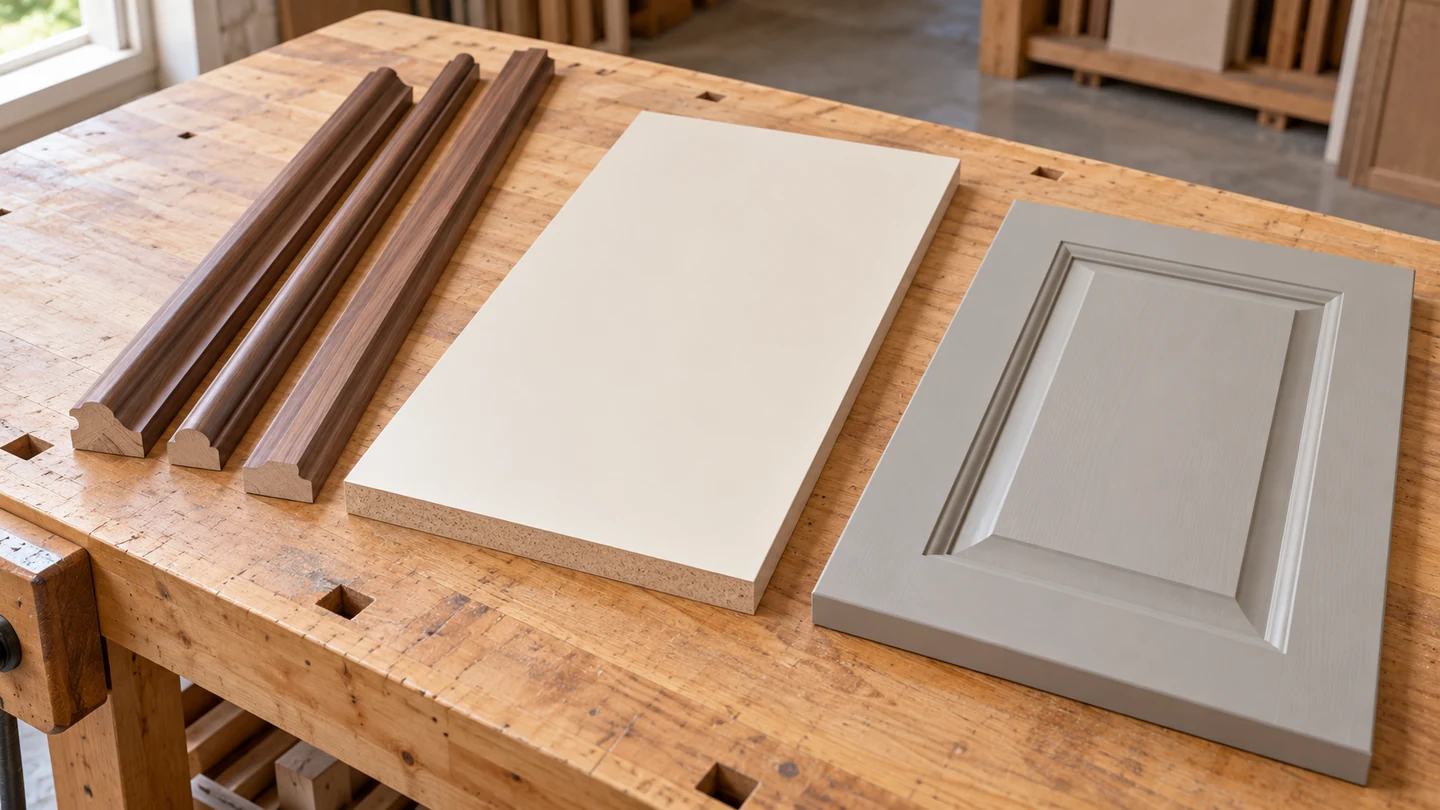
This distinction becomes useful when two doors look similar from the front. A five-piece door can use separate wrapped frame members around a center panel. A one-piece routed door can get its frame-like appearance from a single machined core covered by a formed film.
Ask for a cross-section and look at how the facing reaches the recesses and edges. A continuous longitudinal groove or J-pull can be handled by some combined wrapping equipment, so the presence of machining by itself does not mean every part must go into a membrane press. The thermofoil and laminate door comparison explains the finished-door choices in more detail.
Which parts suit each route?
Long members with a consistent shaped section suit profile wrapping, broad flat faces suit flat lamination, and relief across an individual face suits membrane pressing. A furniture assembly can use more than one of these routes.
| Component | Route to evaluate | Detail that decides it |
|---|---|---|
| Moulding, skirting or a shaped frame member | Profile wrapping | The same cross-section continues along the length |
| Rails and stiles of an assembled door | Profile wrapping | Each member is finished before the door is assembled |
| Cabinet side, backboard, flat door or wall panel | Flat lamination | The main facing bonds across a broad flat face |
| Routed one-piece front or raised-panel door | Membrane or vacuum pressing | The film must follow face relief and corners |
| Five-piece door | Wrapped frame plus a separately faced center, where specified | Frame members and center panel have different geometries |
Furniture wrapping applications include cabinet frame members, decorative mouldings and wardrobe profiles. These component examples from an equipment manufacturer show why wrapping and panel lamination often appear in the same factory.
Core material also matters. The industry briefing includes solid wood, wood-based materials, wood-plastic composites, plastics and metals as profile carriers. A machined MDF moulding and an aluminium frame can share a general route while needing different surface preparation and adhesive selection.
For a collection with slab doors and matching shaped trim, identify both parts on the drawing. One decorative color may need two suitable overlay constructions or separately approved converting routes. A matching color name is a starting point for appearance selection, not proof that the same material will form every component.
What overlay materials work on each route?
Profile wrapping needs an overlay flexible enough to reach the complete section; flat lamination accepts facings suited to panel bonding; membrane pressing needs a documented thermoformable film.
The industry briefing lists resin-impregnated papers, CPL, thermoplastic foils, raw veneer and fleece-backed veneer as wrapping materials. Flexibility must be sufficient for the actual profile, including its corners and recesses. Veneer and a thermoplastic film can therefore require different handling even when their finished woodgrain appearance is similar.
Flat faces give you more freedom because the facing does not have to take the profile’s full shape. However, the backing, coating and bond still need to work together. The industry publication’s film descriptions distinguish polyester films used for flat lamination from formable PETG constructions.
For a proposed substitution, compare the complete facing: its support film, decoration, exposed surface and documented conversion route. Our PET, PVC and PETG decorative-film comparison explains those material differences. A flat sample can match color and touch while leaving the forming question unanswered.
Which adhesives are used for profile wrapping and flat lamination?
Profile wrapping commonly uses hot-melt adhesives, including EVA, PO, PA and moisture-reactive PUR; flat lamination also uses systems selected for the facing, core and line. PUR is useful where the bond needs higher heat and moisture resistance, with processing equipment that protects it from premature moisture reaction.
The TKH-6 briefing, September 2024, page 6 gives the following adhesive-family heat-resistance comparison. These are the briefing’s broad property descriptions, not melting temperatures, application settings or service ratings for a complete panel.
| Hot-melt family | Heat resistance described in the briefing | Processing distinction |
|---|---|---|
| EVA | Up to about 80°C | Thermoplastic; comparatively low process complexity |
| PO and PA | Up to about 120°C | Thermoplastic; PA has increased process complexity |
| PUR | Up to about 150°C | Moisture-reactive; special moisture-protected processing equipment |
Those distinctions help explain why an existing glue unit may not be suitable for a new adhesive family. PUR first develops a bond as it cools, then moisture triggers crosslinking. Melting and delivery equipment must protect the adhesive from that reaction before application.
Actual melting temperature, application temperature and coating quantity belong to the selected adhesive’s technical data and trial construction. The briefing treats them separately from heat resistance.
Henkel’s current furniture-adhesive overview lists thermoplastic hot melts, reactive PUR hot melts and water-based dispersions for decorative lamination. The available families reinforce why the actual materials and production route need a named adhesive system.
For flat-panel bonding, the panel lamination adhesive overview covers system selection, while the PUR adhesive article for PET film lamination focuses on that film-bonding context.
How are edges, ends and joints finished on each route?
Wrapping can cover all or part of a profile’s section, but cutting creates end details; flat-faced panels need a planned edge finish; membrane-formed parts carry the film over their designed face relief and formed edges. Each route leaves a different finishing job.
On a wrapped moulding, inspect where the facing terminates and what happens after the member is cut to length. On a frame assembled from wrapped rails and stiles, the assembly joints remain visible features of the construction. A continuous facing around a member does not eliminate the joints between separate members.
For a flat panel, agree whether edging is a separate operation or part of an integrated line. Match the appearance and construction at the face-to-edge junction. The MDF edge-banding article explains why the edge needs its own bonding and finishing decisions.
Membrane pressing can cover the face and perimeter without a separately applied edge strip, but the actual film termination and back detail still belong on the component drawing. Look at a complete part from the side and back, not only a front-view sample.
For a joint or edge that lifts, the decorative-film delamination guide helps separate possible bonding faults.
What drives setup and production cost on each route?
Changeovers, geometry, order size, adhesive handling and downstream finishing drive the converted cost. The cheapest route is the one that can make the required component with the least total work and acceptable output.
Wrapping needs a pressure arrangement that matches the section. An order book with many different sections can therefore carry substantial setup work. Grouping repeat parts makes better use of that setup.
Flat lamination covers a broad panel face efficiently, but the quotation must also include trimming, any opposite-face work and edge completion. Compare a finished flat front with another finished front.
For membrane-pressed parts, include core machining, film preparation, forming and finishing. For reactive adhesives, include the appropriate glue handling and cleaning arrangements. These are real differences in the production route, even when both suppliers quote the same visible decor.
No reliable public price per meter resolves this comparison across different part drawings. A useful costing exercise starts with the same delivered component, quantity and finish, then lists the operations each route needs. Remove any route that cannot make the shape before comparing its apparent material saving.
Can one line do both, and when should you combine the routes?
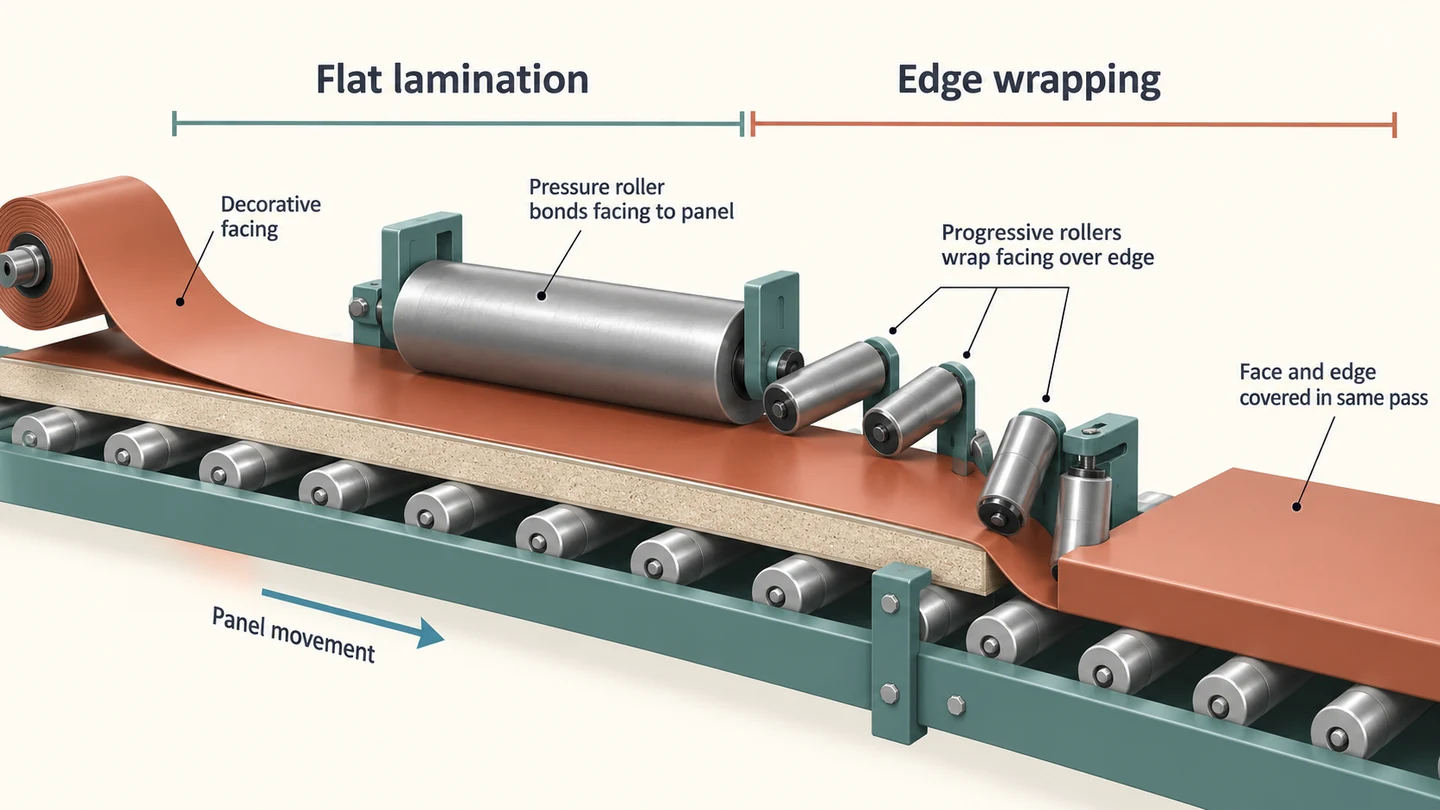
Yes. Some lines combine panel-face lamination with edge wrapping, and a factory can also use separate wrapping and flat-lamination lines for different parts of one collection.
As named equipment examples, Duespohl’s November 2024 flat-lamination article describes MultiWrap Wide with lamination and wrapping zones. Its stated working-width options are 700 or 1000 mm. PowerWrap Wide adds options for surfaces, edges and J-pull handles, with 700, 1000 or 1400 mm widths and configurations for both faces.
These figures describe those machines. They do not divide the whole industry into wrapping below one width and flat lamination above it. The value of a combined line is the set of operations it can perform on the specified section.
A factory making cabinet sides, flat fronts and shaped trim can run panel faces and shaped trim on dedicated lines. Compare handling, changeovers, finish matching and the work remaining after each line, alongside the machine’s rated capability.
For an integrated edge or handle profile, use the actual cross-section in the equipment discussion.
Where does a flat-laminated silicone decorative film fit?
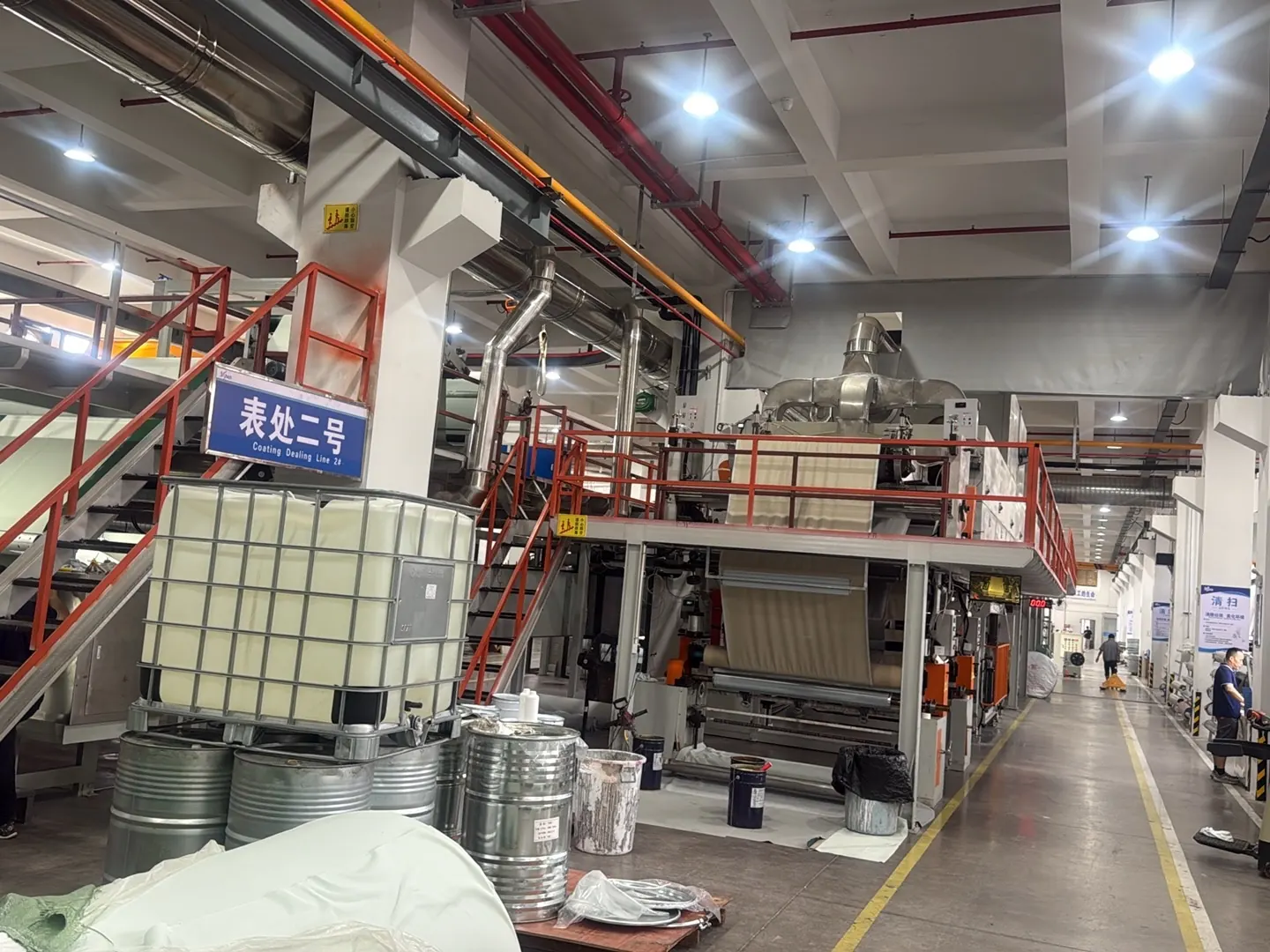
Puremorfilm makes decorative film with a silicone functional surface on a thermoplastic support; our current stable production uses PET. The film is for PUR flat lamination onto board. We do not supply film for profile wrapping, shaped-profile wrapping or vacuum and membrane forming.
Our silicone surface is inherently flame-retardant, with higher grades up to UL 94 V-0 available on request. In the manufacturer’s laboratory tests, coffee, red wine and soy sauce held at 25°C for 24 hours wiped off with no obvious change. We use a No DOP formulation.
Supply is mainly in rolls, with laminated panels available on request. This is a new paint-free facing with a silicone functional surface, distinct from PVC, melamine, PP and PETG decorative faces. For flat furniture fronts, compare the furniture decorative film and laminated MDF panel supply options. Those pages describe a flat-facing route, not a wrapping-film offer.
Profile wrapping or flat lamination: which route fits your part?
Choose the surfacing route from the part’s section and face shape, then compare suitable materials and the complete finishing work. Use the finished-component drawing to keep both technical discussions and quotations on the same basis.
| Your component | Route to evaluate first |
|---|---|
| Long, shaped member with a constant section | Profile wrapping |
| Wide, flat panel | Flat lamination with planned edge completion |
| One-piece front with three-dimensional face relief | Membrane or vacuum pressing with a suitable forming film |
| Assembled frame-and-panel door | The specified combination of wrapped frame members and a separately faced center |
| Panel face plus a continuous edge or handle profile | A suitably configured combined line |
Run the proposed overlay, adhesive and actual part together before committing a full order. Include the section detail and the finished ends in the assessment, because a face-only swatch cannot demonstrate either one.
For a flat silicone-facing project, contact us with the part drawing or cross-section, panel width, intended finish, adhesive and the type of line you run.
Frequently Asked Questions
What are the three types of lamination?
In furniture and panel surfacing, three routes commonly compared are flat lamination, profile wrapping and membrane or vacuum pressing. Printing and packaging use other classifications, so the phrase needs an industry context.
What is the difference between laminate and lamination?
A laminate is a layered material or facing; lamination is the process of joining layers or bonding a facing to a substrate. One names the material or construction, while the other names the operation.
What adhesive is used for profile wrapping?
Hot-melt adhesive is usual, with EVA, PO, PA and reactive PUR among the options. PUR is a candidate for demanding heat and moisture exposure when the materials and moisture-protected equipment suit it.
Which materials can be wrapped onto a profile?
Resin-impregnated paper, CPL, thermoplastic foil and wood veneer can be used when flexible enough for the specified section. The overlay and adhesive must also suit the core and intended exposure.
How does profile wrapping cost compare with flat lamination?
Frequent section changes add setup work to wrapping, while large flat-panel runs favor a face-lamination route. Many components fit only one route, so compare complete processing costs for a component that each candidate line can actually make.