

Formaldehyde free furniture is sold with claims about added-formaldehyde resins or measured emissions, and those claims cover different things. For non-toxic furniture and low-VOC purchases, start with the exact model and the part its evidence covers: the board inside, a finish or the assembled piece. GREENGUARD Gold is one useful emissions label to investigate for a child’s room.
A solid wood dresser, a particleboard bookcase and an upholstered couch each raise different questions. This guide explains the materials, the labels and the records that help you compare them, then applies those checks to children’s rooms and kindergartens.
What does formaldehyde-free furniture actually mean?
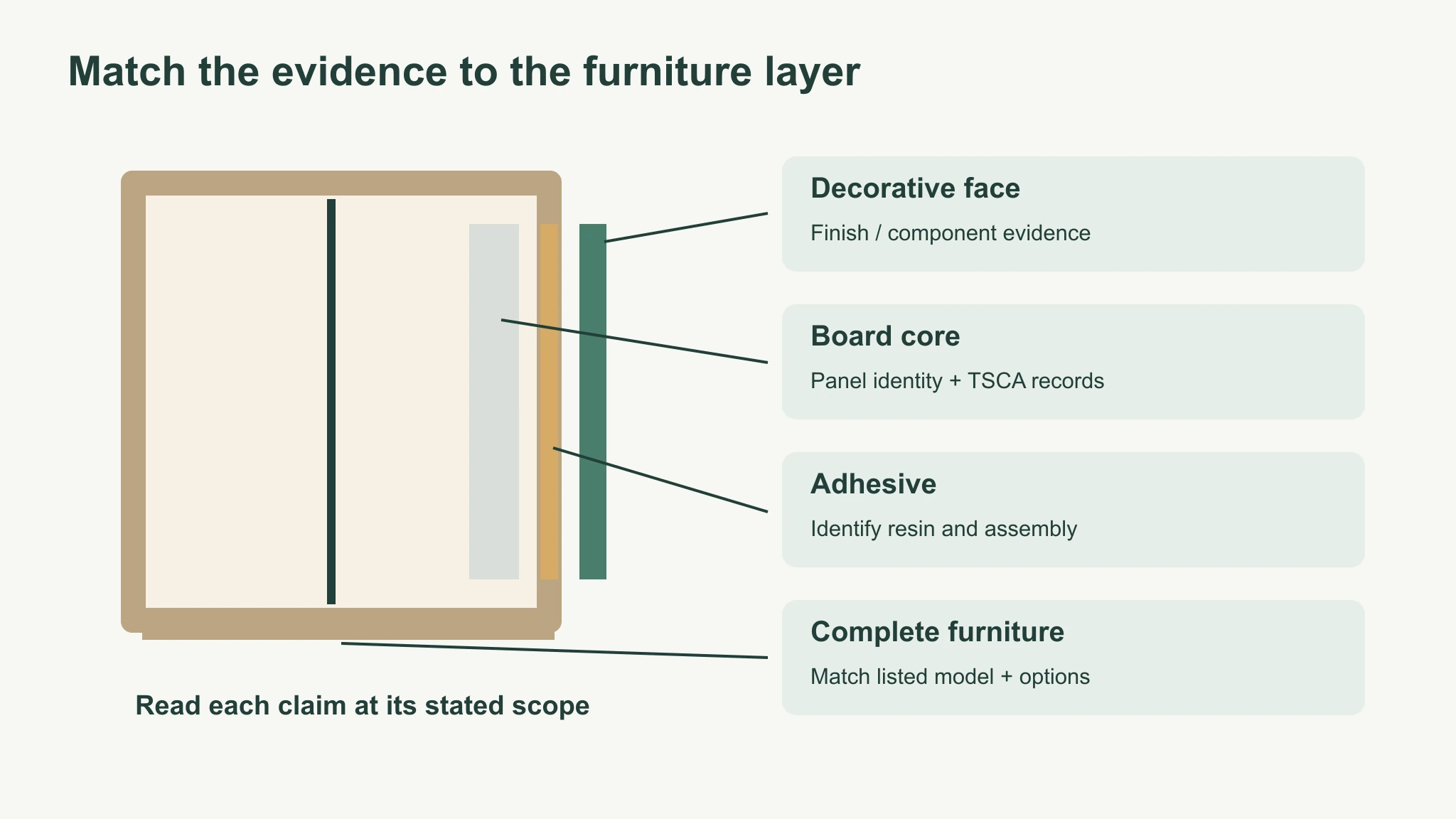
A formaldehyde-free claim needs a stated scope: a resin formulation, a component or emissions from a listed product. “No added formaldehyde” describes how a panel’s binding resin is made. “Low emitting” describes emissions under specified test conditions. A seller should say which claim applies before you compare furniture described with either phrase.
Composite wood includes hardwood plywood, medium-density fiberboard, or MDF, and particleboard, also written as particle board. These are among the regulated panels in the EPA’s formaldehyde standards FAQ. Adhesives and some coatings can contribute formaldehyde, so the attractive outer surface leaves the materials behind it to be identified.
Formaldehyde is also one of many volatile organic compounds, or VOCs. Other VOCs need their own assessment. For a sofa going into a bedroom, that means checking the upholstery and foam as well as the frame. Smell is a poor way to identify an individual chemical; our guide to furniture off-gassing covers the odor and ventilation questions separately.
Which furniture materials release the least formaldehyde?
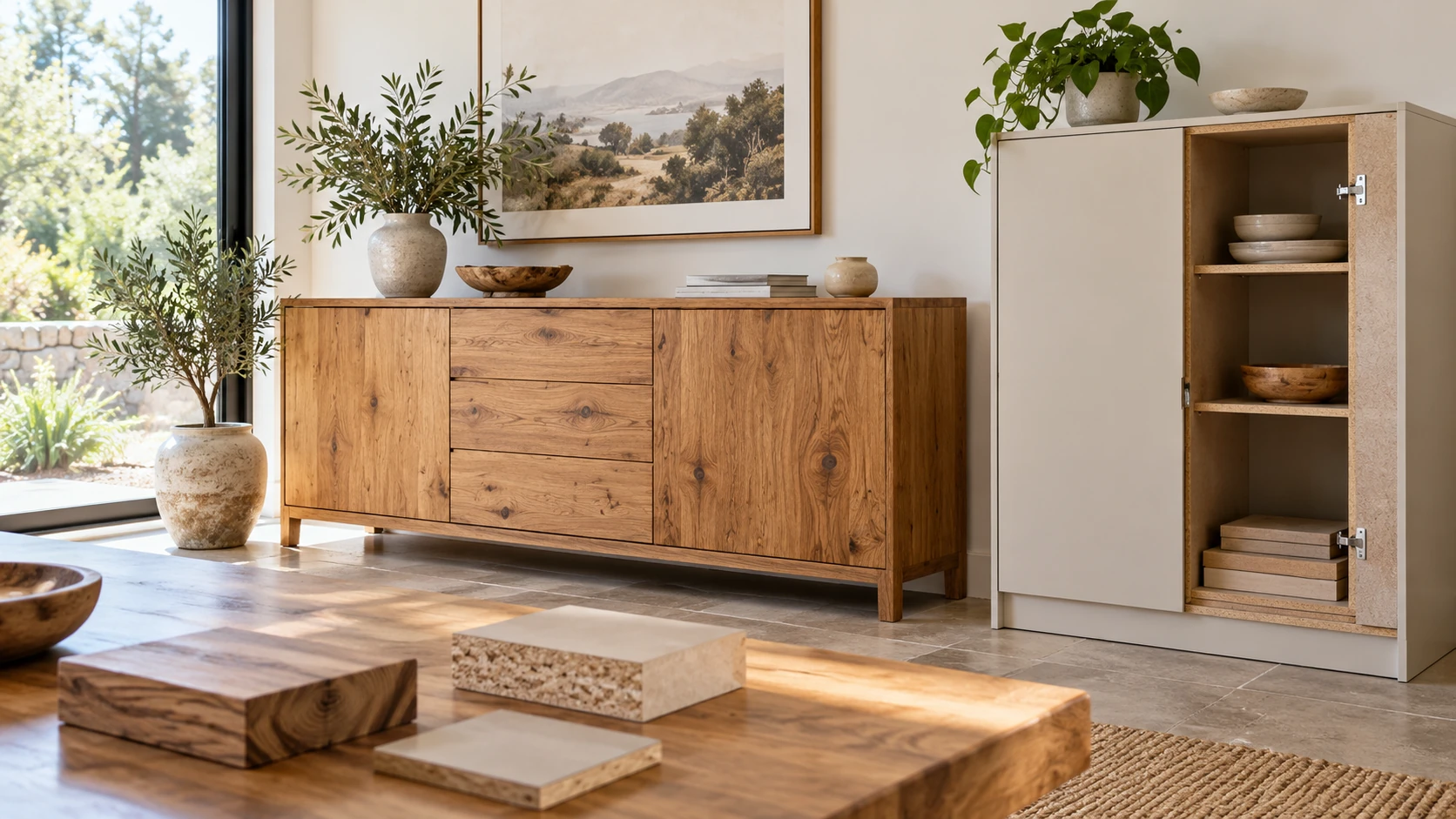
Solid wood or metal construction reduces reliance on composite wood resins, while verified low-emitting panels provide another route for cabinets and shelving. The finish and assembly adhesive still belong in the comparison. For a nursery dresser, a clear description of the whole construction is more useful than “wood furniture” on a product card.
| Material or construction | What to investigate | A useful purchase question |
|---|---|---|
| Solid wood | Joined components, adhesives and finishes | What are the drawer bottoms and cabinet back made from? |
| Metal frame or body | Coatings and any attached wood panels | Does the emissions claim cover the complete configuration? |
| MDF or particleboard | Binding resin and panel emissions | Is the board compliant, and is a NAF or ULEF claim documented? |
| Hardwood plywood | Panel adhesive and applied finish | Which plywood and finish are used in this model? |
| Upholstered furniture | Frame, foam, fabric and treatments | Which materials and emissions evidence cover this sofa? |
NAF means no-added-formaldehyde resins; ULEF means ultra-low-emitting-formaldehyde resins. Their provisions concern composite wood panels, and ULEF resins can include formaldehyde. The CARB NAF/ULEF explanation helps distinguish the terms.
A secondhand solid wood piece can also be worth considering when its construction and condition are clear. Inspect the finish, repairs and added panels. For newly faced composite wood, the faces and exposed edges belong in the emissions assessment; a sealed front alone gives an incomplete picture of the cabinet.
Which labels prove a formaldehyde claim?
Each label answers a different question, so match the claim to the panel, component or furniture model it actually covers. A compliant composite wood label and a low-emissions product certification have different scopes. Comparing those scopes prevents a board document from being mistaken for evidence about every material in a finished chair.
| Claim you see | What it supports | Scope to verify | What to match before buying |
|---|---|---|---|
| TSCA Title VI compliant | Compliance of regulated composite wood within the supply chain | Hardwood plywood, MDF and particleboard used in the goods | Panel identity and the finished-goods label or records |
| NAF or ULEF | A qualifying panel resin and emissions route | Composite wood panel; these terms are not finished-product designations | The panel used in this furniture model |
| GREENGUARD | Certification against chemical emissions criteria | The product named in the certification listing | Model and listed construction |
| GREENGUARD Gold | Stricter emissions criteria, including requirements relevant to schools and daycare | The product named in the certification listing | Model, configuration and applicable options |
CARB’s NAF/ULEF FAQ explicitly distinguishes panels from finished products. UL’s certification description explains the GREENGUARD programs and Gold’s additional criteria. Read the listing itself when buying a particular piece.
For a chest with a composite wood body and fabric drawer fronts, a panel document answers only the panel question. Keep the seller’s material description beside the certification listing and compare the names and options. Our E0, E1 and CARB P2 comparison explains other labels you may encounter without treating them as interchangeable.
What does a Prop 65 formaldehyde warning on furniture mean?
A Proposition 65 warning communicates exposure to a listed chemical under California’s warning requirements; furniture warnings can concern formaldehyde and other chemicals. The official furniture fact sheet identifies examples in furniture materials and explains why a warning may appear.
Read the chemical named and the product information supplied with it. A general furniture warning and a formaldehyde-specific warning need different follow-up questions. For a composite wood cabinet, the official formaldehyde fact sheet points to adhesives in pressed wood and some finishes as potential sources.
A warning label gives neither a chamber-test concentration nor a complete list of the furniture’s ingredients. To compare a warned and an unwarned dresser, return to their construction and model-specific evidence. The absence of a warning, by itself, is insufficient to conclude that the second piece contains no formaldehyde.
How do you choose a non-toxic sofa or upholstered chair?
Start with the frame and any composite wood, then assess the foam, fabric and chemical treatments as distinct parts of the sofa. A solid wood frame can reduce one source of uncertainty while leaving the upholstery questions unanswered. “Organic furniture” may refer to a particular fabric or latex component, so identify the certified material and the finished model separately.
For covered upholstered products, California’s flame-retardant label indicates whether added flame-retardant chemicals are present. The BHGS upholstered furniture FAQ, updated June 2019, explains the label associated with TB 117-2013. Read that statement on the actual couch or chair alongside any emissions listing.
Ask whether stain-repellent or other treatments have been added and what documentation covers them. A washable cover and a treatment applied to fabric are different features. For a sofa used daily by children, include the removable cover, cushion filling and replacement options in your comparison rather than choosing on the frame description alone.
How do you choose formaldehyde-free furniture for kindergartens?
For kindergartens, compare formaldehyde-free furniture by matching compliant composite wood, documented NAF or ULEF panel claims and any GREENGUARD Gold listing to the exact furniture model. GREENGUARD Gold addresses low chemical emissions for settings including schools and daycare. Keep the panel records and finished-product evidence together when approving classroom cabinets.
| Purchase decision | Evidence to collect | Action when it does not match |
|---|---|---|
| Which panels are inside? | Composite wood identity and compliance records | Hold the material decision until the supplied panel is identified |
| What covers furniture emissions? | Listing or report naming the relevant product and scope | Evaluate the supported component separately from the complete cabinet |
| Does it cover this order? | Matching model, finish and configuration | Resolve the difference before accepting a substituted version |
A cabinet offered with only a board document may still meet the applicable board requirements, but the procurement record should describe that limited scope accurately. A certificate for a different configuration needs reconciliation with the item being ordered. The practical check is whether the records and the classroom furniture describe the same thing.
Our TSCA Title VI compliance guide explains the documentation trail in more detail. Classroom purchasers can use that trail alongside the product listing, without turning a board compliance statement into a general “non-toxic” approval.

What are safe, non-toxic materials for children’s furniture?
Children’s furniture needs low-emitting panels and finishes, applicable lead compliance for coatings and accessible components, and suitable stability. Formaldehyde evidence, lead testing and tip-over requirements address different hazards. For a child’s dresser, match the emissions documents, children’s product records and clothing-storage stability evidence to the actual model before choosing its materials.
| Hazard | Relevant scope | Evidence and rule | Boundary to check |
|---|---|---|---|
| Lead in surface coatings | Applicable children’s products and certain furniture | Lead in paint limit: 90 ppm | The coating and covered product category |
| Lead in accessible components | Children’s products | Total lead limit: 100 ppm; applicable Children’s Product Certificate | Accessible parts and applicable testing requirements |
| Clothing-storage tip-over | Covered freestanding clothing storage units | Stability compliance and the applicable certificate | Height, mass, storage volume and product type |
| Other furniture tip-over | Items including bookcases | Appropriate wall anchoring and product instructions | A bookcase falls outside the clothing-storage rule’s scope |
The lead-in-paint FAQ and total-lead guidance explain those different limits. A Children’s Product Certificate applies where the product and rules require it; an adult furniture item does not acquire that requirement merely because a family buys it.
The clothing-storage FAQ describes covered units as freestanding clothing storage furniture meeting all the thresholds: at least 27 inches high, 30 pounds in weight and 3.2 cubic feet of enclosed storage volume. Covered units must meet the stability requirements without the anti-tip device installed. Install the supplied restraint as directed when placing furniture in a child’s room, and anchor bookcases too.
Where does a furniture surface film fit?
Puremorfilm supplies silicone functional surface decorative film for PUR flat lamination onto furniture panels, mainly as rolls; laminated panels are available on request. The film is formaldehyde-free, while the board, adhesive and finished furniture need their own emissions evidence. It is a new paint-free option whose silicone functional face differs from PVC, melamine, PP and PETG decorative faces.
The silicone surface is inherently flame-retardant; higher flame-retardant grades are available on request, up to UL 94 V-0. In the manufacturer’s laboratory tests, coffee, red wine and soy sauce left at 25°C for 24 hours were wiped away with no obvious change. The film uses a No DOP formulation.
Our children’s furniture film is a surface option for manufacturers evaluating a furniture construction. Keep the evidence checks for the completed cabinet alongside the choice of face material.

How do you buy furniture with fewer formaldehyde concerns?
Read the material description, match the evidence scope and verify the exact model before deciding. Start with the item that will enter the room, then work back through its components. That order keeps a fabric claim from standing in for a sofa assessment or a board record from covering an entire dresser.
- For a home sofa or cabinet, identify the frame, panels, upholstery and finishes. Match any emissions listing to the model.
- For a child’s bedroom, add applicable lead and product certification checks, then assess storage stability and anchoring.
- For a kindergarten, keep the panel records, product listing and ordered configuration together so substitutions remain visible.
Apply the same checks to any brand using “non-toxic” or “formaldehyde-free” language. For manufacturers comparing a decorative surface, our furniture decorative film information supports the material assessment. Contact us with the furniture type, panel construction and destination market.
Frequently Asked Questions
What are some organic furniture brands?
We do not rank brands here; compare any organic furniture brand by the certified materials and exact models it sells. An organic fabric or latex claim answers a component question. For a sofa or cabinet, examine the frame, adhesive, finish and emissions documentation as well; a brand-wide label gives less detail than a model-specific listing.
Is GREENGUARD Gold better than GREENGUARD certification?
Yes, GREENGUARD Gold uses stricter chemical emissions criteria and includes requirements relevant to schools and daycare. The useful choice is a listing that matches the furniture you are buying. Verify the model and covered options before treating either certification as evidence for a particular sofa or cabinet.
Is furniture with VOCs really dangerous?
No, the presence of VOCs alone does not determine the health risk. The chemical, concentration, exposure duration and individual sensitivity affect the assessment. For a purchase, use relevant emissions evidence and follow the product’s indoor-use guidance instead of judging safety solely from a smell or a “low-VOC” phrase.
Does solid wood furniture contain formaldehyde?
Yes, a finished solid wood piece may include adhesives, coatings or composite wood components that contribute formaldehyde. Drawer bottoms and cabinet backs deserve attention even when the main body is solid wood. Ask for a construction description that includes those concealed parts and the applied finish.
What furniture does not have a Prop 65 warning?
Furniture can lack a Proposition 65 warning because it contains no listed chemicals or because its exposures may not be high enough to require one, according to California’s furniture fact sheet. Its missing warning supplies less information than a material description and emissions record. To compare two pieces, read the evidence for each model rather than interpreting an absent warning as a chemical-free claim.