
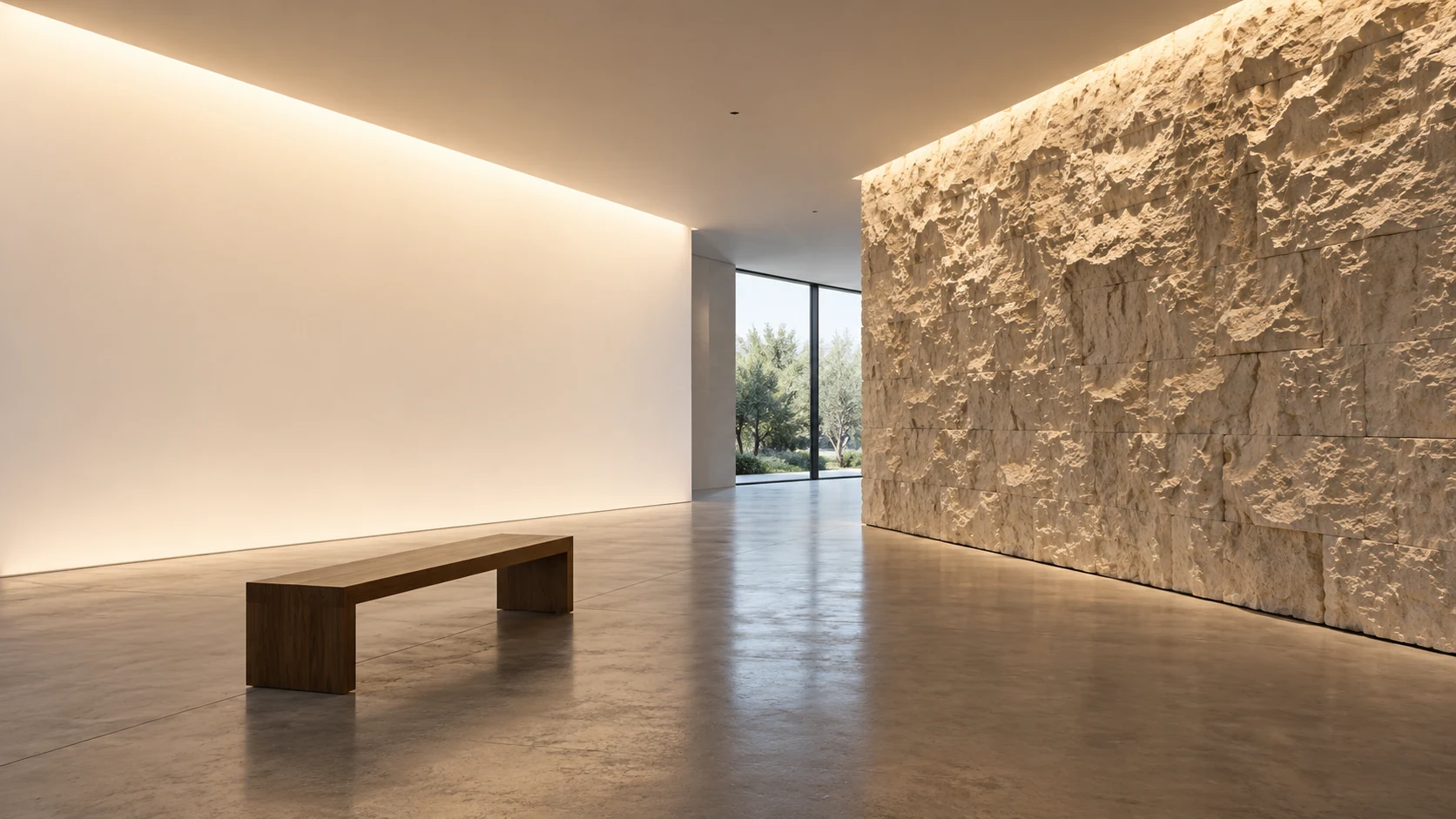
Wall washing vs wall grazing is a choice between an evenly lit wall and a surface whose relief casts visible shadows. Washing spreads light across the wall from fixtures set back from it. Grazing directs light along the surface from close by, emphasizing texture. Choose around the finished surface and the effect you want, then coordinate the optics with the available ceiling space.
For a quiet gallery wall, evenness usually matters more than relief. For textured plaster or a sculpted feature wall, the shadows may be the reason for lighting it. Decide which result belongs in the room before fixing the ceiling positions or approving the wall finish.
What is the difference between wall washing and wall grazing?
Wall washing makes the wall read as a broadly illuminated plane; wall grazing emphasizes its surface structure through highlights and shadows. Both light vertical surfaces, but they direct attention differently.
| Design question | Wall washing | Wall grazing |
|---|---|---|
| Main effect | Broad, even illumination | Stronger relief and shadow |
| Typical position | Set back from the wall | Close to the wall, directing light along it |
| Optical approach | Distribution intended to cover the wall evenly | Distribution intended to skim the surface |
| Surface that benefits | Relatively smooth, low-sheen wall | Stone, brick, textured plaster or relief panels |
| What attracts attention | The lit wall, artwork or display | The texture of the wall itself |
| Typical interior use | Gallery, corridor, reception backdrop | Feature wall or architectural accent |
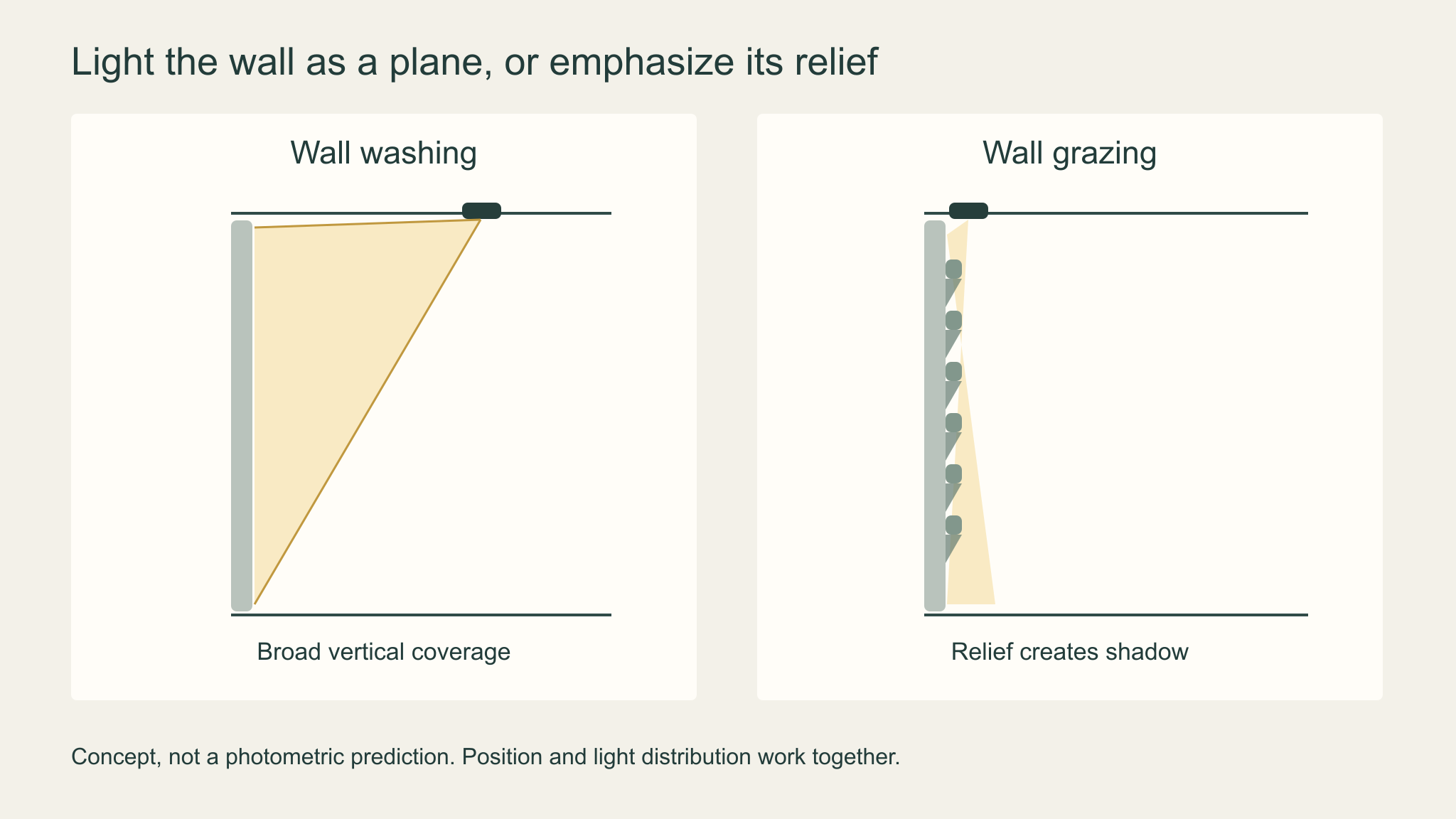
A nearby lamp does not automatically create good grazing, and a distant lamp does not automatically wash a wall evenly. The fixture’s light distribution must support the intended result. In a corridor, a row of ordinary downlights can create separate light scallops where you wanted a continuous bright surface.
Start by describing the wall’s role in the room. If the material itself should become the focal point, relief may be welcome. If the wall should quietly support artwork or circulation, an even wash is often the more suitable starting point.
When should you wash a wall?
Wash a wall when you want a smooth, bright background, a more open spatial impression or broad illumination behind artwork and displays. It works particularly well with relatively flat, low-sheen surfaces that can read as a continuous plane.
In a narrow hall, light on the long wall can make the boundaries easier to read. In a reception area, a washed background can give a quieter setting to the furniture in front of it. For an artwork wall, consider the artwork’s own surface and framing as well as the background; glass and glossy finishes can reflect the light source.
Wall color affects the result. A dark surface returns less light than a lighter one, so choosing the same lighting layout does not guarantee the same impression of brightness. Our article on decorative film light reflectance value explains that material property and its limits.
Washing can reduce strong relief shadows, but it does not repair an uneven substrate or guarantee that joints disappear. Keep the wall preparation and intended lighting connected during design. If a broad wall must look calm from the entrance, judge that complete view before deciding that a brighter fixture will solve the appearance.
When should you graze a wall?
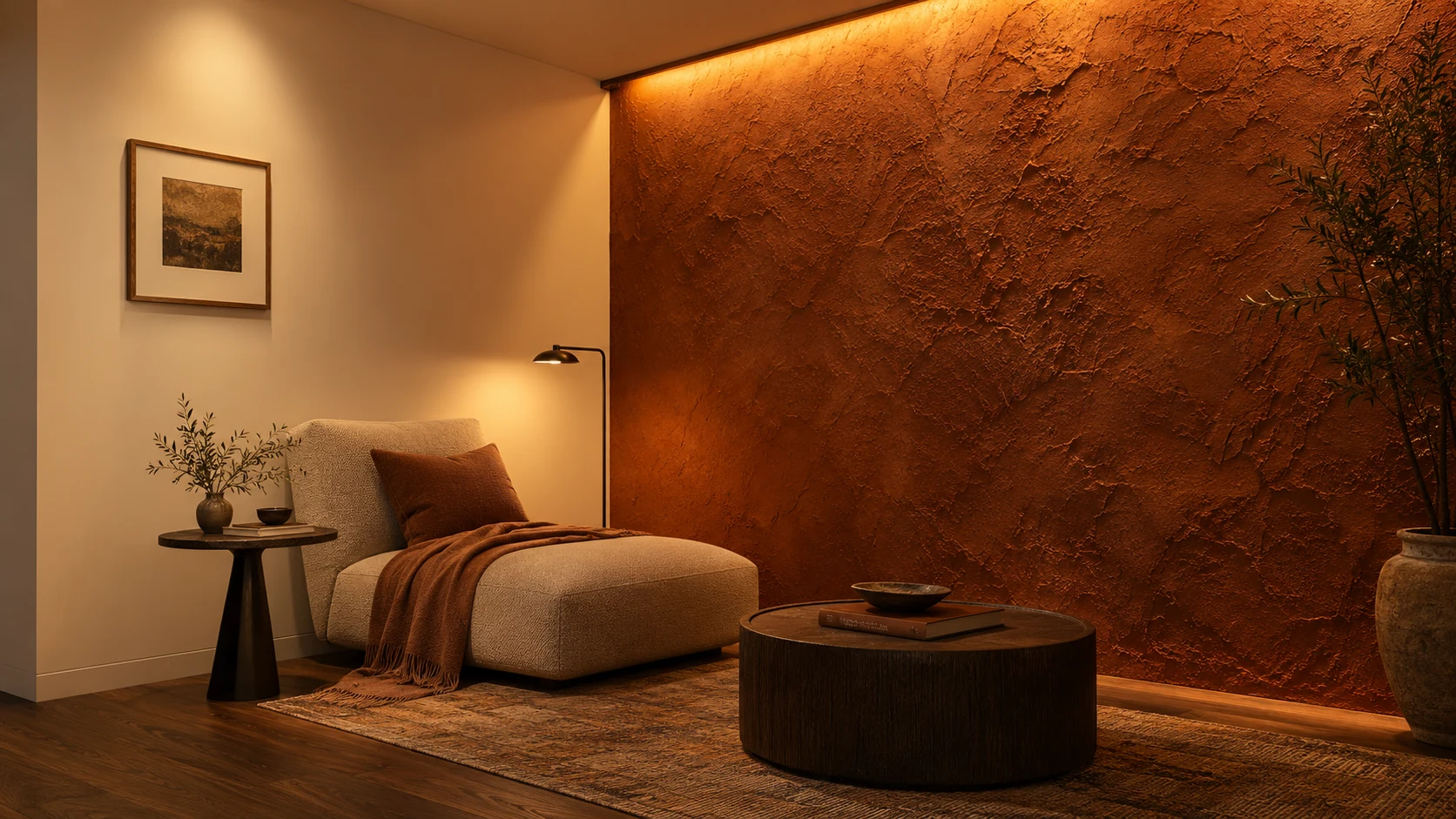
Graze a wall when its texture is intended to be a feature: ridges, stone edges, brick joints and plaster relief become more visible under light traveling close along the surface. The light can come from above or below, changing the direction of the shadows.
For a sculpted reception wall, the raised parts can catch light while recesses remain darker. On a brick wall, the joints and projecting faces become part of the composition. Decide whether that stronger texture fits the room’s visual hierarchy; a dramatic background can compete with furniture or art placed against it.
The depth and direction of the relief affect what you see. Regular grooves create a different pattern from irregular stone. A sample that looks restrained under diffuse room light may look much busier once each ridge casts a shadow. Our wall paneling ideas article shows how relief and panel arrangements change the character of a room.
Treat the viewing direction as part of the design. Look toward the wall from the entrance and from the seated positions that matter. The desired texture should remain convincing across those views, and the light source should sit comfortably within the room’s sightlines.
Is distance from the wall what separates wash from graze?
Distance matters, but the optical design and room height determine a useful setback; a fixed distance alone cannot define the technique. Two product families designed for uniform wallwashing illustrate the difference.
ERCO’s Quintessence round lens-wallwasher guidance places the wall offset, a, at approximately one third of room height, h. Its Atrium double-focus wallwasher guidance uses one fifth of h, particularly for high spaces above 6 m while also allowing lower rooms. Both give longitudinal fixture spacing, d, up to 1.3 times a. These are family-specific layout rules from the April 22, 2026 editions. Quintessence, page 5, Atrium double focus, page 4.
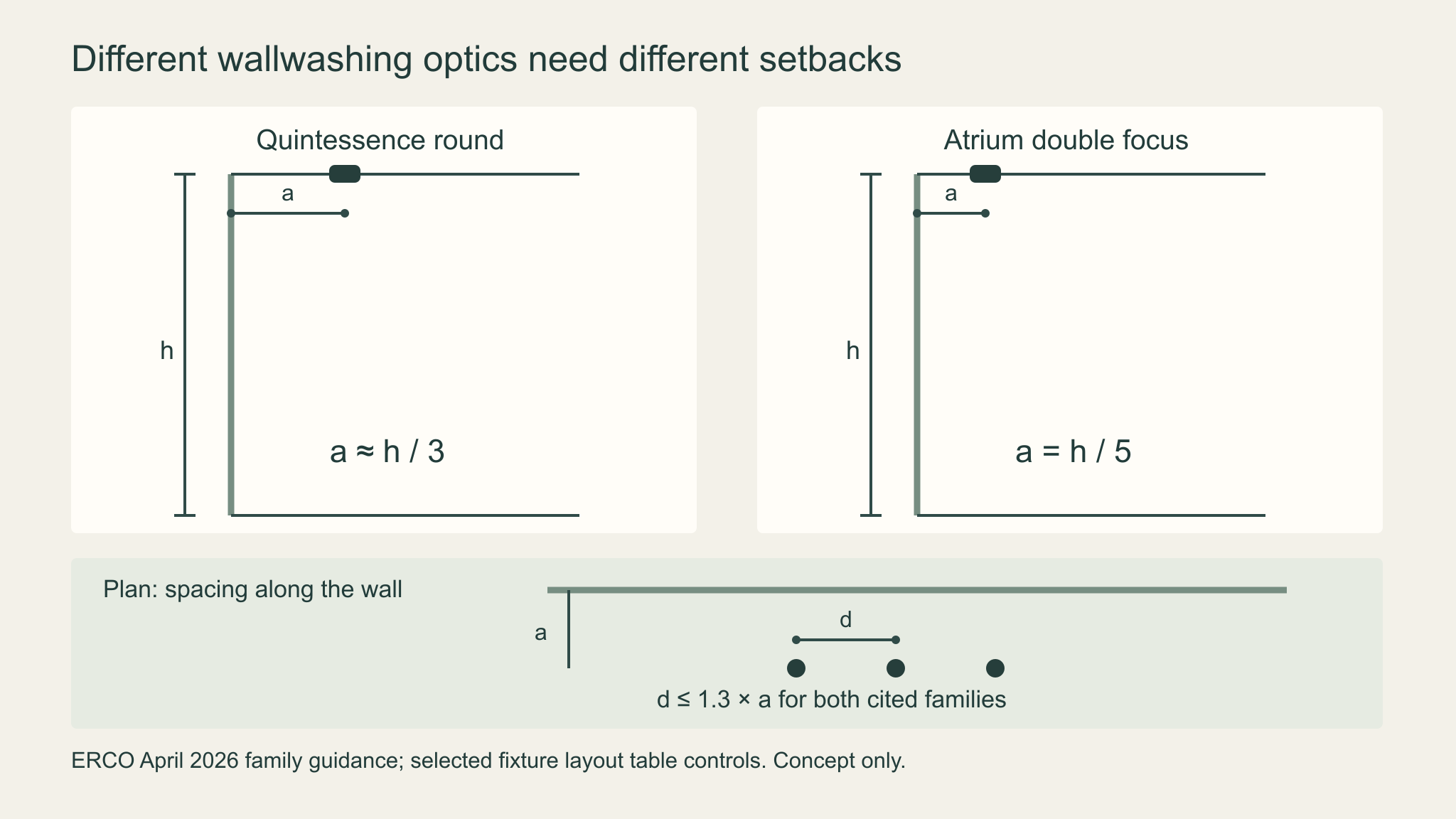
Both examples are wallwashing. They show why an arbitrary one-foot boundary between wash and graze can lead to the wrong design decision. They are different optical families, not a comparative installation test in the same room.
Before freezing ceiling positions, select the optical family together with room height, available setback and fixture spacing. Check the selected fixture’s actual wallwashing layout table. Where a ceiling beam restricts the setback, investigate a suitable distribution before accepting patchy coverage or changing the intended effect.
Which wall surfaces suit washing or grazing?
Smooth, low-sheen surfaces generally suit washing, while surfaces with physical relief suit grazing. Glossy finishes need particular attention to reflected light sources and viewing positions under either approach.
| Wall surface | Washing tends to emphasize | Grazing tends to emphasize | What to examine |
|---|---|---|---|
| Smooth painted wall | The wall as a broad plane | Small surface variations | Evenness under the intended light |
| Glossy stone or panel | Reflection and overall brightness | Reflected sources as well as relief | Glare from entrances and seated views |
| Grooved or relief panel | Color and general arrangement | Ridge depth and repeated shadows | Whether the shadow pattern supports the room |
| Brick or irregular stone | The overall surface | Joints and projecting edges | Which details become the focal point |
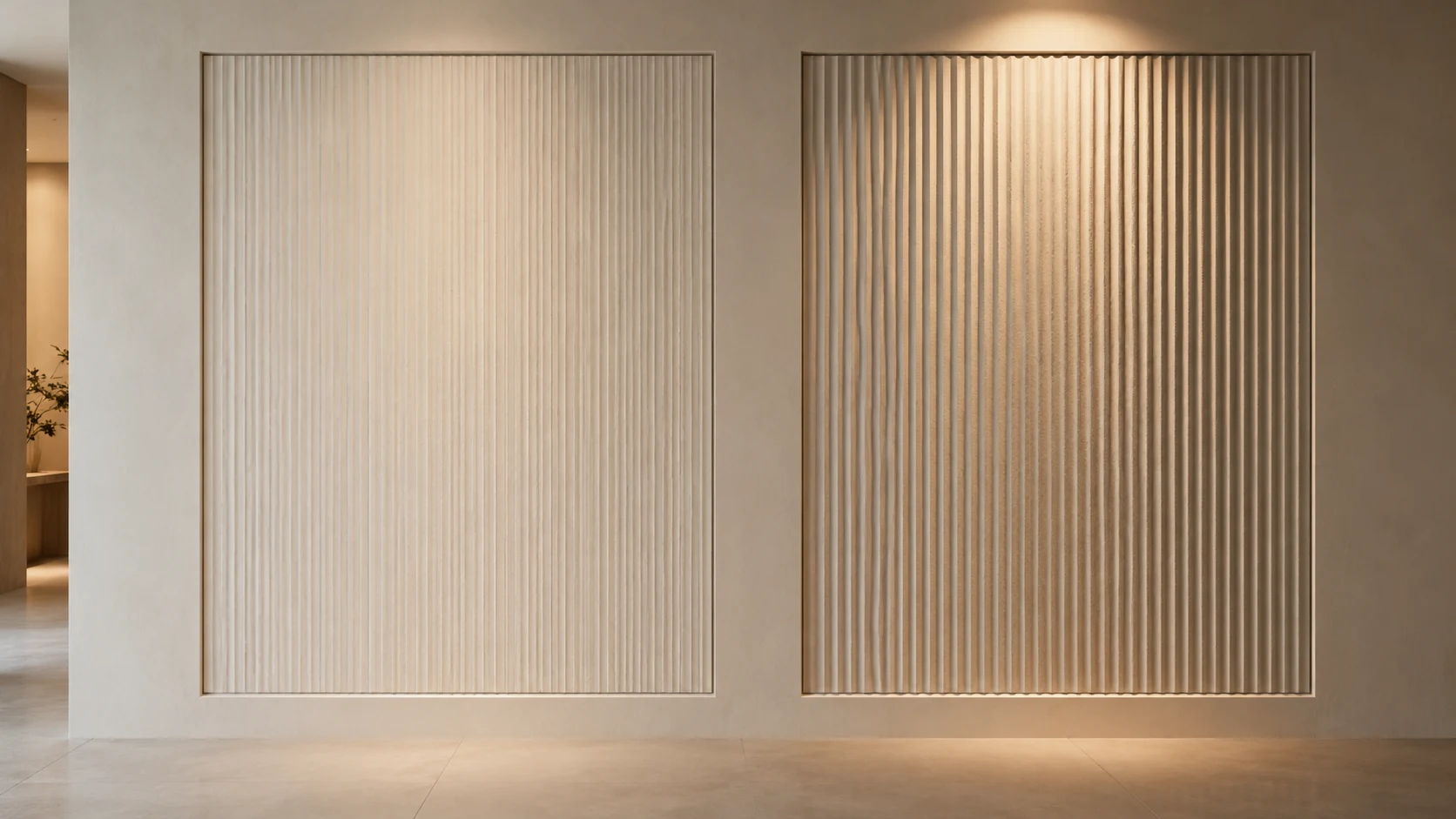
A printed wood or stone image and a physically textured finish offer different things for the light to reveal. Grazing reacts to relief; it cannot create physical depth from a flat printed vein. When the design relies on shadow, examine the actual surface texture, not only the pattern photograph.
For artwork, consider the painting or print, any glazing and the wall together. A uniform background can still leave an unwanted reflection on the framed piece. Make the comparison from where people will stand or sit, with the actual surface types represented.
Why can grazing reveal flaws on a finished wall?
Strong oblique light exaggerates small surface differences, so even a properly finished wall can show variations that are less apparent under diffuse light. The question is whether the lighting reveals the intended material relief or an unwanted change in the finished plane.
For gypsum finishes, the Gypsum Association’s GA-214-2026 explains that critical lighting should be identified during design and documented in the contract documents. Level 5 finishing minimizes, rather than eliminates, the possibility of joints or fasteners showing through the decoration. Its jobsite mock-up provisions call for final decoration and lighting representative of occupied conditions, including natural and artificial light, before widespread finishing. GA-214-2026, pages 3 and 5.
That guidance concerns gypsum panel finishing; for decorative panels, the following is our suggested design approach. Include a face, joint, edge and return in a representative finished sample, then view it under the planned wash or graze lighting from the room’s actual viewpoints.
Agree which shadows belong to the intended texture before work spreads across the room. If the effect is too severe, reconsider the light position, distribution or finish. A switch to washing may soften relief, but the complete sample still needs review. Our wall panel materials comparison covers the material and joint choices behind that sample.
How do you plan wash or graze lighting in a room?
Set an intention for each wall first, then coordinate the fixture type, ceiling or cove detail and controls with that intention. A room can use washing for orientation and grazing for a selected feature.
Linear fixtures can support a continuous line of light, while spaced fixtures depend on the chosen distribution and spacing for continuity. In either case, look at the whole wall, including its top and bottom. A bright central band can be distracting if the design called for an evenly lit surface.
A concealed source also depends on the surrounding detail. The cove opening and ceiling edge can intercept light, so their geometry belongs in the coordination review. Keep enough information in the drawings to show the intended light path and the visible ceiling condition together.
Consider the scenes in which the wall will be used. The brightest presentation setting may differ from an evening hospitality setting, and daylight can change the impression again. Select the intended color of light with the room palette; our metamerism and changing-light explanation addresses color comparisons under different illumination.
Review the coordinated wall before approving the final arrangement. Include furniture, shelves or artwork that will interrupt the light or introduce reflective surfaces. This gives the lighting and interior teams the same visual outcome to work toward.
Where does a silicone-faced decorative film fit on lit walls?
Puremorfilm makes decorative film with a silicone functional surface for flat wall-panel and furniture faces. With our decorative wall film, you can examine actual color and texture samples alongside the neighboring materials and intended lighting.
Our silicone surface is inherently flame-retardant, with higher grades up to UL 94 V-0 available on request. Coffee, red wine and soy sauce left at 25°C for 24 hours showed no obvious change after wiping in the manufacturer’s laboratory tests. The formulation is No DOP.
More than 100 patterns are available, and texture and gloss can be customized. Free samples let you examine the proposed surface; request the particular sheen you plan to evaluate. Supply is mainly rolls for PUR flat lamination, with laminated panels offered on request.

Wall washing or wall grazing: which should you choose?
Choose washing for a calm, broadly illuminated plane and grazing when physical texture should lead the composition. Combine them where different walls have different jobs, and coordinate each result with its own surface and available ceiling detail.
| Room requirement | Starting choice | Before committing |
|---|---|---|
| Bright, quiet background or artwork wall | Wash | Examine continuity and artwork reflections |
| Texture-led feature wall | Graze | Examine relief, joints and actual viewpoints |
| Glossy wall facing seated occupants | Carefully coordinated distribution | Review reflected sources from the seats |
| Restricted ceiling setback | Optical selection alongside ceiling design | Check the chosen fixture’s layout |
| Unresolved finished appearance | Representative complete sample | Resolve the surface and lighting together |
Our new paint-free material uses a silicone functional face, distinct from PVC, melamine, PP and PETG decorative faces. We can provide samples for you to consider in the intended lighting. With the wall’s use, planned lighting approach, desired texture and sheen, and sample requirements, contact us.
Frequently Asked Questions
What is a wall washer light fixture?
A wall washer is a luminaire with a light distribution intended to illuminate a vertical surface broadly and evenly. Its optics and layout work together to produce that coverage.
What is the difference between a spotlight and a wash light?
A spotlight concentrates attention on a particular object or area; a wall wash spreads light over a larger vertical surface. The intended coverage determines which distribution is useful.
What is the difference between a downlight and a wall washer light?
A downlight mainly directs illumination downward toward floors or working surfaces. A wall washer directs an appropriate part of its distribution toward the wall; some fixtures combine these tasks.
When should you not use a wall washer?
Skip a wall washer when the wall’s texture should lead the design, because grazing suits that better. Be cautious on very dark walls, where a wash adds little visible brightness, and on glossy walls, where it can reflect the light sources as glare.
What are the types of wall-washing applications?
Upward, downward and cross-lighting are common ways to illuminate vertical surfaces. Grazing is another vertical-lighting approach used for stronger relief, with a different result from uniform washing.