E0 and E1 are formaldehyde-emission classes tied to a specific standard, while CARB P2 names California’s Phase 2 requirements for regulated composite wood. Under China’s GB/T 39600, E0 has a lower chamber limit than E1. For U.S. supply, verify applicable TSCA Title VI evidence and the tested product, rather than equating labels.
What do E0, E1 and CARB P2 classify?
E0 and E1 classify emissions under a named standard; CARB Phase 2 sets California requirements for particular composite-wood products and their supply chain. Keep the standard, material and test together on your comparison sheet.
| Label | What the claim describes | What you can conclude | What the label alone leaves open |
|---|---|---|---|
| E0 under China’s GB/T 39600-2021 | A formaldehyde-emission class for wood-based panels and finishing products | A lower chamber-emission ceiling than E1 under that same system | U.S. certification, EU article compliance and the result for a different panel build |
| E1 under a specified Chinese or European standard | A class defined within that standard’s scope and test route | The reported product met the cited class when tested or assessed as stated | Whether another standard uses the same specimen preparation or whether current market rules demand more |
| CARB Phase 2, often shortened to CARB P2 | California’s Phase 2 requirements for covered hardwood plywood, particleboard and MDF | The relevant product category has its own limit and compliance requirements | Federal TSCA Title VI evidence or compliance under a Chinese or European classification |
Do not read “E1 board” as a complete material specification. MDF, particleboard and hardwood plywood are different products, while a decorative face adds another layer. Our guide to what laminated MDF contains explains that face-and-core distinction.
China’s official grading explanation identifies E1, E0 and ENF under GB/T 39600-2021. The European E1 chamber classification is described in Annex B of EN 13986 and reproduced in Commission Decision (EU) 2016/1332. Those references identify classifications, not a universal approval system for every destination.
For a purchase from China, ask which standard the supplier means before comparing two offers. An unsupported E0 logo gives you less usable information than a report that names the product, method, result and applicable requirement.
Which limits and test methods can you compare?
Compare results directly only when the method, specimen and test conditions are compatible; changing the unit cannot make different compliance systems equivalent. Keep the original unit and product category alongside each limit.
| System or requirement | Product and test route | Limit as reported in that system | How to use the number |
|---|---|---|---|
| China, GB/T 39600-2021 grading | Wood-based panels and finishing products; chamber-emission grading, with the cited method identified on the report | E1 ≤0.124; E0 ≤0.050; ENF ≤0.025 mg/m³ | Compare these classes within the named Chinese system, not against a desiccator-water number |
| China, mandatory GB 18580-2025 | Indoor wood-based panels and their products; 1 m³ chamber method | Panels: E1 ≤0.124 mg/m³; panel products: E0 ≤0.050 mg/m³ | Identify whether the supplied object is a panel or a panel product before choosing its requirement |
| European E1 chamber classification | EN 13986 / EN 717-1 chamber route for wood-based panels | ≤0.124 mg/m³ | A classification ceiling, not sufficient evidence of the EU’s current article restriction |
| CARB Phase 2 | Covered composite wood; ASTM E1333 primary chamber method and permitted secondary methods under the program | Hardwood plywood 0.05; particleboard 0.09; MDF 0.11; thin MDF 0.13 ppm | Select the actual category; there is no single CARB P2 limit for every board |
| Federal TSCA Title VI | Covered composite wood; ASTM E1333 or an accepted equivalent ASTM D6007 route under the rule | Hardwood plywood 0.05; particleboard 0.09; MDF 0.11; thin MDF 0.13 ppm | The limits match CARB Phase 2, but the federal program has its own requirements |
The Chinese figures above come from the official standards explanations. The EPA’s product-category guidance gives the U.S. limits and defines thin MDF as no more than 8 mm thick. A thin-MDF result cannot be reassigned to thicker MDF by retaining the same label.
Why are mg/m³, ppm, mg/L and mg/100 g different?
Chamber results describe formaldehyde in air. A desiccator result expressed in mg/L refers to formaldehyde collected in water under that test. A perforator result expressed in mg/100 g refers to formaldehyde content relative to dry board mass. These measure different things under different procedures.
ISO describes the desiccator method and the perforator extraction method as separate procedures; the latter determines content in unlaminated, uncoated panels. A gas-concentration conversion under defined temperature and pressure can change the notation between ppm and mg/m³, but it cannot supply a missing test, certification or specimen match.
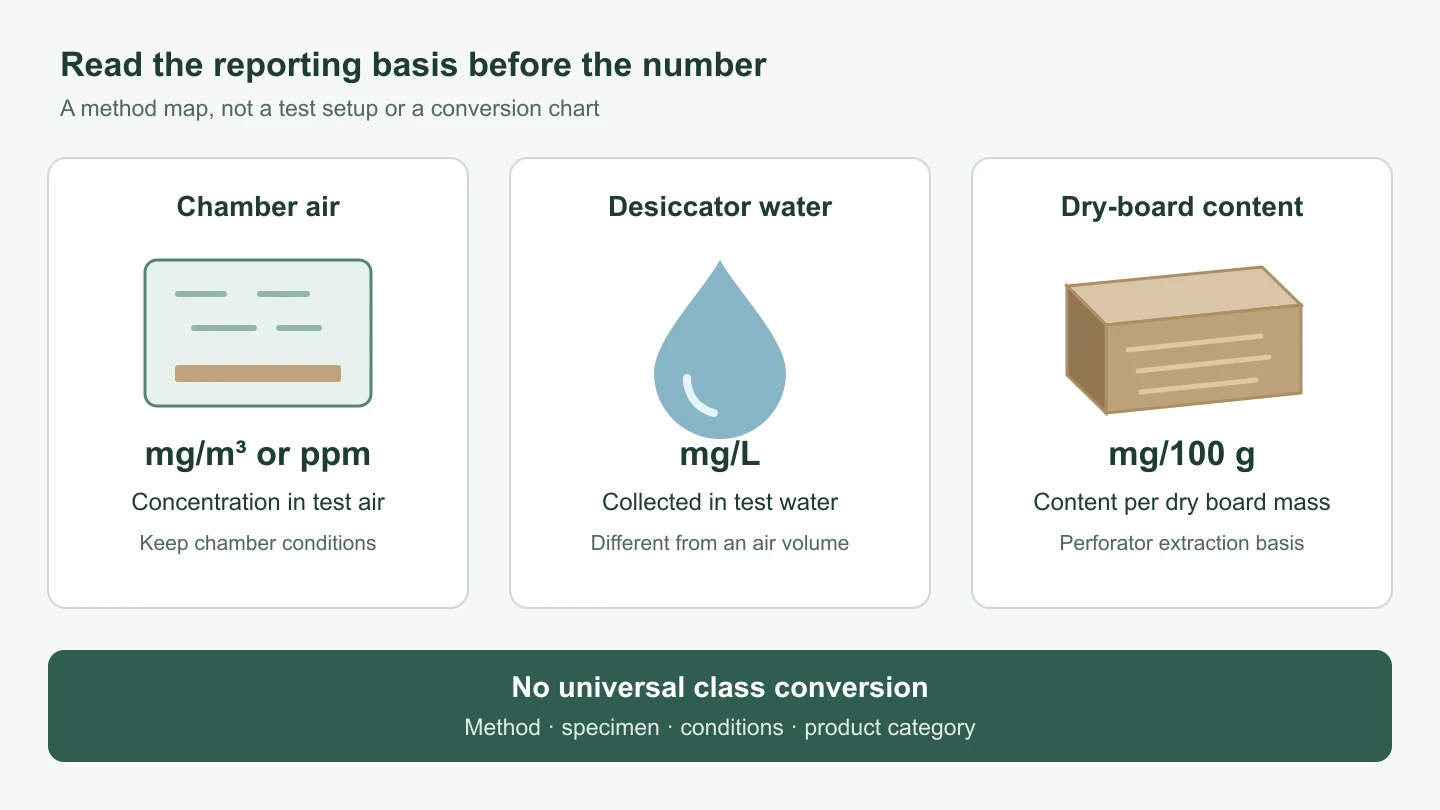
Different reporting bases require the named method. This schematic is not a test setup or a conversion chart.
Two chamber tests can also differ in loading, temperature, humidity, exposed surfaces and the point at which the result is taken. Before accepting a comparison, read those conditions rather than comparing the numbers alone. A panel classification also differs from room-air performance after installation; furniture off-gassing includes other materials and exposure conditions.
Which Chinese standard version belongs on the report?
For current Chinese requirements, read GB 18580-2025 alongside any claimed GB/T 39600-2021 grade; do not keep treating GB 18580-2017 as the current mandatory edition. The official standard registry records that the 2025 edition replaced the 2017 edition on June 1, 2026.
The change distinguishes the product being assessed. The National Forestry and Grassland Administration’s explanation states E1 for wood-based panels and E0 for wood-based panel products. It includes decorative-faced panels among examples of panel products. It also confirms the 1 m³ chamber route and revised specimen-preparation requirements.
That distinction affects a film-faced order: a report on raw MDF and a report on the supplied decorated panel describe different objects. Do not apply the raw-panel requirement to a panel product merely because both contain the same core. Conversely, do not summarize the update as “all Chinese boards must be E0.”
GB/T 39600-2021 remains a grading reference. Its official registry entry identifies it as current, and the standards authority explains the three levels as follows:
| GB/T 39600-2021 class | Formaldehyde-emission ceiling | Meaning within this grading system |
|---|---|---|
| E1 | ≤0.124 mg/m³ | The E1 ceiling; not the current mandatory ceiling for every category of panel product |
| E0 | ≤0.050 mg/m³ | A lower emission ceiling than E1; not zero formaldehyde |
| ENF | ≤0.025 mg/m³ | A lower emission ceiling than E0; not a declaration that the material contains no formaldehyde |
An older report may still document an earlier test. It does not, on its own, demonstrate assessment under a replacement edition with changed preparation or acceptance rules. Have the laboratory identify which current claims the report supports and what further work is needed for the supplied product.
Put the standard number, edition, class, specimen description and method into the order. The supplier-evaluation checklist helps you connect that evidence to the material actually delivered, rather than accepting a grade word detached from a report.
Are CARB Phase 2 and TSCA Title VI interchangeable?
No. Their product-category emission limits match, but California and the federal government operate distinct compliance programs. A CARB Phase 2 statement alone is not the complete evidence for a current U.S. import.
CARB’s official comparison identifies differences in certifier recognition, labeling, records and other requirements. Its federal column states that composite-wood products must be TSCA Title VI compliant; finished goods containing them must use compliant composite wood. The earlier reciprocity period ended in March 2019.
Choose the regulated category before reviewing a result. Hardwood plywood, particleboard, MDF and thin MDF have different limits, even though all may appear in a furniture order. For covered hardwood plywood, identify the relevant core construction; the EPA guidance explains which plywood constructions fall under the emission standards.
Certification or an applicable documented exemption concerns the regulated product and producer. A low result from a convenient loose sample does not establish the complete program status. Likewise, “NAF” refers to qualifying no-added-formaldehyde-based resin provisions; it is not a synonym for an E0 result or for every formaldehyde-free material.
Keep the detailed filing and label workflow in the TSCA Title VI compliance guide. For the comparison here, the decision is to require federal evidence for U.S. supply and to address California’s requirements as applicable, without replacing either with an E0 or E1 report.
What does the EU require after August 2026?
For articles within scope, the EU restriction now requires more than an E1 classification. After August 6, 2026, REACH Annex XVII entry 77 prohibits placing articles on the market when releases exceed 0.062 mg/m³ for furniture and wood-based articles, or 0.080 mg/m³ for other articles, under Appendix 14 conditions.
The European Commission’s explanation identifies the two limits. The regulation’s official text, reproduced by Poland’s chemical authority, supplies the dates, conditions and exceptions.
Appendix 14 specifies reference conditions including 23 ±0.5°C and 45 ±3% relative humidity, with loading, air exchange and steady-state requirements. Matching the unit alone does not establish compliance with that appendix.
Exceptions include articles with only naturally present formaldehyde or releasers, second-hand articles, and exclusively professional or industrial articles only where foreseeable use does not expose the general public. A business purchaser alone does not establish that last exception. For an EU furniture order, assess the actual article and its applicable evidence; do not release it solely on an E1 or Chinese E0 label.
Which reports match furniture and film-faced panels?
Match each report to the object it tested and to the requirement you are trying to demonstrate. Core, adhesive, facing and finished-article evidence answer different questions; one cannot automatically stand in for the others.
| Evidence supplied | What it can describe | What still needs to match |
|---|---|---|
| Raw MDF, particleboard or plywood report | The named core, product type and test specimen | Producer, thickness/category, applicable certification and the core used in your order |
| Adhesive documentation | The specified adhesive’s composition, handling or particular test results | The actual bond application and the applicable emissions evidence; an adhesive statement does not certify the board |
| Decorative-film report | The film sample tested | The surface supplied; it does not report emissions from the core or complete assembly |
| Faced-panel or finished-article report | The stated build under the recorded preparation and test conditions | The same relevant core, bond, faces, edges and supplied configuration, within the report’s scope |
Ask the supplier and laboratory to identify the core type and producer, thickness, facing, adhesive and specimen preparation behind the report. Single-face exposure, exposed edges and a different back construction can affect what the specimen represents. The panel-lamination adhesive guide covers the bonding choice; an adhesive recommendation is not emissions approval for the assembled panel.
“Laminated product” also has a narrower legal meaning under TSCA Title VI than everyday trade usage. The EPA definition concerns wood or woody-grass veneer on a regulated platform. Plastic film facing does not acquire that veneer classification merely because a quote calls the board laminated. Covered composite wood within the product still needs the applicable federal compliance evidence.
For a laminated MDF panel order, record substitutions in the build before relying on earlier evidence. A report for one assembly is not permission to replace the core, adhesive or facing without checking whether the evidence still covers the change. When a drawing changes, ask which report or certification scope remains applicable.
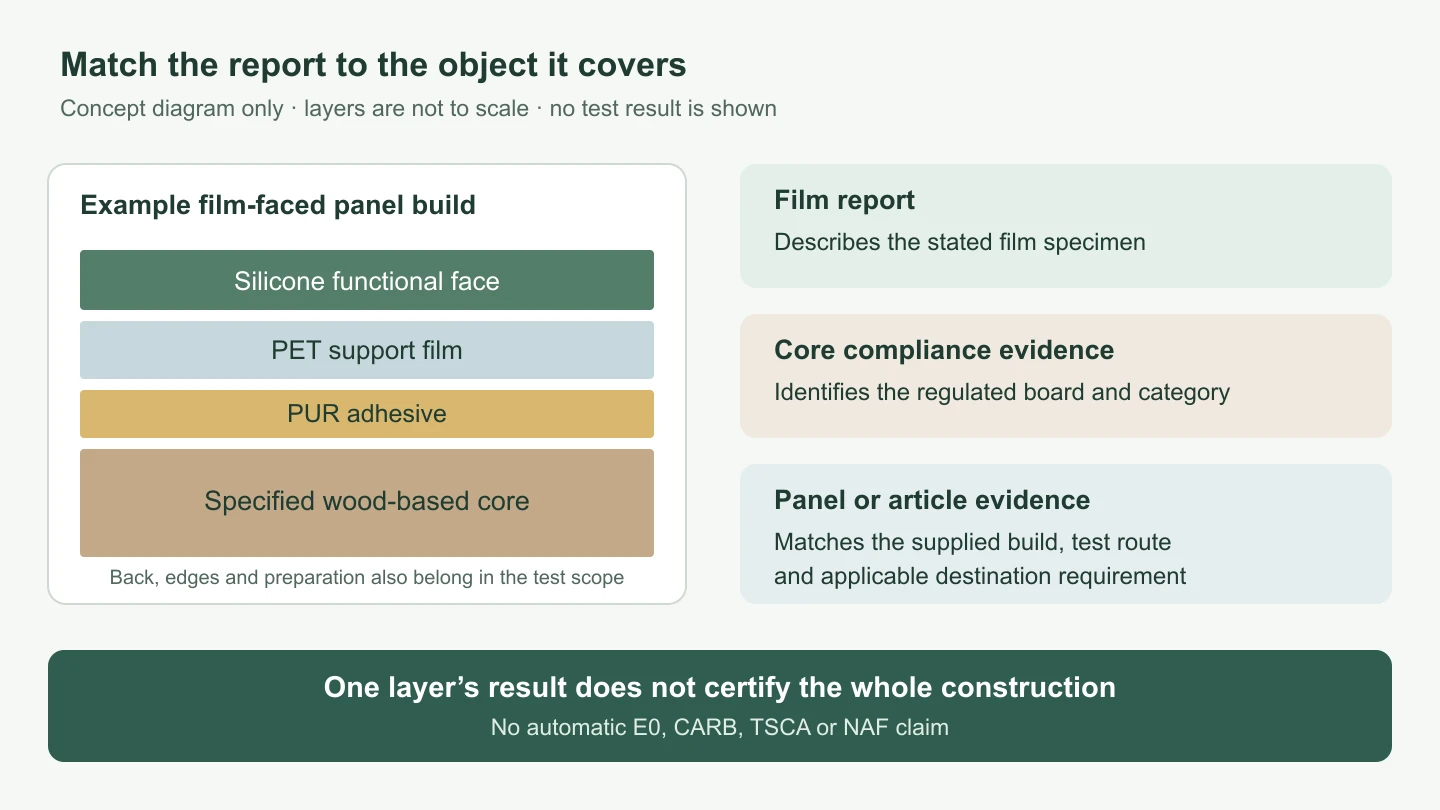
A result for one layer covers its stated specimen. The panel or article needs evidence for the applicable market requirement.
Does formaldehyde-free film make the whole panel compliant?
No. A formaldehyde-free film describes the film itself; the core, adhesive and assembled product still need their own applicable assessment. The statement does not turn the film or panel into an E0, CARB, TSCA or NAF-certified product.
Puremorfilm manufactures silicone decorative film in China with a silicone functional face on PET support. Our film contains no formaldehyde. The rolls have no self-adhesive backing and are flat-laminated to board using PUR adhesive; we also supply silicone laminated panels quoted per project.
Our film has passed SGS testing for formaldehyde emission, with reports available on inquiry. That film-sample evidence is separate from the compliance file for the board or furniture. We do not assign an E0, CARB or NAF grade to the film from that statement, and we do not extend the film result to a customer’s adhesive or core.
The intended uses are furniture fronts, cabinet doors and wall panels on vertical or low-wear faces. Floors, all countertops, cooktops, shower floors and other walked-on areas are excluded. For the material’s structure and supply route, see what silicone decorative film is.
Learn more about silicone decorative film for flat furniture panels. Share the core, adhesive, destination market and required report scope when you request samples.
Which specification should you request for your market?
Choose the applicable market requirement first, then specify its product category, test route and supporting evidence. Use a lower-emission class as an additional requirement where appropriate, not as a replacement for another jurisdiction’s compliance system.
| Order destination or use | Main evidence question | Specification direction |
|---|---|---|
| U.S. furniture or covered panels, including imports | Does the covered composite wood meet the applicable federal program, with California requirements addressed where relevant? | Require the appropriate TSCA Title VI evidence and identify each board category; E0/E1 alone is insufficient |
| China, raw panels or decorative-faced panel products | Which current mandatory product category and any additional grade apply? | Cite GB 18580-2025 and the correct panel/product requirement; state GB/T 39600-2021 if an additional named grade is ordered |
| EU furniture and wood-based articles | Does the article meet entry 77 under Appendix 14, or does a documented exception apply? | Require evidence for the actual article and route; an E1 label alone does not answer the current restriction |
Before approving a batch, put the named standard and edition, actual product build and accepted evidence in the same specification. Keep the report’s original method, unit and result. Resolve a mismatch by getting the right evidence for the intended claim, rather than relabeling an existing number.
For a silicone-faced project, contact Puremorfilm with the panel build and destination-market requirements. Furniture and wall film rolls start at 500 m. Laminated panels are 1220 × 2440 mm with a minimum of 200 sheets, quoted per project; neither supply format replaces the compliance work for the finished construction.
Frequently Asked Questions
Is E0 the same as formaldehyde-free?
No. Under China’s GB/T 39600-2021, E0 permits a chamber-emission result up to 0.050 mg/m³. A ceiling above zero is not a statement that the material contains no formaldehyde.
Can CARB P2 alone replace TSCA Title VI evidence for U.S. supply?
No. The category limits match, but the programs have distinct certification, labeling and other requirements. For a current covered U.S. order, obtain the applicable federal evidence rather than relying only on a CARB Phase 2 statement.
Does an E1 label prove current EU furniture compliance?
No. E1 is a classification, while entry 77 applies its own article scope, test conditions and limits. The actual emissions evidence may support more than a class label shows, but the E1 label alone does not establish compliance with that restriction.
Can a desiccator result in mg/L be relabeled as E0 in mg/m³?
No. The water-collection result and chamber-air result come from different procedures and reporting bases. Use the test and assessment route required by the claimed standard; a unit calculation cannot supply the missing evidence.
Which reports should you request for a batch of film-faced MDF?
Request the applicable core compliance evidence, the faced-panel or article evidence required by the destination, and records identifying the actual film, adhesive, core and configuration. A loose-film result or an unmatched core report does not describe the complete supplied build.