

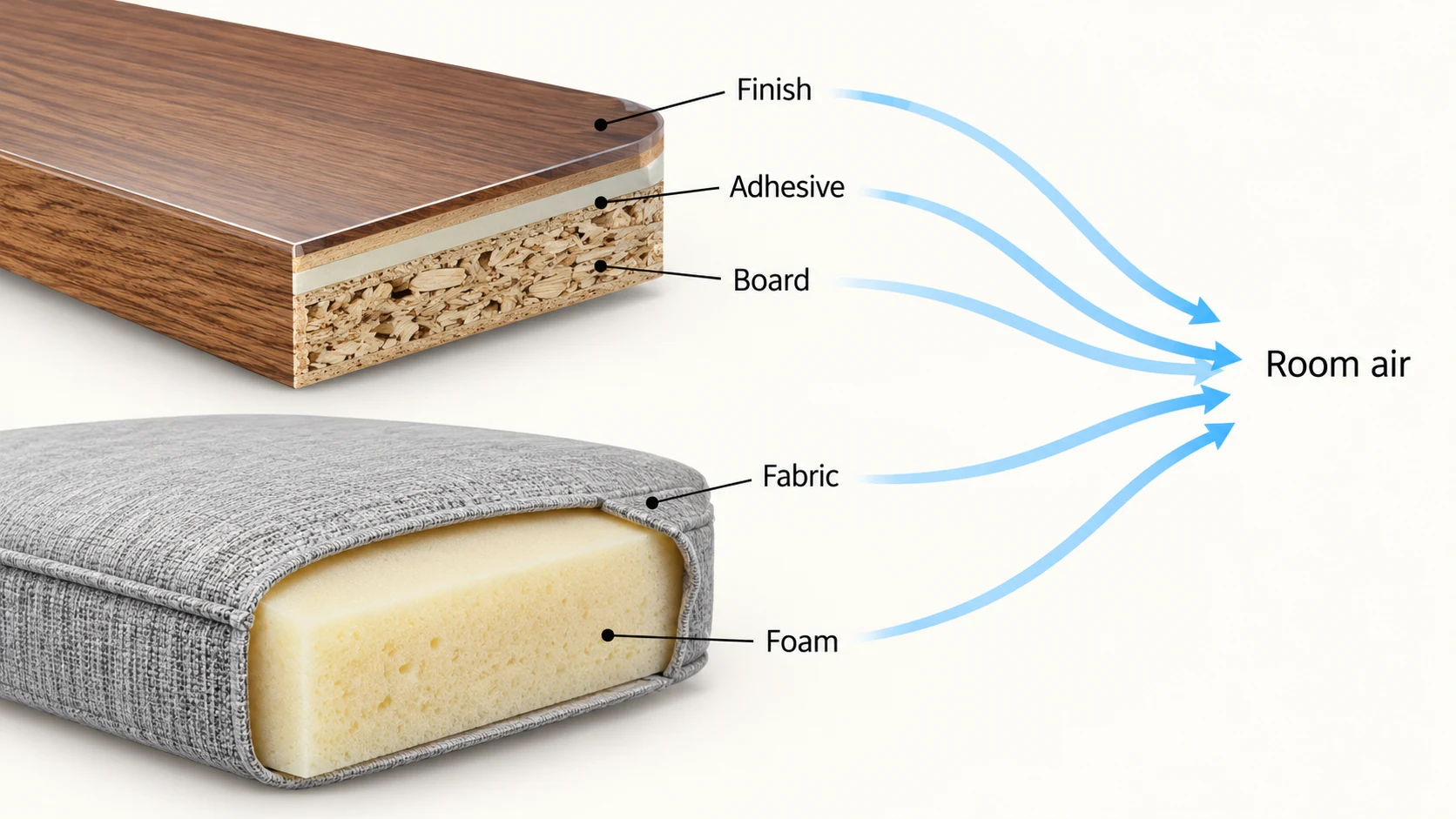
Furniture off-gassing is the release of volatile organic compounds, or VOCs, from a new piece’s boards, adhesives, finishes, foam and fabric. The smell is not always formaldehyde; varnishes, paints and decorative finishes can produce it too. Emissions are usually strongest when the piece is new and fall over time, so unpacking, ventilating and keeping the room cool and dry do most of the work.
A new sofa and a new wardrobe smell for different reasons. The sofa brings foam, fabric and glue into the room; the wardrobe brings boards, bonded faces and edges.
What Is Furniture Off Gassing?
Furniture off gassing happens when chemicals that turn into gas at room temperature leave a solid material and enter the air around it. How much that matters depends on which chemicals are released, how concentrated they get and how long you spend in that air.
The EPA’s VOC guidance lists paints, adhesives and building materials among indoor sources. One piece of furniture can contain all three, so a strong smell does not tell you which layer it came from.
You notice it most in a small closed bedroom right after unpacking. Open the doors and drawers, open the window, and the odor can weaken as fresh air circulates.
A musty smell, wet packaging or staining is a different problem. Raise those with the seller, and keep the label and receipt so the exact model and materials can be traced.
Odor and emissions are one part of a furniture check; for scratch, abrasion and adhesion testing of the finished surface, see cabinet surface durability testing.
What Makes New Furniture Smell Like Chemicals?
Boards, glues, surface finishes and upholstery can each add to the smell. Knowing which parts your piece contains gets you further than a label such as “wood furniture.”
| Furniture part | Possible source to investigate | Useful information to request |
|---|---|---|
| Pressed-wood panels | Resins used to bind wood particles or fibers | Panel type and the relevant formaldehyde-compliance label |
| Bonded joints or decorative faces | Adhesives used during assembly or lamination | Adhesive system and product emissions information |
| Painted or varnished surfaces | Volatile constituents of the finish | Finish identity and its drying or curing instructions |
| Upholstery and cushions | Foam, textiles and other materials in the assembled item | Emissions testing for the actual furniture model |
| Hidden interior faces and edges | Exposed board and unfinished areas | How the panels, faces and edges are constructed |
California’s consumer guide to composite wood says plainly that a smelly product is not necessarily off-gassing formaldehyde, because finishes contribute to the odor. The guide is old, so use it for this point and not for its transition dates.
Upholstered pieces add their own layers. A 2021 chamber study of new chairs looked at cover textiles, polyurethane foam, wood frames and adhesives as separate components. If your sofa smells, ask about the foam and fabric treatment, not just the frame.
For a wardrobe, MDF describes the core, while laminated MDF adds a decorative face and its adhesive. The difference between MDF and particle board tells you how the board is made, not how much a finished piece emits.
How Long Does New Furniture Off-Gas?
Furniture off gassing has no single deadline. Release is highest when the piece is new and then falls, faster or slower depending on the materials, room temperature, humidity and ventilation.
The CPSC’s Publication 725, 2016 revision gives two useful reference points. Formaldehyde emissions from pressed-wood products decrease six to ten months after initial testing. Wallpaper and paint emissions are sometimes still detectable one to three months after application. Treat these as material-specific observations, not a countdown for your dresser.
A freshly finished piece behaves differently from one that sat in a warehouse for months. Shrink-wrapped furniture often smells strongest the moment you open it, because gas builds up inside the packaging. Ask the seller when the piece was made and what finish was used.
Solid wood does not settle the question either. As MDF versus solid wood explains, a solid-wood piece can still carry glue, varnish or paint.

Is Furniture Off Gassing Harmful?
It can be, depending on the chemical, how concentrated it gets and how long you breathe it. The smell alone cannot tell you which of those you are dealing with.
Government guidance lists eye, nose and throat irritation, headaches and nausea among possible effects of VOC exposure. Formaldehyde is also a known human carcinogen, which is why pressed-wood emissions are regulated. Some chemicals give little odor warning, so a piece that smells mild still deserves the same label checks.
If a newly furnished bedroom makes you uncomfortable, sleep elsewhere while you ventilate and contact the seller. See a healthcare professional if symptoms persist, and note when they started and which item arrived.
For cabinets, separate a claim about the board from a claim about the whole cabinet. The cabinet-material comparison shows how cores and surfaces differ, which helps you ask whether a test covered a raw board, a coated panel or the finished unit.
How Do You Get Rid of Off-Gassing Smell Faster?
Unpack it, ventilate with outdoor air and keep the room cool and dry. Outdoor air reduces the buildup of gases; moderate temperature and humidity help control formaldehyde release.
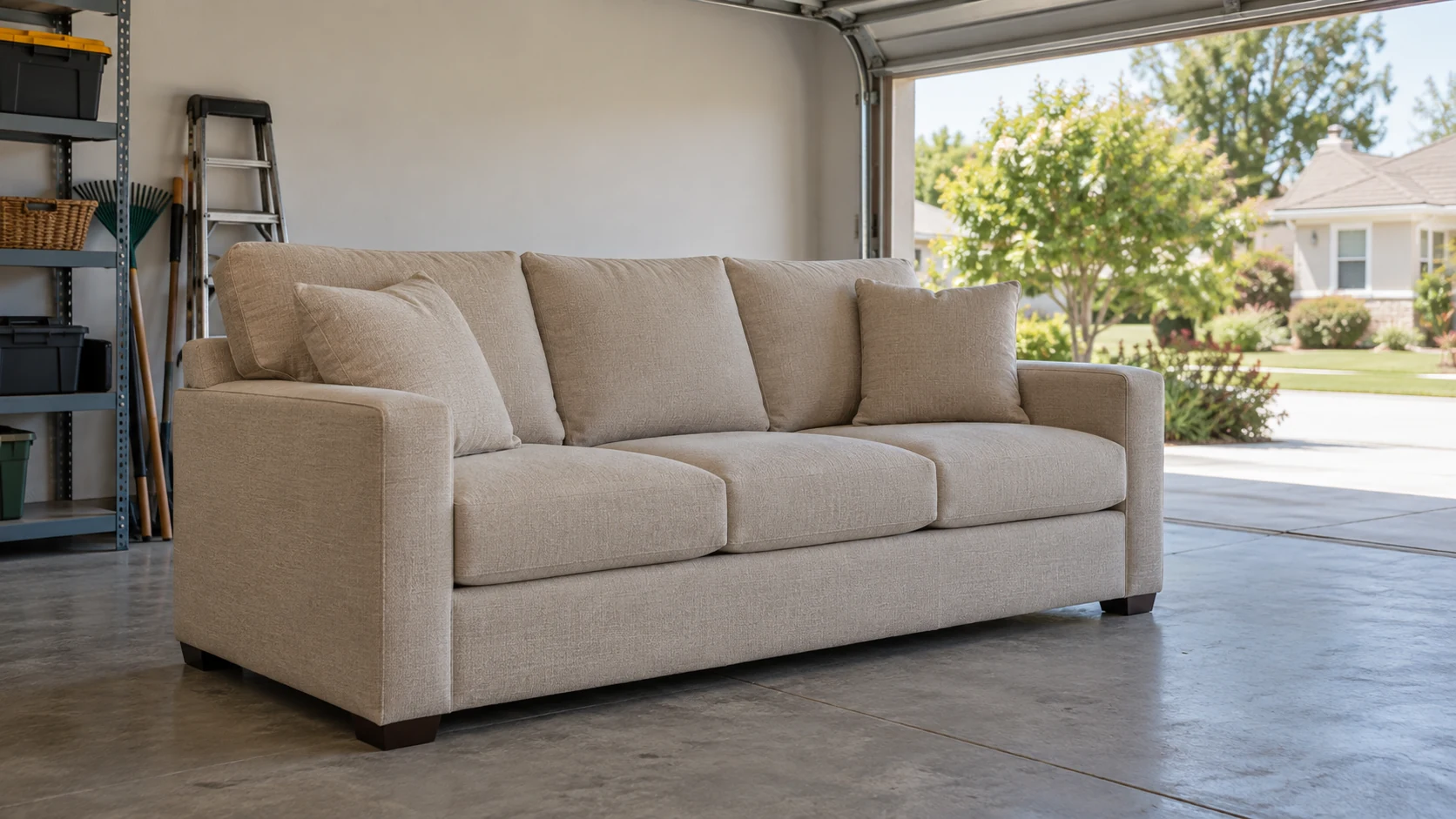
California’s composite-wood guide suggests leaving a new item in a garage or another well-ventilated space for a few days before bringing it inside. Pick a dry space, protect the piece from weather and open its doors and drawers.
The CPSC’s 2016 guidance recommends avoiding high indoor temperatures and keeping humidity at 40–50%. In practice that means running the air conditioner on hot days and a dehumidifier when it is humid. Do not heat an occupied room to “bake out” furniture; heat raises release into the air you breathe.
Skip fragrance sprays on a new sofa. They mask the smell while adding another source, and household mixtures can damage upholstery or finishes.
Do air purifiers help with furniture off gassing?
Only the right kind. HEPA filters and CADR ratings deal with particles. The EPA’s home air-cleaner guide says gases need a filter with a substantial amount of activated carbon or another sorbent, and that there is no widely used gas-removal rating like particle CADR.
For a bedroom with a new dresser, buy on stated gas filtration, not on CADR alone, and keep ventilating.
How Can You Tell if Furniture Is Low-Emitting Before You Buy?
Product-specific tests and relevant labels help you assess furniture off gassing before buying. Then check exactly what each label covers.
For furniture with composite wood, look for TSCA Title VI compliance information. It covers formaldehyde from the panels, not every VOC from a finished sofa or cabinet.
UL GREENGUARD certification is an emissions certification. Look up the exact model or line in the certification listing; a logo on a brand’s homepage does not mean every item is covered. The certifier also warns that a product containing low VOCs will not necessarily emit low levels of VOCs.
| Seller’s statement | Follow-up question |
|---|---|
| “Compliant composite wood” | Which panels and which requirement does the label cover? |
| “Certified low emissions” | Does the listing include this exact furniture model or line? |
| “Low-VOC finish” | Is this a content claim or a finished-product emissions result? |
| “Sealed board” | Are both faces and the edges covered, and what was tested? |
Turn the piece around before you buy. Raw pressed-wood panels generally emit more formaldehyde than laminated or coated ones, so a dresser with a bare particleboard back and unsealed drawer bottoms is worth questioning. MDF edge banding is part of that picture, though any reduction still needs evidence for the actual piece.
Where Does a Silicone-Faced Furniture Film Fit?
A decorative film is one layer of a cabinet, so judge what it is made of separately from what the finished cabinet emits.
Puremorfilm makes furniture decorative film with a silicone functional face on a thermoplastic carrier, currently produced on PET. The silicone surface is inherently flame-retardant, with higher grades up to UL 94 V-0 available on request. In the manufacturer’s laboratory tests, coffee, red wine and soy sauce left for 24 hours at 25°C wiped off with no obvious change. The film is formaldehyde-free and uses a No DOP formulation, which describes what is left out, not a zero-VOC or odor-free result. We supply mainly rolls, plus panels made by PUR flat lamination. It gives cabinets a paint-free silicone face, unlike PVC, melamine, PP or PETG faces; the emissions of the finished cabinet still depend on its core and adhesive.

What Should You Do About a Smelly New Piece of Furniture?
To deal with furniture off gassing, cut your exposure first, then get facts about that specific piece before deciding to keep, move or return it.
| What you notice | Useful next action |
|---|---|
| Odor immediately after unpacking | Remove packaging and ventilate a suitable dry space |
| A strong smell in a small closed room | Improve outdoor-air exchange and avoid unnecessary time in the room |
| Irritation or other persistent symptoms | Leave the affected room and seek appropriate health advice |
| Unclear “low emissions” marketing | Request a listing or test that matches the actual product |
| Musty odor, damp packaging or visible damage | Contact the seller about condition before assuming routine off-gassing |
| Buying another item | Compare complete-product evidence, panel labels and return terms |
If you make furniture and are choosing a decorative face, contact us with the core board, edge construction, adhesive and the finish you want.
Frequently Asked Questions
How long does it take for new furniture to off gas?
Furniture off gassing has no universal duration. It depends on the materials, how old the piece is, and the room’s temperature, humidity and airflow.
How to tell if furniture is toxic?
Labels and model-specific emissions tests provide evidence about the tested chemicals; odor gives no reliable toxicity assessment. Make sure any certification lists the model you are buying.
Why does my new sofa smell like chemicals?
Its foam, fabric, adhesives, frame and finishes release VOCs, and sealed packaging concentrates them until you open it.
What does off-gassing smell like in a house?
It usually smells sharp, solvent-like or like fresh paint. The smell cannot tell you which chemical it is or how harmful it is.
Do air purifiers help with furniture off-gassing?
Yes, if they have a proper gas filter such as a substantial carbon bed. Particle-only filters do not remove gases. Continue source control and ventilation.