
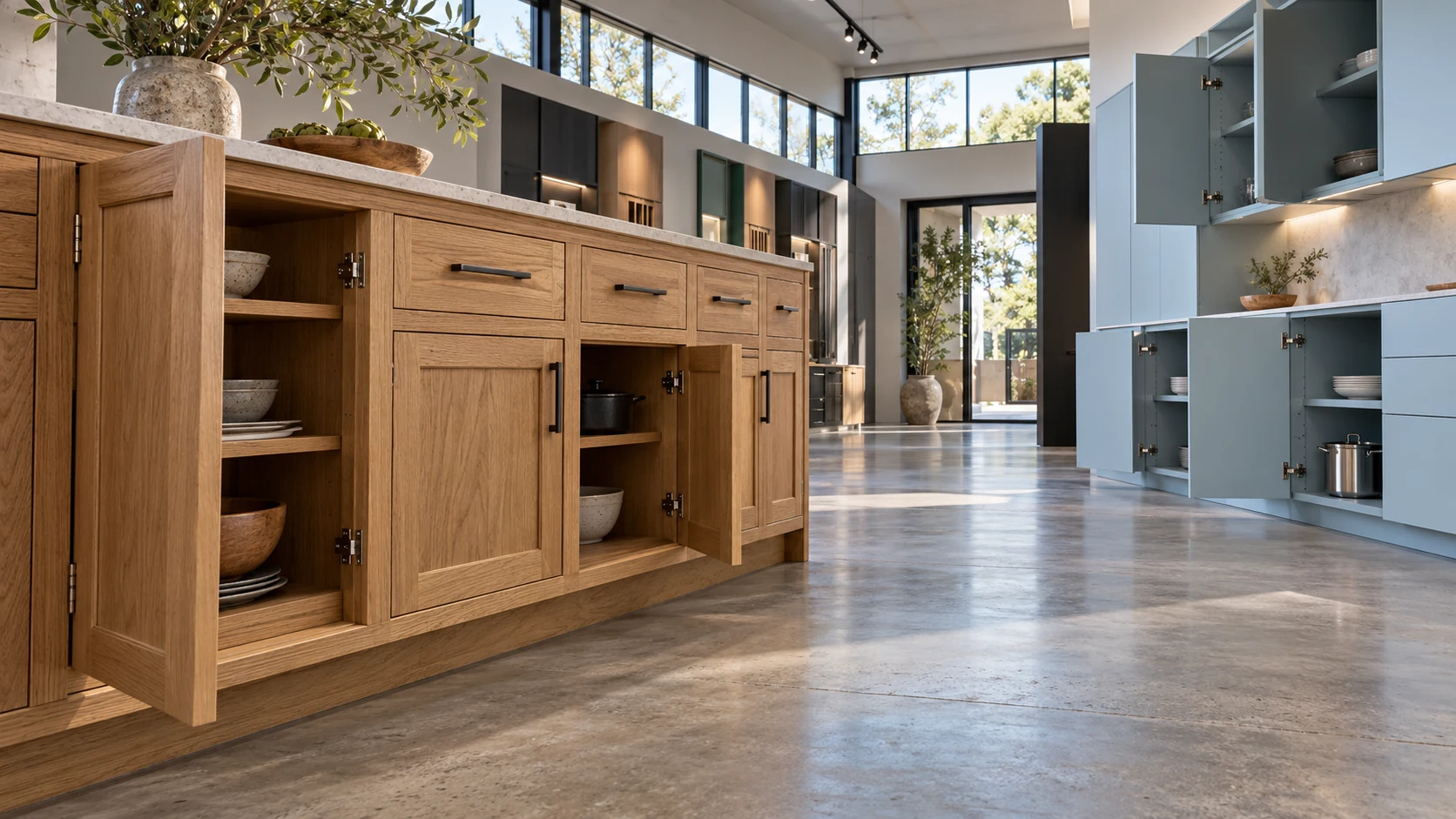
Frameless vs framed cabinets is a choice about the front of the cabinet box. A framed cabinet has rails and stiles forming a face frame; a frameless cabinet mounts the doors and hardware from the box sides without that front frame. Frameless can provide a less obstructed opening, while framed offers a visible framework and familiar inset or overlay arrangements. Compare the actual drawer interior, construction evidence and installed quotation before choosing. A similar closed-door appearance can conceal quite different usable openings.
What is the difference between framed and frameless cabinets?
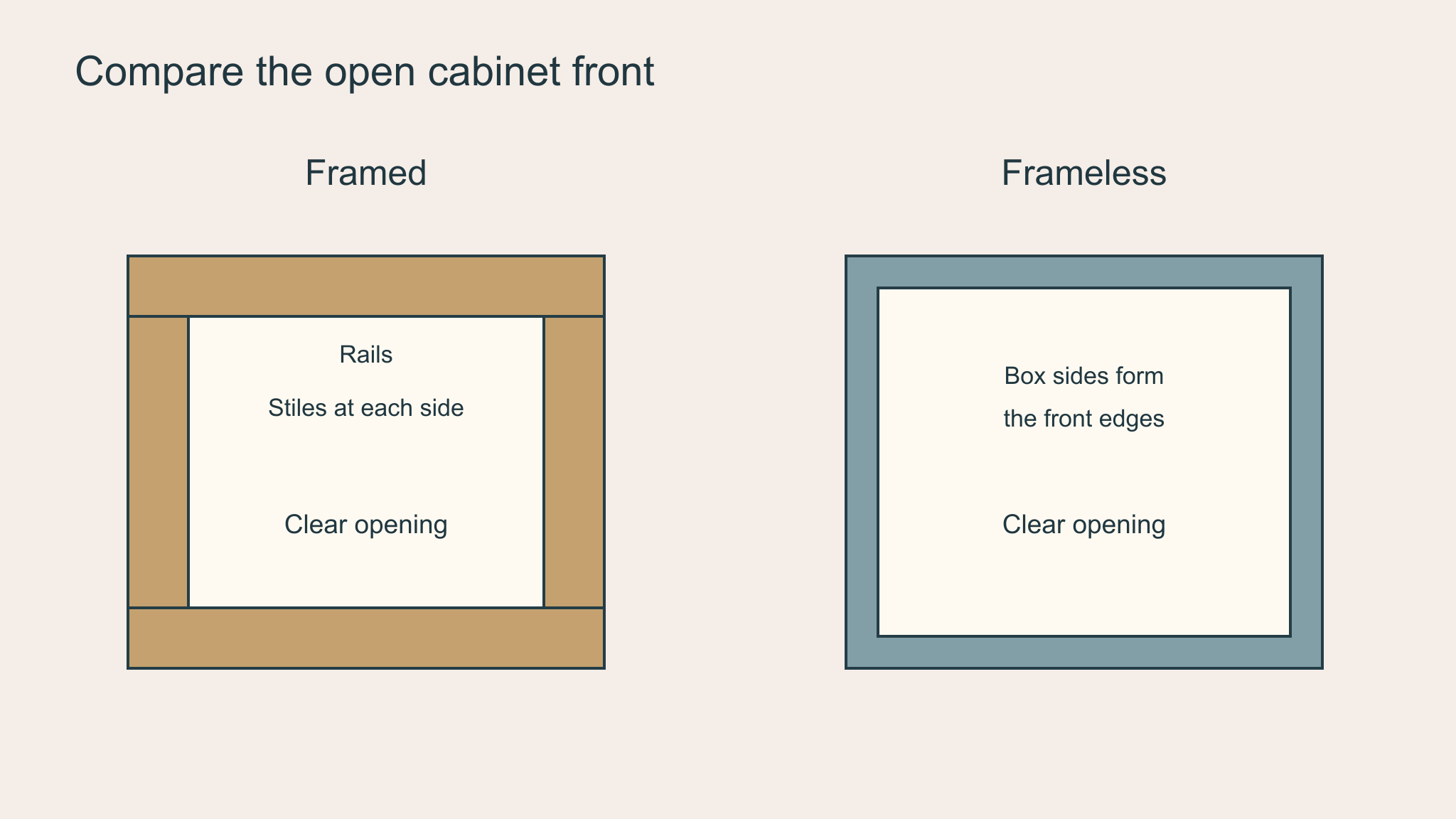
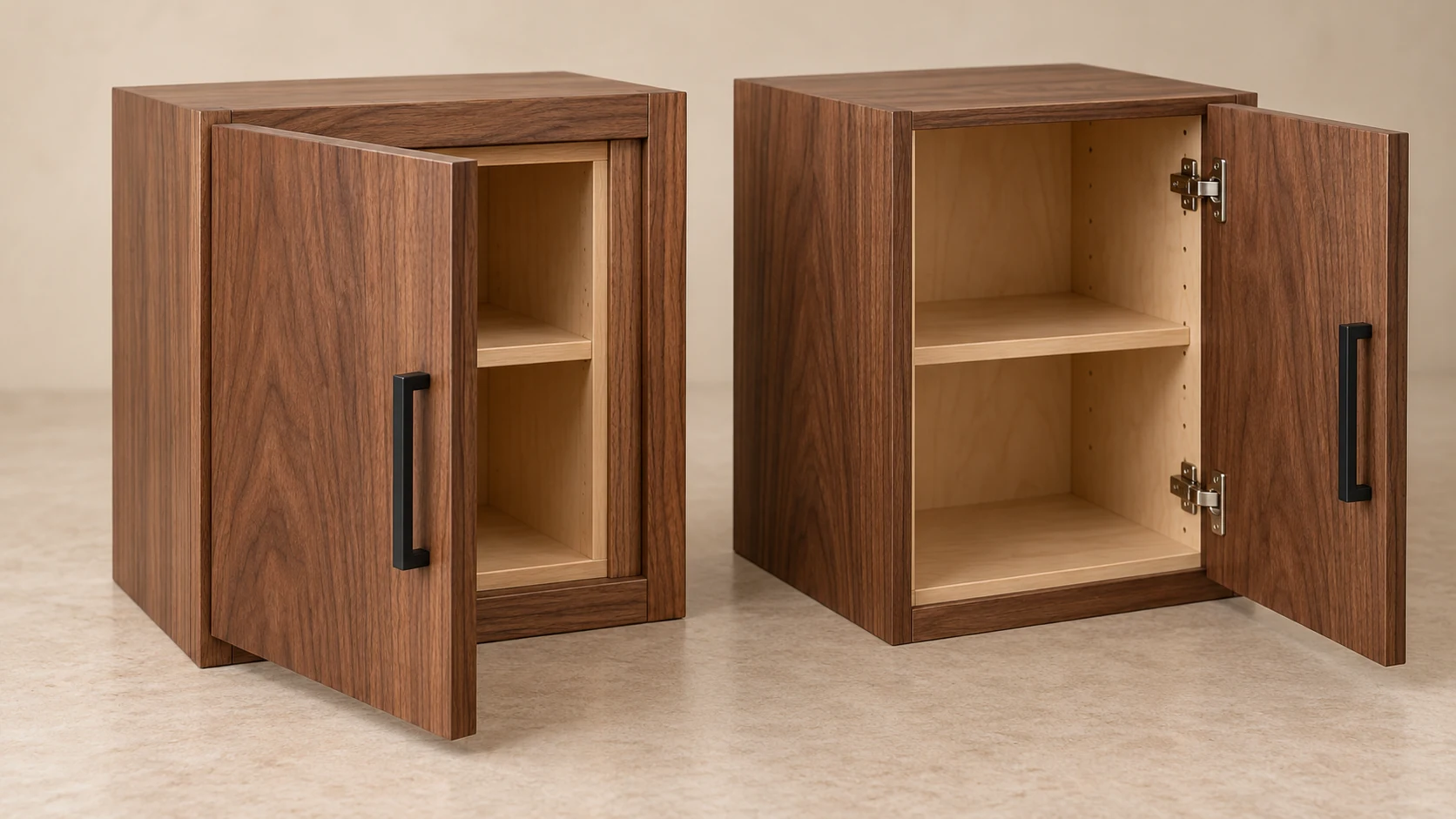
Framed cabinets add a face frame to the front of the box, while frameless cabinets use the box components themselves as the front structure and fixing points. The rails run horizontally and the stiles vertically around the framed opening.
| Detail | Framed | Frameless |
|---|---|---|
| Front construction | Rails and stiles form a face frame | Box sides form the front edges |
| Door-hardware fixing | At the face frame or a suitable frame mounting arrangement | Usually on the inside of the box side |
| Access | Frame components can narrow the opening | Opening generally has less front obstruction |
| Common door appearance | Partial overlay, full overlay or inset | Usually full overlay, with other constructions possible |
The AWI 0641-2019 material requirements, sections 3.2.1.1–2, describe the fixing role of the face frame and, for frameless work, the typically edge-banded case components. A face-frame member is often described in US cabinet comparisons as about 1.5 inches wide, but the actual cabinet range sets its dimensions.
Door position and box construction are separate choices. A full-overlay door can cover most of a face frame, so a sleek front view does not establish that a cabinet is frameless. Open a sample door to see the construction.
If you are retaining an existing box, the face frame is part of that starting structure. Our refacing versus replacement comparison explains why replacing fronts and changing the cabinet architecture are different scopes of work.
How do framed and frameless cabinets look different?
Framed cabinets can show a deliberate border around the doors, while frameless full-overlay cabinets usually present a more continuous field of fronts. Full overlay on a framed cabinet can make the difference much less obvious when the doors are closed.
The door profile still determines much of the room’s character. Both constructions can use simple slab fronts or Shaker-style doors. A frame does not require an ornate finish, and a frameless box does not force a high-gloss modern kitchen.
For specified architectural work, AWI 0641-2019 section 3.4.2.1(a) explicitly allows flush-overlay construction with either cabinet architecture. The drawing and open sample show the construction behind a “European look.”
Look at the full elevation, including exposed ends, tall cabinets and appliance fronts. A framed partial-overlay run makes the frame pattern part of the design. A full-overlay run makes the alignment and proportions of the doors more prominent.
Then choose the visible material. Our cabinet-finish comparison explains paint, stain and decorative-facing routes. A wood appearance can be made through different constructions; that decision need not dictate whether the box has a face frame.
How much more storage do frameless cabinets give?
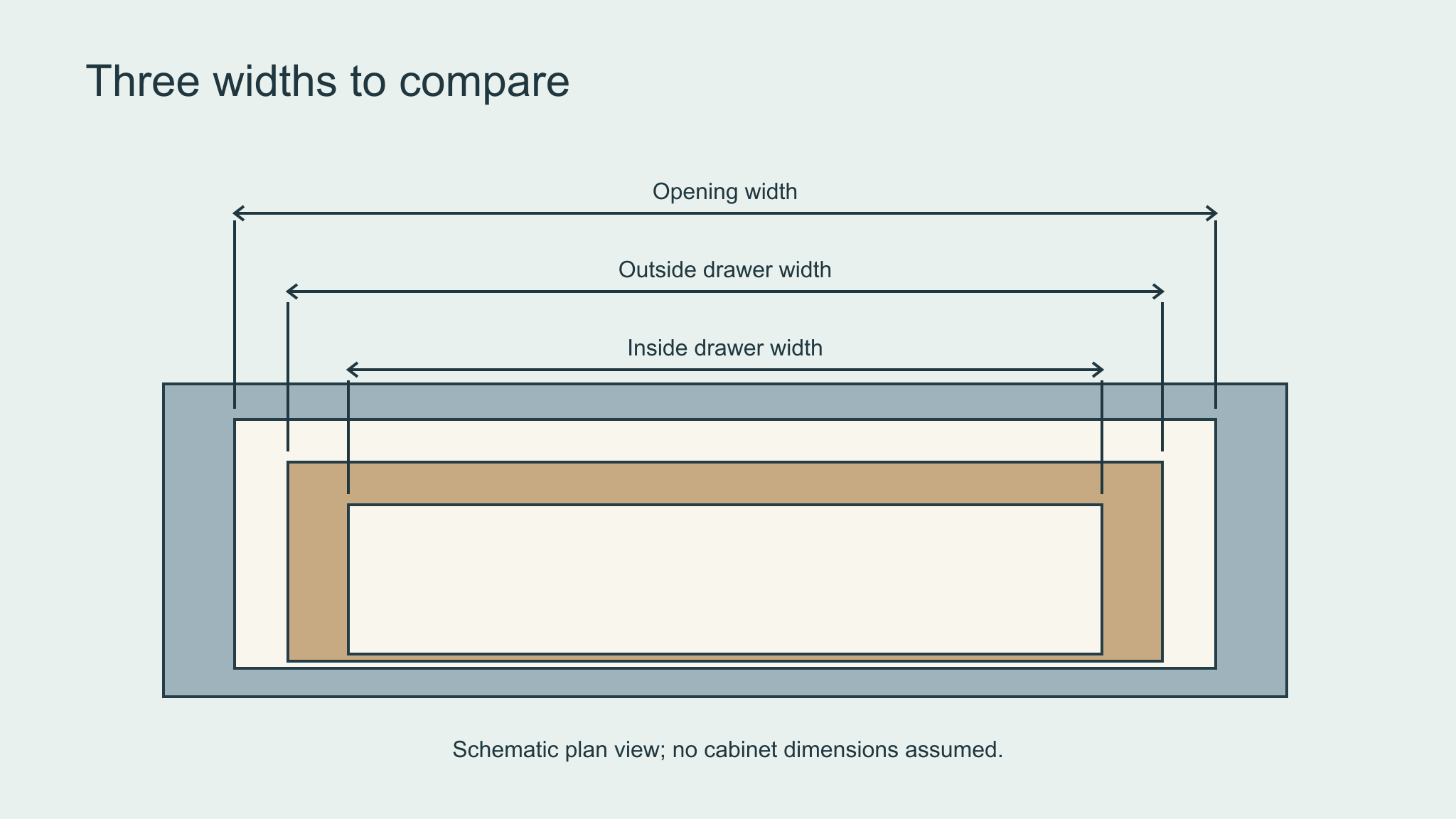
Frameless construction often gives a wider clear opening, but the useful gain is the space inside the actual drawer or pull-out, not a fixed percentage for every kitchen. A framed opening can be narrowed by its stiles, while a center stile can further affect access where one is present.
Consider one specific drawer system: the 2025 Blum TANDEM plus BLUMOTION 563 catalog gives inside drawer width = opening width − 42 mm. Its outside drawer-width deduction changes with drawer-side thickness: 10 mm for 16 mm sides, or 18 mm for 12 mm sides. Page 13 of the US planning catalog also shows blocking for face-frame applications.
Those are planning rules for that drawer system, not deductions for every drawer on the market. They show why an opening measurement, an outside drawer width and an inside drawer width answer different questions.
For your kitchen, compare the quoted inside drawer dimensions with the pan, tray or storage container you intend to use. A wider opening has little value if the selected drawer construction consumes the gain. Conversely, a small increase can be valuable when it allows a frequently used tray to lie flat.
Check door cabinets separately. The opening route past a center stile or hinge can matter more than the empty box volume. Ask to see the proposed accessory installed in that cabinet configuration before accepting a general storage advantage.
Are framed cabinets stronger than frameless?
No, a face frame alone does not establish that a cabinet is stronger; the complete box, joints, materials and hardware determine how it performs. Well-designed cabinets of either construction can be suitable for a kitchen.
ANSI/KCMA A161.1-2022 states that its performance standard does not prescribe a particular design or material. KCMA’s certification FAQ also confirms that both framed and frameless cabinets can qualify. Ask whether the particular cabinet line has the relevant complete-cabinet evidence.
The base front-joint test in section 5.3, which checks the joints stressed when cabinets are fastened together, shows why labels can mislead. It uses 250 lb for cabinets with a drawer rail and 200 lb for cabinets without one, applied over 4 minutes, with the exposed joint remaining closed. The grouping is based on the drawer rail, not a ranking of framed against frameless cabinets. See the 2022 standard, printed page 3.
These laboratory test loads are not everyday shelf or drawer load ratings. For a heavy-use kitchen, request the line’s certification or equivalent full-cabinet test information, then check the load limits for the particular drawer and shelf.
Core selection contributes to the construction too. The MDF versus plywood comparison explains material differences and helps connect core choice with the cabinet construction.
Which door styles and hinges work with each?
Framed cabinets readily support partial overlay, full overlay and inset arrangements, while frameless ranges most often use full-overlay doors with concealed hinges fixed to the cabinet side. The range’s offered combinations matter more than the shorthand label.
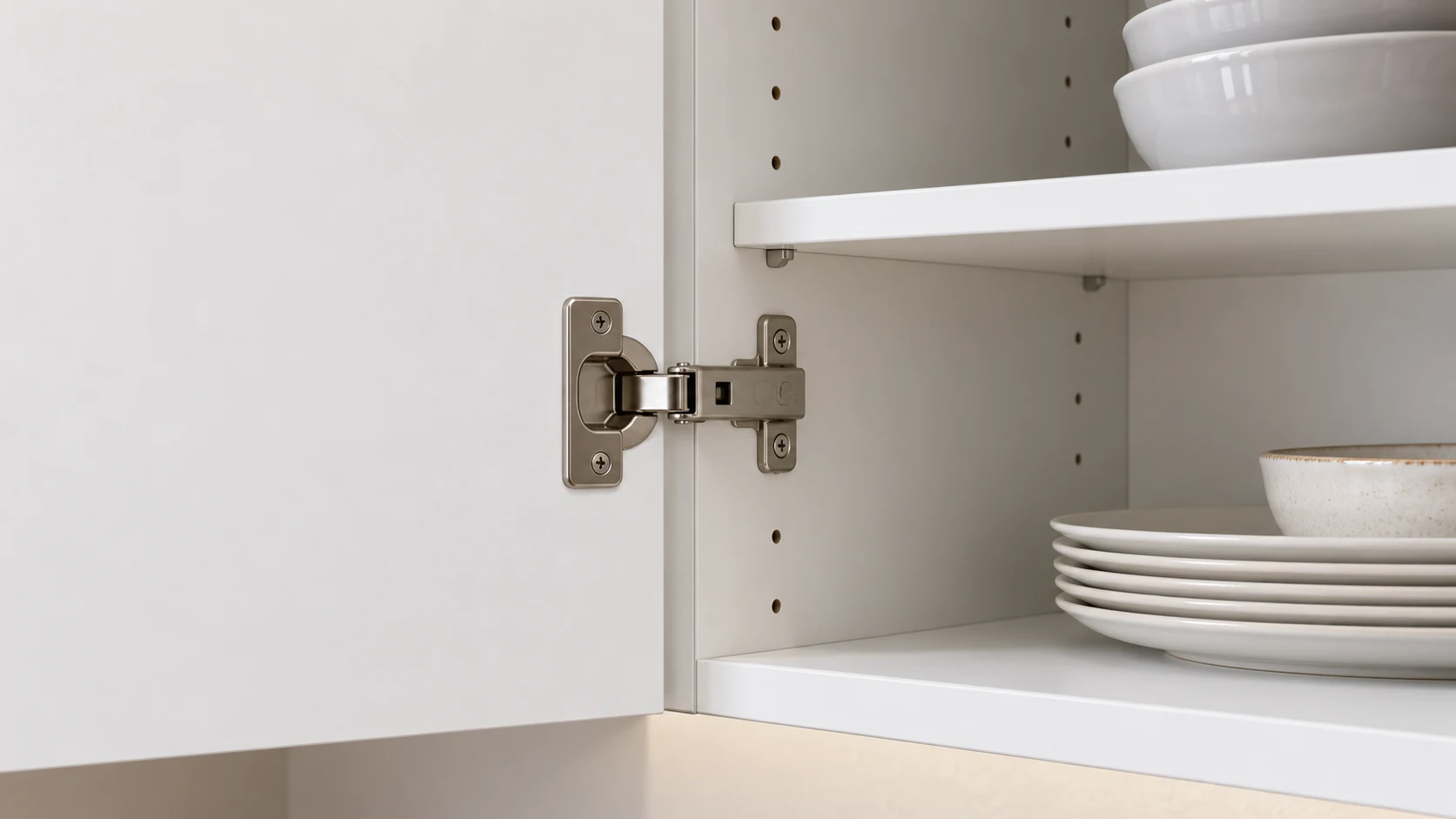
On a framed cabinet, a hinge can be visible or concealed and may mount directly to the frame or use a frame-specific mounting arrangement. On a frameless cabinet, the inside box side provides the usual mounting surface for a concealed cup hinge. The plate and hinge geometry place the door where it belongs.
Frameless inset is possible, although many ready-made frameless ranges concentrate on full overlay. Inset in that construction leaves the box’s front edges visible around the opening, which makes their finish part of the design. Ask for the offered sample rather than assuming an inset door automatically implies a face frame.
At the end of a run, look at the opened door as well as the closed front. A hardware arrangement that looks discreet when shut still needs to clear the adjacent wall, appliance or end panel comfortably.
Which is easier to install?
Framed cabinets generally give the installer more front-frame material to align and join, while frameless cabinets place greater visual emphasis on precise box alignment. Both need a level, square, securely fixed installation.
A face frame provides a front reference and can make modest fitting allowances easier to manage. That helps explain why framed construction is often described as more forgiving in an uneven room. It still needs sound support and appropriate fixing; the frame does not straighten a distorted cabinet box.
With frameless full-overlay fronts, the cabinet’s position directly affects the alignment of the door field. A small box-position problem can become visible as an uneven line across a long bank of drawers. Final hinge adjustment works best after the run is properly installed.
Discuss fillers and finished ends before ordering. A door beside a wall needs room to open, while an exposed box end may need a coordinated finish. The required fitting follows the actual wall, corner and hardware arrangement. A plan that omits those pieces can understate both the work and the finished cost.
When comparing quotations, the useful detail is the installation scope offered with each one: how the run joins, where the visible ends occur and who completes final adjustment. That is more informative than treating one construction as automatically suitable for every irregular room.
Do frameless cabinets cost more?
They often cost somewhat more in comparable retail ranges, but the quoted total also reflects the door, finish, drawer system and box material. Price the same layout and level of equipment to see the difference relevant to your kitchen.
An October 2026 published comparison from Captivating Cabinets lists three 30-inch B30 base-cabinet examples from the same brand: Allure Galaxy framed at US$555.75, Illume Catalina Bianco Gloss frameless at US$650.00, and Ovela Catalina Bianco Gloss frameless at US$695.50. The retailer’s comparison was updated October 21, 2026.
Those configurations differ in their doors, finishes, box materials or drawers, so the prices cannot isolate a pure frame-construction premium. They are a useful illustration of why a cabinet label and a single percentage are insufficient for a budget.
Ask for installed quotations that identify the offered range, face finish, drawer equipment, exposed ends, fillers and fitting. A lower cabinet-unit total can become a higher installed total if visible-end panels and adjustment work appear later as additions.
When an existing framed kitchen already works well, changing the face material may be the more relevant comparison than replacing every box. For a new kitchen, decide whether the actual storage access and the preferred door appearance justify the complete quotation.
Where can a silicone-faced film fit on either cabinet type?
Puremorfilm makes decorative film with a silicone functional surface for flat cabinet faces and other flat panels. That face choice can be considered with either framed or frameless construction, while the cabinet maker designs the box and hardware.
We use a No DOP formulation. The silicone surface is inherently flame-retardant; higher flame-retardant grades are available on request, up to UL 94 V-0. In the manufacturer’s laboratory tests, coffee, red wine and soy sauce held at 25°C for 24 hours wiped off with no obvious change.
More than 100 patterns are available, with texture and gloss customizable. Our furniture decorative film options help compare the visible door and end-panel scheme. Rolls for PUR flat lamination are our main supply form, and faced panels can be supplied on request. The cabinet maker provides the evidence for the complete box construction.

Framed or frameless: which should you choose?
Choose framed when its visible framework or inset options suit the room, and choose frameless when the actual opening and door-led appearance work better for your layout. Either choice should come with construction evidence and an installed scope you can compare.
| Your priority | Useful starting point | What settles the decision |
|---|---|---|
| A visible frame or familiar inset offering | Framed range | The actual door arrangement and sample |
| Broad drawer access and a continuous front | Frameless range | Measured usable drawer interior |
| An irregular existing room | Either, with a developed installation detail | Fillers, fixing, alignment and fitting scope |
| Heavy everyday use | A tested cabinet line of either type | Complete-cabinet evidence and component load limits |
We can help coordinate the flat decorative faces once you have selected the cabinet construction. Our new paint-free material uses a silicone functional face, distinct from PVC, melamine, PP and PETG decorative faces.
Send the box construction, the flat door faces and exposed ends to be covered, and the patterns you prefer; contact us to discuss the facing options.
Frequently Asked Questions
What’s the purpose of framed cabinets?
A framed cabinet uses its front rails and stiles as a framework for door and hardware fixing and as a visible border where the door arrangement exposes it. The frame supports several door-position choices.
Can full overlay doors go on framed cabinets?
Yes, full-overlay doors can cover most of a face frame. The closed appearance can therefore resemble frameless cabinetry, even though the frame remains behind the doors.
Can you get inset doors on frameless cabinets?
Yes, a frameless cabinet can be designed with inset doors, although many stock ranges offer full overlay instead. In the inset arrangement, the front edges of the box remain visible around the opening.
Do framed and frameless cabinets use different hinges?
Yes, their mounting arrangements commonly differ. A similar concealed cup-hinge style can serve both, but a frame mounting plate and a box-side plate position and fix it differently.
Can I mix framed and frameless in the same kitchen?
Yes, provided the elevations coordinate their door positions, visible frames, heights, depths and finish. Resolve the meeting points and countertop alignment in the drawings before ordering the two ranges.