
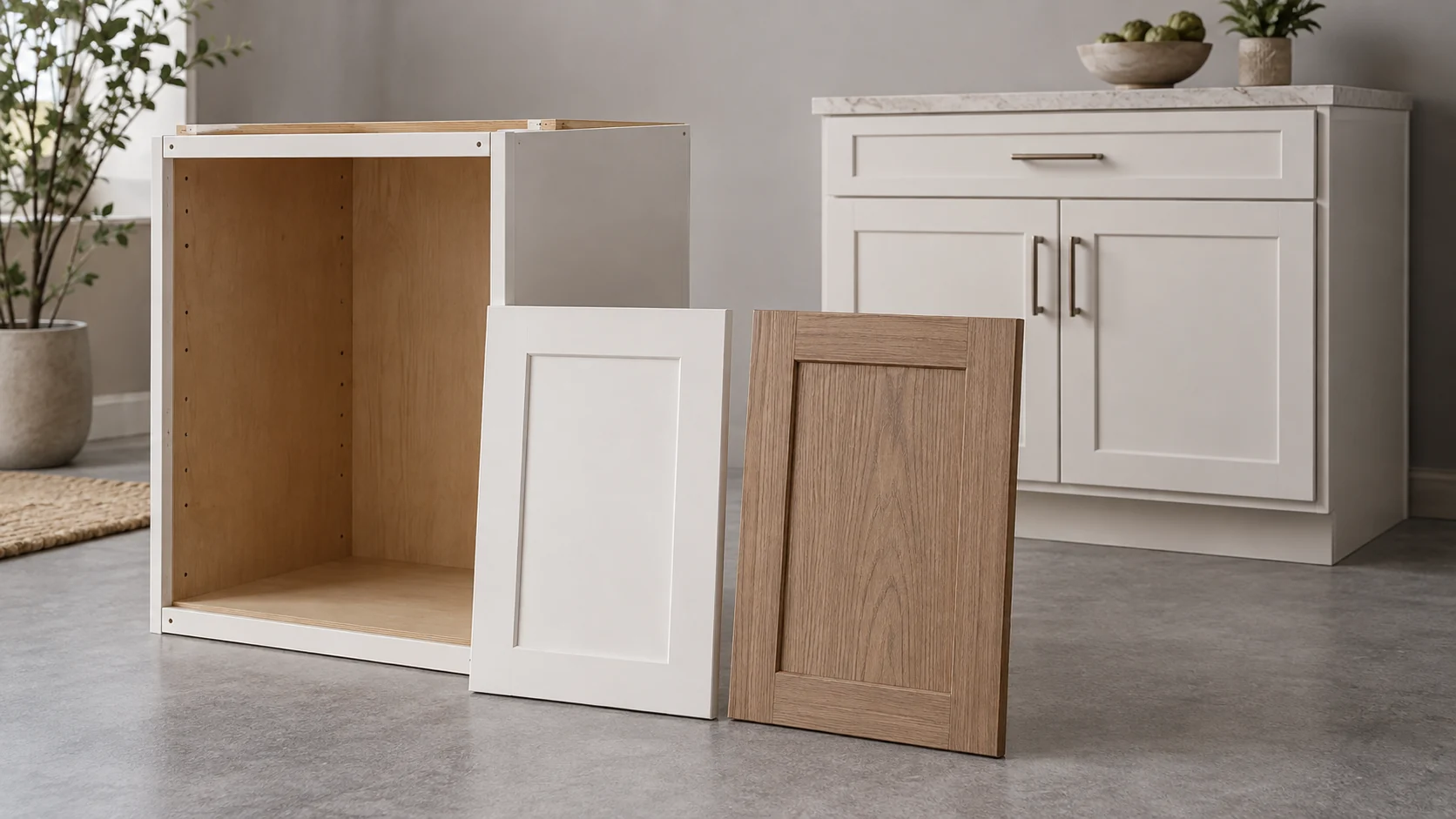
For cabinet refacing vs replacement, refacing usually costs less: Fixr’s January 26, 2026 U.S. guide puts refacing at $3,000–$13,500, with an $8,250 average, and full replacement at $4,000–$15,000 or more. These are public budgeting figures, not a quote for your kitchen. The ranges overlap, so what each price includes matters as much as the advertised saving.
What changes when you reface rather than replace cabinets?
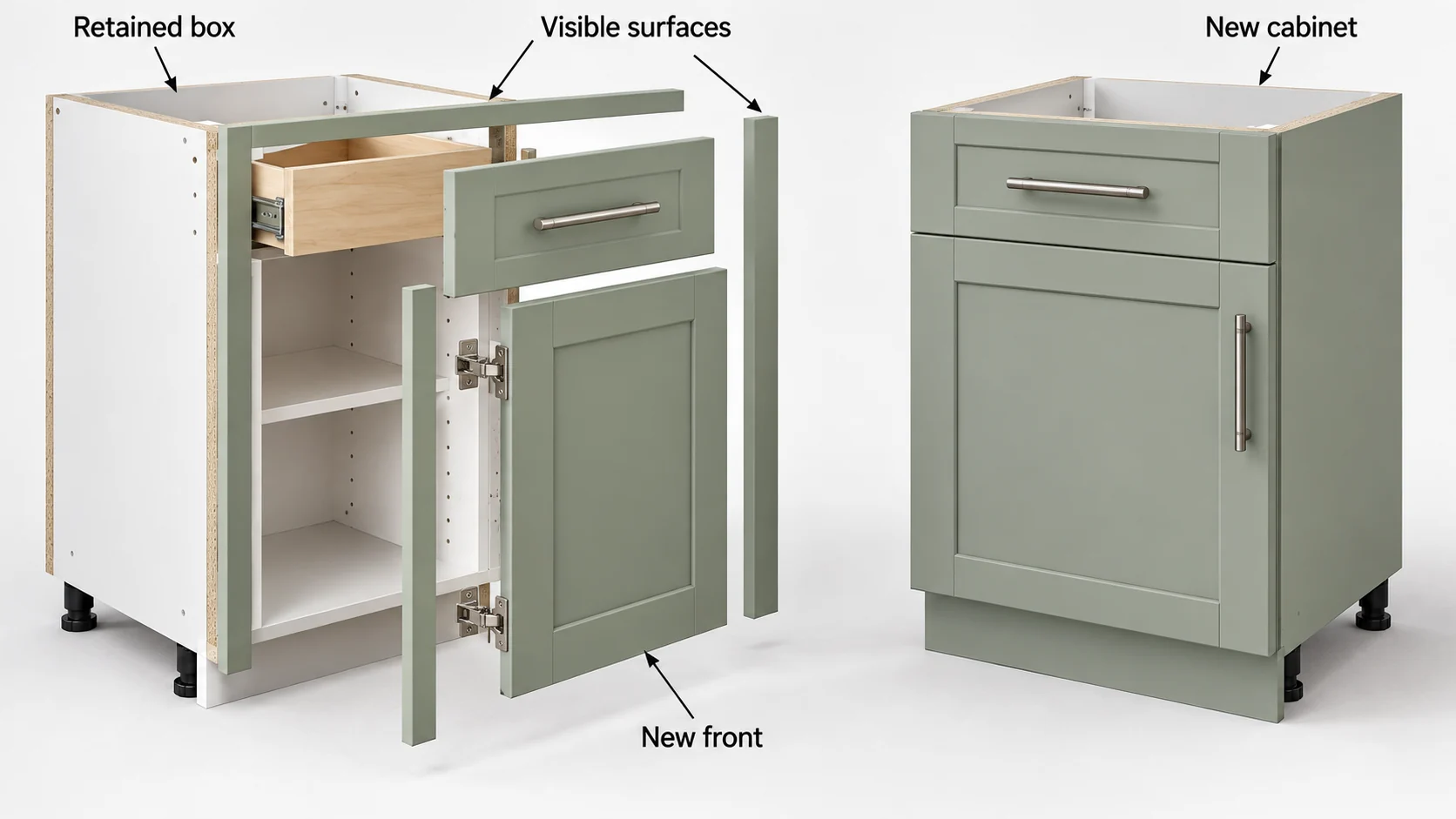
Refacing keeps your cabinet boxes and gives them new visible fronts; replacement puts in new boxes as well as new doors and drawers. A refacing job usually means new doors, new drawer fronts and a veneer or laminate covering on exposed box surfaces, sometimes with new hardware.
| What you are changing | Cabinet refacing | Cabinet replacement |
|---|---|---|
| Cabinet boxes | Existing boxes stay | New boxes are installed |
| Doors and drawer fronts | Replaced | Replaced with the new system |
| Exposed ends and face frames | Covered or finished to match | Supplied or finished with new cabinets |
| Kitchen footprint | Existing positions stay | Positions and cabinet sizes can change |
| Interiors | Existing interiors remain unless extra work is included | New interiors and storage configuration |
| Work around the cabinets | Counters and connections can often stay | Removal can affect counters, backsplash and connections |
That is why new fronts can transform how a kitchen looks while the storage stays exactly where it was, as the same publisher’s refacing and replacement comparison explains.
Refinishing is the third option: you keep the doors and change their paint, stain or clear coat. It suits a door shape you still like. Refacing makes more sense when you want a new profile as well as a new color. If a contractor offers “resurfacing,” ask whether that means paint, new fronts or covering the boxes.
The face and the box are separate parts. Our kitchen cabinet materials guide helps you tell them apart before you compare options. In a refacing job, the new door still hangs on the old box.
Keeping the boxes also means less cabinet material in the dumpster. If you replace, salvage usable doors and hardware; EPA’s reuse guidance supports recovering building components for reuse.
What do they cost, and is 30–50% savings realistic?
Sometimes. Refacing can save 30–50% according to Bob Vila’s U.S. cost guide, updated May 1, 2024, but current published ranges for refacing and replacement overlap a lot. Use the percentage for planning and work out your real saving from comparable local quotes.
| Option | Published U.S. budgeting range | Source and update date |
|---|---|---|
| Refacing with new fronts and box facing | $4,000–$13,500 | Angi, August 31, 2026 |
| Full cabinet replacement | $4,000–$15,000 or more | Fixr, January 26, 2026 |
| Refinishing a standard kitchen | $2,000–$4,500 | Fixr, January 26, 2026 |
For a 10×10-foot kitchen, Fixr’s small-kitchen benchmark is $4,400–$6,875 for refacing. It covers rooms under 150 square feet with 16–25 linear feet of cabinets, so count your doors and exposed ends rather than relying on room size alone.
Premium fronts, damaged hinge areas and a lot of work on exposed ends push a refacing total up. At the other end, stock replacement cabinets can bring the two prices close. Moving a sink or replacing counters adds work beyond the cabinets.
Ask for both estimates with the same finish, hardware, installation and repairs. Then add removal, disposal and surrounding work wherever an option needs them. A door-only price and a finished replacement project buy different results.
To work out the saving, divide the difference between the replacement and refacing totals by the replacement total, then multiply by 100. Read the wording carefully: a price that is 30–50% *of* replacement implies a bigger saving than one that is 30–50% *less*. A percentage means something only when you know what it is compared with and what work is included.
How can you tell whether the existing boxes are worth keeping?
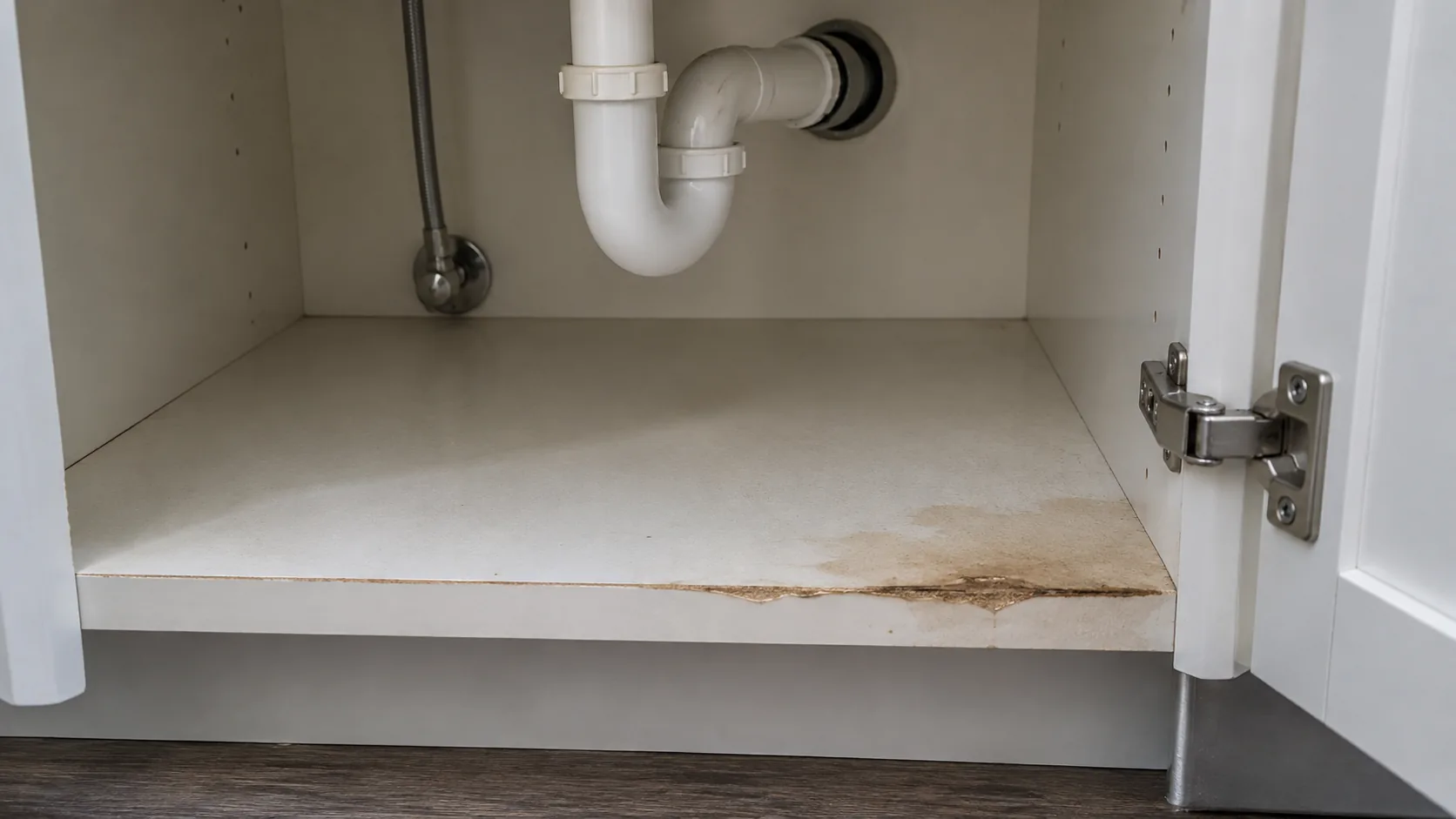
Keep boxes that are dry, solid and still usable. Lean toward replacement when widespread swelling, failed joints or awkward cabinet sizes would drag expensive repairs into a refacing job. Eagle Woodworking’s August 19, 2026 inspection guide lists those structural and fixing checks to make before you pick new fronts.
Walk the kitchen before you choose a finish:
- Open the sink cabinet and look at its bottom, edges and plumbing openings for swelling, softness or signs of an active leak.
- Open every door and drawer. Note sagging doors, loose hinge fixings, sticking drawers and separated joints.
- Look at the exposed ends, face frames and cabinet interiors. Decide which faults are surface wear and which affect the box or its attachments.
- Sketch the changes you want, including appliance positions and storage.
A loose handle or a worn drawer runner is a small repair. Several damaged boxes, loose wall fixings or widespread distortion are a much bigger problem for keeping the cabinets. Have a professional look at any unit that feels insecure, and don’t load it up to test it.
A wood-based core can swell while its face still looks fine, as our MDF moisture guide explains. A peeling thermofoil front may need repair or replacement while the box behind it is perfectly usable. Assess the damaged front and the box behind it when you find one lifting edge.
How long will the kitchen be disrupted?
Professional refacing usually takes 2–5 days on site. Installing new cabinets in a small kitchen can also take 2–5 days, but replacement adds tear-out and any surrounding work. HomeGuide’s April 6, 2023 refacing guide gives the refacing window, and its April 5, 2023 installation guide gives the small-kitchen installation window.
Ordering time comes on top. HomeGuide allows a month or more for custom cabinets, and 10–14 days to install a larger kitchen. Add ordering, removal and surrounding work to estimate the whole project.
With refacing, keeping the counters and cabinet positions usually means less disruption. Doors still come off, surfaces get prepared and hardware is adjusted, so ask which cupboards and appliances you can use at each stage. Set up a temporary prep area away from the work.
For replacement, pin down when the old cabinets leave, when the new ones arrive and when the sink and counters work again. A countertop template or plumber’s visit after the cabinets go in can stretch the time without a kitchen. Get those dates before demolition starts.
If you have to keep cooking throughout, ask which functions will work each day. Plan meals and storage around that, not around the installer’s day count.
Which finish changes suit refacing or refinishing?
Refinish to keep a door shape you like; reface for new fronts, a new profile or one coordinated surface across all the visible cabinetry. Only replacement lets you change the cabinet sizes.
For real grain, wood veneer puts a real wood surface over a supporting panel. CPA’s veneer description sets out that construction, and our wood veneer and laminate comparison covers appearance and repair. Printed laminate gives a decorative pattern; its grain is part of the print, not sliced wood.
A formed-film front can give you a shaped profile. Our thermofoil and laminate comparison covers that difference. CPA describes three-dimensional laminates as films formed over a shaped substrate, a different construction from a flat-faced panel.
Hold the door sample against an exposed end, under the lighting you are keeping. New fronts and the surfaces you keep should read as one finish. Our matte and gloss cabinet guide explains how lighting changes that.
Think about cleaning too. Pick a finish that suits how you clean and how you want the kitchen to look. The cabinet cleaning guide helps you tell ordinary grime from a damaged finish or edge.
Where does organosilicon film fit into a cabinet update?
Puremorfilm supplies decorative film with an organosilicon functional surface for flat furniture faces. It gives a fabricator another surface option for new flat fronts or panels within a cabinet update.
The silicone surface is inherently flame-retardant, with higher grades up to UL 94 V-0 available on request for the film. In the manufacturer’s laboratory tests, coffee, red wine and soy sauce left at 25°C for 24 hours were wiped away without noticeable change. We use a No DOP formulation. Worked examples described in the patent application reported no layer separation or bubbling after 500 hours at 85°C and 85% relative humidity.
We primarily supply rolls, with film-faced panels available on request; the furniture route uses PUR flat lamination. This is a fabricator-applied flat facing, not a DIY pressure-sensitive sticker. Your cabinet contractor handles box repairs and the finished installation.
Our new paint-free material uses an organosilicon functional face, distinct from PVC, melamine, PP and PETG decorative faces. See our furniture decorative film for that route. It is intended for furniture faces; floors, cooktop countertops, shower floors and other walked-on areas are excluded.

Which option should you choose for your kitchen?
Reface for a new look the existing kitchen can support; replace for a new layout or boxes that need major rebuilding. Refinishing is the simplest route when you like the door style and just want a new coating.
- Keep the current doors and change their coating: refinishing.
- Change fronts and visible surfaces within the retained kitchen: refacing.
- Change the footprint or rebuild the cabinet structure: replacement.
Decide in that order: check the structure, name the functional change you want, compare complete project prices, then fit the work and waiting time around your household.
If your plan includes new flat furniture fronts, contact us with photos, the finish you want and where the panels will go.
Frequently Asked Questions
What is the downside of cabinet refacing?
You keep the original interiors and storage layout. Awkward openings or tired shelves need extra work if you want them changed.
Is cabinet refacing worth the money?
Yes, when the finished job gives you the look you want for clearly less than comparable replacement, counting exposed box surfaces and installation.
What is the average cost of refacing compared with replacing cabinets?
Refacing averages $8,250 in Fixr’s January 26, 2026 United States guide; its replacement range is $4,000–$15,000 or more.
What does refacing a 10×10 kitchen cost?
About $4,400–$6,875, from Fixr’s January 26, 2026 United States small-kitchen benchmark for 16–25 linear feet of cabinets in a room under 150 square feet.
Is cabinet refacing the same as refinishing?
No. Refacing replaces the visible fronts; refinishing recoats the doors you already have.