
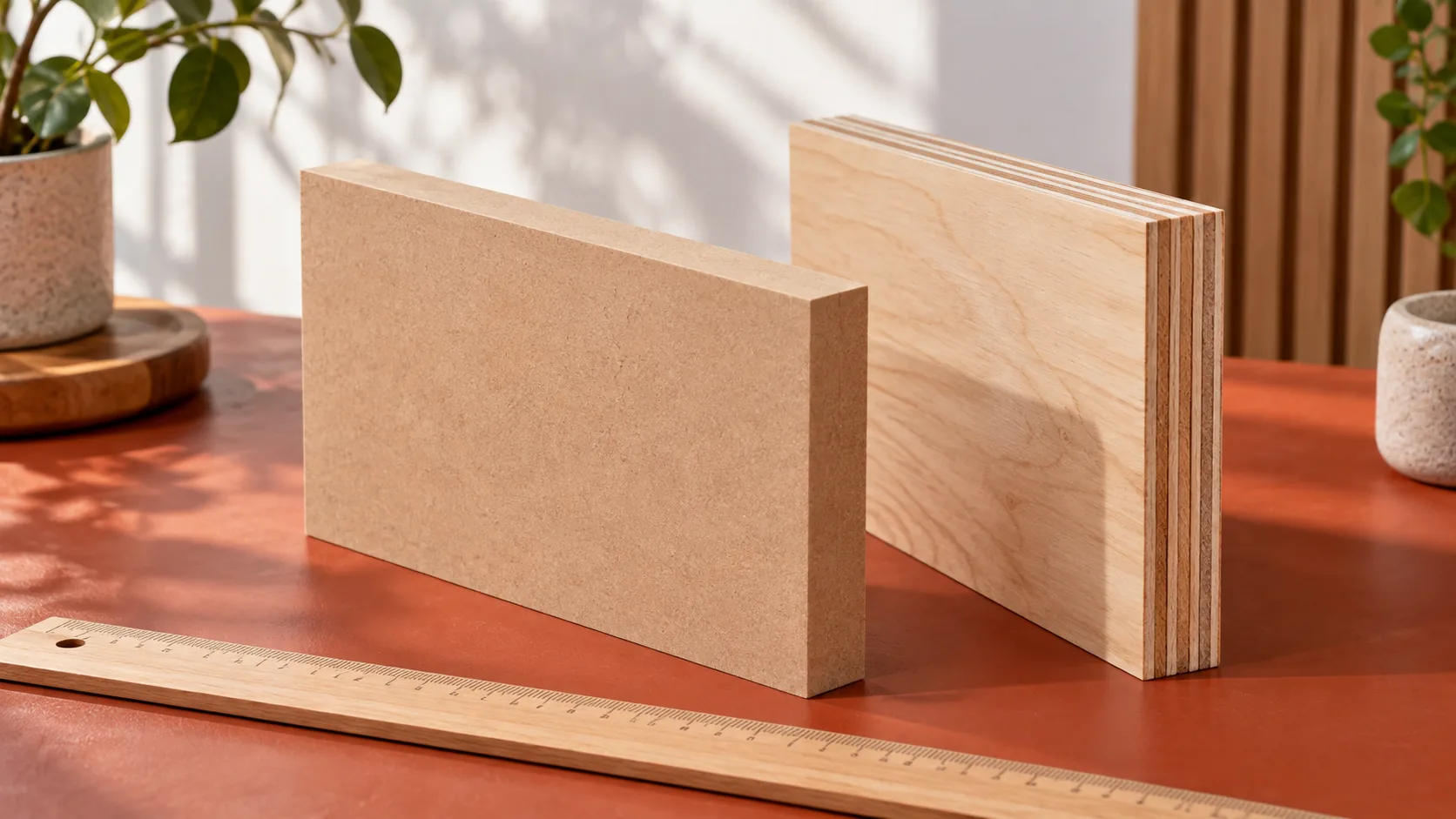
For MDF vs plywood, choose MDF for routed, painted cabinet doors and plywood for visible wood grain or components that need a documented structural grade. MDF provides a uniform fiber face; plywood uses crossed veneers. Shelf performance still depends on grade, thickness, span and support, while either board needs a finish suited to exposure.
Last Updated: 2026-10-24
What is the main difference between MDF and plywood?
Fibers versus veneers. MDF is a panel of bonded wood fibers; plywood is bonded veneer layers with the grain of neighboring layers generally crossed. MDF gives you a uniform surface to shape and paint. Plywood keeps its wood grain and is stronger in one direction than the other.
MDF and plywood are core boards. The final column is a separate surface route for a selected core, so film-surface data cannot rank board strength, moisture grade or screw holding.
| Selection dimension | MDF core | Plywood core | Silicone film (facing only) |
|---|---|---|---|
| Composition and layer | Fine wood fibers bonded into a panel | Bonded veneer layers with a defined layup | Silicone functional face on PET support film; a facing applied to a separate core |
| Visible face | Smooth, without a natural grain pattern | Wood species and face grade determine the grain and appearance | Paint-free color and texture on a flat board; the board face still needs preparation |
| Routed profiles and wrapping | Useful for routed edges and an opaque finish | Face grain and exposed layers may require additional preparation | PUR flat lamination onto flat board faces; shaped fronts need a separately qualified facing process |
| Shelves, loads and hardware | Design the grade, thickness, span and supports; prepare MDF fixings for the chosen fitting | Select the grade, strength direction, thickness and supports; cross-laminated construction is useful for near-edge fastening | The board and its joints carry loads and screws; select their properties separately from the facing |
| Moisture and exposed edges | Choose a documented humid-interior grade where needed and seal vulnerable edges and cutouts | Select the bond classification for the exposure; Exposure 1 is not Exterior | A face film does not waterproof the core, cutouts, joints or fixings |
| Scratch resistance | The exposed paint, veneer or laminate determines surface scratch behavior; MDF alone is a core choice | The exposed coating or facing determines surface scratch behavior; plywood alone is a core choice | Film surface has its own 2H pencil-scratch sample result (below); core strength is assessed separately |
| Heat exposure | Check the selected finish and complete bonded construction for the intended heat exposure | Check the selected finish, adhesive and complete construction for the intended heat exposure | Not for worktops or stovetops; film test results do not establish a finished-panel service temperature |
| Finished-part cost | Include machined-edge preparation, coating and any shelf stiffener | Include face grade, veneer preparation and the exposed-edge finish | Include film, PUR bonding, balancing construction and edge finishing; compare finished parts |
| Useful starting applications | Routed painted doors, smooth panels and moldings | Visible-grain fronts, cabinet boxes and suitably designed shelves | Flat furniture fronts, cabinet doors and wall panels on the chosen core; vertical and low-wear uses |
The wood handbook chapter on panel manufacturing covers both constructions. MDF uses fibers, which are much finer than the chips in particleboard. Crossed veneers even out the grain of any single layer, but a finished plywood sheet still has a strength axis, so note it when you lay out a long shelf or cabinet side.
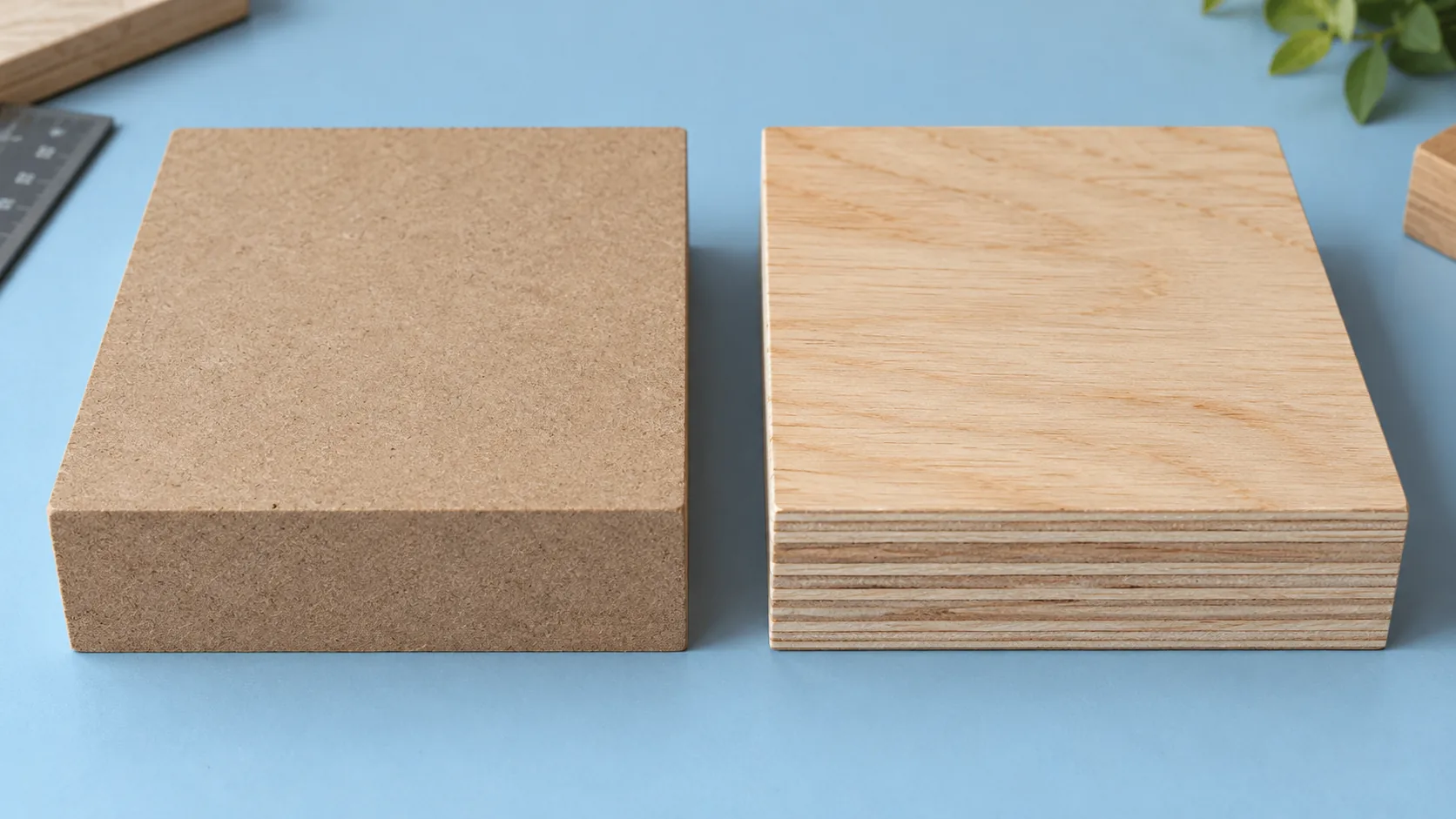
Read the product description when you buy. Furniture plywood with a selected face, structural sheathing and plywood with a composite core are made for different jobs, and a handsome wood face tells you nothing about the core under it. Our MDF definition guide explains the fiberboard option before any finish goes on.
HDF is a fiberboard too, so swapping MDF for a denser panel is a separate decision. The HDF and MDF comparison explains why the grade and the part matter more than the sales label.
Which board is better for paint or visible wood grain?
MDF for a smooth painted front or a routed profile; plywood with the right face species and grade when you want real wood grain under a clear or stained finish.
MDF’s flat, smooth and uniform surface suits decorative surfacing and precise machining, which makes it a consistent base for an opaque finish. Its machined edges soak up coating faster than the face, so edge prep is part of the paint job.
With plywood, judge the face grade against the finish you plan. Knots, patches or strong grain texture are fine inside a utility cabinet and wrong for a smooth painted door. A thin decorative veneer also leaves little to sand, so buy the face quality you need instead of planning to sand defects away.
For high-gloss or thin-build finishes, EPF’s MDF lacquer-finishing guidance recommends a light 150/180-grit face sand. It treats MDF edges as more absorbent, needing a dedicated sealer or a heavier coating build. That schedule is written for MDF lacquer work, not for plywood veneer.
For a painted cabinet door, specify face prep, edge sealing, a compatible primer and the topcoat. For a clear-finished plywood door, specify the species, face grade, color range and coating. The MDF finishing guide goes further into coatings once you’ve picked the core.
Which board should you choose for shelves and hardware?
Plywood for parts that carry load or take screws near an edge. MDF works for shelves when its grade, span and supports give enough stiffness, with fixings kept away from corners.
| Component | Useful starting choice | What controls the finished result |
|---|---|---|
| Routed painted front | Suitable furniture-grade MDF | Recess depth, edge profile, finished mass and hinges |
| Visible-grain cabinet box | Appropriate furniture plywood | Face quality, panel layup, joints and fixing locations |
| Long loaded shelf | Rated plywood or a designed MDF shelf | Thickness, span, strength direction where applicable, support and load |
| Short supported shelf | Either board with suitable properties | Grade, geometry, sustained loading and acceptable sag |
| Fixing close to a panel edge | Suitable cross-laminated plywood as a starting choice | Layup, screw type and the specified connection detail |
| MDF hardware connection | MDF with adequate edge/corner distances and prepared pilots | Fitting, entry direction, insertion and remaining material |
Stiffness is the main gap. The mechanical-properties compilation, table 12–1, lists a bending modulus of elasticity of 3.59 GPa for MDF and 6.96–8.55 GPa for plywood. Those are research materials, so read them as the size of the gap, not as minimums for a board you’re buying.
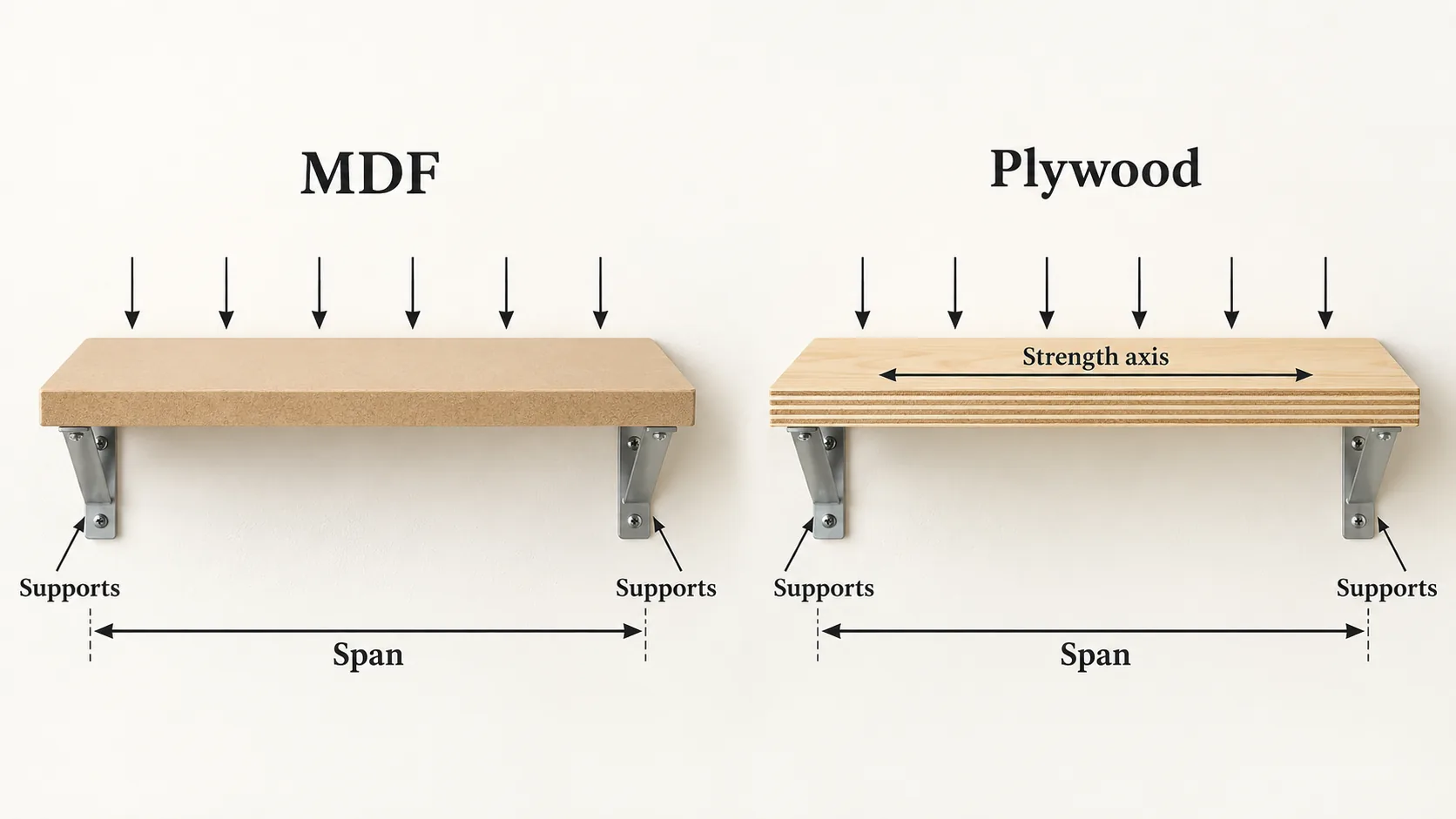
If an MDF shelf sags, shorten the unsupported span, add a center support or add a stiffener along the front, and design for the load it carries for months, such as a full row of books. For plywood, APA’s selection guidance treats strength direction, thickness and panel rating as design variables. A sheathing stamp gives you no cabinet-shelf rating.
When a screw has to go close to an edge, start with plywood. The wood handbook’s construction chapter (printed page 11–7) explains that cross-lamination reduces splitting, which helps near-edge fastening.
For ordinary screws in MDF, EPF’s fixing guidance puts face screws at least 12 mm from an edge and 25 mm from a corner, and edge screws at least 70 mm from a corner. Drill pilots at 85–95% of screw core diameter (the root between the threads), at least 1 mm beyond expected insertion. A specific fitting’s own instructions come first. The MDF cutting guide covers preparing parts before assembly.
How do you compare weight and finished-part cost?
Compare finished parts of the same size and job. Work out core mass from volume and density, add finish and hardware, then price each accepted part instead of each sheet.
For a rectangular core, mass = length × width × thickness × density, with dimensions in meters and density in kilograms per cubic meter. A door-sized blank of 450 × 720 × 18 mm at an assumed 740 kg/m³ gives 0.45 × 0.72 × 0.018 × 740 = 4.31568 kg, or 4.32 kg before finish and hardware. For your order, use the offered board’s documented density or weigh a real part.
MDF is the heavier board for the same size. Table 12–1 gives specific-gravity ranges of 0.7–0.9 for MDF and 0.4–0.6 for plywood. Check the density sheet for the board you’re actually quoted; the compiled values only show which way the gap runs.
For price, divide the total material and processing cost, plus rework or disposal, by the number of accepted finished parts, and count scrap once. Compare painted MDF with painted plywood only after adding MDF edge prep and any grain filling the plywood needs for the same look. A clear-finished plywood front is a different look, so price it on its own.
A cheap sheet can still cost more per door if it yields fewer usable parts or needs more finishing. Ask each quote to state the face, back, edges, machining and hardware it includes.
Which grades suit humidity or outdoor exposure?
Ordinary dry-use MDF in dry rooms, a documented moisture-resistant grade in humid rooms, and an exterior-suitable board and build for permanent outdoor use. Exposure 1 plywood and interior MR MDF both stay indoors.
APA’s plywood bond classifications separate Exterior from Exposure 1. Exterior describes a glue bond built for long-term weather exposure. Exposure 1 copes with moisture during construction and is unsuitable for permanent outdoor exposure. Neither rating makes the wood rot-proof or the cabinet watertight.
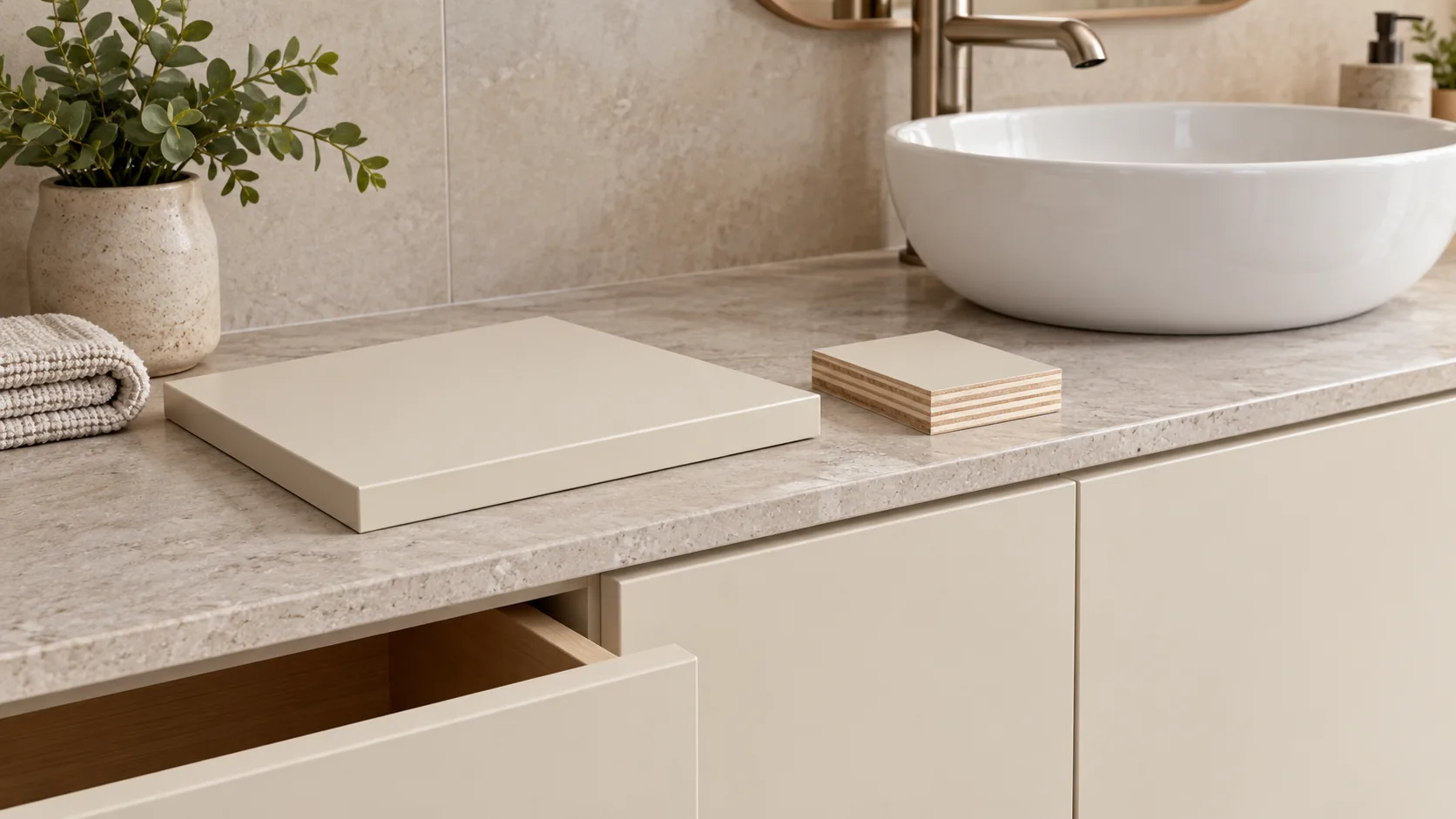
One board maker’s MR product notes list its board as MDF.H1 under EN 622-5, for humid interiors such as kitchens and bathrooms. Even that board needs full sealing and coating in those rooms, should not get wet, and is not for exterior use. Ask for the declared category on any other board sold as MR.
Swelling from too much moisture can stay after the board dries out (dimensional-stability bulletin), and a decorative front can hide a swollen cut edge. Inspect the whole part after any leak.
In a sink base, water gets in at the bottom edge, the back, hinge recesses, pipe cutouts and joints, so seal and detail those. Store panels dry and supported before machining. After water damage, check for swollen edges, changed dimensions and a loosened facing before you keep a part in service.
The MDF moisture guide explains moisture resistance versus direct wetting. Beside a basin, the core grade and detailing have to handle the real splashing and cleaning; a surface finish only covers the face.
What should a production order specify?
The part, the core grade, the finished geometry, the look and the acceptance checks. Change the face, thickness, joints or finish and the same named material gives you a different part.
| Item | What to specify | Why it matters |
|---|---|---|
| Core and grade | Exact MDF product or plywood type, layup and grade | Connects the order to documented properties |
| Finished geometry | Drawing, thickness, dimensions, grooves and tolerances | Defines component fit after surfacing |
| Appearance | Opaque finish or wood species, face grade and color range | Makes visual acceptance clear |
| Loaded parts | Span, loading, supports and strength direction where applicable | Supports a relevant stiffness assessment |
| Hardware | Fittings, recesses, screw preparation and entry direction | Controls assembly and connection checks |
| Face, back and edges | Surface system, balancing details and exposed-cut treatment | Defines the complete panel construction |
| Exposure and records | Intended environment, applicable documents and traceability | Links the supplied part to its declared use |
US formaldehyde limits differ by composite-wood category. EPA’s applicable-products guidance lists 0.11 ppm for MDF, 0.13 ppm for thin MDF and 0.05 ppm for covered hardwood plywood; thin MDF is 8 mm or less. These are panel emission-test limits, not room-air readings or a formaldehyde-free claim.
Work out the actual category, including any structural-plywood exclusion, from the product’s construction and paperwork, and keep the core record with the surface record. The laminated MDF guide explains what a finished panel contains; the veneer and laminate comparison helps pin down the appearance spec.
On repeat orders, check the offered build against the approved drawing. A new face grade, core thickness or backing can change the look, fit or balance even when the decor name stays the same. Record any substitution and recheck the part against the original acceptance criteria.
How does decorative film fit the material choice?
As a facing on a flat core you have already chosen. Pick the core for structure and exposure, then specify the film and bonding process for the surface.
Puremorfilm makes decorative film with a silicone functional face on a PET support film. Rolls are supplied without self-adhesive backing for PUR flat lamination onto MDF, plywood or another suitable board. The film supplies the exposed surface; the board supplies the supporting core. Prepare visible grain, voids and other face defects before evaluating the finished face.
For a surface-scratch reference, an SGS-tested film sample showed no visible scratches from a 2H pencil at 500 gf and 45°, with three lines longer than 20 mm. This sample result does not rate screw holding, shelf stiffness or the finished panel.

When you ask about a filmed part, send the core grade, drawing, back construction and exposed-edge details. Judge the finished panel in its real use; a thin-film result tells you little about a whole cabinet. On plywood, face quality and visible defects are still part of preparing a flat substrate.
Our furniture decorative-film page covers this surface route. Film rolls are our main supply, with film-faced panels quoted per project. The leather-like surface has some give and is unsuitable for floors, all countertops, stovetops, shower floors and other walked-on areas.
Which material should you choose for each component?
MDF for smooth painted profiles, plywood for visible grain or load-bearing structure, and a documented exposure grade for either one where moisture matters.
- Opaque routed door: furniture-grade MDF, with a coating system for the machined edges.
- Visible natural grain: plywood with the face species and grade the design calls for.
- Shelves and boxes: settle stiffness, support, joints and hardware before you accept either core.
- Humid or exterior use: the grade and construction made for that exposure.
For flat parts on either core, our paint-free silicone face replaces paint or a separate laminate. Contact us with the drawing, the core grade and the room or conditions the part will face.
Frequently Asked Questions
Is plywood always stronger than MDF?
No. Compare bending strength separately from stiffness and screw holding. The USDA stiffness figures favor plywood, but grade, thickness, span and support decide whether a particular MDF or plywood component meets the job.
Can MDF be used for cabinet shelves?
Yes, if the grade, thickness and support suit the load. If sag is the limit, shorten the span or add a support or stiffener.
Is plywood waterproof?
No. Exterior-rated plywood has a bond suited to long-term weather exposure, but the wood still absorbs water and can swell or decay. Grade, sealing, drainage and construction determine suitability.
Is MDF always cheaper than plywood?
No. Compare quotes for finished components with the same dimensions, finish and duty. Edge preparation, coatings, supports and accepted yield can change the cost, so a sheet-price comparison alone does not establish the cheaper route.
Which is better for kitchen cabinets, MDF or plywood?
Choose MDF for routed painted doors and plywood with the specified face and grade for visible-grain fronts or cabinet structure. At a sink base, the declared exposure grade, sealed cutouts and joints decide suitability; neither material name guarantees a waterproof cabinet.