
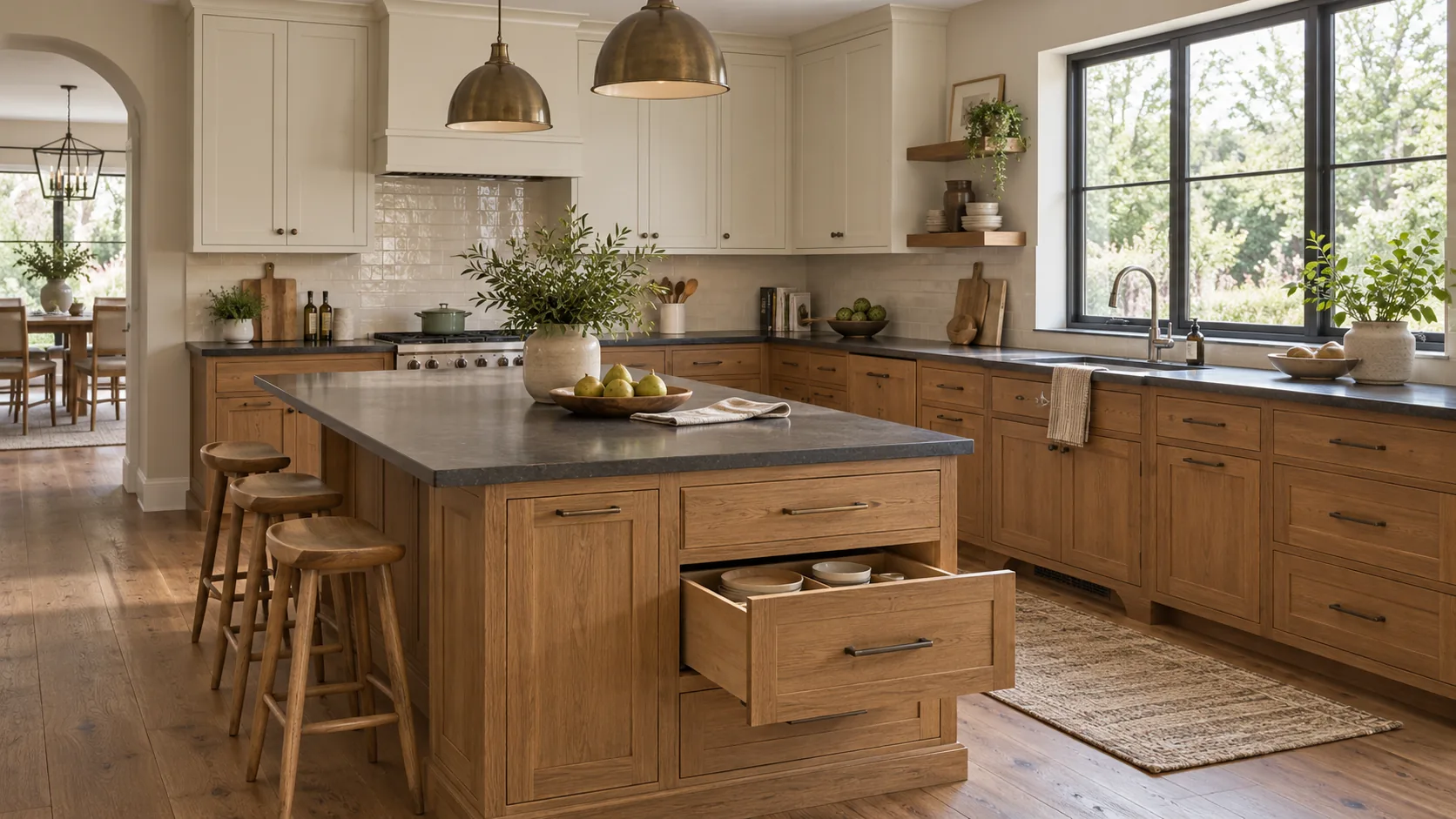
Choose kitchen cabinet finishes by door shape and the face you want: HPL or TFL for manufactured flat fronts, paint for continuous solid color around profiles, and stained wood or veneer for real grain. Compare the specified surface’s wear performance, hot and wet edges, and repair route before choosing a color or sheen.
Stain, glaze and two-tone describe color or effects; they do not identify the complete protective system. A painted or veneered door still needs its coating specified, and a laminated door still needs a core, backing, bond and finished edge.
What Are the Main Types of Kitchen Cabinet Finishes?
Stained or painted wood under a protective coat, or a panel face such as TFL, HPL, thermofoil or veneer. Glazing and distressing are effects layered on another finish, and two-tone simply combines colors or materials.
The Composite Panel Association’s decorative-surface categories separate coatings, HPL, TFL, films and veneer. The following table uses those construction differences to narrow the door and repair route; it does not rank every product within each category.
| Finish route | Door shape and appearance | Wear, hot or wet exposure | Damage and renewal route |
|---|---|---|---|
| Stained solid wood with clear coating | Choose for real grain; stain changes color while the wood layout remains visible | The clear coating supplies first-contact protection; protect edges and identify the system | A sound face may be recoated using a compatible system; cracks or structural damage need separate assessment |
| Opaque paint / factory color coating | Choose continuous color on flat or routed fronts | Compare the named coating’s abrasion, stain and edge evidence; paint color alone is not a durability grade | Compatible touch-up or recoating may work; a local sheen/color match can remain visible |
| Glaze over stain or paint | Choose to accent a profile or aged effect already on a base finish | Protection comes from the complete finishing system, not the glaze effect alone | Repair must reproduce both base color and glaze distribution |
| TFL / melamine-faced panel | Choose coordinated printed decor on flat doors with separate edge treatment | Evaluate the specified face and completed edge; the board is not protected where exposed | Small cosmetic repairs may remain visible; through-face chips can favor replacement |
| HPL-faced panel | Choose a specified decorative-sheet grade, usually on slab doors | Select grade for expected wear and assess the separate edge and adhesive near water/heat | Sanding cannot recreate printed decor; deep damage may need a new face or front |
| Thermofoil / qualified 3DL | Choose a formed continuous face on routed contours | Check the identified foil/topcoat, bond, back termination and appliance clearances | Lifted or torn film needs bond assessment before repair, refacing or replacement |
| Wood veneer | Choose real wood leaves on a supporting board; specify finished color and grain sequence | Coating and edge construction govern service care; real wood alone is not a wear rating | Recoating may renew a sound face; unknown remaining veneer thickness limits sanding |
Any of these faces can sit on different boards underneath. Our kitchen cabinet materials guide separates the door finish from the cabinet core, so a plywood box with laminate doors is a perfectly normal combination.
What Does a Stained Finish Do to Wood Cabinets?
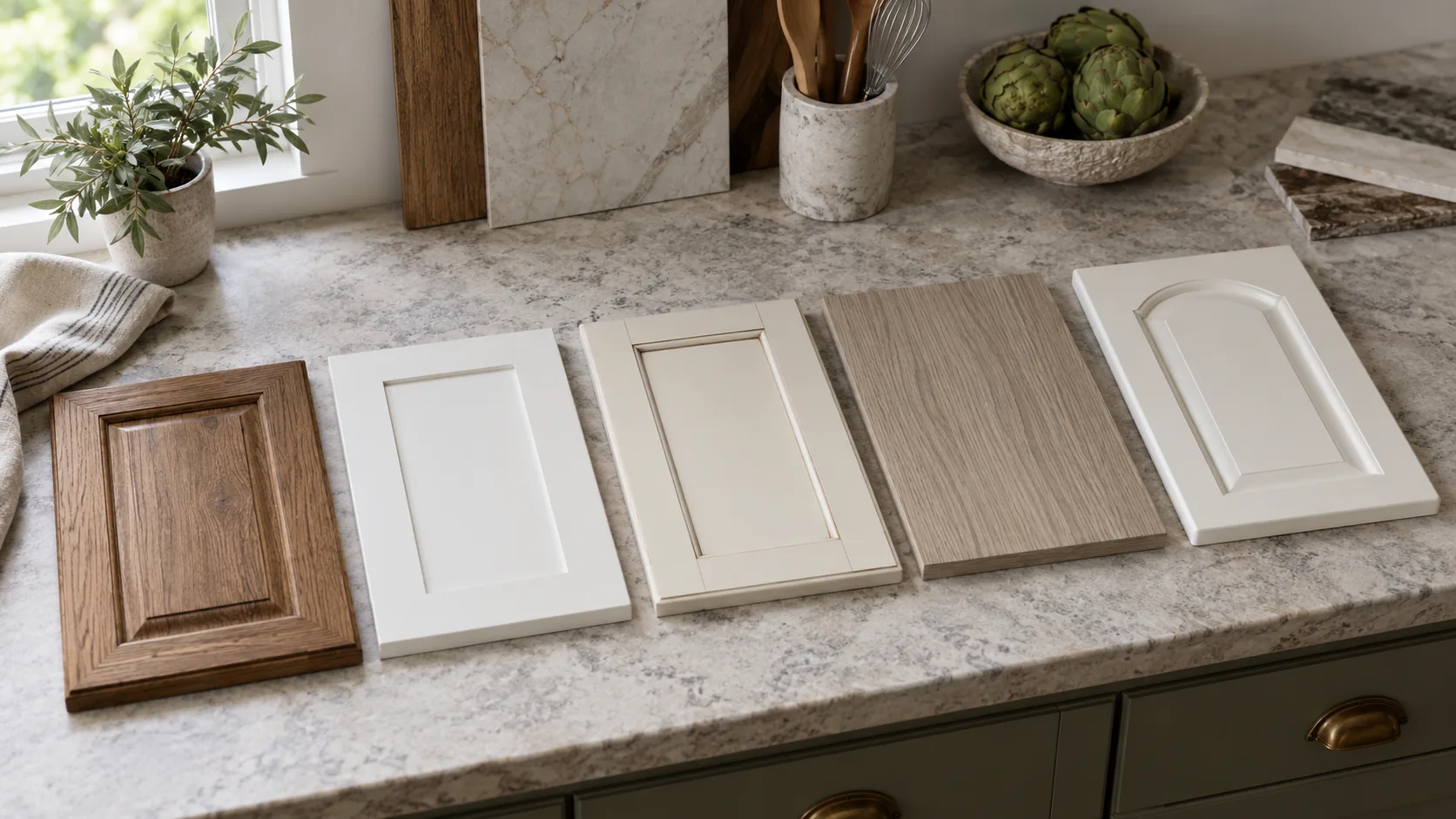
Stain changes wood color while keeping the grain visible, so choose it when the timber itself is part of the design. The species, preparation and stain determine the finished appearance; the protective coating above it governs service care.
Approve the stained sample in the actual wood species and finished coating. A color name alone cannot fix how grain, pore structure and preparation will appear across a batch.
Some woods take stain unevenly. The Hardwood Manufacturers Association’s finishing guide explains how wood structure and preparation affect color absorption. Approve the preparation, stain and finished coating together, rather than choosing from a color name.
Wood and its coating can change color with light exposure. The Timber Veneer Association’s care guidance relates that change to species, coating and exposure. Compare replacement doors with the installed run, and assess color under the intended lighting.
When Is a Painted Finish the Better Choice?
When you want a solid color more than visible grain. Paint can match your walls or trim, and a sound painted door can be repainted later if your taste changes.
Wood texture can remain visible through paint, while a prepared MDF face offers a different surface for coating. Our MDF and solid wood comparison separates the core choice from the paint system.
Paint’s weakness is damage you can see. Scratches, chips and visible flaws are its main drawbacks, and a dark solid color or high sheen makes every nick stand out. Use a cabinet enamel made for doors and trim, not a wall paint picked for its color.
View the full coated door under side light before choosing a high-gloss finish, especially around routed profiles where preparation defects can remain visible. Our matte and gloss cabinet guide explains how reflections affect the appearance of handling marks.
What Does a Glaze Add to Painted or Stained Cabinets?
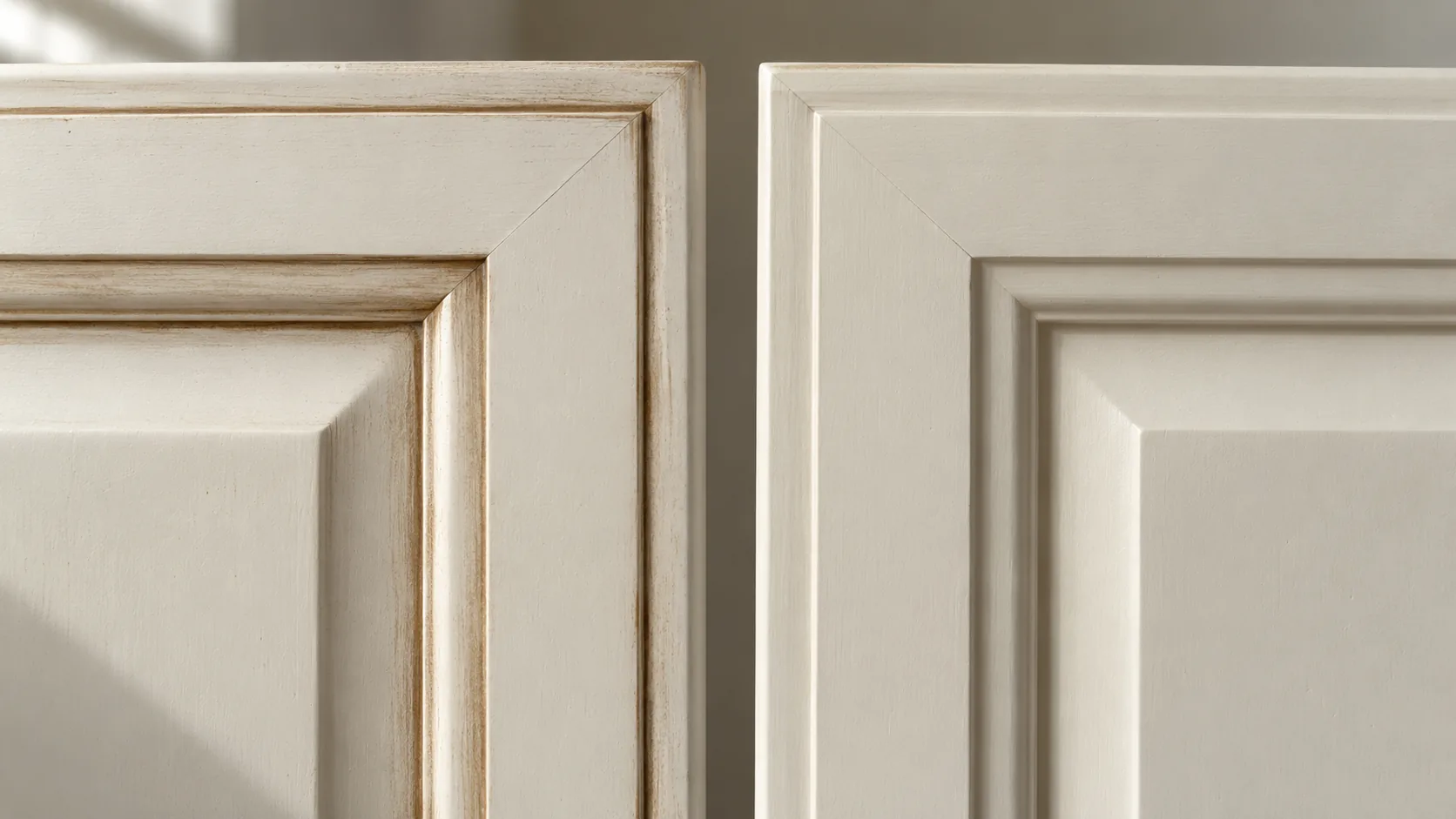
A glaze adds a tinted, see-through layer over paint or stain that settles into profiles and corners. It’s for doors whose shape you want to show off, usually in traditional or aged designs.
The Hardwood Manufacturers Association’s finishing guide describes transparent or semi-transparent glazes applied after a sealer coat. In an accent finish, the placement and amount left on the profile change the effect. Approve the completed profile rather than only a flat color chip.
A repair needs to match the base color, glaze placement and final sheen. Two doors described as glazed can show different amounts of contrast at the corners, so the finish record should include an approved completed sample.
So look at the raised center, inside corners and flat face together before you choose. And keep the base color and glaze details on file; matching only the background color will leave a touch-up visible.
How should you choose a clear protective topcoat?
Choose a clear topcoat by the identified chemistry, application build and performance evidence. Varnish, lacquer, waterborne and UV-cured labels describe different attributes; none establishes the strongest kitchen finish across every wear, chemical and repair condition.
The CPA coatings overview explains the carrier and curing routes. A waterborne product can also be UV-cured: waterborne identifies a carrier, while UV identifies how the coating cures. For a cabinet offer, name the full system rather than treating those labels as mutually exclusive grades.
| Label on a quote | What the label identifies | Useful selection rule |
|---|---|---|
| Varnish | A broad film-forming coating family | Choose the actual formulation and build for appearance, wear and the required compatible repair |
| Lacquer | A coating family that includes different technologies | Identify the specific factory system; a glossy sample does not establish its resistance |
| Waterborne | The carrier route, not one fixed resin or cure | Compare the actual formulation and test results; do not assume all waterborne products perform alike |
| Solvent-borne | The carrier route, with different possible resins | Specify application and curing requirements as well as the proposed service performance |
| UV-cured | A curing mechanism | Confirm the finished system’s performance and repair route; fast curing is not a universal durability ranking |
ANSI/AWI 0400-2022 section 3.2 calls for the finishing system or technology and performance characteristics to be specified. Use that record to compare abrasion and chemical results under matching conditions and to identify an allowed touch-up or recoat.
A clear coating can be a suitable indoor finish when you want the wood visible. Surface preparation and coating coverage still affect the result. For day-to-day care, our kitchen cabinet cleaning guide separates cleaning methods by finish.
How Do Laminate, Melamine (TFL) and HPL Finishes Differ?
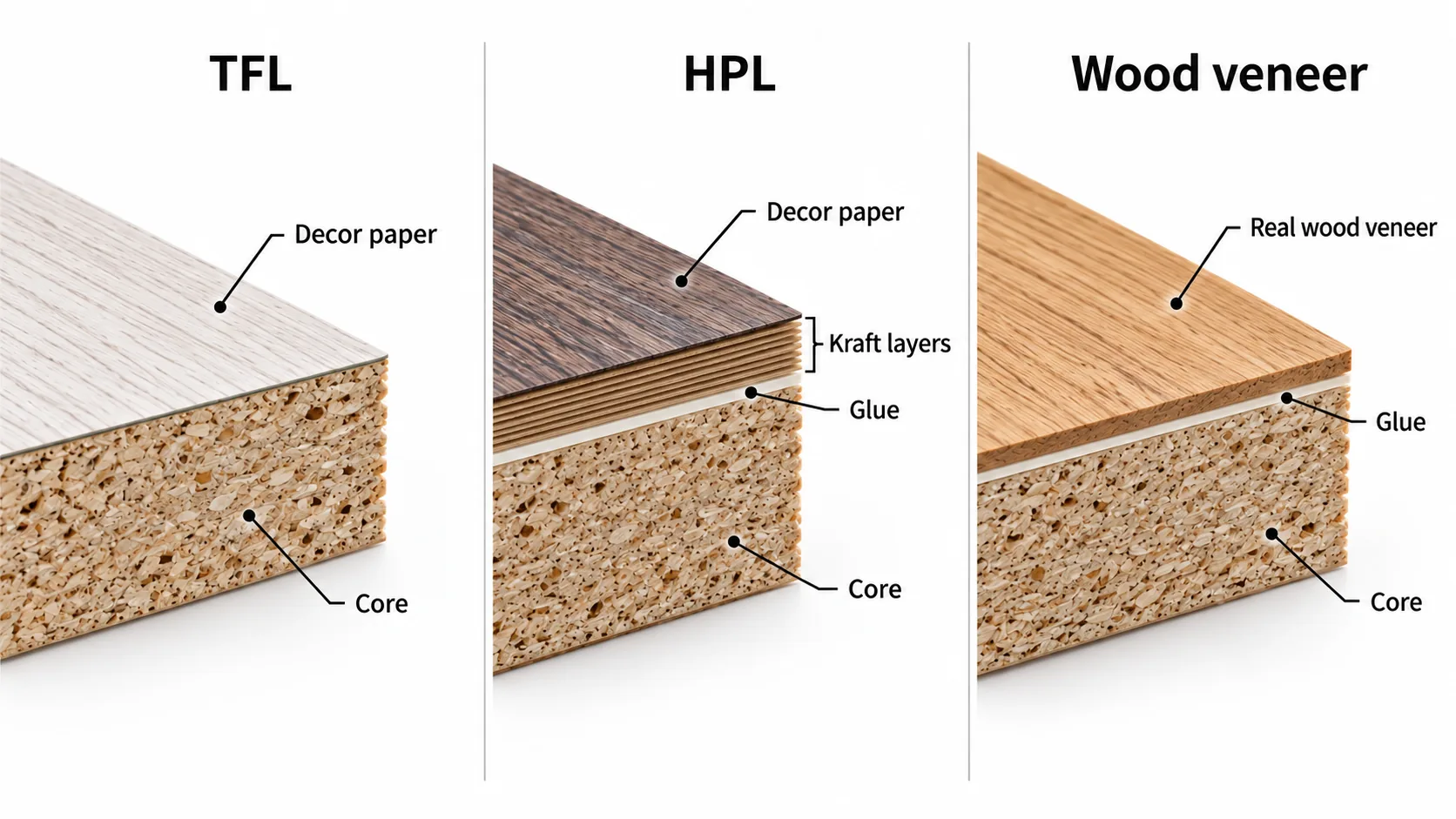
TFL is decorative resin paper fused straight onto a panel; HPL is a separate laminate sheet glued to a panel; wood veneer is a thin layer of real wood. That construction explains how each one looks and how far you can repair it.
What is TFL, often called melamine?
Thermally fused laminate, formerly known as melamine, is resin-treated decor paper, commonly 60–130 g/m², fused to MDF or particleboard, according to the CPA’s TFL definition. The result resists scratches and wear, but exposed edges need their own edge treatment.
TFL suits flat doors with a coordinated printed decor. Check the edges as closely as the face, because a chipped edge exposes the board underneath.
What makes HPL a separate laminate sheet?
HPL is several resin-treated kraft layers plus a decorative layer made into a separate sheet, as the association’s HPL explanation describes. General-purpose sheets are typically 0.71–1.22 mm thick; special grades have different constructions and intended uses.
Choose the HPL grade for the expected wear, including a special high-wear grade where the job calls for one. A pattern may disguise a light mark, while lost printed decor requires a separate repair or replacement decision. Protect the exposed edges as well as the face.
How is wood veneer different from printed laminate?
The grain on veneer is real wood, glued as a thin layer onto a supporting board. Because the layer is thin, refinishing is limited. Our wood veneer and laminate comparison goes into the choice in more detail.
What Is Thermofoil, and Why Can It Peel Near Heat?
Thermofoil is an identified thermoplastic facing formed over a door, often MDF. A qualified 3DL route suits contours and continuous edges; heat or moisture reaching a vulnerable bond can lead to lifting, so the completed door and appliance clearances need assessment.
The association’s 3D laminate overview distinguishes membrane-pressed 3DL from 2DL flat lamination and profile wrapping. The selected route determines which contours and edge details can be supplied.
Heat sensitivity and delamination are the main concerns. The doors to watch are those beside the oven and above the dishwasher’s steam vent. A peeled film is hard to repair invisibly; our thermofoil peeling guide helps you judge an existing door.
In a photo, thermofoil and flat laminate can look alike, but they suit different door profiles. Our thermofoil and laminate comparison helps you match one to shaped or flat fronts.
Which Finishing Techniques and Two-Tone Looks Suit Your Kitchen?
Choose distressing for a deliberately aged look and two-tone to set uppers, lowers or the island apart. Both change the appearance without changing the finish system underneath.
Specify the amount of distressing, worn-edge effect, glaze and sheen on an approved sample. The effect sits over the selected wood or coating construction, so a deliberately aged look does not establish a different abrasion or water-resistance rating.
For two-tone cabinetry, compare both colors and their underlying surfaces together. Using one coating or facing on the uppers and another on the lowers changes the care and repair requirements as well as the appearance.
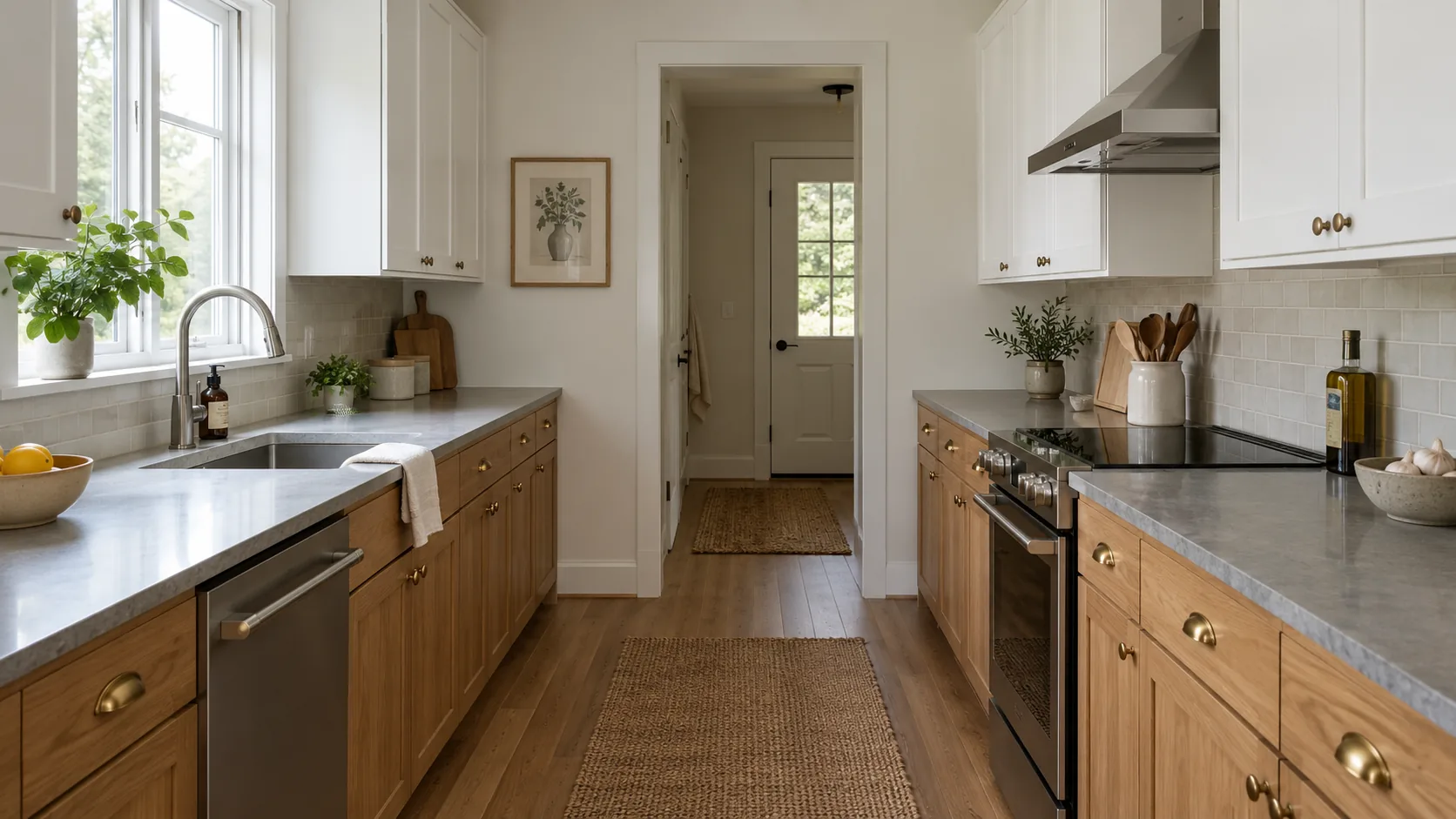
White uppers over wood-toned lowers is the classic version; a contrasting island with matching surrounding doors is another. Look at both colors together against your worktop, floor and lighting, because a single sample won’t show how the pair works.
Where Does a Silicone-Surface Film Fit Among Cabinet Finishes?
Silicone decorative film fits among factory-laminated faces for flat furniture fronts. Puremorfilm manufactures the film in China with a silicone functional face on PET support film. The film is applied by PUR flat lamination, rather than vacuum-formed around a routed cabinet profile.
For a wear-focused comparison, an SGS-tested film sample completed 2000 revolutions under ASTM D4060-25 with CS-10 wheels, 1000 g per wheel and 60 rpm, showing slight matting without substrate exposure or coating peel. Compare wear results only with matching methods and conditions; this film result does not rate an assembled cabinet door.
We supply rolls without self-adhesive backing for PUR flat lamination, starting at 500 m. Silicone laminated panels are quoted per project in 1220 × 2440 mm format, starting at 200 sheets. The film suits furniture fronts, cabinet doors and wall panels with vertical or low-wear exposure; it is not for floors, countertops, cooktops, shower floors or other walked-on areas.
See our furniture decorative film for the flat-front material route and supply options.
What is the best cabinet finish for rental apartments?
The best cabinet finish for a rental apartment is one tenants can clean safely and the landlord can repair or replace between tenancies. A specified laminate or melamine face is a practical starting point for cabinet components; paint offers a different repair route. Choose the countertop separately for its working exposure.
| Component | Starting choice | Turnover check |
|---|---|---|
| Cabinet carcass and shelves | A suitable melamine/TFL-faced board with completed edges | Check shelf damage, sink leaks and whether individual parts can be replaced. |
| Flat cabinet doors | A specified laminate face or a maintainable painted finish | Keep the decor/paint reference and confirm matching replacement fronts. |
| Routed cabinet doors | A validated formed-film or painted-door construction | Check heat exposure, edge condition and the supplier’s repair route. |
| Countertop | A worktop grade selected for heat, moisture and wear | Price and assess it separately; a cabinet-front film is not a worktop specification. |
The melamine and laminate comparison explains the different constructions. For a worn rental kitchen, compare refacing and replacement after checking the condition of the boxes and wet edges.
Which Kitchen Cabinet Finish Should You Choose?
Choose stained wood or finished veneer for real grain, a specified paint system for continuous color and routed profiles, or a suitable HPL/TFL construction for flat manufactured fronts. For a shaped wrapped door, choose a qualified 3DL route and check its bond and appliance exposure.
| Your priority | Finish to consider | Decision check |
|---|---|---|
| Visible real grain | Stain and clear protection, or finished veneer | Species, natural variation and renewal depth |
| A solid custom color | Cabinet paint | Surface texture, sheen and matched touch-up |
| Detailed, aged profiles | Glaze over paint or stain | The exact glaze effect and repair matching |
| Easy-care flat fronts | TFL or HPL | Facing construction and protected edges |
| Continuous facing on shaped doors | Thermofoil | Heat exposure and the condition of the film bond |
| Frequent handling | A named coating system or facing grade with relevant wear evidence | Match the test method and endpoint, then assess hot or wet edges and the repair route |
Use the table as a three-step check:
- Decide whether you want real wood grain, a solid color or a printed decor.
- Match that finish to the door shape: flat fronts suit TFL or HPL, while shaped fronts suit paint, stain, glaze or thermofoil.
- View a full sample door in your kitchen light, then decide how you would clean it and deal with a chip. For a flat-panel film finish, contact us with the door profile, quantity, intended location and preferred texture or sheen.
Frequently Asked Questions
What should a batch of finished kitchen doors specify?
Record the door drawing, core, backing, edge treatment and actual facing or coating system. Add color, sheen, texture and any grain sequence, then approve a completed sample with the relevant wear and wet-edge evidence and an agreed repair route.
What is the most durable finish for kitchen cabinets?
Choose a suitable HPL or TFL grade for manufactured flat fronts, or a specified coating or qualified 3DL route for shaped doors. Compare actual wear results, hot or wet edges and repair. No finish label establishes the most durable door for every condition.
Is UV-cured coating always stronger than lacquer or paint?
No. UV describes curing, while lacquer and paint names can cover different chemistries and builds. Compare the identified completed systems under the same relevant methods and conditions, including the repair you would accept after damage.
Do both sides and edges of a cabinet door need finishing?
Yes. Specify the required face, back and edge completion for the door construction. Coatings slow moisture exchange rather than making wood waterproof; an unfinished or damaged edge remains a separate exposure path.
Can you use ordinary wood stain to recolor laminate or thermofoil?
No. Ordinary wood stain cannot color a resin or plastic face by penetrating it as it does timber. Recoating needs a preparation and coating system approved for that identified facing; loose or damaged surfaces need assessment before refinishing.