
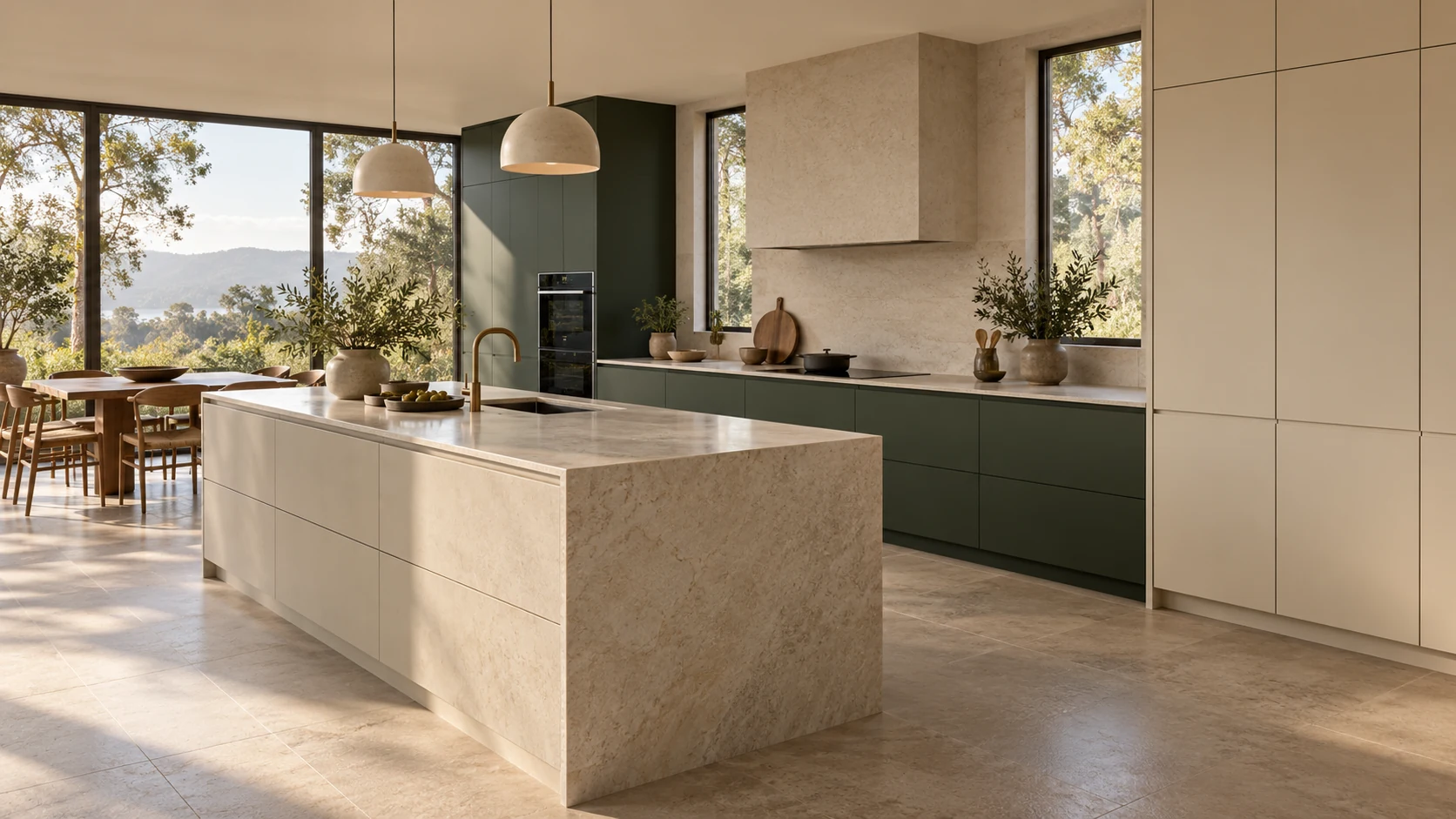
Handleless kitchen cabinets open through a grip formed into the door, a recessed channel behind it, or push-to-open hardware instead of projecting knobs and pulls. The best choice can change within the same kitchen: a grip channel can suit a loaded base drawer, while a reachable lower door edge can work on an upper cabinet. Decide how each front opens before choosing its color or finish. The uninterrupted appearance works only when the doors you use every day remain comfortable to reach and operate.
What are handleless kitchen cabinets?
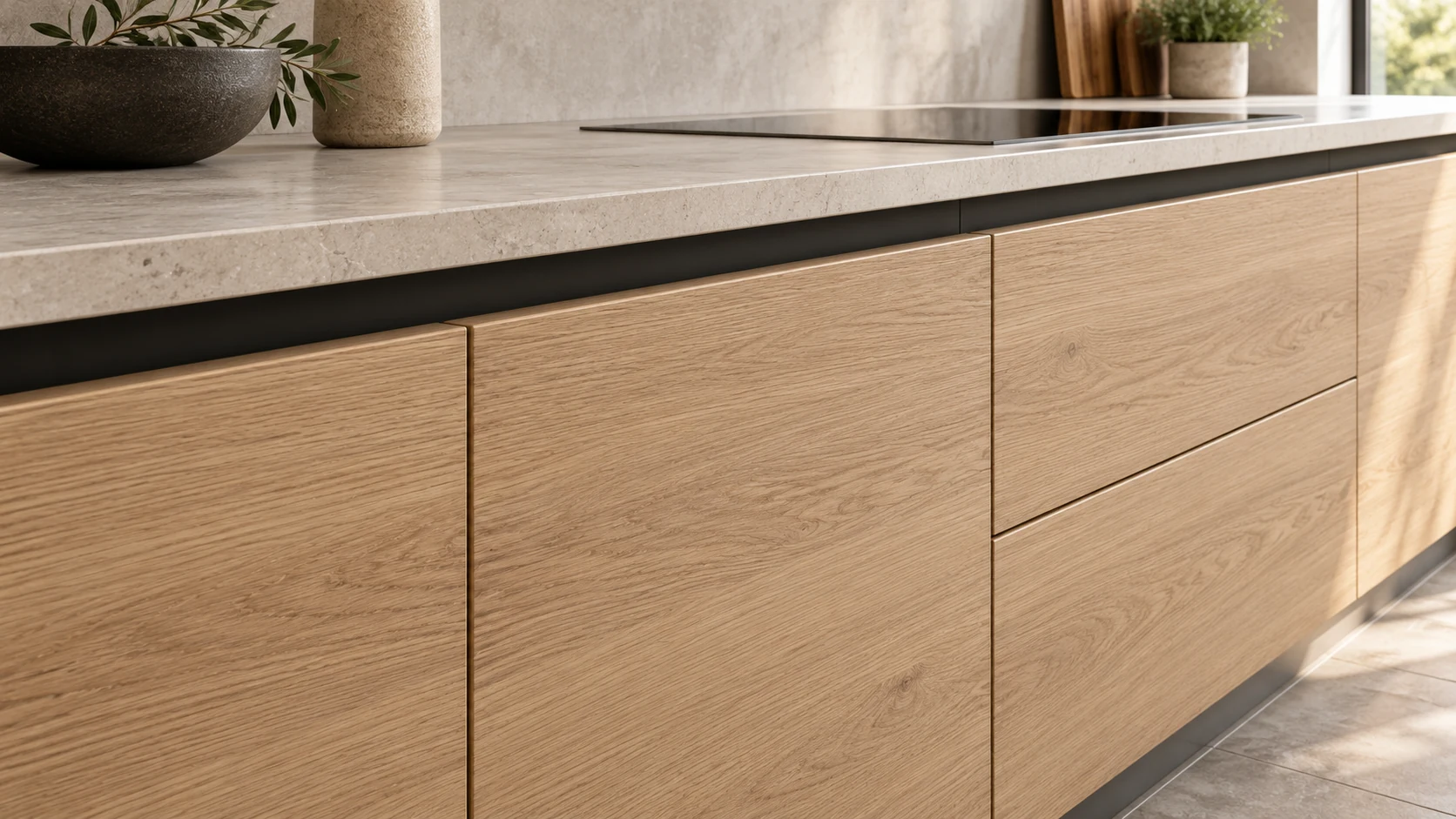
Handleless cabinets are cabinets whose fronts open without a projecting knob or pull. Some still have a physical handle, but it is built into the door edge or concealed behind the front. Others use a mechanism that releases when you press the face.
In a showroom, a kitchen with long horizontal recesses gives your fingers a place to pull. A kitchen with apparently flat, closely spaced faces may rely on push hardware. Both can look quiet in a photograph, yet they feel different when you open a full cutlery drawer with one hand.
Handleless also describes the opening arrangement, rather than whether the cabinet has a face frame. It can be designed around different cabinet constructions. Likewise, slab doors are a common visual partner, but a flat-looking front alone does not explain how it opens.
Start your finish comparison after identifying the grip. Finger contact falls on the visible face with push opening and near the edge with a recessed grip. Our matte versus gloss cabinet comparison explains how sheen changes the appearance of marks and reflected light in those areas.
How do handleless cabinets open?
They open by pulling an accessible edge or channel, or by pressing a front fitted with a release mechanism. The everyday difference is where your fingers go and whether opening begins with a pull or a push.
| Opening method | What you touch | What it changes in the design |
|---|---|---|
| J-pull or integrated grip | A recess shaped into the door edge | The grip belongs to the door profile |
| Extended lower edge or rear bevel | An exposed edge, often under an upper cabinet | The cabinet and door must leave room for fingers |
| Recessed channel, often called Gola | A channel fitted behind the door fronts | The cabinet layout includes the channel and its terminations |
| Push-to-open | The visible door or drawer face | The hardware needs inward travel and reliable triggering |
A J-pull is therefore one type of handleless front. A channel system creates the grip through the relationship between the door and cabinet. Push opening removes that finger recess, but adds a mechanism to select and adjust. A quotation should name which of these methods each front actually uses.
Look at a corner and the end of a cabinet run as well as the middle. A channel has to end somewhere, and the end treatment contributes to the finished appearance. Door-profile manufacturing is a further choice; our explanation of profile wrapping and flat lamination helps distinguish a shaped grip from a flat decorative face.
Which opening method suits each cabinet?
A pullable edge suits frequently used or heavily loaded fronts, while push opening suits fronts where direct pressure is easy and comfortable. Plan the opening at the cabinet level instead of assigning one mechanism to the entire room automatically.
On upper cabinets, try reaching the proposed lower edge from the actual standing position. An extended door lip can be simple to use when it is reachable. A tall cabinet needs a grip at a useful height; a detail that works beneath a wall cabinet may be awkward beside an oven tower.
For base drawers, put the expected contents into the showroom or sample drawer before comparing opening methods. A broad drawer of pans presents a different task from a lightly loaded cupboard door. With push opening, also test the places where your hand naturally lands as you walk past the island.
Mixing methods can solve those differences. You might use a continuous channel on lower drawers, an underside grip on uppers, and a visible pull on a heavily used tall door. Repeating the face color can still give the room a coherent appearance.
What does push-to-open need to work well?
Push opening needs room for the front to move inward, plus a trigger arrangement that works where you actually press. Closing the front hard against the cabinet removes the travel that starts the mechanism.
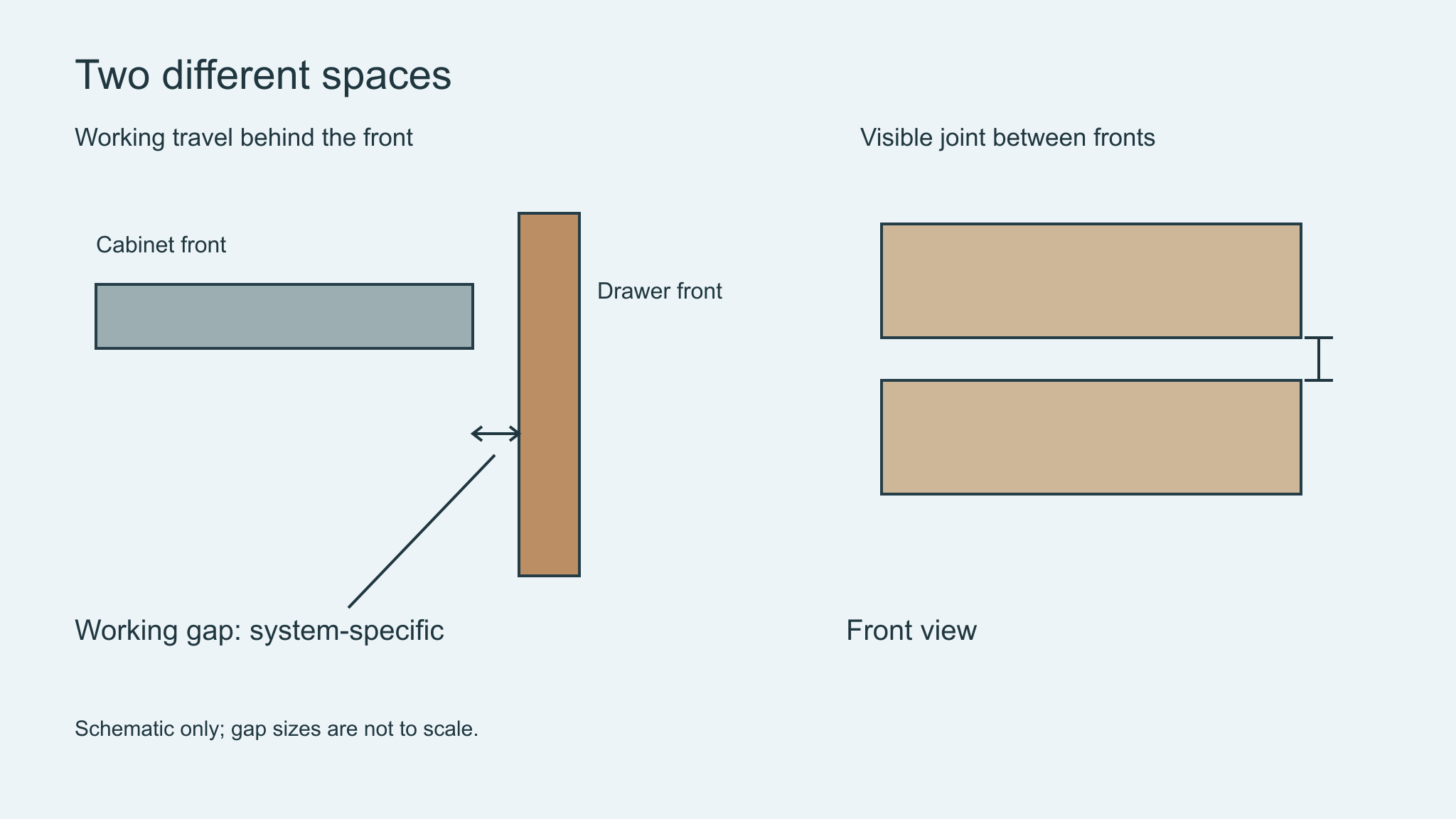
For a specific drawer example, Blum’s TIP-ON BLUMOTION instructions require an equally adjusted front gap on both sides, with a minimum of 2.5 mm. They also warn against adding a bumper that restricts triggering and describe a synchronization rod for a wider activation range. These manufacturer tips are a 2016 edition that the current US LEGRABOX assembly page still links; see pages 2–3 of the tips.
Here, the front gap is the working space behind the drawer front, not the visible joint between neighboring fronts or a dimension for every push latch. Hettich’s March 2018 Push to open Silent folder also describes a 2.5 mm drawer front gap and optional synchronization for operating wide fronts near their edges; see pages 3–4.
During the sample trial, press the center and your usual positions near either side with the drawer loaded. Ask which synchronization parts are included. A drawer that opens only from a carefully chosen spot will be irritating at the sink or preparation area.
How do panel-ready appliances open without handles?
Panel-ready appliances need their own opening arrangement, chosen with the appliance model. Matching the cabinet face does not make a dishwasher door operate like an ordinary cupboard door.
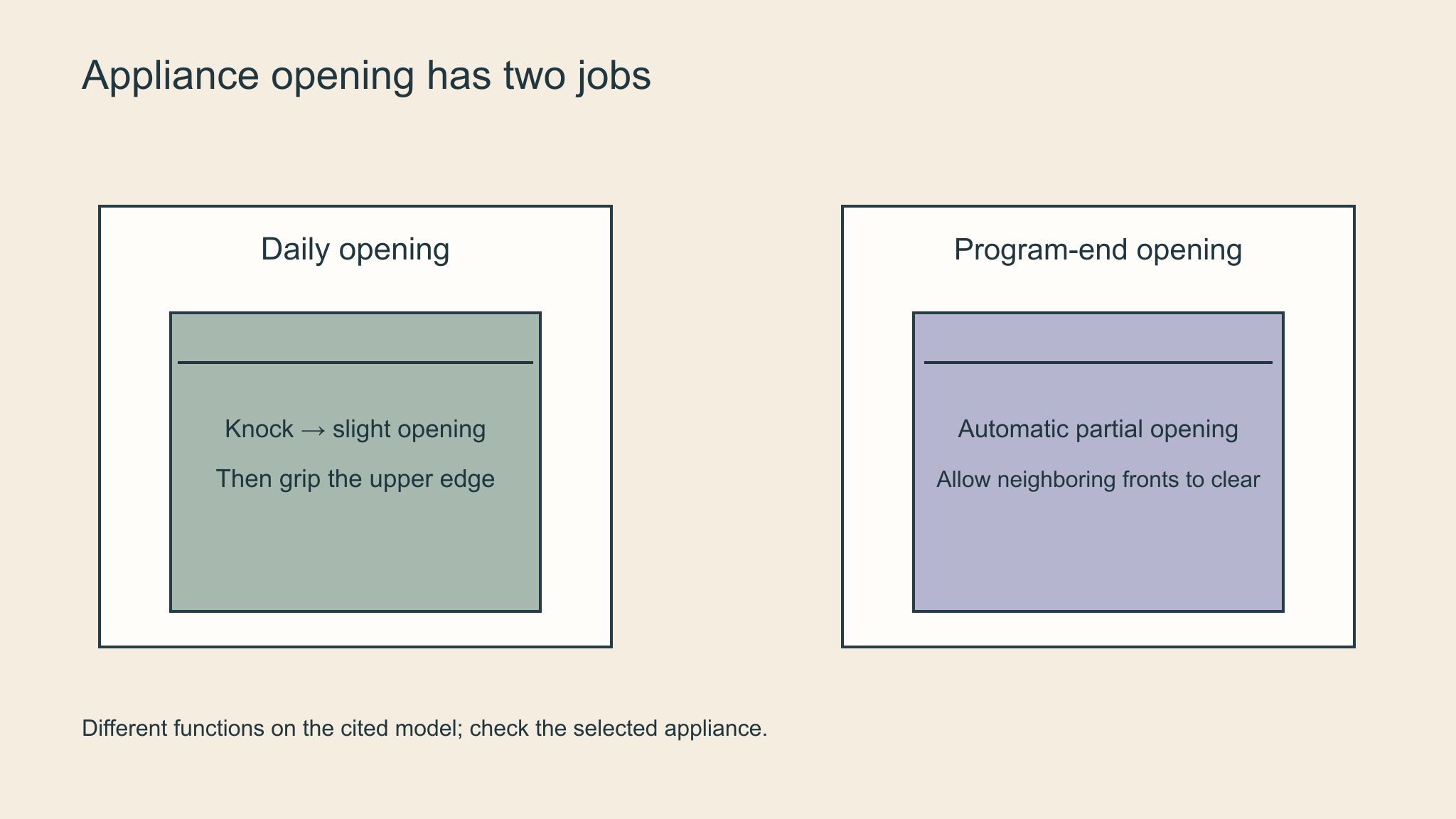
The US Miele G 7791 SCVi AutoDos K2O provides a useful example. Its manual describes Knock2open as two quick knocks on the upper third of the front, after which the door opens slightly and you pull its upper edge. AutoOpen is a different function: the door opens partially at the end of selected programs to help drying. The manual also requires the automatically opening door to clear neighboring doors and cabinet fronts. These instructions appear on page 20 of document 12 783 831-002-01, linked from the US model page.
For that model, disabling Knock2open means a handle must be fitted, as explained on page 39. These are model-specific functions, not instructions for adding a furniture push latch to an appliance.
Put the appliance opening on the kitchen elevation: how you open it daily, what opens automatically after a cycle, and what changes if you disable either function. Check the neighboring drawer in its open position too. This catches a problem that a closed-door rendering can conceal.
Are handleless cabinets easier to live with?
Yes, their flat faces can be easier to wipe and their fronts have fewer projections to catch clothing; recessed grips and push opening bring their own daily-use tradeoffs. Removing a projecting pull changes the cleaning task; it does not remove it.
A broad flat front is straightforward to wipe. A J-shaped recess or horizontal channel creates another surface where crumbs and cooking residue can settle. Push opening puts fingertips directly on the face, so examine the finish after handling the actual sample under side lighting.
Try the opening with wet hands and with the amount of finger movement you comfortably have. A narrow grip that feels acceptable once may be tiresome on the cupboard you open throughout cooking. A visitor or another household member may also prefer a visible place to pull. A mixed arrangement can accommodate that without changing every door.
Wear and cleaning claims belong to the specific surface. A laboratory scratch result needs its test conditions. For the wider choice between paint, stain and decorative-facing constructions, compare the cabinet finish options before selecting a sheen from a photograph.
Can you make existing cabinets handleless, and what does it cost?
Yes, some existing cabinets can accept suitable push hardware or replacement grip doors, while a continuous channel usually requires more work to the cabinet layout. The cost follows which of those changes you make.
Retrofitting a push latch starts with sound, aligned doors and compatible hinges. Changing to a J-pull means changing the door profile, often through replacement fronts. A recessed channel occupies a physical position behind the faces, so adding one can affect the cabinet’s front construction and the clearances around appliances.
As a public component-price example checked in October 2026, Rockler listed its black Sugatsune heavy-duty push-to-open door latch, item 68657, at US$39.99 sale price, with a US$49.99 regular price, each. The retailer listing includes a latch and strike plate. That is one component price, not a kitchen conversion budget including doors, hinges, fitting or tax.
Compare quotations using the same doors and opening functions. A low latch price tells little if the doors also need replacement or the existing hinges resist release. Identify which existing parts are worth keeping before the opening detail is changed.
Where does a silicone-faced film fit on handleless fronts?
Puremorfilm makes decorative film with a silicone functional surface for flat cabinet faces, including fronts in a handleless design. A flat face and a shaped finger recess are different manufacturing details, so our flat-lamination supply applies to the face scheme.
Our silicone surface is inherently flame-retardant; higher flame-retardant grades are available on request, up to UL 94 V-0. In the manufacturer’s laboratory tests, coffee, red wine and soy sauce left on the surface at 25°C for 24 hours wiped off with no obvious change. We use a No DOP formulation.
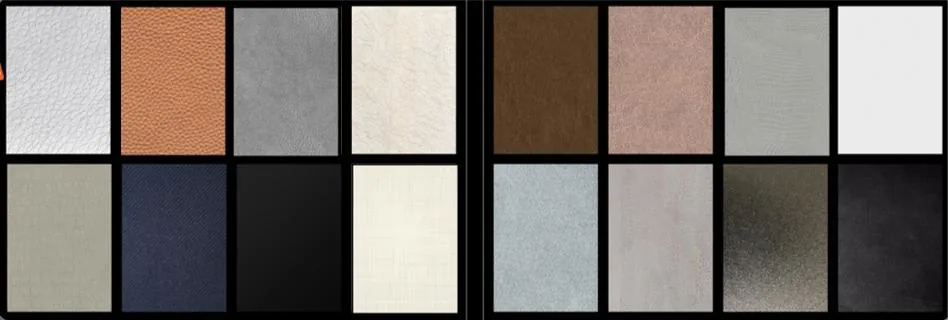
There are more than 100 patterns, with texture and gloss customizable on request. Compare the available patterns and finishes with the grip detail; a furniture decorative film can visually connect an island and a taller cabinet run. We mainly supply rolls for PUR flat lamination, with faced panels available on request.
Should you choose handles or no handles?
Choose handleless fronts when you like the uninterrupted appearance and find the proposed opening comfortable; choose a pull where a direct grip makes a frequently used door easier. A mixed kitchen can make that decision cabinet by cabinet.
| Your priority | Useful starting choice | What to try before ordering |
|---|---|---|
| An easy grip on loaded base drawers | Recessed channel or integrated grip | Pull with the intended load |
| Flat fronts without a visible channel | Purpose-matched push opening | Press where your hand naturally lands |
| Reachable upper doors | An accessible lower edge | Reach from the working position |
| A fully integrated appliance | The appliance’s own supported opening | Daily opening and neighboring clearances |
We can help compare the decorative face once the opening arrangement is settled. Our new paint-free surface material uses a silicone functional face, distinct from PVC, melamine, PP and PETG decorative faces.
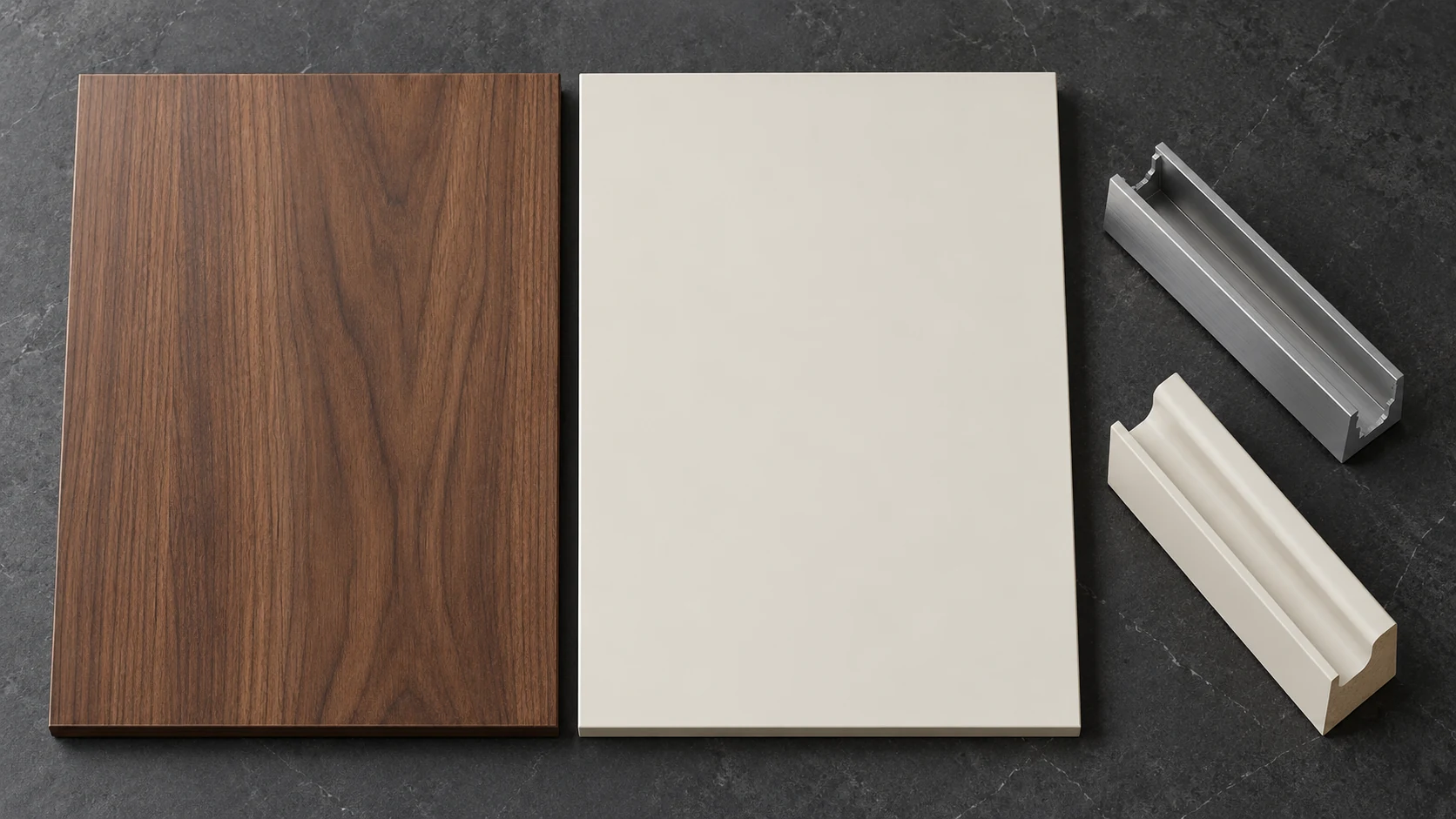
Bring an elevation or photos, the opening methods, the flat door-face dimensions and the patterns you like; contact us to discuss the film-facing options.
Frequently Asked Questions
Is a handleless kitchen a good idea?
Yes, when the opening method suits the people using the kitchen and the cabinets they open most. Try a loaded drawer and the tall doors before choosing a completely handleless arrangement.
What is the difference between handleless and J-pull?
Handleless describes the absence of a projecting knob or pull; J-pull is one way to achieve it, using a grip shaped into the door edge. Recessed channels and push opening are other approaches.
Are handleless cabinets more expensive than traditional cabinets?
Yes, they can be when special grip profiles, channel components or push hardware add to the same cabinet specification. Compare like-for-like quotations; removing an expensive pull can offset part of that difference.
Can handleless cabinet doors be installed in existing cabinetry?
Yes, replacement grip doors or suitable push-opening hardware can work on sound existing cabinets. Adding a continuous recessed channel generally involves more changes than fitting a latch.
Do handleless cabinets work with soft-close hinges?
Yes, a J-pull or channel front can use ordinary soft-close hinges. Push-open doors need a hinge and latch that the hardware maker pairs for that use; push-and-soft-close drawer systems exist, but they do not show that any door hinge will work with a push latch.