Learning how to choose materials for LEED credits starts with the project’s rating-system version, installed product category and accepted evidence. A PVC-free label alone does not satisfy the emissions, disclosure or project-wide calculation requirements.
The examples here follow the July 2026 LEED v5 requirements for Building Design and Construction (BD+C) and Interior Design and Construction (ID+C). A project pursuing v4.1 needs its own version’s requirements. Start with that choice before comparing wall finishes, cabinetry or supplier documents.
The mistakes to avoid are specific: using a different version’s threshold, classifying a cabinet as a wall finish, accepting a report for another product, or treating one environmental declaration as a project point. Each changes what belongs in the material approval schedule.
Which LEED credits apply to PVC-free interior materials?
PVC-free interior materials can be evaluated under the material and emissions credits in your project’s LEED version. For LEED v5, the relevant routes include MRc3 Low-Emitting Materials and MRc4 Building Product Selection and Procurement. Eligibility depends on the installed product, accepted documentation and project calculations; PVC-free composition alone earns no credit.
For an interior finish, begin with the question the project is trying to answer. Emissions evidence addresses substances released into indoor air. Environmental and ingredient documents address other material attributes. These lead to different requirements in the current ID+C rating system.
| Version and route | Evidence to examine | What the project counts |
|---|---|---|
| v5 MRc3 Low-Emitting Materials | Accepted emissions evidence for the installed product category | Compliant products within the required categories |
| v5 MRc4 Building Product Selection and Procurement | Eligible documents supporting the product’s sustainability attributes | Adjusted product values within whole categories |
| v4.1 EQ Low-Emitting Materials | The v4.1 emissions and applicable content criteria | The categories and thresholds specified in that version |
| v4.1 MR Environmental Product Declarations or Material Ingredients | The document and product coverage required by the selected option | The qualifying products or other measures in that option |
A declaration that a film contains no PVC answers a composition question. To approve its use on a project pursuing these credits, the reviewer still needs the documents and quantities relevant to the chosen route. Record the claim separately from the credit decision so a useful material description does not become an unsupported eligibility statement.
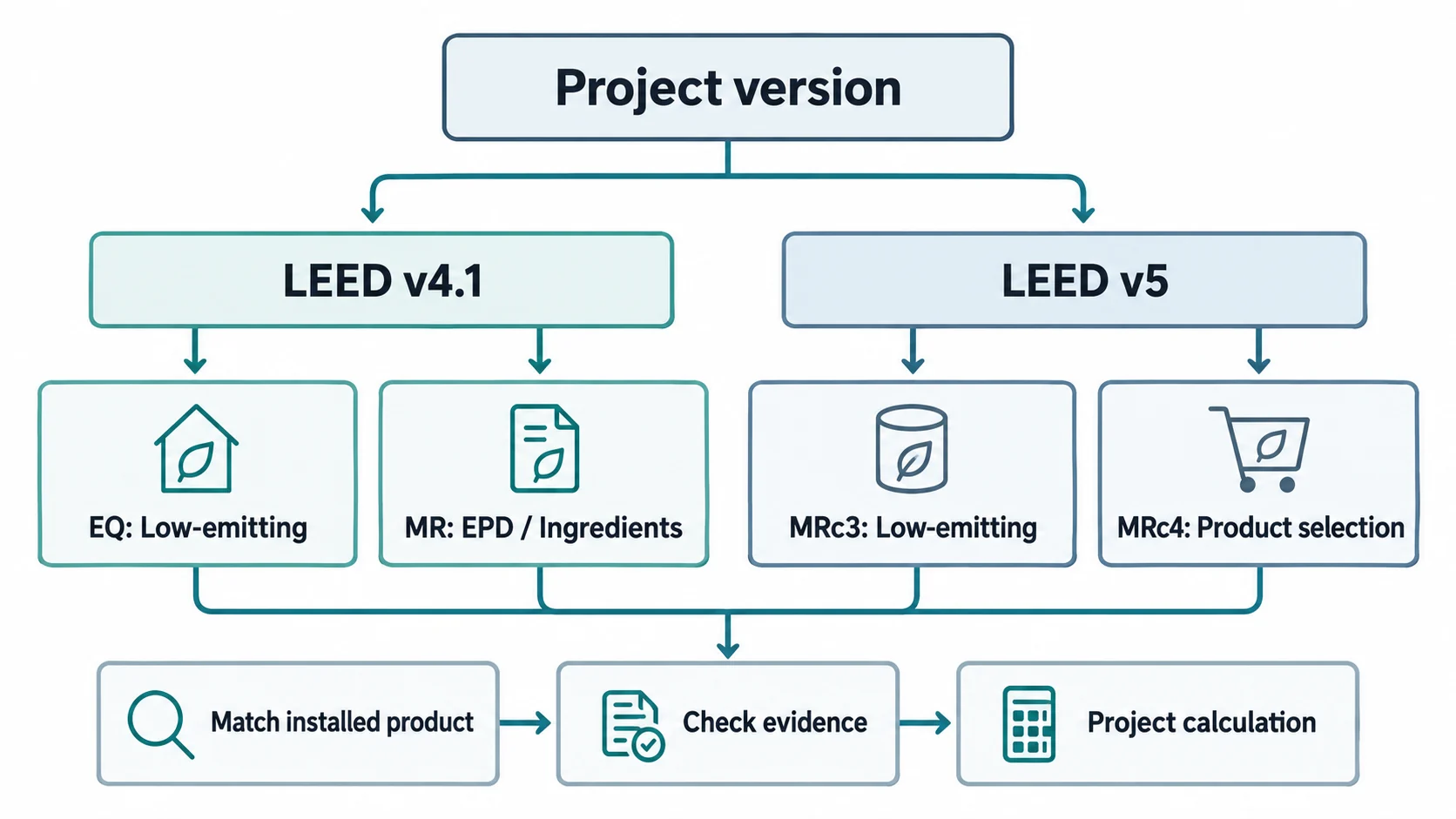
Which LEED version and rating system does the project use?
Use the version and rating system selected for the project, then read that system’s credit requirements. BD+C covers building design and construction; ID+C covers interior projects. Guidance written for LEED residential projects can describe a different system with its own product categories and calculations.
USGBC provides separate LEED v5 rating-system resources and v4.1 resources. The v5 BD+C and ID+C documents used here are the July 2026 editions, listed on their resource pages as published August 1, 2026. Put the edition beside the credit name in the approval schedule.
Low-Emitting Materials appears under Indoor Environmental Quality in v4.1 and under Materials and Resources in v5. The product selection framework also changes. Transferring an old spreadsheet’s heading while retaining its old calculations can therefore produce an apparently complete but incorrect submission.
For a commercial fit-out, establish whether the material is being reviewed under the building project or an interiors project before requesting declarations. When a supplier sends a general “LEED information” sheet, compare its named version and credit against that decision. Keep the correct source document with the product record for later review.
Is the finish a wall product, furniture or composite wood?
Classify the installed item by its use and construction. In v5, a wall covering and a cabinet can use similar-looking decorative surfaces while belonging to different low-emitting product categories.
The v5 category definitions include wall coverings, paneling and other finish carpentry in the walls category. They exclude cabinetry, case goods and countertops from walls and place them in furniture. The following comparison applies to those v5 definitions.
| Installed item | Category or evidence route | Consequence for the finish review |
|---|---|---|
| Interior wall covering or wall paneling | Walls; VOC emissions evaluation | Match the report to the wall product being installed |
| Custom cabinet or other casework | Furniture | Evaluate the completed item or the qualifying components |
| Applicable composite wood product | Composite wood; formaldehyde emissions evaluation | Examine the specified wood product’s accepted evidence |
| Adhesive wet-applied on-site | Adhesives and sealants | Include the site-applied product in its stated scope |
For custom furniture, v5 provides two useful routes. All components of the finished piece, applied on-site or off-site, can be declared under furniture and meet the VOC emissions criteria. Alternatively, the finished piece can meet the furniture emissions or VOC emissions criteria as a whole. This gives the reviewer a practical choice between a complete component evidence set and evidence for the completed item.
A film-only report leaves the adhesive and core to be addressed in the component route. A formaldehyde-free declaration for furniture needs to identify whether it refers to the face, the core or the assembled item. For the project submission, identify the actual construction before accepting a surface document as evidence for the item.

What evidence meets the low-emitting materials route?
Accepted evidence must match the product, test method, exposure scenario and purchase date. For v5’s VOC emissions route, the current requirements allow a qualifying third-party certification valid at purchase, or a qualifying independent laboratory report or summary for testing performed no more than three years before purchase.
The ID+C low-emitting criteria reference CDPH Standard Method v1.2-2017 and its private-office limits. Classroom products may use the schools or private-office scenario. Furniture and composite wood also have their own evaluation routes, so the document review must follow the selected category.
Read the scope before the result. Does the document identify the submitted model, finish and construction? Does it cover the product as purchased, or a component used to make it? Then examine the test date, the certification’s validity and the exposure scenario. A report for another formulation needs an explicit basis for covering the proposed product.
For a custom reception desk, decide whether the submission will use the finished-piece route or the component route before collecting files. The component approach needs evidence across the finished construction, including materials applied in the factory. A folder containing only the decorative face’s certificate would leave that approach incomplete.
Odor and cleanability can prompt separate questions during sample evaluation. The discussion of furniture off-gassing explains that broader topic; the credit review should use the specified emissions evidence. Scratch and stain results answer service-performance questions instead.
How do environmental and ingredient documents differ?
Environmental product declarations describe life-cycle environmental information; ingredient disclosures identify product contents; emissions testing evaluates substances released under defined conditions. Select the document that answers the credit requirement you are reviewing.
Under the v4.1 ID+C requirements, Environmental Product Declarations and Material Ingredients are separate MR credits with their own options. An EPD review concerns its scope, applicable standards and product or manufacturer coverage. An ingredient review concerns an accepted inventory method and the disclosure required by that option. Neither review can be completed from a PVC-free statement alone.
For a specified wall finish, place each document beside the question it answers. The EPD belongs with the environmental-information review. A complete accepted ingredient inventory belongs with the ingredient review. An emissions report belongs with the indoor-emissions review. This arrangement exposes a missing document without asking one certificate to answer every question.
In v5, Building Product Selection and Procurement considers eligible documentation across climate health, human health, ecosystem health, social health and equity, and circular economy. Its current requirements determine which attributes can be counted. Preserve the eligibility assessment with the document before entering a score.
For the terminology behind some ingredient labels, see how to check Red List Free wall-panel evidence.

How are material contributions counted toward LEED points?
Count contributions within the project’s required categories, using the calculation for the selected credit. A document supporting one product enters that calculation; it does not assign the project a point by itself.
For v5 ID+C MRc4, the product’s documented sustainability attributes determine its multi-attribute score, or MAS. The calculation then uses:
Adjusted product value = product value × verified MAS
The category calculation adds these adjusted values, divides by the total value of all products in the category, and multiplies by 100. A v5 ID+C category result greater than 100% earns one point; a result greater than 200% earns two. That credit permits up to ten points. The ID+C MRc4 text supplies the formula and thresholds; BD+C has its own allocation and maximum.
The denominator includes the whole category, so retain the total alongside the qualifying entries. Adding documented products while omitting the rest of the category would change the result. Keep the chosen value basis consistent with the applicable category requirements.
MRc3 uses another calculation. For example, v5 ID+C’s two-category, one-point pathway requires more than 90% in each of those product categories. These are strict “greater than” thresholds in the July 2026 text. Copying a different version’s percentage, or replacing the symbol with “at least,” changes the requirement.
How to choose materials for LEED credits?
Start with the project version, classify the installed item, match its evidence, and enter its contribution on a consistent calculation basis. The material approval schedule below turns that sequence into checks you can complete for each finish.
| Schedule field | What to enter | What the entry prevents |
|---|---|---|
| Project basis | Version, rating system and selected credit option | Applying a different system’s requirements |
| Installed item | Location, use and product category | Counting cabinetry as a wall finish |
| Product identity | Proposed model, finish and construction | Accepting evidence for another product |
| Evidence coverage | Document type, issuer and covered components or finished item | Leaving a layer outside the selected route |
| Dates and scenario | Purchase date, applicable validity or test date, exposure scenario | Accepting unsuitable or outdated evidence |
| Calculation basis | Applicable cost, area, volume or units; category total | Losing the denominator or mixing measures |
| Approval outcome | Accepted entry or the exact unresolved requirement | Treating an incomplete review as approval |
This is a working review checklist derived from the requirements, not an official submission form. Attach the actual supporting files to their entries, so another reviewer can follow the decision without interpreting a supplier’s marketing page.
When a finish is substituted, revisit the affected entry. A visually matching replacement can have a different product identity, construction or document scope. Compare those fields before carrying the previous approval forward. The sample can resolve color and touch; the schedule resolves whether the proposed replacement has the evidence needed for its stated role.
How can you evaluate a silicone decorative surface?
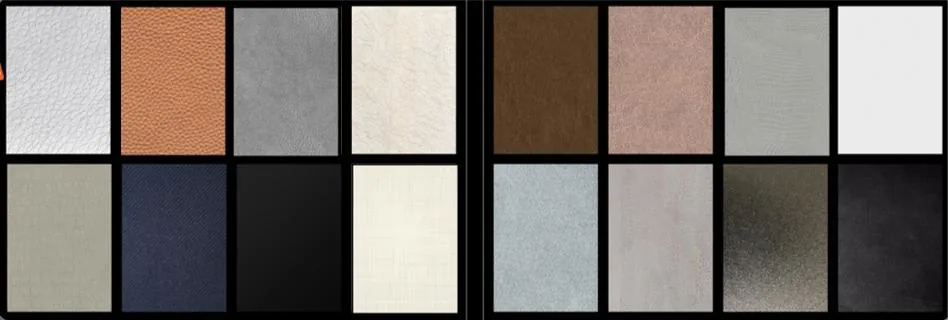
Puremorfilm makes decorative film with a silicone functional surface for furniture and interior walls. Compare samples for appearance, touch and the intended application. Our silicone functional surface provides a paint-free finish distinct from PVC, melamine, PP and PETG decorative surfaces.
The film’s silicone surface is inherently flame-retardant, with higher grades up to UL 94 V-0 available on request. In the manufacturer’s laboratory tests, coffee, red wine and soy sauce left at 25°C for 24 hours wiped off with no obvious change. The film uses a No DOP formulation. Our furniture and wall films are PVC-free, and the film itself is formaldehyde-free.
We mainly supply rolls for PUR flat lamination, with film-faced panels available on request. Explore furniture decorative film or decorative wall film, then request free samples. Evaluate any project-credit documentation through the same approval process described above.
What should be approved before ordering the finish?
Approve the proposed construction, the matching evidence and its place in the project calculation before ordering. Give the finish a clear approval outcome so sample acceptance cannot be mistaken for completion of the document review.
| Review outcome | Next action |
|---|---|
| Product, documents and calculation entry match | Retain the approved record and assess the sample for the intended application |
| Appearance is suitable but evidence has a gap | Identify the missing product, component or document requirement before approval |
| A replacement changes the construction or product identity | Review the affected classification, evidence and calculation entry again |
For a wall finish, the category review follows its wall use. For cabinetry, the finished-item or component route determines the evidence set. Keeping those decisions beside the sample reference gives the design and documentation teams the same proposed product to approve.
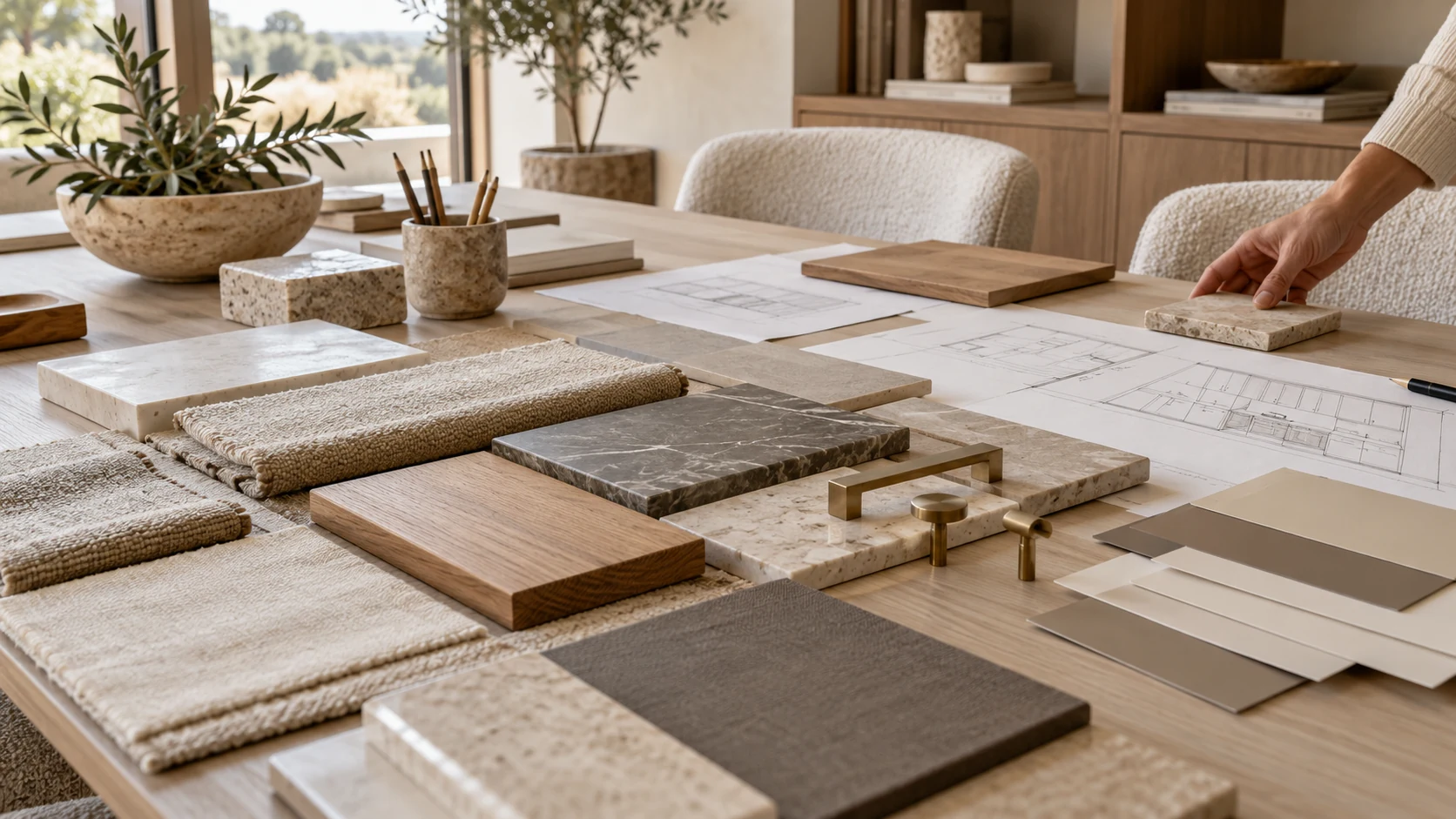
Bring the project version, installation location and required evidence categories when requesting samples or an inquiry; contact us to discuss the decorative surface you want to evaluate.
Frequently Asked Questions
How to get LEED credits?
Projects earn LEED credits by meeting the chosen rating system’s requirements across the documented project scope. Select the applicable credit pathway, establish which products and categories it covers, and supply the evidence and calculations that pathway requires. Product literature can support that work, but the project submission determines credit achievement.
What criteria should you consider when selecting materials?
Material selection should follow the project’s version, installed category, evidence route and calculation basis, together with the application’s performance needs. Compare the proposed product identity with the supporting document, review its dates and scope, and record the applicable quantity. Evaluate appearance and touch through samples alongside that documentary review.
Does LEED certify individual building materials?
No. LEED certifies projects, not individual building materials. A product may have documentation that supports a project’s selected credit pathway. Its eligibility must be assessed against that pathway and the project’s requirements, rather than inferred from a claim that the product is “LEED certified.”
Which material documents are useful for a LEED project?
Product-specific emissions evidence and the environmental or ingredient documents required by the selected credit are useful. Their scope should cover the proposed product or the components needed for the chosen route. Keep product identity, relevant dates, exposure scenario and the calculation entry with the documents so their intended use is clear.
Do EPDs guarantee LEED credit eligibility?
No. An EPD must meet the selected pathway’s requirements and cover the applicable product or manufacturer. The project also needs to satisfy the credit’s calculation and scope requirements. Review the declaration under the project’s actual version before carrying its contribution into the material schedule.