
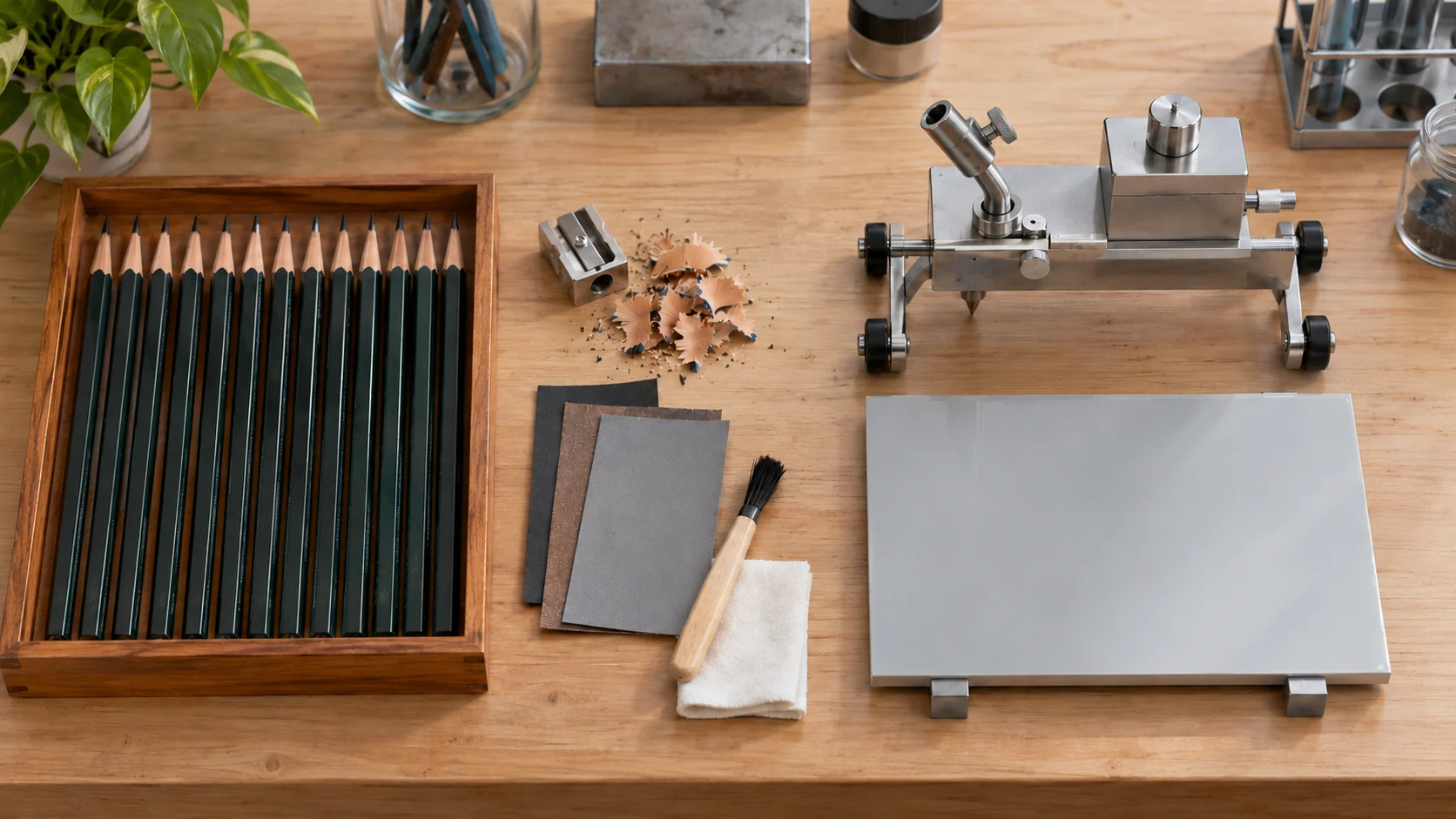
A pencil hardness test rates a coating with graded graphite pencils. To judge a result, you need the method, prepared pencil ends, controlled samples and a clear damage endpoint. A report that gives only a grade leaves out the support and applied force.
What does a pencil hardness test measure?
A coating’s relative resistance to damage from a prepared pencil lead under set conditions. You push graded pencils across the surface and find the boundary between the pencils that damage the coating and those that leave it intact.
The coating, pencil and support all shape the result. Use it to compare coated panels under controlled conditions or check production against an agreed reference. Comparisons get harder when supports, cure histories or procedures differ.
The D3363 method is a rapid assessment of organic coating films on metal or similarly hard substrates, and the 15184 method is limited to smooth surfaces. So a loose flexible film, a textured panel and a coating on metal each need different handling when you plan the test.
A pencil grade is a ranked result; force and mineral hardness use different measurements. Passing a harder pencil tells you little about keys, repeated rubbing, impact or chemicals.
For wear from repeated contact, use an abrasion method. D4060 uses a Taber Abraser on organic coatings on a flat, rigid surface; its abrasion-method scope describes that separate test. Match the test to the failure you care about before you compare numbers on data sheets.
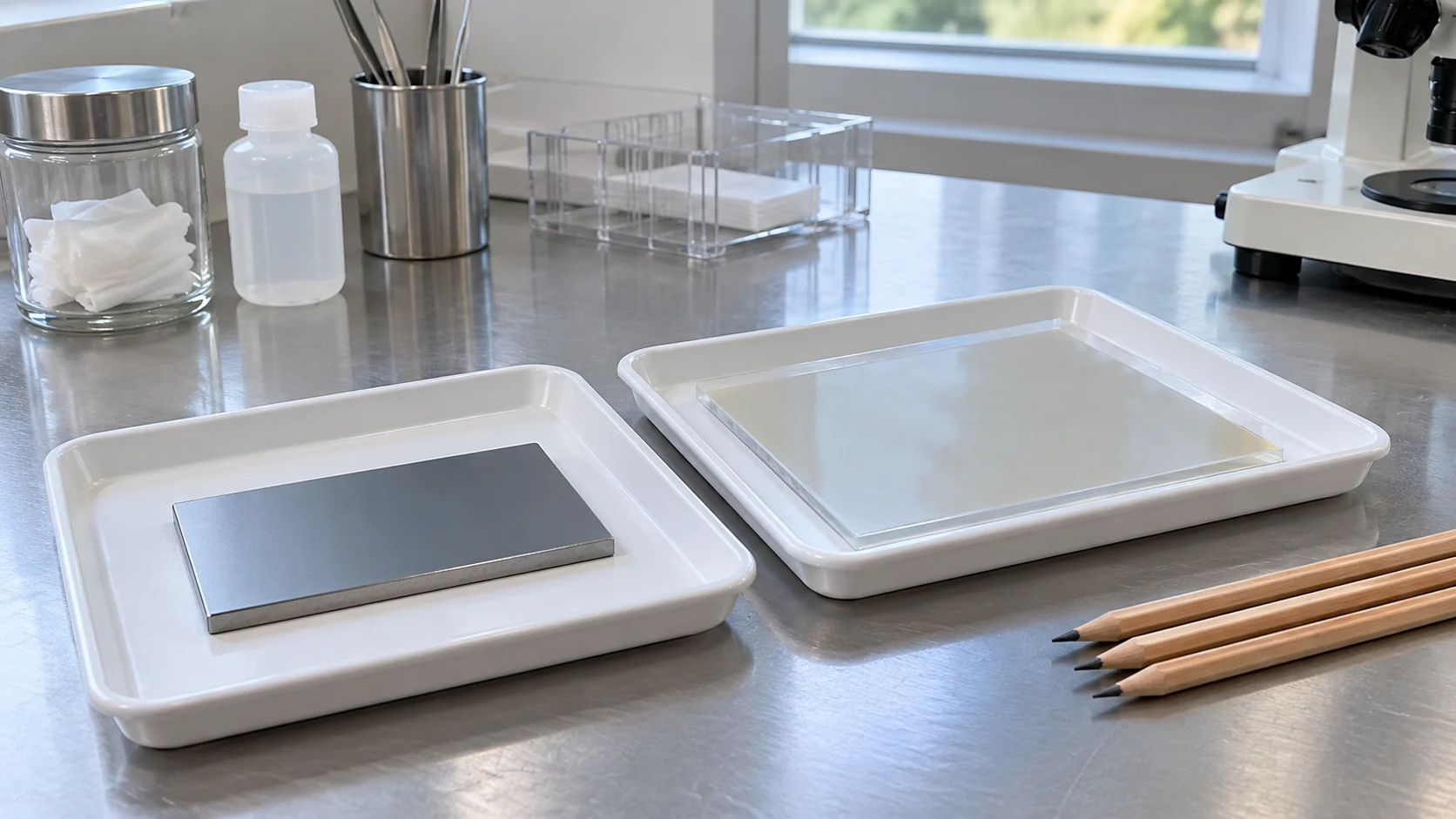
For the wider test plan covering the face, core, edge and bond, see cabinet surface durability testing.
Which standard should you specify before testing?
The standard’s designation and edition, then the endpoint and the sample construction. D3363 and ISO 15184 cover related pencil tests, but the publisher states that they are not technically equivalent.
At the time of this review, D3363-22 is listed as active, and 15184:2020 is published with a draft revision under development. A draft number on a website should not quietly replace the published edition named in your test agreement.
| Method reference | Published scope or status | What to establish in the test agreement |
|---|---|---|
| ASTM D3363-22 | Organic coating film on metal or a similarly hard substrate | Required endpoint, panel construction and procedure edition |
| ISO 15184:2020 | Pencil assessment of a coating or upper coating layer on a smooth surface | Applicable sample, defect criterion and complete method conditions |
| Customer-defined pencil procedure | Conditions supplied by the customer or laboratory | Full instructions, applied force and meaning of a passing result |
The publisher pages are D3363-22 and 15184:2020. Their summaries give scope and status; a lab needs the full agreed procedure to run and report a conforming test.
If you ran a customer-defined procedure, call it that. In a purchase agreement, settle the method before anyone tests, so buyer and supplier measure the same thing.
How do pencil grades and pencil selection affect the result?
H grades are harder leads, B grades are softer, and HB sits in between. A bigger number before H means harder; a bigger number before B means softer.
The “lead” is graphite-based, and its grade describes the material challenging the coating. Faber-Castell’s graphite-grade explanation shows the scale, including HB and 2B: 2B is softer than HB.
Use a set that brackets the expected result, and record which set it is. A desk pencil can carry the right grade and still behave differently from the set behind your reference. Use the same maker and batch for comparisons, and note any change.
Check the graphite end before each stroke. A chipped or uneven edge changes the contact, so re-prepare the tip rather than counting a bad stroke as a material result.
For incoming inspection, buyer and supplier can agree on one reference set. A disputed result is much easier to investigate than two anonymous pencils with the same grade. Store the pencils with the records so a later check can repeat the selection, preparation and sequence.
How should factory teams run a controlled pencil test?
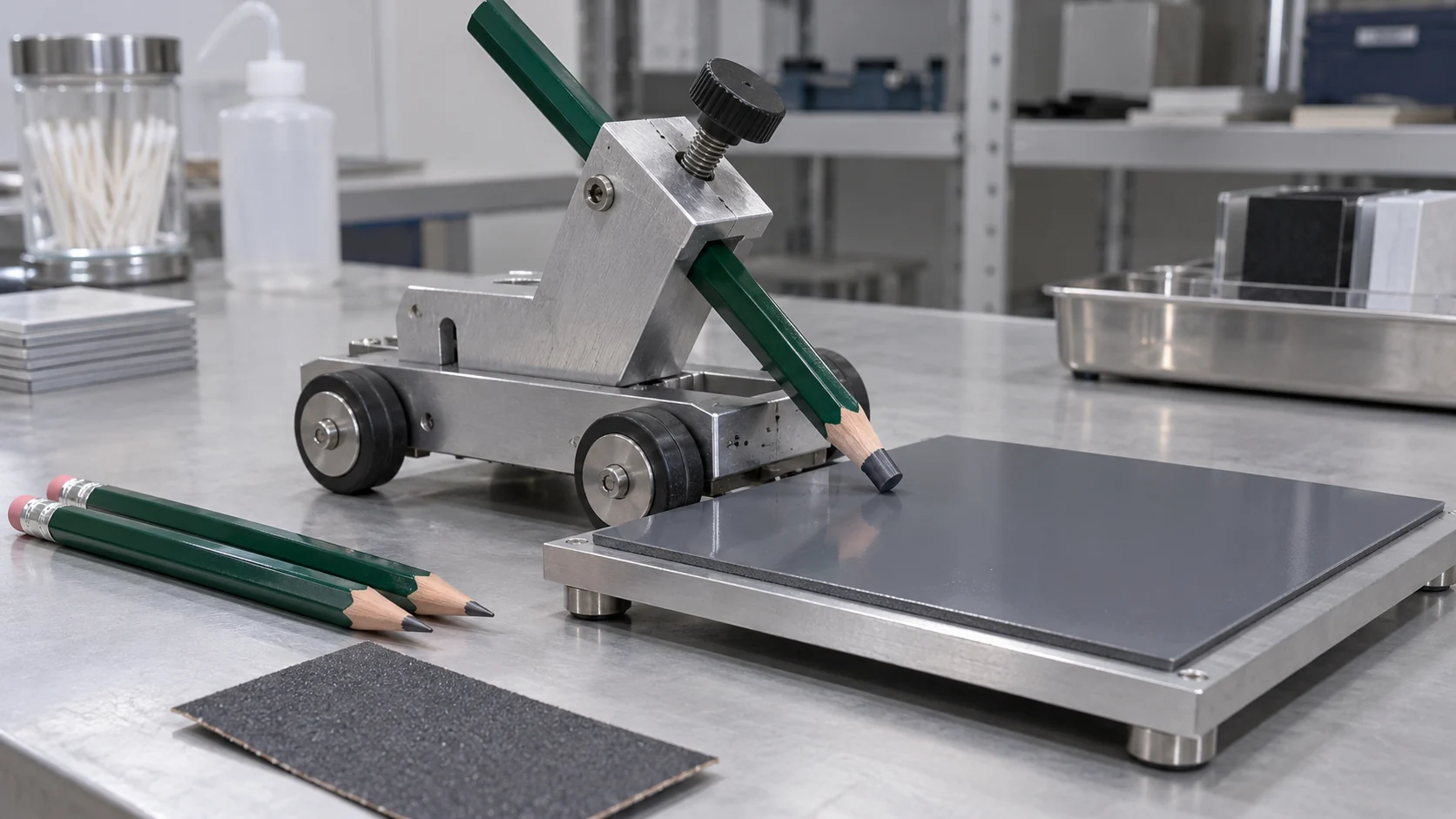
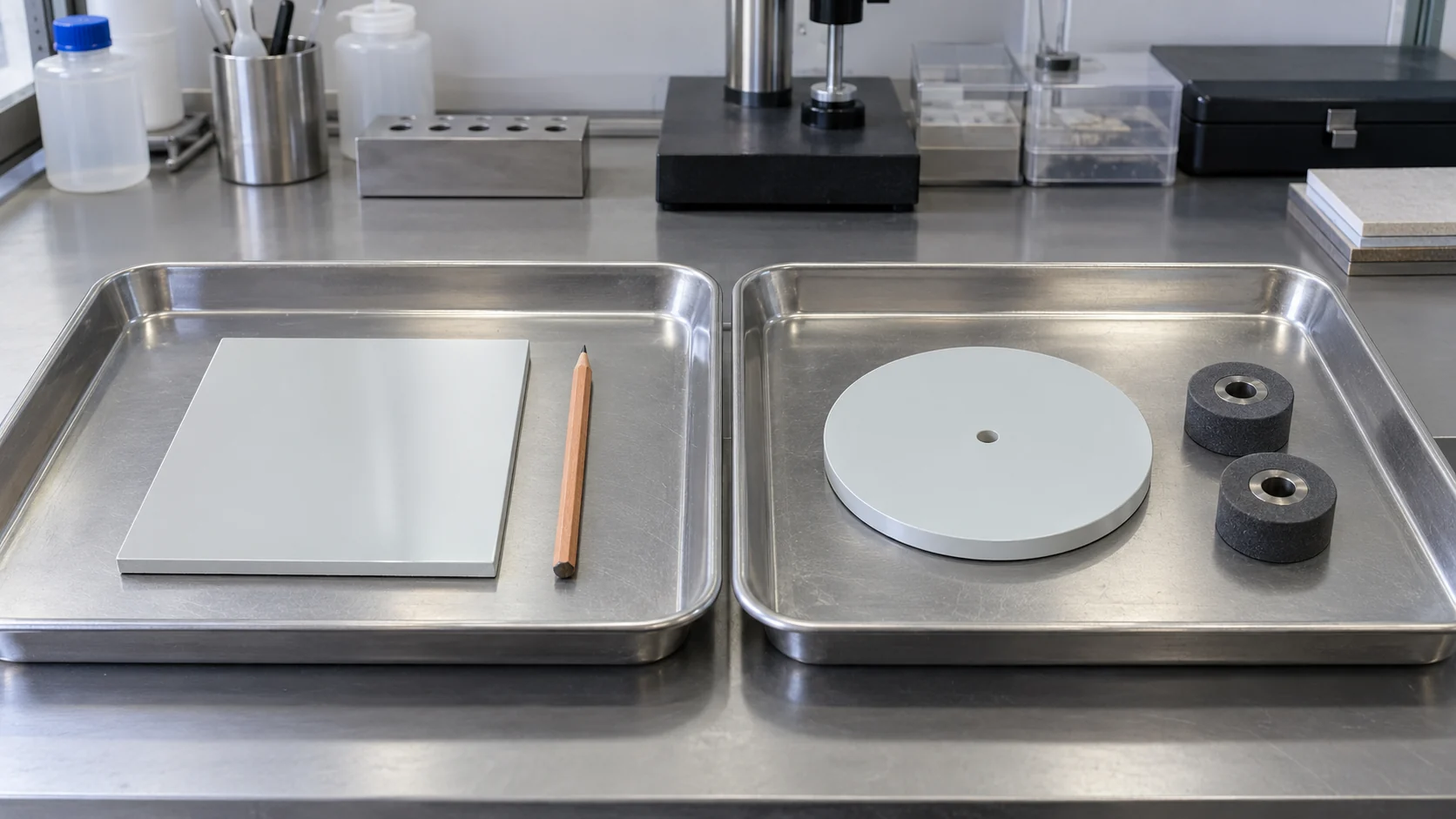
Prepare a smooth, supported, fully cured sample and form the prescribed flat pencil end. Run the chosen procedure with the same angle, force and grading sequence throughout. A holder fixes the pencil position; the operator must still name and report the method.
DeFelsko’s PosiTest PT manual shows how one tool runs the test. It tests at 23 ± 2°C and 50 ± 5% relative humidity unless otherwise agreed. Its ASTM D3363 branch starts with the hardest pencil, applies enough pressure to cut the coating or crumble the lead edge, and works down to softer grades; its 15184 branch uses a different sequence.
| Example step | PosiTest PT manual detail | Why you record it |
|---|---|---|
| Prepare the lead | Expose approximately 5–6 mm; flatten the end with the supplied 400-grit abrasive | Establishes the intended contact edge |
| Make the ASTM-branch stroke | Hold the pencil at 45° and push at least 6.5 mm | Defines angle and travel for this example |
| Determine gouge and scratch endpoints | For gouge hardness, find the pencil that does not cut through to the substrate or previous coat over at least 3 mm; for scratch hardness, find the pencil that does not scratch or deface the coating | Applies the stated damage criterion to each result |
| Repeat the ASTM-branch procedure | Perform it twice | Provides a repeated determination |
See the PosiTest PT manual, English preparation and pencil-test sections for the illustrated procedure. DeFelsko lists the optional cart’s constant force as 7.35 N on the current product page; the manual requires the cart for its 15184 procedure and makes it optional for the D3363 procedure.
Record the holder and how it applies force. The tool’s total weight differs from the force at its pencil tip. Report force in a stated unit, such as newtons or gram-force, and describe the setup. If the report only says “grams,” ask the issuer what it means.
How do you distinguish pencil marks, scratches and gouges?
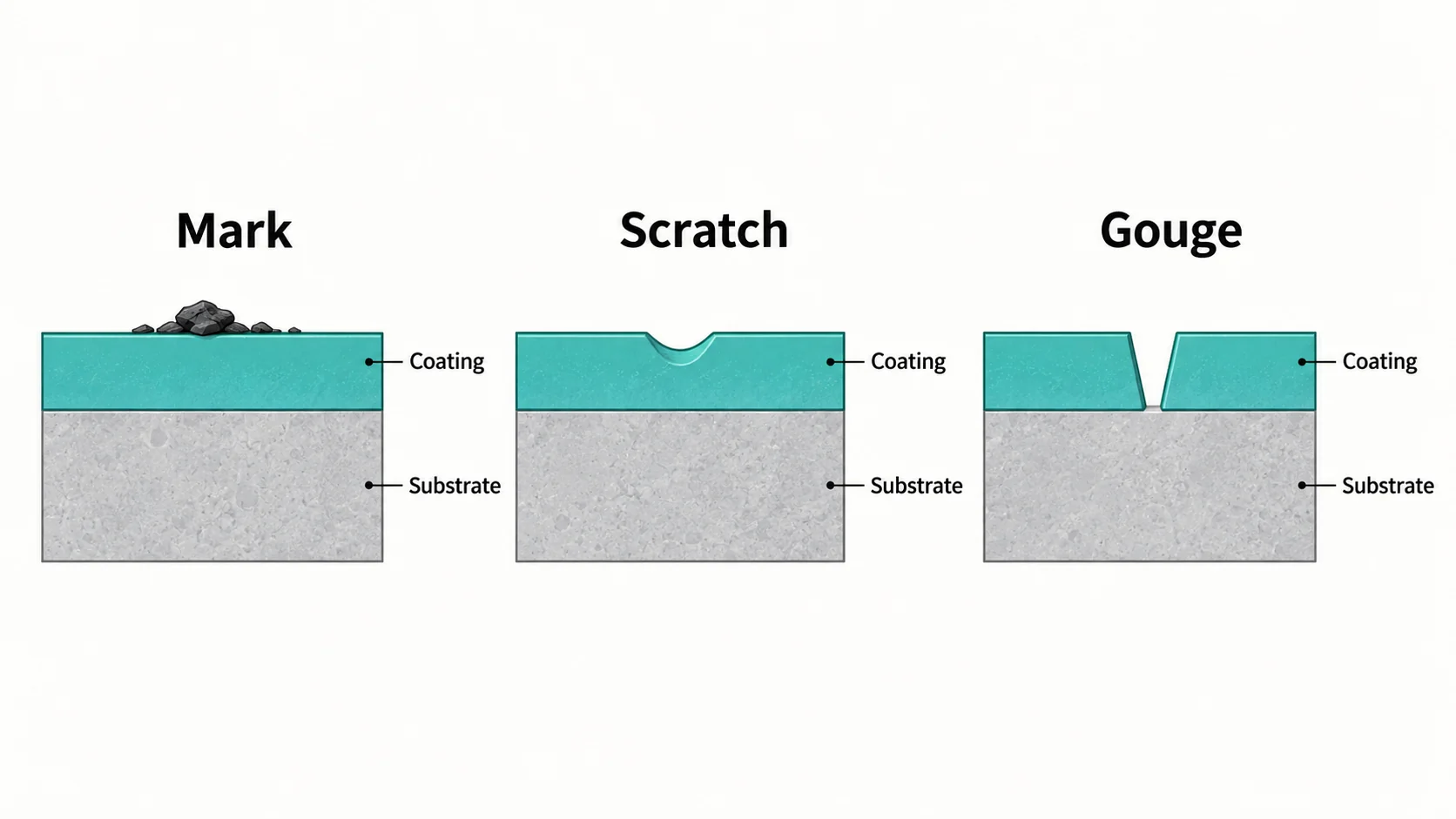
Look at whether the stroke left graphite on an intact surface, damaged the coating surface, or cut into the layer below. Each points to a different endpoint, so describe what you see before you assign a grade.
A dark line can be just graphite. The agreed procedure may let you wipe it off with something that leaves the coating unchanged and then inspect the track. Check that the cleaner doesn’t alter the finish first, or you can no longer trust the observation.
For scratch hardness, find the pencil at which the surface gets damaged. For gouge hardness, look for penetration through the film toward the substrate or an earlier coat. One coating can give different scratch and gouge results in the same test.
The American Coatings Association’s discussion of pencil-test endpoints explains the distinction, and KTA’s coating-hardness article shows how the hardest non-damaging pencil sets the boundary.
Photograph any doubtful track with the sample ID and describe it. “Passed” on its own leaves the reader guessing whether you looked for a scratch, a gouge or a wipeable mark. If the surface was damaged before testing, note it and move to an undamaged spot.
Why can results differ between panels or laboratories?
Pencil set, sample support, coating condition, preparation and evaluation all move the result. Compare like samples under the same procedure before you read a grade change as a coating change.
Softer substrates, including wood, can deform and affect the result, according to the standard’s significance-and-use section. That matters for decorative films and finishes on wood-based panels, where the face and the panel together are what you are testing.
Record the support used under a flexible sample. If your question is how a finished laminated panel behaves, test that panel, and label a film-on-rigid-support test for what it is. Our laminated MDF construction guide explains the face and core roles that belong in that record.
Wood-based cores differ too. If you switch cores, record the core with the finish; our MDF versus solid wood discussion gives the background. A facing comparison is hard to defend when the substrate changed at the same time.
Track curing as well: when the coating went on, how it cured and when you tested. A fresh coating and an older specimen can be at different stages. If a result jumps unexpectedly, check those records and repeat the agreed procedure on a comparable sample before you draw a production conclusion.
What belongs in a test report and purchase specification?
The sample, procedure, pencil set, loading, endpoint and observations in the report. A purchase specification adds the acceptance limit and the construction it applies to.
| Item | What to specify | Why it matters |
|---|---|---|
| Sample identity | Coating or film model, production lot and tested face | Connects the result to the supplied material |
| Construction | Substrate, support and coating or facing thickness | Describes what was actually tested |
| Method | Standard and edition, or a complete named custom procedure | Establishes the procedural basis |
| Pencil and setup | Pencil manufacturer, batch, preparation, holder, angle and force | Supports repeat testing and comparison |
| Conditioning | Cure history and test environment | Identifies the state of the sample |
| Evaluation | Scratch, gouge or other specified defect; observations and repeats | Makes the pass/fail criterion interpretable |
| Acceptance | Agreed minimum result and action on a discrepant result | Makes the requirement usable for purchasing |
A full-scale grade determination and a single-pencil check are different results. The first finds a boundary across grades; the second records what one pencil did under stated conditions. Say which one your acceptance limit needs.
Carry the real assembly into the specification. A furniture-facing material and a wall-facing material can both quote a pencil result, yet a cabinet door and a corridor wall need their own construction and service criteria. Ask for evidence that matches your component and the damage you expect.
What does our reported 2H pencil check tell you?
Puremorfilm makes decorative film with a silicone functional surface for furniture and wall panels. Its SGS pencil check (report PL02, August 26, 2026) used a Mitsubishi Uni 2H pencil at 500 gf and 45°, and three lines at least 20 mm long showed no obvious scratches. That is a single-pencil check under the stated load, not a full grade determination. For repeated contact, an SGS Taber abrasion test (ASTM D4060-25, CS-10 wheels, 1,000 g per wheel, 60 rpm) found only slight matting after 2,000 cycles, with no substrate exposure or coating peeling.
Beyond hardness, the silicone surface is inherently flame-retardant, with grades up to UL 94 V-0 on request; the film uses a No DOP formulation, and in the manufacturer’s laboratory tests, coffee, red wine and soy sauce left on the surface for 24 hours at 25°C wiped off with no obvious change. We supply it mainly in rolls, with laminated panels on request, for PUR flat lamination. It is a new paint-free facing whose silicone functional surface differs from PVC, melamine, PP and PETG decorative surfaces. The company overview explains the supply options.
How should you use the result to choose a decorative facing?
Use the pencil result for the coating-damage question it answers, and add evidence for the wear and the finished construction your application involves.
| Your question | Evidence to use |
|---|---|
| Is this coating consistent with an agreed reference? | Comparable pencil tests with the same procedure and endpoint |
| Will the face withstand repeated rubbing? | An appropriate abrasion test with its own conditions |
| How does the finished panel behave? | Evaluation of the specified facing, core and support |
| What did a selected-pencil check observe? | The exact pencil, setup, tracks and recorded observations |
A kitchen door that gets keys and cookware against it needs the pencil result plus abrasion data on the laminated panel. A lobby wall touched now and then may need little more than the pencil check.
Define that requirement before you ask for a sample. To discuss a furniture or wall-facing sample, contact us with the intended construction and the test question you need answered.
Frequently Asked Questions
How to check pencil hardness?
Push prepared, graded graphite pencils across a supported coated surface and find the specified damage endpoint. Record the method, construction, pencil set and loading.
Which pencil is softer, HB or 2B?
2B is softer than HB. B grades get softer as the number rises; H grades get harder.
What is the ASTM standard for pencil hardness testing?
ASTM D3363-22, Standard Test Method for Film Hardness by Pencil Test, is the current active edition on ASTM’s publisher page.
What is pencil hardness?
Pencil hardness is a relative rating of how a coating responds to prepared graphite pencils under a defined procedure. It means little without the sample, conditions and defect criterion.
What is the difference between scratch and gouge hardness?
Scratch hardness is about surface damage; gouge hardness is about a cut through the coating toward the layer below. One coating can give different results for each.