
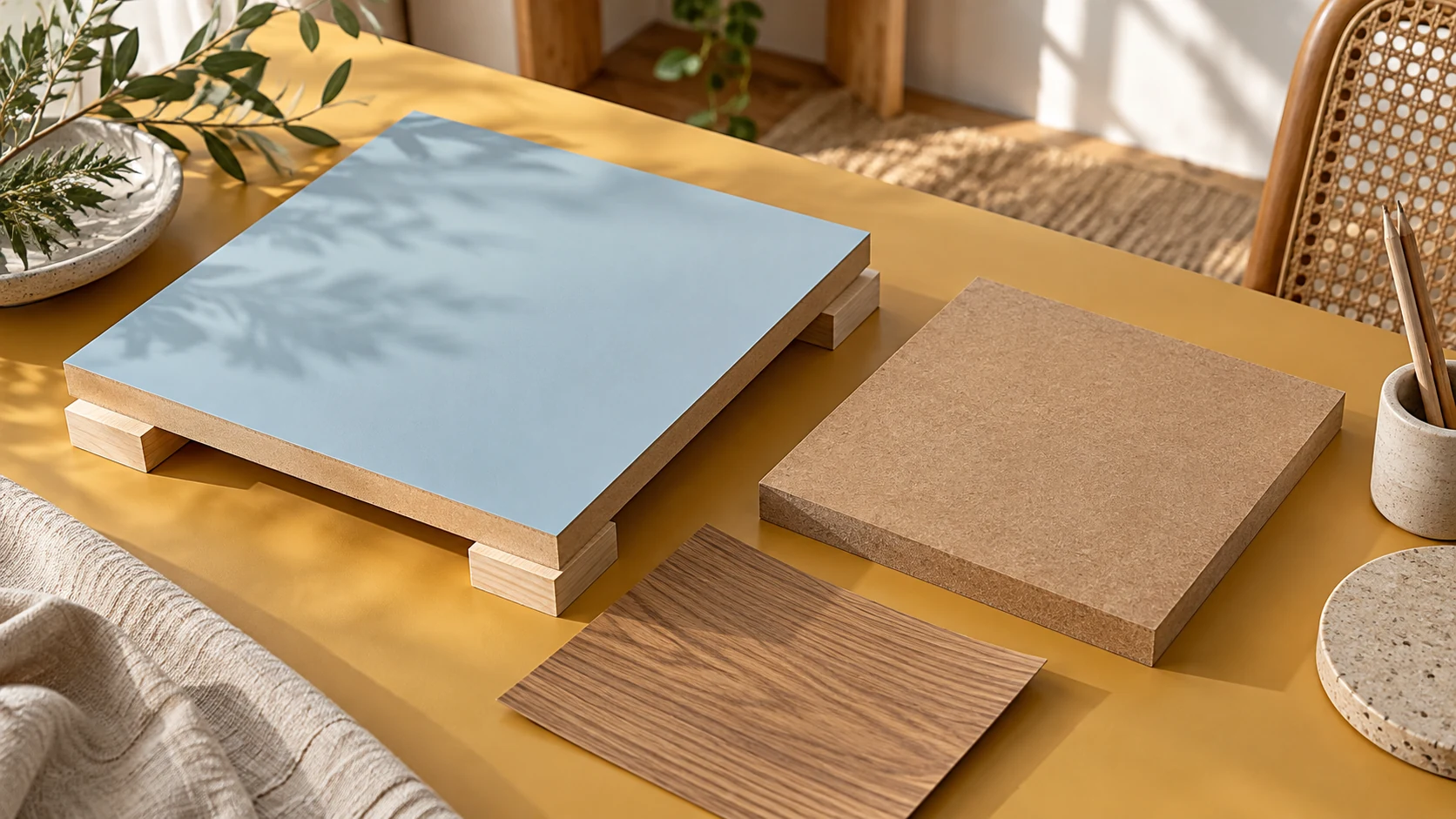
Laminated MDF is medium-density fiberboard with a decorative layer bonded to its face, most often melamine paper (TFL), a high-pressure laminate sheet (HPL), PVC or PET film, or wood veneer. The MDF core gives a flat, stable panel and the laminate gives the color, pattern and wear resistance, so the panel arrives ready to use without painting. Common uses include cabinets, wardrobes, office furniture and wall panels.
What does laminated MDF mean?
An MDF board with a finished decorative face bonded on; raw MDF is the same board before facing. MDF production combines cellulosic fibers with resin and forms them under heat and pressure, as the Composite Panel Association’s MDF overview describes. Its smooth core takes several different finishing systems.
“Laminated” describes the panel’s construction without identifying the facing. A white cabinet side could carry fused resin paper, a glued HPL sheet or a polymer film. In a photo they look alike, but their construction, edges and repair options differ.
MDF contains wood fibers but none of the continuous grain of solid lumber. Printed oak on a resin or film face is still a printed design. A real wood-veneer face is a thin layer of wood, so name it separately on the order instead of calling both “wood finish”.
The core is also what tells laminated MDF apart from faced particleboard. A cut MDF edge shows fine fibers; particleboard shows larger particles. Our guide to what MDF is explains the core, and the MDF and particleboard comparison helps when two finished panels look the same but sit on different boards.
Our silicone-faced laminated MDF panels page describes the faced-panel option available on request.
Laminated MDF vs plain MDF: what changes?
| Question | Plain (raw) MDF | Laminated MDF |
|---|---|---|
| Surface out of the pack | Smooth brown fiber face that still needs priming and paint, veneer or a laminate | Ready decorative face in a color, woodgrain or texture |
| Typical uses | Painted doors, routed profiles, moldings, shop-made parts | Cabinet boxes, shelves, flat doors, wardrobes, office furniture, wall panels |
| Cleaning and wear | Depends entirely on the paint system you apply | Depends on the facing: melamine, HPL, film or veneer |
| Cut edges | Need sealing before paint | Need edge banding or a sealed, finished edge |
| Moisture | Swells if water reaches the core | The face resists splashes, but cut edges and holes are still the weak points |
In short, laminated MDF saves the finishing step and gives a consistent face, while plain MDF is the better start when you need to rout shapes or paint a custom color.
Which facing changes the surface and edge design?
TFL for a fused decorative-paper face, HPL for a separately made laminate sheet, film for a bonded polymer face and veneer for real wood. Name the facing and its grade before you compare two quotes.
| Facing | How it reaches the MDF | Detail to identify |
|---|---|---|
| TFL, often called melamine | Resin-impregnated decorative paper is fused directly to the core | Face treatment, back treatment and separate edge finish |
| HPL | A finished laminate sheet is bonded to the core with adhesive | Sheet grade, bonding system and balancing back |
| Decorative film | Film is bonded using the specified flat or forming process | Film chemistry, supported geometry and adhesive route |
| Wood veneer | A real-wood layer is bonded to the core | Species, matching pattern and clear or pigmented finish |
TFL uses decorative paper of typically 60–130 g/m² (TFL manufacturing description). That is the paper’s basis weight; panel thickness and glue spread are separate specs. TFL goes on MDF or particleboard, so “melamine board” tells you nothing about the core.
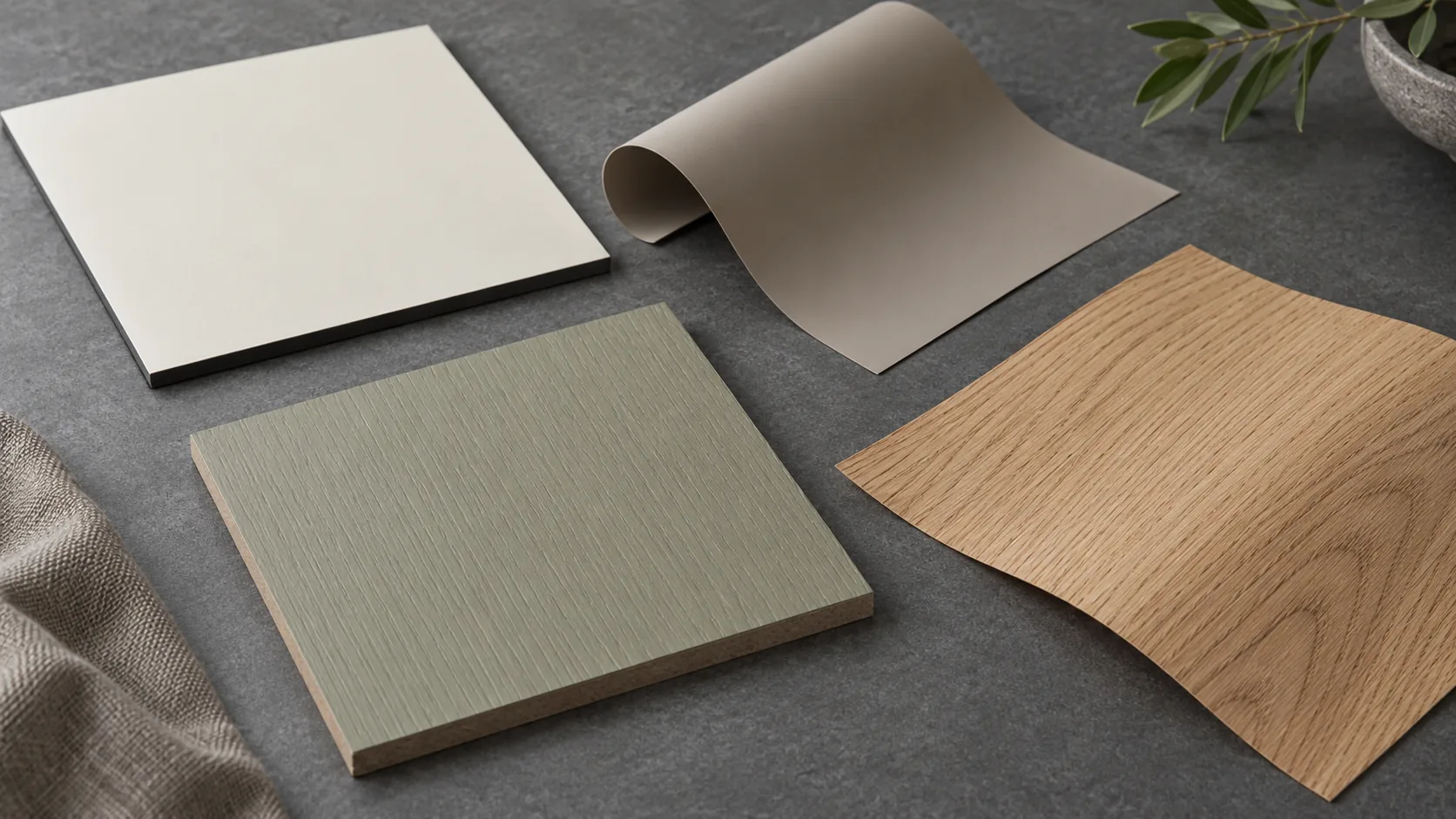
HPL is made as a separate sheet from resin-treated paper layers, pressed at more than 1,000 psi (HPL sheet-making process). Gluing that finished sheet to MDF needs its own bonding spec, and the bonded panel then includes the facing, adhesive, core and back.
For curved or profiled fronts, tell a qualified forming film apart from a flat sheet. Do not send a flat-lamination film through membrane pressing merely because both carry the decorative-film label. The melamine and laminate guide explains why those two names overlap in everyday cabinet talk.
Is laminated MDF suitable for damp areas?
Only for humid air, and only with a moisture-resistant core and protected faces, edges and openings. Where water hits the panel directly, use a separately qualified wet-service construction.
The MEDITE MR guidance, for example, requires bathroom furniture made from that grade to be fully sealed and coated, and excludes waterproof and outdoor use. In a bathroom cabinet, humid air and water running into an exposed edge are two different conditions.
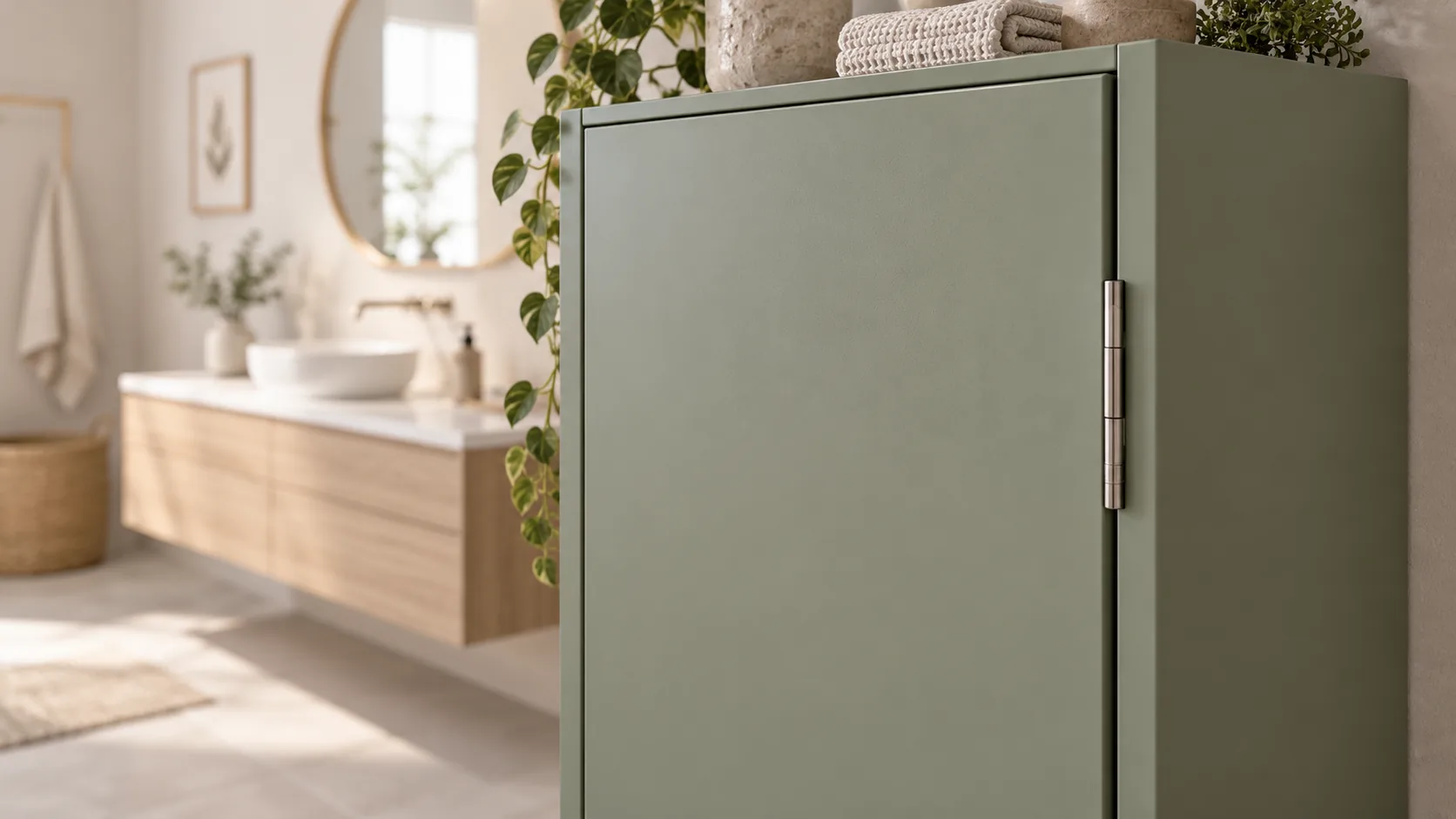
Trace the whole water path. A finished front can still have a bare hinge recess, a cut plumbing hole, a damaged bottom edge or a joint that holds cleaning water. Protect the back and any newly machined areas along with the face.
Fix a sink leak promptly and check the panel for swelling or a lifting face. New banding over a swollen edge leaves the damaged core underneath, and once the shape or hinge fit has changed, a new part is often the practical fix.
The MDF water-resistance guide separates ordinary, moisture-resistant and other qualified grades. On the purchase spec, state the exposure plainly: dry storage, humid interior or water contact. A green core or a glossy face is not enough evidence.
How should you cut and fasten the finished panel?
A panel saw for repeated straight rectangles, a CNC router for shaped outlines and openings, and fixings laid out separately for face entry and edge entry.
First decide which faces stay visible. A door seen from both sides needs clean edges on both faces; a hidden cabinet back can accept less. The European Panel Federation covers panel cutting and CNC routing for shaped or profiled MDF. Your tooling also has to cut the actual facing cleanly; bare-core guidance doesn’t set up a laminate cut.
Check the first machined part for chips, edge breakout and lifting face before you release the program. Keep the decor grain running the same way across doors that sit side by side.
For ordinary screws in one maker’s standard board, the V13 fixing guidance, page 4 calls for a pilot at least 85% of the screw core diameter. Keep a face-entry screw at least 12 mm from the panel edge and 25 mm from a corner; for edge entry, at least 70 mm from the corner. Proprietary fittings need their own hole sizes and layout.
Our MDF cutting guide covers cutting choices, and the edge-banding guide deals with the exposed perimeter. Plan the edge finish into the cut sizes so the final dimensions fit the assembled part.
How do you care for or refinish a laminated face?
Dust with a microfiber cloth, wipe grime with warm water or a mild dish-soap solution, and dry. When the finish itself is worn out, use a documented resurfacing system, and treat a printed resin or polymer face differently from sandable wood.
That routine follows a US cabinetmaker’s care guide, which specifies microfiber cloths for its laminate and high-gloss cabinets. Use a damp cloth, not a wet one, especially near joints and cut edges: a tough face and a vulnerable bare core can sit in the same door.
Dust first so you don’t drag grit across the finish. Don’t treat an unknown matte film like glossy HPL; a cleaner approved for one may mark the other. The laminate cabinet-cleaning guide treats routine cleaning and stain removal as two jobs.
Sound glossy laminate can be painted over a bonding primer. The Stix SXA-110 technical data calls for cleaning and deglossing first. Recoat time is 3–4 hours at 77°F and 50% relative humidity, and full scrape resistance takes about 3–4 days. On an uncertain polymer or composite face, the same sheet asks for a small adhesion and topcoat test; where the facing is loose or the core damaged, repair or replace that area before coating.
Sanding through printed decor destroys the pattern. Veneer may be too thin for heavy refinishing, so check how much wood is left before you remove any. If the facing has come away over a wide area or the core is swollen, weigh replacing the part against resurfacing it.
What sizes and thicknesses does laminated MDF come in?
The most common sheet size is 1220 × 2440 mm, sold as 4 × 8 ft; some mills also offer longer or wider sheets such as 1220 × 2745 mm or 1830 × 2440 mm. Thicknesses usually run from about 3 mm for backs and drawer bottoms to 25 mm or more for worktops and heavy shelving, with 18 mm the usual choice for cabinet carcasses and wardrobe sides, and 15–16 mm common in European furniture.
Check whether the quoted thickness is the core alone or the finished panel, whether both faces are laminated, and which moisture-resistant or low-emission grade the core meets. Price follows the facing (melamine is usually the cheapest, HPL and specialty films cost more), the core grade, the thickness and the order quantity, so compare quotes on the same specification.
What should you specify when buying laminated MDF?
The whole panel: core, face, back, edges and machining, so two quotes describe the same finished part. A color code and a nominal thickness leave too much open.
| Item | What to specify | Why it matters |
|---|---|---|
| Core | MDF grade, nominal thickness and service environment | Establishes the substrate and its intended exposure |
| Face | TFL, HPL, film or veneer; decor and surface grade | Identifies the actual material rather than its appearance |
| Back | Material and balance construction | Reduces the risk of comparing unlike panel assemblies |
| Edges and openings | Edge material, corner treatment and protection after machining | Describes exposed areas that the face does not cover |
| Finished part | Drawing, dimensions, tolerance, grain direction and hardware | Makes acceptance and interchangeability measurable |
| Documentation | Applicable core compliance, facing data and care instructions | Links each claim to the material or assembly it describes |
Face and back need similar physical properties for a panel to stay flat (panel-warp bulletin). Matching colors can hide a back that moves or stiffens differently, so state the balancing build for any free-standing door that has to stay flat.
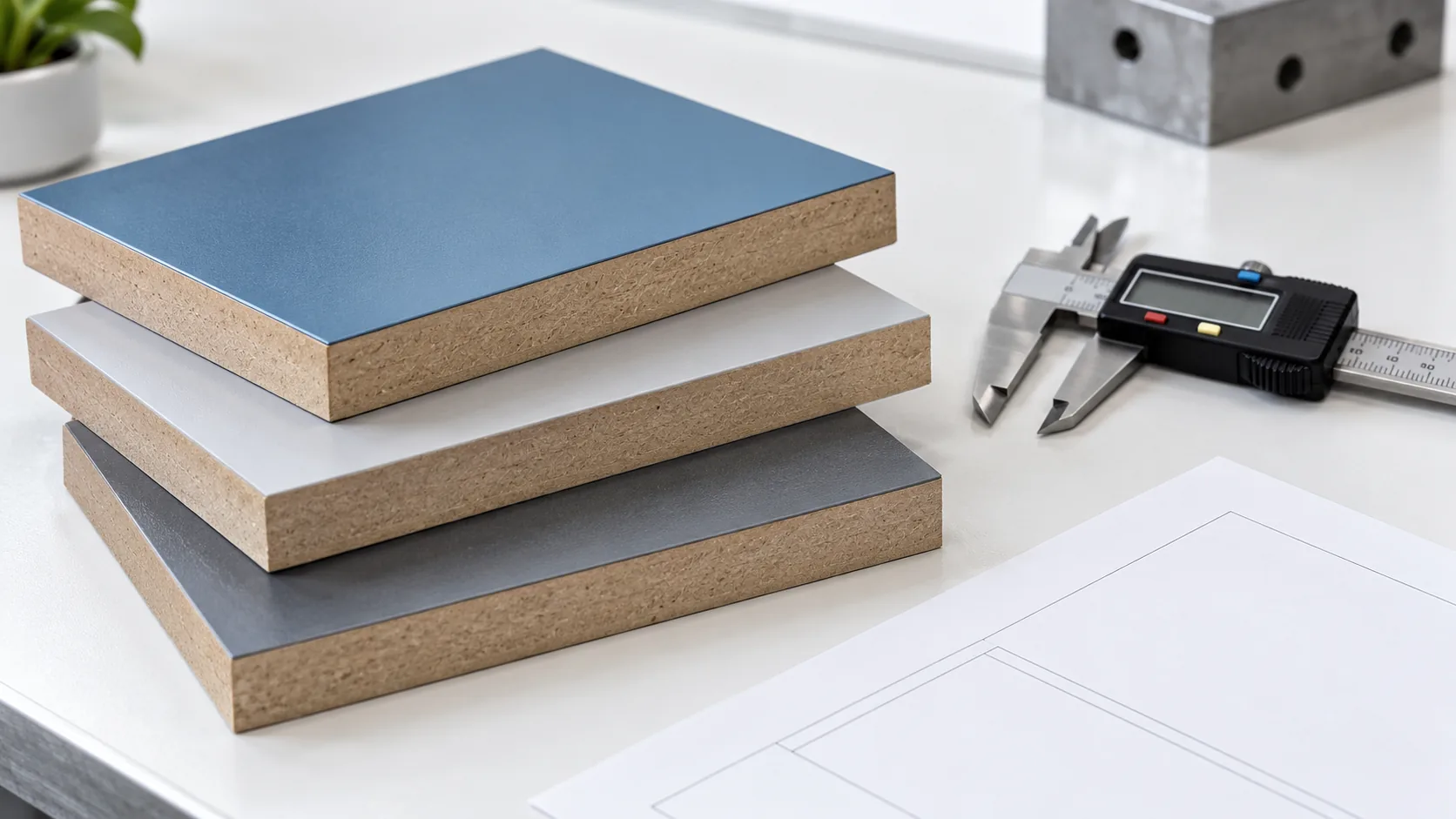
In the US, the trade name and the legal definition differ. 40 CFR 770.3 defines a “laminated product” around wood or woody-grass veneer bonded to specified composite-wood cores. That legal definition is narrower than the everyday use of “laminated MDF” for film-faced or HPL-faced panels, so check the paperwork against the real construction and supply role.
Record any accepted appearance variation, such as veneer matching, gloss and texture direction. Keep the construction record with the decor reference for repeat orders; otherwise a later panel can match the color and still use a different back, edge or face grade.
Where does silicone decorative film fit this choice?
As one more facing for flat furniture parts, judged on the same core, edge and finished-part requirements as the others, where a flat bonding route suits the panel.
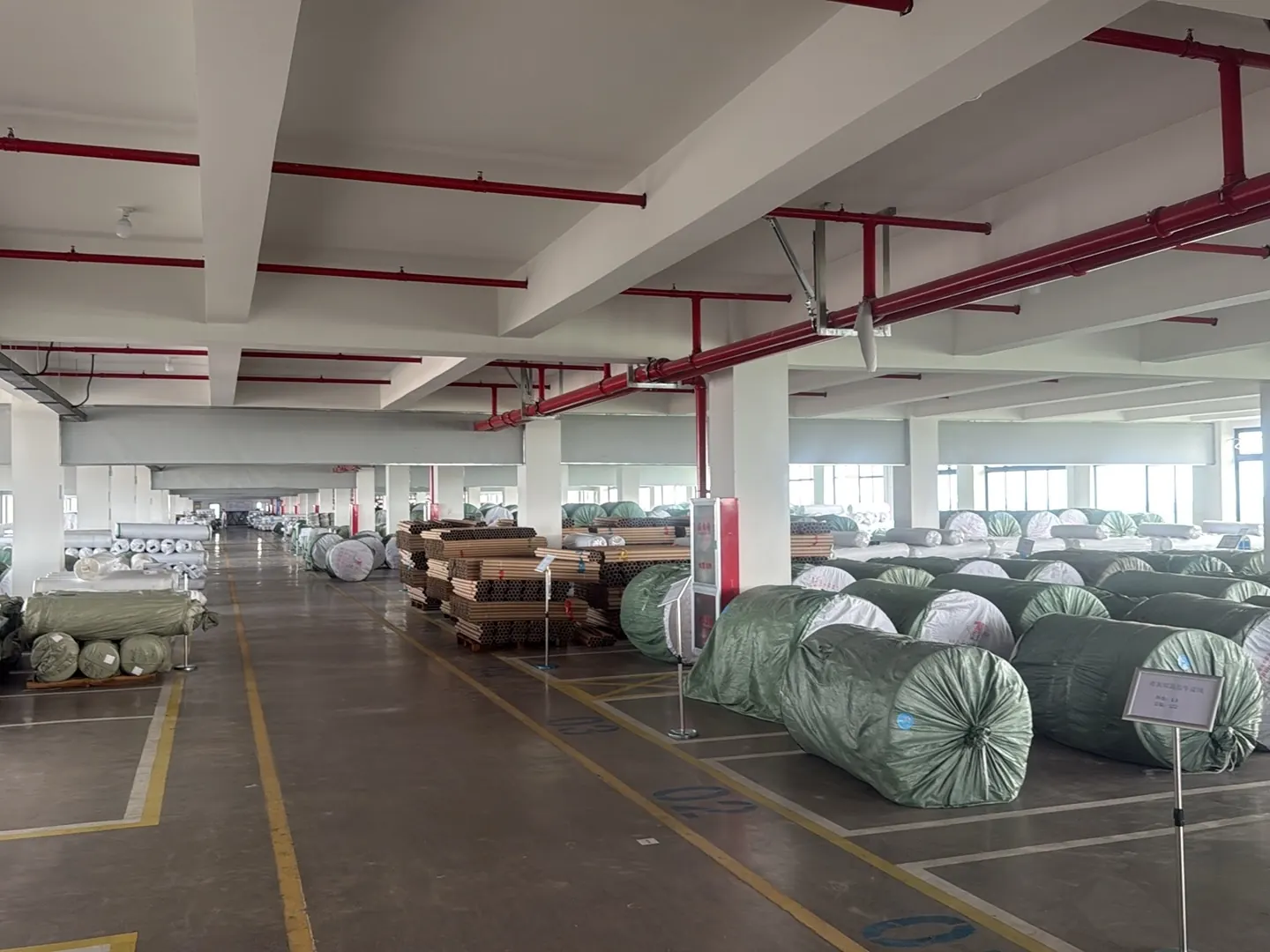
Puremorfilm supplies decorative film with a silicone functional surface, mainly as rolls for flat lamination with PUR adhesive, with film-faced panels available on request. Rolls come in effective widths of 1,240, 1,260 or 1,400 mm and lengths of 50, 100, 250 or 500 m, depending on the model, in more than 100 patterns. The silicone surface is inherently flame-retardant, with higher grades up to UL 94 V-0 available on request. The film uses a No DOP formulation, and in the manufacturer’s laboratory tests, coffee and red wine left for 24 hours at 25°C wiped off with no obvious change.
Abrasion resistance, cleaning compatibility or a humid-room assembly each need evidence for the chosen product and build. An HPL grade’s results don’t carry over to a film just because both cover MDF.
The furniture decorative-film page introduces this route. Bring the front shape, core grade, edge design and service environment to the discussion. The film is not for floors, cooktop countertops, shower floors or other walked-on areas.
Which laminated MDF construction should you choose?
Pick the core for structure and moisture, then the facing and edges for the job the surface does.
| Scenario | Selection rule | Detail to resolve |
|---|---|---|
| Dry cabinet interiors | Compare TFL-faced constructions | Core grade, back and exposed edges |
| Furniture needing a specified HPL surface | Select the applicable HPL grade and bond | Back balance, sheet grade and finished geometry |
| Real-wood appearance with natural variation | Choose veneered MDF | Veneer matching and coating system |
| Flat film-faced furniture fronts | Compare a qualified film route | Film construction, PUR process and edge design |
| Humid interior furniture | Start with the suitable core and protected assembly | Openings, back protection and water exposure |
Compare finished parts, back and edges included, before you choose from a swatch. A bathroom vanity order starts with the core and water-entry details; a dry wardrobe order can focus on surface, look and machining.
If you are comparing faced-panel routes, put our paint-free silicone face on the list; it is a different surface from PVC, melamine, PP and PETG. Contact us with the panel drawing, core and how the surface will be used.
Frequently Asked Questions
Is laminated MDF solid wood?
No. The core is engineered wood fiber, and the surface is usually printed paper, plastic film or HPL; only a veneer face is real wood, and even that is a thin slice over the MDF.
Is melamine always laminated onto MDF?
No. Melamine (TFL) is just as often fused onto particleboard, which costs less; MDF is chosen when the panel needs smoother faces or machined edges. A cut edge or the spec sheet tells you which core you have.
How long does laminated MDF last?
Many years in dry indoor use, though there is no fixed lifespan. Panels usually fail from water at the edges or chipped laminate on exposed corners, so sealed edges and care near sinks matter most.
Can you paint laminated MDF?
Yes, after preparation: degrease, scuff the laminate with fine sandpaper, apply a bonding primer made for glossy surfaces, then paint. Without that primer, paint peels easily from the smooth face.
Is laminated MDF waterproof?
No. The laminate face resists splashes, but water entering a cut edge, hole or damaged corner makes the core swell. For kitchens and bathrooms, use an MR core and seal every edge.