
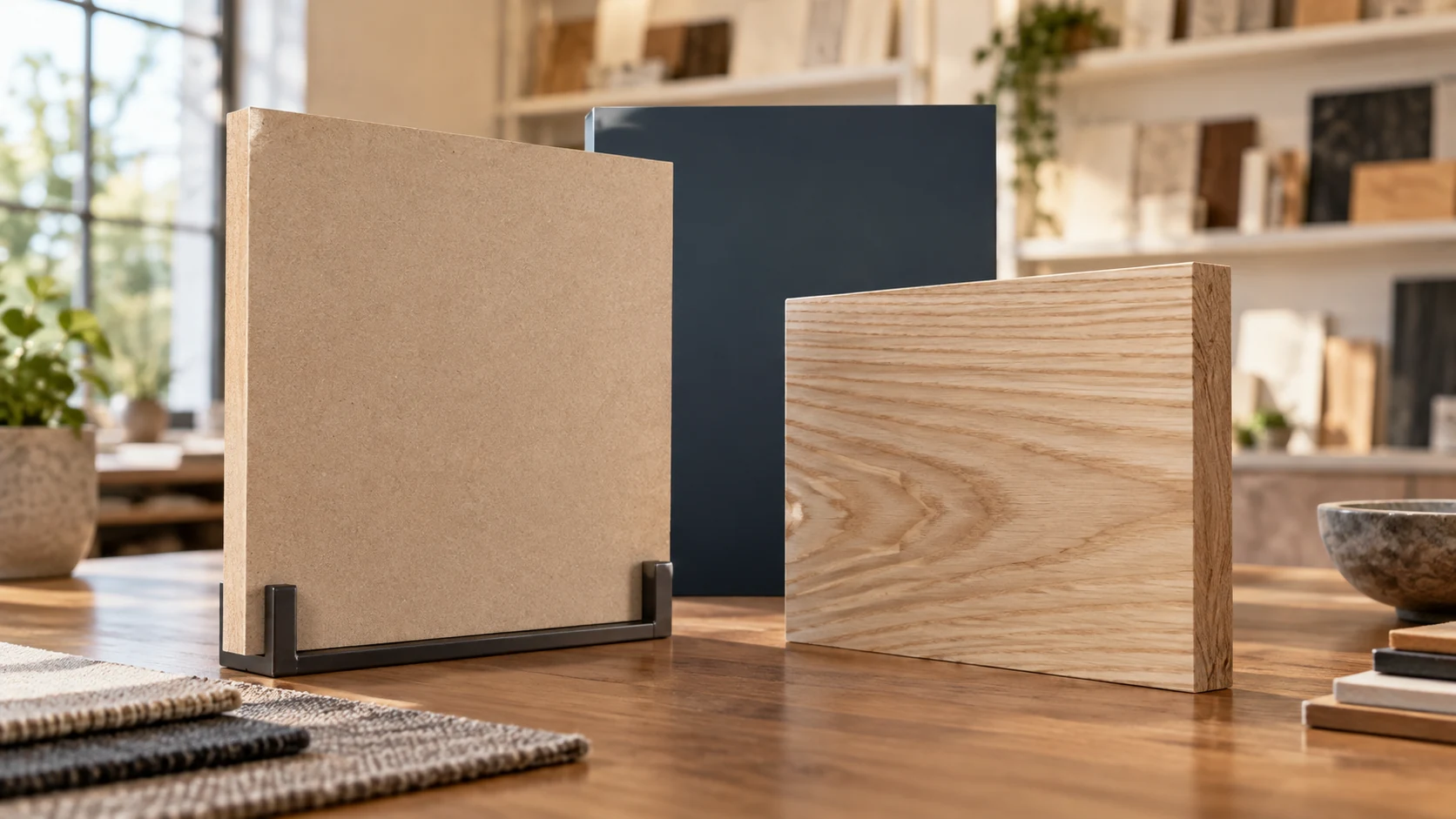
MDF vs solid wood is a choice about the part as well as its appearance. Painted doors can look identical over different cores, while loaded shelves need a suitable construction.
When comparing MDF vs solid wood, choose MDF for economical, evenly finished panels in dry interiors, and solid wood for visible natural grain, load-bearing members and surfaces you expect to refinish more than once. Decide what the part has to do first, then pick its finish.
What is the difference between MDF and solid wood?
MDF is a panel of wood fibers bonded with resin under heat and pressure; solid wood keeps the tree’s grain, so it behaves differently along and across that grain. Both make good furniture parts, but they trade off looks, stiffness and moisture movement in different ways.
The core is the body of the part. Paint, veneer or decorative film is only its visible skin, so a wood-grain door front tells you little about what sits underneath.
| Comparison | MDF | Solid wood |
|---|---|---|
| Structure | Bonded wood fibers forming a uniform panel | Natural wood with grain direction and variation |
| Surface appearance | No natural grain or knots; usually painted or faced | Natural grain can remain visible under a clear finish |
| Common furniture role | Broad panels, painted doors, decorative profiles | Rails, legs, frames and visible wood components |
| Bending behavior | Usually less stiff than common solid-wood examples | Usually stiffer along the grain; species and defects affect results |
| Moisture behavior | Standard interior grades need protection from wetting | Absorbs moisture and changes dimension, especially across the grain |
| Refinishing | Limited by the finish and condition of the fiber core | Can often be sanded and refinished while enough sound wood remains |
The Composite Panel Association’s MDF overview describes the panel’s uniform surface and furniture uses, and our guide to what MDF is goes into more detail.
Is MDF cheaper than solid wood for finished furniture?
Often for the raw board. MDF can be an economical base for a broad painted panel. Edge preparation, support and facing still belong in the finished-part quote.
MDF is a lower-cost alternative for many applications, and its precise machining cuts trimming waste. The saving varies with species, panel grade and order scope.
A June 17, 2024 cabinet guide lists MDF cabinets at $100–$300 per linear foot and solid-wood cabinets at $150–$1,200 per linear foot. They are broad cabinet budgets with unmatched configurations, not raw-board prices or a same-specification saving.
Where can the material saving disappear?
Compare the work it takes to produce the same finished part. A large flat MDF door painted on every visible surface and a solid-wood frame with a separate panel are different builds, even if both get called a cabinet door.
- For painted MDF, include sheet stock, cut-edge preparation, coating and any extra shelf support.
- Solid wood also needs species, lumber yield, grain selection, joinery and finishing.
- With faced MDF, add the facing, bonding and edge completion to the chosen core and its support.
A cheaper board can still come with a bigger finishing bill. Price material, machining, finish, support and handling together, at the same dimensions and delivered condition.
Ask both suppliers to quote the same hardware preparation, visible edges and packaging. A raw MDF sheet and a finished hardwood door are different purchases, and a cabinet price per linear foot won’t tell you how much of the gap comes from the material.
Is solid wood stronger than MDF, and is MDF heavier?
Usually yes to both. Common solid woods are stiffer and stronger in bending along the grain than ordinary MDF, and MDF is often heavier than a light softwood of the same volume. That extra weight doesn’t buy a stronger shelf or joint.
The research examples below come from Table 12–1 of the USDA Wood Handbook. Specific gravity is relative density. Bending stiffness, or modulus of elasticity, is resistance to sagging under load; bending strength is the stress at which the piece breaks.
| Material example | Specific gravity | Bending stiffness, GPa | Bending strength, MPa |
|---|---|---|---|
| MDF | 0.70–0.90 | 3.59 | 35.85 |
| Western white pine, clear wood | 0.38 | 10.07 | 66.88 |
| White oak, clear wood | 0.68 | 12.27 | 104.80 |
The wood figures come from defect-free research specimens, so use them to compare materials, not as grade guarantees or shelf ratings. They show why a broad MDF shelf usually needs more thickness or more support than a solid-wood one.
What do the bending figures mean for a shelf?
For a long bookshelf or pantry shelf that carries real weight, start with a stiffer material or shorten the unsupported span. MDF works well as a supported panel, but its name tells you nothing about a safe load. Thickness, span, supports and the actual grade decide that.
When you choose materials for cabinet components, treat a door or side panel differently from a shelf, rail or leg. They do different jobs in the same cabinet.
Does the heavier panel give you a stronger joint?
No. Weight follows density and volume, while a joint’s strength depends on the fastener, where it goes and the material around it. MDF holds screws differently in its face and its edge, and the handbook lists those properties separately, so a screw driven into a panel edge won’t hold like one in the face. Use a fixing designed for MDF, especially for loaded hinges and parts that get taken apart and rebuilt.
MDF’s weight penalty shows most against lighter woods. Dense hardwoods, other thicknesses and added finishes change the picture, so don’t assume every solid-wood part is the lighter one.
How do humidity and water affect each material?
Neither is a general winner for moisture. MDF offers a uniform core for dry indoor panels; solid wood changes dimension with humidity, especially across its grain. Standard interior MDF does not belong beside a recurring leak, and solid wood absorbs water too. For wet spots, pick a construction rated for that exposure and detail it properly.
Humid air and liquid water cause different problems. Solid wood trades moisture with the air and moves far more across the grain than along it. A wide tabletop or panel therefore needs room to move even if it never gets visibly wet.

Does moisture-resistant mean waterproof?
No. Wax additives slow liquid-water uptake for a limited time but do little against water vapor or humidity-driven swelling. Different resins and board grades also have different exposure limits.
A cabinet door in a dry hallway and the base panel of a sink cabinet with a dripping trap are separate material decisions. Our explanation of MDF and water exposure covers the edges and openings that stay vulnerable even when the face is protected.
Why does solid wood need room to move?
Solid wood should go into service at a moisture content close to the room it will live in. Moisture content is the water in the wood as a percentage of its dry weight. Table 13–2 of the Wood Handbook gives these guidelines for interior woodwork:
| US conditions in the handbook | Recommended average wood moisture content | Range for individual pieces |
|---|---|---|
| Most areas | 8% | 6–10% |
| Dry southwestern areas | 6% | 4–9% |
| Damp, warm coastal areas | 11% | 8–13% |
The guidelines assume well-ventilated buildings without unusual moisture sources or air conditioning, so in a conditioned home match the wood to the room you actually expect. They are lumber targets and say nothing about MDF.
Which gives you a better painted or wood-grain finish?
MDF for paint, solid wood for grain. MDF is the easier base for an even opaque finish, and solid wood is the natural pick when you want real grain right through the part. Veneered MDF sits between them: a real-wood face without a solid-wood core.
MDF has no knots or natural grain, and it can carry a veneer overlay. Veneer is a thin layer of real wood bonded to another material; a printed wood-grain finish only copies the look.
Does a wood-grain surface mean a solid-wood core?
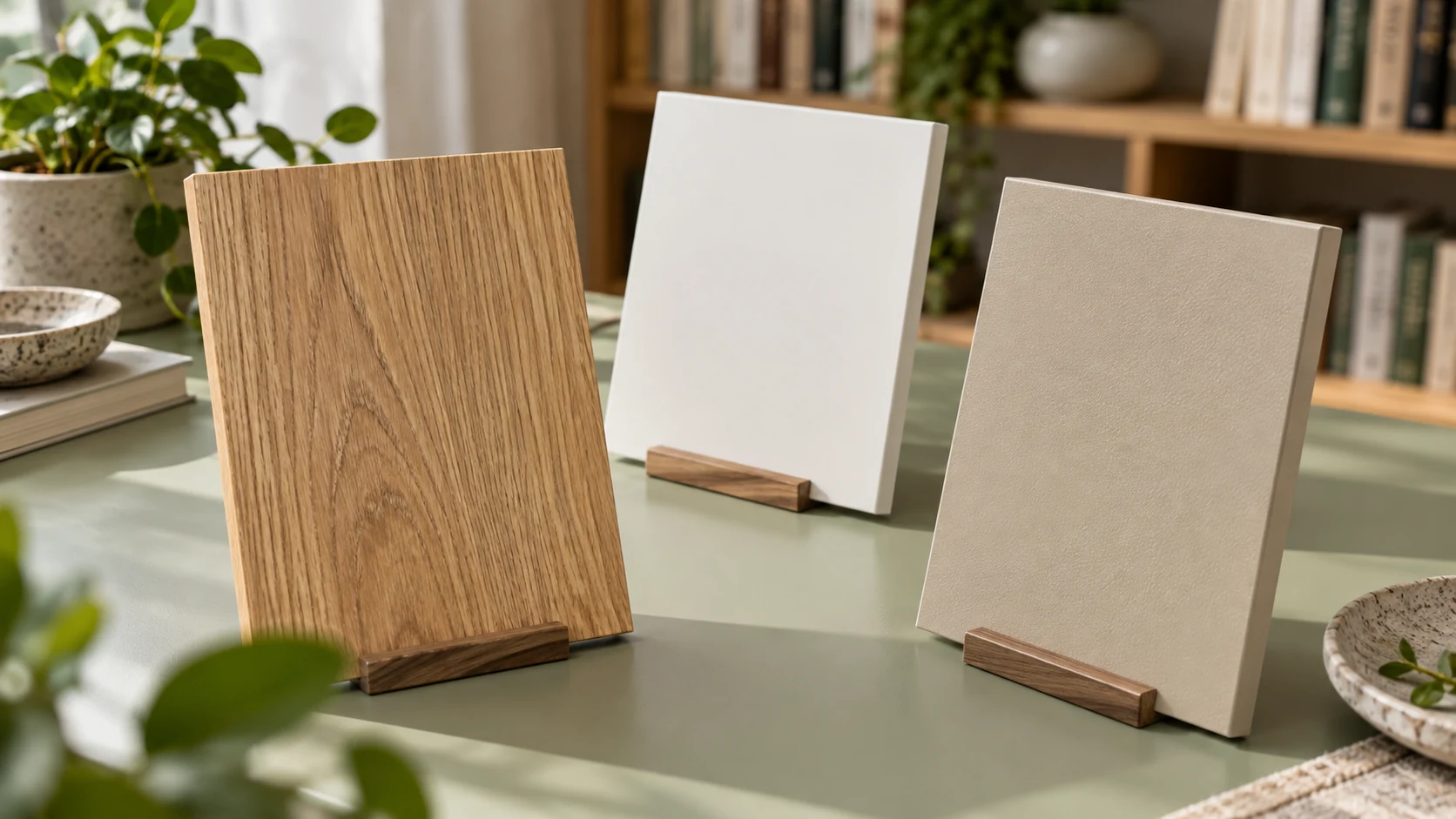
No. A veneered or printed wood-grain panel still has a separate core underneath. Its face can meet the design brief without putting solid wood through the part.
If you want real wood at the exposed edges and through carved or routed details, solid wood wins. If you only need a wood-look face on a broad panel such as a wardrobe side, compare wood veneer and other laminate surfaces before paying for a solid core.
What changes when you paint the surface?
MDF’s even face takes grain and knots out of the starting point. Solid wood takes paint too, but some species contain water-soluble colored compounds called extractives, and water can carry them to the paint surface, leaving yellow-to-reddish-brown stains.
So for a white or pale painted finish on solid wood, use a stain-blocking primer where the species needs it; more topcoat alone may not hide the stain. With MDF, prepare the cut edges and routed details too, even when the face already looks smooth.
What changes when you machine and finish each material?
MDF, for repeated cuts and routed profiles; solid wood suits builds that use its grain and wood-to-wood joinery. The finish you want sets how much preparation follows the machining.
Precise machining and less trimming waste are two of MDF’s selling points. Solid wood brings grain direction and natural variation, which decide where you cut and how much usable material you keep.
What changes at cut edges and routed profiles?
A clean face doesn’t finish the cut edge for you. USDA Chapter 11 describes MDF edges as capable of being shaped and finished for the end use, but they still need their own finishing step, and a routed door exposes far more shaped surface than a plain flat one. Plan these as separate tasks:
- Cutting to size and producing the required profile.
- Preparing exposed faces, cut edges and routed areas.
- Applying the selected coating or facing.
- Completing the edge detail and hardware preparation.
Our guides to cutting MDF and finishing MDF surfaces and edges cover those steps. Cost the whole route before you assume a cheap panel stays cheap.
Drilling for hardware differs from solid wood too. The European Panel Federation’s MDF screw guidance recommends a pilot hole of 85–95% of the screw’s core diameter, the solid center inside the threads. Follow your fastener’s instructions as well; a solid-wood drilling setup can leave too little room for the screw core, especially near a thin panel’s edge.
Which lasts longer and is easier to repair?
Solid wood offers more refinishing scope when enough sound wood remains. An MDF part’s repair options depend on its facing and core condition. Neither material comes with a fixed service life.
Refinishing renews the surface as long as the wood underneath is sound: prepare the surface, strip the old finish and recoat.
Is the damage in the finish or in the core?
Check that first, because a worn coating, a cut through a thin facing and a swollen panel need different repairs. Sanding a thin veneer or decorative film can expose the core, while sound solid wood usually has enough material for another round of preparation.
MDF that swells beyond its original size in high humidity doesn’t fully shrink back when it dries to its original moisture content. A door swollen by a dishwasher leak may never regain its thickness or fit, so budget to replace a badly swollen core instead of repainting it.
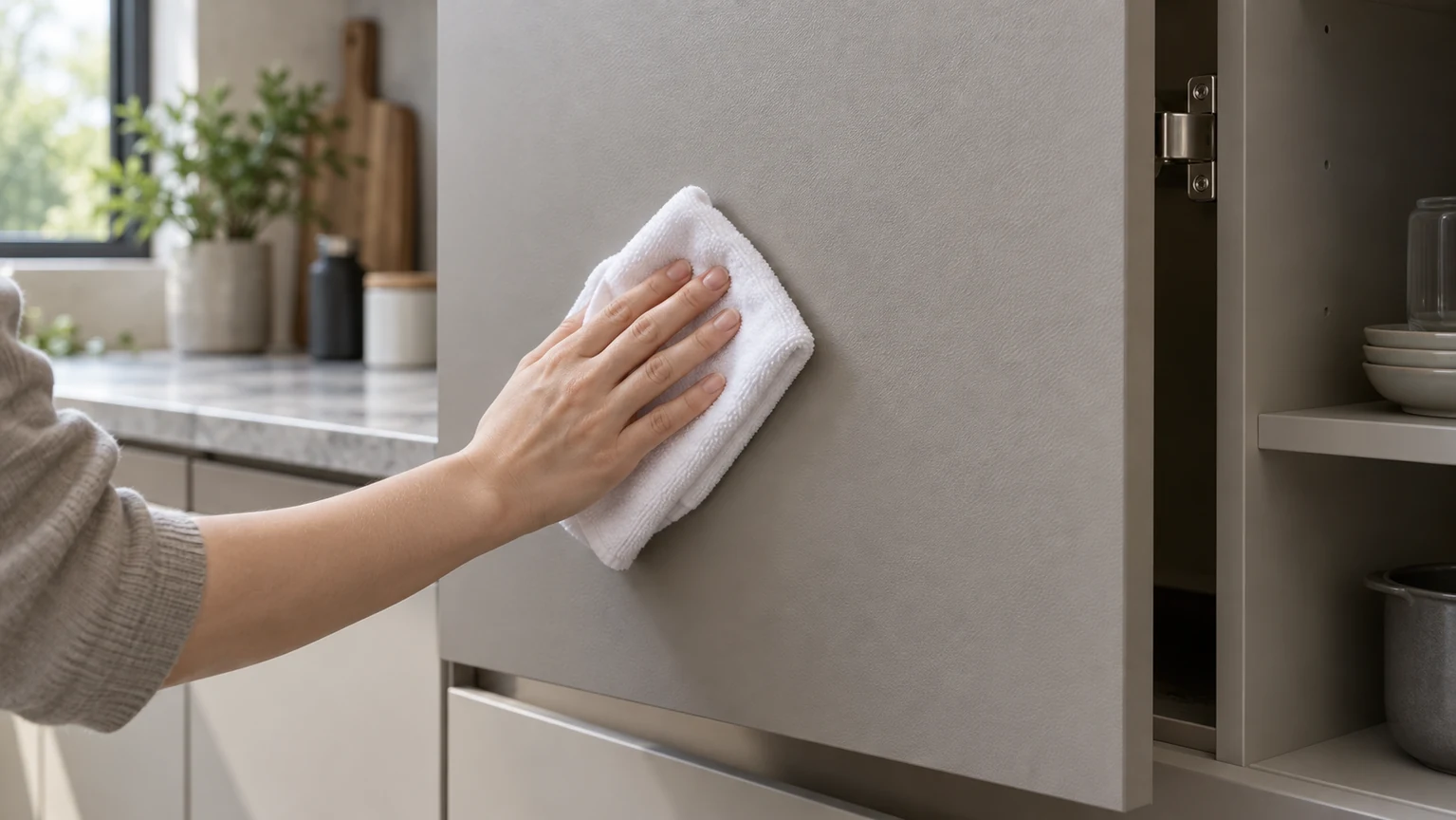
For routine care, follow the instructions for the surface material. Advice on cleaning laminate cabinet surfaces is about the finish; keep liquid away from exposed MDF edges and openings.
When is refinishing preferable to replacement?
When the substrate is sound and only the finish is worn. If a door has warped, its core is crumbling or a key joint has failed, a new finish won’t fix the part. For furniture you expect to refurbish again and again, build that repair route into the original choice.
Is MDF or solid wood safer and more sustainable?
Either can be, if you check the right paperwork. In the US, order MDF that complies with TSCA Title VI; for either material, count adhesives and finishes when you look at emissions, and compare lifecycle data on the same basis. Natural wood and recycled fiber each tell only part of the story.
What do the MDF emission limits actually tell you?
The EPA’s guidance for regulated stakeholders sets formaldehyde emission limits of 0.11 ppm for MDF and 0.13 ppm for thin MDF, meaning 8 mm thick or less. They apply under the prescribed panel test method.
They aren’t room-air limits or proof that a finished piece emits nothing. Glue and coatings need their own check, on a glued and lacquered solid-wood chair as much as on an MDF cabinet.
Does recycled fiber automatically mean a lower impact?
No. MDF can use residual wood fibers, which gives otherwise low-value material a use, but its environmental product declarations still count lifecycle impacts well beyond raw materials.
Compare manufacturing, transport, service life and end of life on the same basis. A part that has to be replaced early adds a second product to the tally, so recycled content alone can’t settle the choice. Solid wood’s result also depends on how it is sourced, processed and used.
When should you use our silicone decorative film on MDF?
Once you’ve picked a suitable interior core and want a paint-free surface on it. Puremorfilm’s silicone decorative film is formaldehyde-free and uses a No DOP formulation. In the manufacturer’s laboratory tests, coffee, red wine and soy sauce left on the surface for 24 hours at 25°C wiped off with no obvious change. The silicone surface is inherently flame-retardant, with higher grades up to UL 94 V-0 available on request. We mainly supply rolls, with film-faced panels on request; choose the MDF or wood core for its job first.

What does each layer do?
The silicone layer is the visible surface. Under it sit the PET support film, the adhesive, the MDF core and the edge detail, and the last three belong to the assembled panel. The drawing shows the order of the layers.
The face supplies the look; the core and the assembly still decide load capacity and water resistance. Keep the core’s emissions paperwork on file too, because our film’s No DOP formulation says nothing about formaldehyde from the MDF underneath.
Should you buy film rolls or laminated panels?
Rolls, if you run the facing step yourself; laminated panels, if you want a faced board as your starting material. Our guide to laminating MDF covers surface preparation and assembly. Tell us your core, what the part does and which supply form you want, and we can suggest a route.
Should you choose MDF, solid wood or a mixed construction?
Use each where it is strongest: MDF for economical painted or faced panels in dry rooms, solid wood for natural grain and load-bearing members, and a mix when parts do different jobs. Moisture, span and how often you expect to repair can shift that starting point.
| Bulk order | Main material question | Practical starting choice |
|---|---|---|
| Cabinet-door production | Uniform opaque finish or visible natural grain? | MDF for flat painted or faced doors in dry interiors; solid wood for exposed grain or a solid-wood frame |
| Furniture production | Broad panel, loaded member or long shelf? | MDF for supported panels; suitable solid wood for legs and rails; size and support long shelves for their load |
| Panel-facing production | Which core suits the finished panel’s use? | Interior-grade MDF for a smooth facing base in dry service; use an exposure-rated construction where repeated wetting is expected |
Choose the core for the part’s job, then settle the visible surface and how you’ll repair it. Our paint-free silicone surface is a different surface from PVC, melamine, PP and PETG finishes. To talk through a project, contact us with the part’s use, your chosen core and the supply form you prefer.
Frequently Asked Questions
Is solid wood furniture better than MDF?
No, not for every part. Solid wood suits visible natural grain, suitable load-bearing members and surfaces with room for refinishing. MDF is a useful core for painted or faced panels in dry interiors; grade, support and joints still matter.
What happens if MDF wood gets wet?
Ordinary interior MDF can swell, and some thickness expansion can remain after it dries. Stop leaks and replace a badly swollen component when its shape or fixings cannot be restored.
What does MDF look like?
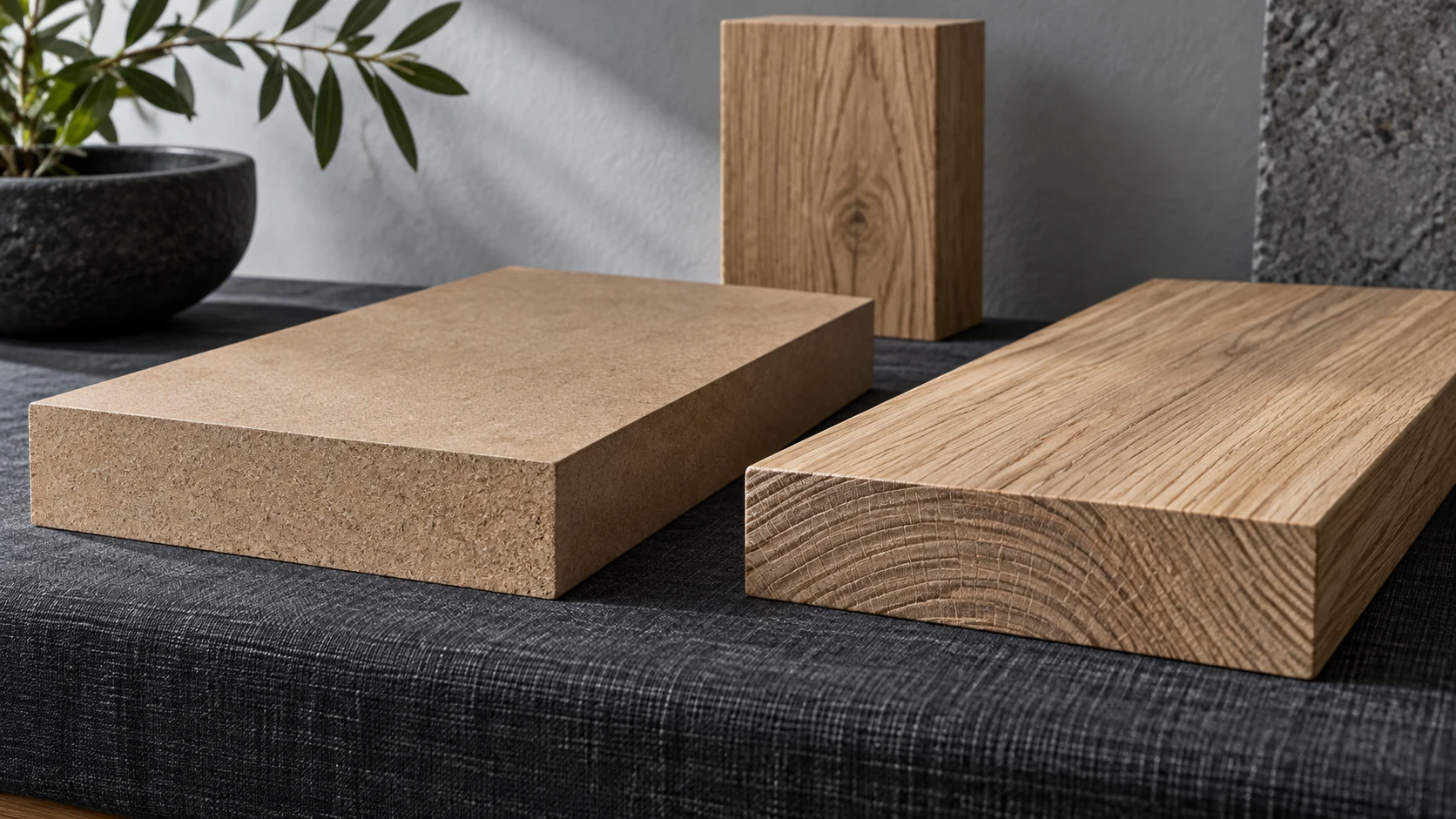
The cut edge shows fine wood fibers rather than solid wood’s growth rings, and the smooth face has no natural grain or knots. Paint, veneer or decorative film can conceal that core.
What’s the best choice for a shelf carrying heavy items?
Suitable solid wood or a reinforced panel, with adequate support, for a long span. MDF can work with enough thickness and closer supports. Work out capacity from the actual grade and shelf design, because lab bending figures aren’t shelf ratings.
Does silicone decorative film make MDF stronger?
No. The film provides the decorative surface, while the core, thickness, supports and joints carry the load.