
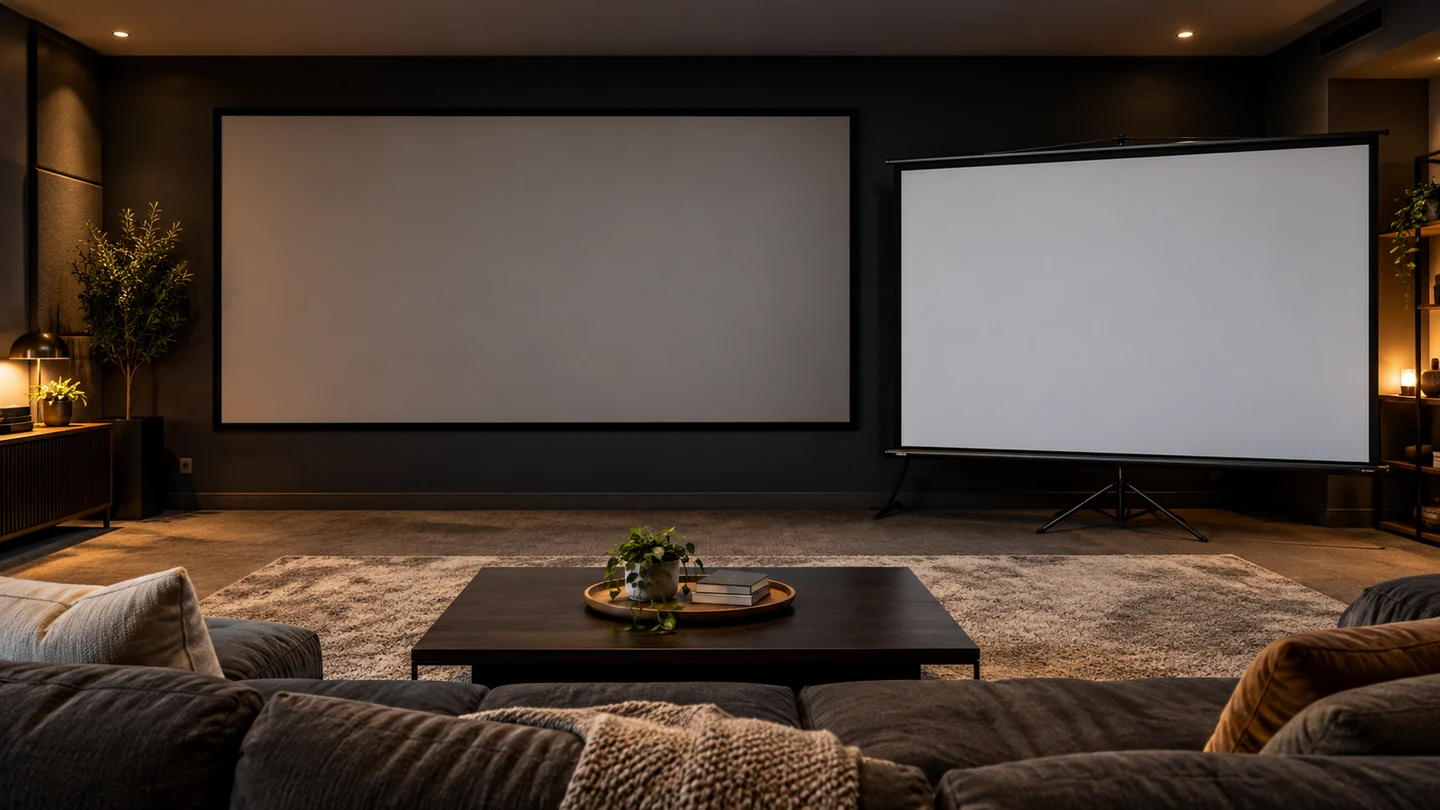
Projector screen paint vs screen comes down to the room, the wall and the projector. A smooth wall with flat neutral paint can give a usable picture in a dark room; a bright room or an ultra-short-throw (UST) projector points toward a screen built for that light direction. In one 2024 comparison of eight paints, one coating measured below 0.09 gain while others produced higher peak brightness than a 1.1-gain reference screen.
How do walls, projector paints and screens compare?
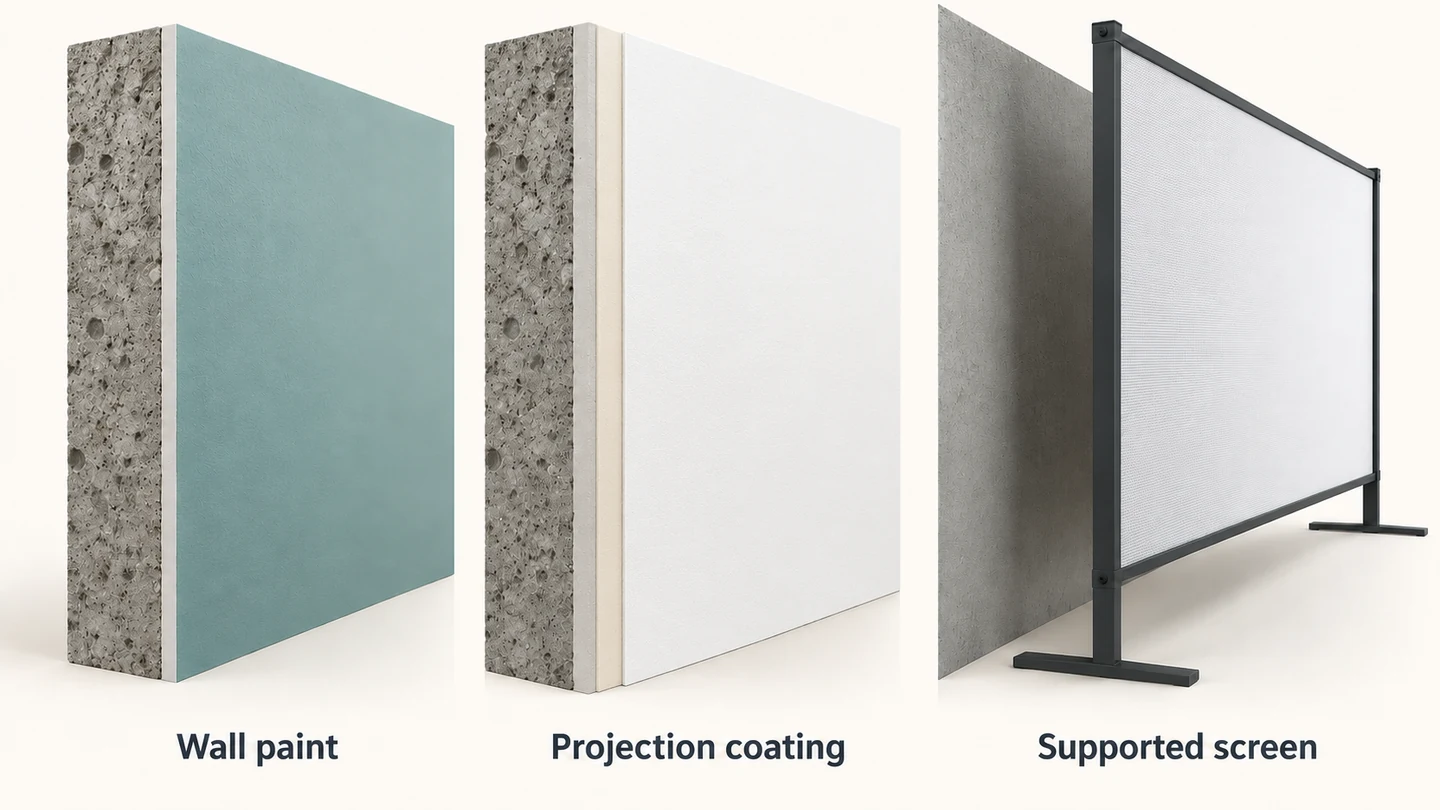
They differ in who controls the reflecting surface. With ordinary paint or a projection coating, the wall sets the shape; a manufactured screen brings its own support and surface.
Screen fabric can be plain white, grey or a directional ambient-light-rejecting (ALR) design, and those are different products. Dedicated projection paints also vary in color, reflectivity and application system.
| Choice | What determines the surface? | Preparation or support | Main decision |
|---|---|---|---|
| Ordinary wall paint | Wall flatness, texture, paint color and sheen | Repair and prepare the wall | Is the picture sufficient in the actual room? |
| Projection coating | Prepared substrate and the selected coating system | Follow its specified application instructions | Does this formulation improve the required image? |
| Manufactured screen | Screen material, support and any engineered optical structure | Appropriate frame, roller or other mounting | Does the material suit the projector and room light? |
A screen’s gain and viewing behavior explain much of the brightness difference. Gain measures reflection against a reference, so judge color, black level, seating position and visible wall flaws alongside it.
Is ordinary white wall paint good enough?
Yes, flat neutral wall paint can be enough on a smooth wall in a light-controlled room. Test it with your own projector and content, because a paint sold as white can still tint the picture.
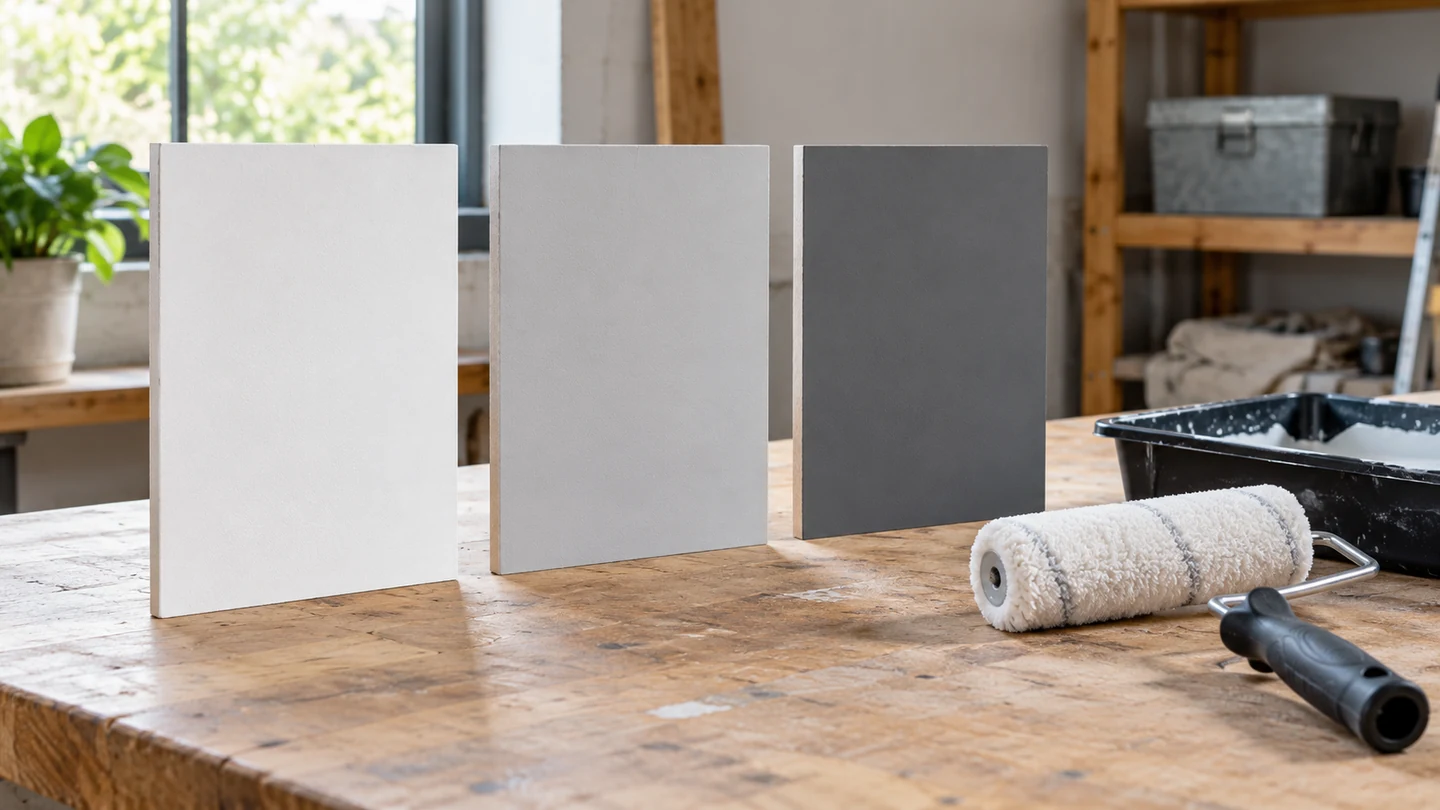
In The Hook Up’s July 18, 2024 comparison, the reviewer applied eight paints to two matching 92-inch PVC panels over a white primer. Gain was measured in a fixed projector-and-probe setup against a reference screen rated at 1.1; the wider comparison also used other projectors. Behr i300 Dead Flat White, bought for $22 a gallon at the time of the test, came out brighter than the reference. Its red response was higher than its blue, though, so white images leaned red.
So check grey areas, skin tones and a full white field, not only a bright movie scene. Roller texture and sheen changes also show through.
Some projectors offer a wall-color setting. Epson documents a wall-projection color adjustment for the models in that manual. It corrects color only; it cannot flatten the wall or keep room light off the picture.
What does dedicated projection paint change?
It changes how much light the coating reflects and how evenly it reflects each color, so compare the actual formulation with ordinary paint under the same projector and room conditions.
In the same test, measured gain varied widely: Partay Sirius C came in below 0.09, S1 Ultimate Contrast at about 0.69 and Crow at about 0.56, while other paints were brighter than the reference. Those figures belong to the coatings tested, not to projection paint as a category.
Color accuracy and ease of application also differed. Rolled metallic-looking coatings could leave visible marks, and a wall that looks even with the projector off can show streaks under a bright image.
Read the coating maker’s substrate, primer, application and finish instructions before you buy. The coating still follows the wall underneath, and filling holes or smoothing a textured wall can be a bigger job than the final coat. Paint a sample board large enough to show roller marks and color shifts before you commit the whole viewing area.
Is a painted wall a waste with an expensive projector?
No, not by itself: a painted wall can suit an expensive projector when the room and the prepared surface support the picture you want. The projector’s price tells you nothing about whether the wall’s color, texture or reflectivity is right.
In the independent test, room reflections and each projector’s black level changed which coating looked best. A very bright white surface also bounces more light onto nearby walls and back onto the image. Darker coatings can reduce reflected brightness, so weigh that benefit against the light available from the projector.
Control stray light first. Then compare the same scene, image size and seat on each candidate surface, looking at shadow detail and color as well as peak brightness. A sample that looked good in a showroom or with someone else’s projector is a weak basis for a permanent wall.
Surrounding finishes matter too: a surface’s light reflectance value describes its visible-light reflectance, while projected-screen gain describes reflection toward the viewer relative to a reference.
What changes in bright rooms or with a UST projector?
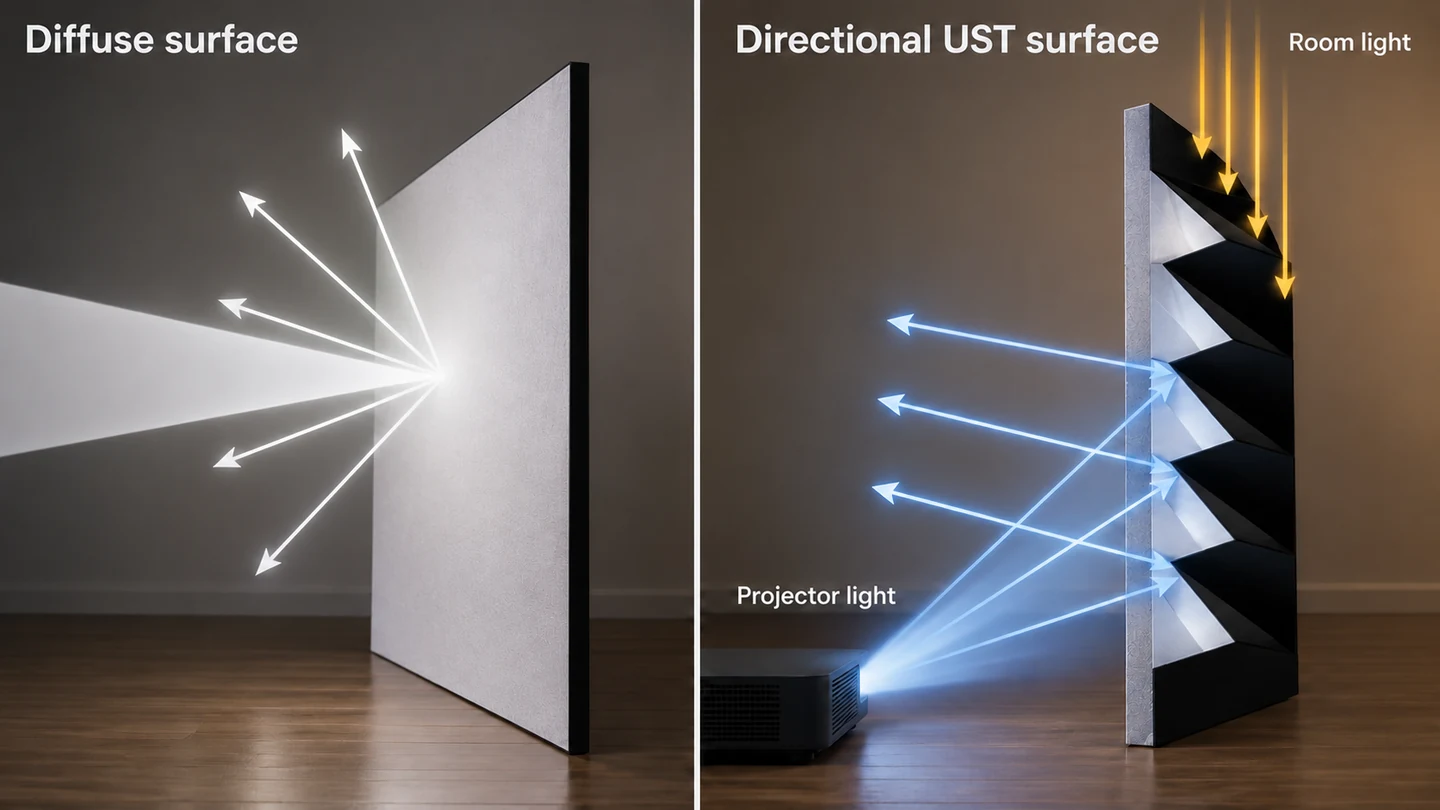
A bright room calls for a surface matched to the projector’s light direction, and UST projection can make wall irregularities more conspicuous. A basic white screen and a compatible UST ALR screen are very different purchases.
The BenQ guide to light-resistant screens explains Fresnel and black-grid structures that reflect UST light arriving from below and reject light from other directions. Match that structure to where your projector sits and where the room light comes from.
None of the paints in the independent test had the Fresnel or lenticular structure of those UST screens; that finding covers the paints tested, not every product sold as projection paint.
Because UST light strikes the wall at a steep angle, small waves in a painted wall become obvious. Look at a real projected image before accepting the wall. Curtains and lamp placement still matter: a compatible ALR surface helps, but a darker room gives a better picture.
Can projection paint be cleaned and repaired?
Yes, some projection coatings have documented repair procedures. Follow the installed system’s method; a dab of matching paint can leave a visible patch.
Goo’s repair and maintenance instructions are a clear example. Its Classic and 2.0 systems use different repair layers, and both procedures sand the damaged area and its surroundings back to the primer, rebuild the layers and finish with one coat over the whole screen to tie old and new areas together.
Include a full-area finishing coat in the budget when the installed system’s repair instructions require one. Keep a record of which system was used and follow its instructions for preparation and curing; another maker’s coating may use different layers.
For cleaning, the same instructions warn against forceful scrubbing and abrasives on matte coatings. Where the wall will face physical contact, ask the coating maker for the specified product’s scratch-test evidence and repair instructions. For manufactured screens, follow the material-specific projector screen cleaning guide and the maker’s care instructions.
Why does paint look different beside screen material?
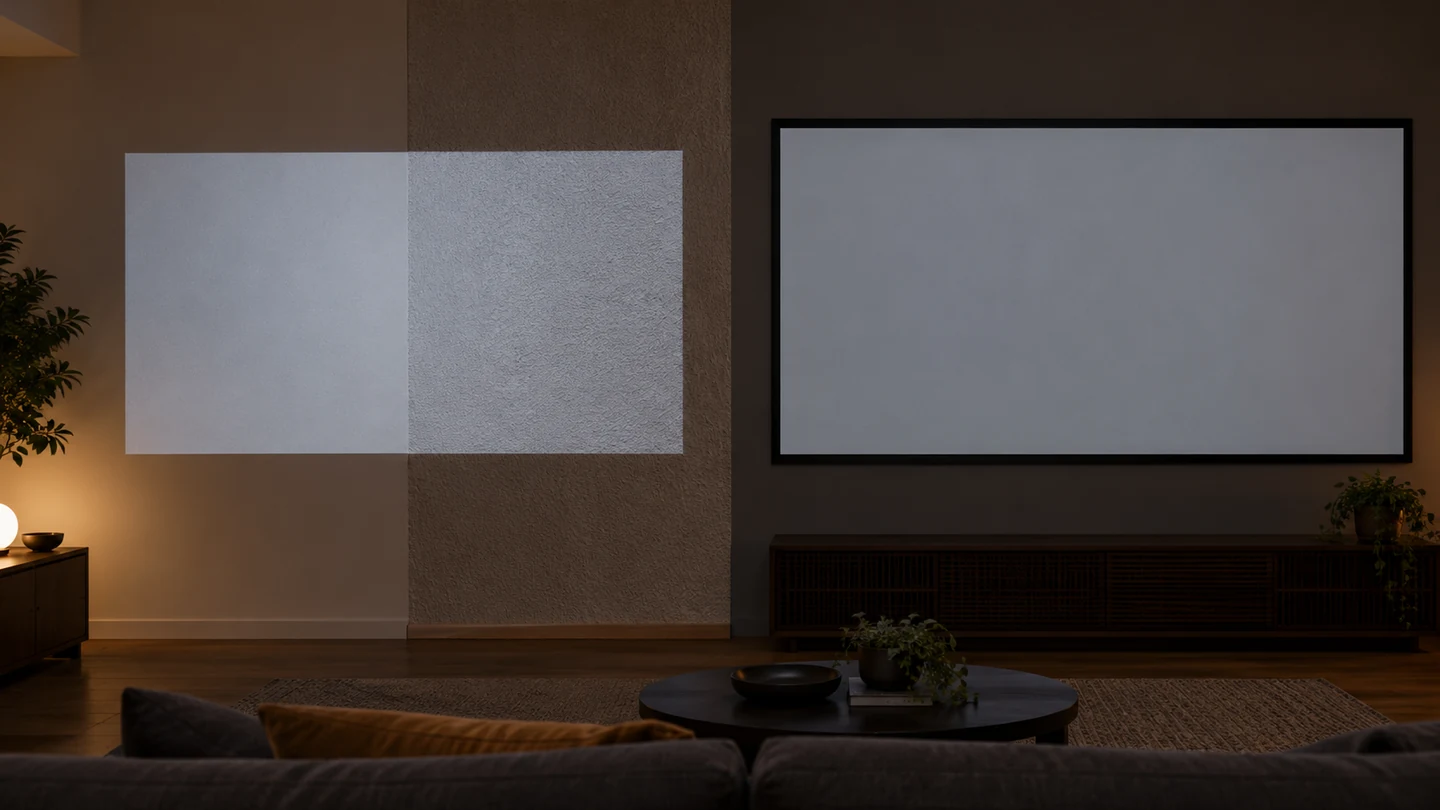
Paint and screen material reflect different amounts and colors of light, so a junction between them can stay visible inside one projected image. A dark outer border cannot fix a color or brightness step within the picture.
The independent test’s different red, green and blue responses show that two white-looking surfaces need not reproduce the same white. When a mixed paint-and-screen area shows a visible step, the sounder fix is one continuous surface across the whole active image; that is a practical inference from those measurements, not a tested repair.
First find where the junction falls. If it runs through the picture, compare both materials with the same full-white image and plan a single surface for the viewing area. If it sits outside the picture, a matte border gives the image a clean edge, though it will not recalibrate either material.
A patch within one coating system is a different problem. Follow that system’s repair instructions, including any full-area finishing coat.
How much do projector paint and a screen cost?
In the listed examples, a gallon of coating costs nearly as much as the basic 100-inch fixed-frame screen, but those prices cover different things; compare the completed installations. A paint container price says nothing about the work needed to get a smooth wall.
These are specific public-price examples captured on October 19, 2026:
| Listed product | Stated size or quantity | Listed price |
|---|---|---|
| Paint On Screen Radiant White, interior | Quart | $98 |
| Same interior coating | Gallon | $189 |
| Silver Ticket STR-169100, white fixed-frame screen | 100-inch, 16:9 | $229.98 |
| Silver Ticket STR-169120, white fixed-frame screen | 120-inch, 16:9 | $279.98 |
The coating prices come from the Radiant White product listing; the screen examples come from the maker’s model and price listings. They are examples of one named coating and two white fixed-frame screens, not an industry price range and not ALR equivalents.
For paint, budget for wall repairs, substrate preparation, the full coating system, tools and labor. For the screen, check the supplied frame, mounting and installation. Confirm tax and delivery for each order, and check coverage against the chosen coating’s current instructions instead of assuming a quart covers a set image size.
Where does a supplied projection film fit?
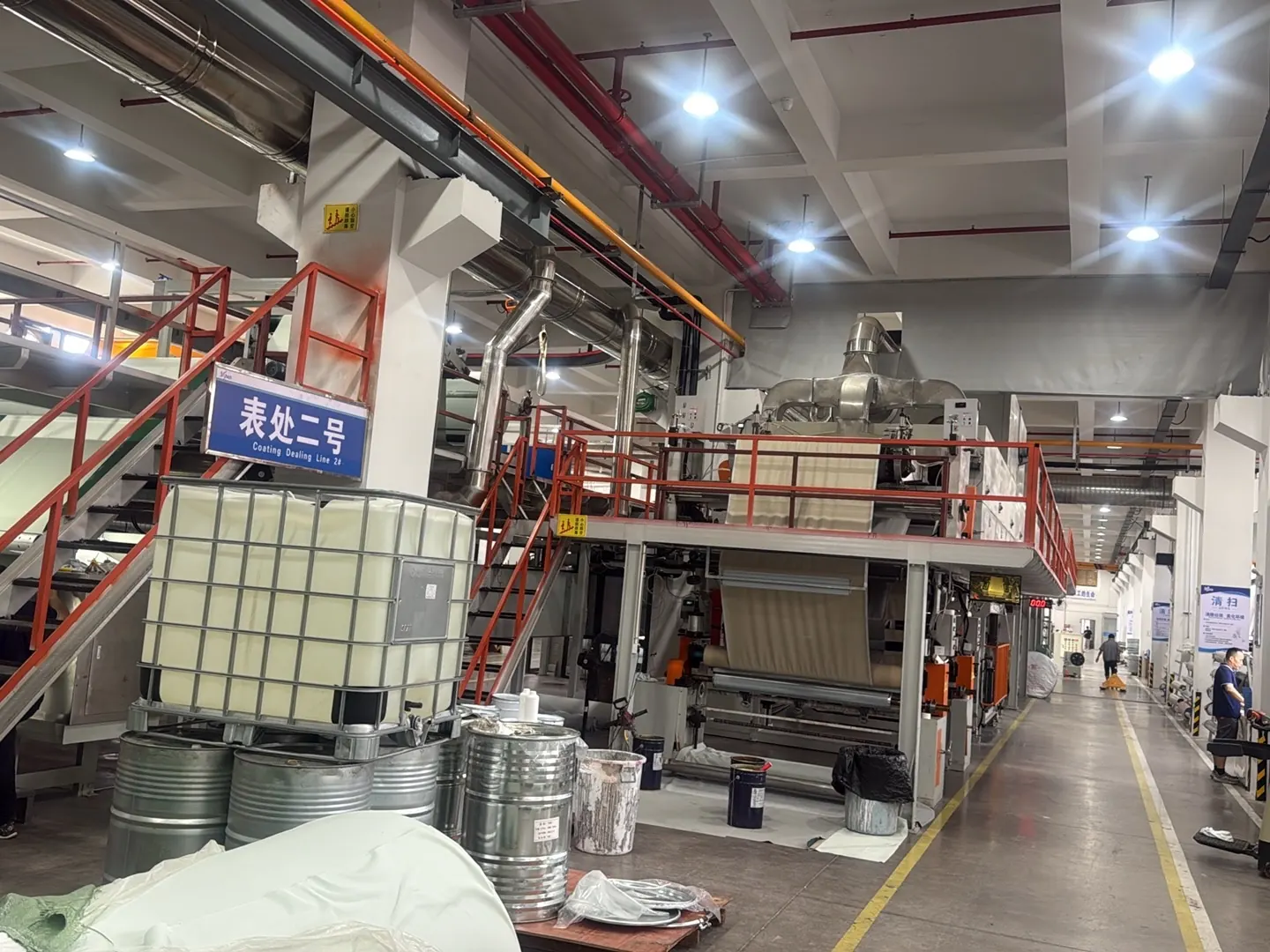
Puremorfilm supplies projection film with a silicone functional surface for front projection, without back adhesive and in whole pieces. It gives you a manufactured viewing face for an installation you design separately, a third material route alongside coatings and complete screens.
Standard samples ship within three days. Supply is mainly in rolls, with laminated panels available on request. Our silicone surface is inherently flame-retardant, with higher grades up to UL 94 V-0 available on request. In the manufacturer’s laboratory tests, coffee, red wine and soy sauce held at 25°C for 24 hours wiped off with no obvious change. We use a No DOP formulation.
This is a paint-free facing, distinct from PVC, melamine, PP and PETG decorative faces. See the projection screen film for the supplied material. Support, mounting and projector suitability remain installation decisions; whole-piece supply does not settle tension requirements or directional optical performance.
Which option suits your room and installation?
Choose from the room and the finished installation you need, and test samples with your own projector, image size and lighting before you prepare a permanent surface.
| Situation | Sensible starting point | Check before committing |
|---|---|---|
| Dark room and a smooth existing wall | Flat neutral paint or a dedicated coating | Color, texture and usable brightness |
| Strong room reflections | A suitable grey coating or screen candidate, with better light control | Shadow detail and remaining brightness |
| Bright room or UST projector | A compatible directional screen | Throw direction, room light and surface geometry |
| A movable or retractable image surface | A manufactured screen designed for that arrangement | Mounting, size and use |
| A custom painted viewing area | A complete coating system on a prepared substrate | Wall preparation, application and later repair |
For a supplied front-projection film enquiry, contact us with the projector model and throw arrangement, image dimensions, room lighting and intended support.
Frequently Asked Questions
What kind of paint should I use for a projector screen?
Flat neutral paint is a starting point for a smooth wall in a dark room; a dedicated projection coating should follow its specified application system. Choose white or grey from your projector’s brightness and the room’s reflections.
Can I use paint on my wall as a projector screen?
Yes, a smooth, prepared wall can work. Check the image for texture, color shift and uneven reflection, especially with a UST projector.
What color is better for a projector screen?
White generally preserves more brightness, while a lower-gain coating can reduce image brightness, including the black level. Compare the specific surfaces with the same projector and room conditions.
Can I use any wall with projector paint, or does it require a special surface?
No, not any wall as it stands: rough or uneven walls must be repaired and smoothed for the chosen coating system, which goes on a clean, flat substrate with any primer the system specifies.
Is there a significant difference in setup and maintenance between projector paint and screens?
Yes. Paint needs wall preparation and careful application, and a repair can mean recoating the whole viewing area; a screen needs its intended frame or mounting.