
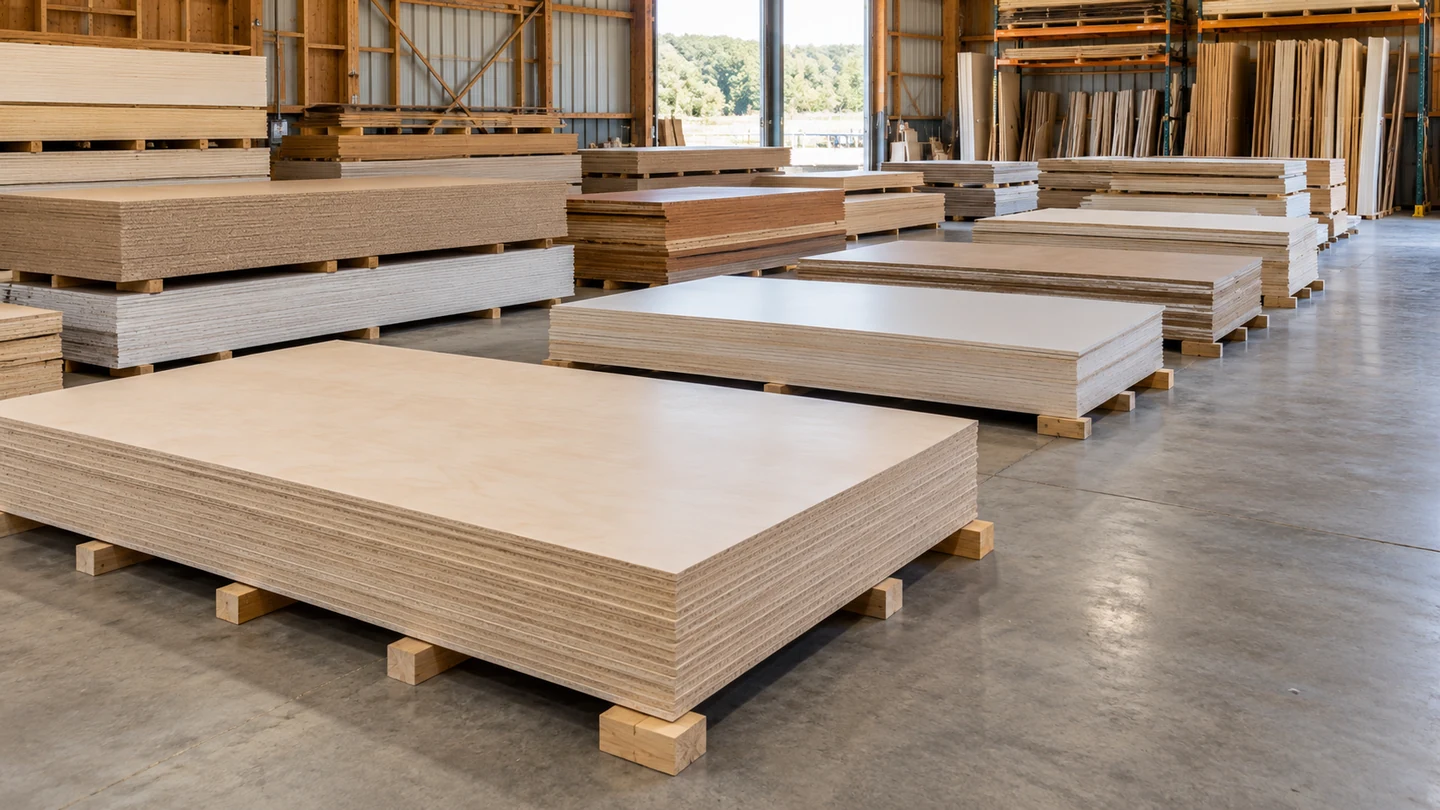
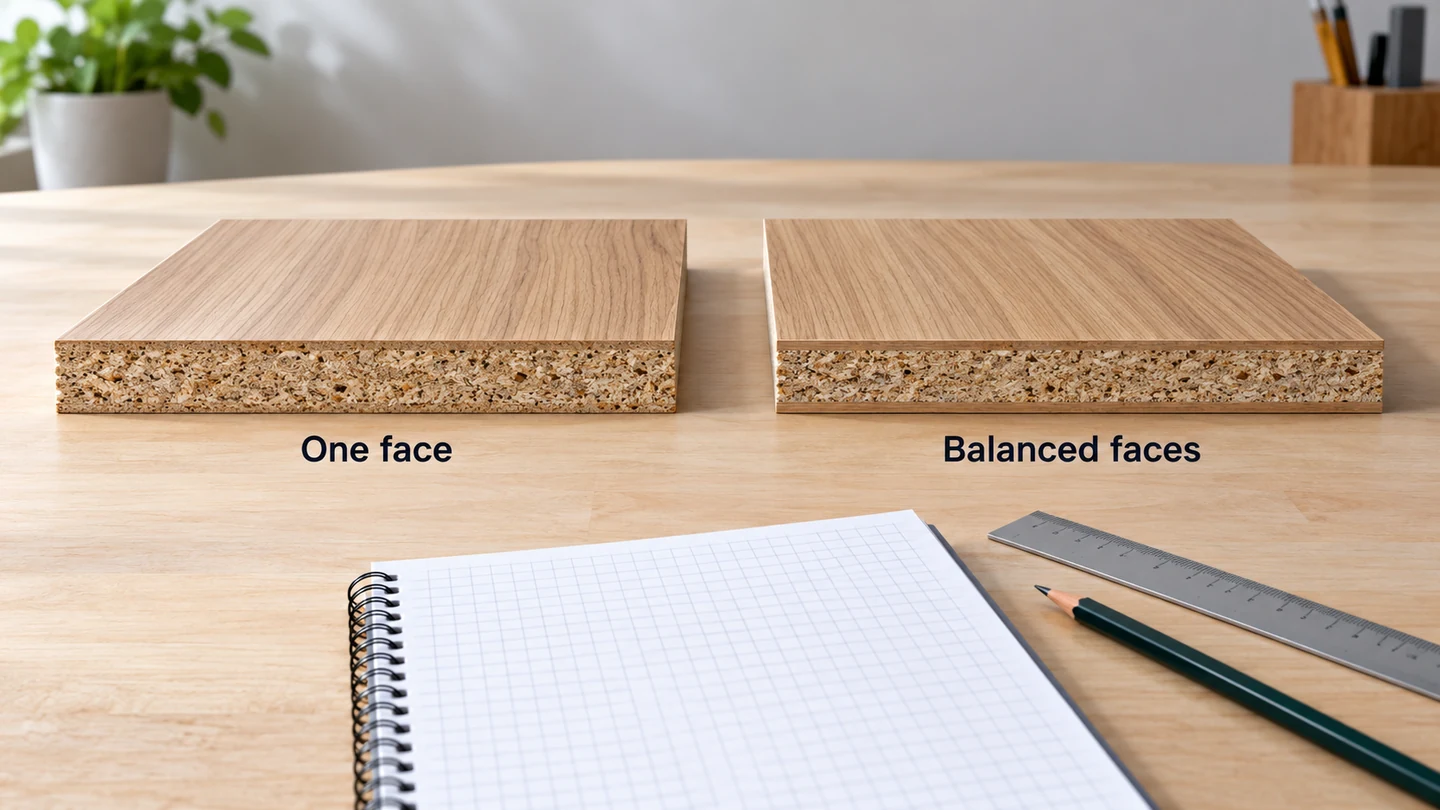
To understand how to prevent panel warp, start with a balanced construction: panels warp when moisture-related expansion and contraction become unbalanced across the face, core and back. On an architectural-woodwork job using AWI requirements, for example, ISO 4586 laminate at least 0.5 mm thick is one listed backer option, and its balance against the face still needs checking.
To find why a particular panel bent, trace when the bow first appeared, then check the face, backer, core, adhesive, support and environment. A bow’s direction is evidence to record, rather than proof of a single cause.
Why can a panel laminated on one side warp?
A panel can bend when its layers change dimensions differently and the resulting forces are unbalanced. A facing can also slow moisture exchange on one side, creating a temporary difference between the faces.
The Composite Panel Association’s 2024 warp bulletin explains the mechanism for laminated particleboard and MDF. When dissimilar materials are bonded with a rigid adhesive, they cannot move freely relative to each other. Moisture-related dimensional change creates stress; excessive, unbalanced stress can bend the panel.
The bulletin says balance is generally best achieved by using the same material on both sides. Different materials can also be evaluated by their expansion, stiffness and thickness. Color and the fact that both faces are covered tell you little about that balance.
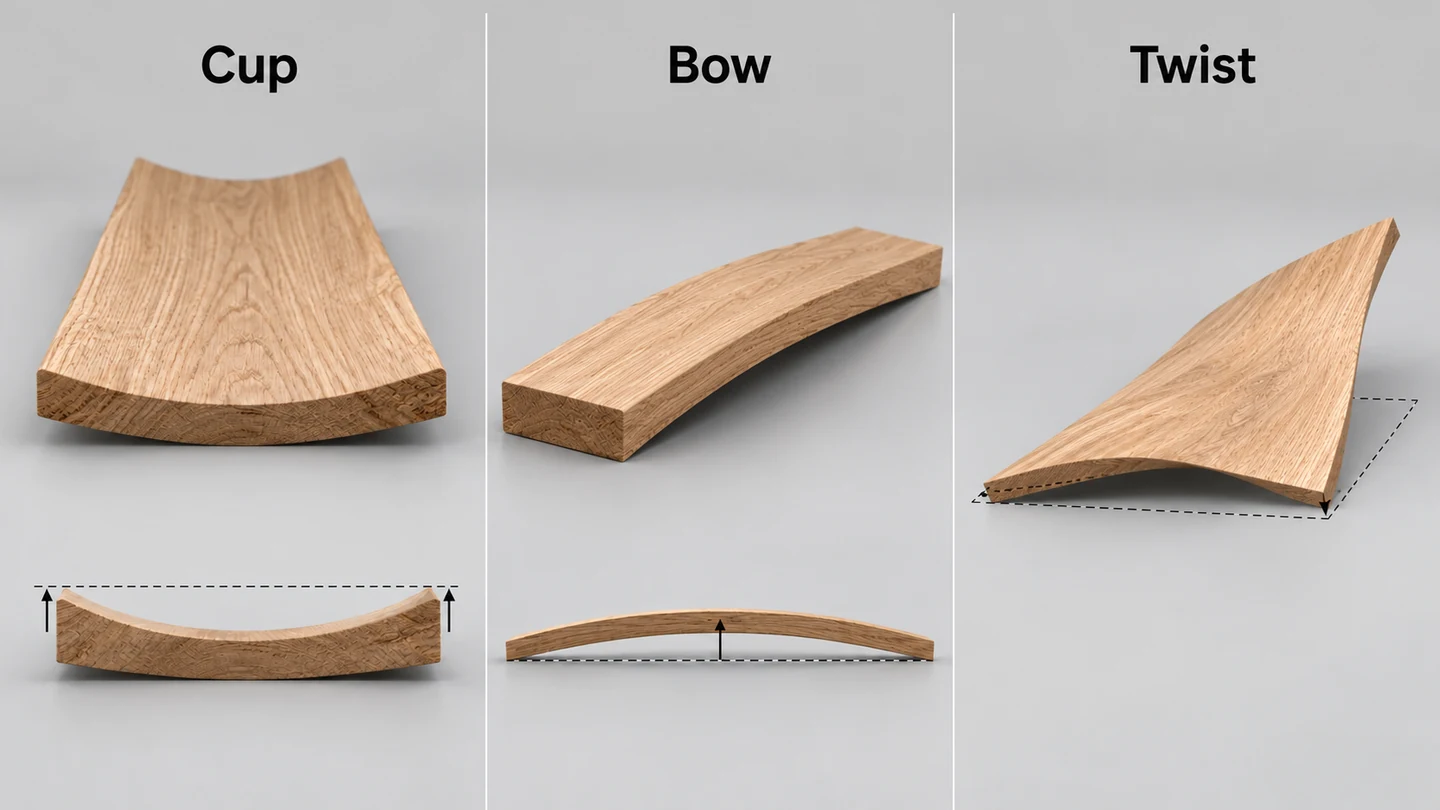
The association’s TFL Panel Standard 5-25, published on May 1, 2025, distinguishes cup across the width, bow along the length and twist at the diagonal corners. Record that geometry as well as the direction of bending. These terms help describe the observation consistently.
The MDF lamination guide covers the basic construction route. Here the task is to investigate a panel that changes shape: which conditions differ between a satisfactory panel and the affected one? Record bending separately from face separation, because a strongly bonded panel can still bow.
When did the bow first appear?
The first observed change tells you where to begin checking, but it cannot assign the cause on its own. An imbalance built into a panel may remain hidden until the moisture conditions change.
| First observation | Checks to prioritize | Evidence to retain |
|---|---|---|
| Immediately after pressing | Face/back construction, incoming materials, adhesive water, pressing and cooling record | A measurement before pressing and after release |
| After cooling or stacking | Cooling and support associated with the actual construction | Shape checks before and after stacking |
| During storage | Support, stacking, material conditioning and room changes | Stack arrangement and repeated shape checks |
| After delivery | Transport, storage and the receiving environment | Dispatch and receipt condition records |
| After installation | Exposure of both faces, fixings and movement allowance | Installed position, room conditions and attachment details |
Avoid turning this table into a probability ranking. The sources identify mechanisms and relevant conditions, not how frequently each mechanism occurs at every stage.
Also record bubbles, lifting or a cleanly separated interface as a separate finding. The decorative-film delamination guide addresses bond failure. A bow may occur with or without it, and the investigation should preserve both observations.
What should you check when a panel bows after pressing?
Check whether the construction or material condition changed before blaming the adhesive alone. Compare the affected panel with a satisfactory panel made from identified materials.
The bulletin lists several potential sources of imbalance: different veneer thicknesses or species, mismatched HPL and backer properties, different face and backing papers, unequal sanding of the substrate faces, and a single-sided overlay. Those examples describe construction differences to investigate.
Incoming moisture condition matters too. If a facing and core are bonded before they reach a suitable equilibrium, later moisture exchange can produce opposing dimensional changes. For heat-pressed impregnated-paper constructions, the bulletin calls for flat, supported cooling with both faces cooling evenly. Keep that specific LPL context when reviewing cooling records. Assess incoming flatness, substrate stiffness and thickness, then set a moisture-acceptance range for the actual materials and order.
A water-based adhesive adds another source of moisture at the coated face. A 2006 factory discussion reports a one-sided HPL/MDF panel bending away from the HPL face. A contributor describes possible flattening as water leaves, followed by bending toward the HPL if the panel becomes too dry or the back later absorbs moisture. This reported sequence shows why direction needs a time record; it cannot identify the cause of another panel by itself.
Why can a panel warp while it is stored?
Storage can change support and moisture exposure after a panel initially appears flat. Check how the panel is held and what each face encounters.
The bulletin’s storage guidance calls for dry, flat storage, protection from moisture and extreme conditions, and support off the floor on equal-thickness bearers. It also calls for suitable space between units and conditioning before assembly.
Its discussion of incoming-material equilibrium says satisfactory conditioning can take two or more weeks, depending on season and air movement. That observation concerns the moisture equilibrium of incoming materials.
Inspect the top and bottom of the stack, bearer alignment and any contact with a damp floor or wall. Compare environmental records across the period in which the bow appeared. A recently machined solid-wood board can also retain moisture gradients and internal stresses despite being stacked with stickers, as in Fine Woodworking’s 2009 question. Do not transfer its heat-based correction methods to a faced MDF panel.
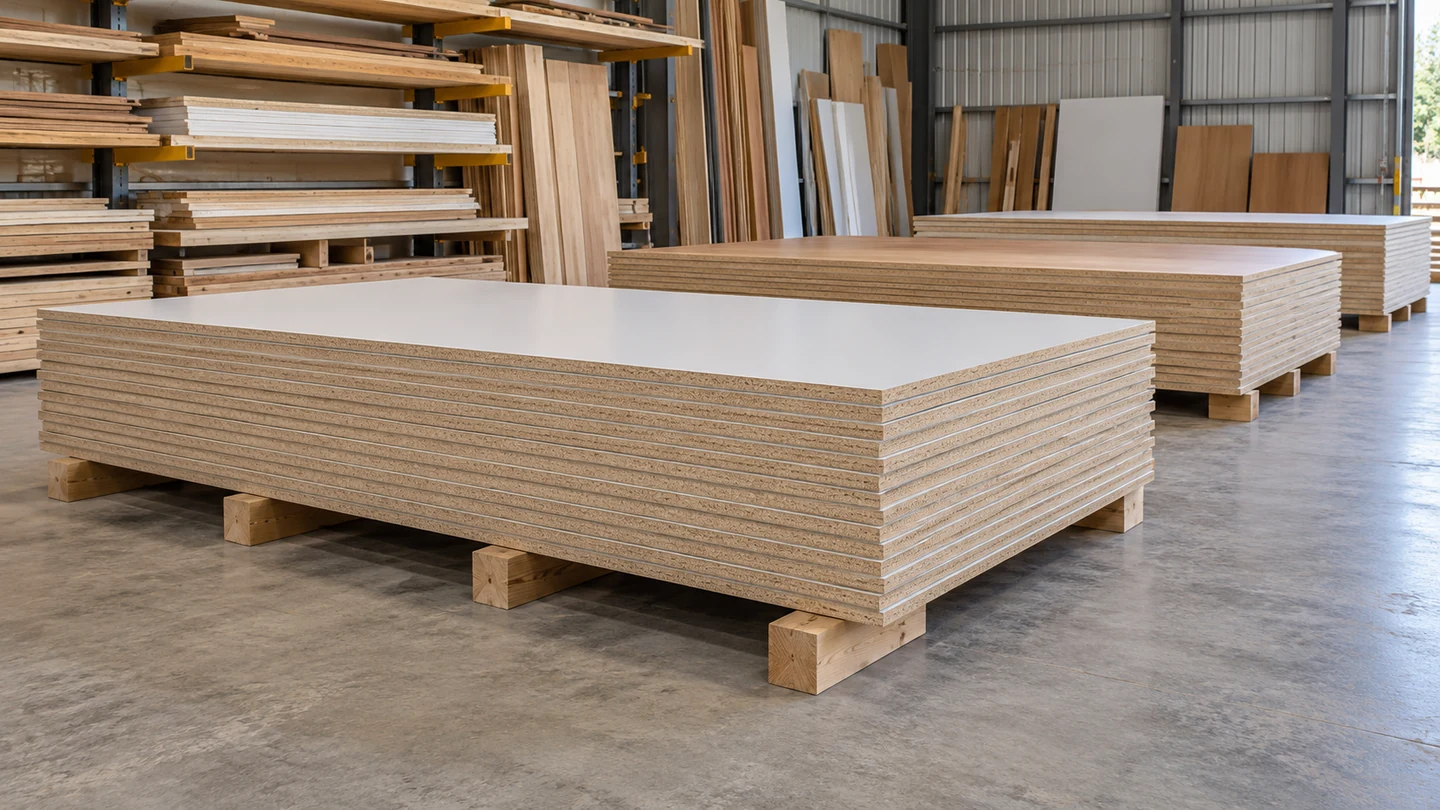
Why can a flat panel warp after it reaches the site?
A change in moisture exposure or installation restraint can bow a panel that left the supplier flat. A balanced construction still needs conditions suited to its use.
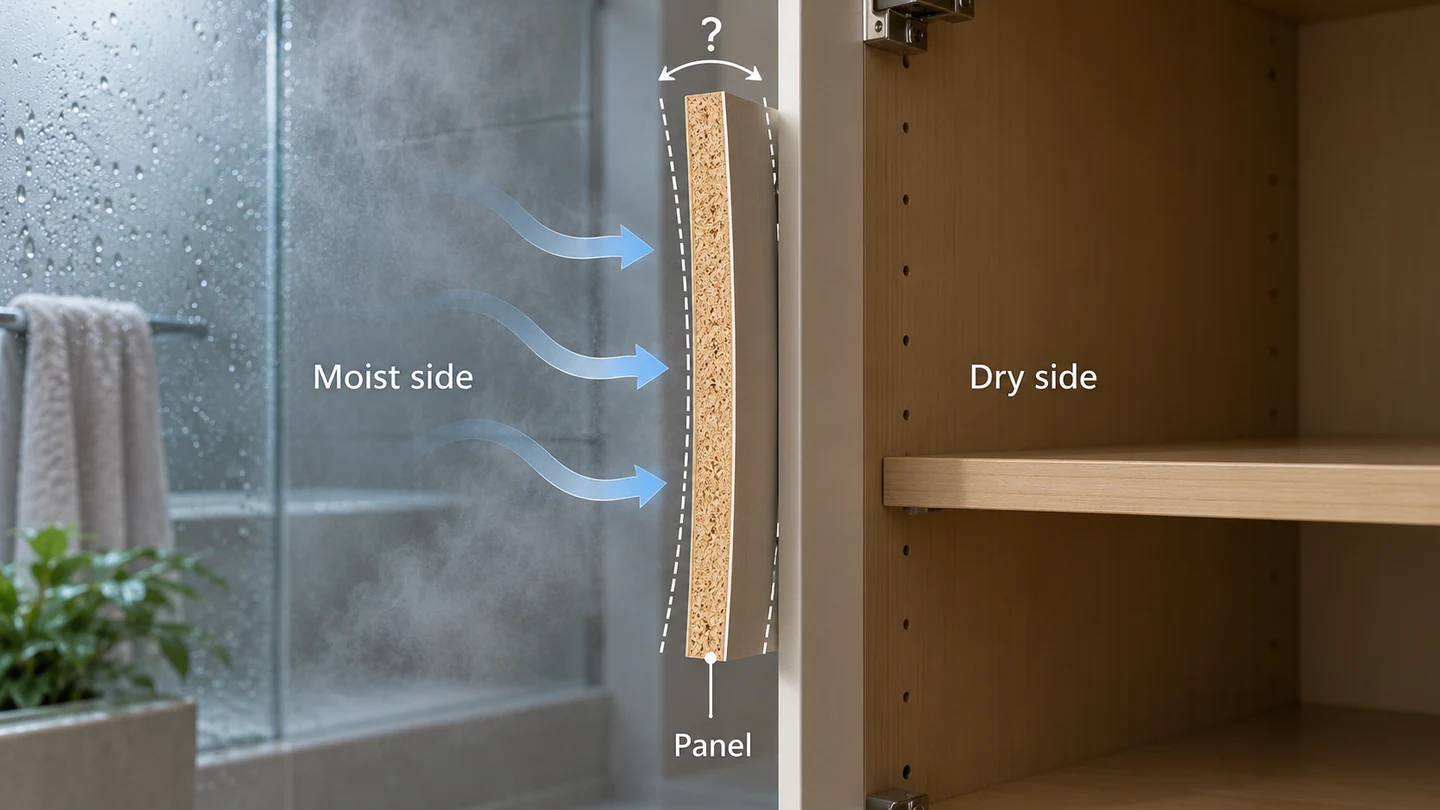
The bulletin describes panels whose two faces experience different environments, such as one face exposed to moisture and heat while the other remains dry. The 2021 USDA Wood Handbook explains that wax additions of 0.5%–1% in particleboard and fiberboard can slow liquid-water uptake for a limited time, while having little effect on water-vapor sorption or humidity-related dimensional change. A moisture-resistant description leaves the actual site exposure to assess. The CPA warp bulletin also notes that long runs of panels without expansion joints may warp, and that panels butted edge-to-edge and rigidly fastened may buckle as their moisture content rises.
Record the receiving area’s conditions, any storage before fitting, and the exposure of each installed face. Look for nearby moisture sources, damp construction, enclosed spaces and rigid fixing arrangements. Compare the installed panel with an uninstalled retained sample where one is available.
A balanced panel with a temporary moisture imbalance may return toward flatness as that imbalance resolves. That possibility offers no assurance for a damaged construction or an unresolved built-in imbalance. Ask the fabricator to assess the actual panel before forcing it flat with additional screws. Changing its restraint may conceal the symptom while adding stress elsewhere.
Does adhesive choice change the moisture-related risk?
Yes, a water-based adhesive can introduce water at the bonded face, while a suitable 100% solids hot melt avoids that particular water source. Other causes of imbalance still need checking.
Jowat’s 2020 customer magazine describes reactive hot melts as free of water and solvent on PDF page 9. Its thin-facing discussion on printed pages 24–25 explains how a 100% solids hot melt avoids water-related swelling beneath veneer, paper or film.
PUR still needs moisture for chemical curing. Henkel’s September 2025 TECHNOMELT PUR 5013GP technical sheet, page 1, describes reaction with moisture from the substrate, air or both. Page 2 of Jowat’s undated flat-lamination brochure distinguishes physical setting on cooling from later moisture-triggered crosslinking. Protecting unreacted adhesive from premature moisture exposure is part of its handling; extra substrate moisture is not a remedy prescribed here.
When reviewing a water-based process, identify the moisture contribution and how it changes during conditioning. For a hot-melt process, still examine incoming material condition, face/back balance, cooling, support and the eventual service environment. The relevant adhesive’s instructions remain part of that investigation.
The panel-lamination adhesive guide explains the broader adhesive choices. The PUR adhesive discussion covers that specific route. Neither an adhesive-family name nor the absence of added water replaces evidence from the complete construction.
How should you specify production backers and balance layers?
Specify the backer material and thickness, then verify the balance required for the complete flat-laminated construction. The CPA bulletin notes that pairing HPL with a backing sheet of different thickness and properties is common practice for cost savings, and lists that pairing as a source of imbalance, so a lower-cost backer needs checking against the face and intended restraint.
For architectural-woodwork projects adopting AWI materials requirements, section 3.3.3.4 lists backer materials that may be used where AWI Standards require a backer. Three of its options:
| Listed backer material | Thickness | Nature of the value |
|---|---|---|
| Laminate conforming to ISO 4586 | 0.5 mm (.020 in) | Minimum |
| Synthetic polymer-treated backing sheet designed for HPDL | 0.43–0.48 mm (.017–.019 in) | Nominal |
| Phenolic-resin-impregnated kraft paper | 0.4 mm (.016 in) | Nominal |
Where AWI requires balance material, section 3.3.3.3(a) specifies material compatible with the HPDL or TFL face and the same thickness. Match each provision to its stated role in the project; the backer list supplies no evidence that every listed sheet balances every face.
How do the face and backer work together?
For HPL-faced particleboard and MDF, the bulletin recommends similar face/backer linear expansion, stiffness and thickness properties, with their machine directions parallel. A thin core combined with a relatively thick facing is particularly sensitive to the stresses involved. The MDF and plywood comparison explains why the supporting material also deserves attention.
For a freely moving door, use a verified balanced construction instead of assuming a single-sided face will stay flat. The warp bulletin gives a conditional countertop example where an elastic adhesive reduces stress transfer and attachment further reduces movement. That example is outside the AWI provisions just cited; it grants no permission to substitute contact adhesive in an AWI-specified layup.
Use the applicable backer specification alongside balance evidence for the proposed pairing. The AWI dimensions belong to their stated project and material provisions, while a film-faced assembly needs its own validated construction. Compare actual supplied scope and cost after those requirements are resolved.
How can test pieces and records narrow the cause?
Use controlled comparisons to investigate a specific hypothesis, supported by records from each stage. A face/back comparison can show whether construction influences the bow, but it cannot identify every cause at once.
A practical investigation can compare panels from the same identified stock under the same recorded environment, then examine construction, adhesive and exposure variables separately. This proposed diagnostic comparison follows the mechanisms described in the bulletin. Changing from one face to two also changes the amount of adhesive and the moisture barrier, so interpret the comparison carefully.
| Record item | What to specify | Why it helps |
|---|---|---|
| Materials | Core, facing, backer, batch and dimensions | Connects the result to an actual construction |
| Incoming condition | Arrival, storage and conditioning history | Shows what changed before bonding |
| Bonding record | Adhesive identity and documented process conditions | Enables review against the supplier’s instructions |
| Observation | First change, bow direction and repeated measurements | Preserves the sequence instead of a remembered impression |
| Environment | Press area, storage, transport and installed conditions | Tests exposure-related explanations |
| Support and fixing | Bearers, stack arrangement and installed restraint | Identifies mechanical differences |
The bulletin names ASTM D1037 for moisture-content testing. CPA 5-25 separates flatness from warp acceptance: its flatness criterion is less than 3 mm/m (0.036 in/ft), tested under EN 14323:2021 section 6.2, and excludes panels TFL-faced on only one side. Its warp entry cites the Standard Method for Measurement of Warp in Composite Panels (August 2022), with permissible warp agreed by user and supplier.
These acceptance provisions belong to the TFL standard. Establish the applicable method and agreed acceptance for the actual order; they supply neither a general film-panel tolerance nor measurement steps for this diagnostic comparison.
Where does a PUR flat-laminated film fit?
Puremorfilm makes decorative film with a silicone functional surface for PUR flat lamination onto board. Standard supply has no back adhesive. Laminated panels can be faced on both sides. Supply is mainly in rolls, with laminated panels available on request. Our silicone surface is inherently flame-retardant, with higher grades up to UL 94 V-0 available on request. In the manufacturer’s laboratory tests, coffee, red wine and soy sauce held at 25°C for 24 hours wiped off with no obvious change. We use a No DOP formulation.
This is a paint-free facing, distinct from PVC, melamine, PP and PETG decorative faces. The laminated MDF panel page explains the offered construction, and the furniture decorative film page describes the facing. We provide technical guidance when customers encounter problems after starting lamination; this article gives no product-specific processing settings.
What should you change before the next run?
Change the factor supported by the investigation, then compare the result under recorded conditions. Retain the panel construction and observation history so that the next adjustment can be assessed.
| Where the change appeared | Review before changing the process |
|---|---|
| After pressing | Construction, incoming condition, adhesive contribution and cooling |
| During storage | Flat support, bearers, conditioning and environmental changes |
| After delivery or installation | Receiving conditions, face-to-face exposure and restraint |
| Across several stages | A built-in imbalance that becomes visible after moisture change |
For a facing enquiry, contact us with the core, face/back construction, adhesive route, storage and service environment, and the first recorded appearance of the bow.
Frequently Asked Questions
What can cause warping?
Warping can result from unbalanced moisture-related dimensional changes across a construction. Investigate the materials, adhesive contribution, environment and restraint rather than assigning a cause from the bow direction.
Can you reverse wood warping?
Yes, a balanced panel with a temporary moisture imbalance may move back toward flatness as conditions equalize. That possibility cannot be promised for a damaged or inherently unbalanced construction, and solid-wood correction methods should not be transferred to faced panels.
What wood is least prone to warping?
Plywood has good dimensional stability along its length and width, but these sources do not establish a universal ranking for warp resistance. Evaluate the complete faced construction and its intended moisture exposure.
Can you laminate only one side of MDF?
Yes, some supported constructions can use a single face, but a panel that must remain flat on its own needs a verified design. CPA’s conditional countertop example includes adhesive behavior and attachment; it should not be transferred to a free door.
Does water-based glue cause laminated panels to warp?
Yes, water introduced at the bonded face can contribute to unequal dimensional change. A water-free hot melt removes that input, while the construction, incoming moisture and later exposure still need checking.