

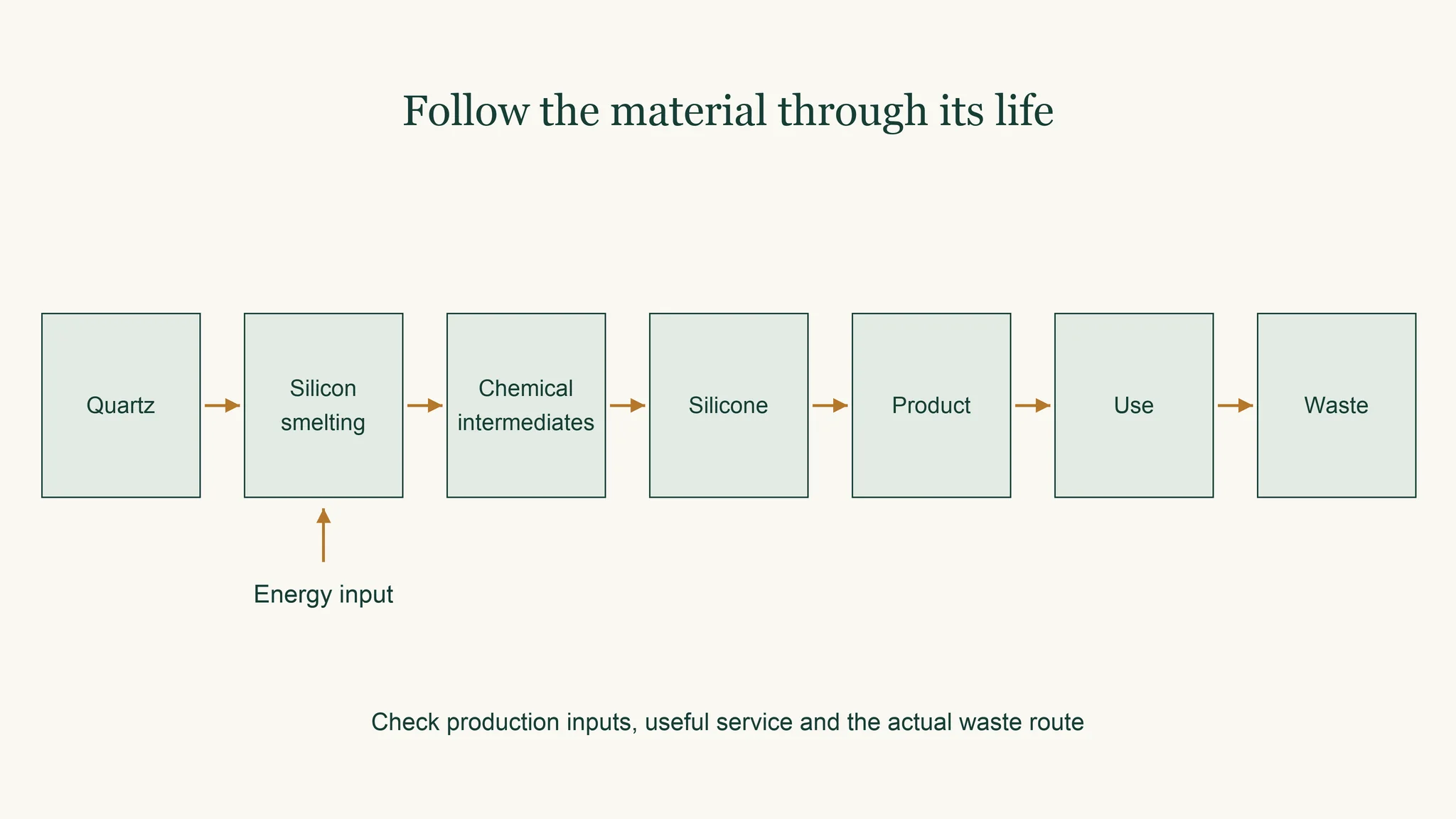
To answer “is silicone harmful to the environment” for a particular product, start with production and disposal: silicon smelting uses substantial energy, and a cured silicone product needs a documented end-of-life route. A 2023 laboratory study also produced silicone-based fine particles through severe mechanical breakdown. Judge a particular product by its footprint for the intended use, complete construction and the waste treatment actually available.
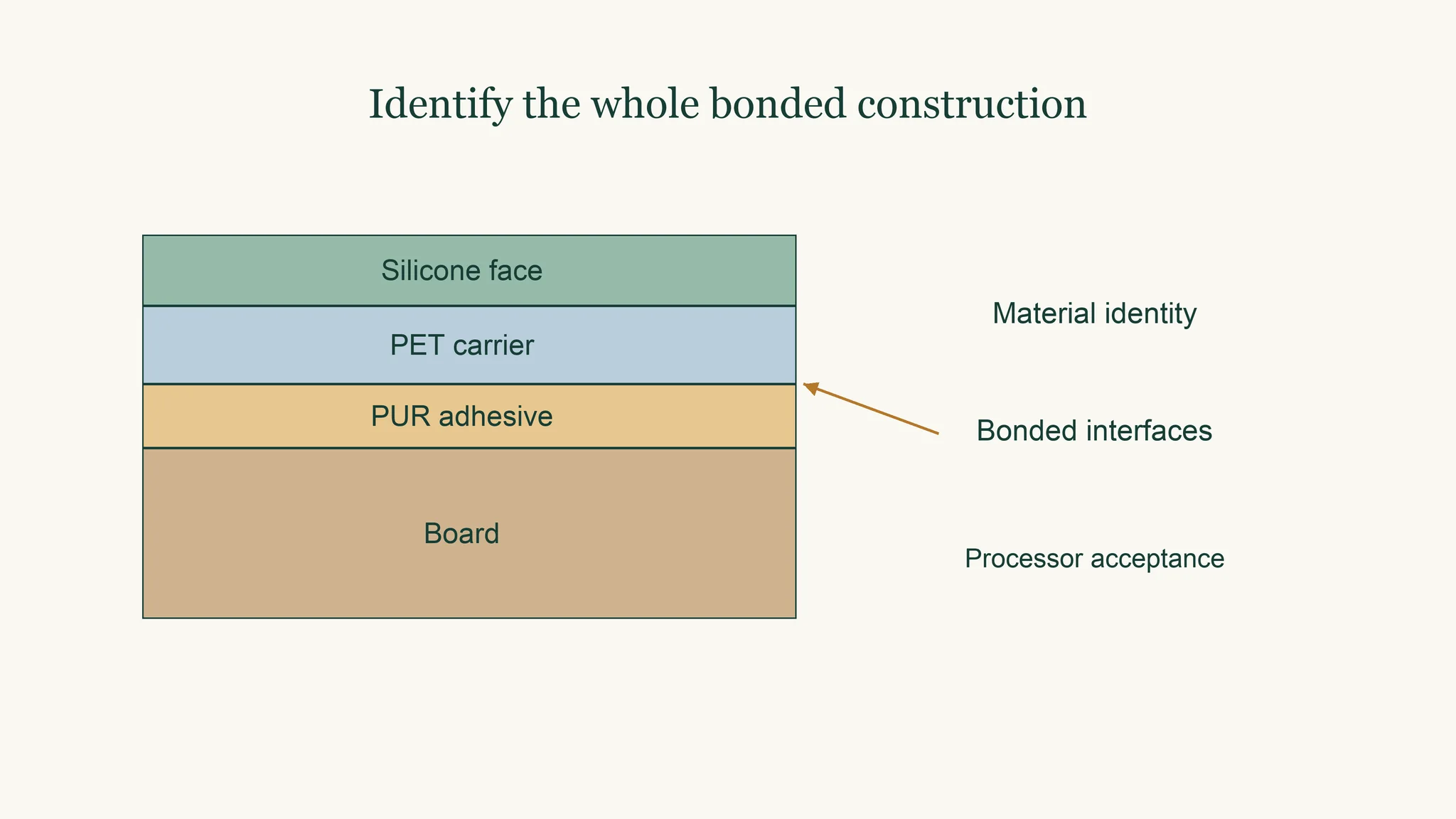
For a decorative surface, that means looking beyond the face material. The supporting film, adhesive and board remain part of the object you buy and eventually discard. Their combination matters when comparing both production impacts and practical disposal options.
What environmental impacts should you weigh for silicone?
Weigh production energy and raw materials, useful service, particle formation during breakdown and the available end-of-life treatment. Those stages answer different questions. A material can remain useful for a long time while still carrying production impacts and creating waste that needs a specific processor or disposal route.
| Stage | What to ask | Evidence to examine |
|---|---|---|
| Production | What enters the supply chain and where does its energy come from? | A footprint with its production boundary and material identity stated |
| Use | Will this product serve the intended function for the planned period? | Relevant performance evidence and a realistic replacement scenario |
| Breakdown | What material and exposure produced the reported particles? | The original experimental protocol and controls |
| End of life | Who accepts the complete waste object? | A processor’s acceptance of that construction and waste condition |
A description such as “made from silica” addresses feedstock origin. It leaves energy use, processing and the finished product’s destination unanswered. Similarly, a durable surface can still be difficult to separate from the rest of a panel.
The explanation of silicone and plastic covers the material’s polymer identity. Use that identity as the beginning of the environmental assessment, then follow the actual product through manufacture, service and disposal.
For an interior project, write down what is being compared: a bare film, an adhesive-bonded panel or a complete cabinet door. Comparing one of those with another requires the additional materials and manufacturing work to be included.
How does production affect silicone’s footprint?
Silicone production includes energy-intensive silicon smelting and subsequent chemical processing, so its footprint requires production data beyond the source of quartz. Electricity supply, carbon-containing reducing materials, methanol supply and the route used to make silicon derivatives all influence the production assessment. Ask for data covering the material that will actually be supplied.
Elkem’s production and footprint discussion, published in December 2025, identifies smelting as a particularly energy-intensive stage. Its process account also explains why upstream electricity and chemical inputs belong in a footprint discussion.
The chemistry continues after making silicon metal. The industry association’s synthesis explanation describes silicon reacting with methyl chloride to form methyl chlorosilanes. A mineral feedstock therefore passes through both metallurgical and chemical operations before becoming a silicone material.
When comparing suppliers, read the boundary next to the footprint. A figure for an upstream ingredient answers a narrower question than a figure for a finished decorative panel. Check whether the supplied film, adhesive, board, processing and transport are included in each comparison.
A purchasing decision based on a lower reported value becomes useful when both values cover equivalent objects. Keep the calculation boundary and unit beside the number when sharing it with a designer or project owner. Otherwise, the shorter description can lose the conditions that made the comparison meaningful.
Does a longer service life make silicone the better choice?
A longer service life can improve the comparison when the product performs the same function and remains in use for that period. It does not automatically settle the choice. Include production and disposal impacts, then compare the alternatives over the same intended service rather than awarding a benefit for longevity alone.
This is a comparison rule derived from looking at how materials are made, used and disposed of. It requires a realistic use scenario. A surface removed during a redesign cannot deliver the full benefit of a service-life assumption that extends beyond that redesign.
Record whether replacement is expected because of appearance preferences or damage. For a frequently redesigned display, those can lead to different conclusions about the value of extra durability. For cabinetry intended to stay in place, maintaining the original finish may carry more weight in the decision.
The cabinet surface durability testing guide explains how to connect performance evidence with a surface requirement. Use appropriate performance information to support the service scenario; keep the environmental comparison tied to the full product.
Record the assumption openly: the intended use, planned period and reason for any replacement. This makes it possible to revisit the decision if the project changes.
Does cured silicone biodegrade or break into particles?
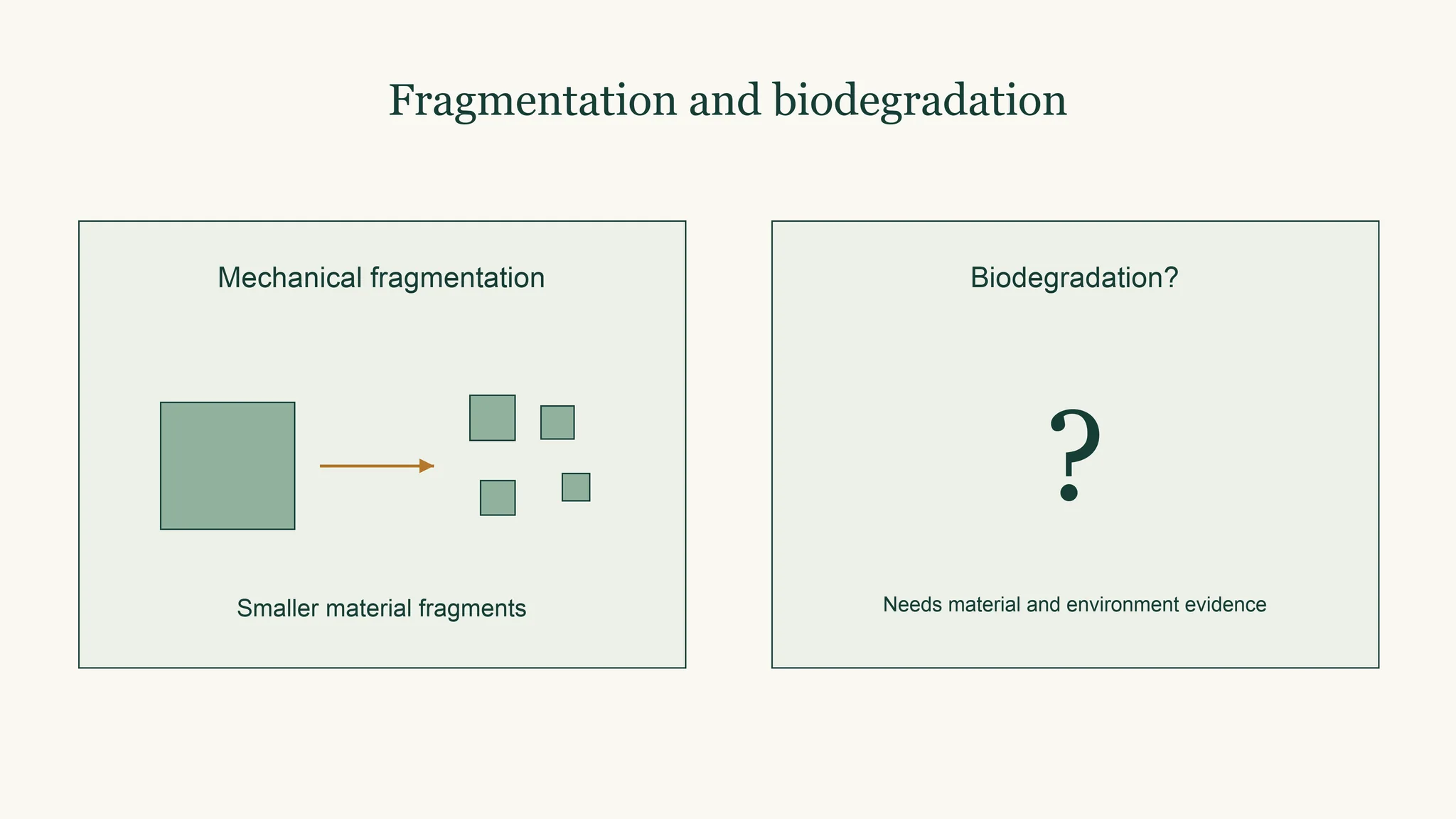
A cured silicone product should not be assigned a universal biodegradation timetable from its name. Mechanical fragmentation is a separate process: severe laboratory breakdown has produced silicone-based fine particles with chemistry similar to the starting material. Check the actual material, environment and exposure before using either claim to plan disposal.
The association’s environment explanation defines persistence in relation to a substance and its environmental compartment. Its discussion of small cyclic and linear siloxanes cannot supply a degradation lifetime for a cured decorative film or bonded panel.
In Ekvall and colleagues’ 2023 study, researchers placed 2 g of silicone pacifier material in 115 mL of ultrapure water and used an immersion blender at its highest speed for 5 minutes. The preparation passed through a 0.8 μm filter, and ATR-FTIR analysis found particle chemistry similar to the starting material. The authors also warned that blenders themselves can release particles and examined blended-water controls.
That protocol supports a specific conclusion about strong mechanical breakdown. It supplies neither an ordinary furniture-use release rate nor a health assessment for decorative surfaces.
Keeping the chemistry recognizable does not prevent an object from becoming smaller fragments. Conversely, seeing fragments is insufficient to establish biological degradation. When a material claim says “no microplastics” or gives a disappearance time, look for the material identity and experimental conditions supporting that exact statement.
Can silicone and bonded decorative films be recycled?
Silicone recycling depends on the particular network and an available processor that accepts the waste. Research has demonstrated specially designed reversible silicone crosslinks, while most silicone elastomers are thermosets. A film bonded to a board adds separation requirements, so assess the complete composite and its condition before assigning a recycling route.
Zheng and Brook’s research abstract, first published online in August 2020, describes thiopropyl-modified silicones with reversible disulfide crosslinks. The authors used particular chemical reactions to recover that specially designed material. Their abstract establishes a research route for that network, not commercial acceptance of an ordinary decorative composite.
A loose production offcut and an adhesive-bonded panel are different feedstocks. The latter includes the face, carrier, adhesive and core, plus any contamination acquired during use. A processor needs that information to decide whether its process can accept the waste and what preparation it requires.
The PET versus PVC decorative film comparison explains a separate material-selection question. The carrier polymer identifies only one part of the complete bonded object that a processor must assess.
For a project claim, obtain acceptance for the actual construction from a named processor, including whether it handles clean manufacturing scrap or used material. Keep any separation requirement and resulting output route with that confirmation. Where acceptance has not been established, describe the route as unresolved and follow the applicable local waste instructions.
What evidence makes a fair material comparison?
Compare footprint studies that use the same function, system boundary and service assumptions, then check the complete construction and accepted end-of-life route. Composition statements can describe ingredients or exclusions, but they answer a different question from lifecycle impact. Keep those statements in their own part of the specification.
| Evidence | What to ask for | Why it matters |
|---|---|---|
| Footprint study | The boundary, reported unit, calculation basis and supplied object | Makes the production figures interpretable |
| Function and service | The same surface function and a stated use period | Keeps the alternatives comparable |
| Material construction | Face, carrier, adhesive, board and other supplied layers | Identifies what is being purchased and discarded |
| Processor acceptance | A named receiver that accepts the construction and waste condition | Connects a recovery claim to an available route |
| Composition statement | The exact substance or material excluded | Defines the scope of the ingredient statement |
A bare-film footprint and a finished-door footprint may both be valid calculations. Their totals address different objects. Either compare the same supplied object or account explicitly for the extra components and operations needed to provide the same function.
The same care applies to disposal. A study of reversible chemistry and a processor’s confirmation of feedstock acceptance provide different kinds of evidence. Keep both visible if a project uses a recovery claim.
For a supplier review, use a small evidence file with the material description, study boundary, service assumptions and receiver confirmation.
Missing evidence should narrow the claim. You can describe what the material contains while leaving a comparative carbon or recycling claim unmade. That gives a designer usable facts without filling the gaps with a broad “green” label.
How should a silicone decorative surface be described?
Puremorfilm supplies decorative film with a silicone functional surface on a plastic film base, currently PET in stable production, for furniture and interior walls. We mainly supply rolls for PUR flat lamination, with laminated panels available on request. Assess the finished construction when discussing the material’s eventual waste treatment.
We use a No DOP formulation, and the furniture film is PVC-free. These composition statements describe the material; they supply neither a product footprint nor evidence of an accepted recycling route.
The silicone surface is inherently flame-retardant, with higher grades up to UL 94 V-0 available on request. In the manufacturer’s laboratory tests, coffee, red wine and soy sauce left at 25°C for 24 hours wiped off with no obvious change.
Our silicone-surface furniture film is a paint-free material with a silicone functional face, distinct from PVC, melamine, PP and PETG decorative faces. Free samples are available.
How should you choose and dispose of a silicone material?
Choose by defining the intended function and service period, comparing matching footprint boundaries, listing the complete construction and confirming an accepted waste route. Check the conditions behind any degradation or particle claim. Keep the evidence with the specification so the installed product and its eventual disposal follow the same material description.
| Situation | Better choice action |
|---|---|
| Comparing production footprints | Match the supplied object, unit and calculation boundary |
| Relying on a long service life | Check that the expected use period and performance support it |
| Buying a bonded decorative panel | Include carrier, adhesive and core in the material description |
| Planning recycling | Obtain acceptance for that exact waste construction and condition |
| Reading a degradation or particle claim | Check the original material, exposure and measurement conditions |
Before ordering, settle the comparison assumptions and save the material construction with the project documents. Before disposal, check that the intended receiver still accepts that waste. A practical route can depend on the object’s condition when it leaves service, as well as the material originally supplied.
For a decorative-film discussion, contact us with the intended application, required environmental information and proposed panel construction.
Frequently Asked Questions
Is silicone petroleum-based?
No, its main chain is a silicon–oxygen backbone rather than the carbon backbone of a conventional petroleum-based polymer. Production still uses organic chemical inputs, including methyl chloride associated with methanol supply. The organic feedstocks and the finished-product footprint need their own evidence.
Is silicone biodegradable?
No verified universal biodegradation timetable can be assigned to cured silicone from its material name. Disposal planning should use evidence for the particular construction and environment. Do not assume that a bonded surface will biodegrade simply because its upstream silicon originated in quartz.
Is silicone safe from microplastics?
No, an absolute claim that silicone cannot form fine particles conflicts with the mechanical-breakdown experiment described above. That study used strong blender treatment of a silicone pacifier material. It does not quantify ordinary particle release from furniture or establish a health outcome for a decorative surface.
Is silicone as bad as plastic?
No general environmental ranking can answer that comparison. Match the function, production boundary, service assumptions and actual waste route for the specific alternatives. A material name or a composition exclusion cannot supply the missing comparative footprint.
Can silicone be recycled?
Yes, specially designed silicone networks have been recovered in research, and a practical route requires a processor that accepts the particular waste. For a bonded decorative film or laminated panel, the receiver must confirm it accepts the whole construction.