
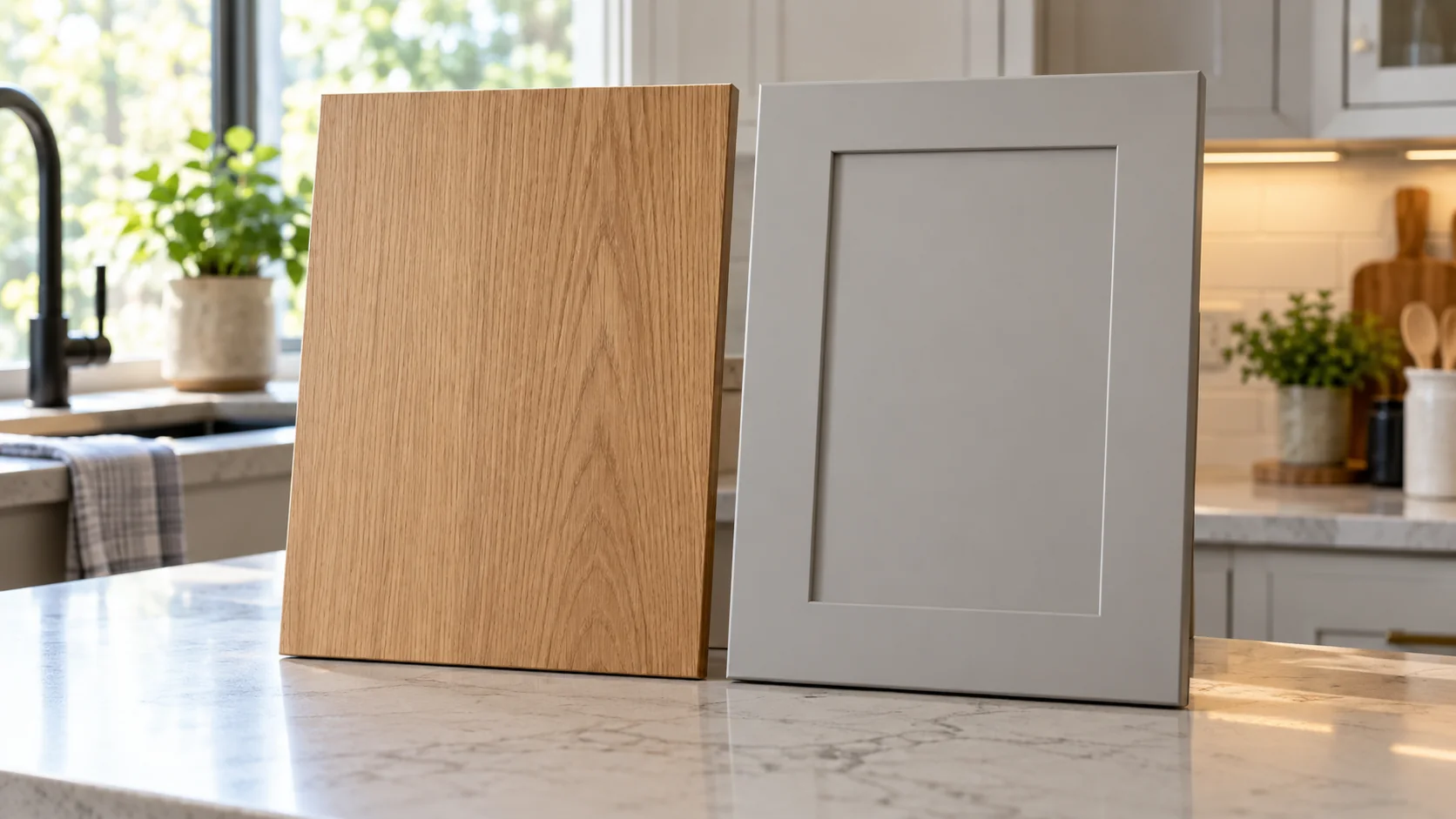
If you are replacing kitchen doors, the first decision is usually the face shape. In slab vs shaker cabinets, choose slab when you want an uninterrupted door face and fewer inside corners to wipe. Choose Shaker when a recessed center and surrounding frame suit the room. A traditional Shaker door has two vertical stiles and two horizontal rails, but the finished appearance can also be machined into a single panel.
Start with the door shape, then choose its construction, finish and fit on the cabinet box. Recording each choice makes it easier to compare quotations and understand what you will receive. Slim Shaker offers another option when you like a frame but want less visual detail across a long run.
What is the difference between slab and Shaker cabinets?
A slab door presents a continuous flat face, while a Shaker door has a recessed center inside a simple frame. Slab creates fewer lines across the kitchen; Shaker repeats a framed outline on each door. Both shapes can use different materials and finishes, so compare the complete door specification alongside the appearance.
| Feature | Slab | Shaker |
|---|---|---|
| Face | Uninterrupted surface | Recessed center with a surrounding frame |
| Typical construction | Solid, veneered or faced panel | Often an assembled frame and panel; routed versions also exist |
| Overall look | Quiet, continuous planes | Repeated outlines and visible depth |
| Cleaning access | Broad face with fewer internal corners | Frame ledges and recess corners need attention |
| Cost tendency | A simple construction can reduce making steps | Frame assembly or routing adds work; materials and finish can change the comparison |
| Common design pairing | Contemporary rooms and continuous woodgrain | Traditional and transitional rooms |
Read the phrase “flat panel” carefully. A seller may use it for a whole slab door or for the flat recessed center of a framed door. A photograph of the face and a section drawing resolve that ambiguity more reliably than the label.
Compare both styles on an elevation containing drawers, tall doors and corner units. A single attractive sample can hide how often its frame repeats. The larger drawing also reveals whether a narrow drawer front can carry the same proportions as a tall pantry door.
How do door shape, construction and cabinet fit differ?
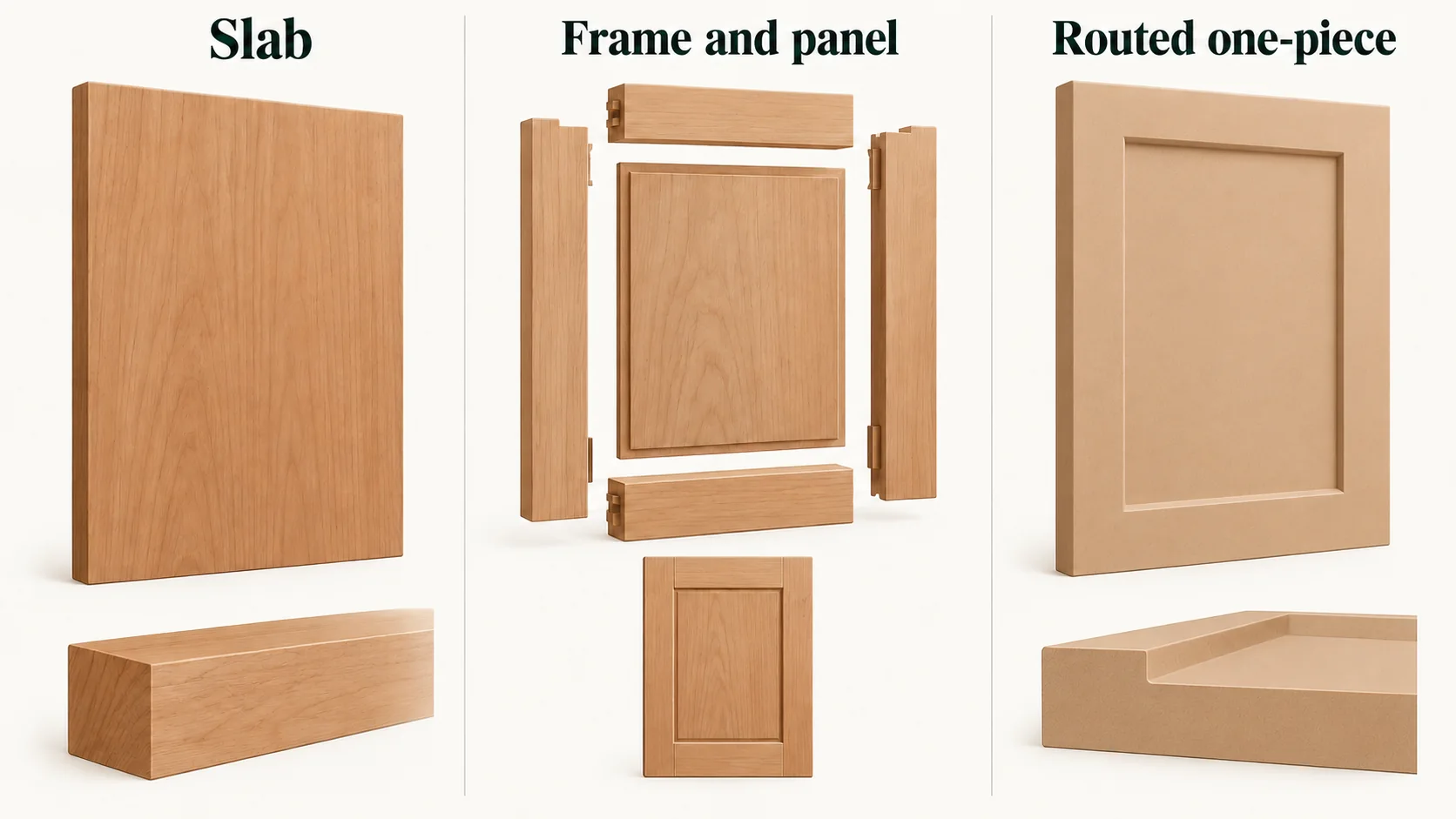
Door shape, component construction, cabinet-box construction and door fit are four separate choices. A Shaker appearance can come from assembled pieces or a routed panel, and a slab door can sit inset within a frame. Specify each choice separately so that the quotation describes the door you intend to buy.
| Item | What to specify | Why it affects the choice |
|---|---|---|
| Face shape | Slab, framed recess or slim Shaker, with a drawing | Establishes the visible geometry |
| Door construction | Actual core, facing and assembled or routed construction | Identifies the component behind the look |
| Cabinet box | Framed or frameless | Determines the supporting cabinet construction |
| Door fit | Inset or the intended overlay | Establishes the door position and visible gaps |
Door construction
Traditional five-piece Shaker construction uses two rails, two stiles and a center panel. A cabinet-maker’s construction examples for painted panel doors also describe routing a panel appearance into a single ¾-inch MDF slab and making assembled five-piece HDF doors. Material names therefore need a construction description beside them.
In assembled wood doors, movement at the rail-and-stile joints can produce visible lines through a painted finish. Look closely at the rail-and-stile joints when comparing painted samples. The cabinet surface durability test guide explains how to read scratch and wear results alongside the door specification.
Cabinet box and door fit
Slab doors can be used with inset cabinetry, as these inset slab-door examples show. Shaker styling also works with different box and overlay arrangements. Ask to see the proposed door on its intended cabinet box, including the hinge side and neighboring front.
Finishing route
The Composite Panel Association’s 2D and 3D laminate description describes flat lamination and forming suitable laminates over contoured parts. It identifies routed MDF Shaker doors as a 3DL application. A flat decorative face with a separately finished edge and a film formed into a routed recess require different material and process choices.
Which style suits your kitchen’s look?
Choose slab when broad planes, continuous woodgrain or a restrained contemporary layout lead the design. Choose Shaker when the room benefits from repeated frame detail and a traditional or transitional character. Look at the doors with the worktop, floor and hardware, because those surrounding choices change how busy either style feels.
A long wall of tall cabinets makes the difference especially visible. Slab fronts can read as a continuous surface interrupted mainly by the working gaps. Shaker fronts add an outline around each opening. In a room with patterned flooring, open shelves and a strong worktop, that additional rhythm may be welcome or may compete with the other details.
Woodgrain creates another decision. A slab face gives the grain a broad area to cross. An assembled Shaker door joins a center panel to rails and stiles, so their grain directions become part of the design. Compare the wood veneer and laminate options before selecting the face material, then mark the intended grain direction on the cabinet elevation.
Mixing styles can work when the change follows a clear part of the room. For example, keep framed perimeter cabinets and use slab fronts on the island. Carry a shared color, wood species or hardware finish through the two areas. That gives the change a visible purpose without requiring every door to match.
Is slim Shaker a middle ground between slab and Shaker?
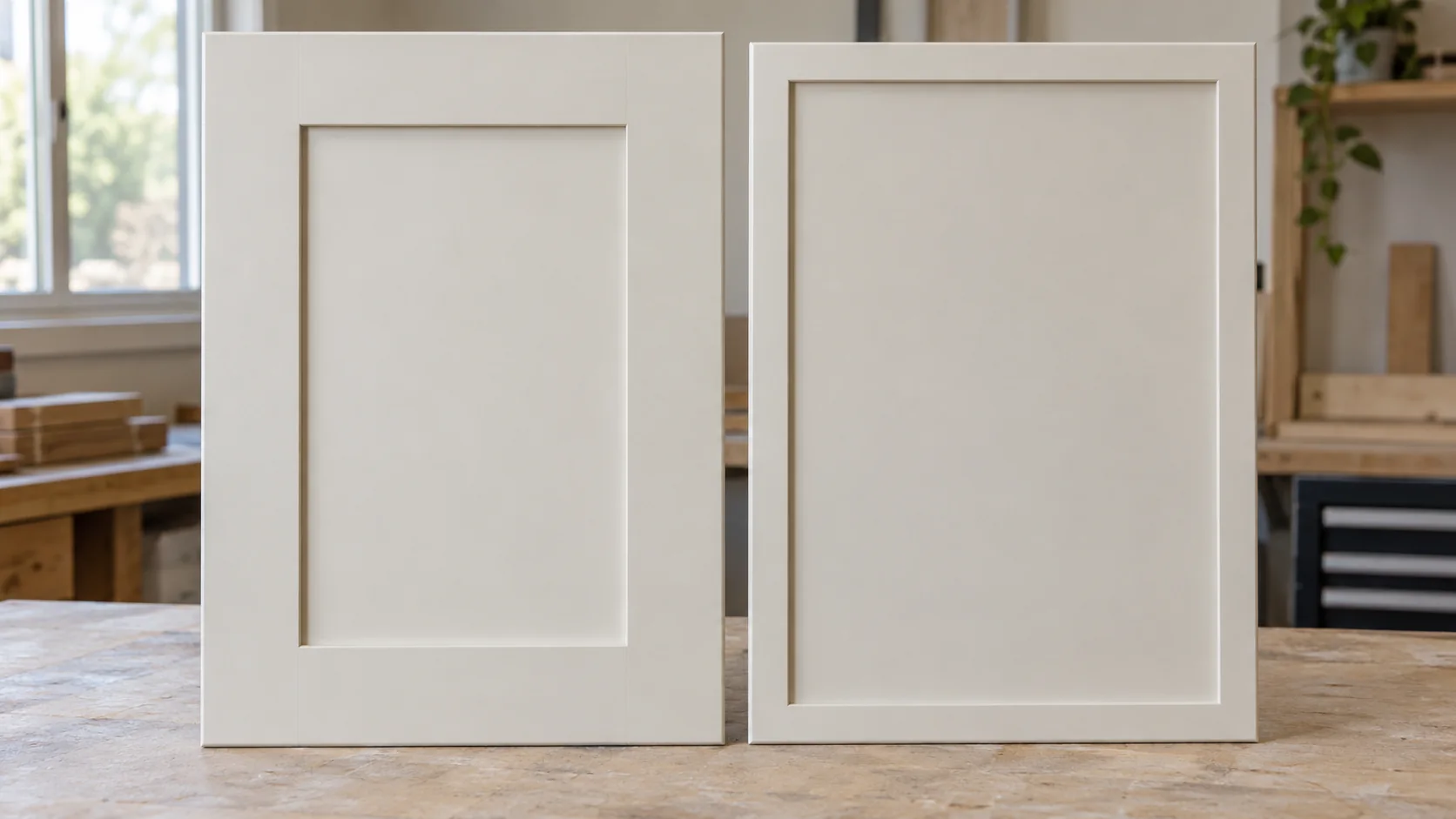
Yes, slim Shaker keeps a recessed center while reducing the width of the surrounding frame. It can bring the quieter look of slab closer to a framed door, but the recess and inside corners remain. Compare frame width, recess depth and inside-edge shape on actual samples before choosing between versions.
Dura Supreme’s Shaker door examples illustrate how much those details vary. Its Paris door uses 1¾-inch rails and stiles, and its shallow-Shaker category has a ⅛-inch step down to the center. The named Homestead Panel and Craftsman Panel doors use 2 3/16-inch and 2 11/16-inch frame widths respectively, both with 90° inside profiles. These dimensions describe those examples, rather than a universal slim or standard specification.
Place the samples upright beside each other. Look first from the normal approach to the kitchen, then move close enough to inspect the recess. A narrow frame can read almost flat at a distance while still casting a distinct shadow under light from a nearby window.
Check the proposed drawer fronts as well as the doors. A frame that looks balanced around a large pantry panel can leave a much smaller center on a shallow drawer. Ask for a drawing of that exact front so the sample choice carries through to the full order.
Which door is easier to clean around the details?
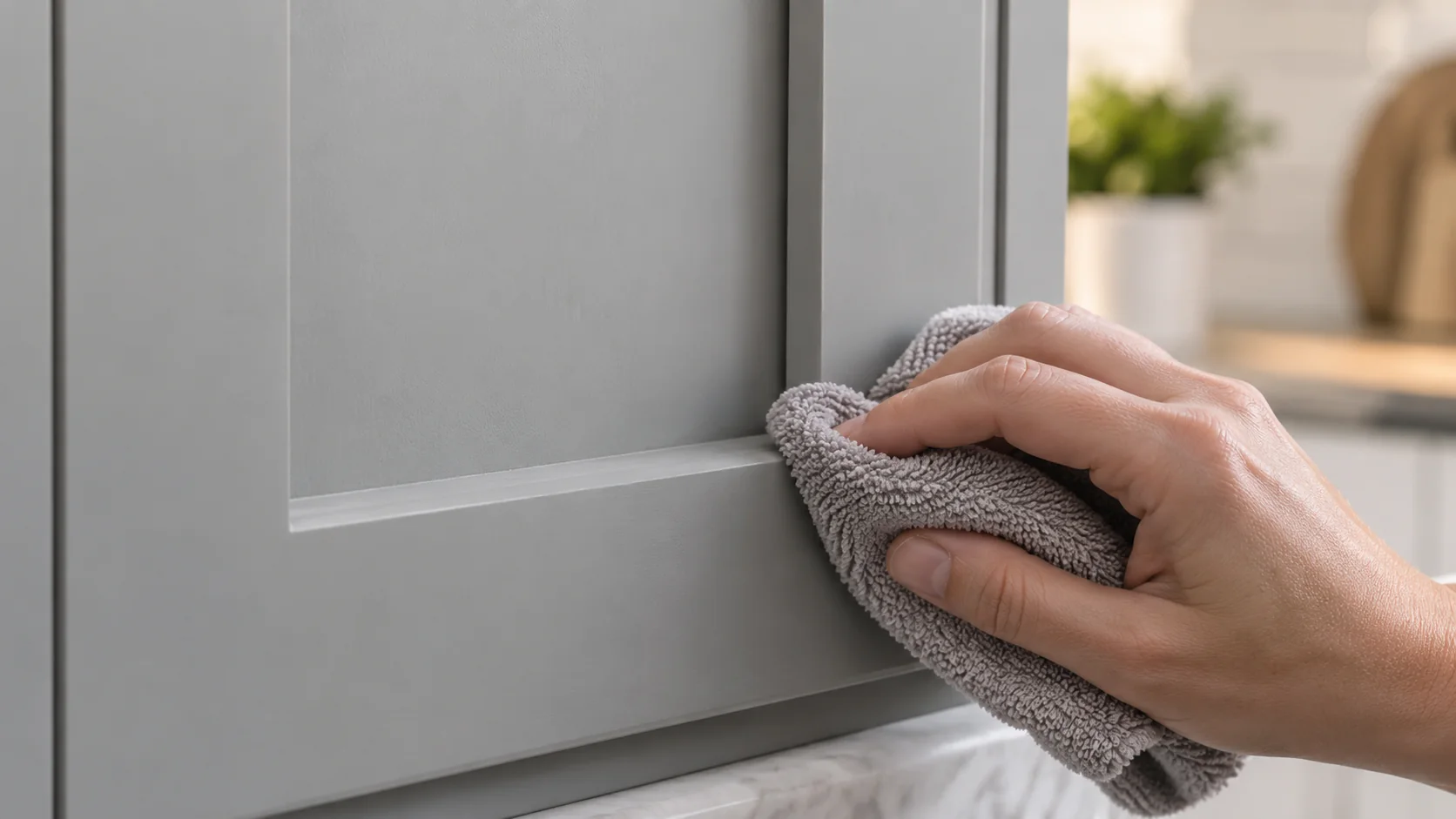
Slab doors are usually easier to wipe across because the face has fewer ledges and inside corners. Shaker doors need more attention along the lower frame and around the recessed center. A shallow recess or beveled inside edge can improve access, while the finish instructions determine which cloth and cleaner to use.
On a sample door, move a folded cloth along the bottom rail and into the inside corners. Check whether the cloth reaches the corner comfortably and whether a sharp step catches it. This is a useful way to compare the geometry before it becomes part of the kitchen.
The same cabinet-maker’s Shaker examples describe beveled Hudson and Carson inside profiles as easier to clean, without putting a number on the difference. Use the cloth test above to see whether the profile you are offered behaves the same way.
KraftMaid’s 2025 cabinet care guide, page 17, advises wiping its wood finishes with a damp cloth and then drying, removing spills promptly, and avoiding excessive moisture and abrasive cleaners or scouring pads. It also warns against hanging wet towels over sink-base doors. Read the care sheet for the finish you are offered the same way: it tells you which cloth and cleaner your sample test should use.
Sheen changes the appearance of marks across a broad face. The matte versus gloss cabinet comparison covers that finish decision. Review sheen alongside the recess geometry when inspecting the finish.
Are slab doors always cheaper than Shaker doors?
No, slab doors are not always cheaper than Shaker doors. A straightforward slab construction may cost less to make, but a premium veneer or facing can reverse that comparison. Match the material, finish, dimensions, hardware and installation scope before using price to choose between two door styles.
A door-only price and a professional replacement price cover different work. For context, Homewyse’s May 2026 replacement estimate was $416–$602 per door for basic professional replacement under favorable site conditions, using its default ZIP code 47474. Its example included a solid-wood panel door with adjustable hinges, face-frame and side-panel veneer, labor, related supplies and equipment. This is a dated installed-job example, not a measured slab-versus-Shaker difference or a material-only price.
Request comparable quotations for the same schedule of openings. Include the tall doors, drawer fronts and exposed end treatments, then ask which items are included. A low unit price for a common door size may tell you little about the complete kitchen if the other components are priced separately.
For an existing kitchen, also establish whether the cabinet boxes will stay and what work they need. Reusing a suitable box and replacing the entire cabinet produce different project scopes. Decide that scope before comparing door styles, so an apparent style saving does not come from leaving out installation work.
Where does a silicone decorative film fit?
Puremorfilm makes decorative film with a silicone functional surface for furniture and interior walls. For this door choice, it is a surface option for flat components: we supply mainly rolls for PUR flat lamination, with laminated panels available on request. A routed Shaker recess needs a different finishing route from a flat face.
Our furniture decorative film uses a No DOP formulation. The silicone surface is inherently flame-retardant, with higher grades up to UL 94 V-0 available on request. In the manufacturer’s laboratory tests, coffee, red wine and soy sauce left at 25°C for 24 hours wiped off with no obvious change. Those conditions describe the surface test, not a complete cabinet’s performance.
Texture and gloss can be customized. Free samples are available. Our paint-free material uses a silicone functional face, distinct from PVC, melamine, PP and PETG decorative faces.

How should you choose your cabinet door style?
Choose slab for uninterrupted surfaces and straightforward wiping, Shaker for a visible framed detail, and slim Shaker when you want a narrower outline with a recess. Then check the actual construction, finish and cabinet fit. Make the final comparison with matching quotations and a door sample that represents the proposed design.
| Your priority | A useful starting choice | What to check next |
|---|---|---|
| A calm, continuous cabinet wall | Slab | Grain direction, working gaps and edge treatment |
| Framed detail in a traditional room | Shaker | Frame proportions and the complete cabinet elevation |
| A restrained framed look | Slim Shaker | Actual frame width, recess depth and drawer proportions |
| Easy access for wiping | Slab or an accessible shallow profile | The finished sample and its care instructions |
- Put both door shapes on the same kitchen elevation, with the intended worktop and hardware.
- Record the face shape, door construction, cabinet box and fit as separate choices.
- Inspect a finished door and drawer sample for frame proportions, corners and edges.
- Compare quotations covering the same components and installation work.
For a flat decorative face, contact us with the door drawing, finish appearance, component shape and required quantity so we can discuss a sample for your project.
Frequently Asked Questions
Are Shaker style cabinets timeless?
Yes, Shaker cabinets have a long-established, simple framed appearance that suits many traditional and transitional rooms. The frame width, color and hardware can make a particular version feel more contemporary. Choose those details for the room instead of treating the style name as a promise about future fashion.
What are the three main types of cabinet styles?
Shaker, slab and raised-panel are common ways to group cabinet door faces. Shaker has a framed recess, slab has a continuous face, and raised-panel doors bring the center panel forward. Framed or frameless cabinet boxes and inset or overlay door fitting describe separate construction choices.
Are raised panel cabinets dated?
No, raised-panel cabinets are not automatically dated. Their effect depends on the center profile, surrounding moldings, color and the rest of the room. Compare the complete elevation with a simpler recessed-panel or slab version if you want to judge how much detail the kitchen needs.
Can I mix door styles in one kitchen?
Yes, you can mix door styles in one kitchen, such as Shaker around the perimeter and slab on an island. Make the transition follow a clear area of the layout, and repeat a color, material or hardware finish to connect the two parts.
What is the difference between slim Shaker and Shaker?
Slim Shaker has a narrower surrounding frame than a broader Shaker version, while keeping the recessed center. The label has no single universal frame width. Compare the actual width and depth on the proposed door and drawer fronts, including the inside-edge profile.