
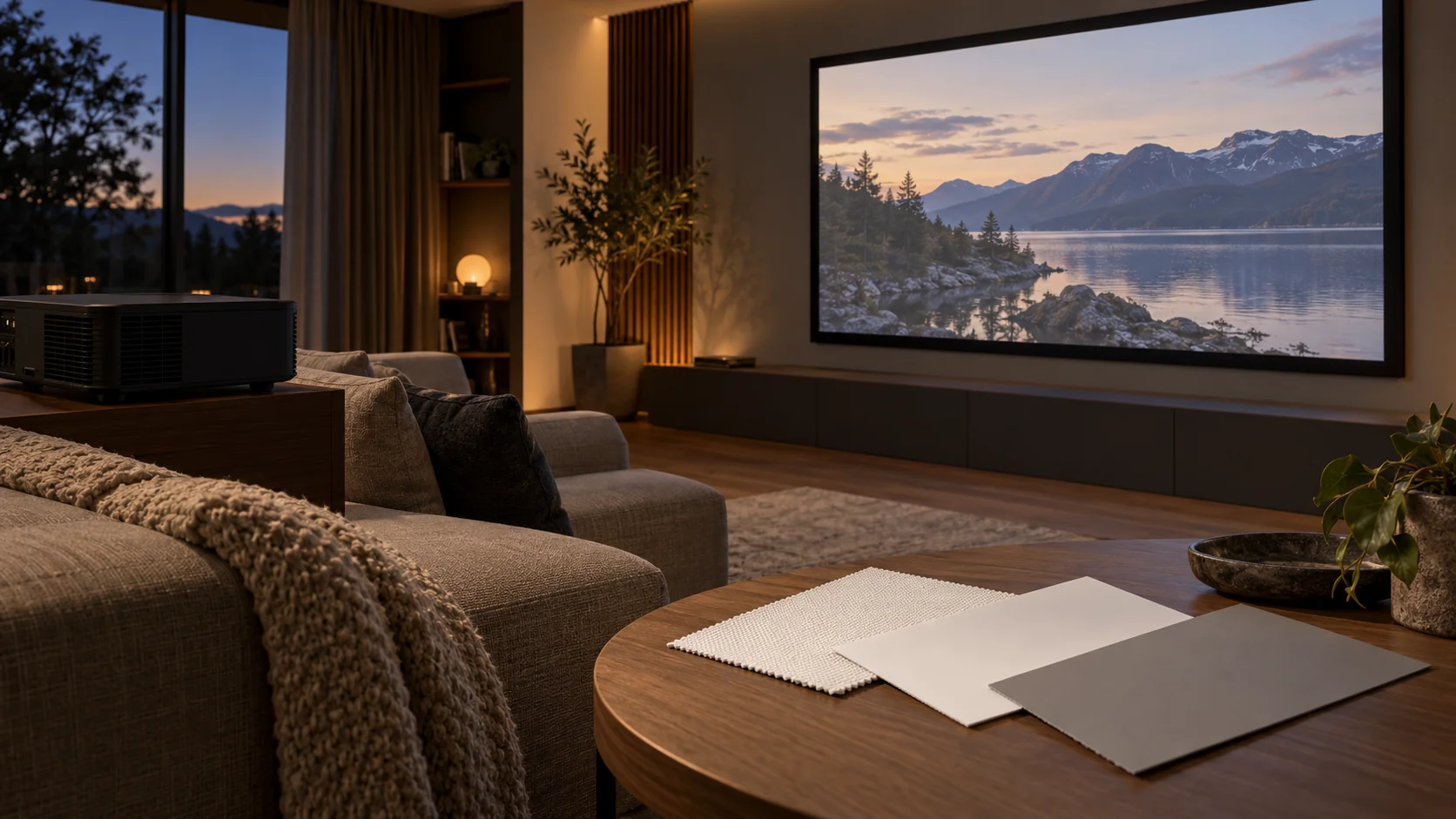
Types of projector screen material are easiest to compare by separating the sheet construction, its light-reflecting surface and any sound-through structure. Start with matte white in a dark, light-controlled room. With room lights on, choose the optical surface around the projector position and seating, then match the sheet to its frame or mechanism.
A listing might describe one screen as PVC, gray, acoustically transparent and retractable. Those descriptions answer different questions. Understanding each one helps you compare actual screens instead of choosing a familiar material name and hoping it will suit the room.
What are the main types of projector screen material?
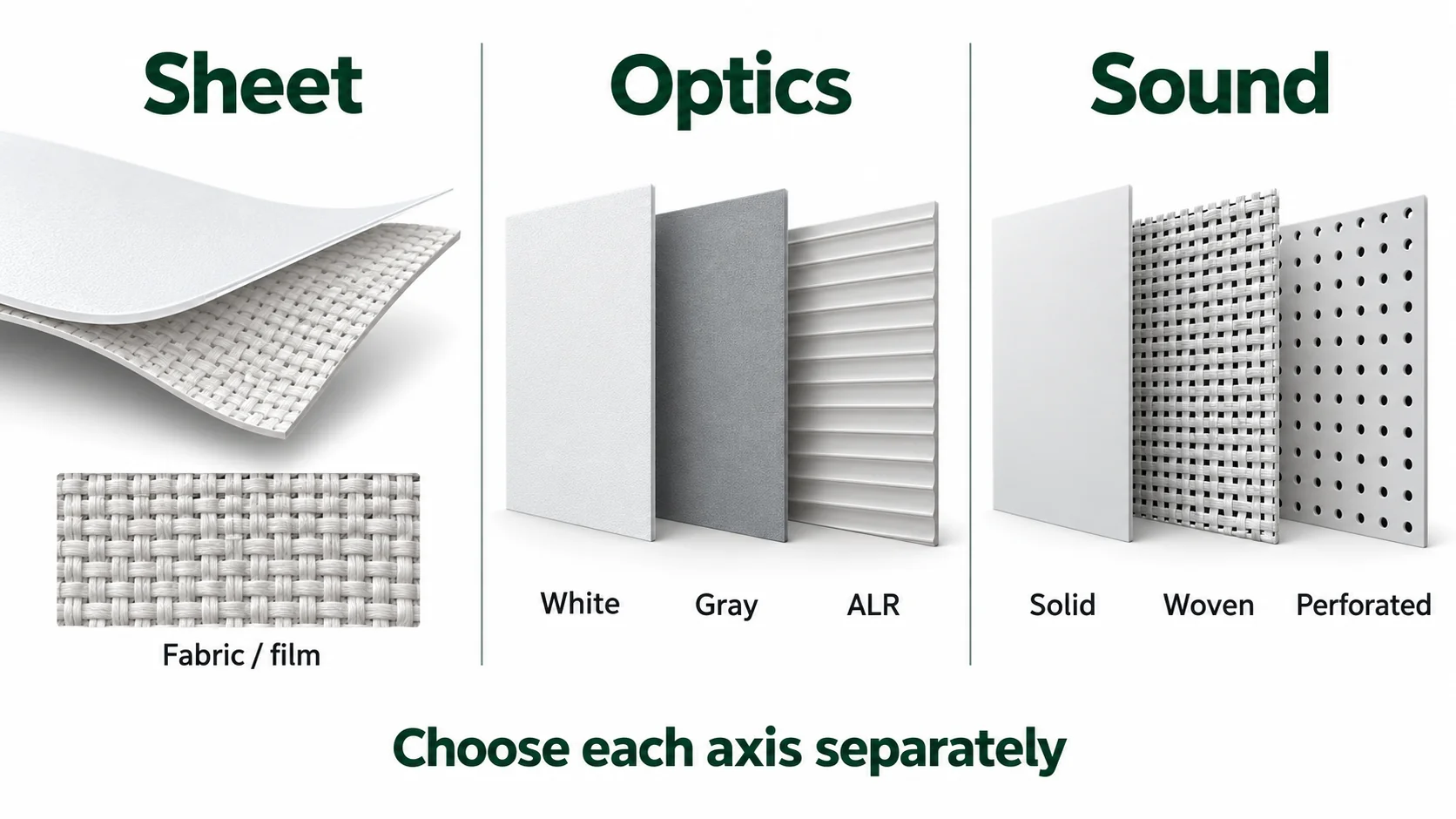
Projection screen surface materials are the fabrics, polymer sheets and coated or structured faces that receive a projected image. Their construction supports the screen, their optical surface controls reflected light, and woven or perforated openings can provide a sound path. Compare these features separately before matching a screen to its room.
| Part of the choice | Examples you will encounter | What to check |
|---|---|---|
| Sheet and support | Coated woven fabric, vinyl or PVC sheet, supported film | Required tension, backing and approved mounting format |
| Optical face | Matte white, gray, directional ambient light rejecting surface | Projector geometry, lighting and viewing positions |
| Sound path | Solid face, woven acoustic structure, perforated structure | Whether speakers will sit behind the image and how the finished screen performs |
A material can occupy all three rows. A woven base may have an opaque coating and backing, while a purpose-built acoustic weave leaves a path for sound. Likewise, a PVC-based sheet can carry different optical treatments. The polymer name gives you part of the construction, rather than a complete picture specification.
The selection process should therefore begin with the room: where the projector can go, which lights will remain on and where people will sit. You can then compare products that answer the same viewing problem. A well-supported ordinary white screen may be the appropriate choice for a dark room, even when another surface carries more elaborate optical features.
What do matte white and gray surfaces change?
Matte white is a sensible starting point for a dark room with controlled light; gray can deepen the perceived black level while reducing reflected brightness. Look at the projected image from your actual seats before accepting that tradeoff.
Diffuse surfaces send light over a broad area. That suits a sofa with people spread across it, provided the room lets the projected image retain contrast. Light-colored walls and uncontrolled lamps can also return unwanted light toward the screen. In a room like that, a diffuse screen can look washed out, as this technical account of screen optics explains.
Screen gain describes reflected brightness relative to a reference under specified viewing conditions. It belongs beside viewing angle and uniformity in a comparison. A larger gain number can concentrate useful light toward particular positions, so read our projector screen gain explanation before treating the largest number as the best choice.
Use a familiar image containing faces, bright areas and dark detail. Compare the center seat with the end of the sofa. A screen that looks bright straight ahead may look less even from the side. Keep the projector settings unchanged during that first comparison so the surface difference remains visible.
A painted wall introduces another set of choices involving surface preparation and the paint itself. Our projector screen paint versus screen comparison covers that route; here, the decision concerns a screen material intended to receive the image.
When does an ALR screen need a particular projector position?
An ambient light rejecting screen needs a projector position that matches its directional optical design. Match the incoming image light, unwanted room light and viewing area together.
ALR surfaces redirect or absorb light according to its direction. Angular-reflective designs direct the image along a reflected path; retroreflective designs return more light toward the source direction. A lamp near the projector can send light onto the screen along a similar path, which makes that lamp harder for the surface to reject. Moving or switching off that light can be more useful than changing the screen material.
Ultra-short-throw projectors place the lens close to the screen and send the image upward at a steep angle. A directional ALR surface for that arrangement must accept the image from below and send it toward the audience. A directional surface designed for another projector position can reject useful image light.
Choose an ALR surface for your projector’s throw ratio, and expect less help from it when room light arrives from the same direction as the projector, as this guide to light-rejecting screens explains. Its Fresnel example reflects only light arriving from below, which is why it pairs with a UST projector. Lenticular and Fresnel structures belong to the optical face, not to the supporting plastic.
For a living room, mark the projector, windows, ceiling lights and sofa on a simple room sketch. Compare those positions with the screen’s installation guidance. In a light-controlled room, a compatible, uniformly tensioned matte white screen remains an option with an ultra-short-throw projector. The current UST installation guidance recommends a specified fixed-frame or tab-tensioned PVC white material and separately describes directional rejection for ambient-light rooms.
Do woven and perforated screens suit hidden speakers?
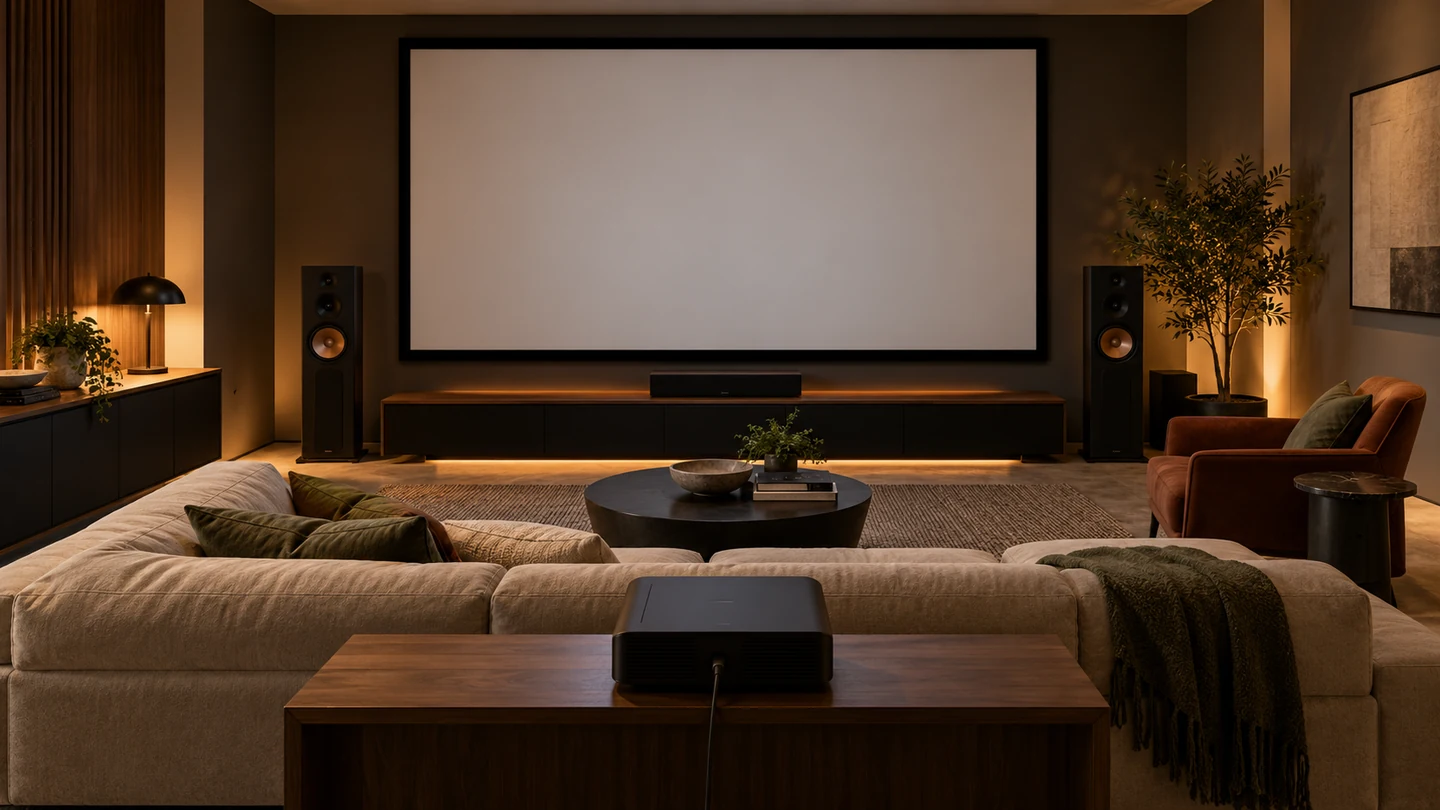
Woven acoustic and perforated screens suit a layout with speakers behind the image when their finished optical and acoustic performance fits the installation. Choose that sound path deliberately.
A solid viewing surface can obstruct sound. Acoustic constructions use gaps in a weave or perforations to let sound pass through. This technical explanation of acoustic screen construction describes both routes. Examine the actual construction, because an ordinary woven support covered by an opaque face is a different product.
This choice is useful when placing the center speaker at the image makes sense for the room. When the speakers already sit beside or below the screen, the material decision can focus on the projected image and mounting needs.
Test acoustic material with the intended speaker arrangement and from the nearest intended seat. Look for visible weave or holes in the picture and listen with the screen in position. A regular mesh or hole pattern can also interact with the projected pixel pattern to produce moiré. The relevant result is the combined screen and speaker installation, including the full-size face under its intended tension.
Before ordering, check that the frame, speaker position and service access fit together; a speaker hidden behind the image still needs to be reachable for adjustment.
Should you choose fabric, PVC or a supported film sheet?
Choose the sheet construction that is approved for your mounting format, after selecting the optical face. Fabric, PVC and supported film describe useful construction details, but the finished product determines whether a screen can be tensioned, rolled or transported.
| Construction or format | Useful question | Practical consequence |
|---|---|---|
| Coated fabric or backed sheet | Does the backing block light, and what keeps the face flat? | Evaluate the supported face, not the uncoated base fabric |
| Flexible vinyl or polymer sheet | Is this exact material specified for the frame or mechanism? | Thickness or flexibility alone cannot establish roll-up suitability |
| Directional optical face | Must the optical structure face a particular way? | Preserve orientation and follow the specified handling method |
| Fixed, retractable or portable assembly | What maintains an even viewing plane? | Compare the completed mounting system alongside the material |
For example, the current MaxWhite material description identifies a coated woven construction with black backing. That example illustrates how a fabric support, optical face and light-blocking back can perform separate jobs within one material.
A fixed frame can maintain tension across a dedicated wall area. A retractable assembly gives the room back when the image is no longer needed, but its material and mechanism must work together. A portable screen adds repeated setup and storage to the requirements. Decide which behavior the room needs before comparing individual material samples.
Structured optical faces also need handling appropriate to their construction. Do not infer repeated roll-up suitability from the fact that a sheet arrived rolled for transport. For a screen already showing waves, our projector screen wrinkle guide explains how to identify the problem before choosing a repair.
How do you test a screen sample in your own room?
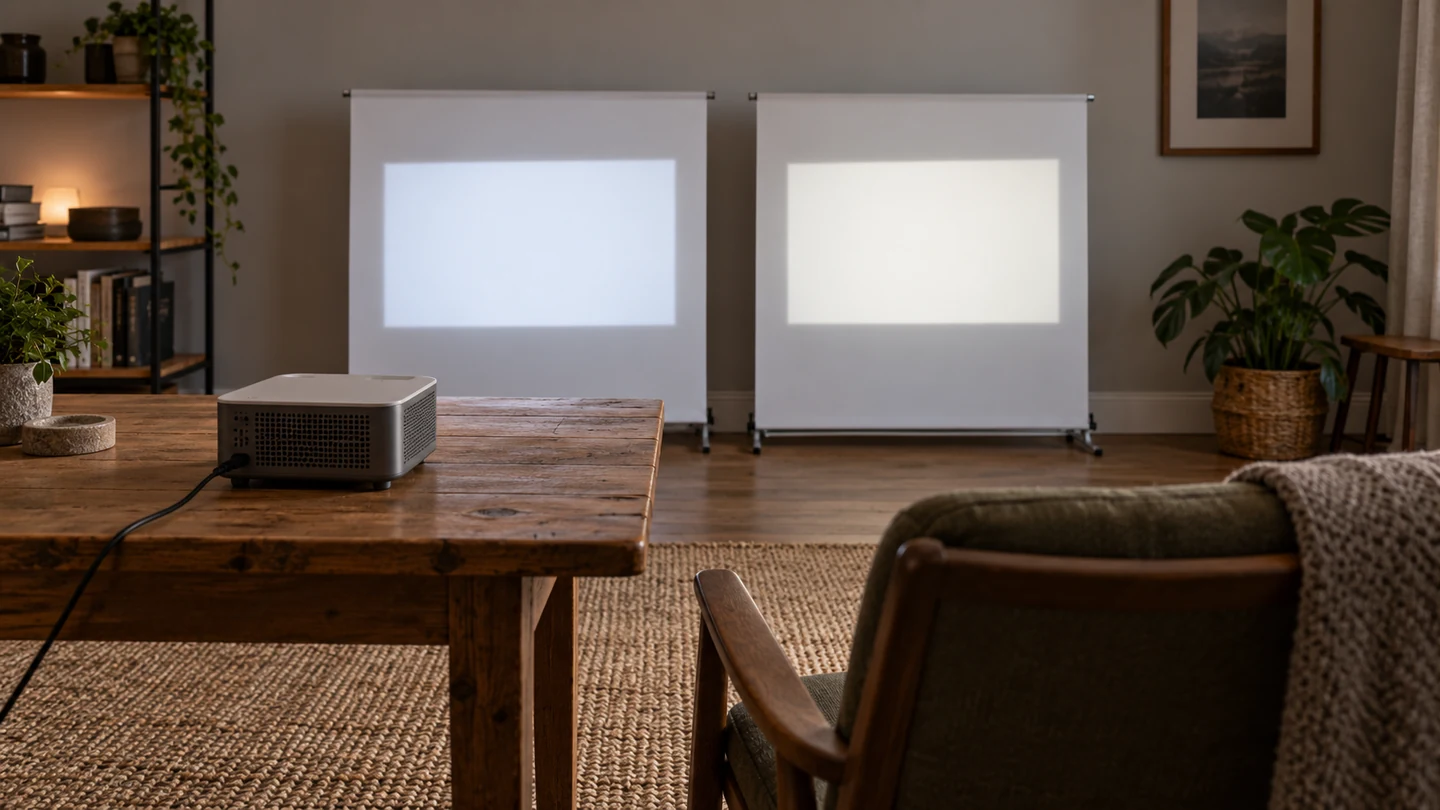
Test candidate samples in the intended screen position with the actual projector, normal lighting and intended seating. Use the same sequence for each sample so you can compare the results.
- Record the projector model, lens position, screen position and intended picture size. Keep those conditions consistent between samples.
- Place each sample in the viewing plane and orientation specified for that material. Support it without introducing folds or an artificial curve.
- Compare the image with normal room lights on, then with the lights and window coverings arranged for a darker viewing session.
- View a white image, dark scene and fine text from the center and outer seats. Look for uneven brightness, hot spots, color changes and visible surface texture.
- For directional ALR, test the ceiling and side lights you actually plan to use. Pay attention to a lamp or window near the projector direction.
- Record image observations separately from mounting, handling and cleaning requirements. A material needs to satisfy both groups before it suits the room.
Compare the sample results
| Check | How to compare | What the result helps you decide |
|---|---|---|
| Lighting | Repeat the same image with normal and controlled light | Whether a diffuse face is sufficient or directional rejection is useful |
| Seating | Move between the middle and outer intended seats | Whether the viewing area suits everyone |
| Surface | Inspect bright fields, dark detail and fine text | Whether texture, hotspots or nonuniformity distract from the image |
| Installation and care | Read the exact material’s mounting and maintenance guidance | Whether you can keep the chosen surface usable |
This is a buying comparison method, with observations you can repeat, rather than a laboratory acceptance standard. A small sample helps eliminate an unsuitable surface. The final full-size assembly still needs to maintain the flatness and viewing behavior you selected it for.
Cleaning belongs in this decision before the screen is installed. Our projector screen cleaning guide explains why a method suitable for one face can damage another. Choose care instructions for the exact surface, especially when it carries an optical coating or fine structure.
Where does a silicone projection film fit?
Puremorfilm supplies projection film with a silicone functional surface for front projection, in a whole piece without a self-adhesive back. Evaluate the projection screen film against the projector and assembly requirements established above.
Our silicone surface is inherently flame-retardant, with higher grades up to UL 94 V-0 available on request. We use a No DOP formulation. In the manufacturer’s laboratory tests, coffee, red wine and soy sauce left at 25°C for 24 hours wiped off with no obvious change.
Across our film range, we supply mainly rolls, with faced panels available on request; our decorative panels use PUR flat lamination. This paint-free material uses a silicone functional face, distinct from PVC, melamine, PP and PETG decorative faces.
Those material facts give you a starting point for evaluating the surface. Select a completed screen using the optical, mounting and care evidence for the proposed construction; the film data above supplies no measured gain, ALR or acoustic result.
Which surface should you choose for your room?
Choose the surface that gives a usable image across your seats under the lighting you plan to keep, in a mounting format the room can accommodate.
| Room or installation need | Starting choice | Check before committing |
|---|---|---|
| Dark, light-controlled room | Compatible matte white surface | Uniformity and appearance across the seating |
| Desire for a deeper black appearance | Compare gray with white | Whether the brightness tradeoff suits the image |
| Normal room lights remain on | Directional ALR matched to the projector | Actual light directions and outer seats |
| Speakers behind the image | Suitable acoustic construction | Picture texture and installed sound performance |
| Screen must disappear after use | Material specified for the retractable assembly | Flatness, handling and permitted storage |
Compare those requirements before narrowing the choice to a polymer or fabric name. Keep the successful sample identified with its surface, orientation and proposed mounting system so the ordered assembly matches the one you evaluated.
Bring the projector model, proposed lens position, screen dimensions, seating range and lighting conditions when you contact us to discuss samples or a quotation for your proposed assembly.
Frequently Asked Questions
What is projector screen material?
Projector screen material is the sheet and viewing face that receives the projected image. It may combine a fabric or polymer support, a light-reflecting coating or structure, and a backing. The completed construction determines how those parts work together.
Is PVC good for projector screens?
Yes, PVC can form a useful screen sheet when its optical face and mounting specification suit the room. The PVC name identifies the polymer; compare viewing angle, image uniformity, lighting compatibility and handling for the exact screen.
Does a UST projector need special screen material?
No, not necessarily. A compatible, uniformly tensioned matte white screen can work with a UST projector in a light-controlled room. If you choose a directional ambient light rejecting screen, it must be specified for the steep projection geometry of the UST arrangement.
What fabric is best for a projector screen?
A purpose-built coated projection fabric is the clearest starting point for an ordinary solid screen; a dedicated acoustic weave suits speakers behind the image. Compare the actual optical face and installation requirements before using general-purpose cloth as a substitute.
Can a projector screen get wet?
No, you should not assume a screen tolerates rain or soaking. Some specified surfaces permit controlled damp cleaning: the CineWhite UHD-B Manual Tab-Tension 2 guide allows a warm-water damp cloth and forbids rubbing or chemical cleaners. Follow the exact material’s care method and remove excess moisture.