
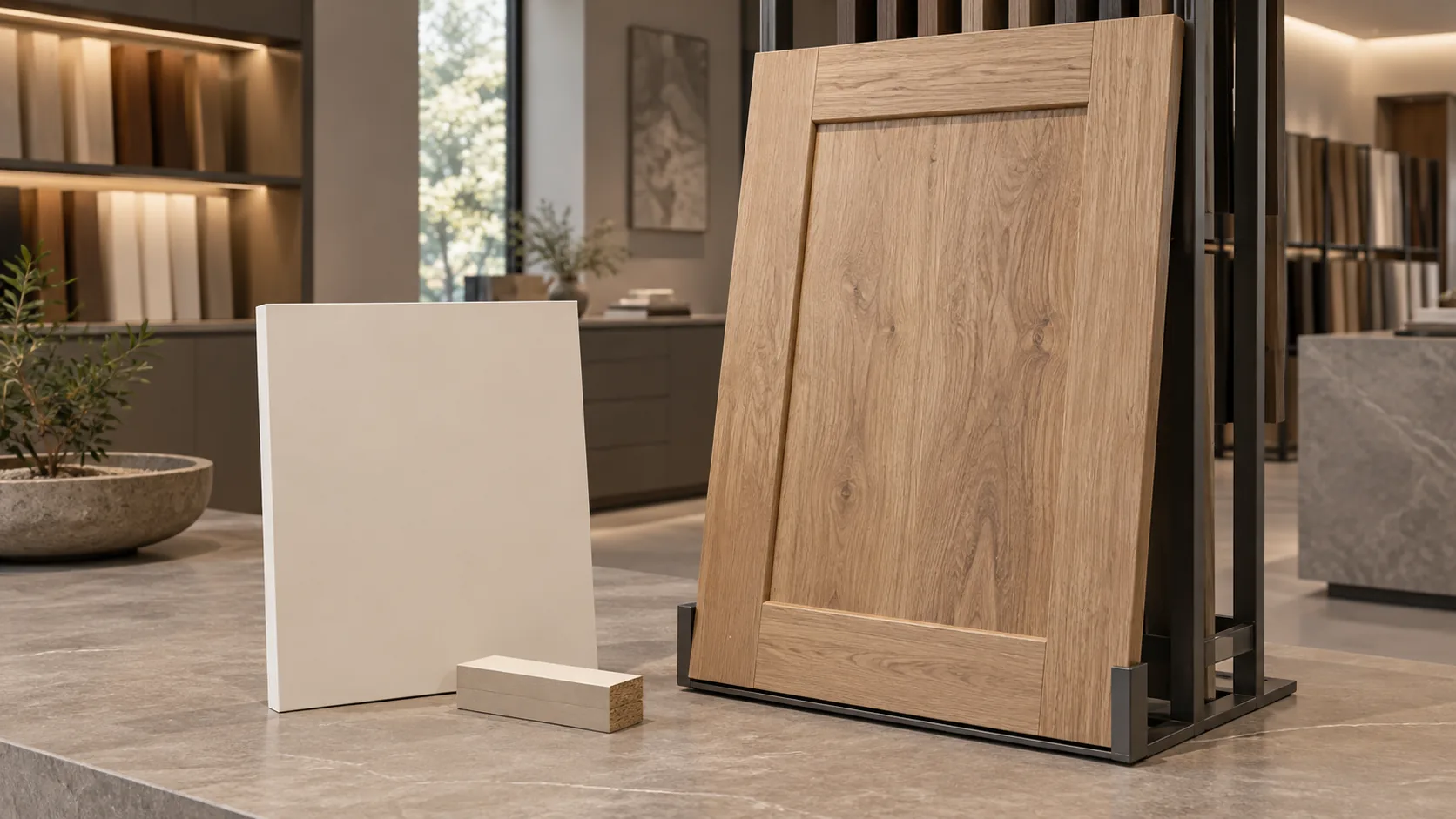
For wood veneer vs laminate vs foil-wrapped doors, choose veneer for real wood grain, HPL for a specified decorative sheet on flat fronts, and a suitable formed foil for continuous facing over routed profiles. Compare the coating, edges, adhesive and core as a completed door; appearance alone cannot establish wear resistance or a repair allowance.
Wood veneer vs laminate vs foil-wrapped doors: how do they differ?
Veneer doors use a real wood face, laminate doors use a decorative sheet or resin-paper face, and foil wrapped doors use a specified film applied around the component. Choose by door shape, edge construction and likely repair. Compare prices for the same finished door, including coating, machining, edging and installation.
| Decision dimension | Real wood veneer | HPL decorative laminate | Foil-wrapped / formed film door |
|---|---|---|---|
| Visible face | Choose for natural species, cut and leaf layout under a specified finish | Choose a printed decor, texture and HPL grade | Choose the identified foil, surface coating and decor; a wood look can be printed |
| Door geometry | Flat veneered panels are straightforward; selected veneer systems also permit profile wrapping | Flat slab fronts are the usual route; specified postforming grades cover defined curves | 3DL membrane pressing suits routed contours and continuous edges; 2DL wrapping is a different route |
| Wear and cleaning | The protective coating governs care and first-contact wear; species alone is not a scratch rating | Select the HPL grade for the intended wear and its permitted cleaning | Select the actual foil and topcoat for scuff resistance; polymer or matte labels alone are insufficient |
| Wet edges | Finish continuity, edge design and core protection remain necessary | Edge joints, backing junction and the bond remain moisture paths | A continuous face still has a back termination and a bond; inspect them near wet or hot locations |
| Repair after surface damage | Sound coating may be recoated; lost wood or an unknown remaining veneer thickness limits sanding | Sanding cannot recreate missing printed decor; assess a visible repair or new face | Torn or peeling film needs bond and substrate assessment; large damage often favors a new facing or door |
| Batch appearance | Plan leaf sequence, grain direction and finished color | Record grade, decor code, texture and pattern direction | Record foil code, route, profile geometry and back-edge termination |
The Composite Panel Association’s veneer description gives typical sliced thicknesses of 0.51–1.0 mm. That is new veneer. An old cabinet that has been sanded before has less wood left, which is why a veneer repair needs more care than a solid-wood one.
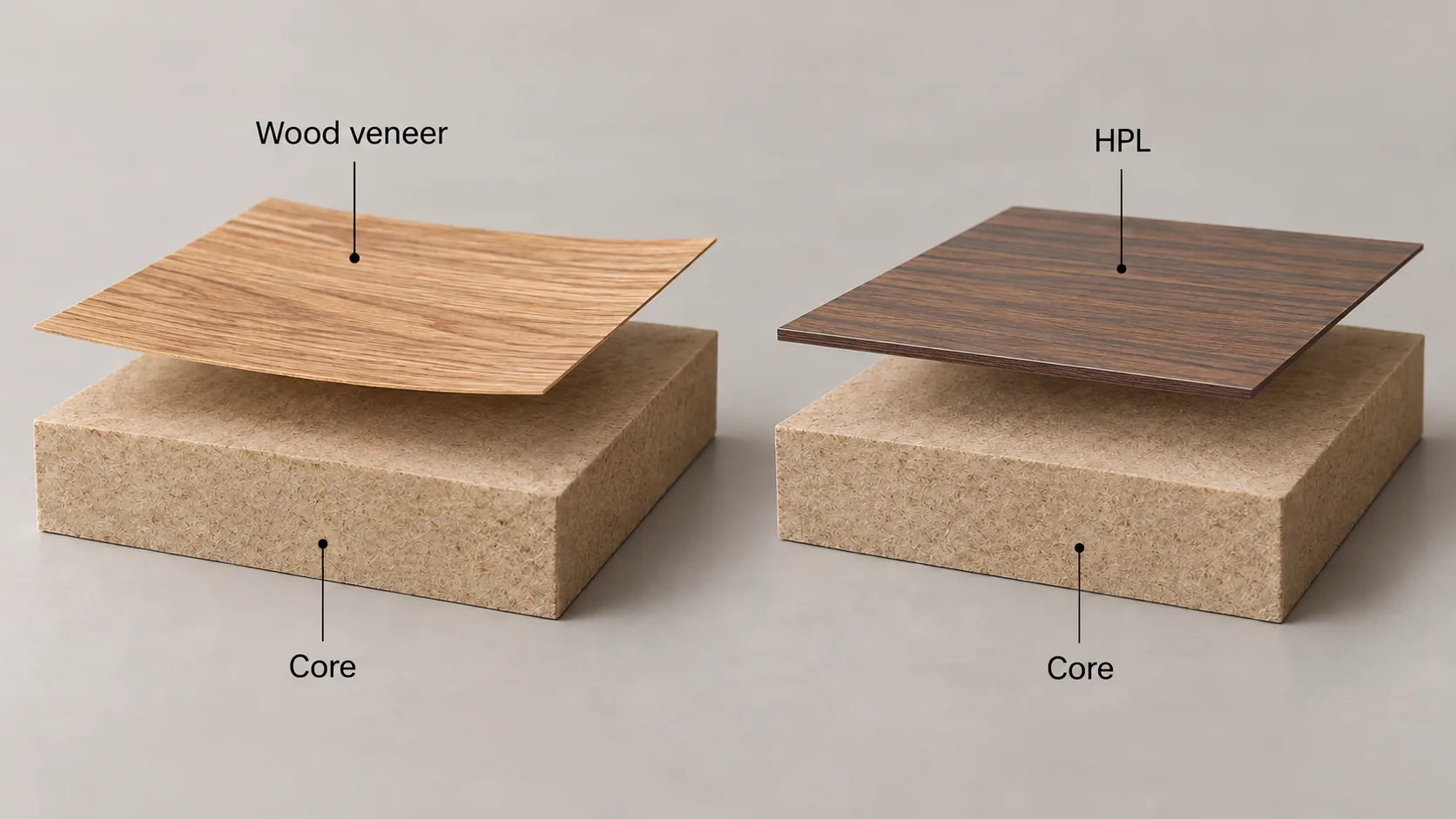
HPL is made as a separate sheet from resin-treated kraft layers and decorative paper. General-purpose grades are typically 0.71–1.22 mm thick, according to the HPL guidance. Compact and special grades are built differently, so keep that range to general-purpose sheet.
TFL is another route: resin-treated decor paper fused straight onto the board, as described in the TFL guidance. Our melamine and laminate comparison distinguishes it from HPL. Similar oak-look designs can appear on TFL, HPL or film, so the visual sample alone does not identify the construction.
Compare veneer with HPL, melamine and film faces in the decorative laminate overview.
For foil-wrapped doors, distinguish 3DL membrane-pressed film from 2DL flat lamination or profile wrapping. The CPA’s 3DL and 2DL definitions explain why the forming route changes the available contours and edges. Our thermofoil and laminate comparison develops that door-shape choice.
Which surface gives the grain and color you want?
Choose veneer for a real species and a planned leaf layout; choose HPL for a printed decor and texture, or formed foil when the required contour favors that process. Each route needs its own appearance specification.
With veneer, name the species and cut first, then decide how leaves join across a door or panel. Adjacent leaves give a planned pattern. Random pieces of the same species can look patchy across a run. The stain or clear coat changes the final color and sheen, so ask for the sample finished.
On a feature wall or a long cabinet run, mark grain direction and sequence on the part layout. One good sample shows color and texture. The part map shows how they carry across the room.
For HPL, keep the decor code, texture, direction and lot information. A printed design repeats, but a replacement batch still needs checking against the doors already installed. Under kitchen downlights, texture can make two nominally identical panels read differently side by side.
Our wood-grain panel guide explains why the visible face and the board behind it need separate names on an order. The grain tells you how a panel looks; the material record tells you what it is.
How should wear, moisture and cleaning affect the choice?
For heavy rubbing, choose a high-wear HPL grade. Keep ordinary coated veneer away from wet, hard-working horizontal surfaces such as a busy worktop. The veneer association excludes those uses unless the wood face is fully enclosed in a suitable resin system.
HPL comes in special high-wear grades, so pick the grade for the job instead of treating every sheet as the same. Coated veneer can have a defined finish spec too. The species name, though, says nothing about how the coating stands up to scratches.
Veneer care follows the coating. The Timber Veneer Association’s care bulletin recommends dusting with a soft cloth, wiping spills promptly and avoiding abrasive cleaners. Persistent damp, direct heat and strong sun are beyond ordinary furniture care, and species and coating both affect how the color shifts over time.
On an HPL-faced cabinet you didn’t install, find out the finish and its care route before reaching for a stronger chemical. Our laminate cabinet cleaning guide covers routine grime and how to tell a removable mark from real surface damage.
At a sink, follow the water path into edges, cutouts and joints. The MDF moisture guide explains why no face makes the core waterproof. A swollen core can push a door out of shape while most of its face still looks fine.
What can be repaired, recoated or replaced?
Recoat veneer when the wood and core are sound. Replace the face or the part when the veneer is worn through, the bond has failed over a wide area or the core has swollen. On HPL, a gouge through the decor layer means a facing repair or replacement, because sanding cannot bring back a printed pattern.
| Observed condition | Veneer route | HPL route | Foil-wrapped route |
|---|---|---|---|
| Surface residue | Clean using the coating’s approved care | Use the supplied face’s permitted care | Use care approved for that foil/topcoat |
| Minor coating or surface defect | Assess compatible touch-up or recoating on a sound wood face | Judge an approved cosmetic repair against the decor and sheen | Use an approved repair only if the foil and bond remain sound |
| Visible face missing | Replace the face or part when wood has been lost | Missing print cannot be restored by sanding; assess refacing or replacement | Torn film cannot be sanded back to a continuous design; assess refacing or replacement |
| Widespread separation | Assess bond and retained core before rebuilding | Assess sheet, adhesive and retained core before rebuilding | Find the heat/moisture or bond fault before making a replacement |
| Swollen or distorted core | Replace the damaged component | Replace the damaged component | Replace the damaged component |
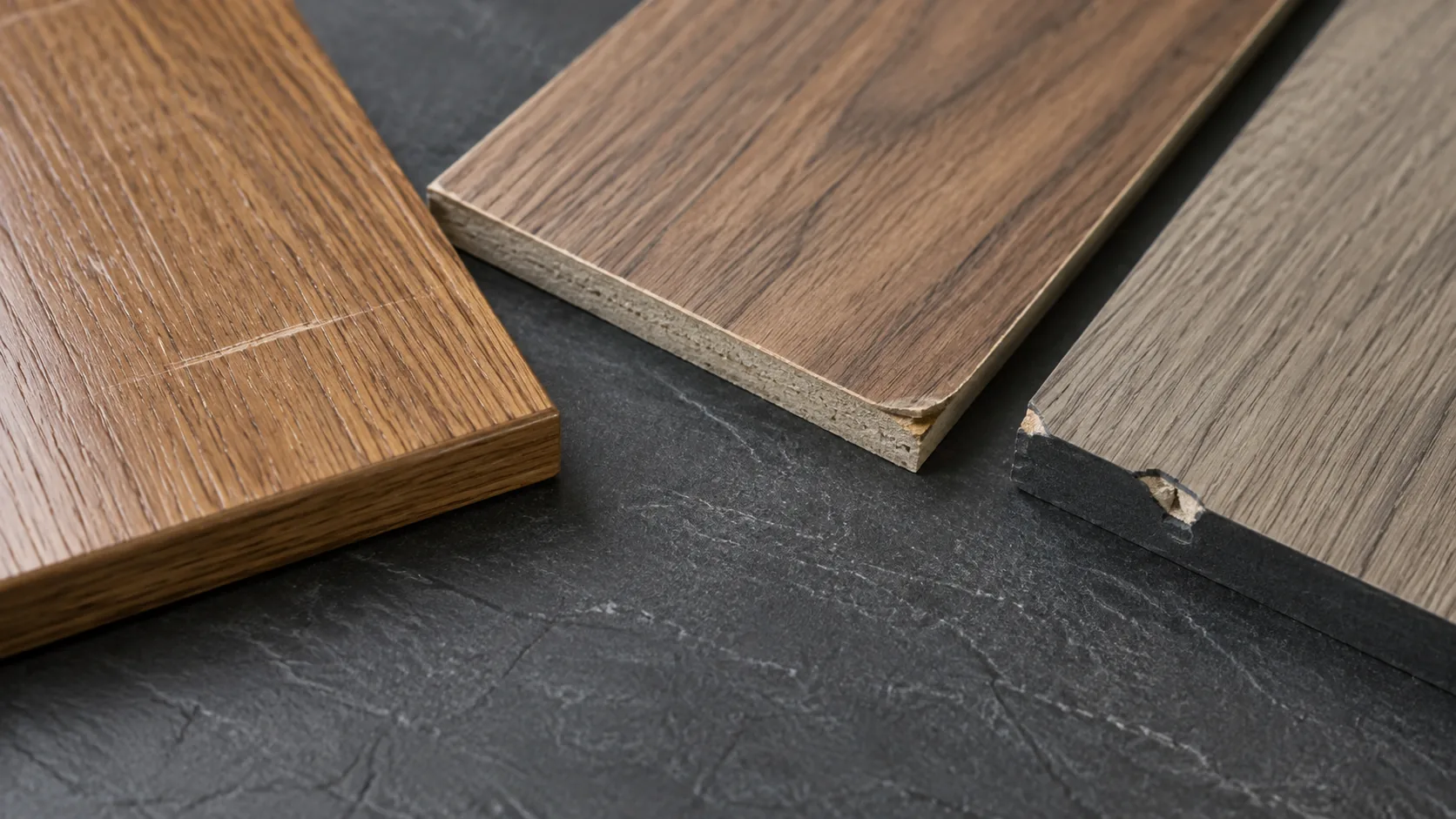
Before you oil, stain or recoat old veneer, find out what finish is already on it. A label, invoice or old refinishing record narrows it down. A new finish over an unknown one can shift the color, fail to stick or make a patch stand out.
Nobody can tell from the nominal thickness how much wood survived factory sanding and earlier repairs. Start with the treatment that removes the least. Heavy sanding is a bad way to find out the wood was already thin.
Judge looks and soundness separately. A touch-up may leave a visible patch, and a new face may break the grain sequence beside its neighbors. The MDF finishing guide covers exposed fiberboard; it gives you no sanding allowance on the veneer above it.
How do you compare completed-component costs?
Price all three on the same drawing, core, back, appearance and delivery scope. A veneer leaf, an HPL sheet, a roll of foil and a finished drilled door contain different amounts of work, so raw-material unit prices do not settle the comparison.
For veneer, count species and cut, matching yield, bonding, surface prep and the finish. A sequenced run of wall panels uses leaves differently from a batch of unrelated small parts. If the design calls for stain or a clear coat, it belongs in the quote.
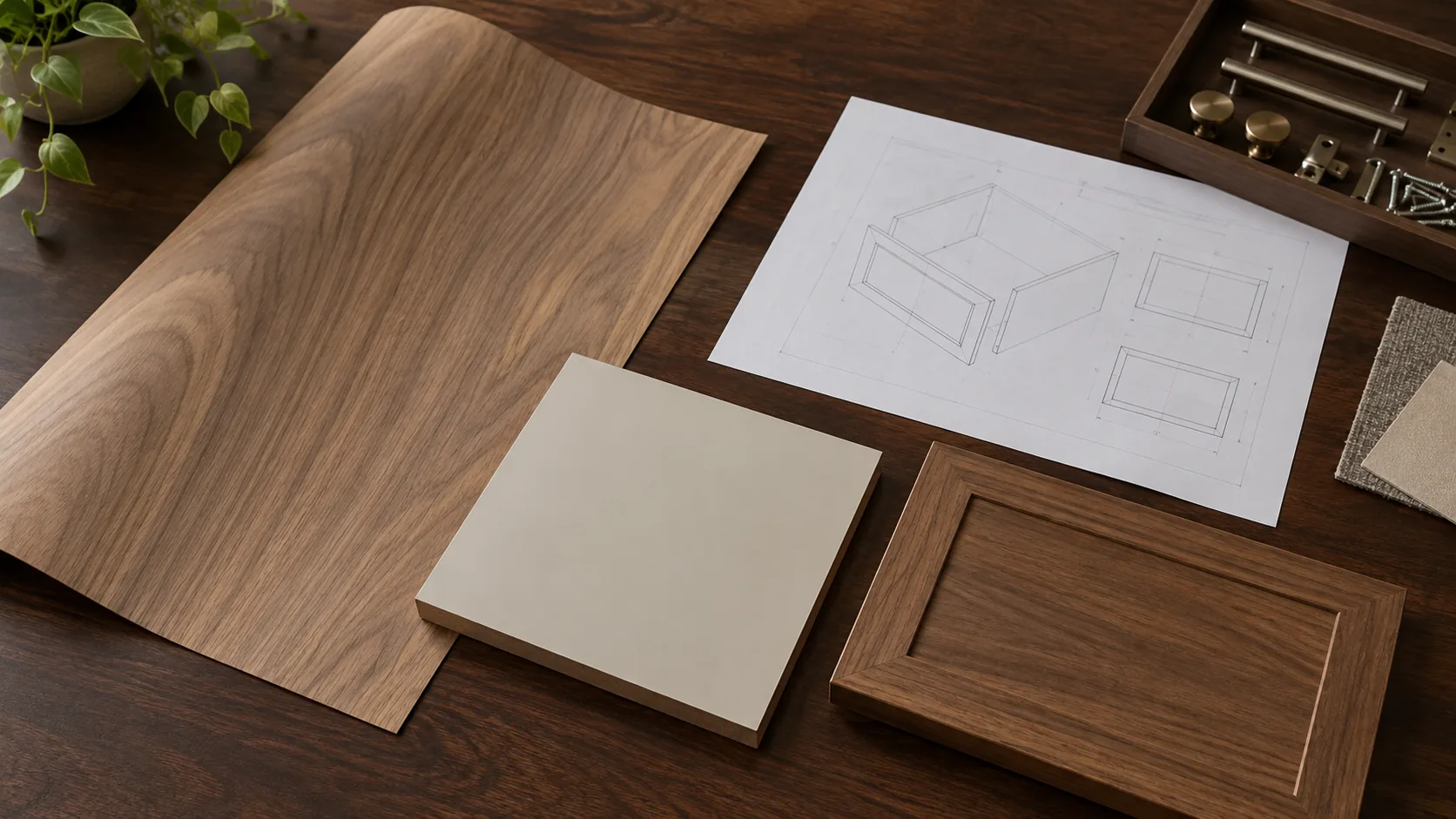
For HPL, count grade and decor, front and back sheets, bonding, trimming, edging and hardware prep. Sheet layout drives yield. If the quote is for ready-faced panels, ask which steps are already done and what your shop still has to finish.
For a foil-wrapped door, include profile machining, preparation, forming or wrapping, adhesive, trimming and the back-edge termination. Then divide each route’s total batch price by the accepted finished quantity, adding the same delivery and installation scope where applicable.
For a repair quote, list the kept parts, the defect, the look you need and the replaced material. Recoating a sound veneer door and replacing a gouged laminate face are different jobs with different results. Compare those real scopes, not guessed lifetime savings.
What should matched production panels specify?
Specify the face and its layout, plus the core, back, bond, edges and inspection conditions. For veneer, record species, leaf sequence and finish; for HPL, grade, decor and direction; for foil, the identified material, forming route, profile and back termination.
| Item | What to specify | Why it matters |
|---|---|---|
| Veneer face | Species, cut, leaf arrangement, sequence and finish | Defines the natural-wood result |
| HPL face | Grade, decor identity, texture, direction and relevant lot | Defines the decorative-sheet result |
| Foil-wrapped face | Foil identity, surface coating, forming route, profile and back termination | Defines the wrapped geometry and its visible finish |
| Component | Drawing, dimensions, core and hardware preparation | Establishes the supplied geometry |
| Back and edges | Balancing construction and exposed-edge completion | Covers the complete layered part |
| Matching | Part map, transitions and available sheet or leaf limits | Shows how appearance continues across a run |
| Inspection | Agreed lighting, viewing position and defect disposition | Makes the appearance decision reproducible |
| Change record | Substitution, affected parts and release disposition | Preserves the approved purchase scope |
ANSI/AWI 0642–2024, section 3.4 separates veneer panel-set matching from planned transitions for when the available leaves can’t cover the whole layout. Its laminate provisions allow for sheet-size limits. It is written for architectural paneling, but the same principles work well in a furniture order.
The core and back shape the finished part as much as the face does. CPA’s dimensional-stability bulletin, pages 3–4, explains moisture movement and balanced restraint. Change the face or the back, and flatness can change with it.
So swapping the substrate takes more than a matching color. The MDF and plywood comparison covers core construction, and the MDF material guide explains the fiberboard under a veneer or laminate face. Record any substituted core, face or finish before those parts ship.
Where does organosilicon decorative film offer another route?
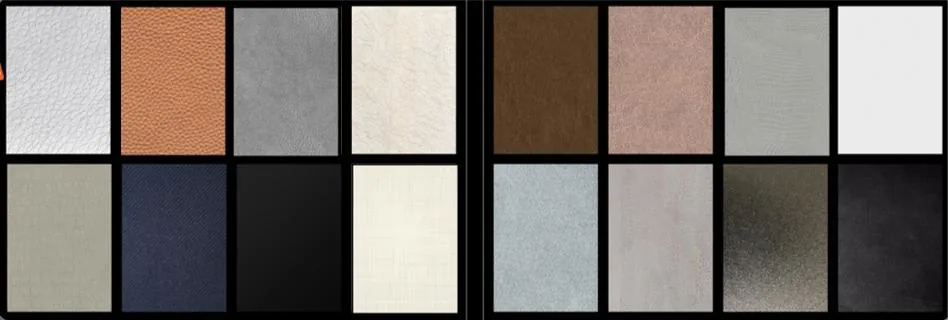
Silicone decorative film offers another route for flat furniture fronts when real wood or a specified HPL sheet is not required. Puremorfilm manufactures the film in China with a silicone functional face on PET support film, rather than a real wood face or a formed 3DL door skin.
For wear evidence, SGS tested a submitted film sample to ASTM D4060-25 using CS-10 wheels, 1000 g per wheel, 60 rpm and 2000 revolutions. The sample showed slight matting without substrate exposure or coating peel. This film result does not rank complete veneered, HPL or foil-wrapped doors.
We supply rolls without self-adhesive backing for PUR flat lamination, starting at 500 m. Silicone laminated panels are quoted per project in 1220 × 2440 mm format, starting at 200 sheets. The film suits furniture fronts, cabinet doors and wall panels with vertical or low-wear exposure; it is not for floors, countertops, cooktops, shower floors or other walked-on areas.
Our furniture decorative-film page explains the flat-lamination route. Veneer care instructions and HPL grade results belong to their respective surfaces and cannot be transferred to this film.
Which face should you choose for the project?
Choose veneer when real wood character and a planned leaf layout matter most; choose the right HPL grade for a manufactured flat face; choose a qualified formed foil for a routed door with a continuous facing. Compare the complete door, exposure and likely repair rather than the grain pattern alone.
- For a room or a long cabinet run, settle the part map and any planned transitions before buying faces.
- On an existing door, work out whether the damage is in the coating, the face or the core before choosing a repair.
- For a repeat order, check the delivered construction and look against the recorded purchase spec.
For flat furniture parts, contact Puremorfilm with the drawing, desired wood look and intended exposure to discuss a silicone decorative-film route alongside the conventional faces.
Frequently Asked Questions
What should a matched batch of veneer, laminate or foil doors specify?
Record the same component drawing, core, back and edge scope. Add species and leaf sequence for veneer, grade and decor direction for HPL, or foil code, forming route and back termination for a wrapped door. Approve the finished sample under agreed viewing conditions.
Is foil-wrapped MDF the same as HPL-faced MDF?
No. HPL is a separately made resin-paper sheet bonded to MDF, while a foil-wrapped door uses an identified film or foil and its specified wrapping or forming process. Similar printed woodgrain does not make the constructions equivalent.
Is wood veneer always more expensive than laminate?
No. Species, leaf matching, finish, HPL grade, machining, edging and batch yield change the delivered price. Compare the same finished-door drawing and accepted quantity rather than a veneer leaf against a completed laminate component.
Can wood veneer always be sanded and refinished?
No. Sanding depends on the remaining wood thickness, earlier repairs and the existing coating. Nominal new-veneer thickness is not a safe sanding allowance; a worn-through face, failed bond or swollen core can require replacement.
Does a continuous foil face make the whole door waterproof?
No. Water can reach the supporting board at damage, joints, back-edge terminations or a failed bond. Compare the completed construction and follow the particular face’s care instructions, especially around sinks and appliances.