Antimicrobial surfaces contain agents such as silver, copper or quaternary ammonium compounds that suppress microbes on the material. Whether that helps in a real building is less clear: a 12-week hospital study published in 2021 found no statistically significant difference in bacterial contamination between items with a silver-copper-zinc coating and untreated items. You still have to clean them, and in the US, claims about protecting people need a different legal and evidence basis from claims about protecting the material itself.
What Are Antimicrobial Surfaces?
Materials or coatings designed to hold back microorganisms on the surface, as an addition to cleaning. Manufacturers can build the active agent into the material or apply it as a coating, so two products with the same label can contain different ingredients and need different care.
“Antimicrobial” is broader than “antibacterial.” It covers bacteria, fungi and viruses, and each needs its own evidence: a result against bacteria says nothing about a virus. The EPA describes antimicrobial pesticides as controlling microorganisms on inanimate objects and surfaces; its approved use defines which organisms a specific product targets.
Antiadhesive surfaces are a third idea: they make it harder for microbes to attach. The 2021 hospital paper treats them separately from antimicrobial coatings. Discouraging attachment, slowing growth and killing organisms are three different things, even when a seller groups them under one word.
[Servicon’s explanation] describes the realistic goal(https://servicon.com/glossary/antimicrobial-surface-coatings/): control growth between cleanings, not a sterile surface. On a cabinet door, worktop or handle, food residue and visible dirt still have to be wiped off.
Antimicrobial results are separate from wear performance; for scratch, abrasion and adhesion testing on cabinet faces, see cabinet surface durability testing.
How Do Antimicrobial Surfaces Work?
In three main ways: releasing an active ingredient, acting through chemistry bound to the surface, or making it hard for microbes to attach. Each responds differently to cleaning and wear.
| Type | How it acts | Examples discussed in the sources | Practical limits |
|---|---|---|---|
| Release-based treatment | Makes an active substance available at or near the surface | Silver ions and copper compounds | Evidence concerns the particular formulation and target organisms |
| Surface-bound active chemistry | Acts through an active coating at the contact surface | Quaternary ammonium organosilane coatings | Cleaning chemistry, application and remaining coating affect performance |
| Antiadhesive design | Discourages organisms from attaching | Polymer treatments and physical surface structures | Reduced attachment alone does not establish killing activity |
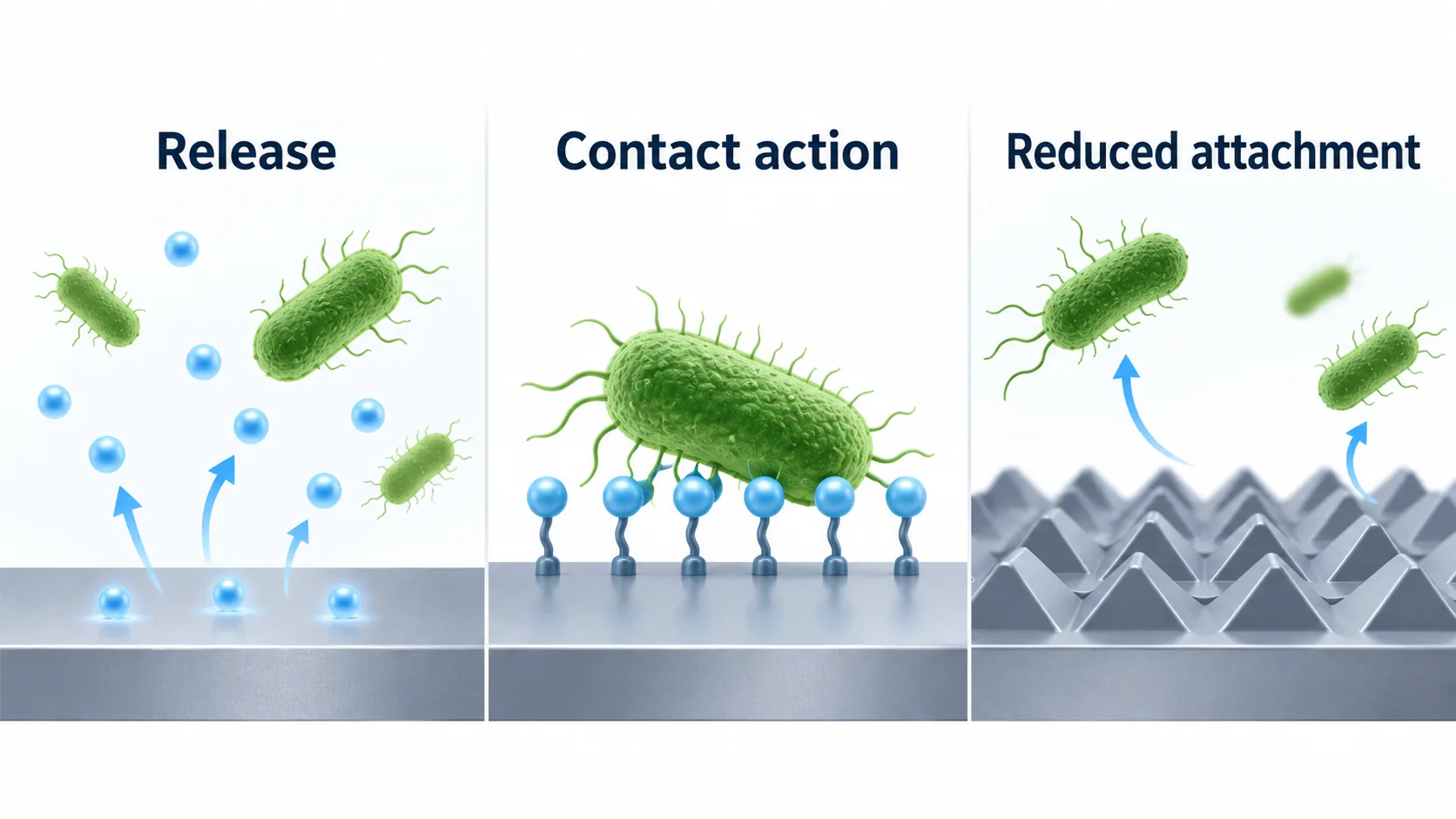
Not every product called antimicrobial uses the same mechanism; Servicon’s overview and the hospital research describe all three under the same broad term. A useful product description names which one it uses.
Durability claims need the same scrutiny. In a Dancer commentary published online in 2019 and in a 2020 journal issue, the author questioned one quaternary ammonium organosilane intervention, including its advertised 15-week life and recoating roughly every four months.
The same commentary notes that quaternary ammonium compounds have limited activity against C. difficile spores and raises concern about microbes becoming tolerant after long exposure. So look for evidence that names the organisms tested: a bacterial test doesn’t answer questions about viruses, fungi or spores.
Cleaning interacts with all of this. Dirt can block an applied treatment, while the wrong chemicals can damage the coating that carries it. Joints, corners and handles still need to be easy to reach and wipe.
What Are Antimicrobial Coatings Made Of?
Most antimicrobial coatings and treated surfaces rely on one of a handful of active agents. Each works differently and has its own limits:
| Active agent | How it acts | Where you see it | Main limits |
|---|---|---|---|
| Silver (ions or particles) | Releases silver ions that damage microbial cell membranes and enzymes | Plastics, coatings, textiles, laminates | Needs moisture to release ions; often slow-acting compared with a disinfectant |
| Copper and copper alloys | Kills microbes on contact through copper ions and oxidative damage | Solid copper-alloy hardware and touch surfaces; copper-containing coatings | Works only where the copper surface is exposed; sealed or waxed copper loses activity |
| Zinc compounds (such as zinc pyrithione or zinc oxide) | Interferes with microbial metabolism and growth | Paints, plastics and sealants, often to protect the product itself from mold or odor | Usually protects the material rather than proving a hygiene benefit for users |
| Quaternary ammonium compounds (including bound “quat” silanes) | Positively charged molecules disrupt cell membranes | Spray-on residual coatings, treated textiles and surfaces | Soil and some cleaners can reduce activity; durability depends on the binder |
| Photocatalytic titanium dioxide | Light activates the surface to produce reactive oxygen species | Coatings, tiles, glass | Needs enough light, usually UV; weak in dim indoor areas |
The agent alone does not tell you how well a coating works. Concentration, the binder that holds it on the surface, wear, cleaning chemicals and the test organism all change the result, so ask for test reports on the finished product.
Antimicrobial vs Antibacterial: Is There a Difference?
Yes. Antimicrobial is the umbrella term for agents that act on microorganisms in general, which can include bacteria, fungi and viruses. Antibacterial means bacteria only. A surface tested only under an antibacterial method such as ISO 22196 has evidence against the bacteria tested, not against viruses or mold, so check which organisms the report actually names.
Do Antimicrobial Surfaces Actually Reduce Germs in Real Use?
Sometimes in the lab, less reliably in occupied buildings. Results depend on the treatment, the comparison and what was measured, as two hospital studies show.
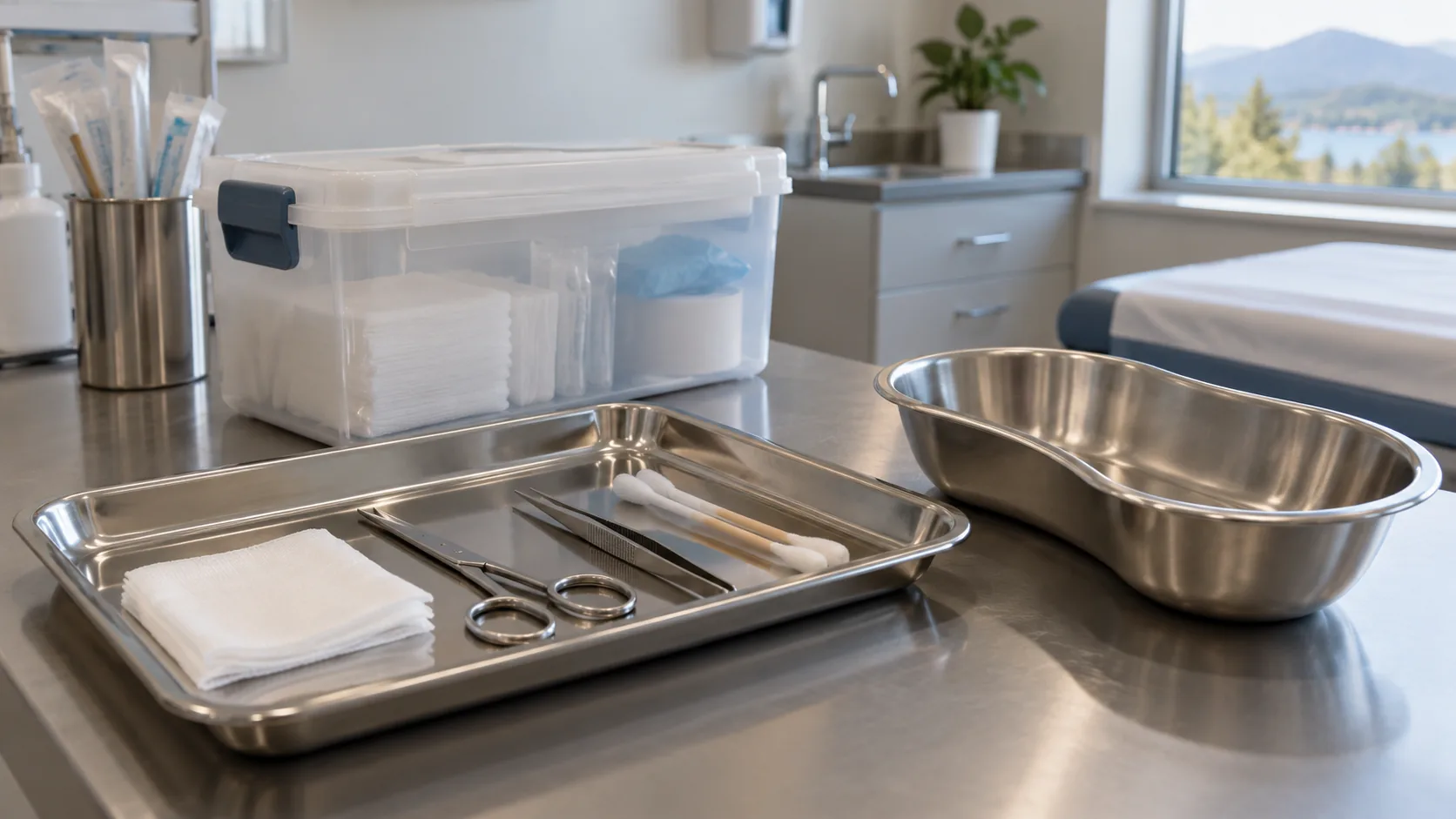
The 2021 Czech hospital study put a silver-copper-zinc nanolayer called AD30 on basins, trays and storage boxes in a general surgery department and sampled them every seven days for 12 weeks. Treated and untreated items showed no statistically significant difference in contamination: p-values were 0.407 for basins, 0.808 for trays and 1.000 for boxes, against a significance threshold of p ≤ 0.05.
Those are statistical comparisons, not germ-kill percentages, and the study didn’t measure patient infections. Its inconsistent published sample totals prevent a reliable overall sample count.
What Did the Second Hospital Intervention Show?
A different picture, with caveats. Dancer’s separate commentary examined a quaternary ammonium organosilane intervention at two hospitals, where the underlying study reported fewer surface bacteria and lower rates on some infection measures. The commentary points out that the study wasn’t randomized, cleaning wasn’t audited, data on antimicrobial use were missing and only bacteria were measured. That intervention and AD30 are different treatments, so their results shouldn’t be combined.
| Evidence | What it can show | What it leaves unanswered |
|---|---|---|
| Controlled laboratory test | Activity against specified organisms under the test conditions | Performance after repeated real-world use and cleaning |
| Controlled study in an occupied building | Differences observed for the studied treatment and setting | Whether the same outcome transfers to another formulation or site |
| Patient infection study | Infection outcomes for a defined intervention and population | How much of the outcome comes from the surface rather than other changes |
| Manufacturer description | Intended use and declared features | Independent confirmation of effectiveness |
Fewer bacteria on a surface and fewer infections are separate outcomes. When you see a claimed reduction, check what the study measured, whether it used a fair comparison group, and how researchers handled cleaning.
How Are Antimicrobial Surfaces Tested?
In the lab against named microorganisms on a defined material, and in field studies during real use. Which method and which organism tell you what a result means.
ISO 22196:2011 covers antibacterial activity on plastics and other nonporous surfaces; ISO 21702:2019 covers antiviral activity on the same kinds of surfaces. The antibacterial standard excludes building materials unless they’re used like treated articles, and the antiviral standard warns that a result for one virus may not apply to another. The full procedure is in the standards themselves and in the test report for the actual sample.
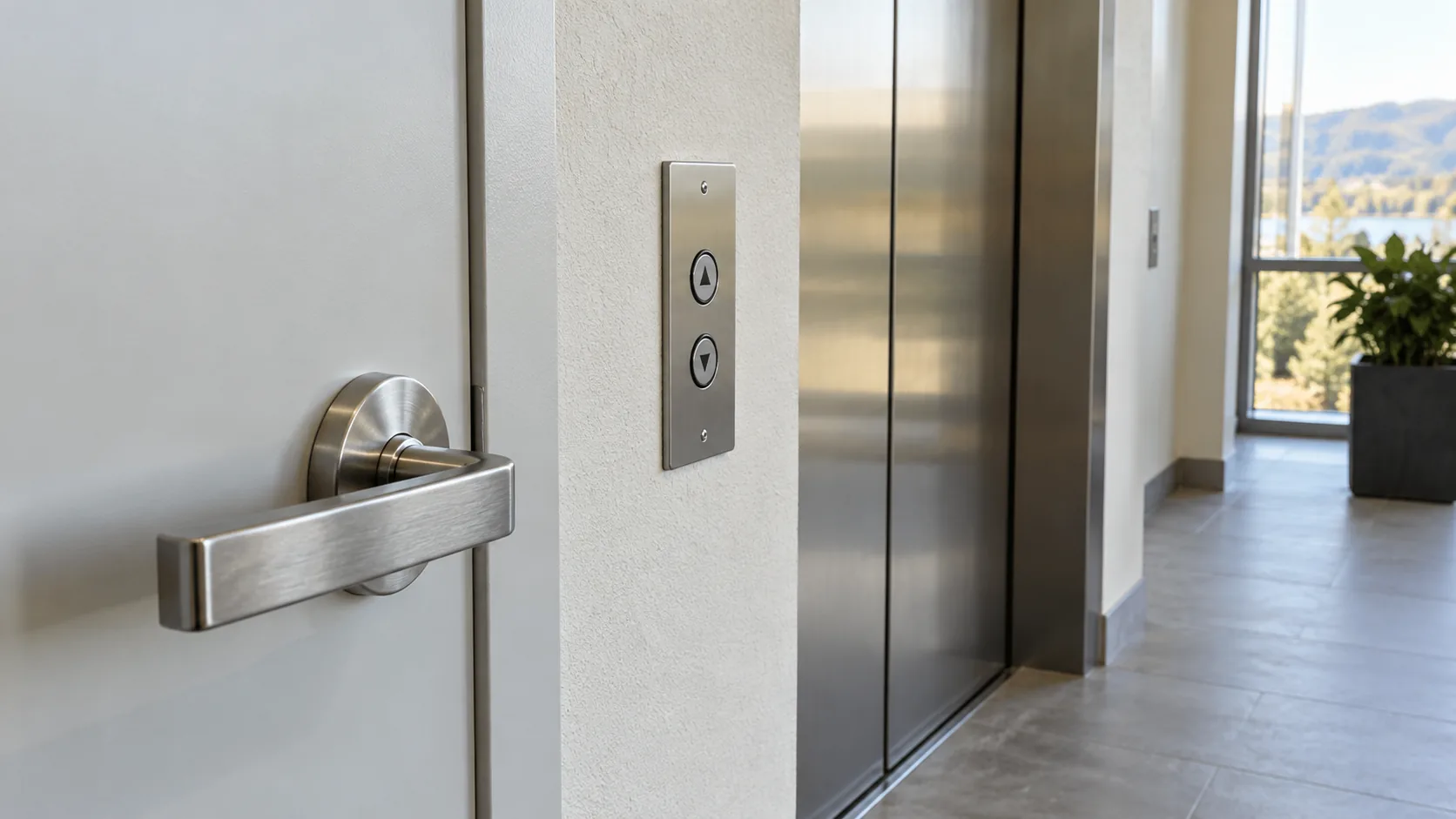
High-touch surfaces such as handles and elevator buttons also appeared in a legacy WELL feature, Q3 2018; it’s archived, so don’t treat it as a current building requirement.
A percentage reduction means little without the organism, exposure conditions, comparison and method. Log reductions use a logarithmic scale, so headline percentages from different methods can’t be compared directly. And a test on a fresh coating says nothing about how it performs after months of cleaning or abrasion.
Read time figures carefully too. In the hospital study, 36°C incubation for seven days plus 24 hours of further culture was how the lab grew organisms from the samples, not how long the coating took to kill them; 80°C for three hours was part of preparing the coating.
For everyday decorative surfaces, cabinet surface cleaning matters whatever the microbial data say. A good test report lets you identify the product, the target organism and the result, and judge whether the test matches how you’ll use the surface.
Which Antimicrobial Surface Tests Should You Recognize?
| Method | What it tests | How it works in brief | Watch for |
|---|---|---|---|
| JIS Z 2801 / ISO 22196 | Antibacterial activity on plastics and other nonporous surfaces | Bacteria are held against the sample under a thin cover film, commonly for 24 hours at about 35 °C, and compared with an untreated control | ISO 22196 was developed from the Japanese JIS Z 2801 method; the result is a log-based activity value, not a real-world kill time |
| ISO 21702 | Antiviral activity on the same kinds of surfaces | Uses a similar contact approach with a named virus | A result for one virus may not transfer to another |
| ASTM E2180 | Antimicrobial agents in polymeric or hydrophobic materials | The inoculum is mixed into an agar slurry so it spreads on water-repellent surfaces instead of beading; 24 hours is common | Reported as percent reduction; not meant for biofilm claims |
| EPA residual coating methods (US) | Whether a coating still kills microbes after wear | The 2020 interim method required at least a 3-log reduction within 1–2 hours after repeated wet and dry abrasion cycles; testing started on or after October 7, 2023 follows EPA methods MB-40 and MB-41 | Needed to support public-health residual claims in the US, together with registration |
What Can an Antimicrobial Product Claim in the US?
Products under the treated-article exemption can claim to protect the article itself; claims to control germs that affect public health require pesticide registration. The exemption has conditions, including that the pesticide protecting the article is registered for that use.
The EPA’s treated-product guidance, updated May 5, 2026, gives examples of material-protection claims, such as resistance to microbial deterioration, and expects labels to make clear that the treatment protects the product and that cleaning is still needed. Claims about controlling named public-health organisms such as E. coli or S. aureus require the relevant registration.
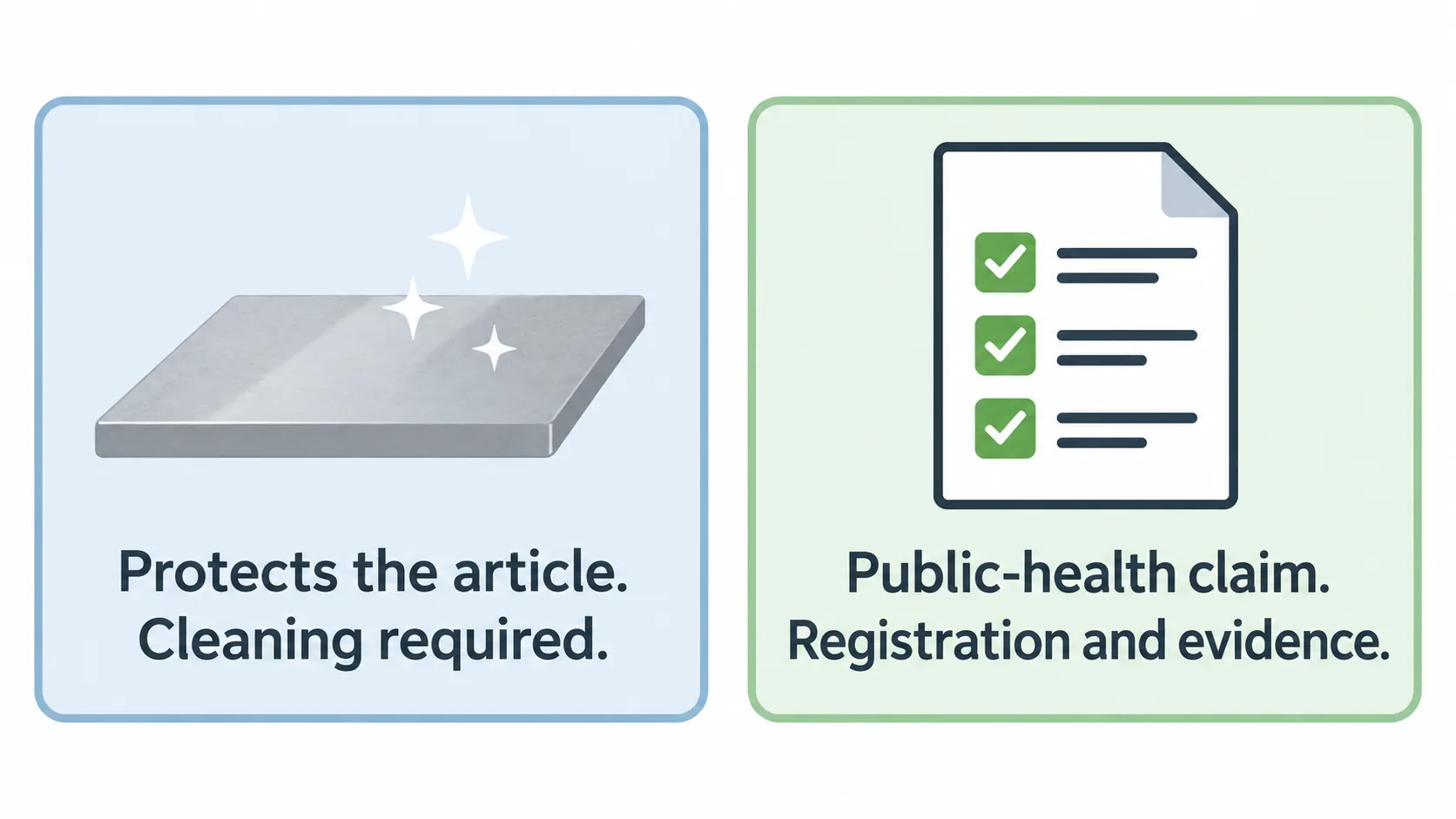
A missing registration number doesn’t prove a product is exempt; the guidance notes that illegally marketed products can lack one too. Read the exact wording and intended use, then check its status.
For interior finishes, protecting the material from microbial deterioration and protecting people from infection are separate questions. Our wall-material comparison helps with choosing the surface itself; any US antimicrobial claim needs evidence and labeling for that specific product.
How Should You Clean and Disinfect Antimicrobial Surfaces?
The same way as any other surface: remove dirt and residue first, then disinfect when the situation calls for it. Cleaning first lets a disinfectant actually reach the surface.
The CDC household guidance dated January 31, 2025 separates three steps. Cleaning removes dirt and impurities along with germs; sanitizing reduces germs to levels considered safe by public-health standards; disinfecting kills most germs on surfaces. In most homes, regular cleaning is enough; illness or a vulnerable household member can call for disinfection too.
Contact time comes from the disinfectant’s label, and the surface has to stay wet for the whole period. Swapping products, cutting the time short or letting it dry early changes the treatment.
Healthcare settings go further. The CDC core practices, dated April 12, 2024, call for routine and targeted cleaning and disinfection using a registered disinfectant active against the pathogens of concern, with the right dilution, contact time and material compatibility. Household routines don’t substitute for a patient-care cleaning plan.
Compatibility cuts both ways. Dancer’s commentary raises the possibility that cleaning chemicals can deactivate or strip an active coating. Check that the care instructions for a furniture decorative finish list acceptable cleaners, and that your disinfectant is compatible; the word antimicrobial won’t tell you which alcohol, bleach or peroxide products a finish can take.
Which Antibacterial Furniture Surfaces Suit Healthcare?
For healthcare furniture, the most important “antibacterial” property is a smooth, nonporous, seamless surface that survives frequent disinfection, not an antimicrobial additive. HPL, compact laminate, solid surface, powder-coated or stainless metal and well-sealed vinyl upholstery are common choices; solid copper alloys are sometimes used on high-touch hardware. Antimicrobial treatments can be an extra layer, but cleaning still does the main work.
| Check | Why it matters in healthcare |
|---|---|
| Nonporous face and sealed edges | Germs and fluids collect in pores, open edges, seams and stitching |
| Disinfectant compatibility | The surface must tolerate the facility’s actual products, such as quaternary ammonium, bleach or hydrogen peroxide disinfectants, without cracking, clouding or softening |
| Few joints and easy-clean shapes | Fewer seams, gaps and hard-to-reach corners mean more reliable cleaning |
| Impact and wear resistance | Scratches and chips create places where soil collects |
| Evidence behind antimicrobial claims | Ask which organisms and which test method (for example ISO 22196) support the claim, and whether it protects users or only the material |
Where Does an Easy-Clean Silicone Surface Fit?
As an easy-clean decorative face, not an antimicrobial one. Puremorfilm makes decorative film with a silicone functional face for furniture and wall panels, and we make no antimicrobial claim for it.
What it does offer is a surface that wipes clean. In the manufacturer’s laboratory tests, coffee, red wine, soy sauce and lipstick left for 24 hours at 25°C wiped off with no obvious surface change. Anchoring components chemically bond the silicone face to its supporting film.
Our silicone surface is inherently flame-retardant, with higher grades up to UL 94 V-0 available on request for the film, and the formulation uses No DOP. We mainly supply rolls, with film-faced panels also available, for PUR flat lamination to boards.
Our decorative wall film is a paint-free finish with a silicone functional surface, distinct from PVC, melamine, PP and PETG decorative faces. Choose it for its documented material properties and how you plan to clean it.
How Should You Decide Whether to Use Antimicrobial Surfaces?
Start from the hygiene job, the evidence and your cleaning plan, and treat any antimicrobial treatment as an extra. If a product claims to protect people, it needs the registration and evidence for that use.
| Setting | What to prioritize |
|---|---|
| Patient-care area | Infection-control requirements, compatible cleaning and disinfecting, and evidence for any proposed antimicrobial claim |
| Office, hotel or school | Accessible, cleanable surfaces and compatibility with the actual maintenance products |
| Home | Regular cleaning, with additional disinfection when circumstances require it |
| Decorative furniture or wall panel | The appearance, stain behavior and care requirements of the completed finish |
Then compare the product’s label and evidence with the outcome you need. A treatment studied on a hospital tray tells you nothing about a different wall film. For broader material choices, our guide to the differences between decorative film faces separates surface chemistry from health claims.
For a decorative panel finish, contact us with the intended setting, the cleaning products you plan to use, panel dimensions and approximate quantity.
Frequently Asked Questions
How long do bacteria last on the surface?
Some bacteria can survive for weeks in temperate conditions, as the Dancer commentary explains. It varies with the organism, surface and environment, and an antimicrobial label doesn’t change that into one fixed number.
What is the most common antimicrobial?
Silver, copper and quaternary ammonium compounds are the agents most often discussed for surface treatments. That refers to material treatments, not antibiotics, and isn’t a market-share ranking.
Do antimicrobial coatings replace cleaning?
No. Treated surfaces still need physical cleaning to remove dirt and residue; follow the surface’s care instructions and the cleaning product’s label.
Are antimicrobial coatings regulated?
Yes. In the US, antimicrobial pesticide claims fall under EPA regulation, and material-protection exemptions and registered public-health claims have different conditions and labeling rules.
Do antimicrobial surfaces work against viruses and fungi?
No, not automatically. Activity against bacteria doesn’t show activity against viruses or fungi; that needs evidence for the specific organisms, material and test conditions.