
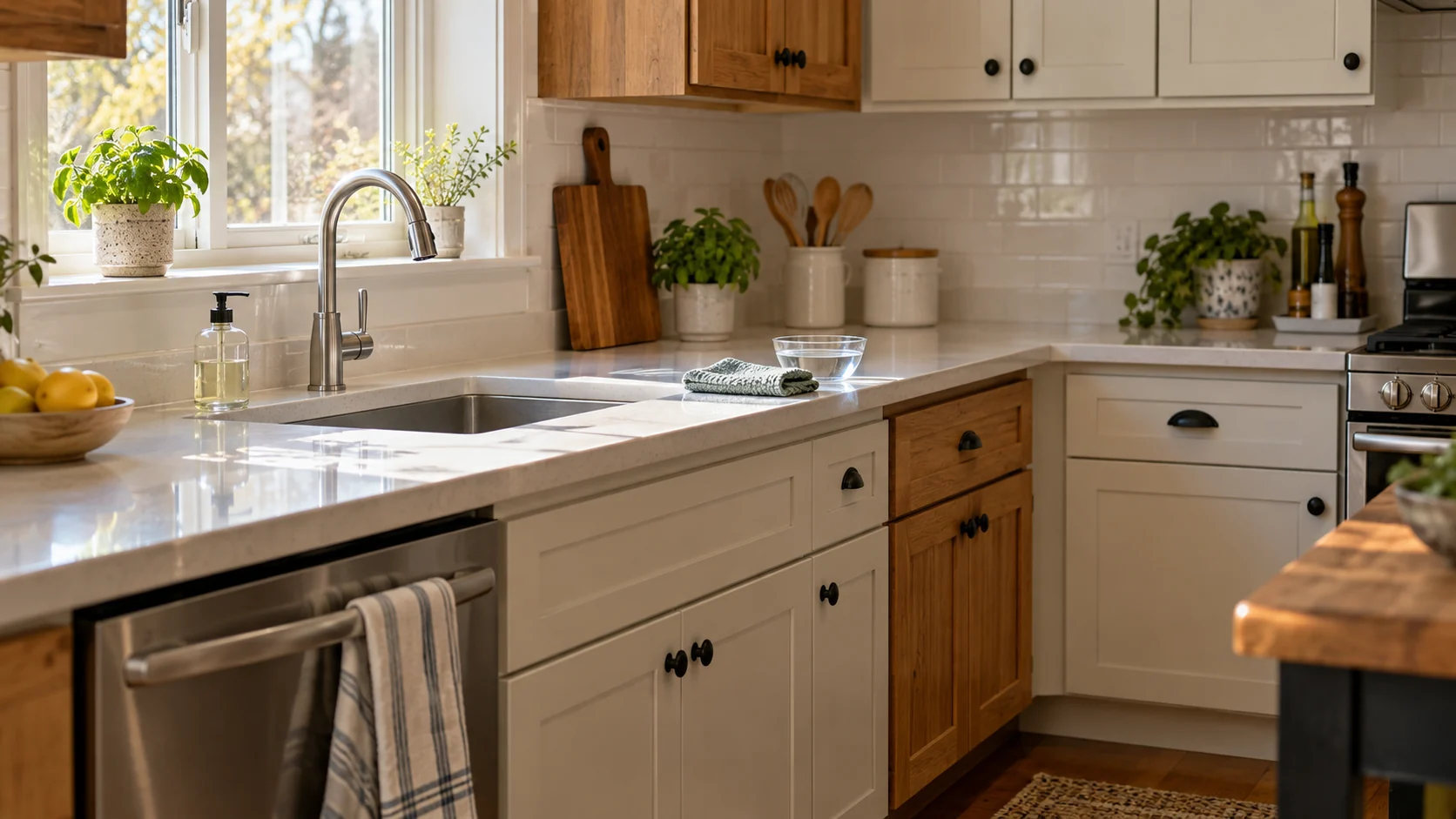
How to clean kitchen cabinets safely: identify the finish, remove loose dust, and wipe sound, fully cured paint or sealed wood with a soft cloth and a permitted mild cleaner. Spot-test first, wipe off residue with a separate lightly damp cloth, and dry promptly. Keep liquid away from damaged edges and exposed wood.
What cabinet surface are you cleaning?
The visible finish. Work out whether it is paint, clear-coated wood, veneer or a decorative facing before you pick a cleaner, because the coating, not the board inside, decides what can touch it.
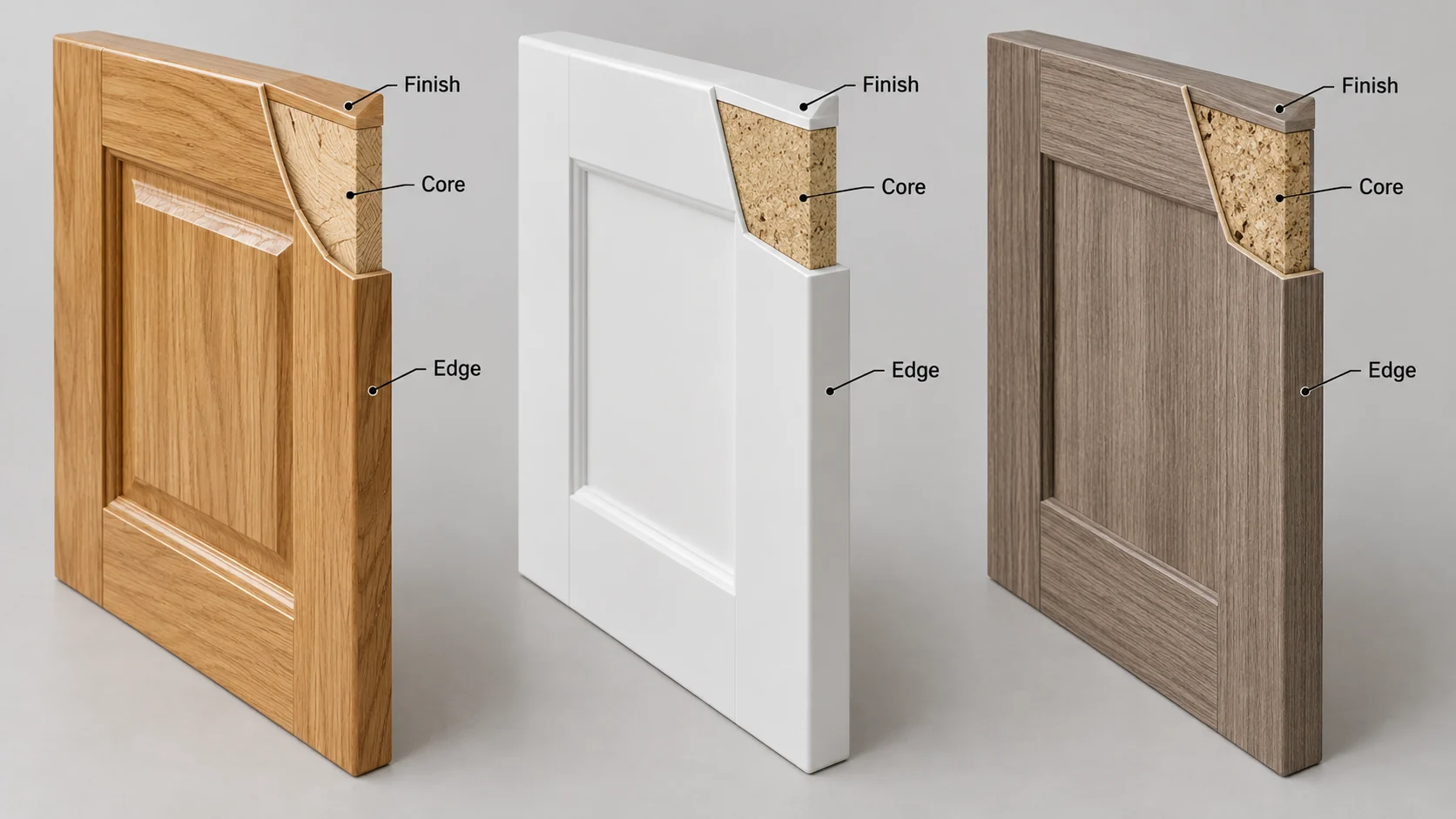
Solid wood shows its natural grain. Veneer is a thin wood face over another material and may have a clear coat on top. Paint can cover wood or a manufactured panel. A printed wood pattern may be a laminate or film. Our kitchen cabinet materials guide explains these parts, and the wood veneer versus laminate comparison helps you tell the faces apart.
| Surface you have | What to establish first | Cleaning starting point |
|---|---|---|
| Painted door | Whether the paint has cured and remains intact | Gentle cleaning with the paint maker’s permitted mild solution |
| Clear-coated wood or veneer | Whether the protective coating is sound | Lightly damp soft cloth; permitted mild cleaner for grease |
| Laminate or melamine face | Which facing is fitted and whether edges are bonded | Nonabrasive care appropriate to that facing |
| Thermofoil door | Whether the film is attached around edges and profiles | Gentle surface care; address lifting film separately |
| Bare wood or exposed core | Where the protective finish is missing | Keep wet cleaning away from the exposed area |
If the look leaves you unsure, find the care sheet, invoice or paint label; a photo of wood grain can’t reliably identify the finish. If the door is MDF, it is a fiber-and-resin panel used for cabinet parts and decorative surfacing. MDF is only the core, and its decorative coating has its own care rules.
What should you check before using soap and water?
That the finish is intact and any new paint has cured. Then lay out clean soft cloths and warm water, and clear crumbs and loose dust first so you aren’t wiping grit across the door.
Paint that feels dry may still be hardening. Benjamin Moore’s painted-surface care guide puts cabinet paint at touch-dry in about 2–4 hours and fully cured about 30 days later, so wait that long before normal cleaning. If your paint’s instructions say otherwise, follow them.
That curing wait is different from drying a door after you wash it. Curing lets a new coat harden; towel drying just removes water from a surface that is already ready.
Use one cloth for cleaning, another for rinsing off soap, and a dry towel. A soft brush or vacuum brush attachment lifts dust from recesses you can reach. Leave the used dishcloth at the sink, since it can carry food and grit. Do your first pass on a hidden patch of the same finish, such as the inside of a pantry door, let it dry and check the color and sheen before going further.
How do you wash cabinet doors without leaving residue?
Clean a small area, rinse off the soap with a separate damp cloth, and dry it before moving on. Keeping the steps apart lets you spot any change in the finish early.
For intact, compatible finishes:
- Dust the face and accessible recesses with a clean soft cloth or brush.
- Dampen the cleaning cloth with the permitted mild soap solution and wring it out until it does not drip.
- Wipe gently, keeping liquid out of open joints, damaged edges, and hardware openings.
- Remove cleaner residue with a fresh cloth lightly dampened with plain water.
- Towel-dry the face and any wet surrounding areas.
On painted cabinets, dab local marks gently. On sealed wood, wipe with the grain where you can. Turn to a clean part of the cloth as it picks up dirt, so a greasy patch on the cloth doesn’t go back onto the door.
As a named example, the Dawn cabinet-cleaning guide uses a small amount of Dawn Platinum in warm water, then rinses and dries. Start from the dilution your cabinet finish allows, since dish-soap strength varies.
How do you clean wood cabinets without damaging the finish?
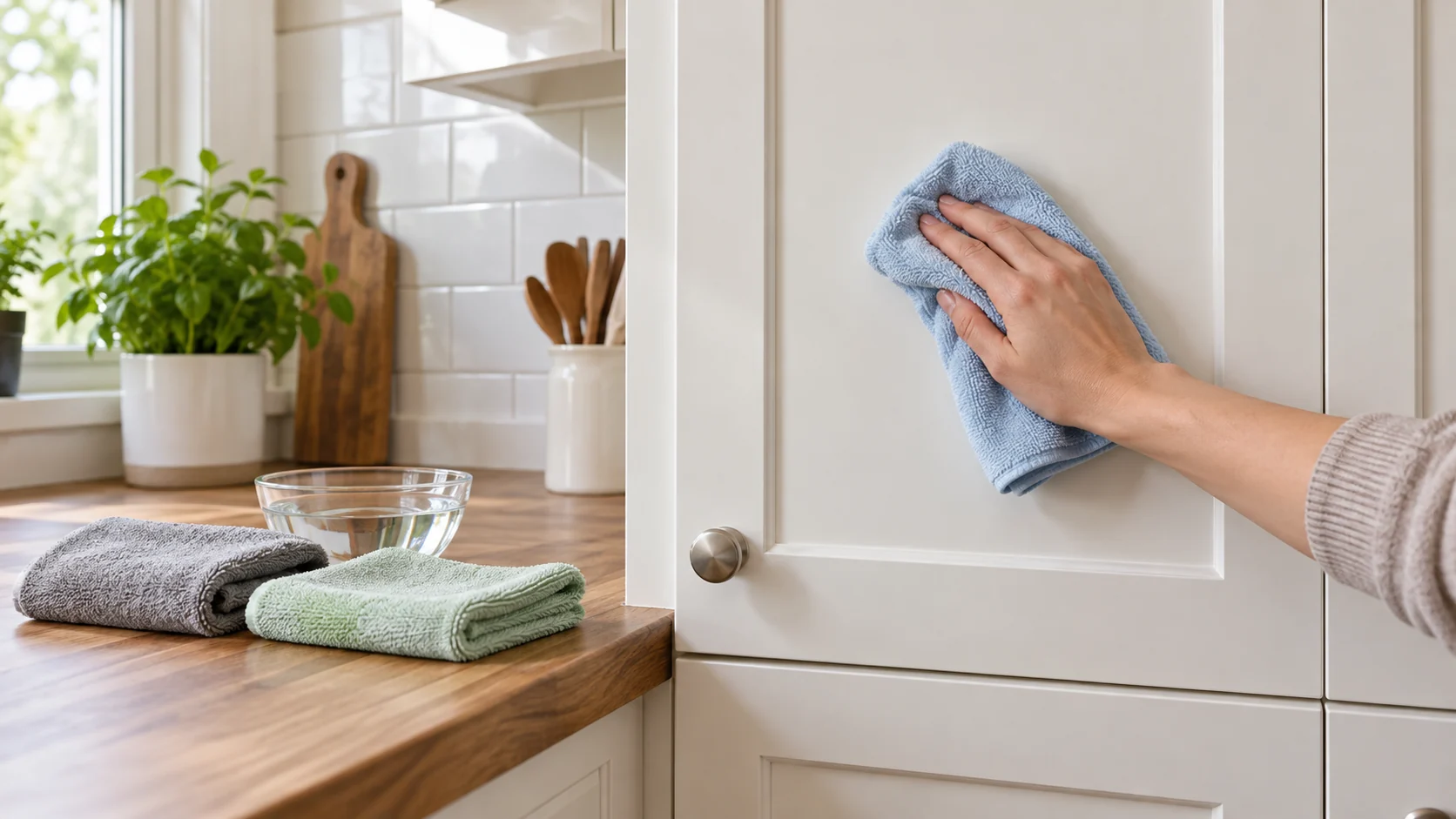
Clean wood cabinets with the method permitted for their finish, using lightly damp cloths and prompt drying where wet cleaning is allowed. Identify the coating from the care sheet, invoice or finish label. Lacquered, varnished or polyurethane-coated wood and oiled or waxed finishes can require different care; ask the supplier if the finish is unknown.
- Dust first. Remove loose dust with a dry microfiber cloth or a soft brush so grit is not rubbed into the finish.
- Use a permitted cleaner. For compatible sealed finishes, use warm water and a small amount of mild dish soap as the finish maker permits. Follow the maker’s own cleaning method for oiled or waxed finishes.
- Keep the cloth damp, not wet. Wring the microfiber cloth well and wipe in the direction of the grain, working one door at a time.
- Rinse and dry straight away. Wipe again with a clean, lightly damp cloth, then dry with a dry cloth, paying attention to edges, joints and the area around handles where water can soak in.
- Test the permitted cleaner. Try it on a hidden spot before a wider clean. A spot test does not override the maker’s restrictions, such as Masterpiece’s exclusion of vinegar.
Avoid soaking the doors, excessively hot water and abrasive pads. Benjamin Moore advises against bleach, ammonia, alcohol and melamine sponges on its painted surfaces; follow the cabinet maker’s exclusions for other finishes.
How do you make wood cabinets shine again?
Clean the cabinets with the finish maker’s permitted method, remove residue, and dry fully before judging their sheen. Use a polish only if it is approved for that finish. For its stained cabinetry, Masterpiece recommends emulsion-type cleaners without wax, petroleum solvents or silicones; follow the instructions for your own finish.
Repeated wax polish can leave a film, and Masterpiece warns that silicone polishes can damage its finishes. If a door remains dull, rough or patchy after the permitted cleaning routine, have the finish assessed before choosing a repair or refinishing route.
How do you remove sticky grease and cloudy streaks?
For grease on an intact, compatible finish, repeat the gentle pass; for haze on a door that is already clean, rinse off the leftover cleaner before adding more soap. The cloth and the dried surface tell you which step comes next.
Grease builds up near the range and around handles. Work that area with a clean part of the cloth, lift off the loosened grime and check it once dry. Jumping straight to a stronger cleaner makes it hard to tell whether the haze is grease, cleaner residue or a damaged finish.
If the door feels slippery or streaky after washing, go over it with a fresh, lightly damp rinsing cloth and then a dry towel. If the mark doesn’t change, stop pressing harder. Note where it is and what you’ve used, especially if the finish looks patchy or color comes off on the cloth; a cabinet technician will find that more useful than a list of extra products tried on the same spot.
Cleaning lifts dirt; it won’t bring back faded paint or flatten a raised edge. A shiny patch from polishing also changes how the door looks and can hide whether the original mark came off. For laminate-faced doors, our laminate cabinet cleaning guide covers care for an intact laminate finish.
What if dish soap does not lift the grease?
On sealed wood, try a ready-to-use cleaner, but only if the cabinet’s care sheet allows it. The Kitchn’s five-method test found Pledge Everyday Cleaner useful, though dish soap did better on its maple cabinets. A current option is Pledge pH Balanced Multisurface Cleaner Spray, whose instructions cover finished, sealed wood: spray, wipe with a soft cloth, no rinsing.
Test it on a hidden patch of the same finish, let it dry, and check color and sheen. Keep it off bare wood, exposed cores and lifting edges, and don’t mix it with other cleaners.
If your cabinet maker rules out commercial sprays, stick to its routine, and leave vinegar out too if the maker excludes it. Stop if the coating changes or the grease survives a finish-safe trial.
Which cleaners and tools should you avoid?
Abrasive tools and harsh cleaners the finish maker hasn’t approved, and glass cleaner anywhere except the glass. A product that works on the oven or countertop doesn’t automatically suit the door next to it.
| Tempting approach | Concern for cabinet care | Better starting point |
|---|---|---|
| Scouring pad or abrasive powder | Can scratch or dull the protective finish | Soft cloth and a permitted mild cleaner |
| Bleach, ammonia, or alcohol on paint | Benjamin Moore excludes these from its painted-surface routine | Warm water and mild soap appropriate to cured paint |
| Vinegar as a universal cabinet cleaner | Masterpiece excludes vinegar for its cabinet finishes | Use the actual cabinet’s permitted cleaner |
| Furniture wax or polish to hide streaks | Can add a film or alter appearance; recommendations vary by finish | Remove residue and evaluate the dry surface first |
| Spraying glass cleaner across a glass-front door | Liquid can reach surrounding trim and joints | Apply cleaner to the cloth used on the glass |
The Masterpiece care guide gives different directions for wood, painted and decorative-faced panels.
Don’t mix a cleaning cocktail from several household products. With one permitted cleaner, you can trace both the result and any problem. And don’t hang wet towels over cabinet doors: a towel draped on the sink-base door keeps moisture exactly where you’ve been trying to control it.
How should you clean interiors, handles, and damaged edges?
Clean shelves and handles with care that suits their finishes, and treat exposed or lifting edges as a repair job. Empty a cupboard before you wipe it so food and dishes stay out of the way.
Brush out crumbs, wipe a sound shelf lightly and let it dry before putting things back. For ordinary knobs and pulls, mild soap, water and a soft cloth remove grime. Dry the hardware and the finish around it, and skip metal polish unless the hardware maker allows it; harsh brass and silver polishes can damage hardware finishes.
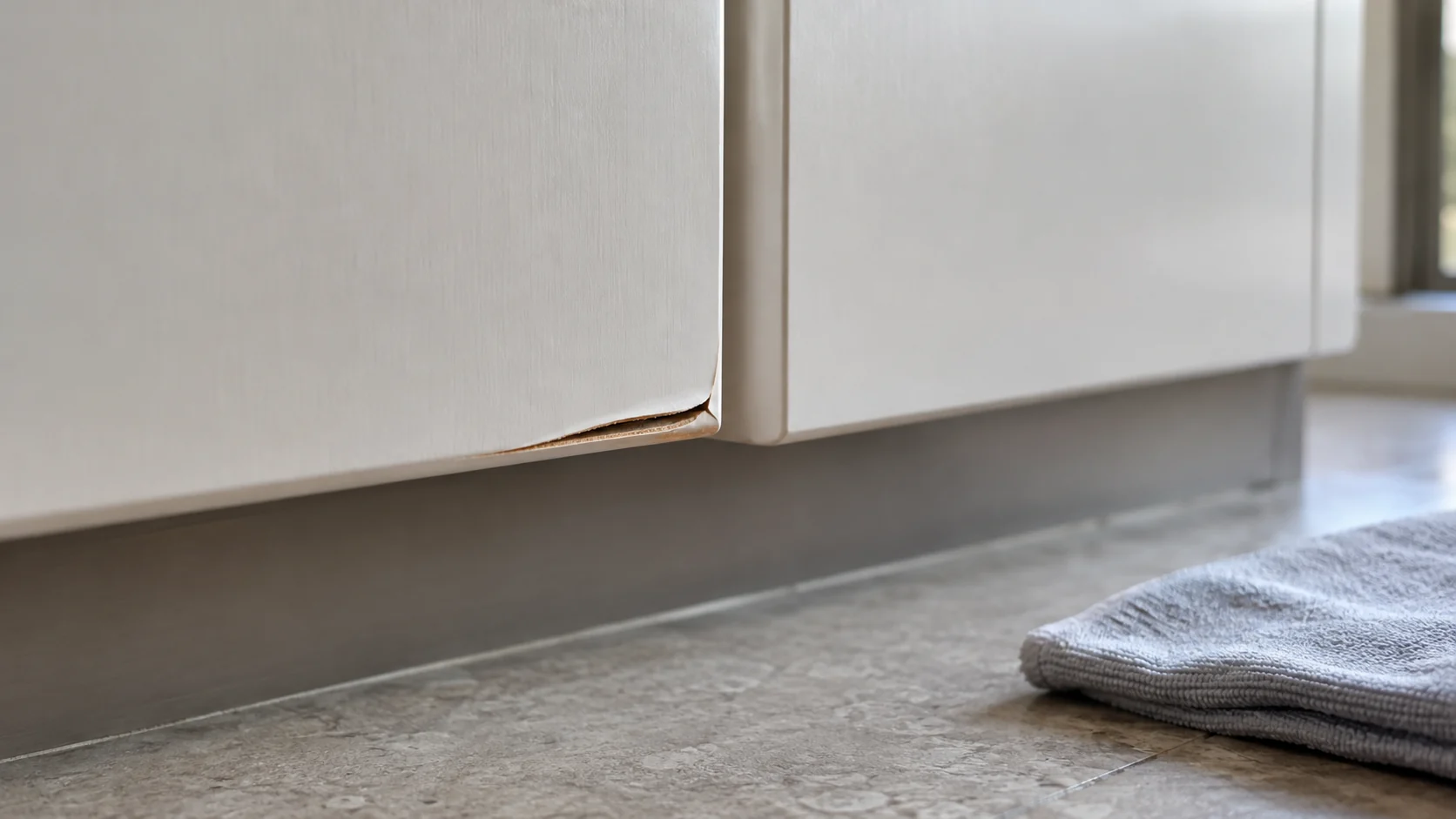
Check the lower edge of the sink-base door, the corners, the joints and the areas around pulls. Take a photo before cleaning and another once the surface is dry. A brown deposit that disappears was dirt; a lip that still stands proud of the face is a physical defect.
Our MDF and water exposure guide explains why the panel under the finish matters too. For lifting film, the thermofoil peeling guide covers repair and replacement.
If a door needs replacing, give the cabinet shop photos of the damage, the door size, hinge positions and whatever finish information you have found. Ask for a complete finished door with care instructions, including how exposed edges, hardware holes and any damaged core will be dealt with.
Where does a silicone surface fit in replacement doors?
On flat replacement doors. Puremorfilm makes decorative film with a silicone functional surface for cabinet doors and other flat furniture panels. Stains are the first thing to check on a kitchen surface: in the manufacturer’s laboratory tests, coffee, red wine and soy sauce left for 24 hours at 25°C wiped off with no obvious change, and lipstick did the same. Flame-retardant properties are standard for the film; a required fire rating needs evidence for the proposed grade and complete panel construction. The film formulation is No DOP and formaldehyde-free; the board and adhesive need separate assessment.

We mainly supply rolls, with film-faced panels on request, and the film goes onto flat boards by PUR flat lamination, so routed or wrapped door profiles need a different material. The film is unsuitable for floors, worktops, stove tops, shower floors and other walked-on areas. It is a new paint-free facing, a different surface from PVC, melamine, PP and PETG. The furniture decorative film page shows the colors and supply options.
Should you keep cleaning, repair the finish, or replace the door?
Keep cleaning if the dirt comes off a sound finish, repair the finish for local coating damage, and look at replacement when the door or facing is physically damaged. Judge the door once it is dry.
| Result after gentle cleaning | Next action |
|---|---|
| Grease clears and the face remains uniform | Return to a mild maintenance routine |
| A small painted nick remains | Arrange a compatible touch-up or finish repair |
| Film lifts, an edge stays raised, or the panel shape has changed | Have the component assessed for repair or replacement |
When you replace, order a complete finished door. For a flat-panel replacement project, contact us with the door size, the look you want and photos of the door you plan to replace.
Frequently Asked Questions
What is the best thing to clean kitchen cabinets with?
A soft cloth and a mild soap solution that suits the finish. Dust first, then rinse off the cleaner and dry. Check fresh paint and damaged areas before any routine wash.
Can I use Dawn dish soap to clean wood cabinets?
Yes, on compatible finished wood once a hidden spot passes. Dawn describes a diluted Platinum solution for greasy cabinets. Bare wood, damaged coatings and maker-specific restrictions call for a different approach.
What not to use to clean kitchen cabinets?
Abrasive pads, scouring powders and any cleaner the finish maker excludes. Benjamin Moore rules out bleach, ammonia and alcohol on painted surfaces, Masterpiece rules out vinegar, and oven cleaner should never touch cabinets.
How do you clean kitchen cabinets without removing the finish?
Gently, and only on a sound, cured finish: lightly damp cloths, rinse, towel-dry, and stop if the color or sheen changes. Extra force damages coatings when the mark actually needs a repair.
Why do my cabinets look smeared after cleaning?
Usually leftover cleaner or grease that got spread around. Wipe with a fresh damp cloth and check again once dry. Uneven sheen, color loss or a raised surface that stays needs a closer look before you try another product.
How do you clean cabinets before painting?
Remove all grease first, because paint and primer do not bond to a greasy film. Wash the doors with a degreasing cleaner suited to the surface, rinse with clean water and let them dry fully, then sand or scuff the surface and wipe off the dust before priming. For laminate fronts, see our guide on how to paint laminate cabinets.