
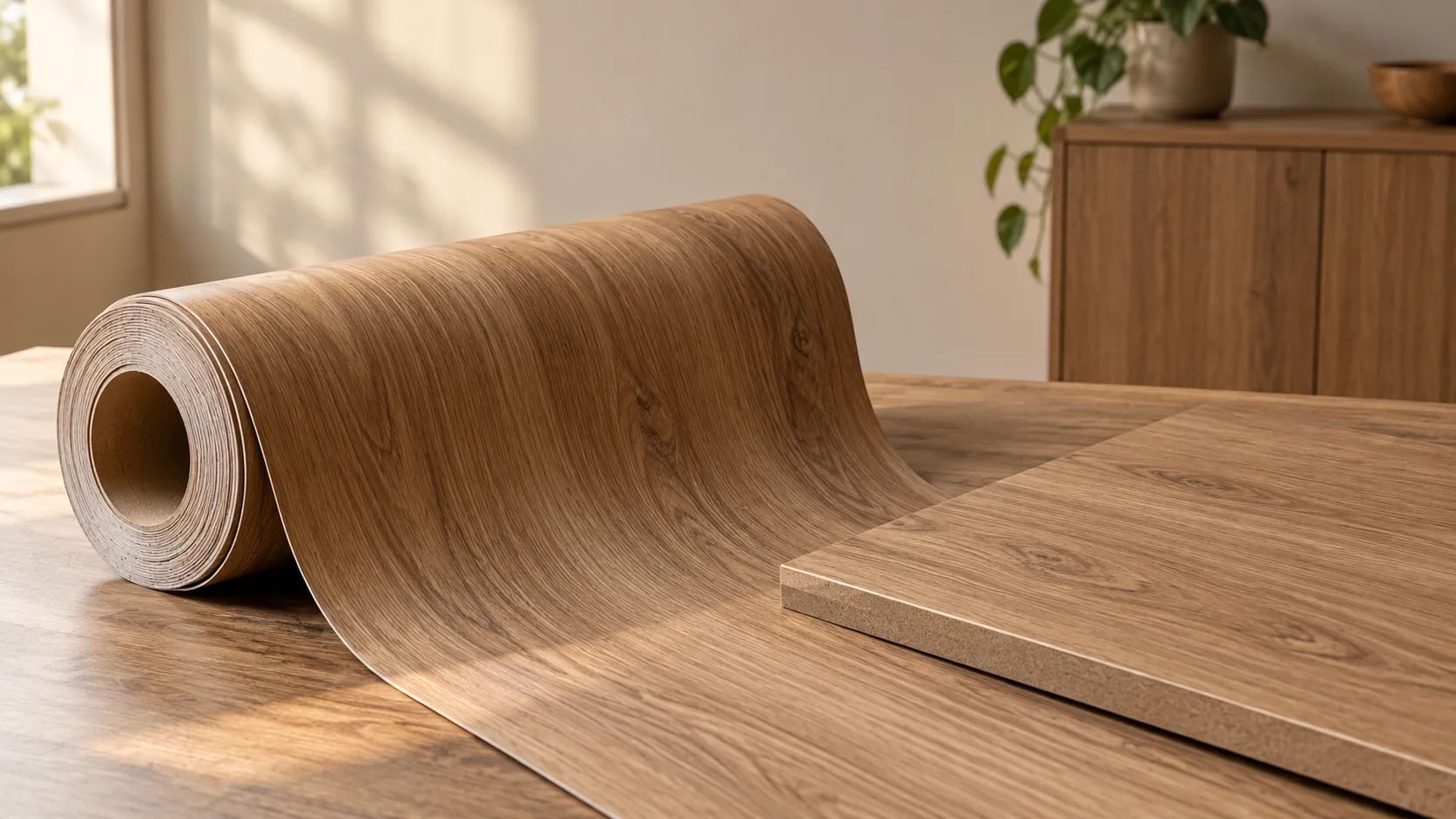
Finish foil has a printed design and a protective topcoat; furniture manufacturers bond the paper facing to panels such as MDF or particleboard. The Composite Panel Association’s 2026 Design Portfolio uses “finished foils” for topcoated decorative foils. In printing and crafts, “foil finishing” means something else entirely: transferring a metallic effect onto print. This article is about the furniture facing.
What Is Finish Foil?
Finish foil, often called paper foil or finish foil paper in furniture, is a paper decorative facing with a lacquer-type coating that protects its printed design. The board underneath gives the panel its strength; the foil gives it the pattern and the surface you see and touch.
The Composite Panel Association’s 2026 portfolio (printed pages 36–37) groups decorative foils with light basis weight papers, separates the topcoated products called finished foils, and positions decorative foils for parts that need more durability and scratch resistance than light papers offer.
So when a furniture listing says “foil,” ask about the actual paper, the topcoat and its bonding method. The word alone doesn’t tell you the resin, a wear rating or which material forms the board. Our laminated-MDF explanation helps separate those layers.
The printing meaning is unrelated. FSEA’s 2025 article on metallic print embellishments describes hot, cold and digital foil-transfer methods that add a metallic effect to packaging and cards, not a paper face laminated to furniture.
Compare finish foil with melamine, HPL and other furniture faces in the decorative laminate overview.
How Is Finish Foil Made?
From four layers: a paper carrier, a printed pattern, a resin treatment and a coated finish. The paper and the coating chemistry decide how the foil machines and how it wears once bonded.
The portfolio describes papers pre-impregnated with acrylic, polyester or other resins to strengthen their internal bond. After printing, the topcoat can be polyurethane, urea, polyester, acrylic, melamine or a combination. There’s no single recipe, so ask which topcoat a given foil uses.
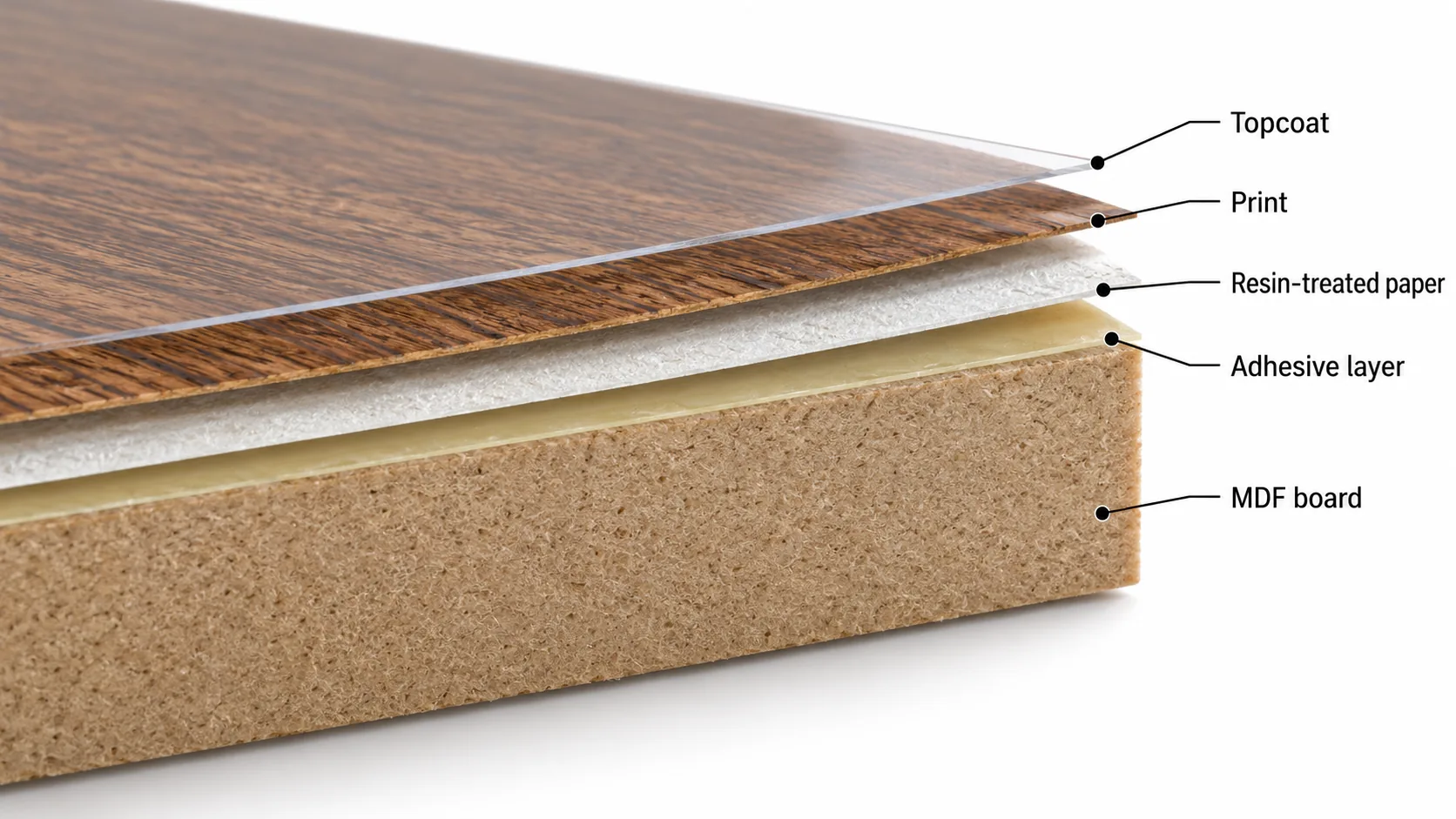
The print usually reproduces wood grain or another natural look, and optional chemical or optical embossing, plus matte or gloss effects, change the surface further. Judge texture and gloss on a finished, bonded sample: two papers with similar printing can feel quite different once coated.
The association also describes precoated hot-melt foils for direct hot-roll lamination, which changes how you receive and bond the foil. A wood-grain decorative finish can give a similar look with a different facing material.
How Does Finish Foil Compare With Melamine, HPL, Film and Veneer?
Adhesive bonds finish foil’s coated paper to the board; heat and pressure fuse TFL (melamine) resin-soaked paper straight to it; HPL is a multilayer laminate sheet; thermoplastic films are plastic; veneer is real wood. The same wood-grain pattern can sit on any of them.
| Material | Visible facing and structure | Bonding or processing route | Selection consideration |
|---|---|---|---|
| Finish foil | Printed, treated paper with a finished topcoat | Adhesive lamination; some grades support profile wrapping | Paper grade, topcoat and actual bonded construction |
| Melamine/TFL | Resin-impregnated decorative paper | Heat and pressure fuse the paper directly to a board | The finished panel and its documented grade |
| HPL | Decorative paper with resin-treated kraft-paper layers | Manufactured laminate subsequently bonded to a substrate | A grade appropriate to wear and exposure |
| Thermoplastic film | Films such as PVC or PETG, with other materials in two-dimensional laminate families | Flat lamination, wrapping or forming according to material | Whether the grade suits the required shape and route |
| Wood veneer | Natural wood leaves | Leaves arranged for a grain pattern and bonded as a facing | Species, cut, matching and the final finish |
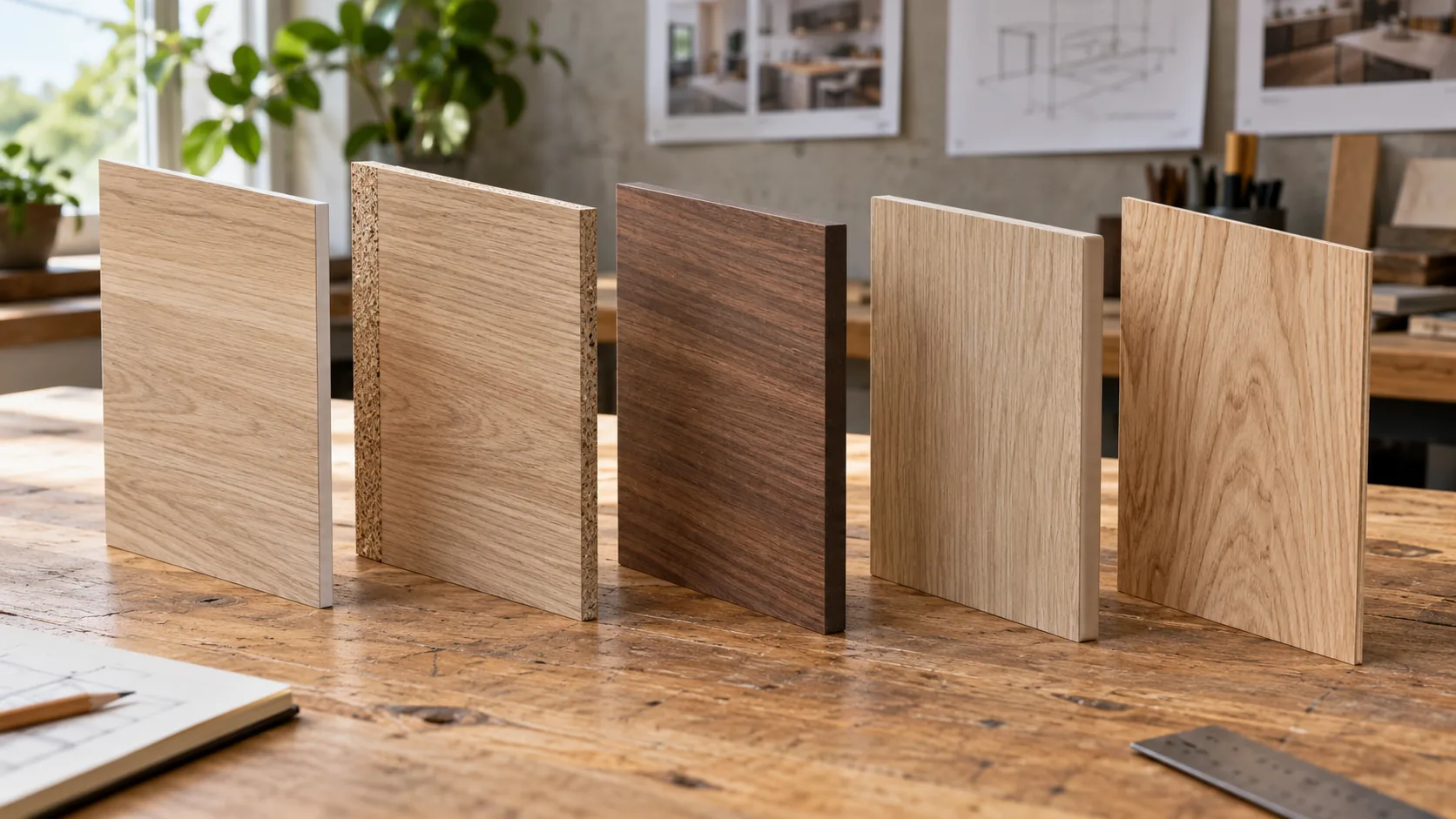
These descriptions follow the The portfolio’s 2026 material sections: TFL on printed page 30, films on 40–41, HPL on 44 and veneer on 48. The TFL panel standard issued May 1, 2025 defines TFL as bonded through its own impregnating resin, with no separate adhesive layer; that’s the key difference from foil.
For TFL versus HPL, see melamine versus laminate; for shaped fronts, thermofoil versus laminate covers forming. Neither ranks every finish-foil grade.
If you want real grain rather than a printed design, veneer is the option; our veneer-versus-laminate comparison goes into that choice.
Where Is Finish Foil Used?
On furniture, cabinets, shelving, storage systems, display fixtures and wall paneling, and suitable grades can wrap profiles and mouldings.
The association lists these uses, notes that wrapping depends on the paper’s weight, and gives recreational-vehicle examples: cabinets, walls, ceilings, doors and interior passage doors. Those show where paper facings appear, not that every grade suits every spot.
Think in components. A flat cabinet side, a moulding and a shelf edge are different shapes and take different wear. Pick the grade, adhesive and board for each part, not just a pattern that matches.
Our cabinet-material overview shows where a paper facing fits in the whole cabinet construction.
Which Finish Foil Grade and Finish Should You Choose?
Pick the paper grade for how it machines, and the topcoat and surface effect for looks and wear. The association describes standard grades with lower resin content and industrial grades with higher resin content and better machining.
| Choice | Options or information | What it affects |
|---|---|---|
| Paper grade | Standard or industrial | Economy and processing behavior |
| Topcoat | Resin chemistry identified for the actual product | Durability and wear of the finished face; the CPA notes topcoats are added to increase durability and longevity |
| Surface effect | Matte, gloss or an embossed effect | Reflection, feel and pattern realism |
| Paper weight | The declared grade and grammage | Whether a particular paper is suitable for wrapping |
| Panel construction | A qualified single- or double-sided arrangement | The completed panel’s balance |
The method in ISO 536:2019, which the standards body confirmed in 2025, measures paper grammage. The required weight comes from the grade you choose; the public sources we reviewed give no single g/m² value for flat or wrapped work.
A single-sided paper facing can produce a balanced panel, according to the portfolio, but check balance for your actual construction. Before approving, look at a finished sample for gloss, texture, edges and shape.
Emissions depend on the whole panel, not the face. The EPA consumer guidance, updated March 30, 2026, places MDF, particleboard and hardwood plywood under the US formaldehyde requirements, so check the completed panel’s labeling.
How Is Finish Foil Laminated to Panels and Profiles?
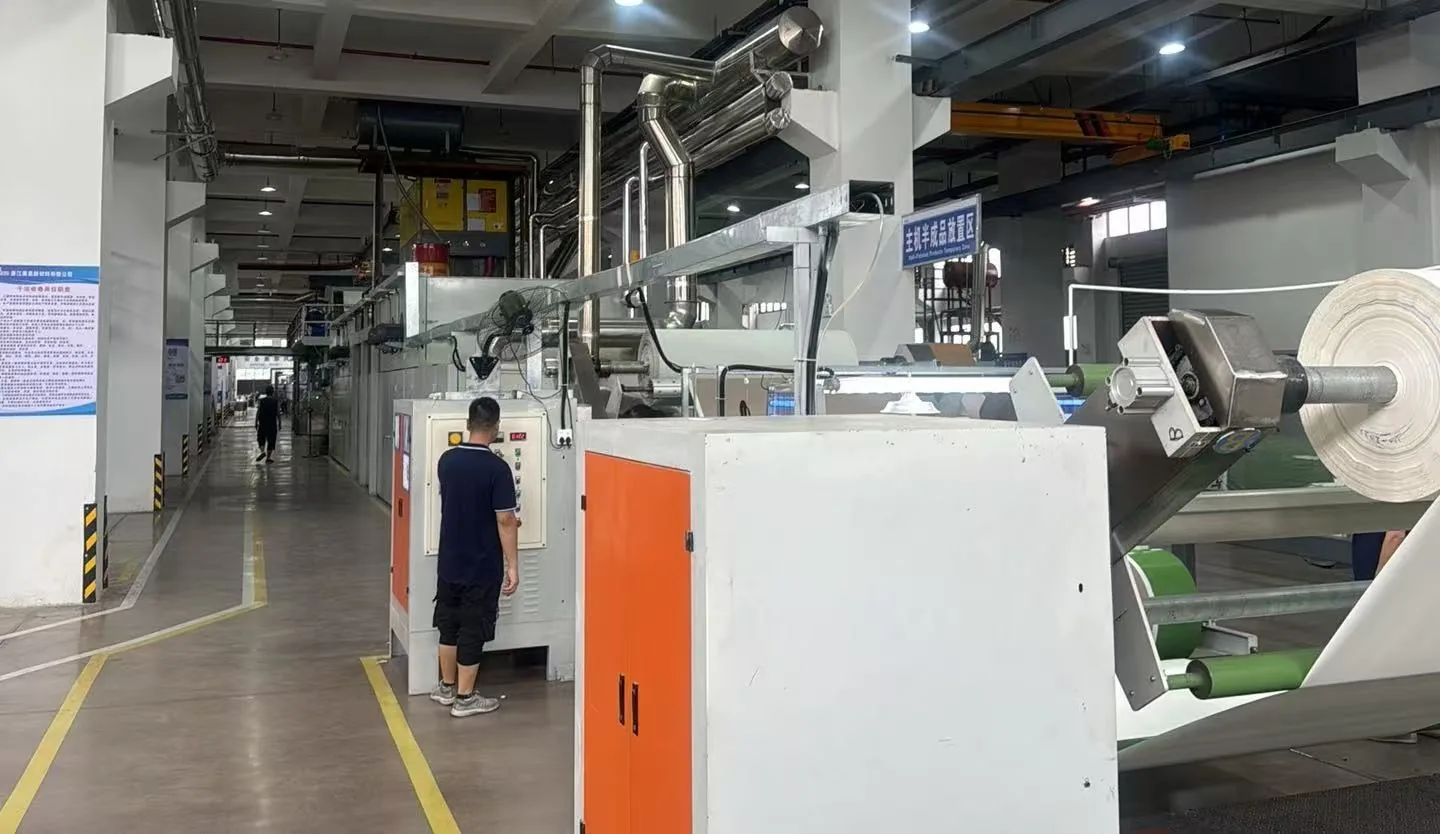
Flat lamination bonds the foil across a board; profile wrapping follows a shaped part and needs a grade made for it. Precoated hot-melt foils can go straight onto a hot-roll laminator.
Paper facings accept various adhesive systems, and the adhesive and the board’s surface quality both shape the final look and performance. A good print can’t hide a poor bond or a rough board.
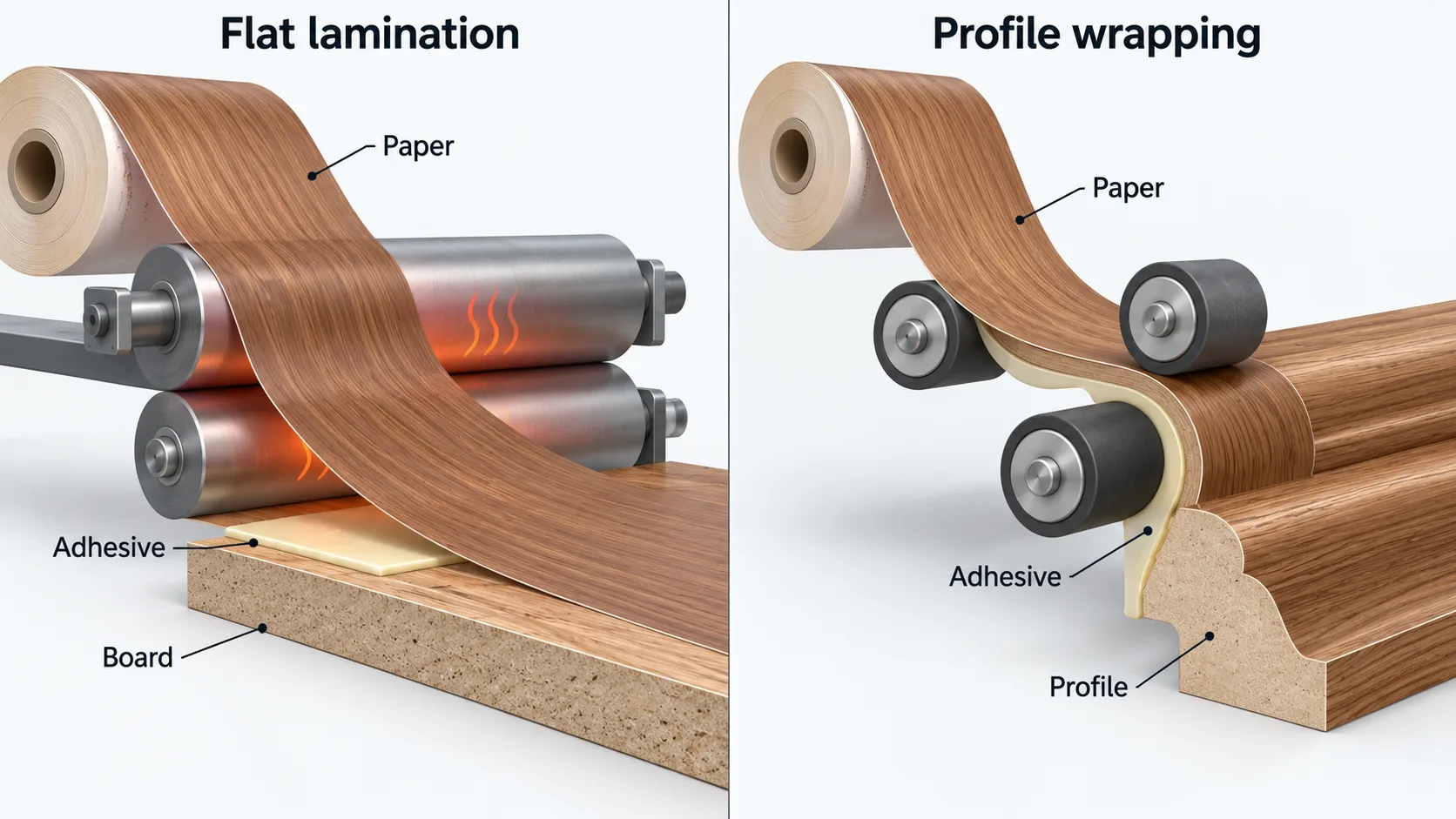
For flat panels, our panel-lamination adhesive overview explains adhesive choices. For mouldings, wrapping suitability is specific to the paper’s grade and weight.
The association gives no temperature, speed or coat-weight settings. Get processing data for your actual paper, adhesive and machine, and don’t borrow settings from plastic films. And don’t assume a paper facing can be vacuum-formed like a thermoplastic door film.
Where Does a Silicone-Surface Film Fit Next to Finish Foil?
As a film alternative for flat panels. Puremorfilm makes decorative film with a silicone functional face on a supporting thermoplastic film, laminated flat onto boards with PUR adhesive; we don’t currently offer it for profile wrapping or vacuum forming.
We mainly supply rolls, with film-faced panels also available, in more than 100 patterns with customizable texture and gloss. Our silicone surface is inherently flame-retardant, with higher grades up to UL 94 V-0 available on request for the film, and the formulation uses No DOP.
In the manufacturer’s laboratory tests, coffee, red wine, soy sauce and lipstick left for 24 hours at 25°C wiped off with no obvious surface change. On wear, an SGS abrasion test on a submitted film sample (ASTM D4060-25, CS-10 wheels, 1000 g per wheel, 60 rpm) showed slight matting and no substrate exposure after 2000 rotations.
Our furniture decorative film is a paint-free finish with a silicone functional surface, distinct from PVC, melamine, PP and PETG decorative faces.
Is Finish Foil the Right Surface for Your Project?
Yes, if its paper grade, topcoat and bonding route suit the part and its intended use. Paper faces vary widely in durability, so compare finished constructions rather than names.
| Project need | Selection direction |
|---|---|
| Printed paper appearance on flat furniture parts | A finish-foil grade and topcoat matched to use |
| Demanding wear or impact exposure | Compare documented grades, including appropriate HPL options |
| A directly fused paper-faced board | TFL |
| A shaped moulding or front | A facing specifically suitable for wrapping or forming |
| Silicone functional face on a flat panel | A compatible flat-laminated film construction |
- Identify the component and whether it needs flat lamination, wrapping or forming.
- Compare paper grade, topcoat, texture and gloss with that component’s intended use.
- Assess the finished construction, including its adhesive, substrate and balance.
For a decorative panel project, contact us with the component type, the supporting board and your preferred pattern or texture.
Frequently Asked Questions
What is the difference between foil finish and other finishes?
Furniture finish foil is a topcoated paper facing glued onto a board; TFL, HPL, plastic films and wood veneer have different structures and bonds. The paper grade and topcoat are what set one foil apart from another.
What is foil paper used for?
In furniture, finish-foil paper faces cabinets, shelves, panels and suitable wrapped mouldings. In printing, foil adds decorative effects to packaging, invitations and cards. The names are similar; the uses aren’t.
What is a foil finish?
In printing, a foil finish adds a metallic effect to print. Hot foil uses heat and pressure; cold and digital foil use their own transfer methods.
Can finish foil be used on doors?
Yes, furniture makers use suitable paper facings on cabinet doors and interior doors, including the applications the CPA describes. Flat and shaped doors need the right grade and bonding route.
Is finish foil eco-friendly?
No, a paper face alone does not make it eco-friendly. The resin, topcoat, adhesive and board all matter, so check the completed panel’s compliance labeling instead of assuming a paper face is formaldehyde-free.
What is paper foil in furniture?
Paper foil is the trade name many furniture buyers use for finish foil: a printed decorative paper with a protective topcoat, bonded to MDF or particleboard to give the panel its wood grain, color or pattern. Kronospan, for example, describes finish foils as paper layers with a lacquer-coated surface. It is thinner and lighter-duty than HPL, so check the topcoat grade before using it on high-wear fronts.