
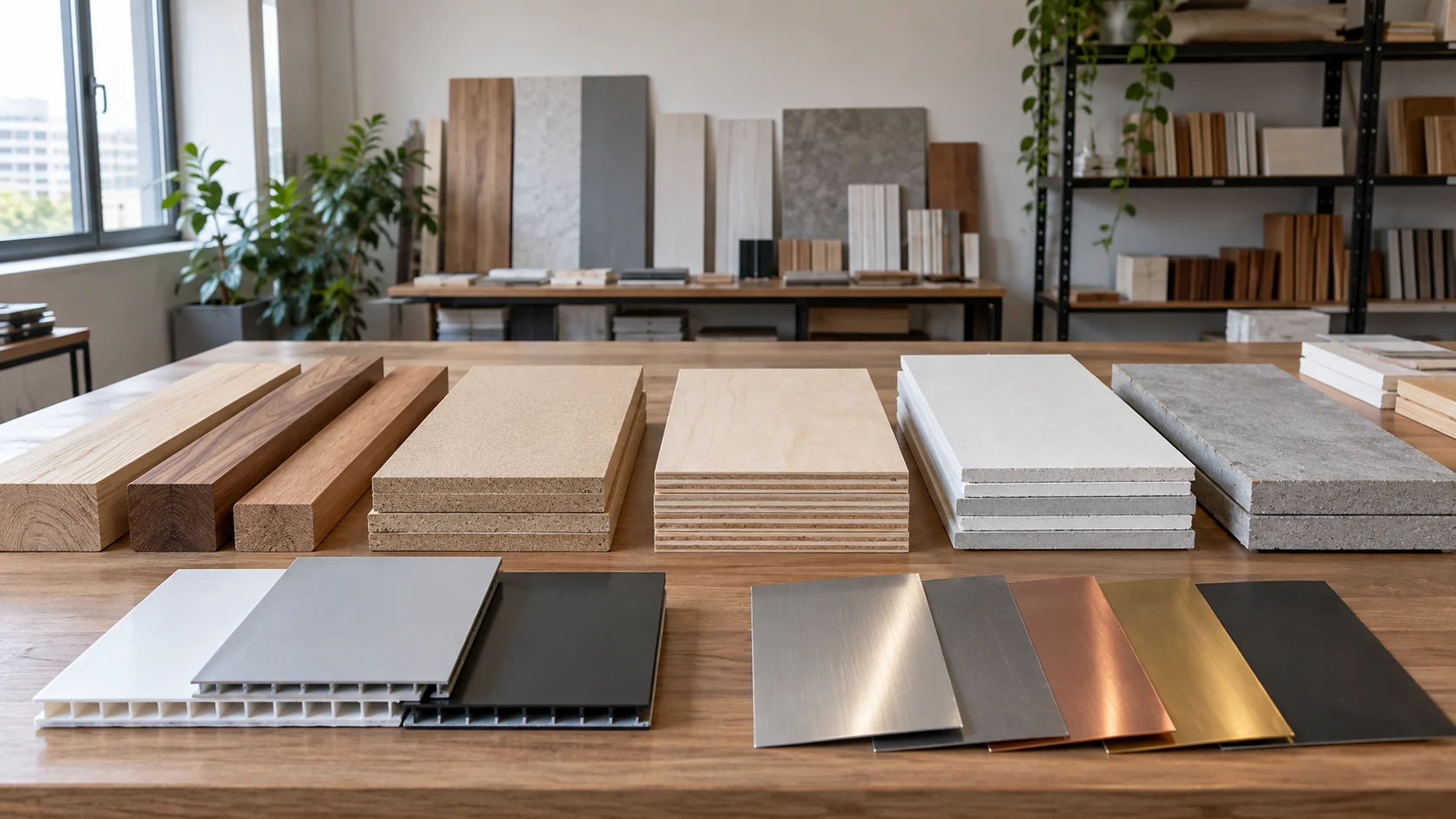
Wall panel materials that look alike can still need different wall constructions: a wood-look sample, a ribbed plastic panel and a painted board are different starting points. Choose each one by its job: select the panel body for the location and fixing method, the visible face for appearance and care, and the complete wall system for any fire or sound requirement.
For a dry decorative wall, wood, MDF or plywood are good places to start. Where regular wet cleaning, sound absorption or a rated partition drives the project, start with a system designed and documented for that task. Compare finished, installed options at the same scope before you decide one material is cheaper or tougher.
Which wall panel materials should you compare first?
Wood-based, plastic and composite, mineral, metal and glass, and acoustic constructions. For each, check whether the name describes the panel body or only its face; a laminate finish on MDF is both a surface type and a core type.
| Material or construction | What it consists of | Useful reason to consider it | What to resolve before choosing |
|---|---|---|---|
| Solid wood | Timber retaining its natural grain | Visible natural wood and shaped trim | Species, movement, finish and joints |
| MDF | Bonded wood fibers forming a panel | Smooth painted or faced decorative work | Grade, edges and moisture exposure |
| Plywood | Bonded wood veneer construction | Wood-faced sheets or a supporting panel | Veneer quality, bond class and support |
| PVC | Polyvinyl chloride plastic panel | A plastic-faced decorative or lining system | Product construction, fixing and service conditions |
| WPC | Wood or other plant material combined with plastic | A composite profile or panel appearance | Actual formulation, profile and intended use |
| FRP | Fiber-reinforced polymer composite | A reinforced plastic lining option | Resin, face texture, joints and care record |
| Gypsum | Gypsum-based board, commonly with a facing | A finished wall lining or specified partition | Board type and complete assembly |
| Fiber cement | Cement-based sheet reinforced with fibers | A cementitious panel construction | Interior or exterior product scope and detailing |
| Metal or glass | A metal sheet/system or glazing construction | A particular architectural surface | Support, edges, joints and complete system |
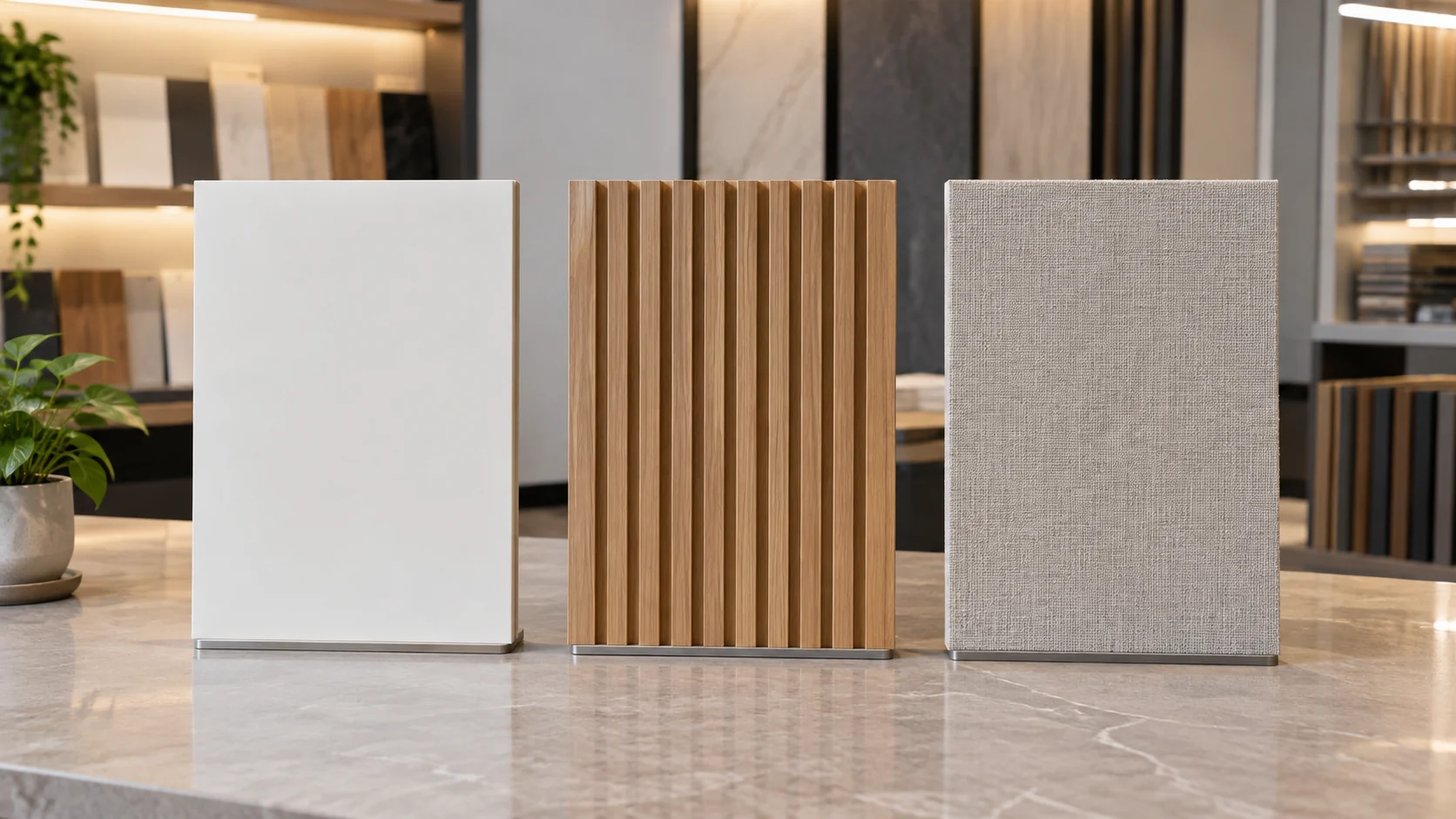
| Acoustic or upholstered panel | Absorptive construction, often with a porous covering | Room sound treatment or a textile appearance | Tested acoustic function and cleanability |
| 3D or textured panel | A relief profile or textured face on a stated panel body | Pattern, depth, and light-and-shadow variation | Body material, relief geometry, joints, and cleaning access |
| Stone-look panel | A stone-pattern decorative face on a stated panel core | A stone appearance using a faced panel | Actual facing and core, edges, joints, and intended exposure |
How do surface patterns differ from panel cores?
“3D” or “textured” names a surface shape, and “stone-look” names an appearance. Composite cores can carry dimensional profiles and textured finishes as well as stone-pattern decorative surfaces. Either way, find out the actual face and panel body before you choose joints, care or exposure limits.
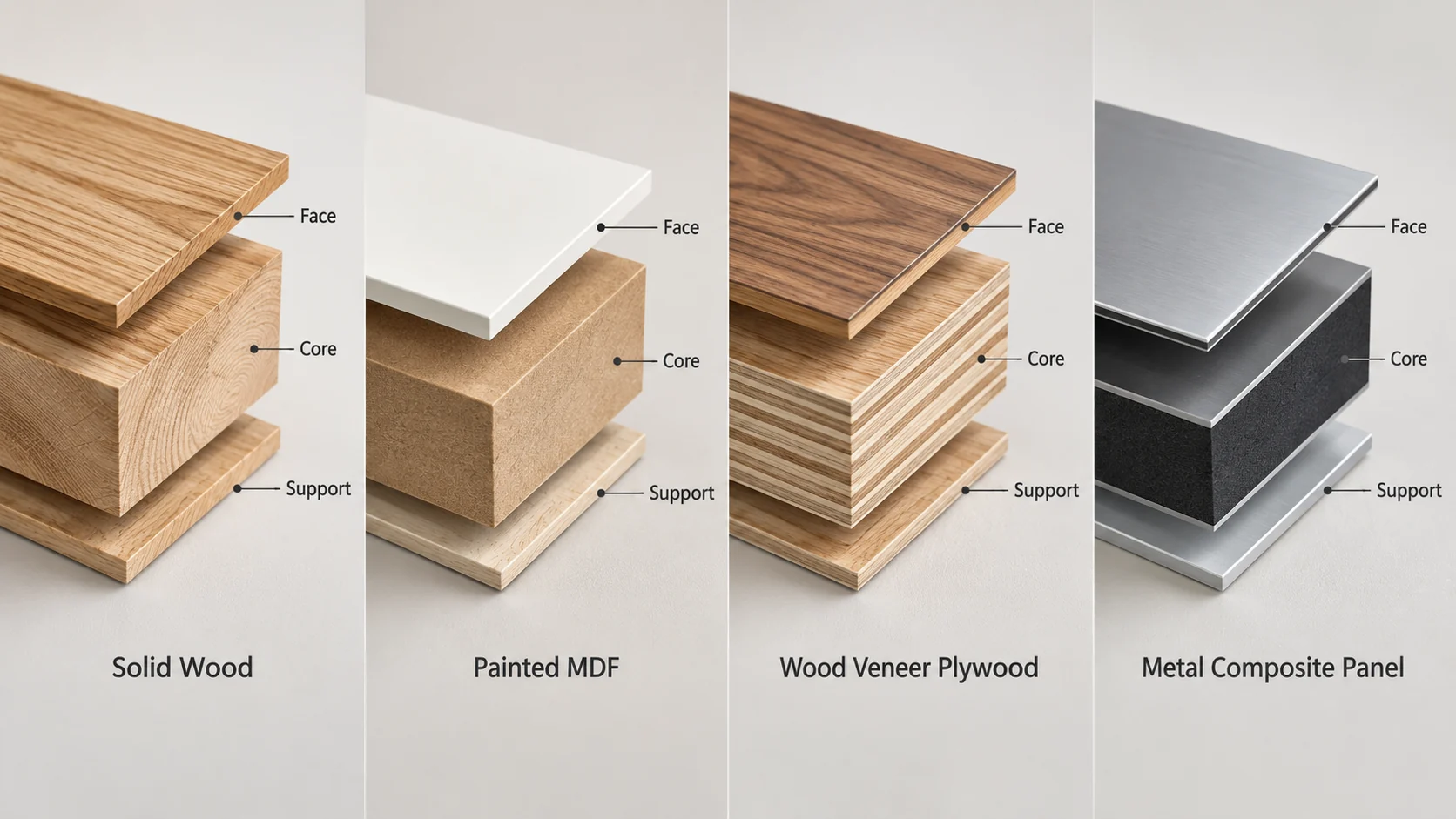
Use the table to name the construction, then judge it against the room. A surface pattern won’t tell you whether the backing is fiberboard, plywood, a hollow plastic profile or a composite panel. Our laminated MDF guide explains how a decorative face and a separate core make a finished panel.
Beadboard and shiplap suit relaxed painted rooms; framed molding, slats and relief panels create different kinds of detail. Choose the layout alongside the wall material and its exposure. Explore the wall paneling ideas.
To compare panels with the other wall finish categories, see the types of wall coverings.
When should you choose solid wood, MDF, or plywood?
Solid wood when natural timber is the point of the design, MDF for smooth painted or faced panels in a suitable interior grade, and plywood when its veneer build and panel properties fit the job. Settle the finish and exposure along with the core.
Solid wood brings species, grain direction and natural variation onto the wall. Decide whether you want that variation across neighboring boards, and design the joints to let the timber move. A clear-finished oak sample shows you something an opaque painted panel never will.
MDF has no knots or grain in its body, which suits uniform painted work and machined shapes such as routed wainscot panels. The Composite Panel Association’s MDF overview describes its fiber-and-resin structure, smooth surface and machining uses. The grade and exposed edges still have to suit the room. For the core comparison, see MDF versus solid wood.
Plywood is another route, including decorative wood-faced sheets. Its grade and bond class tell you far more than the word plywood. Check whether the face will stay visible, how the sheet is supported and what happens at a cut edge or fixing. Our MDF versus plywood guide goes through that choice.
For each option, decide how the panel will arrive. Raw sheets you still have to paint, factory-faced panels and finished slats with mounting hardware are three different purchases.
MDF suits smooth painted or faced interior panels when the grade, edges and wall exposure fit the room. Direct wetting and fixing loads need separate attention. Compare the pros and cons of MDF wall panels.
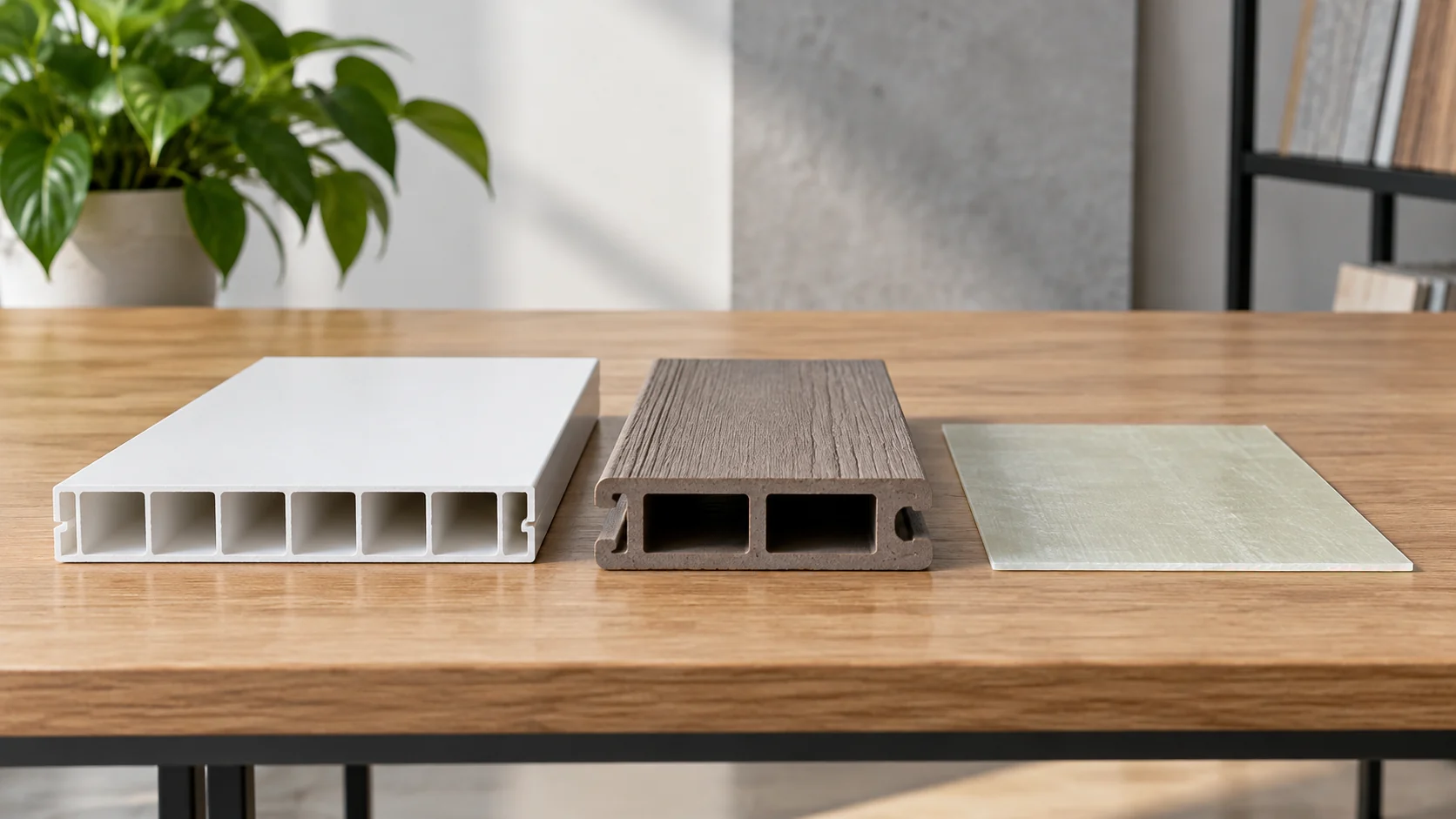
How do PVC, WPC, and FRP panels differ?
They are different constructions. PVC is a plastic, WPC is a wood–plastic composite and FRP is a fiber-reinforced polymer, so compare the actual panel, its finish and its mounting system before giving any of them an edge.
PVC wall products come as solid sheets or profiled panels. A decorative interior panel and a lining system sold with matching trims give you different joints and finished surfaces. Check the product’s stated location, substrate requirements and care method; a plastic face can still sit on vulnerable joints or a backing that needs protecting from damp.
WPC combines plant material with a plastic. Its constituents and processing shape the result, so the WPC label doesn’t carry a single strength, fire, moisture or temperature rating. Ask for data on the wall product itself, especially if a supplier shows test results from decking.
FRP is a polymer matrix with fiber reinforcement, usually glass fiber in wall linings. An introduction from the American Composites Manufacturers Association explains what the matrix and the reinforcement each do. Reinforcement, resin, surface texture and installation details all belong in the product description. Choose a lining on its documented exposure and cleaning conditions, including how corners, seams and pipe penetrations are finished.
Pick between these families by the finished surface you need. A ribbed decorative profile in a restaurant corridor is much harder to clean than a smooth sheet with sealed joints, and buying sheets to cut on site leaves more edge and opening work than buying a finished system.
PVC panels offer a finished, moisture-tolerant face, while heat, impact and joint details can limit the choice. Compare the actual profile, backing and installation system for the room. Read the PVC wall panels pros and cons.
Where do gypsum and fiber-cement boards fit?
Gypsum for a wall lining or partition built from a specified assembly, and fiber cement when the product’s documented use matches your interior or exterior location. Both still need their own finish, joints and support details.
Wallboard usually becomes a painted wall once the joints are finished, and specialist board types serve other defined uses. The Gypsum Association’s technical FAQs treat regular wallboard and wet-area tile backing as distinct products, so read the intended use rather than relying on a moisture-related label.
Fiber cement is a cement matrix with fibers. It may arrive as a finished architectural panel or as a substrate that still needs finishing, so be clear which one you are pricing. An unfinished board may need coating, edge treatment, joint detailing and a suitable fixing system before it becomes the wall you want.
ASTM C1186-26 covers flat fiber-cement sheets for exterior use and explicitly separates them from interior substrate sheets. That gives you a simple sorting rule: an exterior sheet standard is not evidence that a cement board will work as an interior tile backer. Go by the product’s defined use and its system documentation.
Both boards can be one layer in a larger build. Note which layer gives the visible look and which carries any fire or structural claim; adding another decorative face changes the construction the project team has to assess.
When are metal, glass, or upholstered panels useful?
When the design calls for their surface: metal or glass for an architectural look, upholstered panels for a textile finish with a defined room function. Compare the full construction behind the appearance.
Metal wall products include single-skin panels, metal composite panels and insulated metal panels, which the Metal Construction Association’s overview treats as separate families. The same metal face can hide different cores, attachments and joints, so name the family you want instead of asking for “aluminum wall panels.”
Glass and mirror panels bring glazing details, edge protection and support into the wall design. Plan where they go and how openings, corners and replacement access will work.
An upholstered panel may be chosen for its fabric look or for documented sound absorption. Identify its covering, filling or absorber, backing and attachment. A padded panel needs very different upkeep from a smooth rigid lining, so if it will sit behind a café banquette where spills happen, include that in the selection instead of choosing from swatches alone.
Which stone-look wall panels work without real stone?
Stone look wall panels can use a printed decorative face or a mineral-based finish instead of a solid stone slab. Choose by the supplied panel’s weight, joint layout and installation system. A stone pattern does not make a wall waterproof: the core, adhesive, seams and penetrations still need the appropriate wet-area detailing.
| Wall option | Weight and installation | Seams and water |
|---|---|---|
| Printed stone-look panel | Weight follows the carrier and core; installation may use an approved adhesive or mechanical system. | Plan the print repeat and joints. Confirm the full system for damp or splash exposure. |
| Flexible stone/mineral sheet | Confirm whether the sheet contains a real stone layer or a mineral-filled composite. Obtain installed weight and the approved substrate/adhesive. | Curves and corners need the grade’s method; seals and joints remain part of the system. |
| Solid natural stone panel | Check slab thickness, handling load, backing and any required anchorage. | Natural variation and joints need planning; the stone face is not a complete waterproofing system. |
The International Masonry Institute’s interior stone detail illustrates why stone support and joints need a designed assembly. For a wet room, compare wall panels and tiles by the installation system, not just the stone effect.
What are the pros and cons of faux leather wall panels?
Faux leather wall panels offer a soft-looking decorative face and can conceal a modular padded construction. Their drawbacks include vulnerable seams, possible scuffing and cleaning limits that depend on the coating and backing. Compare the finished panel’s care instructions, replacement method and fire evidence before choosing it for a busy interior.
| Decision | Potential benefit | Limit to check |
|---|---|---|
| Cleaning | A compatible coated face can be wiped clean. | Confirm approved cleaners and how seams, buttons and folds are cleaned. |
| Wear | Padding can provide a softer contact surface. | Scuffs, tears and coating wear need evidence for the exact material; softness is not an abrasion rating. |
| Seams and replacement | Modular units can make a damaged part replaceable. | Visible joins, trapped dirt and color matching may limit the result. |
| Fire evidence | A tested assembly can be selected for the project requirement. | The cover, foam, backing, adhesive and mounting must match the evidence. |
| Price | A modular layout lets buyers define the installation and replacement scope. | Compare installed quotes including padding, trims, labor and spare modules; no material-wide price ranking applies. |
For hospitality placement and the distinction between woven fabric and a fabric-effect face, see fabric-texture hotel wall panels. Puremorfilm silicone leather is coming soon. Performance data for our decorative film does not establish performance for that forthcoming leather product.
How should moisture and cleaning change your choice?
Sort the location into dry decorative use, occasional splashes, repeated wet cleaning or direct wet exposure, then choose the panel and joints for that condition. A bathroom feature wall away from the shower and a shower lining are different specifications.
In a dry living room, the main questions may be looks, fixing and repair access. Around a sink or other splash source, add cut edges, openings, bottom joints and the wall behind. For frequent washdowns, choose a complete lining system with a documented cleaning method and details made for that use.
Think about where water could travel behind a panel. A face that sheds a splash can’t deal with a leak, trapped moisture or an exposed wood-based cut. Our MDF and water exposure guide explains grade choice and why protecting only the visible face falls short.
Cleaning narrows the shortlist too. Deep grooves, fabric coverings, open slat gaps and smooth sheets each leave different surfaces to reach. Match the care method to the actual face and joints, and include the cleaning products when regular chemical cleaning is part of the brief. If antibacterial treatment is offered, document it as its own feature alongside the cleaning method.
For tiled wet areas, the same FAQs name specific backing-panel types and rule out regular wallboard. Choose the substrate by that intended use, even when the tile or decorative face looks water resistant.
Approved shower-panel systems offer large sheets with fewer joints to clean, while tile allows more detailed layouts. Both need suitable backing and watertight junctions. Compare bathroom wall panels vs tiles.
Restaurant dining walls can use decorative-faced boards, while preparation, washing and cooking zones need systems matched to their exposure. Set the cleaning access, joints and heat conditions for each zone. Read the restaurant wall panels guide.
Which fire, acoustic, and emissions evidence matters?
The evidence that matches the function you need: surface burning behavior, fire resistance of an assembly, sound absorption in a room, sound transmission through a partition, or regulated emissions from the supplied wood product. Each is a separate property with its own evidence.
Fire-resistance ratings belong to complete tested assemblies under the E119 fire test. A board’s surface-burning report or a flame-retardant decorative face does not give the finished wall that rating. If the project needs a rated partition, keep the specified board, framing, joints and other assembly parts in the selection record.
For acoustics, decide whether the problem is echo inside the room or noise reaching the room next door. A porous absorber deals with reflected sound; cutting transmission through a wall means working on the partition and its paths. GSA’s indoor environmental quality guidance places absorption and sound control within the wider building design.
ASTM C423-23e1 measures sound absorption by the reverberation-room method. When you compare acoustic panel reports, keep the tested construction and mounting with the result, including the backing and any air gap, and quote it as absorption only.
For hardwood plywood, MDF and particleboard sold in the United States, EPA’s composite-wood guidance explains TSCA Title VI certification and labeling. Ask for that evidence on the complete supplied panel, not only its face.
What should you specify before ordering finished panels?
The complete panel, mounting, appearance, exposure and evidence, all at the same purchase boundary so every quote covers the same job. Say whether you are buying raw sheets, faced sheets, finished panels or an installed wall system.
| Item | What to specify | Why it changes the choice |
|---|---|---|
| Panel identity | Core material, grade, thickness and relevant construction | Connects the name to the supplied component |
| Visible face | Material, color, texture, sheen and direction | Defines the appearance and care surface |
| Geometry | Panel dimensions, openings, edge details and layout | Affects yield, joints and installation work |
| Support and fixing | Backing wall, rails or substrate, fasteners or approved adhesive system | Defines how the panel becomes an installed surface |
| Exposure | Dry use, splashes, repeated cleaning or intended wet-area use | Guides material and joint suitability |
| Performance evidence | Relevant fire assembly, acoustic construction and emissions documents | Keeps reports attached to their tested or regulated scope |
| Care and repair | Permitted cleaning method and replacement access | Makes maintenance workable after installation |
| Delivered condition | Work included in cutting, finishing, packing and fitting | Makes quotations comparable |
Take dimensions and thickness from the actual panel drawing and approved construction instead of a generic size, and put the same visible edges, openings, finish and mounting work into every competing quote.
Compare the total delivered scope before ranking on cost. A low sheet price can leave painting, bonding, edge work, trims, transport or installation outside the quote. Price those items for the same room layout and finish standard; a raw MDF sheet and an installed metal panel system are different transactions.
Look at a finished corner, joint and opening alongside the main face sample, because that is where the look and the cleaning method meet the construction. For wood-based faced panels, our MDF edge-banding guide explains the edge options.
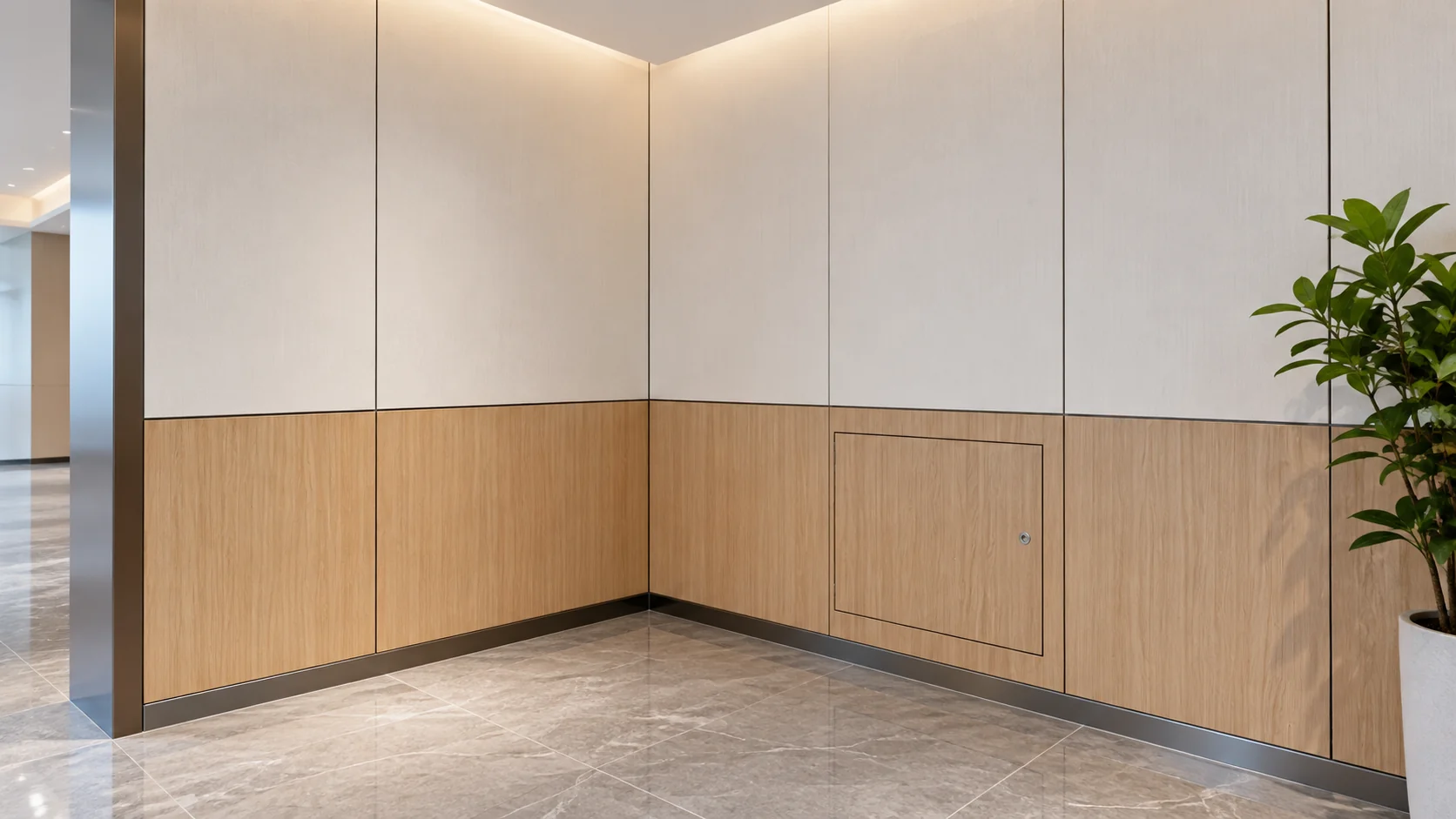
Hotel feature walls call for coordinated appearance, while corridors need accessible cleaning and local repair. Wet areas and acoustic treatments require their own documented constructions. Plan those areas with the hotel wall panels guide.
Where does a silicone functional surface fit?
In the face column. Puremorfilm makes decorative film with a silicone functional surface for flat wall panels, and the board, edges and fixing are still chosen separately. Three facts matter for a wall: the silicone surface is inherently flame-retardant (higher grades up to UL 94 V-0 on request), the film contains no PVC and uses a No DOP formulation, and in the manufacturer’s laboratory tests, coffee, red wine and soy sauce left on the surface for 24 hours at 25°C wiped off with no obvious change. More than 100 colors are available, and texture and gloss can be customized.
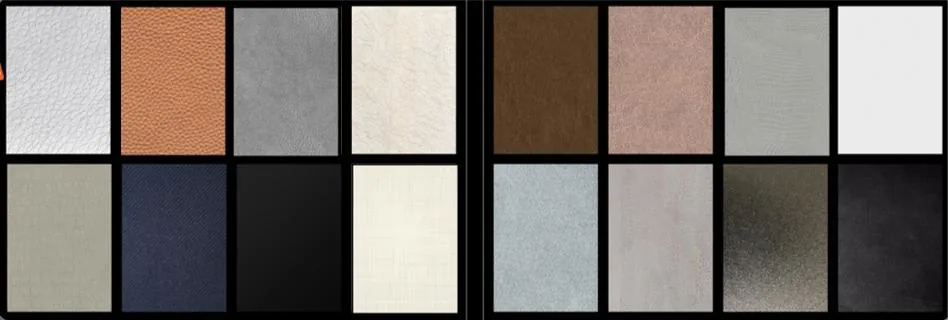
We mainly supply rolls, with film-faced boards on request, for PUR flat lamination onto flat panels. It is a new paint-free facing, a different surface from PVC, melamine, PP and PETG. The decorative wall film page shows the range.
Which wall panel material should you choose for your project?
Start from the room’s main requirement, then compare complete finished constructions on that shortlist, keeping looks, cleaning and documented performance in the same decision.
| Main requirement | Sensible starting shortlist | Decision to settle next |
|---|---|---|
| Natural timber appearance | Solid wood or wood-veneered panels | Grain, core, finish and joints |
| Uniform painted or faced interior design | Suitable MDF, plywood or mineral-board construction | Grade, finish and exposure |
| Frequent cleaning or splash exposure | A documented plastic, composite or mineral lining system | Joints, substrate and care method |
| Room sound absorption | Tested absorptive panel construction | Acoustic function and tested mounting |
| A rated partition | The complete specified wall assembly | Listed components and project requirements |
For a flat-panel facing, contact us with the location, the panel construction, the look you want and your preferred supply form.
Paint suits a lower initial cost and easier changes; wallpaper suits a pattern or texture you want to keep in a dry room. Both depend on the wall preparation and the chosen finish. Compare wallpaper vs paint.
Vinyl wallpaper has a decorative PVC face on a backing that takes the wall adhesive. Its face, backing and adhesive determine cleaning, hanging and removal. Learn what vinyl wallpaper is.
For wall-panel manufacturers, our decorative wall film for panel facing is the surface layer to laminate onto a chosen board.
Frequently Asked Questions
What is the meaning of wall panel and wall paneling?
A wall panel is the covering component; wall paneling is the installed covering or the practice of using it. When you buy, describe the core, visible face, joints and attachment.
What is a WPC wall panel?
A WPC wall panel is a wood–plastic composite wall product. Its formulation and profile decide how it behaves, so the WPC name alone gives you neither a fire rating nor a wet-area specification.
What is a metal wall panel?
A metal wall panel is a cladding or lining panel with a metal face, supplied as a single-skin sheet, a metal composite panel or an insulated metal panel. These share a metal look but differ in core, joints and attachment.
Can wall panels be used in moisture-prone areas like bathrooms?
Yes, when the complete panel and lining system are made for that exposure. A feature wall and a shower surround need different systems, so include joints, edges, openings and substrate in the choice.
What is wainscoting in wall design?
Wainscoting is paneling on the lower part of a wall. It describes the layout, not a material; wood, painted panels or another suitable lining can provide it.