
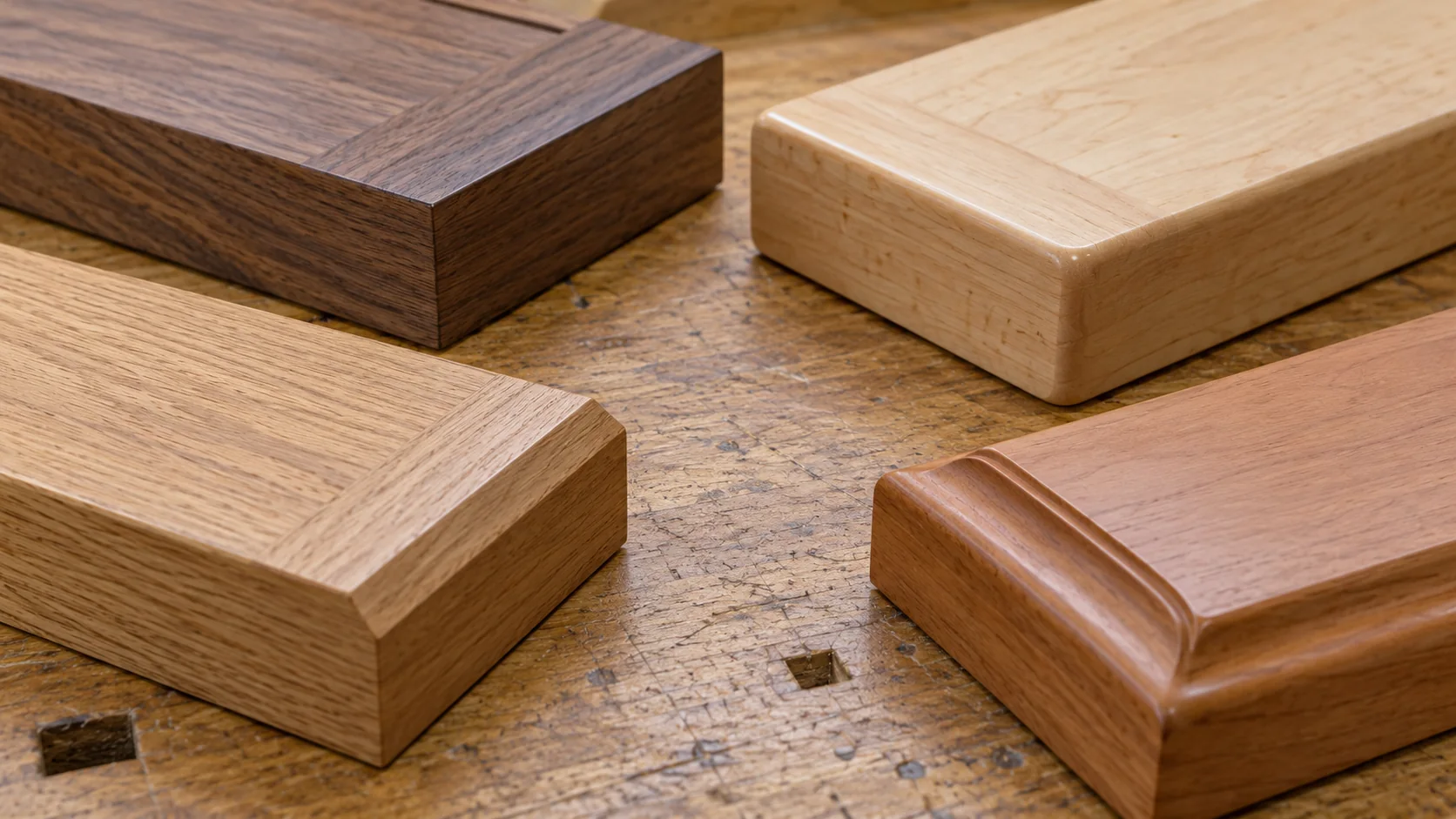
A cabinet door edge profile is the shape along the door’s outside perimeter. One door maker’s options include a 1/16-inch hand-broken roundover, a 1/4-inch bevel and an ogee. Choose that outside edge separately from the inside frame detail and panel shape, then approve the combination on a finished corner sample.
A front-facing photograph can make different edges look similar. The distinction becomes clearer when you see the section and the corner, where the shape, surface finish and adjoining drawer front meet. Start by naming the part of the door you want to change.
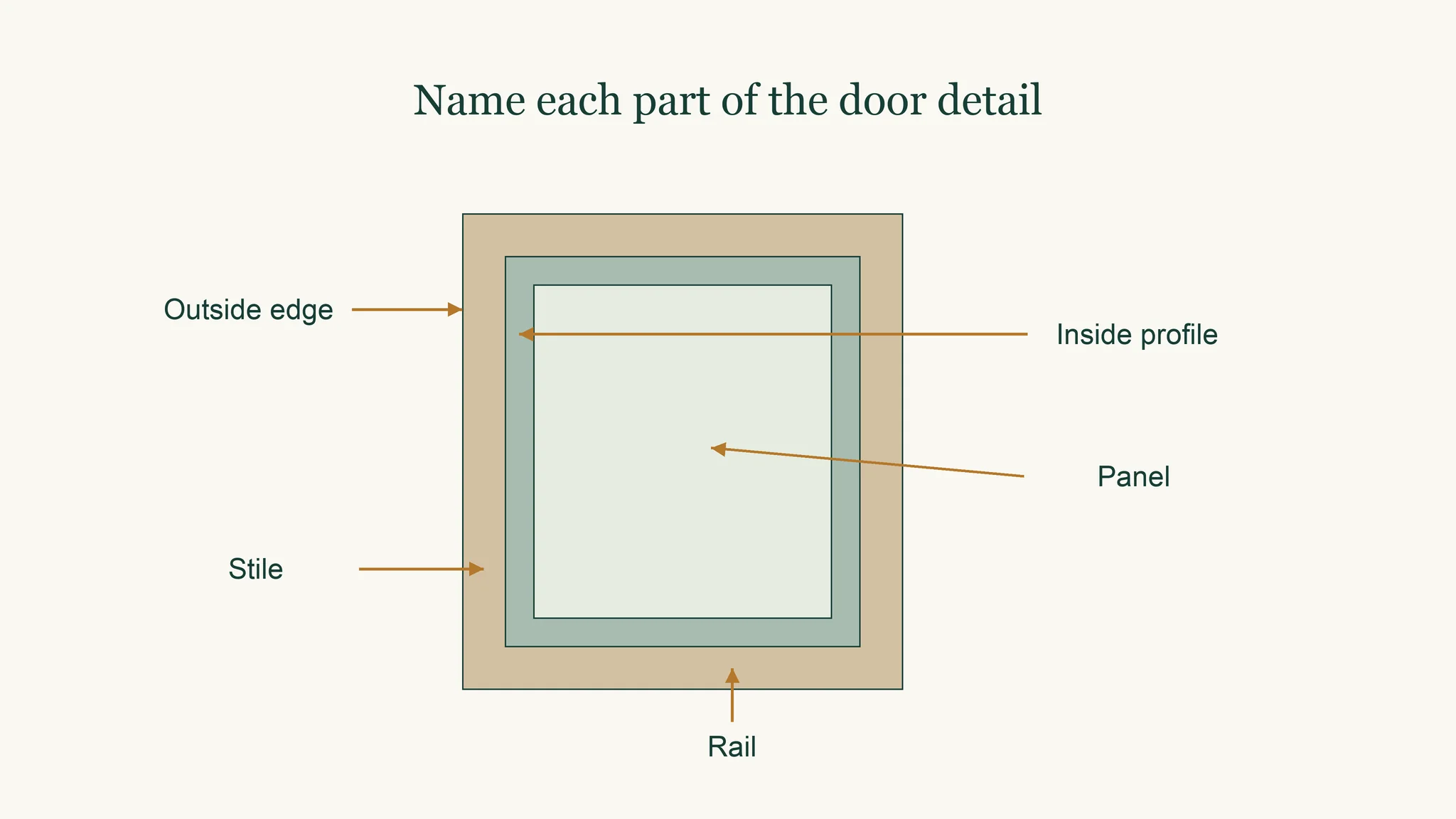
What part of a cabinet door does the edge profile describe?
The outside edge profile shapes the outer perimeter of the door, while the inside profile shapes the frame’s inner boundary around the panel. The panel and the rails and stiles have their own forms. Specify each location separately so an edge name cannot stand in for the whole door design.
| Location | What it shapes | Typical decision |
|---|---|---|
| Outside edge | The door’s outer perimeter | Square, lightly rounded, beveled or ogee detail |
| Inside profile | The inner boundary of the frame | A square or sloped transition toward the panel |
| Panel | The central area | Flat, recessed or raised appearance |
| Rails and stiles | The horizontal and vertical frame members | Frame proportions and construction |
The outside-edge options from a door maker treat this edge as an independent selection. A cabinetmaking cutter set likewise distinguishes rail-and-stile cutters, panel cutters and a drawer-front outside-edge cutter.
Those separate names help describe what you are ordering. “Square detail” could mean the outer edge or the inner frame corner; mark the intended location on the drawing. A sample that looks right from the front can still carry an outside edge different from the one you expected.
The slab versus Shaker comparison covers the broader door-style choice. Once the style is settled, identify the outer perimeter and the frame or panel details individually. This keeps a small edge decision from changing the character of the entire door by accident.
What are the common outside edge profiles?
Common outside-edge choices include square, lightly eased or rounded, beveled and ogee profiles. A square edge keeps the outline direct, a small rounding softens the corner, a bevel adds a sloping facet and an ogee introduces a curved detail. Approve the actual shape because names and codes vary between makers.
| Profile | Shape | Visual effect |
|---|---|---|
| Square | A straight face meeting a straight edge | A simple, direct outline |
| Lightly eased or rounded | A small rounding at the corner | A softer transition with a restrained outline |
| Beveled | A sloped facet between the face and edge | A visible angled border |
| Ogee | A concave curve followed by a convex rounding | A more decorative curved outline |
For a concrete catalog example, Eagle lists E-01 as hand broken with a 1/16-inch roundover, E-02 as ogee and E-03 as a 1/4-inch beveled edge. Those sizes and codes describe that maker’s choices, so copy the actual drawing when comparing another offer.
CMT describes its ogee door-edge cutter as a cove followed by a roundover. That gives you a useful geometric description when a photograph leaves the profile hard to read. Different proportions within that general curved form can still look different on the finished door.
Choose by the visible outline and its relationship to the rest of the kitchen. A narrow facet may suit a restrained flat front, while a curved detail may fit a more decorative frame. The names alone provide no basis for ranking cleaning effort, impact resistance or service life.
How do inside profiles and panel edges change the look?
Inside profiles and panel edges create the lines within a framed door. A square inner corner gives a direct transition, a sloped inner edge softens it, and a raised panel adds another change of level. Choose those inner details with the outside edge so the finished front reads as a coherent design.
An outside ogee and a decorative raised panel occupy different parts of the door. Selecting one leaves the other open. When reviewing a quotation or sample label, ask which perimeter the word “ogee” describes and compare the marked section with the sample.
There are also several ways to produce a Shaker-like appearance. The face can have a square inner corner, a shallow recess or a sloped inner transition. A view straight onto the door may hide the depth and slope that become visible from the side.
Put the samples next to the planned countertop and adjacent fronts. A decorative panel edge plus an elaborate outside edge introduces more lines than either detail alone. That can be appropriate for a traditional room, while a quieter interior may suit fewer visible transitions.
Use a corner sample that includes both the outside and inside detail. A loose outside-edge strip answers only part of the design question. Keep the broader kitchen cabinet finish choices in view as well, because color and gloss change how those lines appear under room lighting.
Can slab doors and drawer fronts have a shaped edge?
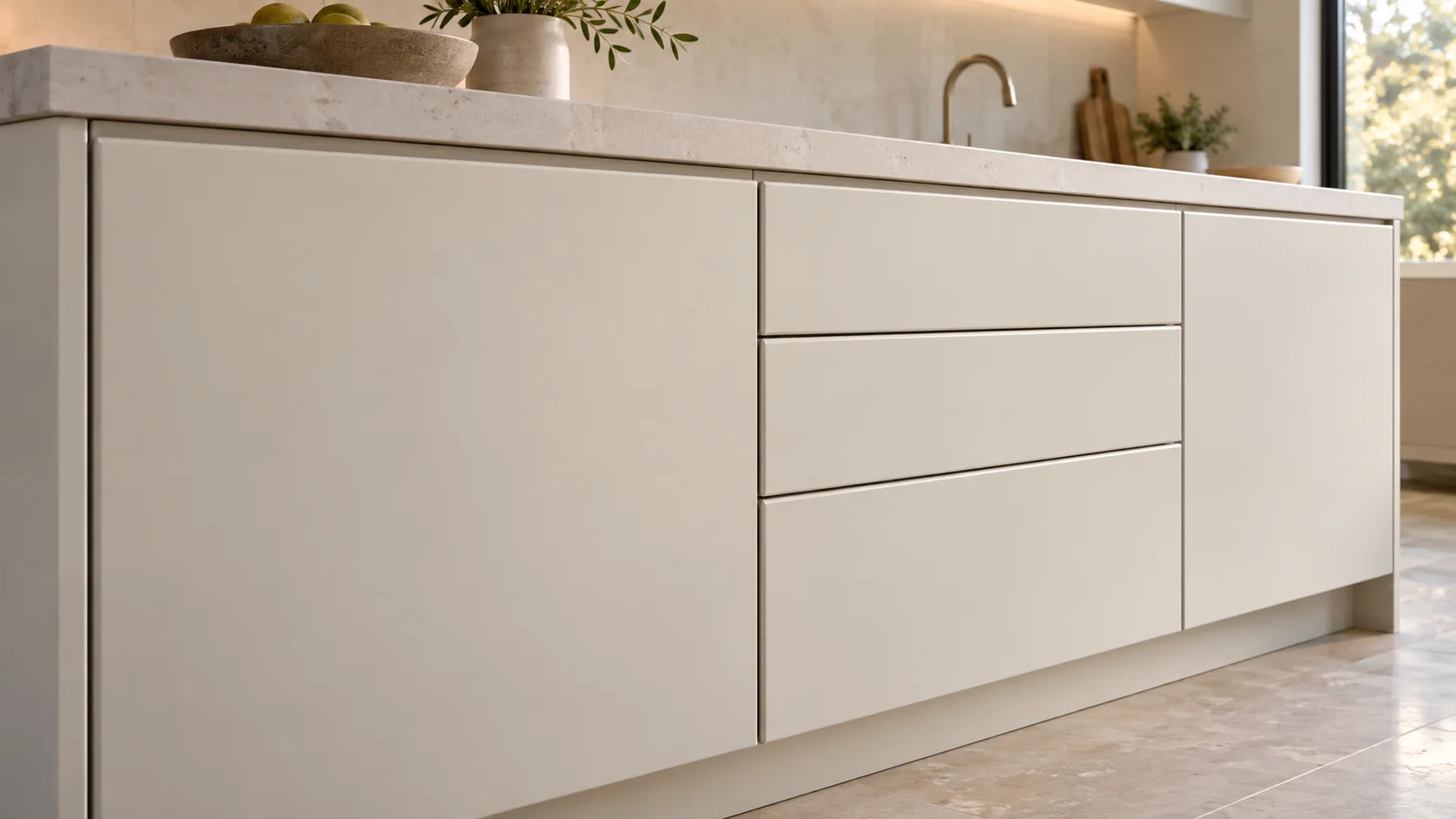
Yes, a slab door or drawer front can have a separately shaped outside edge while retaining a flat central face. The edge detail should match across the door and drawer fronts that share the elevation. Check the result on narrow pieces as well as the largest door before approving the set.
A slab describes the broad face and construction choice, leaving room for an outside-edge selection. The separate drawer-front edge cutter in the cabinetmaking set illustrates the same distinction: a shaped perimeter can be considered independently of a framed panel.
Look at a stack of drawers alongside a tall door. The edge repeats at every drawer boundary, so a detail that appears subtle on the tall face can become more prominent across the stack. Lay out the front sizes before judging the profile from an isolated large sample.
Mark any exceptions on the elevation. An appliance panel, narrow filler-like front or unusually small drawer may need its own review. The aim is a deliberate relationship among the pieces, supported by a drawing and finished samples of the proposed detail.
A handle or finger-access feature is another decision. If the design also removes visible handles, use the handleless cabinet guide to assess that arrangement separately. Do not rely on an edge nickname to specify the access method or hardware clearance.
How does the edge profile change the finishing route?
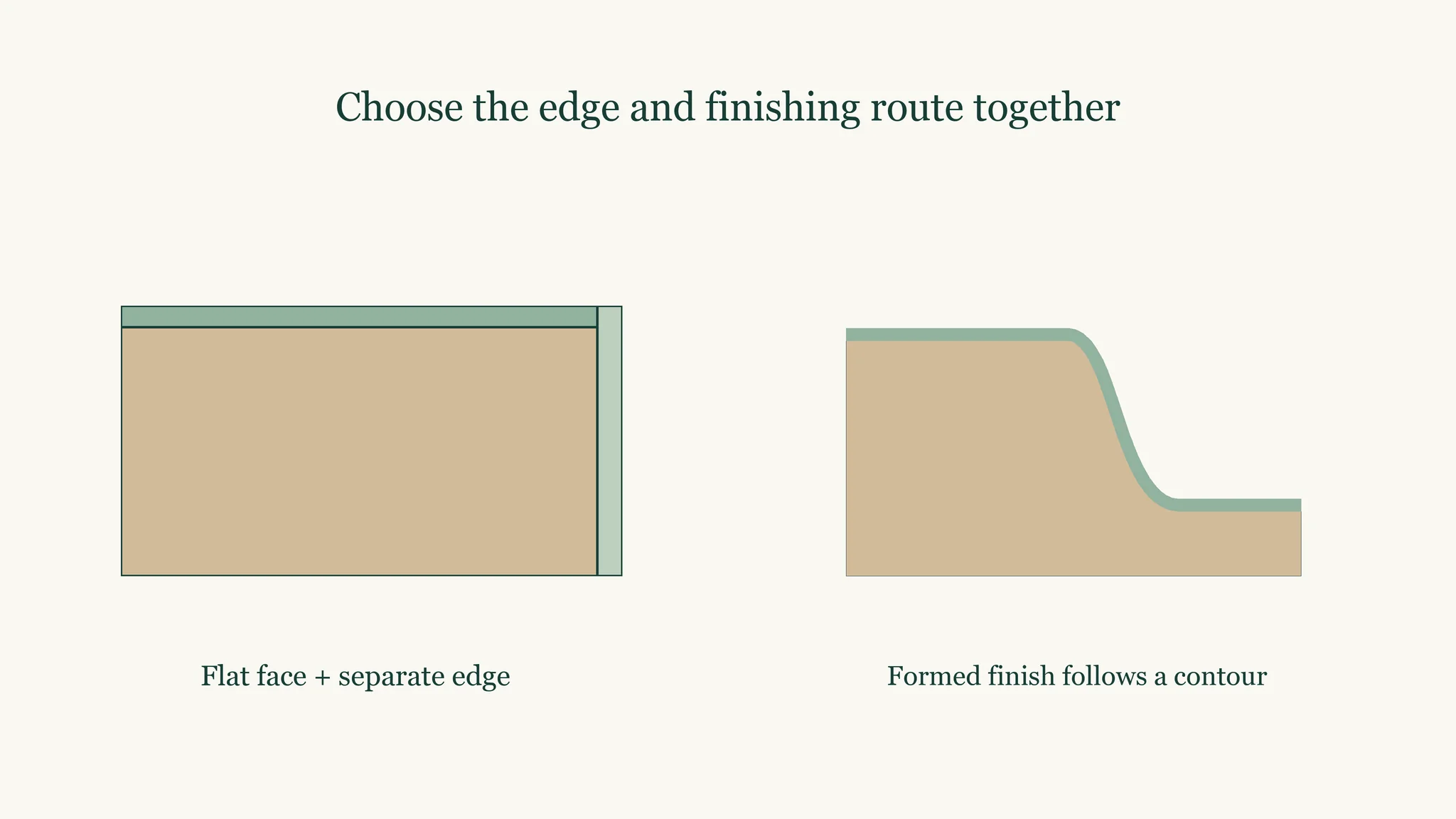
A flat decorative face with separate edge treatment suits a flat-front design, while a shaped perimeter needs a finish route that can cover its contour or a coating applied after shaping. Choose the face and edge construction together. The finished corner should show how the selected route handles the change in direction.
The Composite Panel Association’s laminate explanation distinguishes flat laminating applications from materials formed over contoured components. Its description of formed decorative laminates includes coverage of component edges. That generic route is useful when assessing a shaped door, without assigning it to every film supplier.
For a flat face with a separate edge band, examine where the face and edge meet. A color match viewed from the front may appear different along the edge because the surface direction and reflection change. The edge-banding guide covers that separate selection.
A formed finish over a contour and a painted shaped edge should be compared as complete finished samples. Their surface transitions, corners and rear boundaries can differ. Ask the maker to identify the actual route on the sample or drawing so a photograph cannot blur that distinction.
Settle the required geometry and finish first, then choose a maker whose documented process produces that finished detail.
What should you check on a finished edge sample?
Check a dimensioned cross-section and a finished corner for the intended outside edge, inner detail, panel and surface continuity. Compare the matching drawer front and the maker’s own profile code. This connects the design name to an observable finished object and makes the approval usable when the complete set is ordered.
| Item | What to specify | Why it belongs in the order |
|---|---|---|
| Outside edge | Name, maker code and dimensioned section | Identifies the intended geometry |
| Inside profile | A marked section or the approved sample | Fixes the transition around the panel |
| Panel | Flat, recessed or raised form | Identifies the central face |
| Face finish | The selected finish and application route | Connects appearance to construction |
| Edge treatment | The finish across the edge and corner | Shows how the perimeter will be completed |
| Drawer-front match | The same detail or a clearly marked exception | Keeps the elevation intentional |
View the sample from the front, the side and an oblique angle in the intended lighting. Turn the corner toward the light to see the transition clearly. Include a drawer front when repeated edge lines are a major part of the elevation.
Maker codes help retrieve a particular catalog option, but they remain attached to that catalog. Keep the drawing and approved sample identification beside the code. This is especially useful when comparing quotations from different suppliers that use similar profile names.
Write any accepted variation on the order before approving it. A section drawing identifies shape; a finished sample identifies how the chosen surface appears on that shape. Together they provide a clearer reference than an unmarked rendering.
Where does a flat silicone decorative face fit?
Puremorfilm makes decorative film with a silicone functional surface for flat furniture faces, including slab doors and drawer fronts made by PUR flat lamination. We mainly supply rolls, with laminated panels available on request. A shaped or contoured edge needs its own finishing route, so approve the edge treatment on a finished corner.
We use a No DOP formulation. The silicone surface is inherently flame-retardant, with higher grades up to UL 94 V-0 available on request. In the manufacturer’s laboratory tests, coffee, red wine and soy sauce left at 25°C for 24 hours wiped off with no obvious change.
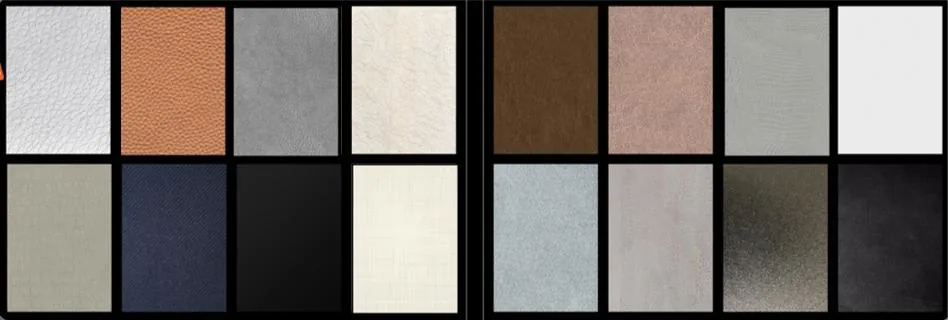
Texture and gloss can be customized, and laminated panels can have film on both faces. Our furniture decorative film is a paint-free material with a silicone functional face, distinct from PVC, melamine, PP and PETG decorative faces. Free samples are available.
Which edge detail should you choose?
Choose a square or lightly eased outline for a restrained flat elevation, a bevel when you want an angled border, or an ogee when a curved decorative edge suits the frame and panel. Match the choice to a workable finishing route, then approve the dimensioned detail and finished corner together.
| Design aim | Edge to examine | Decision to confirm |
|---|---|---|
| A direct, simple flat front | Square or lightly eased | Face and edge treatment at the corner |
| A softer outline with an angled detail | Beveled | The actual facet and its proportion on small fronts |
| A more decorative framed or raised-panel door | Ogee | Its relationship to the inside profile and panel |
| A matching door and drawer set | The approved common profile | Repetition across the complete elevation |
Set the door style, choose the outside edge, select the finishing route and approve a completed corner. Keep those decisions together on the order so each supplier sees the same intended result.
For a flat decorative-face discussion, contact us with the door style, edge section, desired finish and whether the component has a flat face or a shaped contour.
Frequently Asked Questions
What is the trim on a cabinet door called?
“Trim” can mean applied molding, a separate decorative strip added to the door, or the shaped frame details themselves. The frame’s horizontal members are rails and its vertical members are stiles, and the shaped detail inside the frame is an inside profile. The outside edge describes the door’s outer perimeter.
What are the different parts of a cabinet door?
A framed door has rails, stiles and a central panel, with an inside profile around the panel and an outside edge around the perimeter. A slab front has a different construction, so identify the actual component before transferring those frame terms to it.
What are the different types of cabinet panels?
Common panel appearances include flat recessed, raised, beadboard and V-groove forms. Choose the panel appearance separately from the outer edge and check the finished sample to see the depth and line pattern you are ordering.
What are the different styles of shaker cabinet doors?
Shaker-style fronts can vary through standard or slim frame proportions, shallower recesses and square or sloped inner details. Those variations change the face design. Keep the outside-edge choice separately identified when comparing them.
What is an ogee edge on a cabinet door?
An ogee edge combines a concave curve with a convex rounding to make an S-like section. One tool maker’s ogee door-edge cutter produces that sequence as a cove and then a roundover. Approve the particular section because the proportions can vary within that general name.