

Learning how to cut MDF starts with the finished blank: it must meet its size, squareness and face-quality requirements. For the cutting route, use a panel saw for repeated straight blanks, a guided portable saw for occasional straight cuts, or CNC routing for repeated shapes; support the board, allow for kerf and capture dust at the tool.
What should you check before cutting MDF?
Thickness, flatness and the blank size you need. On painted or laminate-faced MDF, also find the decorative face and the edge finish the cut has to protect.
MDF is a wood-fiber panel with a smooth, grain-free face, made in grades and surface options for different parts, so order by grade and facing as well as nominal thickness. Our guide to MDF explains the material before you choose its finish.
Check the real thickness, flatness, damaged corners and product label. On a faced panel, identify the face, back and glue line; our explanation of laminated MDF separates the core from its decorative layers. Pull damaged sheets out before they reach the saw.
Then decide whether the drawing shows a raw blank or a finished part. Edge banding, later trimming and other machining change the starting size, so write those allowances into the cut list. The operator shouldn’t have to work them out from a finished door drawing.
Which tool and blade should you use for MDF?
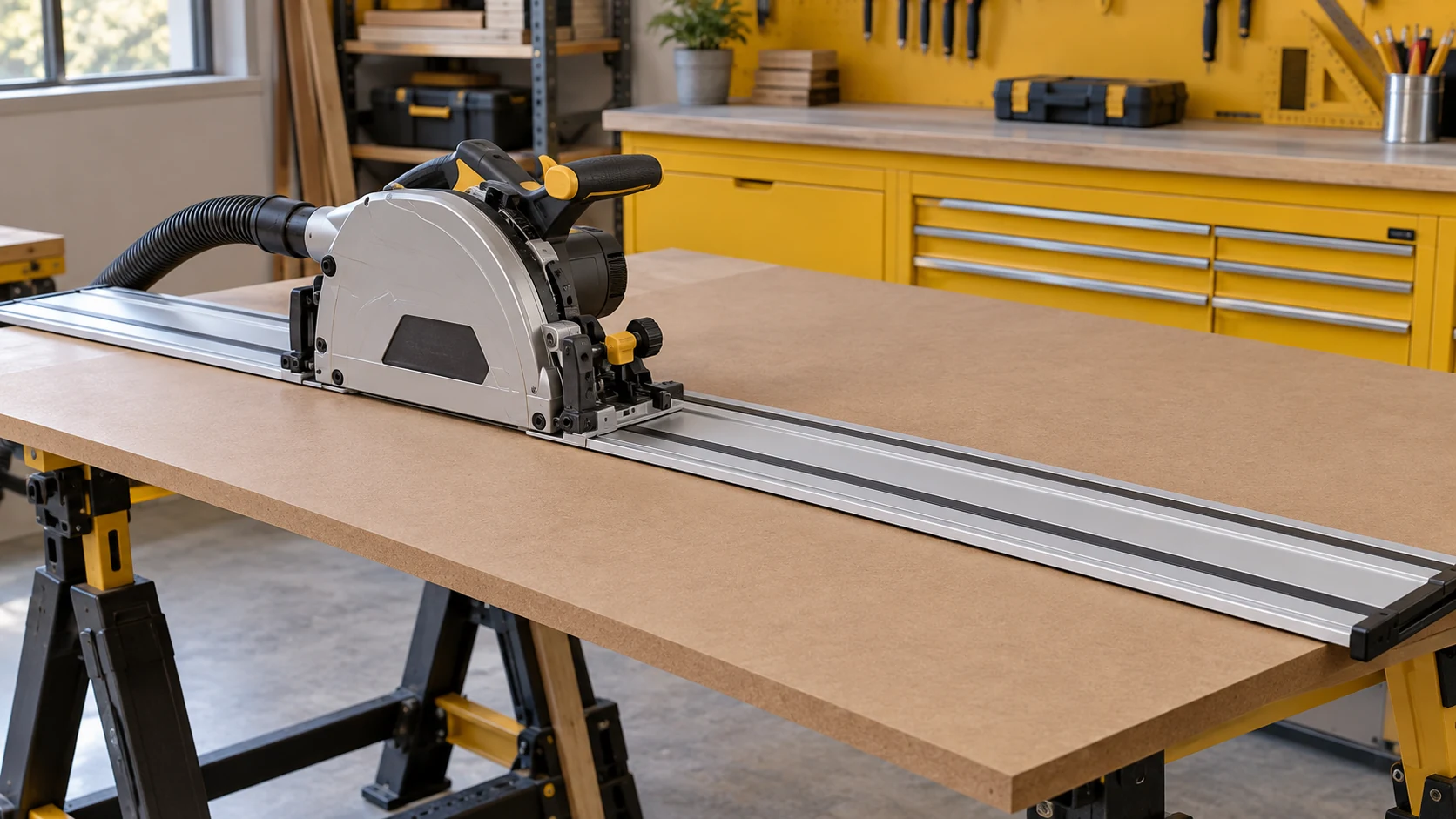
A panel saw with a panel-sizing blade for repeated rectangles, a guided saw with an MDF-rated carbide fine-cut blade for the occasional straight cut, and CNC routing for shaped parts you make again and again.
| Cutting task | Practical route | What can change the choice? |
|---|---|---|
| Repeated rectangular blanks | Electronic panel saw, or a properly equipped table or panel saw | Cut-list sequence, clamping, fence settings and scoring for a faced panel |
| Occasional straight sheet cuts | Track saw or circular saw with a secure straight guide | Sheet support, guide length and the required face quality |
| Curves or internal openings | Jigsaw with a compatible blade | Board thickness, curve radius and edge squareness |
| Repeated shaped components | Template routing or a qualified CNC process | Cutter suitability, fixturing and the approved profile |
Which blade example fits your saw?
For fine straight cuts in raw MDF on a portable or track saw, use a sharp carbide-tipped fine-cut blade with alternating bevel teeth. One MDF-rated blade is 160 mm in diameter with 48 teeth, a 2.2 mm kerf and a 20 mm bore. Fit it only to a saw built for that diameter, bore and kerf.
For coated fibreboard on a pressure-beam panel saw with scoring, choose an industrial panel-sizing blade for the actual core and facing. The batch section below gives one machine-specific configuration; do not fit it to a portable saw.
In production, match blade and feed to the panel build. A scoring unit protects the underside of a faced panel before the main blade finishes the cut; a CNC router needs a cutter and hold-down that suit the whole profile. Keep the part number and face direction in the program so the next station gets the right part.
How do you mark the cut and support the sheet?
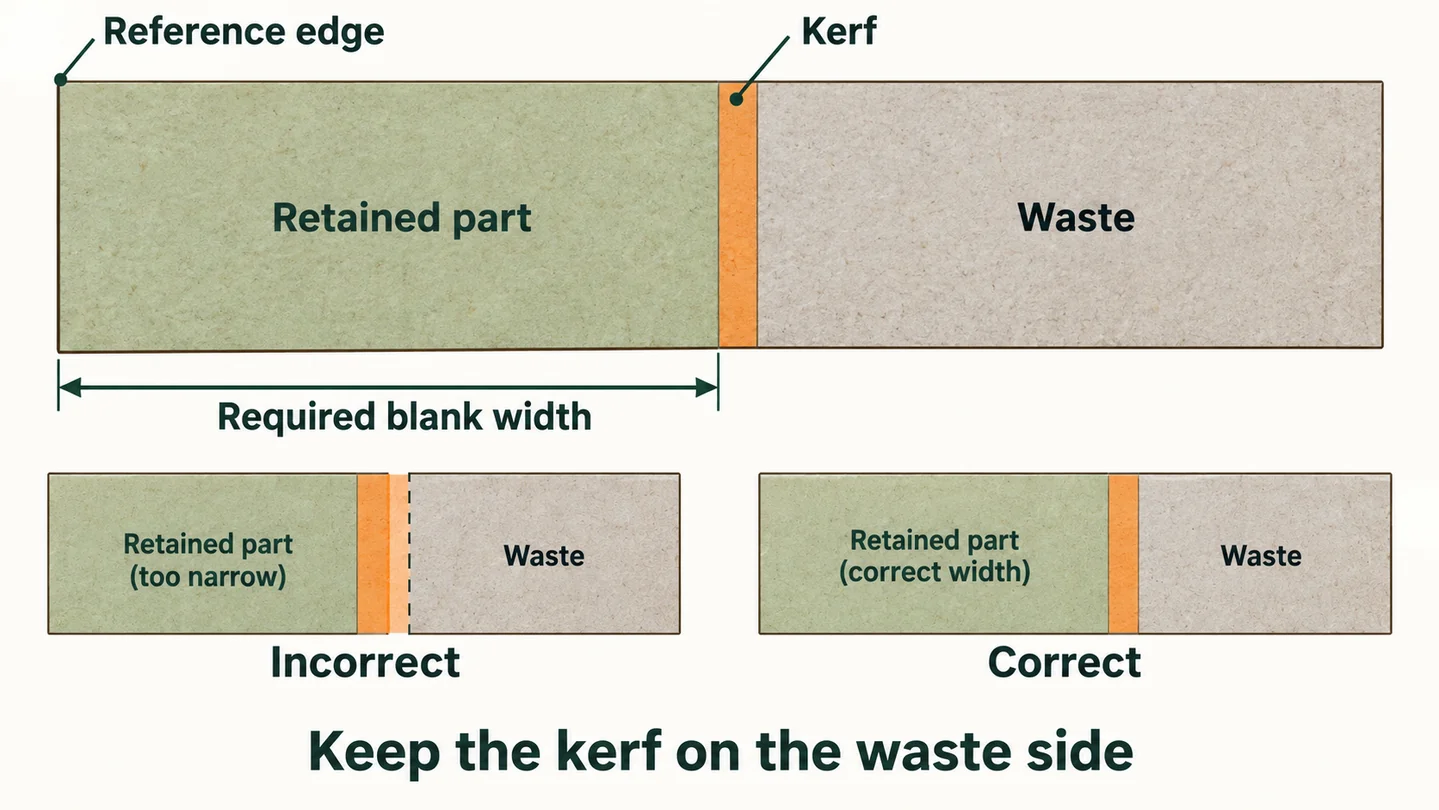
Mark from one reference edge and keep the kerf on the waste side; on a multi-part cut plan, put a kerf between every pair of parts. Support the sheet and the offcut for the whole cut.
Kerf is the strip the blade removes. Center it on the line meant to be your finished edge and part of the blank disappears. On a plan with several blanks, leave a kerf between neighbors instead of drawing touching rectangles.
Take a cut plan with two 600 mm-wide blanks and a 3.2 mm kerf: together they need 1,203.2 mm before any outer trim. Two touching 600 mm rectangles drawn on a 1,200 mm-wide strip leave too little for both. Enter the real blade kerf in the cutting software, and size the blank separately from any edging; our MDF edge banding guide explains that allowance.
For a portable-saw cut, support the part you keep and the offcut near the cut line and at the outer sheet edges, and clamp the guide where it won’t block the saw. The portable-saw instructions show support on both sides near the cut and at the sheet edges, which stops sagging and blade pinch. Keep the blade path clear under the panel.
What dust controls and safety checks do you need?
Extract dust at the blade, and assess formaldehyde exposure separately wherever the panel can release it. Cutting MDF makes fine wood and resin dust, and formaldehyde can be present as a gas or stuck to the particles (MDF health guidance). A panel-emission certificate doesn’t tell you what the operator breathes during cutting.
In US general-industry workplaces under federal OSHA, the wood-dust limits are 15 mg/m³ for total dust and 5 mg/m³ for the respirable fraction, both averaged over an 8-hour shift. The formaldehyde standard sets 0.75 ppm as an 8-hour time-weighted average and 2 ppm over 15 minutes, and its 0.5 ppm 8-hour action level triggers extra duties such as periodic monitoring. These are workplace air limits; check any state-plan rules as well.
Verify your controls with representative air measurements, or document the objective-data exemption the formaldehyde standard allows. The wood-dust guidance calls for extraction near the source and well-kept ducts and collectors. Check the port, hose and collector for blockages or damage, and route hoses and cables clear of the guide and the feed path. Choose eye, hearing and respiratory protection from the workplace assessment: a particulate filter handles dust, while formaldehyde gas needs protection chosen for that gas.
Portable powered circular saws with blades larger than 2 inches need guards above and below the shoe under section 1910.243(a)(1)(i), and the lower guard must snap back over the blade as soon as the saw leaves the work. Check the guards before cutting and retire cracked blades. Isolate power before changing blades, adjusting the setup or clearing a jam.
How do you make a straight cut in MDF?
On a portable saw, clamp the guide so the blade runs in the waste; on a panel saw, run the programmed dimensions and clamping sequence.
For a guided portable-saw cut:
- Mark the reference face, the blank boundary and the waste side.
- Set the guide for the actual blade-to-guide offset, then secure it.
- With the tool isolated, check support, blade clearance, depth and hose routing.
- Start and feed the saw as its instructions say, with the base supported.
- Finish the cut and let the blade stop before you touch the part or the setup.
- Measure the blank and check both faces before the next cut.
The portable-saw manual shows a supported base, a secured guide rail and a depth setting that limits how far the blade pokes below the sheet. Set depth with the tool isolated, keep the saw against the guide and feed steadily without forcing it.
A table saw feeds differently. The table-saw guidance covers guarding, stock support, fence alignment and push sticks for small stock. Never improvise a narrow rip with your hands near the blade; break an awkward full sheet down on a supported setup first.
Which tools suit curves and openings in MDF?
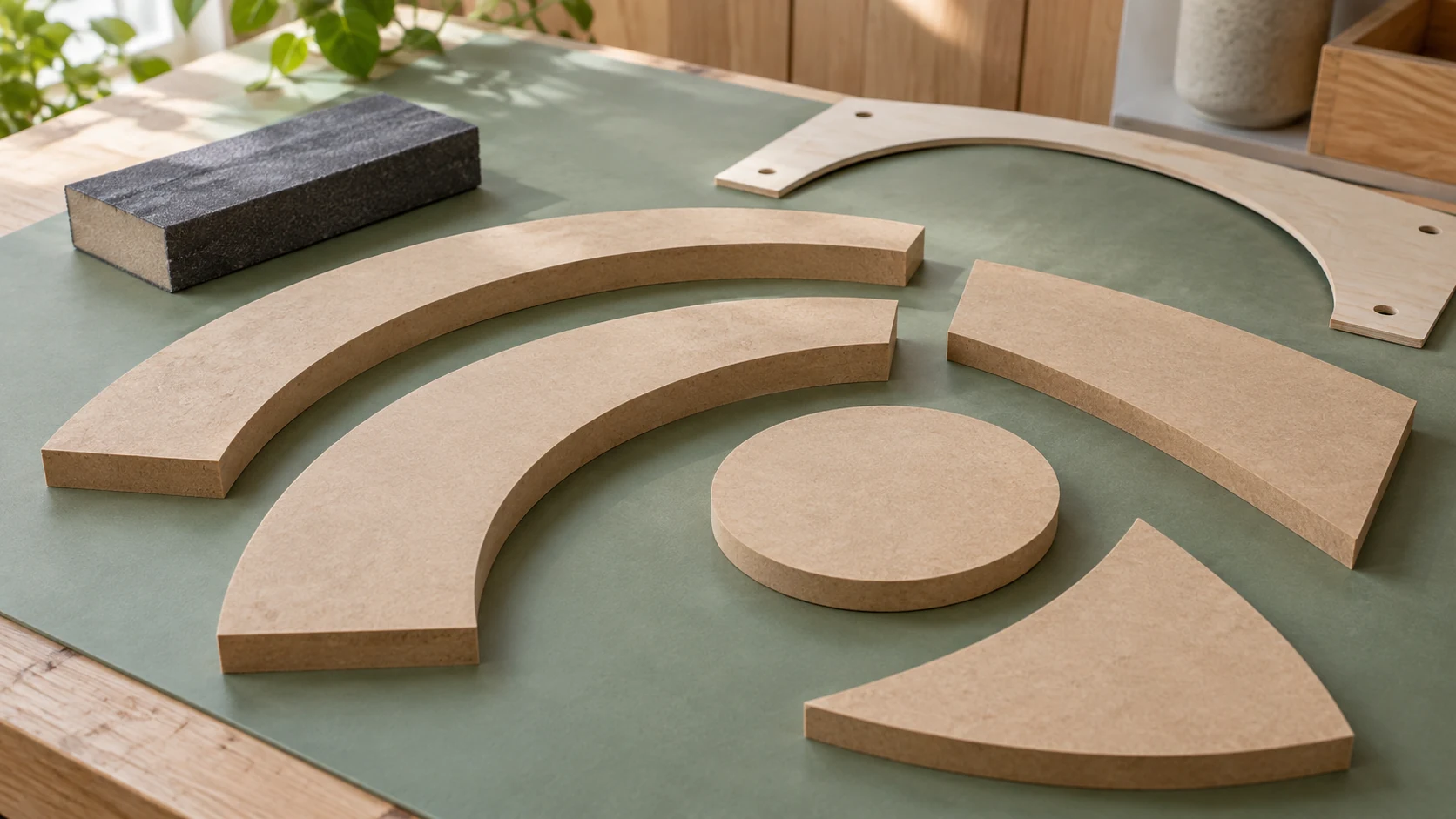
A jigsaw for the odd curve or opening; CNC routing or a secured template for repeated profiles. A narrow blade follows a tight curve more easily, while routing repeats the same contour every time.
Mark the opening so the waste side is obvious. For an internal cut, use a starting hole or plunge method the tool’s instructions allow, with room for the blade. Support the work without blocking the blade underneath.
The jigsaw instructions warn that forcing a curve can leave a slanted cut face or break the blade. Guide the saw at its own pace with the base seated. Check the underside as well as the top line, and put a square on the edge wherever the design needs one.
If the profile gets trimmed later, leave the agreed allowance; sanding or routing off extra material changes the size. For a repeated profile, put the tightest inside radius into the CNC path and check that the cutter diameter can make it. A router always leaves an internal radius, so a square inside corner needs a separate operation or a changed detail.
How do you prevent chips and correct rough cuts?
Sharp, facing-compatible tooling and support where the teeth exit stop chipping; a secured guide with the right offset stops a wandering cut. Treat raw-core fuzz, missing facing and a crushed corner as three different problems.
| What you see | Check first | Action before repeating |
|---|---|---|
| Fuzzy or rough raw edge | Tool condition and feed for the actual material | Sharpen or replace the tooling and inspect the next cut edge |
| Chipped decorative face | Facing, compatible tooling and anti-splinter arrangement | Correct face orientation and restore the splinter guard or scoring setup |
| Cut wanders from the line | Guide security and the measured guide offset | Correct the offset and measure the next blank from its datum |
| Curved edge slopes through the thickness | Blade choice and force through the turn | Reduce force through the turn or move repeated profiles to routing |
| Corner is crushed or blank is undersize | Stock condition, support and layout | Reject or rework only within the drawing’s permitted allowances |
Fix the guide, blade and support before reaching for tape on an occasional cut, and make sure the tape peels cleanly off the facing. Missing facing or an undersize edge means rework within the drawing allowance, or a new blank.
On a panel saw with scoring, line the scoring blade up with the main kerf for faced panels. On a portable saw with a documented scoring mode, use that mode’s forward cut. Keep improvised reverse-feed cuts out of the process, because they defeat the tool’s designed feed and guarding.
On a track saw, keep the good face up. A correctly fitted rail splinter strip supports the top cut edge even though the teeth cut upward (track-saw instructions); a worn strip or an unsupported offcut edge loses that protection.
What should you inspect before finishing cut edges?
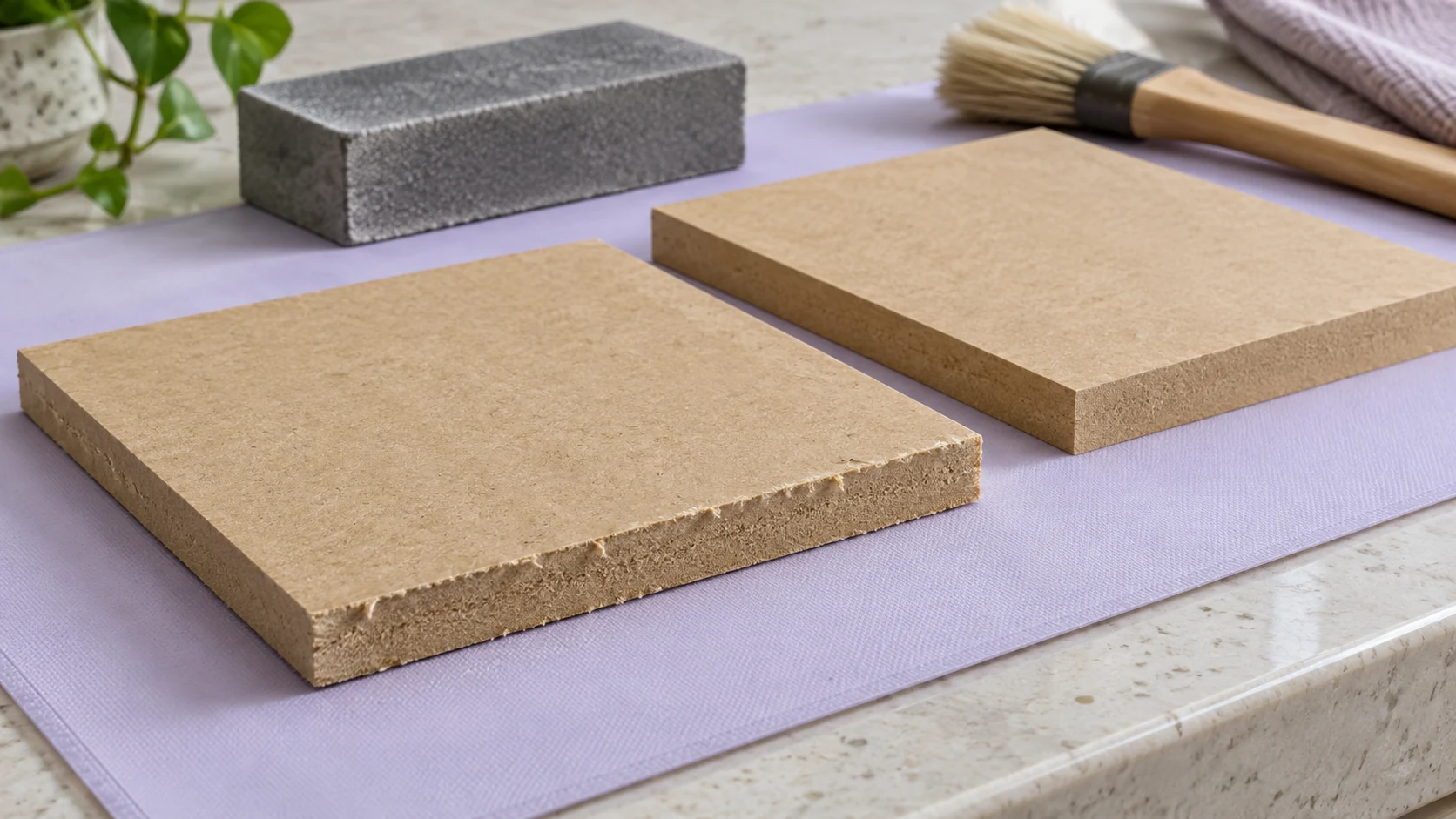
Check length, width and squareness against the drawing, plus the machining allowance on any blank that still gets trimmed or edged. Remove light fuzz without changing those sizes; missing facing needs a different repair decision.
Measure from the marked datum, at more than one point along a long edge. Compare diagonals or use the drawing’s squareness method, and record length, width and squareness separately. Set the limits from the next operation: an edge-banded door, a routed opening and a part waiting for final trim each need their own allowance.
Look at both faces and every corner under good light. A light fuzzy edge can be prepared for paint; missing facing or a broken corner may need a new blank. Our MDF finishing guide covers the next prep steps, so use the approved coating system instead of one sanding grit and sealer for every job.
If edging comes next, keep the edge straight and sized for the bond and trimming route. Check the planned edge banding detail before you take the blank down any further. Stack and move finished blanks so an accepted corner arrives undamaged.
Can cut MDF receive silicone decorative film?
Yes, when the board, film support, adhesive and edge are qualified together as one panel. The film changes the surface; the MDF core still gives the part its shape and strength.
Puremorfilm makes decorative film with a silicone functional surface for flat MDF panels, bonded with PUR adhesive on flat-lamination equipment. The silicone is chemically anchored to a PET support, so cut a test panel and check the edge before committing a batch. The silicone surface is inherently flame-retardant, with higher grades up to UL 94 V-0 available on request, and the film uses a No DOP formulation. It is a paint-free face, and a different surface from PVC, melamine, PP and PETG. Our MDF lamination guide explains why the bonding side and adhesive belong in the process decision.

When should a faced panel reach the saw?
Cut raw blanks before facing when the process laminates after sizing. If the panel is already faced, machine it only after the adhesive reaches its machining-release condition. Keep the bonding record with the batch, and check each cut for lifted facing or bond separation before it goes to edging.
We supply furniture decorative film in rolls and as laminated panels; pick the route that fits your lamination equipment and edge detail. Its leather-like texture and elasticity suit furniture and other decorative uses; floors, cooktop countertops, shower floors and other walked-on areas are outside its intended use.
Which cutting route should you use for your next batch?
Panel sawing for runs of rectangles, CNC routing for repeated profiles and nested shapes, and a guided saw when you only break down the odd sheet.
| Batch application | Main cutting question | Choice and condition |
|---|---|---|
| Repeated rectangular furniture blanks | Repeated dimensions and square edges | Panel sawing with a programmed cut list and controlled clamping |
| Repeated shapes or mixed nested components | Profiles, inside radii and tool clearance | CNC routing with cutter allowance and reliable hold-down |
| Decorative-faced components | Chips on either face and bond damage | Facing-compatible tooling and a scoring or supported cutting route after machining release |
What does a production panel-saw setup look like?
For coated fibreboard on a pressure-beam panel saw with a scoring unit, use a main blade made for panel sizing, with alternating flat and trapezoidal teeth. An industrial blade catalogue, section 1.4.2, lists a 380 mm, 72-tooth configuration with a 4.4 mm kerf and 60 mm bore for that job. Match diameter, bore, locating holes, body thickness, riving knife and rated speed to the machine, then pick teeth and edge geometry for the core and facing. Tooth count on its own tells you little.
ISO 19085-2:2021 covers horizontal-beam panel circular sawing machines, including scoring units; it is a machine-safety standard, not a cut-size tolerance or a guarantee against chipping.
Sign off the cut before coating, lamination and final approval, and pass on the accepted blank sizes and any remaining allowance. For the wider cabinet build, our kitchen cabinet materials guide puts the core and surface in one spec. For a silicone-faced project, contact us with the core, cut geometry, face and back build, bonding equipment and planned edge detail. Include a real cut edge in the sample you approve.
Frequently Asked Questions
What is the best tool to cut MDF?
For straight cuts, a table saw or track saw with a fine-tooth carbide blade gives the cleanest edge; for curves and cutouts, use a jigsaw or router. Workshops cutting many parts use panel saws for straight blanks and CNC routers for shapes.
Which face of MDF should point up for each cutting tool?
Good face up on a table saw or a track saw with a fitted splinter strip; good face down with an ordinary upward-cutting circular-saw or jigsaw blade, because the cleanest edge is where the teeth enter.
A reverse-tooth downcut jigsaw blade also means good face up, and a blade with opposing tooth directions protects both faces.
How should you allow for kerf in a production cut list?
Enter the actual blade kerf between neighboring parts, with outer trim and later machining as separate allowances. A saw cut list needs the blade kerf; a CNC nesting program needs the cutter diameter and its toolpath offset. Changing only the finished part size can leave an undersize blank.
How do you stop MDF from chipping when you cut it?
Use a sharp, fine-tooth carbide blade, support the board fully and cut with the good face on the blade’s entry side. On faced MDF, a scoring blade or painter’s tape along the cut line protects the decorative layer.
Is MDF dust dangerous?
Yes, it can be. MDF dust is very fine and the resin can release formaldehyde, so cut with dust extraction and wear a fitted respirator. OSHA’s permissible limit for formaldehyde is 0.75 ppm as an 8-hour average.