
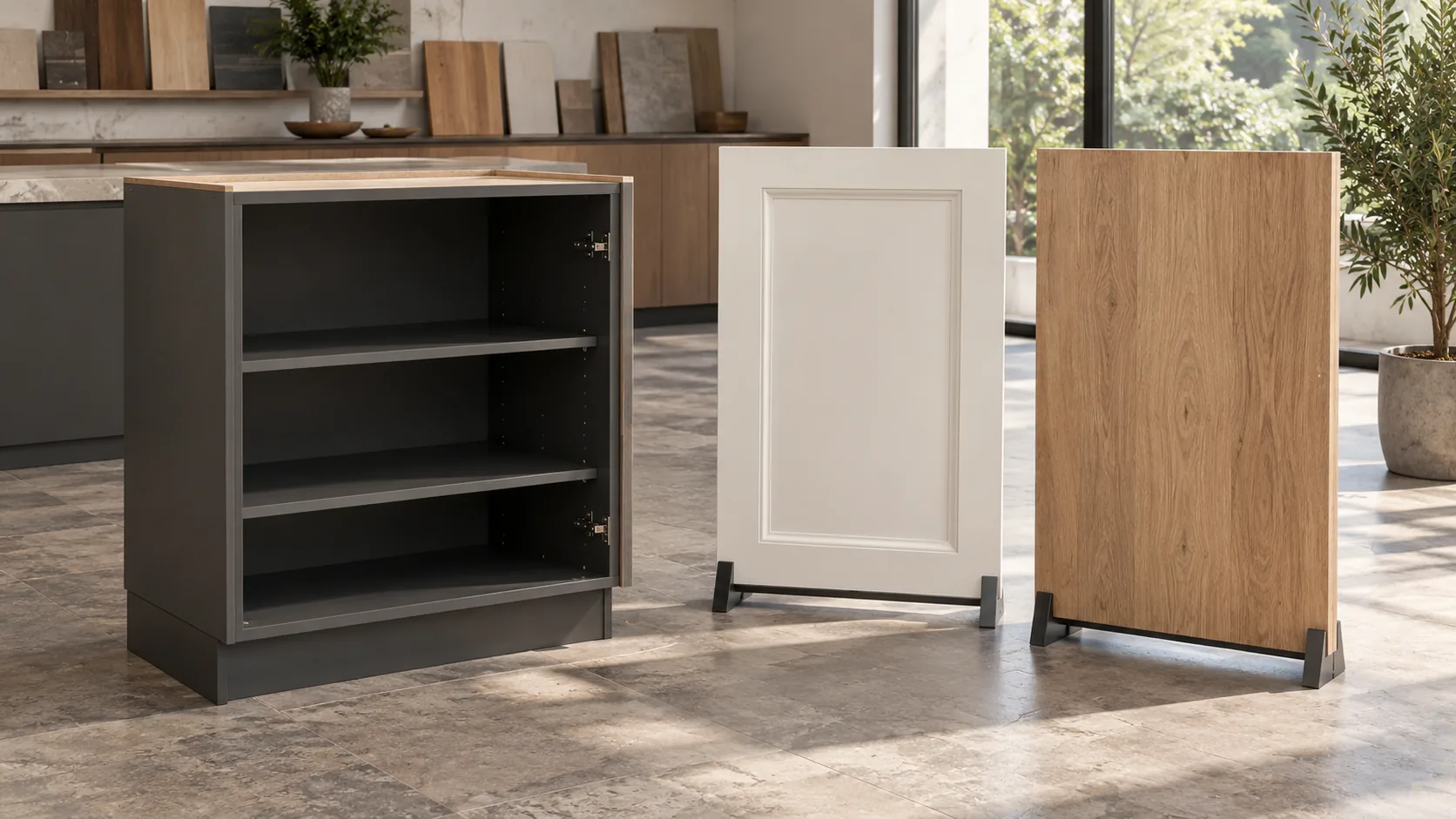
Most kitchen cabinet materials fall into three groups: plywood or particleboard for the boxes, MDF or solid wood for the doors, and a finish such as paint, wood veneer, thermofoil or laminate (HPL or melamine-faced TFL). Plywood is a common choice for cabinet boxes, particleboard for economical dry-interior construction, and MDF for smooth painted doors. The specified grade, joints and exposure still decide suitability. Choose each part for its job, then compare quotes for the same construction.
Which kitchen cabinet materials belong in the box, shelf and door?
Plywood or furniture-grade particleboard for the box and shelves, MDF for a smooth or routed front, and solid wood for frames and rails where you want natural grain. Paint, veneer, laminate or formed film then gives the visible finish, and one cabinet often mixes several of these.
| Item | Plywood construction | MDF construction | Particleboard construction | Solid-wood components |
|---|---|---|---|---|
| Structure | Bonded wood veneers with alternating grain directions | Bonded fine wood fibers | Bonded wood particles | Wood with its natural grain |
| Useful role | Specified cabinet sides, shelves or backs | Smooth fronts, routed profiles and suitable furniture panels | Specified furniture boxes and shelves, often supplied faced | Frames, rails and other parts selected for natural wood |
| Visible finish | Decorative veneer, paint or another suitable facing | Paint, veneer, film, HPL or TFL as specified | Commonly TFL or another suitable facing | Stain, clear coating or paint as intended |
| Selection record | Panel grade, thickness, face/back, direction and joints | Grade, thickness, machined edges and finish system | Furniture grade, joints, edges and finish system | Species, grain orientation, joint and finish design |
| Complete-part check | Shelf support, connections and moisture exposure | Profile, fixing positions and exposed cuts | Fasteners, supported span and treated edges | Movement allowance and finished geometry |
Read every quote as two lists: the face and the core. HPL, TFL, thermofoil and veneer are faces; plywood, MDF and particleboard are cores. A veneered MDF door has a real-wood face and a fiberboard inside.
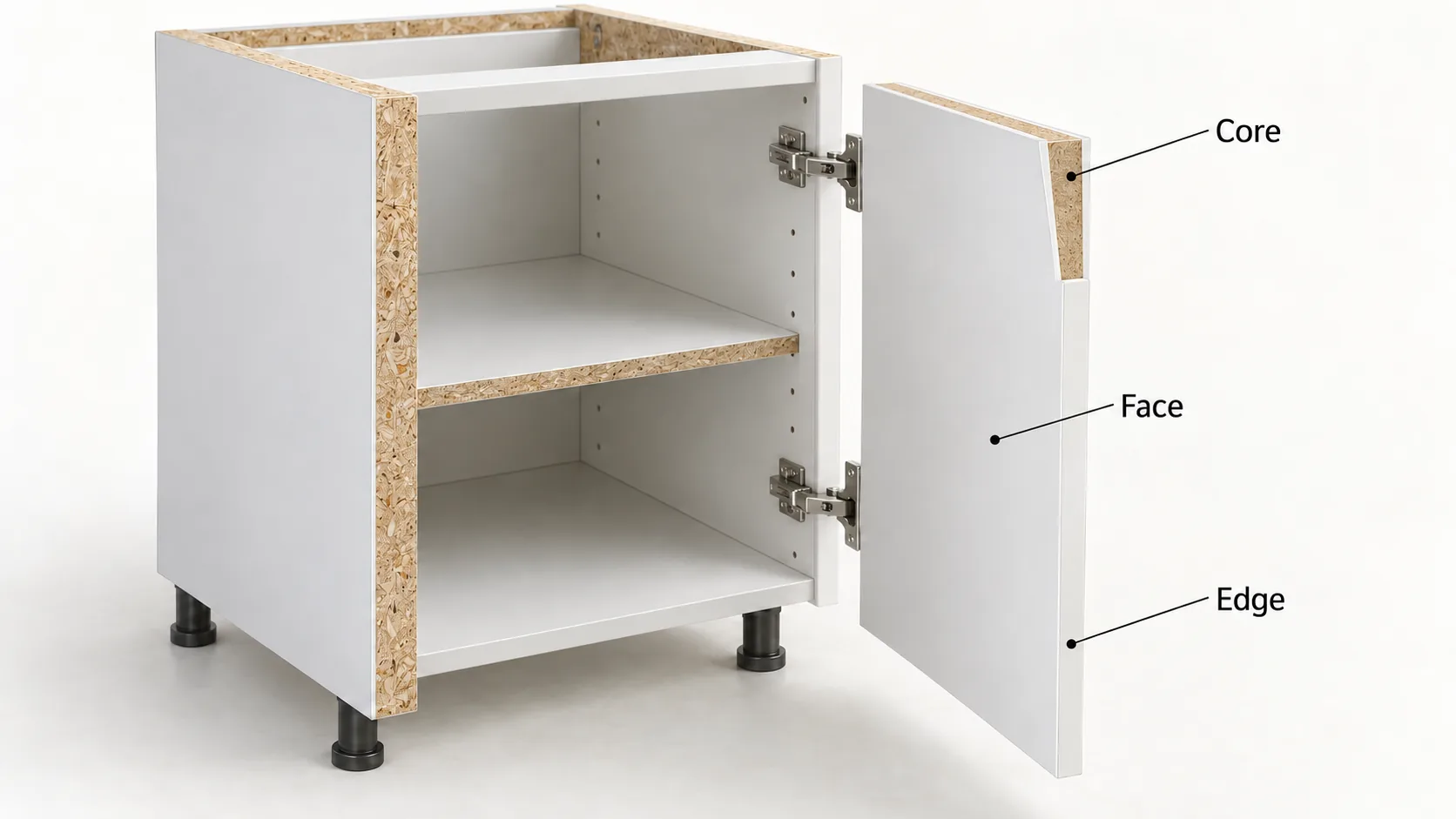
Each part does a different job. A pantry shelf carries tins and jars through its supports into the cabinet sides. A door swings on its hinges all day and carries the look. The same finish can cover both.
The MDF material guide explains the fiberboard core. Our laminated MDF guide shows how that core and a separate decorative face become one finished panel.
Which faces suit paint, real grain and shaped fronts?
Paint for a chosen color on a profiled door, veneer for real grain, a thermoformable film for a routed wrapped front, and HPL or TFL for flat slabs. Pick the look first, then the way it is made, because each route brings its own finishing and edge work.
| Facing route | What provides the appearance? | Useful design choice | Work still present in the component |
|---|---|---|---|
| Paint | A coating system over a prepared surface | A specified painted color and profile | Preparation, coating, drying and exposed-edge treatment |
| Wood veneer | A thin real-wood face on a core | Natural species, grain and leaf layout | Matching, bonding and the intended finish |
| HPL | A separately manufactured resin-paper sheet | A specified decor, texture and suitable grade | Sheet bonding, trimming, back and edges |
| TFL, often called melamine | Resin-treated decorative paper fused to a panel | Suitable flat parts supplied with their face | Cutting, drilling and edge completion |
| Cabinet thermofoil | Thermoplastic film formed over a prepared front | A wrapped routed design using a qualified forming system | Profile preparation, bonding, back and exposed areas |
HPL is made as a facing sheet and then bonded to a substrate (HPL description). TFL is decorative paper fused straight onto the panel (TFL description). Our melamine versus laminate comparison goes further into that split.
3DL films are thermoplastic materials formed with vacuum or membrane equipment. Traditional cabinet thermofoil usually means PVC film over a prepared core. Film and HPL need different fabrication even when both show the same wood grain.
For a run of wood-faced fronts, give the species, veneer cut and layout. Natural variation can be part of the design, but a random pile of similar oak leaves won’t produce a planned grain sequence across a wall of doors. The wood veneer and laminate comparison covers the look and repair side of those two faces.
The cabinet core and its visible finish are separate choices. Paint, stain and clear coatings give different ways to show or cover the wood underneath. Compare kitchen cabinet finishes when you are choosing the visible surface. An acrylic face is another route: a sheet is bonded to a board and the edges are finished separately. Our acrylic kitchen cabinets pros and cons guide covers appearance, cleaning, scratches and repair choices before you settle on that face.
Should you choose matte or gloss kitchen cabinets?
Matte if you want soft, blurred reflections; gloss if you want crisp highlights. Decide with real door samples under your own kitchen lights, because the sheen name says nothing about the coating, core or edges behind it.
A painted matte door and a matte laminated door can look alike and need different care. Keep the material next to the finish name when you compare quotes. Stand samples upright beside the worktop and backsplash, and look at them in daylight and with the evening lights on. Check the window reflection from the doorway and from where you cook or sit.
Handle each sample, look for marks, and try its care routine. Mark visibility, cleaning effort and repair are three separate questions. Write down the finish, door construction and care instructions with the quote before you order.
Read our matte vs gloss kitchen cabinets guide for the full comparison of looks, sample checks and upkeep.
How do plywood, MDF and particleboard differ in use?
Plywood is crossed veneer layers, MDF is fine fiber that machines cleanly, and particleboard is bonded particles made in grades for different jobs. Compare them as the actual part you need, joints and supports included.
MDF has a smooth surface with no knots or grain and an even structure suited to detailed machining (MDF guidance). A deep hinge recess, an exposed cut or an edge screw still has to be designed into the door.
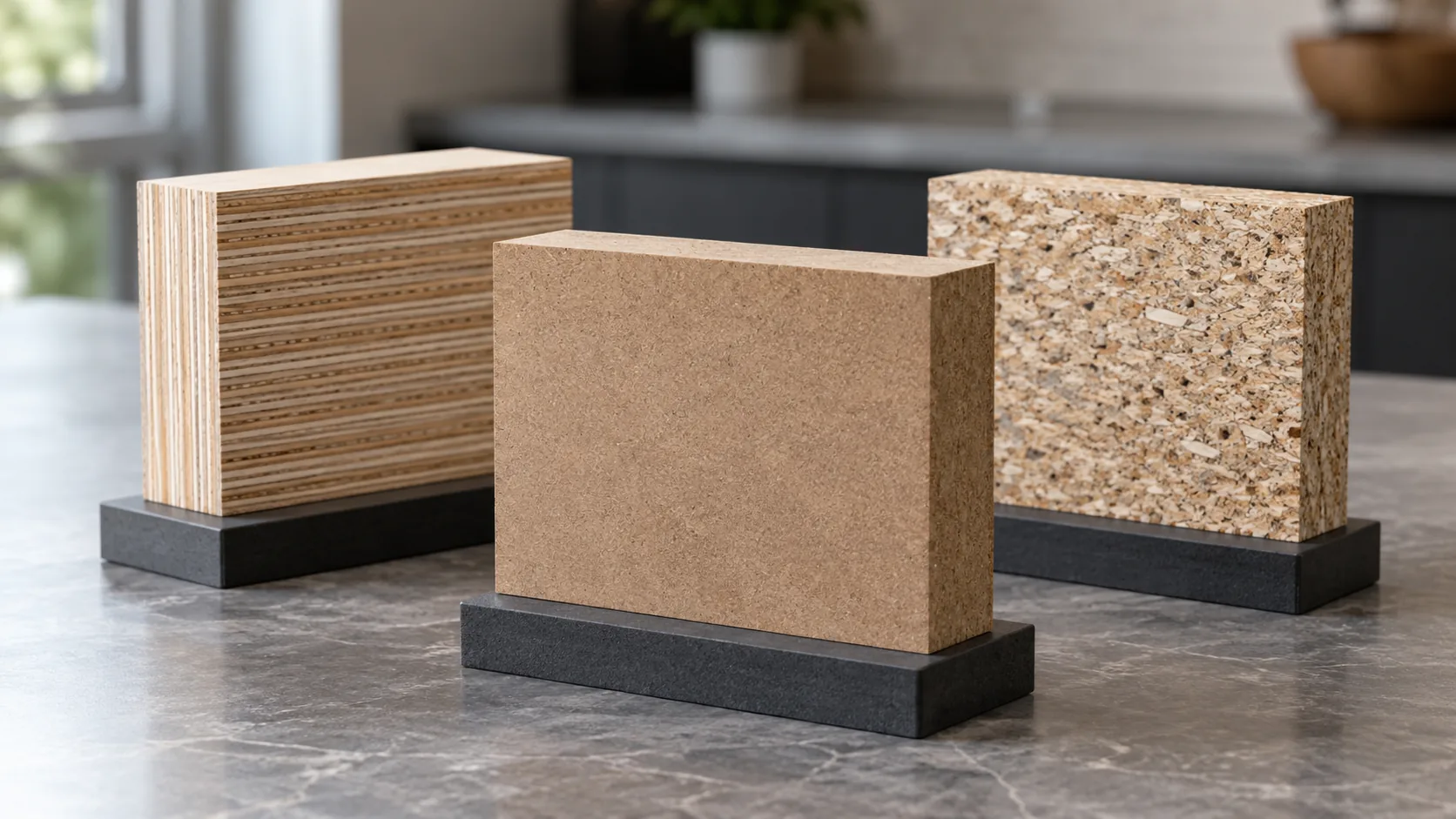
APA’s plywood guidance describes cross-laminated veneers whose mechanical properties vary with thickness, grade and direction. Its span ratings are for roofs and floors. For a pantry shelf loaded with cans, look at the shelf construction and how its supports carry the load into the cabinet sides.
The Composite Panel Association lists cabinets and shelving among the uses for particleboard. Particle size, binder, density and process produce panels for different end uses. A qualified furniture panel with the right joints and edges is a proven cabinet route.
Our MDF and plywood comparison goes deeper into the core choice. The MDF and HDF guide explains density classes. On the order, record the grade and the evidence behind any moisture or screw-holding claim.
The word laminate describes a face, while wood may describe a core, a frame or a visible surface. Compare the specified door construction and repair options in laminate cabinets vs wood cabinets before treating the labels as complete cabinet specifications.
What changes around sinks, steam and exposed cuts?
Pick a panel grade for the moisture it will see, and protect edges, holes and joints. Fix repeated leaks or trapped steam first; a new face won’t solve them. A laminate face can shed a spill while water soaks into a bare cut right beside it.
At a sink base, look at the bottom, the pipe holes, the rear opening and the joints where a leak would land. Next to a dishwasher or oven, trace the heat and steam path and check the appliance clearances. The location exposes far more than the door face.
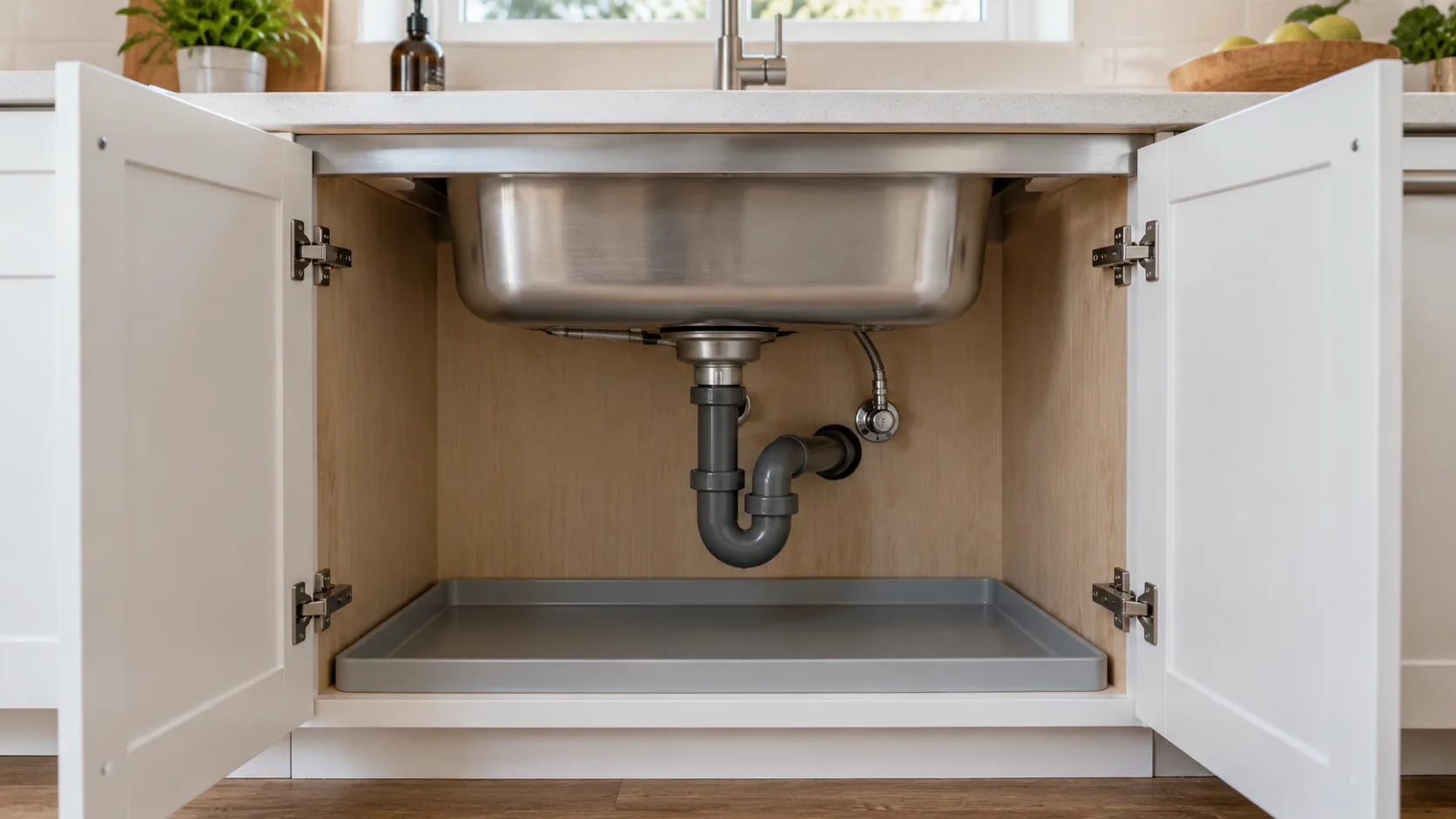
APA separates two plywood bond categories, Exposure 1 and Exterior. Exposure 1 covers limited moisture during construction; Exterior covers the bond for longer weather exposure. In the bond-classification explanation, bond durability is separate from strength and decay resistance, so an Exterior stamp does not make a whole sink cabinet leak-proof.
The same goes for moisture-resistant MDF or particleboard. Find out the grade, then check where machining has opened it up and how each joint keeps water out. Our MDF moisture guide covers grade choice and direct wetting.
For structural PVC/uPVC panels or a metal cabinet, compare that system’s own joint, hinge, heat and corrosion evidence. A PVC decorative-film data sheet describes a face, not the strength of a PVC box.
How should you compare cabinet costs and repair scope?
Compare complete cabinets, or finished parts, on the same drawing and the same included work. A faced sheet, a drilled door and an installed cabinet are three different purchases, and the cheapest sheet price can leave bonding, edging, finishing or installation off the quote.
For the box, count panel yield, back, machining, joints and assembly. A painted or veneered front also needs preparation and finishing. With a faced front, include the face, back, bond, trimmed edges and hardware prep. Note which work arrives done and which your shop still has to do.
Divide the batch price by the accepted quantity delivered, then add rejects, packaging, fitting and transport where they belong. A price gap then traces back to a specific step or material, instead of the old idea that particleboard is always cheap and plywood always dear.
In an existing kitchen, check the boxes before paying for new doors. Square, sound boxes with good fixings can take new fronts. A swollen side, a torn hinge seat or an out-of-square opening is a structural repair first, because a new face doesn’t change the geometry the door has to fit.
Sort damage into coating, face and core. A coating repair can save a sound face; a torn face or a swollen core widens the job. Keep spare-door availability, hardware fit and installation in the quote, and don’t read a warranty term as a promised lifespan.
The condition of the cabinet boxes sets the scope of a renovation. Cabinet refacing vs replacement explains what stays and what changes in each route. If the laminate remains firmly bonded and the board is sound, how to paint laminate cabinets covers preparation and coating steps. For the choice between a new film face and a painted finish, use cabinet wrapping vs painting.
Should you choose thermofoil or laminate for a cabinet door?
Thermofoil for a wrapped, routed door; HPL or TFL for a flat slab. Traditional thermofoil is usually PVC film over MDF. HPL is a sheet bonded to a core, and TFL is resin-treated paper fused directly to a panel, so two doors in the same color can be built quite differently.
Start with the door drawing. A recessed profile, a flat slab and an exposed return edge each lead to different fabrication. Then bring in the back, joints, hardware and appliance position. A door next to the oven sees heat that a pantry door never does, and the material label alone won’t tell you how it copes.
In an existing kitchen, look at the core and at how a damaged face could be renewed. For new work, compare finished fronts of the same size and scope. The detailed guide walks through construction, care and repair for each.
Read the thermofoil vs laminate guide for the detailed choices.
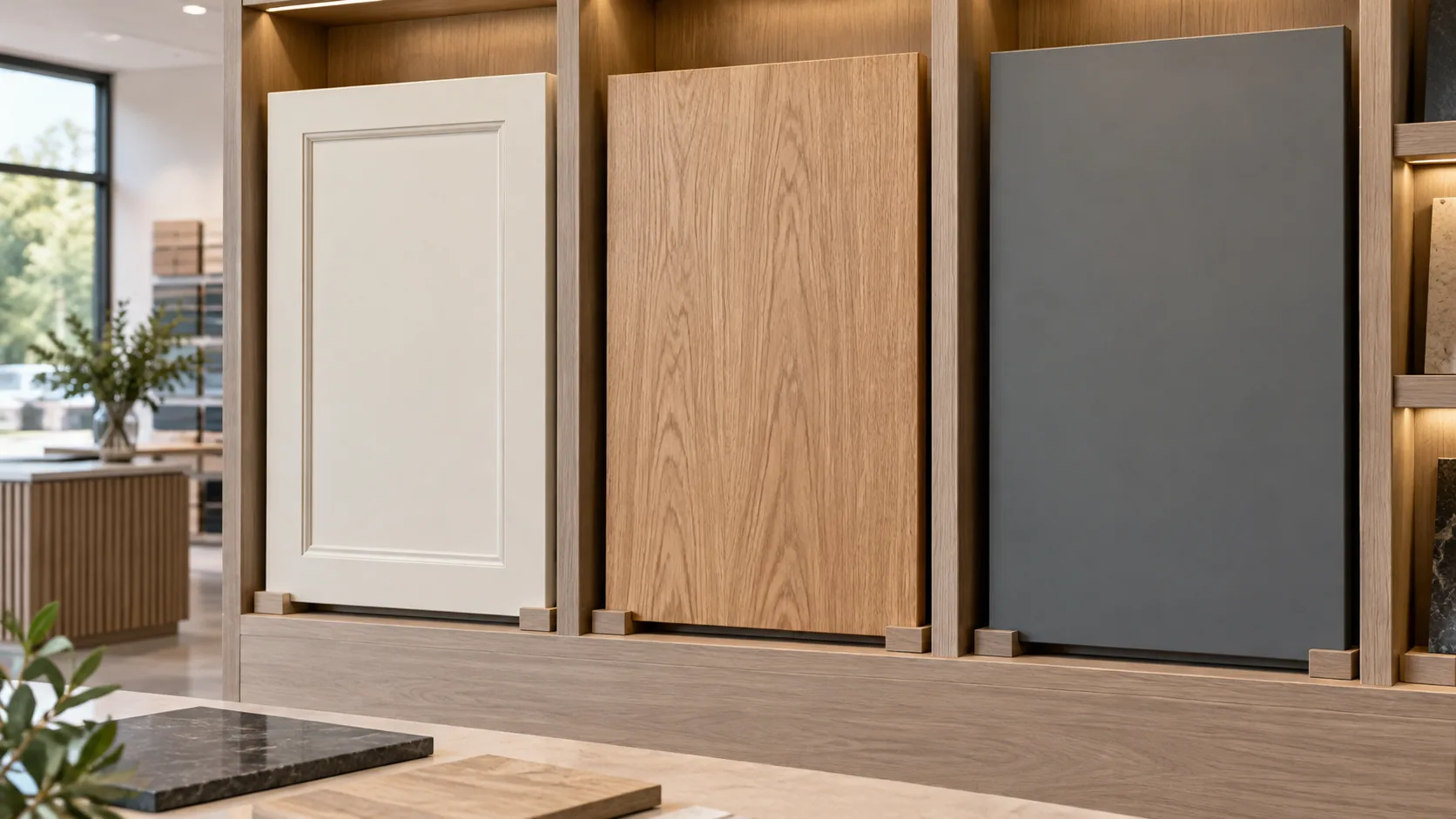
How should you clean painted and sealed-wood cabinets?
With a gentle routine the cabinet maker allows, on intact, fully cured paint or sealed wood, then wipe off the residue and dry the face and joints straight away. Know which finish you have and its condition before you clean the whole kitchen.
A door can have a wood-based core under paint, veneer or another face, so the core name tells you nothing about which cleaner is safe. Keep water away from bare wood, exposed cores and lifting edges. Freshly painted fronts also need their full cure time before normal cleaning.
Try the cleaner on a hidden patch of the same finish, let it dry, and look at color and sheen before you carry on. If a raised edge, loose film or dulled patch remains, assess the damage instead of scrubbing harder.
Read our how to clean kitchen cabinets guide for prep, grease and residue checks, and when to stop cleaning.
How should you clean a laminate cabinet without damaging it?
Start with a soft, lightly damp cloth and a mild soap the cabinet maker allows, then remove the residue and dry the surface and joints. HPL, melamine-faced board, acrylic and decorative film look alike but carry different care instructions, so identify the face before trying anything stronger.
Keep grit out of the cloth and wipe gently. Pay attention to handles, lower edges and seams, where grease and moisture collect. A stain trick from one maker’s guide applies to its own finish, not to everything sold as laminate. Abrasive pads or a homemade chemical mix can turn a cosmetic mark into real damage.
If a mark survives the mild routine, find out what the deposit is before escalating. Haze that won’t shift, bubbles or a thickened edge point to a surface or core problem that cleaning won’t fix.
Read the how to clean laminate cabinets guide for the detailed choices.
When should peeling thermofoil be repaired or replaced?
Repair locally when the loose film is intact and sits over a firm, dry core. Replace the front when the film is torn or the core has swollen. First confirm what is lifting: a flexible skin, a paint coat and real wood veneer each need a different fix.
Check how far the lifting runs, the state of the core, and any heat, steam or water nearby. Peeling beside a self-cleaning oven or above a kettle spot tells you the cause will come back. A cosmetic repair keeps the existing shape and hinge positions. Painting needs a sound, prepared base and a coating made for that surface.
New fronts can save usable boxes, but they must fit the opening and the hinges. Record door sizes, hinge-hole positions and the finish you want before ordering.
Read the thermofoil cabinets peeling guide for the detailed choices.
What must a production specification and US evidence cover?
Each part’s core, face, back, edges, joints and service conditions, plus test evidence for the finished cabinet and US panel-emissions compliance. Raw-panel data and finished-cabinet results answer different questions, and both must name the construction supplied.
| Item | What to specify | Why it matters |
|---|---|---|
| Box, shelf and back | Panel identity, grade, thickness, supports and joint details | Defines the structural construction |
| Door | Profile, dimensions, hardware pattern and fixing details | Connects the material to the finished geometry |
| Decorative face | Coating system, veneer layout or facing grade/decor/texture | Defines the visible finish |
| Back and edges | Balancing construction, cut-edge and hole treatment | Covers areas outside the front face |
| Use environment | Wet zones, appliance exposure, load and care conditions | Identifies what the component must accommodate |
| Verification | Test edition, method, sample construction and reported outcome | Allows an applicable performance comparison |
| Traceability | Supplier, lot and applicable compliance records | Connects evidence to the delivered material |
KCMA A161.1-2022 covers factory-assembled kitchen and vanity cabinets. Section 6.2 cycles doors and hinges 25,000 cycles at 20 ±2 cycles/min, requires them to keep working, and allows sag of no more than 1.6 mm. Ask your supplier for that report on the cabinet itself.
For covered composite wood, 40 CFR 770.10 sets formaldehyde emission limits of 0.05 ppm for hardwood plywood, 0.11 ppm for MDF, 0.13 ppm for thin MDF and 0.09 ppm for particleboard, based on ASTM E1333-14. Under the regulatory definition, thin MDF is 8 mm or less. These are panel limits under a set test method, not a room-air target or a result for an untested cabinet.
EPA’s consumer guidance explains TSCA Title VI labeling for covered panels and finished goods. Keep the producer or fabricator name, lot or date and compliance records through procurement. A generic low-emission claim is no substitute for those documents.
Where does organosilicon decorative film fit in a cabinet?
As film-faced panels when you want the flat furniture face already bonded, or as rolls when your own line does the facing. Both supply forms exist for furniture work.
Puremorfilm supplies decorative film with a silicone functional surface for flat cabinet fronts and panels. The film is formaldehyde-free and uses a No DOP formulation; the board underneath still needs its own emissions documentation. Rolls come in effective widths of 1,240, 1,260 or 1,400 mm and are bonded to board by flat lamination with PUR adhesive. The silicone surface is inherently flame-retardant, with higher grades up to UL 94 V-0 available on request, and in the manufacturer’s laboratory tests, coffee and red wine left for 24 hours at 25°C wiped off with no obvious change.

Our furniture decorative-film page describes the supply route. It is for cabinet fronts and furniture panels, not floors, cooktop countertops, shower floors or other walked-on areas.
Which cabinet construction should you choose?
Painted fronts for a chosen color and profile, veneer for real grain, or HPL/TFL for a flat printed decor, once the assembled cabinet’s test results cover how you will use it. Keep the reports for that shelf, joint, hinge and finish system.
- For a pantry or storage wall with heavy shelves, check the cabinet load report and the real support layout.
- Replacement fronts need square, sound boxes with secure fixings.
- In production orders, tie the agreed construction and its evidence to the delivered lot.
For flat doors and panels, we offer a paint-free silicone face as an alternative to PVC, melamine, PP and PETG surfaces. To check whether it suits your cabinet line, contact us with the core, door sizes and finish you need.
Frequently Asked Questions
Are melamine and MDF the same material?
No. Melamine (TFL) is a decorative resin-paper face; MDF is a fiberboard core. TFL can sit on MDF or particleboard.
Is HDF automatically better than MDF for cabinet fronts?
No. HDF is denser, but density alone doesn’t buy moisture resistance, screw holding or easier machining. Painted and laminated doors are commonly MDF around 18–19 mm (3/4 in) thick; HDF goes mostly into thin backs and drawer bottoms.
Can melamine-faced particleboard make a durable cabinet?
Yes, with a furniture-grade board, the right joints and supports, sealed edges and a dry location.
What is the best material for kitchen cabinets?
For most kitchens, plywood boxes with MDF doors and a durable factory finish. Solid wood suits stained natural-grain doors; melamine-faced particleboard suits tight budgets in dry areas.
Are particleboard cabinets bad?
No, not in dry areas. Its weak points are water at cut edges and screw holding, so sealed edges and the right fittings matter more than with plywood.