
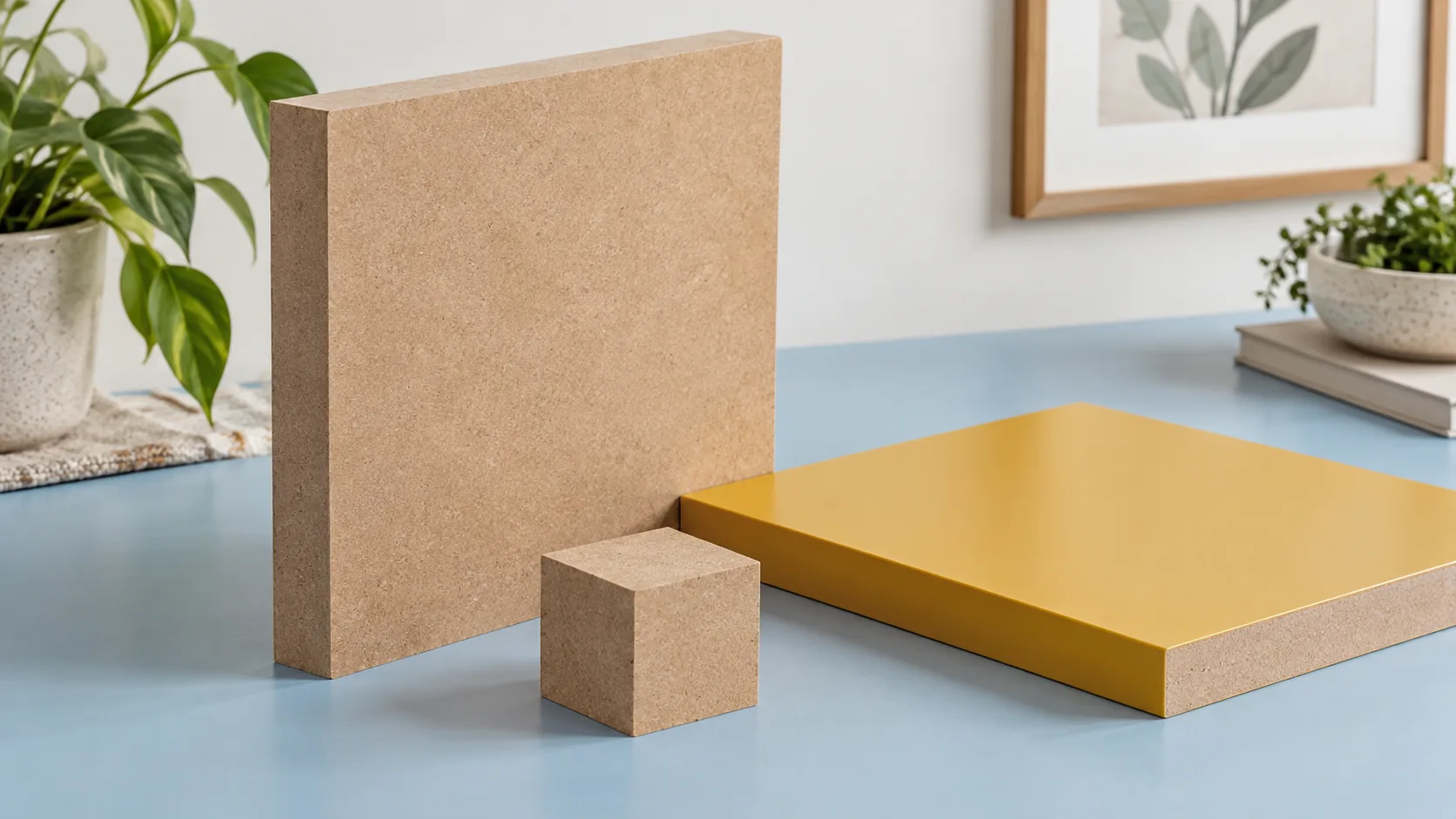
MDF (medium-density fiberboard) is an engineered wood panel made by breaking wood into fibers, mixing them with resin and pressing them into flat sheets, typically about 700–900 kg/m³. It is smooth and uniform, with no grain or knots, which makes it a favorite for painted cabinet doors, furniture panels and moldings. Its weak points are water at unsealed edges and weaker screw holding than plywood, so choose the right grade and seal exposed edges.
What is MDF made from, and how does it differ from wood?
Wood fibers bonded with resin or another binder and pressed into a panel. Solid timber keeps the natural structure of the tree; MDF is an engineered wood product with an even fiber structure and no knots or running grain.
| Material | Basic construction | What a cut edge reveals |
|---|---|---|
| MDF | Bonded wood fibers consolidated into a panel | Fine-fiber material rather than veneer layers |
| Particleboard | Bonded wood particles, often finer at the faces | Discrete particles, commonly coarser in the core |
| Plywood | Bonded veneers with grain directions generally crossed | A defined layered construction |
| Solid timber | A cut and worked piece of natural wood | Wood grain and the natural structure of the species |
The Composite Panel Association’s MDF definition describes cellulosic fibers, a binder, heat and pressure. That defines the category; there is no single recipe or resin percentage shared by every grade.
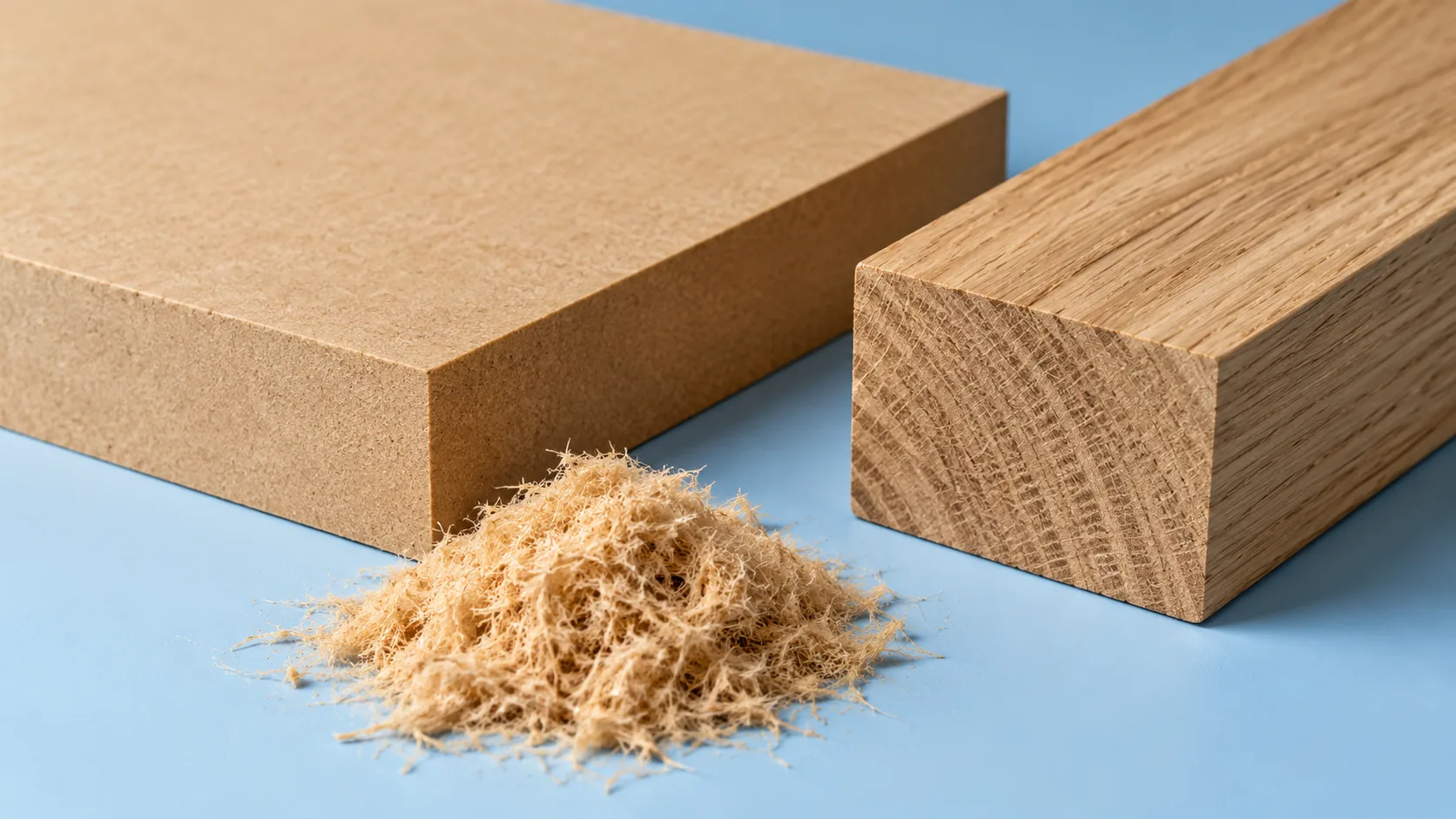
A printed wood pattern on an MDF face doesn’t make the panel solid wood, and real-wood veneer can sit on a fiberboard core. On any finished panel, name the core and the face separately, so the decor name isn’t mistaken for the structure.
The MDF and particleboard comparison explains fibers versus particles. For a layered alternative, the MDF and plywood guide links veneer construction to part selection.
If you would rather order the board already faced, our silicone-faced laminated MDF panels are available on request.
Where does MDF work well in furniture and interiors?
Painted fronts, routed profiles and flat faced furniture parts. When the room gets humid or the part goes outdoors, switch to a documented moisture or exterior grade.
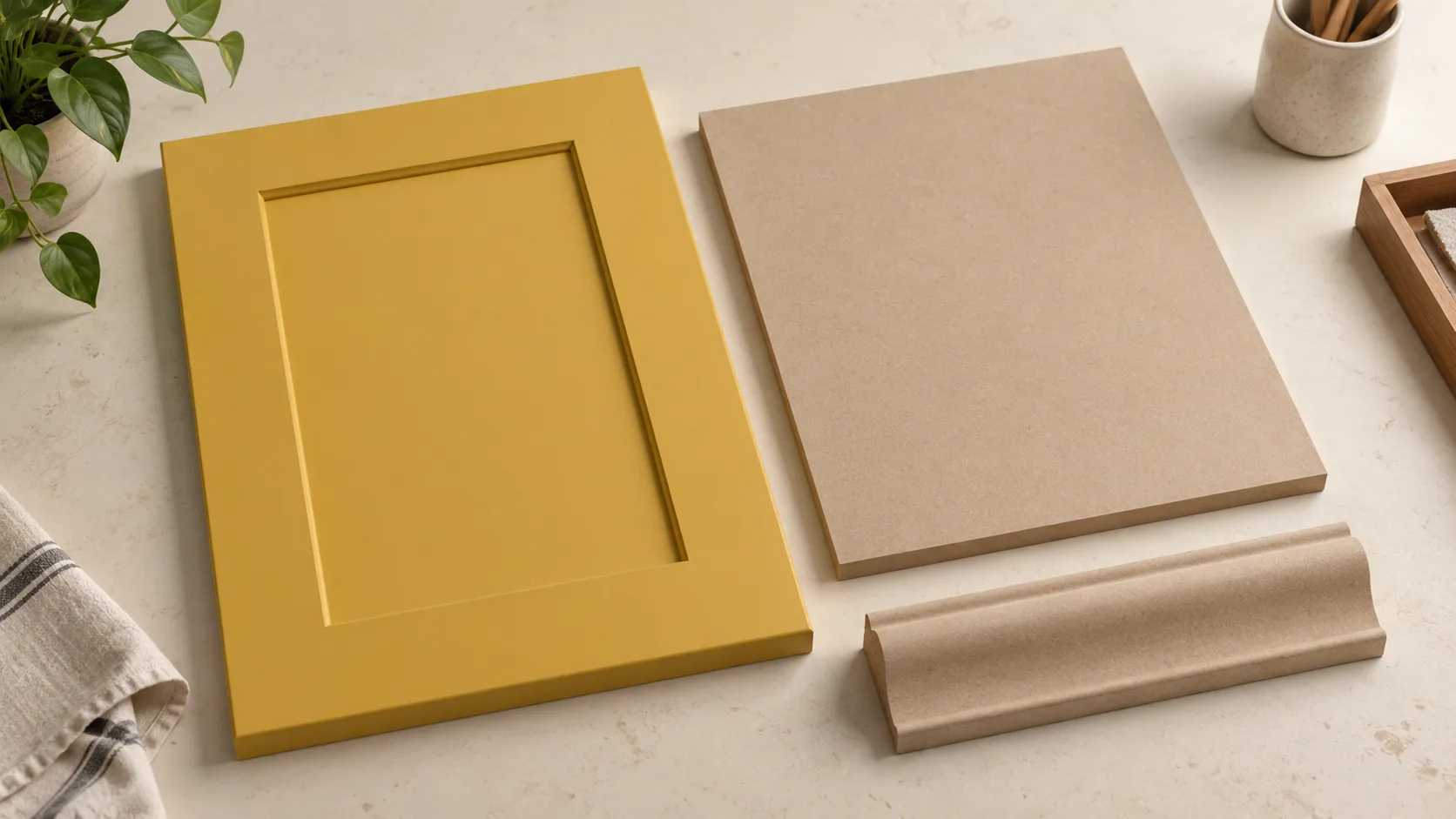
MDF is used widely for decorative surfacing and machined parts (MDF applications guidance). A painted shaker door, a machined crown molding and a flat wardrobe side ask different things of the board, so settle thickness and grade before you choose the finish.
For a painted part, prepare the cut edges as well as the faces. Edges soak up paint differently and show machining marks. Put the sealer or primer, the finish you expect and the recess details into the paint spec, because a smooth raw face doesn’t finish its own edges and holes.
Laminating a face adds thickness and changes the panel’s balance. Veneer, printed paper and paint each look different. A thin bookcase back and a loaded shelf can be the same color and still do different jobs.
Our MDF finishing guide covers painting, and the laminated MDF guide covers panels supplied with a face. Either way, the board grade still has to suit the room.
How do you assess MDF strength and screw connections?
From the declared properties of the grade you are buying, then through the part’s thickness, supports and fixings. MDF works for furniture, but a board test value is not a shelf load or a hinge rating.
One dry-interior board datasheet, version 13, gives these values for its over 12 mm through 19 mm thickness band, which includes 18 mm. They describe one manufacturer’s board.
| Property in that thickness band | Datasheet value and method | How to use the information |
|---|---|---|
| Bending strength | At least 18 N/mm², EN 310 | Compare the specified board’s bending test requirement |
| Bending modulus | At least 1,600 N/mm², EN 310 | Assess stiffness as an input to component design |
| Face screw holding | 1,000 N, EN 320 | Review the stated face-direction test |
| Edge screw holding | 600 N, EN 320 | Review the different edge-direction test |
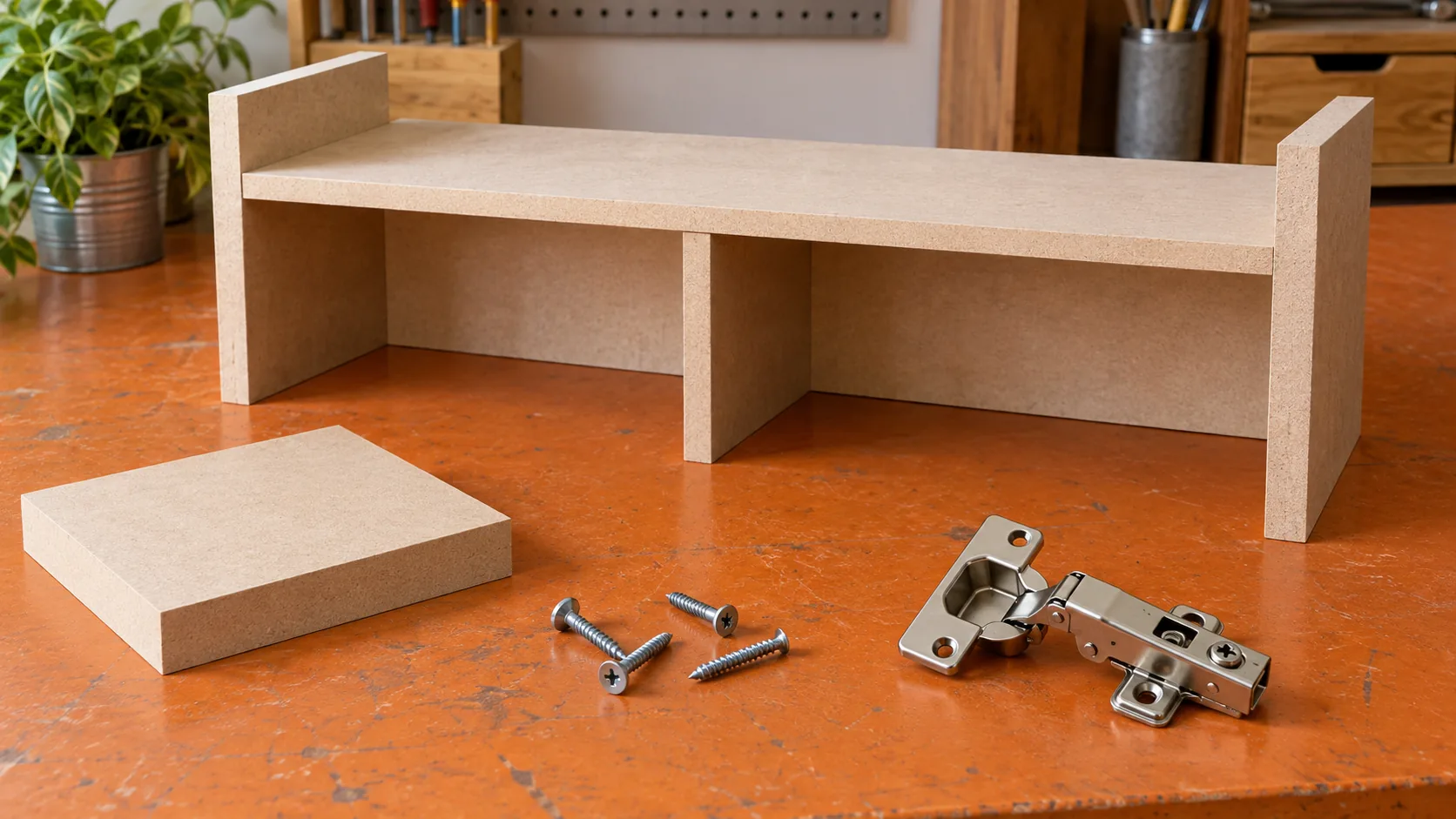
Bending strength is when the board breaks in the test; modulus is how stiff it is. Shelf sag also depends on span, thickness, supports and how long the load stays there. Shortening a bookshelf span or adding a center support can change the answer without changing the board.
For a shelf where stiffness matters most, start with plywood with a specified strength direction. The 2021 USDA research comparison, table 12–1, lists elastic modulus of 3.59 GPa for MDF against 6.96–8.55 GPa for plywood in its example materials, while bending strength overlaps: 35.85 MPa for MDF and 33.72–42.61 MPa for plywood. These are research values, not design allowables. An MDF shelf still works when its documented properties and supports meet the load.
The same datasheet recommends pilot holes at least 85% of screw core diameter (the root between the threads). It places face fixings at least 12 mm from an edge and 25 mm from a corner, and edge fixings at least 70 mm from a corner. Screw size and board thickness matter too, so check the actual fitting.
Face and edge holding values are two different tests; neither tells you what you can hang from a wall cabinet. Specify the hinge, screw, direction, remaining core and insertion before accepting the hardware layout. The MDF cutting guide covers preparing parts for those steps.
How do you estimate an MDF sheet’s weight?
Multiply length × width × thickness × density, with dimensions in meters and the grade’s documented density in kg/m³. For a finished part, add facings, coatings and hardware.
The USDA Wood Handbook, table 12–1, lists MDF specific gravity of 0.7–0.9, which works out to roughly 700–900 kg/m³. Specific gravity has no units, and commercial sheets vary.
For a 1,220 × 2,440 × 18 mm sheet, the volume is 1.22 × 2.44 × 0.018 = 0.0535824 m³. At those densities that gives roughly 37.5–48.2 kg, which is a working estimate; weigh a real sheet for shipping.
For transport, storage or lifting, get the offered board’s declared density or the real sheet weight. A packing list may show package weight instead of one sheet, so check the unit and quantity. Add pallets, packaging and any factory-applied face to the delivered load.
For hinge choice, weigh or calculate the finished door instead of using the raw-sheet figure. Recesses take material away; the back, finish and hardware add it.
Which MDF grades suit moisture or exterior use?
Standard MDF for dry rooms, a documented moisture-resistant grade for humid rooms such as bathrooms and laundries, and a product made explicitly for exterior use outdoors. In every case, the edges, holes and joints are part of the protection.
The boundaries in this table refer to the linked manufacturer examples.
| MDF type | Where it fits | Product boundary |
|---|---|---|
| Standard | Painted furniture, cabinet fronts and interior joinery. | Dry interiors; the example is not moisture-resistant. |
| Moisture-resistant (MR) | Kitchen and bathroom furniture in humid interiors. | Seal and coat it, avoid wetting, and keep it indoors. |
| Exterior | Exterior joinery, door components and decorative panels. | The example needs full coating to its exterior-use guidance. |
| Fire-retardant (FR MDF) | Wall linings, partitions and display panels where specified fire performance is required. | The example is for dry interiors; confirm the required fire classification. |
| Lightweight | Furniture and non-structural interior joinery where easier handling helps. | Check a machined sample for routed doors; the example does not promise the same routed finish as a standard machining grade. |
A fire-retardant MDF core and a flame-retardant decorative film have separate test scopes; the finished faced assembly needs its own fire-performance evidence.
An official MR board FAQ classifies that product as MDF.H1 under EN 622-5, for humid interiors. It must be fully sealed and coated there, wetting should be avoided, and it is not for exterior use. Other boards need their own declared category.
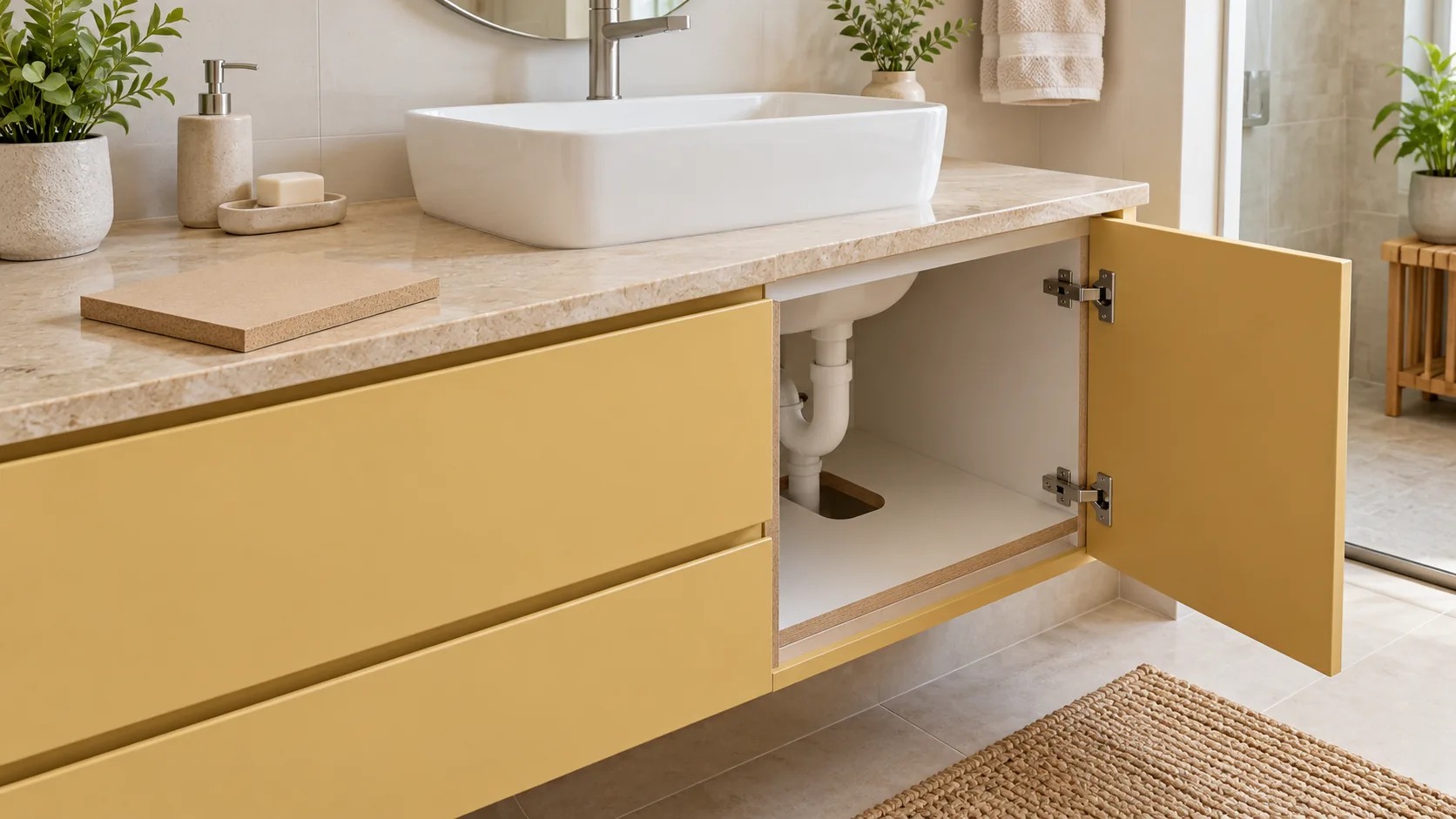
On a vanity beside a basin, detail the bottom edges, hinge recesses, pipe holes and joints. The face can look fine while a bare cut has drunk water. After a leak, check for swollen or soft edges and changed dimensions before deciding the part can stay.
A swelling test on a board sample reports that test only. It doesn’t mean a finished cabinet can sit in water. Keep the service category separate from a single lab result.
The MDF water-resistance guide explains moisture resistance and direct wetting. Outdoors, specify a board and assembly made for that exposure; interior paint on a dry-use board won’t do it.
When should you choose HDF instead of MDF?
HDF for a thin, dense back panel or door skin; MDF for a furniture-thickness blank that needs a smooth face or a machined profile. Both are fiberboards, and HDF is the denser one. Grade, thickness and declared performance decide the fit, not density alone.
A wardrobe back and a routed cabinet front do different jobs. Check how the back is fixed and how the front takes its hinges. More density tells you little about screw holding, shelf stiffness or moisture resistance, and a dense dry-use board still needs the right grade for a humid room.
Compare offered boards at the thickness and drawing you will use, with machining, edges, finishing and handling included. A new board name means a changed part, so recheck it.
Read the hdf vs mdf guide for the detailed choices.
When does solid wood make more sense than MDF?
When natural grain and timber construction lead the design. MDF fits when a smooth painted or faced panel does the job. Solid wood keeps its grain and moves across it with the seasons, so joints and finish have to allow for that.
One piece of furniture can use all three: a painted routed MDF door, a visible timber rail and a flat veneered panel. MDF takes paint and decorative faces well; solid wood shows its own grain. Real-wood veneer on MDF gives a wood face over a fiberboard core, so looks alone won’t tell you the structure.
Compare finished parts, not raw prices: drawing, conditions, prep, finishing and repair. Strength and weight depend on the product and the shape, and either material can be the wrong choice for a given job.
Read the mdf vs solid wood guide for the detailed choices.
Should an MDF face use wood veneer or decorative laminate?
Veneer for real grain and natural variation; decorative laminate for a repeatable printed decor and a specified surface grade. Both go onto MDF, and a veneered MDF panel is still fiberboard underneath.
With veneer, decide species, cut, leaf layout and finishing. Neighboring leaves and panels shape how a run of kitchen doors looks. With laminate, name the decor, texture and grade plus the back and edge treatment. A printed wood pattern stays consistent; real wood varies and needs matching.
Repair follows the face too. Damaged coating, lost veneer and a gouged laminate sheet are different repairs, and how much veneer is left limits what a refinisher can save.
Read the wood veneer vs laminate guide for the detailed choices.
How should you plan cutting an MDF component?
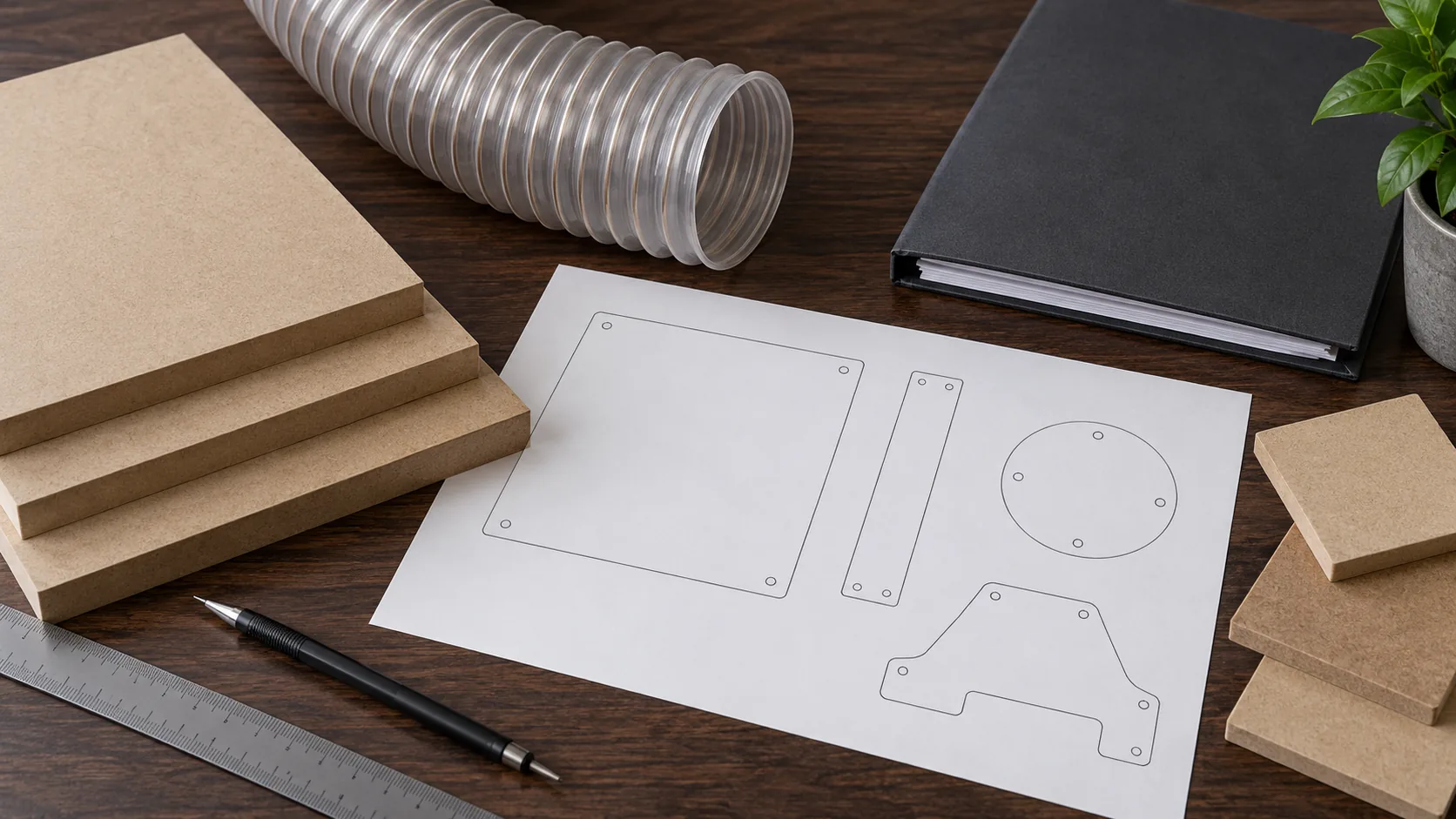
From the finished drawing: support the sheet and the offcut, pick a tool for the shape, and catch the dust at the tool. Straight cuts and inside curves need different tools and setups. Check whether the sheet has a factory face first, because that face goes through the cut too.
Support the sheet so the last piece stays still as the cut finishes. Mark the part and its allowance, then check the tool setup and the extraction path. MDF makes fine dust, so dust capture belongs in the plan, whether you are in a garage or a production shop.
After cutting, check sizes, edge quality and hardware positions against the drawing. Leave material for later trimming where the process needs it. A clean-looking cut can still need edge prep before paint or a face goes on.
How should you choose a finish for MDF faces and edges?
Paint for a solid color, veneer for real grain, or a decorative face for a manufactured look, then prepare the MDF for that route. A clear coat on bare MDF shows fiberboard, not wood grain.
For paint, treat faces and machined edges as two different jobs. Edges soak up more coating and show tool marks, so a compatible sealer or primer and a suitable topcoat are part of the system. Recesses, holes and edges belong in the spec even when the front looks smooth.
For a factory-faced panel, identify the face, back, bond and the edge work still to do. The face saves painting the broad surfaces but leaves other steps. Choose the board’s moisture grade before relying on any finish to protect it.

When do MDF edges need banding instead of paint?
Band the edge when a flat faced panel needs a matching edge; seal and paint it when the whole part is painted. Every cut leaves raw fiberboard showing, and profiles, visible joints and the look you want decide which route fits.
Measure the real finished thickness, faces included, when choosing a band, and allow the overhang your trimming method needs. A clean square edge and the right adhesive give a good bond; a ragged cut shows through. Hand-applied iron-on band and machine edge banding work differently.
After banding, check the joint, the trimmed edge and the final size. A color match is only the look; the band, adhesive and board make the edge. On a film-faced panel, the edge still needs its own detail.
Read the mdf edge banding guide for the detailed choices.
What should a US order specify about emissions and machining?
The exact MDF product, its size, its service grade and its emissions records, plus dust capture at the machine. Emissions records cover the panel; the machining plan covers what you do to it.
| Item | What to specify | Why it matters |
|---|---|---|
| Core and exposure | Exact grade, product and intended dry, humid or exterior use | Identifies the board behind the finished surface |
| Dimensions | Finished drawing, thickness, recesses and tolerances | Defines fit and remaining material |
| Loads and connections | Span, supports, hardware and connection details | Connects board data to the component |
| Finish | Face, back, edge and opening treatment | Includes the complete exposed construction |
| Compliance | Applicable category, producer/lot and compliance records | Supports US composite-wood traceability |
| Machining | Extraction, equipment and process risk assessment | Addresses dust at the source |
40 CFR 770.10 sets 0.11 ppm for covered MDF and 0.13 ppm for thin MDF under its panel emission test, and the thin-MDF definition is 8 mm or less. These are panel limits, not room-air or workplace limits, and not a zero-formaldehyde claim.
EPA’s consumer FAQ explains the labels. Panels carry producer, lot, third-party certifier and compliance details; finished goods carry fabricator, date and compliance details. Ask for the records that match what you are buying.
For cutting, routing and sanding, OSHA’s woodworking dust guidance puts local exhaust ventilation at the source first. Capture dust where it is made, maintain the system and assess the real process for further controls. A board emissions certificate says nothing about the dust your saw makes.
For cost, compare MDF, particleboard, plywood and solid wood on the same drawing and service. Add machining, face and edge finishing, hardware, offcuts and transport, then divide by accepted parts. MDF can save effort on routed painted work, and a faced panel can skip painting altogether, so a cheap raw sheet can end up the expensive option once finishing and rejects are counted.
How does decorative film change a finished MDF panel?
It adds a face and a bonding step to a flat MDF furniture core. The finished panel still needs the right core grade, back, edges and fixings for where it goes.
Puremorfilm makes decorative film with a silicone functional surface that is flat-laminated onto MDF with PUR adhesive. The film is formaldehyde-free and uses a No DOP formulation; the MDF core keeps its own emissions grade, so request that document separately. Rolls come in effective widths of 1,240, 1,260 or 1,400 mm and lengths from 50 to 500 m, depending on the model. The silicone surface is inherently flame-retardant, with higher grades up to UL 94 V-0 available on request.

To discuss a film-faced front, send the drawing, MDF grade, finished thickness, and back and edge details, and say whether you want rolls for your own line or film-faced panels. Judge the finished part against its use; film test data covers the film alone.
Our furniture decorative-film page introduces this route. It is not for floors, cooktop countertops, shower floors or other walked-on areas.
When should you choose MDF for a project?
When the job is a smooth painted profile or a flat faced furniture part, with the grade and supports chosen for the room it will live in. If no MDF grade fits that use, pick another board or construction with the properties you need on paper.
- For repeat parts, compare full sheets with finished parts using your real cutting yield and handling.
- With a qualified PUR flat-lamination line, ask about film rolls; for ready-faced furniture parts, ask about film-faced panels.
- When recesses, hardware or the core change, check the revised part against its drawing before reusing an old approval.
For a ready-finished MDF panel, our paint-free silicone face is an alternative to paint, PVC and melamine. Contact us with the panel drawing, core grade and service conditions.
Frequently Asked Questions
Is MDF real wood?
No, not in the solid-timber sense. It is made from real wood fibers bonded with resin, but it has no natural grain and behaves differently from a solid board.
Is MDF stronger than plywood?
No, not reliably. Bending strength overlaps, but plywood is stiffer, so start with plywood for shelves where sag matters.
Can MDF be used near a sink?
Yes, with care: use moisture-resistant MDF, seal every cut edge, hole and the back, and keep standing water off it. Ordinary MDF swells quickly once water reaches an exposed edge.
Why is MDF expensive?
MDF is not always the expensive option. Compare quotes for the same sheet size, thickness, service grade, quantity and finish. For a cabinet door, include machining, face and edge finishing, hardware, waste and delivery in the finished-part cost.
What is MDF used for?
Mostly painted cabinet doors, furniture panels, shelving, moldings and wall paneling, and as the core under laminate, veneer or decorative film.