

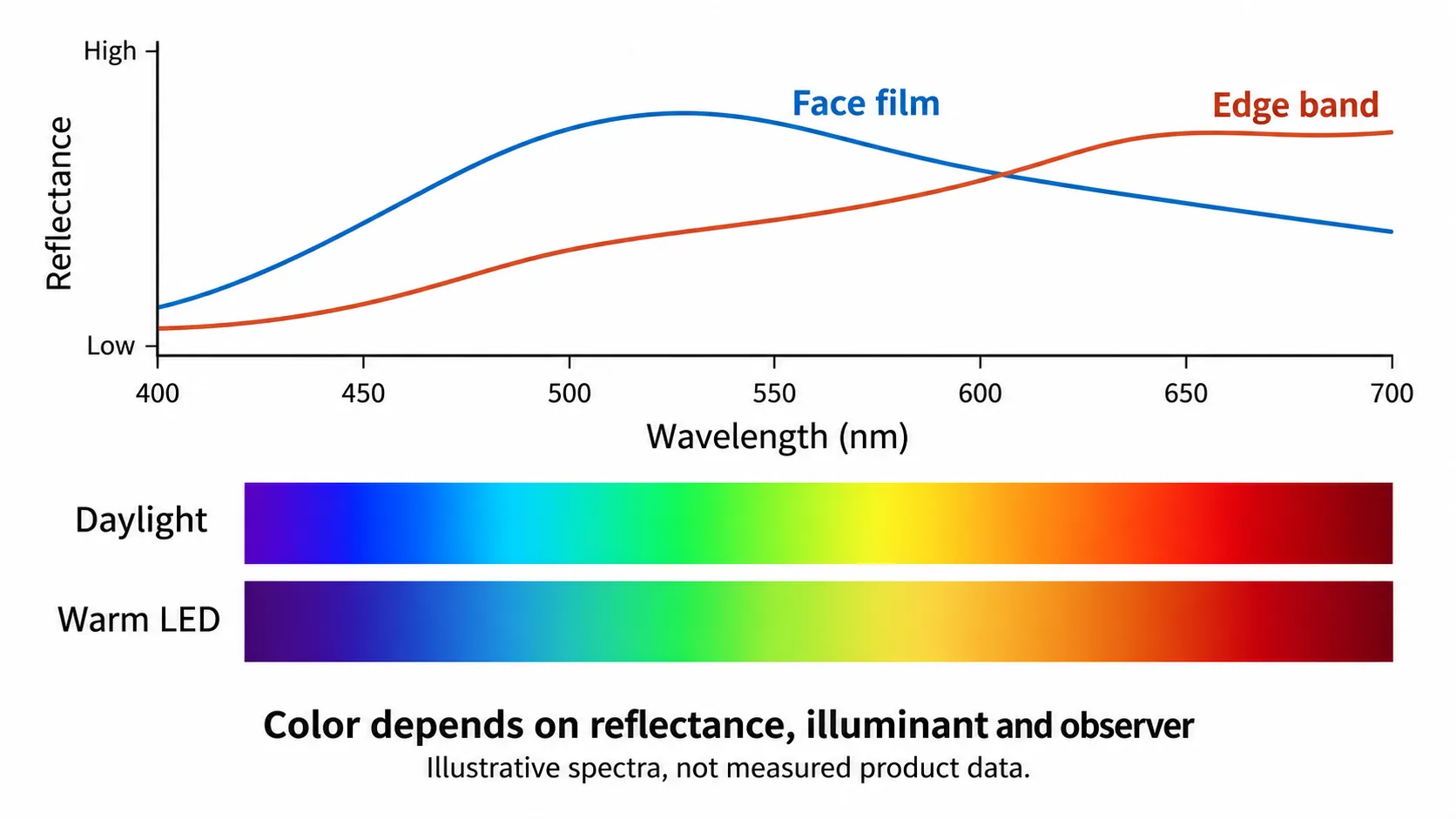
Metamerism in color occurs when two samples with different spectral make-ups look the same under one light and stop matching under another: a face film and edge band can match under a daylight lamp, then separate under warm kitchen LEDs. In colorimetric terms, different spectra can produce the same tristimulus values within a specified system. Standard daylight D65 corresponds to approximately 6500 K, but a lamp carrying that temperature label can have a different spectrum.
For a metamerism color check on a cabinet or wall-panel project, you need two things: a reference sample and the lights you agreed to judge it under.
What is metamerism in color?
Metamerism is when two colors with different spectra produce the same tristimulus values, and so look identical, within a specified colorimetric system. Such a pair is a metameric pair, and either member is a metamer. The CIE definition makes the specified system part of the meaning.
Three elements contribute to an observed surface color: the light illuminating it, the object reflecting that light and the observer. Two surfaces can give an observer the same color response despite reflecting different proportions of light across the spectrum. Change the illumination, and the relationship can change.
Illuminant metamerism concerns a change of light source; observer metamerism concerns differences between observers. This article focuses on the first because a material pair often travels from a showroom or sample room into a differently lit interior.
What you need to know is whether the chosen parts stay matched under the conditions they will be used in. Judge a cabinet face and its edge as a pair, even when both carry the same color name.
Why do two different materials match under one light only?
Different colorants can produce a visual match under one light while giving the materials different spectral reflectance curves. The color response comes from the interaction of those curves with the illuminant spectrum and the observer’s response; changing the light changes that weighting.
D4086-18(2023), section 4.1, identifies different colorants as the source of metameric matches. A film face, a plastic edge band and a painted component may use different pigment or dye combinations to reach a similar appearance. Their color names give no assurance that the spectra are alike.
Consider an illustrative white cabinet door. Its glossy face and edge look matched at the dealer’s desk, but the edge appears pinker under warm under-cabinet lighting. A pair that matches under the first light and separates under the second points to illuminant metamerism.
Different formulations create the risk; they do not make every mixed-material pair fail. Keep the actual face and edge together during review. The MDF edge banding guide covers material pairing and edge construction; the lighting comparison checks the appearance of the selected pair.
Is it metamerism, color inconstancy or a gloss difference?
Identify whether a pair loses its match, a single sample changes appearance, or viewing direction changes the effect. These observations lead to different checks, and several effects can occur in the same assembly.
| Observation | Likely issue to investigate | Useful comparison |
|---|---|---|
| Two samples match under one light and separate under another | Illuminant metamerism | Compare the pair under each agreed light |
| One sample looks different after the light changes | Color inconstancy | Follow the same sample between lights |
| A highlight or apparent tone changes with viewing direction | Gloss, texture or directional color behavior | Compare direction and surface finish consistently |
| Wood-grain features differ in size or placement | Pattern design or alignment | Compare pattern scale and layout |
Color inconstancy describes a single color’s response to changed illumination. Metamerism concerns the relationship between different spectra that match under specified conditions. A sheen difference can make two nominally similar colors appear unlike even before the light source changes.
For appearance choices, matte vs gloss kitchen cabinets explains the finish distinction, while wood grain decorative film addresses pattern selection. An adjustment to colorants will not by itself align two different grain scales.
Diffuse visual comparison has a defined scope. ASTM D1729-22 excludes the directional illumination needed for metallic and pearlescent materials, and the metamerism practice excludes goniochromatic samples. If the effect changes strongly with viewing angle, set up a suitable comparison method before you diagnose it.
Which light sources should you compare before approving a match?
At least two: a D65 daylight simulation and the actual project lighting, plus any other light the parts will be seen under. Pick the set to match where the finish will live.
D65 is a defined relative spectral distribution representing a phase of daylight, with a correlated color temperature of approximately 6500 K. A temperature label describes an aspect of the light’s appearance; it does not identify its full spectral composition. Sources with similar correlated color temperatures can have different spectra.
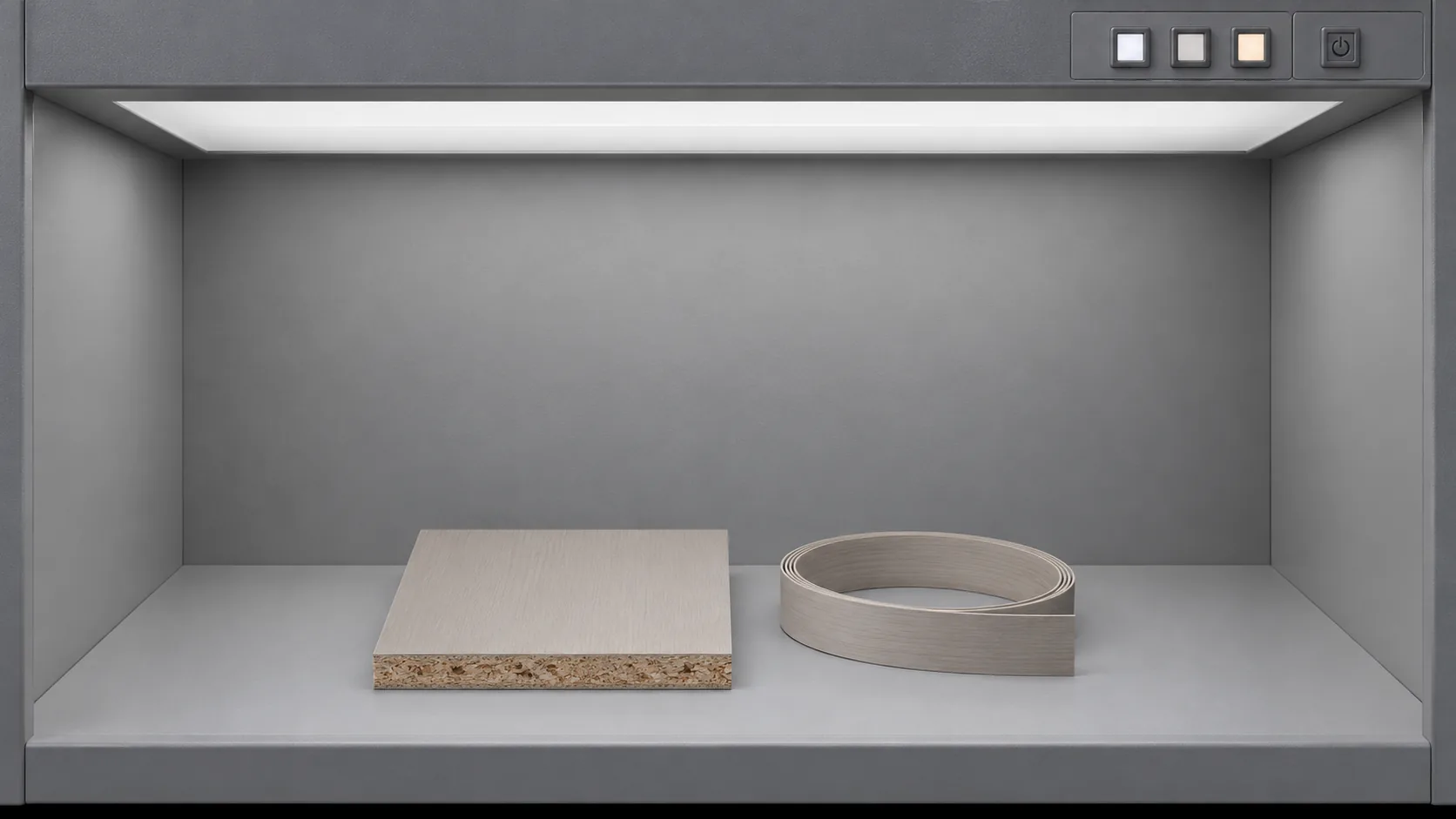
The visual-comparison practice recommends simulated D65 daylight; it identifies D50 for photography and printing applications. For an interior, add the warm white LED or other lamp selected for that installation. Record its type and model, or suitable spectral information, so the review can be repeated.
A sample approved under an office lamp still needs checking under the guest-room lighting of a hotel project. Bring the selected face, edge and adjacent trim into that review together; the hotel wall panels guide provides the wider project context. Naming the lights on the approval record is more reproducible than describing them as simply warm or cool.
How do you check a color match by eye?
Place the samples side by side, compare them under each agreed light, then exchange their positions to check whether the apparent difference follows the material. Keep size, orientation and surface presentation comparable, including grain direction where relevant.
A practical sequence is:
- Identify the reference sample and the proposed matching component.
- Present comparable areas beside each other under the first agreed light.
- Note the direction of any difference, such as a redder edge or darker face.
- Repeat with the other agreed lights, keeping the pair and orientation consistent.
- Swap positions and record the final observation and acceptance decision.
Standardized visual appraisal is particularly useful when a sample and its reference are different materials. D1729 calls for observers with at least normal color vision, preferably superior performance assessed through the FM-100 hue test as specified in E1499; training and experience also matter.
The visual metamerism practice provides for detection by changing illumination and visually estimating the effect. Use the agreed comparison to distinguish a repeatable material difference from uneven lighting or a changing highlight. Record which pair, light and observer produced the observation so the next review starts from the same conditions.
What can spectral data and Delta E tell you?
Delta E expresses a color difference calculated for specified conditions; spectral reflectance data can support calculations under additional illuminants when combined with the illuminant and standard-observer functions. A small difference under D65 therefore does not establish the difference under the project’s warm LED.
ASTM D2244-25, sections 5.1–5.5, explains why results from different color-difference systems require their own interpretation. Values calculated as ΔE*ab and ΔE00 are not directly interchangeable. The practice recommends ΔE00 for small differences in the range of 0.0–5.0 ΔE*ab units; that range describes formula use, not an acceptance limit.
The magnitude also benefits from directional information. Lightness, chroma and hue-related components can help explain how the samples differ and what needs adjusting. Keep those components: a note that the edge reads redder gives a supplier something to correct, while one unsigned total does not.
For tolerance applications under illumination other than daylight, the practice calls for visual confirmation of the extent of metamerism. Correlate instrumental decisions with the agreed visual appraisal under the same viewing conditions.
A metamerism index describes the color difference after a change of illuminant or observer for the relevant metameric comparison. State the color-difference formula used. A spectral graph helps explain the mechanism, but a graph without the calculation conditions cannot supply a project acceptance decision.

Which color tolerance should buyer and seller agree on?
Agree a tolerance and calculation procedure for the actual materials and use, with instrumental results related to visual acceptance. The scope of D2244 recognizes that adjacency, gloss and texture affect the relationship between measured difference and acceptability.
| Item | What to specify | Why |
|---|---|---|
| Reference | Sample identity, version and storage arrangement | Keeps later comparisons tied to the approved appearance |
| Lighting | Daylight simulation and the actual project light sources | Makes the viewing conditions repeatable |
| Observer and formula | Standard observer and named color-difference formula | Defines what the reported number means |
| Measurement setup | Instrument, geometry and relevant settings | Supports comparable results |
| Tolerance | Mutually agreed numerical limits and conditions | Defines the instrumental decision |
| Visual review | Agreed comparison method and decision authority | Relates measurement to appearance in use |
| Exception handling | Recheck, adjustment, concession or rejection route | Records how an unresolved match is handled |
A face and edge touching along a door need assessment in that arrangement. Two separated doors create a different viewing situation. Evaluate the tolerance’s suitability for each rather than assuming one number represents every arrangement or surface finish.
For furniture decorative film, the reference should identify both color and the intended surface appearance. That lets the reviewer distinguish a color deviation from a gloss or texture difference before requesting an adjustment.
How do you avoid color mismatch between panel batches?
Avoid color mismatch between panel batches by ordering connected surfaces together, retaining an approved finished sample and checking every new lot under agreed lighting. Record decor, gloss, texture and direction as well as color. Set visual and measured tolerances in the order, then approve replacements beside the panels they must match.
| Point in the order | Action | Record to retain |
|---|---|---|
| Before ordering | Group adjacent panels and any planned spares into the same production lot where possible. | Part map, decor code, gloss, texture and grain direction. |
| Sample approval | Keep protected, labeled finished samples for both buyer and supplier. | Approval date, sample identity and viewing conditions. |
| New-lot inspection | Compare against the retained standard under the agreed booth light and intended room lighting. | Visual result and any agreed color-difference measurement. |
| Tolerance and replacements | Agree the measurement method and acceptance limits before production. | Written tolerance, approved exception and location of any replacement. |
Physical color-standard guidance explains why buyers and suppliers need an agreed target and tolerances. Protect the standard from aging and check gloss and texture too; a numerical color match does not settle every visible difference.
When should a new film lot or construction be rechecked?
Recheck whenever colorants, raw-material sources, gloss, substrate or the paired edge or panel change, because a formulation change can alter the reflectance spectrum and make an existing pair separate under another light. Routine batch checks for an unchanged formulation follow whatever the parties agreed.
A retained film sample may still match the new film while a replacement edge band separates under project lighting. Review the assembled pairing whenever one component changes. A matching film color name gives no information about the replacement component’s formulation.
Identify retained references, protect them from unnecessary light exposure and replace them when their condition no longer supports a reliable comparison. Write the review and replacement arrangements into the project agreement; storage conditions and use vary too much for one replacement interval.
Color change from exposure or aging raises a further durability question; the cabinet surface durability test guide addresses that evidence. A change discussed in PET vs PVC decorative film can also affect the material pairing, so revisit the actual samples instead of transferring approval from a material description.

How does a silicone-faced decorative film fit into color matching?
Choose an agreed appearance reference for the film and its paired parts, then assess them together. Puremorfilm makes silicone-faced decorative film for cabinet doors, furniture fronts and wall panels, with more than 100 existing colors and patterns and project customization of texture and gloss. Free samples support comparisons with the intended edge and lighting.
The silicone surface is inherently flame-retardant, and higher grades up to UL 94 V-0 are available on request. In the manufacturer’s laboratory tests, coffee, red wine and soy sauce left at 25°C for 24 hours wiped off with no obvious change. Our film uses a No DOP formulation and is PVC-free and formaldehyde-free.
We supply film rolls for panel and door makers to flat-laminate with PUR adhesive, with technical guidance available. The decorative wall film page introduces the surface option.
Our film is a new paint-free finish with a silicone functional face, distinct from PVC, melamine, PP and PETG decorative faces.
How should you approve a matched film, edge and panel?
Approve the specific film, edge and panel combination under the agreed lights, against the recorded reference, measurement conditions and visual decision. If the parties disagree, find which part of that agreement the samples fail.
| Review result | Project decision to record |
|---|---|
| Combination meets the agreed criteria under all specified lights | Approve the combination and preserve the reference |
| Daylight match separates beyond the agreement under project lighting | Adjust the color formulation or paired component and recheck |
| Difference concerns separated components and is acceptable in use | Record the agreed concession and its scope |
| Main difference is gloss, texture or pattern | Address that appearance property before repeating the color judgment |
The approved combination should remain identifiable when components are reordered. A replacement edge, changed finish or revised lighting specification can require another review even if the original color code stays on the purchase order.
For a film-matching discussion, contact us with the edge or panel sample to be matched, the project lighting information and the color reference.
Frequently Asked Questions
What does metamerism mean?
Metamerism means spectrally different colors match within one specified set of colorimetric conditions. The pair can lose that match when the light source or observer changes.
What is an example of metamerism?
A hypothetical replacement cabinet door that matches the original under showroom light but looks different under home LEDs illustrates illuminant metamerism. Different colorant formulations can create that behavior.
What is a metamer?
A metamer is one member of a pair of spectrally different colors that have the same tristimulus values for a specified colorimetric system. The matching relationship belongs to those conditions.
How do you test for metamerism?
Testing uses side-by-side visual comparison under multiple light sources, or spectral measurements used to calculate color differences for specified illuminants and observers. A pair that matches under one condition and separates under another shows the effect being investigated.
What causes metamerism?
Different colorant combinations can give materials different reflectance spectra while producing a match under a particular illuminant and observer. A change of illumination can reveal the mismatch; observer differences can also affect a metameric match.