
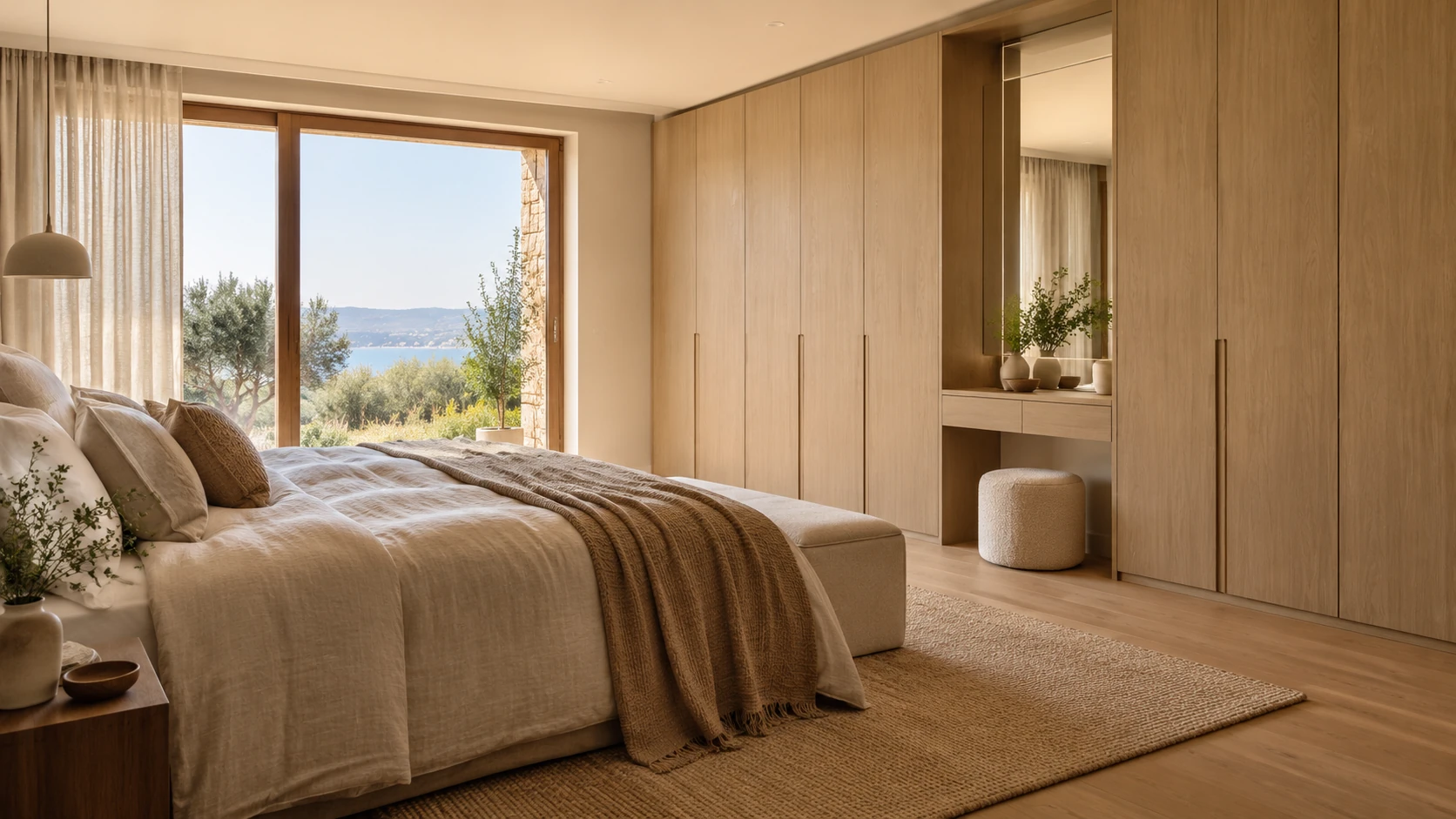
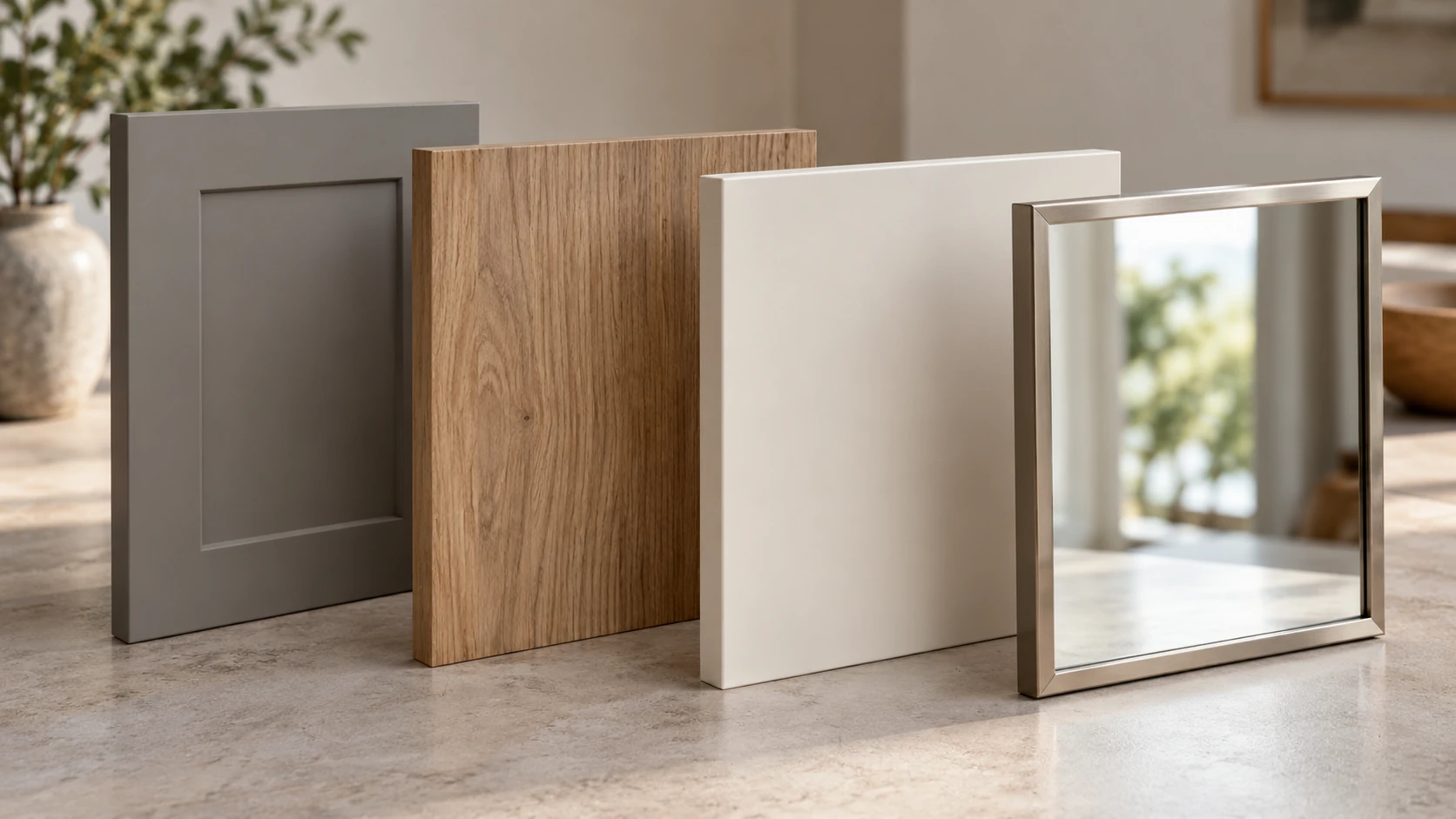
Common wardrobe door materials include MDF, plywood, particleboard, solid wood, glass and mirror. For closet doors, choose the finish and opening style together: a flat melamine-faced panel suits a different design from a painted Shaker door or a framed mirror. Door size, weight and room moisture help narrow the choice.
The core gives a door its structure; the finish supplies the visible surface. Keeping those choices distinct makes it easier to compare a painted MDF door with veneered plywood, or a melamine-faced board with glass. Some retailers call these fronts wardrobe shutters, but the same material and finish questions apply.
What are the best wardrobe door materials?
MDF suits painted or shaped doors, faced particleboard suits economical flat fronts, and veneer or solid wood suits a real wood appearance. Glass and mirrored doors add light or reflection, with hardware selected for the complete door. The best choice follows the look, opening style and construction you need.
| Material | Common face or finish | Useful strength | What to check | Relative cost tendency |
|---|---|---|---|---|
| MDF | Paint, veneer or suitable decorative film | Smooth face for paint and routed detail | Moisture grade, edges and complete door weight | Economical to mid-range |
| Plywood | Veneer, laminate or paint | Layered construction and useful fixing strength | Face quality, edges and flatness | Often above basic faced particleboard |
| Particleboard / MFC | Melamine or another bonded face | Economical flat door construction | Edge quality, moisture exposure and fixings | Often the lower-cost route |
| Solid wood | Clear, stained or painted finish | Real timber character and repair options | Movement with humidity and door construction | Usually higher |
| Glass | Clear, frosted, colored or framed | Light transmission and varied appearance | Safety specification and hardware capacity | Varies with glass and framing |
| Mirror | Mirrored face with its specified support | Reflection and dressing function | Complete assembly weight and cleaning | Varies with assembly |
MDF means medium-density fibreboard. MFC means melamine-faced chipboard: a particleboard core with a decorative surface already attached. Particle board and chipboard name the same broad material family here. These terms explain why a quote can list both a core material and a face without describing two competing door types.
For a bedroom on a modest budget, a well-made flat MFC front is a sensible starting point. For a painted recessed-panel design, compare MDF constructions instead. The cost tendencies in the table describe routes, not quotations; finish complexity, framing and hardware can change their order.
Is plywood or MDF better for wardrobe doors?
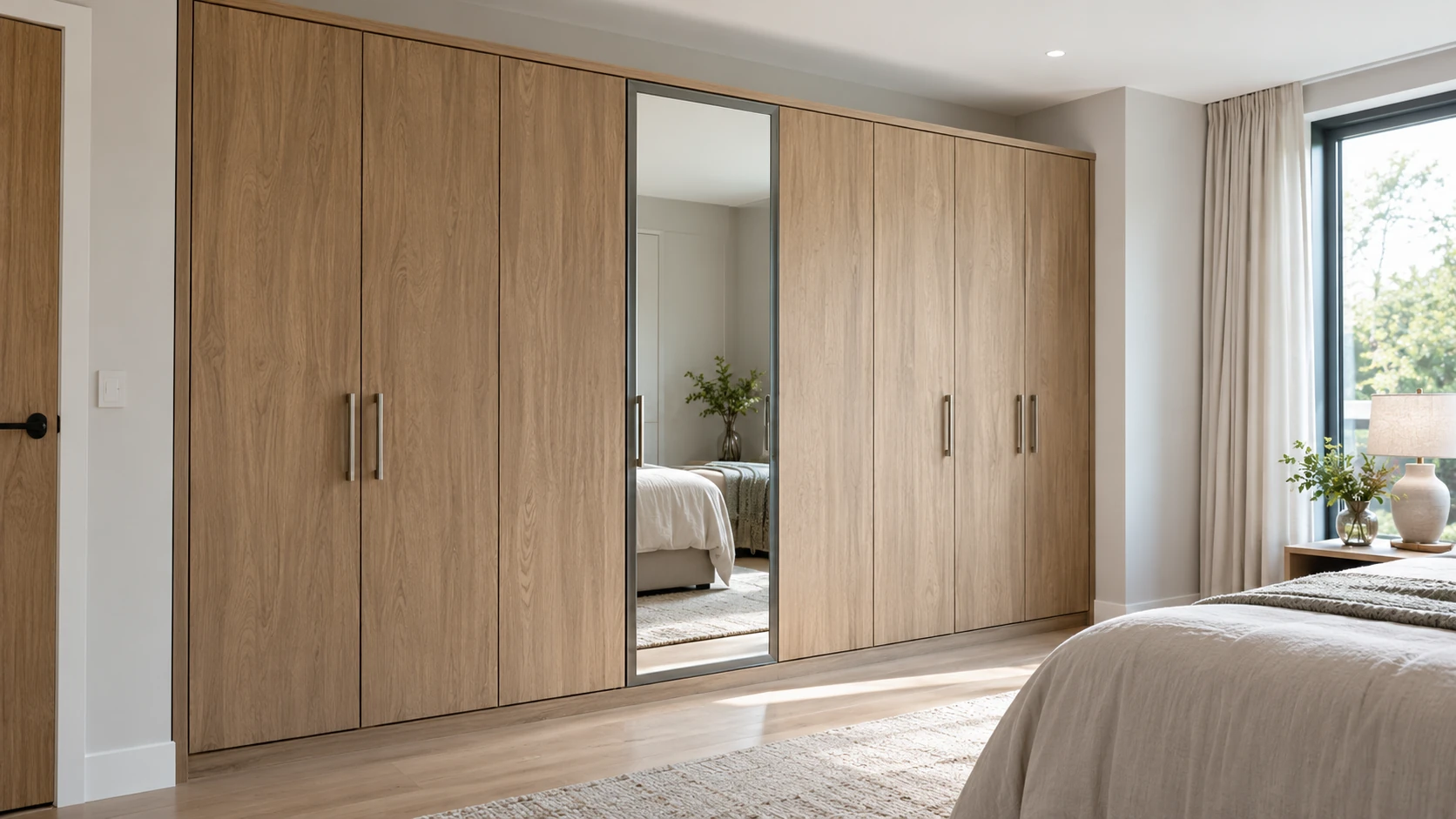
MDF is usually the easier starting point for a smooth painted face and routed detail; plywood is useful when fixing strength and the selected panel’s weight matter more. Grade and construction affect both options, so compare the actual proposed panels before choosing a tall wardrobe door.
MDF has a uniform surface that suits paint preparation, although cut edges need proper finishing. Plywood’s face grain and layered edges can remain visible or affect the finished appearance. That may suit a natural wood design, while a completely smooth painted front calls for more attention to preparation and face quality.
Standard MDF needs protection from moisture. Moisture-resistant MDF offers a different grade for more demanding conditions, but the finished door still needs suitable edge treatment and a room appropriate for the construction. For a wardrobe beside a bathroom, assess moisture exposure before choosing on the appearance of a showroom sample.
Tall doors also make panel flatness, storage and fabrication more noticeable. Compare complete doors, including their finish on both faces and the specified hardware. Our MDF versus plywood guide covers the core-material comparison in more detail; wardrobe selection adds the practical questions of door size, opening clearance and appearance.
When is solid wood the right choice for wardrobe doors?
Solid wood suits a wardrobe where real timber character and the option to refinish are priorities. It also calls for a construction that accommodates movement as humidity changes. Frame-and-panel doors use that movement allowance differently from a wide, uninterrupted timber slab.
For a traditional bedroom, a framed solid wood front can make sense when its grain and joinery are part of the design. Examine the overall construction and finish, including how the center panel fits within the frame. A door sold as “wood” may instead combine a timber frame with a veneered panel, so read the description carefully.
Veneer gives a real wood surface over a supporting core. It offers another way to obtain natural grain on a flatter, more uniform front. The industry description of veneer identifies it as a thin wood surface; the core, adhesive and finish complete the construction.
That makes veneer worth comparing when you want wood grain across a run of flat wardrobe doors. Decide whether natural variation, the feel of timber and future refinishing matter enough to justify the chosen construction. A printed wood-effect face offers a different appearance and maintenance route, so view samples side by side in the bedroom light.
Do sliding and hinged wardrobe doors need different materials?
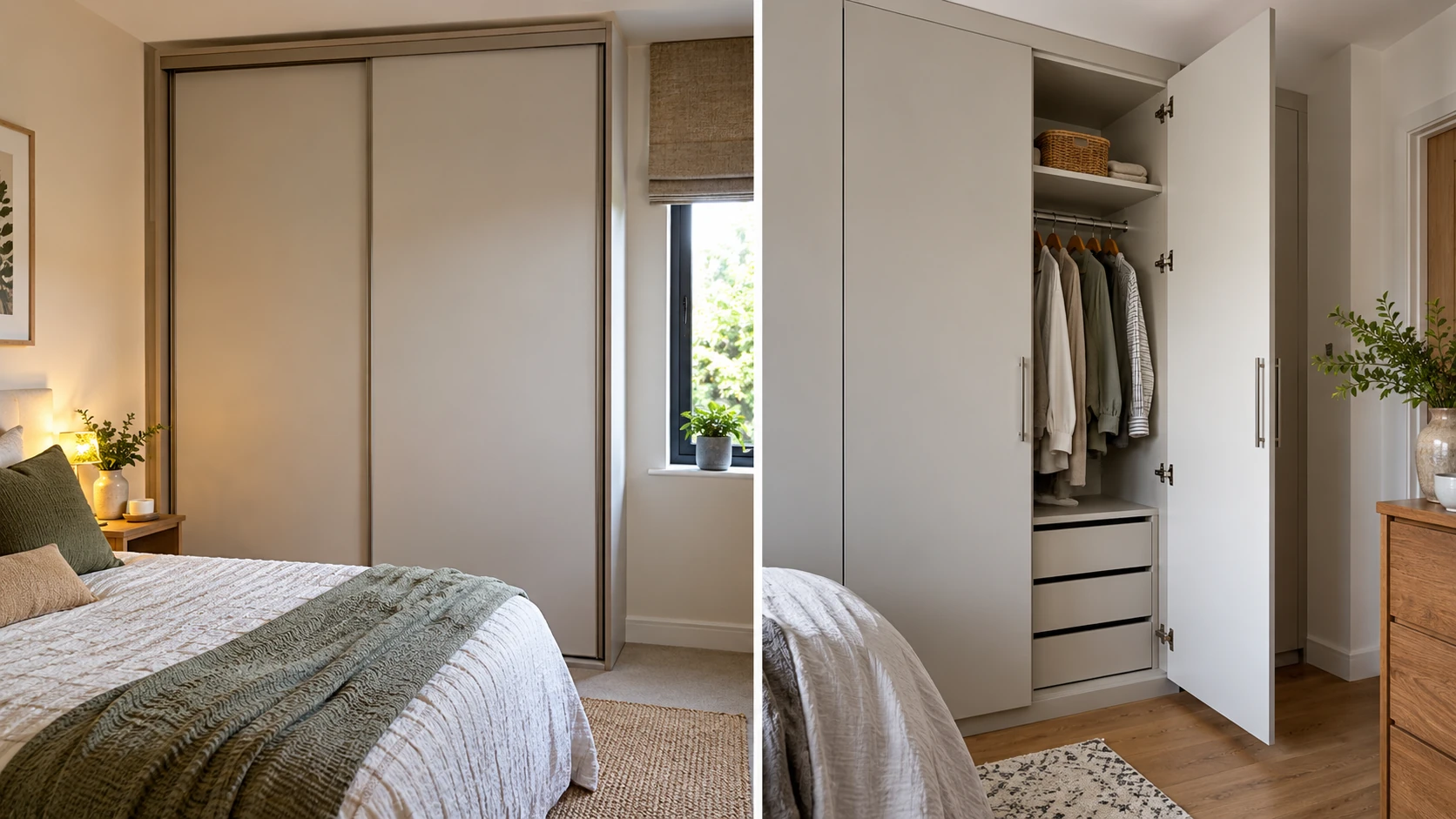
The opening style changes the construction and hardware priorities: sliding doors need a compatible track system, hinged doors load their hinges, and folding doors need a matched folding mechanism. Materials can overlap across these systems, but a finished door must fit the mechanism’s limits and installation requirements.
| Opening style | Useful room situation | Material and construction priority |
|---|---|---|
| Sliding | Limited space in front of the wardrobe | Flat panels, complete door weight and compatible track or roller system |
| Hinged | Clear swing space and full opening access | Door weight, height, fixing support and hinge selection |
| Folding | Access with a shorter projection than a full swinging leaf | Panel construction and weight matched to the folding hardware |
A mirrored sliding assembly and a flat hinged panel can both work in a bedroom. The useful comparison includes the frame, backing, handles and hardware, not the face material alone. For a narrow room, mark the bed and drawer clearances before deciding whether hinged doors have enough space to open comfortably.
For a tall hinged front, evaluate the hardware with the door’s height and complete weight. Adding decorative weight later can change that selection. With sliding fronts, check the system’s requirements for the entire assembly, including any supporting frame. Choose the opening arrangement early enough that the finish sample and hardware specification describe the same door.
Are mirrored or glass wardrobe doors practical?
Yes, mirrored and glass doors are practical when their complete construction and hardware suit the wardrobe. Mirror provides a dressing surface and reflects the room; glass can reveal or soften the view of stored items. Their mass deserves a calculation before you choose hinges or a sliding system.
Pilkington’s glass glossary gives an approximate glass mass of 2.5 kg per square meter per millimeter of thickness. In a hypothetical example, a pane measuring 0.6 m by 2.4 m at 4 mm thick weighs about 14.4 kg before its frame, backing or fittings. This is a mass calculation, not a safe-thickness recommendation.
The Blum 2024/2025 catalogue, page 75, bases hinge quantity on door weight and height, with its illustrated guidance based on a 600 mm door width. Apply the selected hardware manufacturer’s chart to the actual assembly. A comparison with a board door also needs the board door’s measured or specified construction, because weight differences vary with size and materials.
In a small bedroom, a mirror may be useful enough to accept more frequent cleaning. Glass also makes storage behind the door more visible, so consider how the wardrobe will look in daily use. Acrylic fronts offer another appearance route, but distinguish an acrylic face on board from a glass pane when reading the construction and care specification.
What is the best finish for wardrobe doors?
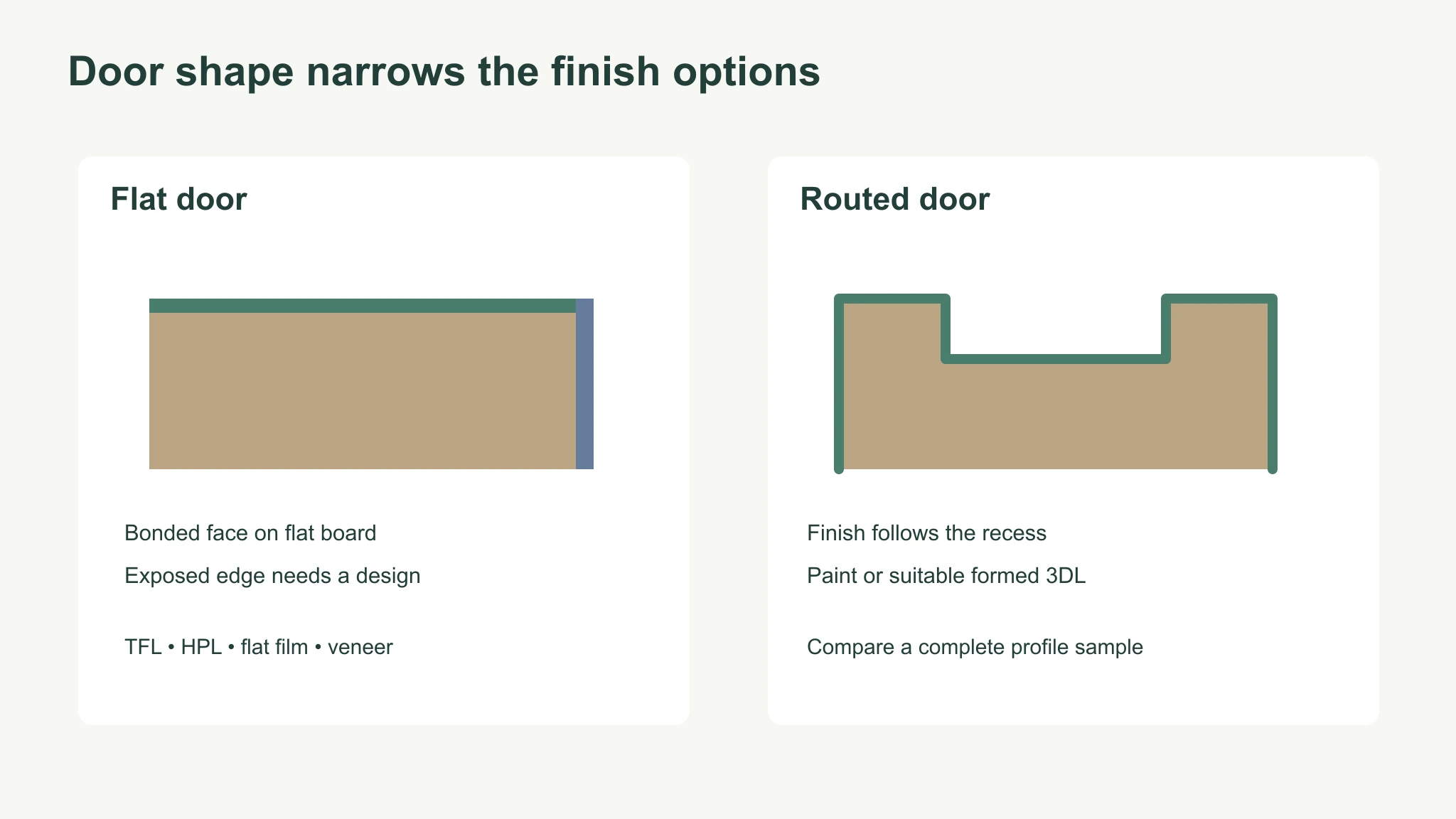
For flat wardrobe doors, melamine/TFL or HPL offers a practical decorative face; painted MDF suits a smooth color or routed design. Veneer gives real wood grain, while suitable thermofoil/3DL can follow shaped profiles. The best finish for wardrobe doors depends first on door shape, then appearance, edge construction and cleaning needs.
| Finish | How it is made | Door shape it suits | Edge detail and everyday check |
|---|---|---|---|
| Melamine / TFL | Resin-treated decorative paper fused to a panel | Flat faces | Separate exposed-edge treatment; inspect the joints |
| HPL laminate | A separately manufactured laminate bonded to a substrate | Flat faces; special grades allow specified postforming | Match edge construction to the design |
| Paint | Coating applied over a prepared surface | Flat or routed doors | Inspect edge coverage and how local repairs would look |
| Thermofoil / 3DL | A thermoplastic film membrane-pressed over a shaped panel | Suitable routed profiles | Check the wrapped edge and the complete door construction |
| Flat-laminated decorative film | Film bonded to a flat panel | Flat faces | Edge construction is a separate part of the door design |
| Veneer | Thin real wood bonded to a supporting core | Flat or appropriately constructed wood designs | Examine edge matching and the protective finish |
The TFL definition and HPL description explain why two panels described as “laminate” can be manufactured differently. The 3D and 2D laminate overview distinguishes forming over profiles from other decorative laminate routes.
A flat sample cannot show how a finish will follow a recessed Shaker profile. For that door shape, compare a painted construction or a suitable formed laminate with a completed sample of the recess and edge. For a flat minimalist front, compare the face and edge together. Our broader cabinet finishes guide explains finish families; the choice here remains a bedroom door design.
How do you keep wardrobe doors looking good over time?
Protect the edges from moisture, clean for the selected finish and keep the hardware operating correctly. Those habits suit an everyday bedroom wardrobe better than choosing on a vague “maintenance-free” claim. The face, its edge and the moving parts each need attention when comparing finished samples.
Near a bathroom, moisture exposure can make core grade and finished edges more consequential. A decorative face covers only part of the construction. Inspect the bottom edges and handle area, and resolve room moisture problems before putting a vulnerable panel in that position.
View a sample in the room’s daylight and evening light. A glossy finish may make reflections and marks more noticeable, while a textured face changes how light crosses the surface. Our matte versus gloss comparison explains those appearance differences without making every finish of one sheen identical.
Use the care instructions for the actual finished door and its hardware. If a hinged front starts to rub or a sliding panel stops moving smoothly, address the alignment or track condition rather than repeatedly forcing it. A finish sample helps choose the look; a complete door sample reveals how the edges, handles and moving parts work together.
Where does silicone-faced film fit on wardrobe doors?
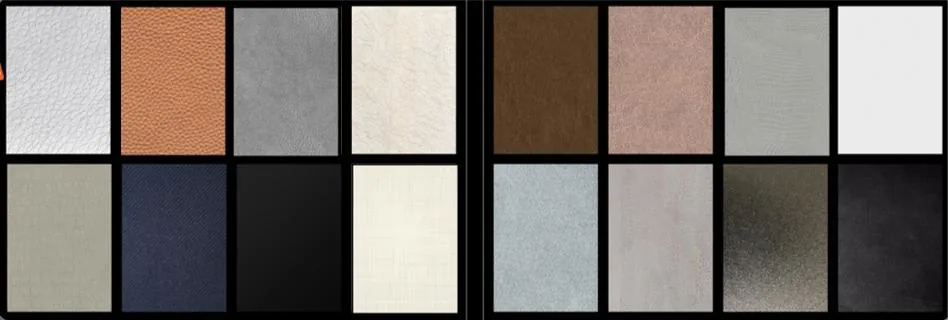
Puremorfilm supplies silicone functional surface decorative film for PUR flat lamination onto flat furniture panels, mainly as rolls; laminated panels are available on request. It is a new paint-free surface option with a silicone functional face, distinct from PVC, melamine, PP and PETG decorative faces. This route fits flat fronts; the flat lamination and profile wrapping comparison explains the process distinction.
The silicone surface is inherently flame-retardant; higher flame-retardant grades are available on request, up to UL 94 V-0. In the manufacturer’s laboratory tests, coffee, red wine and soy sauce left at 25°C for 24 hours were wiped away with no obvious change. The film uses a No DOP formulation.
More than 100 patterns are available, and texture and gloss can be customized. Our furniture decorative film page gives manufacturers a starting point for evaluating a flat wardrobe front. Door construction, edge design and hardware remain part of the finished assembly choice.
Which wardrobe door material should you choose?
Choose the core and finish as a pair, then check the finished door against the room and opening mechanism. For a flat, economical front, start with faced particleboard. For painted detail, start with MDF. For natural grain, compare veneer and solid wood constructions before deciding how much variation and maintenance you want.
| Your priority | Starting choice | Final check before deciding |
|---|---|---|
| Economical flat doors | MFC or another suitable faced board | Edges, hardware and room moisture |
| Painted or recessed design | MDF with paint or a suitable formed finish | Full profile and edge sample |
| Real wood appearance | Veneered core or solid wood construction | Grain, construction and humidity movement |
| Dressing mirror or reflective front | Purpose-designed mirror assembly | Complete weight and matched hardware |
| Narrow room | Compatible sliding door assembly | Access, track space and full assembly limits |
For a bedroom, compare the same door construction across quotations so a different core or edge does not disappear behind a similar finish name. For manufacturers considering our silicone-faced film on a flat front, we can provide samples and material information. Contact us with the door dimensions and quantity, whether the design is flat or profiled, and the desired pattern and gloss.
Frequently Asked Questions
What material is used for wardrobe doors?
Wardrobe doors commonly use MDF, plywood, particleboard, solid wood, glass or mirror. Board doors usually add paint, veneer, melamine, HPL or another decorative face. Read the core and finish separately so a material description such as “wood effect” does not replace the construction details.
Which wardrobe materials are best for long-term use?
Well-constructed solid wood and plywood are useful choices when real wood and repair options matter; faced boards can also suit long-term bedroom use when kept dry and properly supported. The core alone gives an incomplete answer. Compare the finished edges, hardware, room conditions and available repair route.
Which wardrobe finishes are easiest to maintain?
Flat melamine and suitable laminate faces are practical starting points for routine wiping. A smooth flat design also has fewer recesses to clean than a detailed front. Mirror needs regular attention to visible marks, while painted and veneered doors need care suited to their particular coating.
When should you choose MFC instead of MDF for wardrobe doors?
MFC suits an economical flat door with its decorative face already attached. MDF suits a smooth painted surface or routed design that needs a different finishing route. Compare finished doors, since painting, profiling and edge treatment can change both the cost and the appearance of the final assembly.
Is particle board good for wardrobe doors?
Yes, particle board can suit economical flat wardrobe doors in a dry room when its face, edges and hardware are appropriate. Moisture exposure and damaged fixings can limit that choice. For a wardrobe near a damp area, examine the complete construction and proposed panel grade before selecting it.