An EN 13501 fire rating for interior wall panels normally means an EN 13501-1 reaction-to-fire classification for a specified panel construction and mounting arrangement. A designation such as B-s1,d0 describes fire behaviour, smoke production and flaming droplets; the designation does not state a fire-resistance period or approve every installation.
What does BS EN 13501-1 tell you about a wall lining?
BS EN 13501-1 classifies how a construction product reacts to fire under the relevant test conditions. For a wall lining, the result concerns the specified product and its end-use arrangement, rather than a number of minutes for which an entire wall will contain a fire.
The British Standard is the UK adoption of the European classification standard. The BSI series listing separates Part 1, reaction to fire, from Part 2, classification using fire-resistance test data. The part number therefore belongs in the requirement as well as the report.
A reaction-to-fire classification addresses the product’s contribution to fire development under prescribed exposures. Fire resistance addresses functions of a building element, such as integrity or insulation, for a stated time. A decorative panel can need reaction-to-fire evidence while the wall behind it has a separate fire-resistance requirement. One document cannot be assumed to answer both questions.
In England, Approved Document B uses the BS EN 13501-1 system in its guidance for wall and ceiling linings under requirement B2. The official B2 explanation confirms that connection. Approved Document B applies to England; a UK delivery address alone does not make its provisions the requirement for Scotland, Wales or Northern Ireland.
Your wall panel material choice may settle the visible finish and substrate, while the project still needs the appropriate lining classification and any separate wall-assembly performance.
How do you read Euroclass, smoke and droplet codes?
Read the main reaction-to-fire class and each applicable suffix separately. In the illustrative designation B-s1,d0, B is the main class, s1 is the smoke-production class and d0 is the flaming-droplet or particle class. A stronger main letter does not erase a separately specified smoke or droplet requirement.
Wall-lining classifications use the seven main classes A1, A2, B, C, D, E and F. The RISE classification explanation distinguishes these from flooring and cable designations. Use the wall-lining form for a wall-panel discussion; a flooring result with an “fl” suffix answers a different end-use question. In wall-lining notation, A2 to D carry smoke and droplet suffixes, while A1 is written without them.
| Part of a wall-lining classification | How to read it | What the code leaves unresolved |
|---|---|---|
| A1 | Meets the A1 criteria, associated with non-combustibility | The fire resistance of a wall assembled from the product |
| A2 | Has additional combustibility or calorific-value criteria as well as the relevant fire-growth assessment | The permitted panel construction and installation |
| B, C or D | Progressively less restrictive main-class fire-growth criteria | Whether the smoke and droplet suffixes meet the project requirement |
| E | Meets the specified small-flame criteria | Performance at the higher classes’ SBI exposure |
| F | Does not meet the class E criteria | An untested product must not simply be labelled F without the proper basis |
| s1, s2 or s3 | Smoke-production classification: s1 is the most restrictive, s2 is less restrictive, and s3 does not meet s1 or s2 | Smoke toxicity, a safe exposure time or smoke leakage through a wall |
| d0, d1 or d2 | Flaming-droplet/particle classification under the stated test criteria | A promise that no material can ever drip in a real fire |
The RISE surface-classification table gives the criteria. For the SBI assessment, d0 means no flaming droplets or particles within 600 seconds; d1 permits no such droplets or particles persisting longer than 10 seconds within that period. d2 does not meet d0 or d1. These are test observations with a time window, rather than unrestricted statements about every fire.
A government review of smoke and toxicity explains why smoke quantity cannot be directly treated as toxic hazard. An s1 designation is therefore not a “non-toxic smoke” certificate.
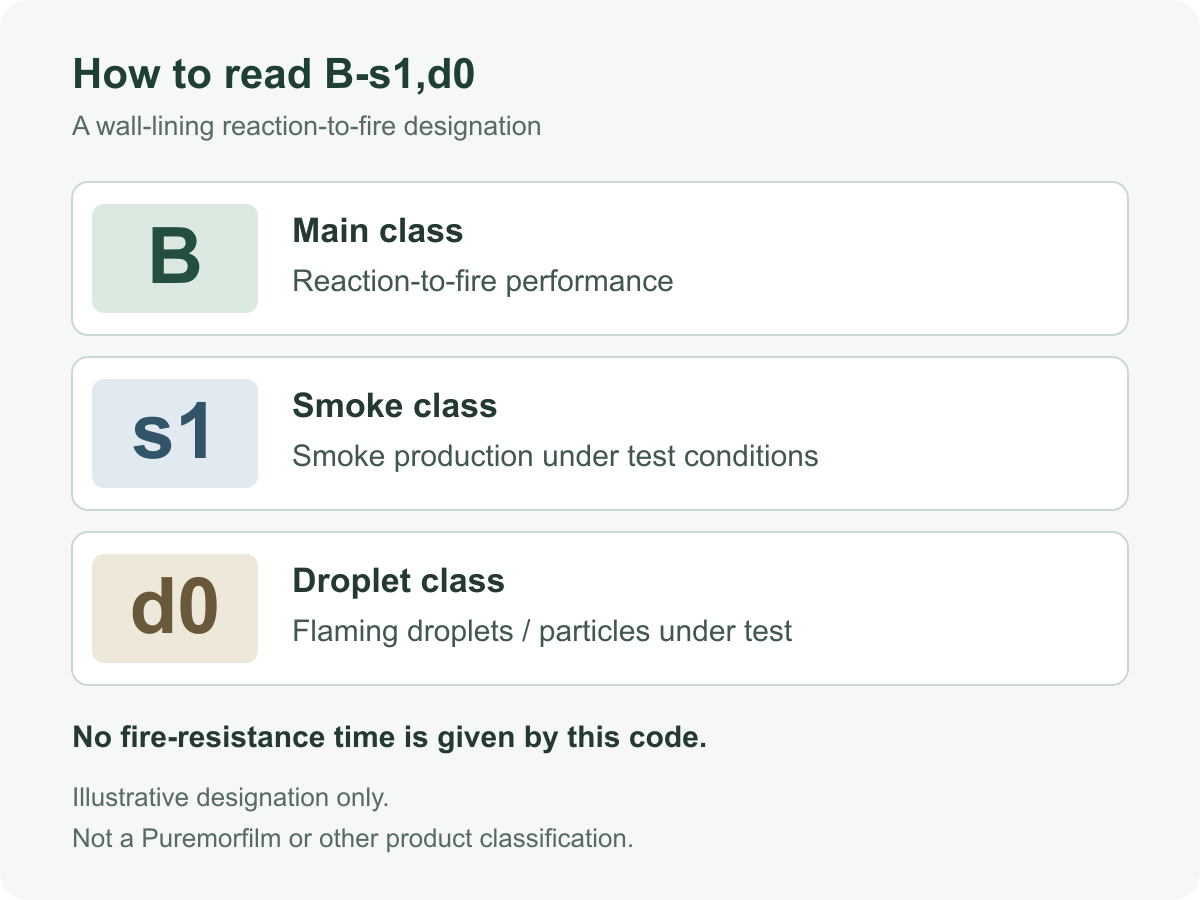
Illustrative code only. This diagram is not a product classification or test report.
Why can the same facing have a different panel rating?
The facing is tested in a construction and mounting arrangement, so changing the core, adhesive, joint or installation can change the scope of the result. A classification of one build cannot be calculated by adding or averaging the classes of its separate layers.
The RISE SBI test description explains that the test evaluates heat release, smoke, flame spread and burning droplets or particles. The specimen should represent the intended mounting, including relevant joints, substrate and possible air gaps. The exposed face is only one part of that arrangement.
For a film-faced board, identify the decorative film, bonding layer and core together. A paper-faced mineral board and a film-faced wood-based board are different constructions, even if the finish colour matches. The MDF wall-panel guide addresses that substrate choice; the fire classification still has to cover the proposed build.
Installation belongs in the comparison too. Direct bonding to a solid substrate and fixing over an air space are different end-use conditions. Open joints, exposed edges and the fixing arrangement also need to match the applicable evidence. Their effect cannot be settled by a sample’s appearance or by a generic claim that the face is flame-retardant.
Keep this distinction when substituting a finish. If you change a face, core or adhesive after approval, the question is whether the new combination remains inside the documented scope. The colour approval can remain visually useful while the fire-evidence review has to be reopened.
What does the classification report actually cover?
A classification report connects a named product and defined construction to a classification and a field of application. Read those together: the class identifies the outcome, while the field of application defines the variations and end uses for which that outcome is supported.
The government’s FAQ 18 on reaction-to-fire scope warns that the same material can achieve different classifications with different forms, fixings, orientations and substrates. It directs designers to examine the field of application and the tested jointing, mounting and fixing methods. Although the FAQ appears under an external-fire heading, its explanation concerns the scope of BS EN 13501-1 evidence.
A single test specimen is not necessarily the entire permitted range. A report may state covered thicknesses, substrates or installation variations. Use the range actually stated, rather than rejecting every difference automatically or assuming every difference is harmless. Where the proposed end use falls outside that scope, obtain an adequately supported assessment from competent professionals or the appropriate further evidence.
Separate the supporting test results from the classification document. A photograph of a specimen, a laboratory booking or an isolated result from one method does not establish that a complete classification has been assigned. The government explanation describes classification as drawing on multiple test outcomes, including the SBI test where relevant.
For your project file, record the report reference beside the exact finish construction. That makes later substitutions visible. The millwork submittal guide explains how to keep material descriptions, samples and drawings connected; the fire document must identify the same proposed work.
Can ASTM E84 or UL 94 be converted to a Euroclass?
No. An ASTM E84 result or a UL 94 plastics rating does not supply an EN 13501-1 classification. The methods examine different exposures and report different outcomes, so a familiar letter or rating cannot be used as a conversion formula.
| Reference | Question the evidence addresses | Why it cannot replace a wall-lining Euroclass |
|---|---|---|
| EN 13501-1 | Reaction-to-fire classification from the relevant test data | This is the required classification system when the project specifies it; check the applicable product scope |
| ASTM E84 | Comparative surface flame spread and smoke development under its tunnel exposure | The indices are not EN smoke suffixes or EN main classes |
| UL 94 | Small-scale flammability of plastic materials for parts in devices and appliances | The scope does not cover building wall or floor coverings |
| EN 13501-2 | Fire-resistance classification for building elements using the relevant test data | A time-related element classification answers a different question from lining reaction to fire |
ASTM’s public E84 scope describes a specimen tested face-down in the ceiling position and reports flame-spread and smoke-developed indices. ASTM also cautions that flame spread alone cannot define a material as non-combustible. Neither index establishes an EN classification. The ASTM E84 Class A explanation covers that separate system in more detail.
UL’s published standard scope identifies UL 94 as small-scale testing for plastics in devices and appliances and excludes building finishing materials such as wall coverings. A plastics rating may be relevant elsewhere in a specification, but it does not qualify an interior wall lining under EN 13501-1.
If a supplier offers one of these reports instead of the requested classification, keep the evidence under its correct name and resolve the missing EN evidence. Do not relabel “Class A” as A1 or describe a plastics rating as a classified wall panel.
Which documents should you check before buying wall panels?
Check that the supplied product, the classification and the proposed installation are traceable to one another. A complete file lets you verify the claim and control substitutions; the presence of a report number alone does not establish a suitable construction.
For a film-faced panel order, the useful checks are:
- Identify the classification document, issuer, date, standard edition and full class, with all referenced pages or annexes needed to understand its scope.
- Match the supplied product designation and covered variations to the face, core, thickness and bonding construction being offered.
- Compare the field of application with the substrate, fixing, joints, air space and orientation shown in the project details.
- Record the required class for the actual location, the applicable guidance or specification and the accepted basis for any variation.
- Carry the accepted construction into the order and installation information, with a clear process for reviewing changes.
These are practical reading checks, not a substitute list of every field a standard or product regulation may require. The supplier evaluation checklist covers the wider supplier decision. Here, the task is to establish that the particular lining claim has evidence relevant to the proposed wall.
A later change should be explicit. If a fabricator proposes a different board or adhesive, identify what changed and compare it with the accepted field of application before treating the original classification as still applicable. A revised drawing and an unchanged marketing datasheet can otherwise describe different constructions.
How should you choose evidence for your wall-panel project?
Choose the required performance for the panel’s actual location, then match the classified construction and field of application to the design. For an England project using Approved Document B, start with the correct volume and current applicable provisions; a class is not a universal approval for every room, corridor or building.
The following two examples come from Approved Document B Volume 2, paragraph 6.1 and Table 6.1, for buildings other than dwellings in England. They are examples of lining guidance, not a complete specification.
| England Volume 2 example | Table 6.1 lining classification | Boundary of the example |
|---|---|---|
| A space within the “other rooms” category, including garages | C-s3,d2 | Confirm that the space falls within this category and check the surrounding provisions |
| A space within the “other circulation spaces” category | B-s3,d2 | Read note 1: qualifying BS EN 15102 wallcoverings of at least C-s3,d2 bonded to an A2-s3,d2 substrate are also accepted by that note |
Do not apply those rows to all UK projects or omit other provisions relevant to the design. The official publication page identifies the England scope and the two volumes. Its collated PDFs include future amendments; read the commencement and transitional notes instead of treating every collated page as already in force.
Puremorfilm currently has no EN 13501 classification report. We manufacture silicone decorative film in China with a silicone functional face on a PET support film. Flame retardancy is a film-level property in our specification; that statement does not establish a Euroclass for a film-faced board or an installed wall.
We supply rolls without self-adhesive backing for PUR flat lamination, or laminated panels quoted per project. The intended uses are furniture fronts, cabinet doors and wall panels in vertical or low-wear positions, excluding floors, countertops, stovetops and other walked-on surfaces. A project requiring an EN-classified panel needs applicable evidence before a construction using our film can be presented as meeting that requirement.
Understand the face and support layers before evaluating a panel construction.
For a film or panel enquiry, contact Puremorfilm with the wall location, required classification and proposed construction. Furniture and wall decorative-film rolls start at 500 m; laminated panels are 1220 × 2440 mm with a minimum of 200 sheets, quoted per project. A quotation or appearance sample does not close the classification gap.
Frequently Asked Questions
Does B-s1,d0 mean a wall will resist fire for 60 minutes?
No. B-s1,d0 is a reaction-to-fire designation, including smoke and droplet classifications. A time-rated wall function requires separate fire-resistance evidence for the relevant building element.
Is BS EN 13501-1 the UK version of EN 13501-1?
Yes. The BS prefix identifies the British adoption. The applicable UK nation’s building guidance and the project’s requirements still determine the performance needed for the proposed location.
Can a classified film give any board the same rating?
No. The field of application must support the proposed face, substrate, bonding construction and installation. A result for one combination cannot automatically be transferred to another board.
Is ASTM E84 Class A equivalent to Euroclass A1?
No. The names belong to different systems with different tests and criteria. An E84 report cannot be relabelled as an EN 13501-1 classification.
Does Puremorfilm have an EN 13501 classification report?
No. Puremorfilm currently has no EN 13501 classification report. Our film-level flame-retardant specification does not establish an EN-classified panel or installed wall.