
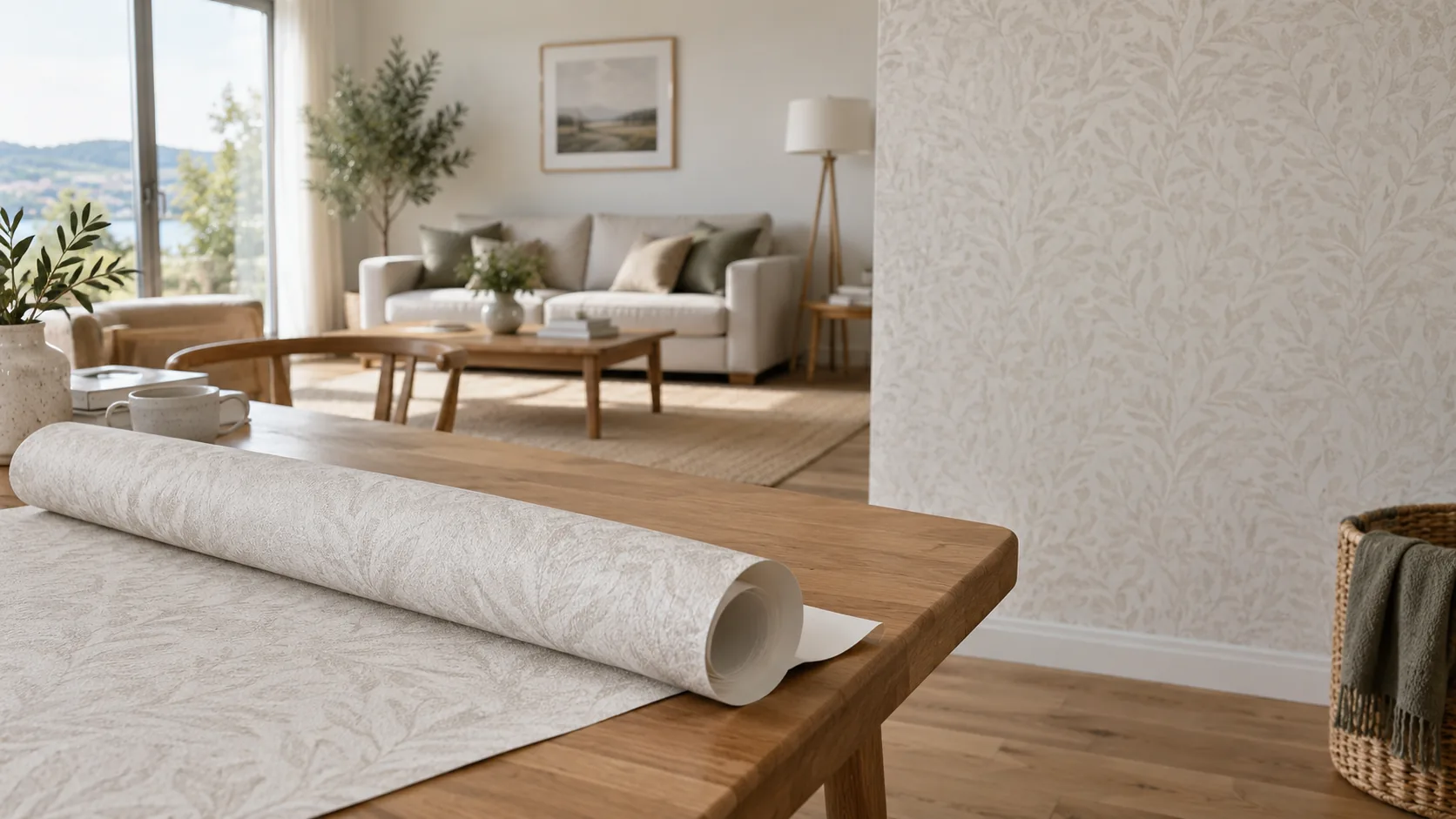
Vinyl wallpaper is a wallcovering with a vinyl (PVC) face bonded to a paper or fabric backing, usually built from three parts: the decoration, an intermediate layer and the backing. The Wallcovering Installers Association calls solid-sheet vinyl generally the most durable wallcovering category. It suits washable walls in kitchens, hallways and the drier parts of a bathroom, but ordinary vinyl wallpaper stays outside the shower.
What Is Vinyl Wallpaper Made Of?
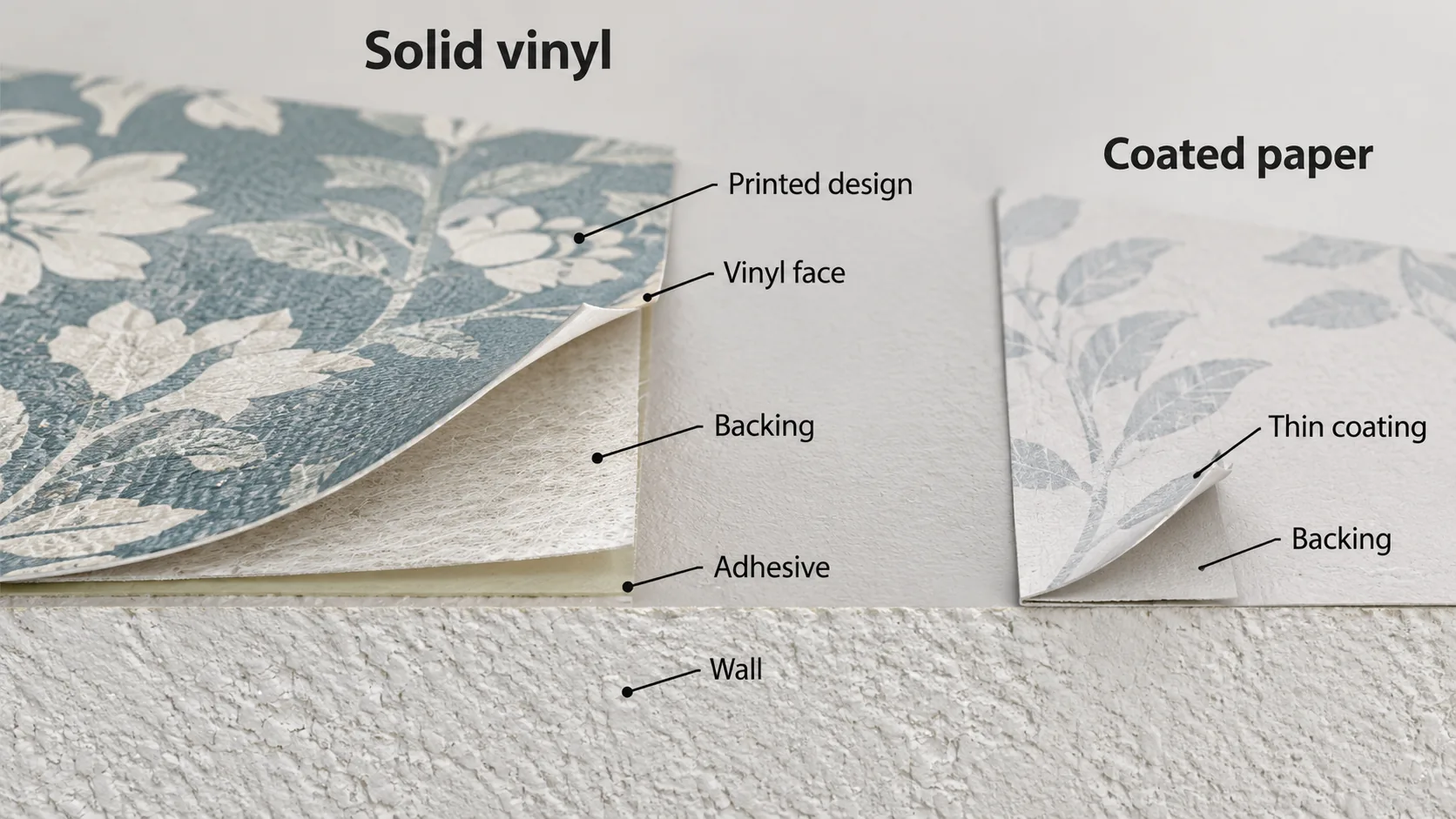
A decorative vinyl face on a backing that takes the wall adhesive. The print or embossing gives the look, the vinyl is the surface you touch and clean, and the paper or fabric behind it makes it hangable. Backings range from nonwoven fabric to woven scrim or heavier cloth.
The WIA dictionary defines solid vinyl as a vinyl film laminated onto paper or fabric. That’s different from coated paper, which has only a thin applied coating and feels and wears differently. Put a solid vinyl face on a nonwoven backing and the surface still barely lets moisture through.
An undated historical Wallcoverings Association/CFFA industry white paper describes many wallcoverings as decorative, intermediate “ground” and backing layers, with the ground layer ranging from less than 1 mil to 20 mils thick. In practice, read the construction and cleaning label on the actual roll.
To see how vinyl wallpaper compares with paint, panels and other wall finishes, see the types of wall coverings.
What Are the Main Types of Vinyl Wallpaper?
Vinyl-coated paper, paper-backed solid vinyl, fabric-backed vinyl, expanded vinyl and peel-and-stick vinyl. The face decides most of the cleaning behavior; the backing and adhesive decide how it hangs and comes off. On a product listing, “vinyl-coated” and “solid vinyl” are not the same thing.
| Type | Construction | Cleaning and durability | Typical use | Removal label to check |
|---|---|---|---|---|
| Vinyl-coated paper | Thin coating on paper | Lighter product; cleaning varies with coating | Lower-contact decorative walls | Strippable or peelable |
| Paper-backed solid vinyl | Vinyl sheet laminated to paper | Durable face; check washable or scrubbable rating | Kitchens, halls and suitable bathroom walls | Face may peel away from backing |
| Fabric-backed vinyl | Solid vinyl face on woven or nonwoven fabric | Stronger construction for repeated contact | Corridors and busy interiors | Product-specific strippability |
| Expanded or blown vinyl | Heat-expanded vinyl creates raised texture | Texture and cleaning method vary | Embossed decorative walls | Strippable or peelable, as labeled |
| Peel-and-stick vinyl | Decorative vinyl with pressure-sensitive adhesive | Wall compatibility affects adhesion | Accent walls and temporary changes | Removable does not mean reusable |
“Vinyl-coated paper” is a looser label than it sounds. The dictionary describes it as acrylic-coated paper and criticizes the name, while the WA/CFFA paper says such coatings can be acrylic or PVC. Read the material description, not just the category name.
Peel-and-stick options vary too. In Urbanwalls’ June 2024 product comparison, its standard matte vinyl uses overlapping seams, while its fabric-reinforced textured version uses butt joints and is sold for rougher surfaces. Other brands differ, and rough brick or damaged plaster still needs a product rated for it.
What Do Commercial Type I, II and III Mean?
They’re weight and performance classes, not colors or sheens. The historical WA/CFFA Table B-1 puts Type I at 10–19.5 oz per linear yard, Type II at 19.6–32 oz and Type III at 33 oz and above, citing CCC-W-408D and CFFA-W-101D. A separate CFFA row lists minimum weights of 10.5, 19.5 and 33 oz per linear yard at 54 inches wide.
The same paper places Type I in lighter-duty rooms and Type II in busier lobbies, corridors and classrooms. These are historical figures that explain the names; if the rating matters for your project, ask for the product’s own type declaration.
How Is Vinyl Wallpaper Different From Paper Wallpaper?
Solid vinyl gives you a tougher, more washable face; paper, light coatings and nonwovens give a different feel and let the wall breathe more. Don’t judge by looks: vinyl can be embossed to imitate fabric.
| Feature | Solid vinyl | Vinyl-coated paper | Uncoated paper | Nonwoven without a solid vinyl face |
|---|---|---|---|---|
| Exposed surface | Solid vinyl film | Light applied coating | Printed paper | Fiber-based material |
| Feel | Flexible sheet; may be smooth or embossed | Lighter and more paper-like | Thin or fibrous | Textile-like fiber structure |
| Cleaning | Washable or scrubbable if labeled | Limited by the coating | Often delicate; avoid wet cleaning unless allowed | Product-specific washable options |
| Grease and splashes | Usually better resistance at the face | Less substantial surface protection | Greater sensitivity | Check the actual finish |
| Moisture vapor | Conventional solid vinyl has low permeability | WIA lists coated paper as breathable | Varies with construction | Often breathable without an impermeable face |
| Removal | Strippable or peelable | Product-specific | Often easier to remove, but thin and more fragile | Many labeled products remove in larger sheets |
The tradeoff shows up when you take it down. Non-vinyl paper wallpaper is thinner and more fragile than vinyl but easier to remove, according to DeccoPrint’s vinyl and non-vinyl explanation. For walls you’ll clean often, the dictionary definitions and M. Brett Painting’s 2015 wallpaper overview both point to a suitable vinyl face. That older article also describes nonwovens as washable, breathable and removable in larger sheets; check a current label before assuming the same of a new product.
On price, HomeGuide’s September 2025 cost guide puts vinyl materials at $0.75–$1.70 per square foot or $20–$50 per roll, before hanging. Roll coverage varies, and a heavy commercial fabric-backed covering will price differently from a paper-backed one.
Is Vinyl Wallpaper the Same as PVC Wallpaper?
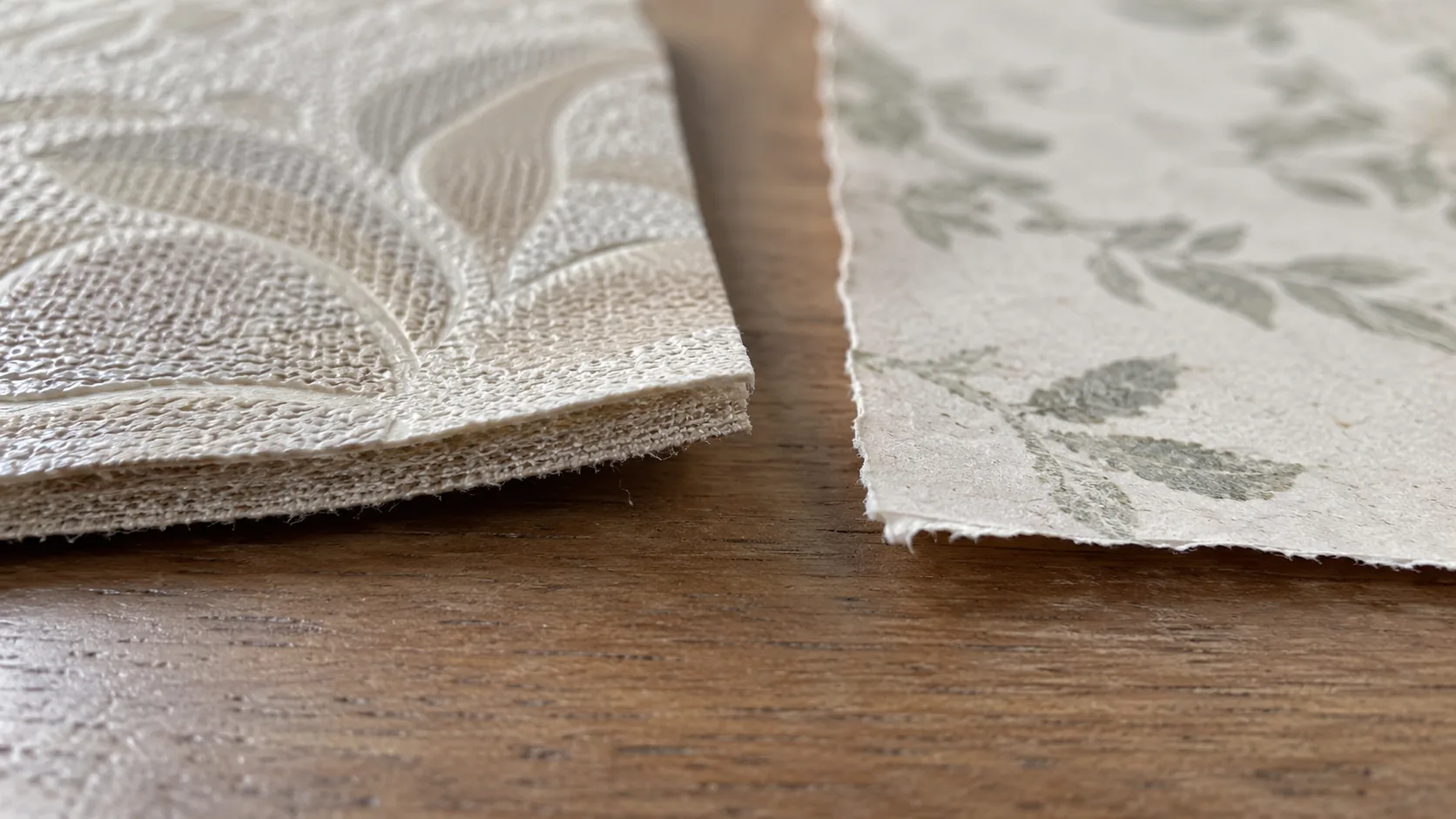
Yes. In wallcoverings, vinyl means PVC, or polyvinyl chloride; the Vinyl Institute’s explanation of production uses both names for the same polymer. What differs between products is the construction, not the plastic.
A solid vinyl sheet on fabric, a PVC-coated paper and a lightly acrylic-coated paper are three different products. A listing titled “PVC wallpaper” is naming the polymer; one titled “vinyl wallpaper” is usually describing the decorative face. Neither title tells you as much as the layer description.
PVC is also used as a panel-facing film rather than a wallcovering; our PET vs PVC decorative film comparison covers that use.
When you shop, check four things: solid vinyl or coated paper, the backing, how it’s pasted, and its cleaning rating. That also keeps it distinct from rigid PVC wall panels, which are a different installed product.
Is Vinyl Wallpaper a Good Choice?
Yes, wherever walls collect fingerprints, grease or light splashes. A washable or scrubbable vinyl face makes routine cleaning easy. On a bedroom wall nobody touches, you may care more about texture, breathability or easy removal.
The cleaning labels mean specific things. In the dictionary’s definitions, washable means a sponge, water and a mild or prescribed detergent; scrubbable allows a brush with a prescribed detergent solution. Neither label covers every strong cleaner, and raised patterns hold dirt differently from smooth faces.
The main caution is moisture inside the wall. The historical white paper discusses mold behind low-permeability coverings in humid-climate buildings where moisture got into the wall assembly. A thick vinyl face slows drying toward the room, so fix leaks and check a damp exterior wall before you choose a covering.
Some early “microvented” products addressed this with about 135 holes per square inch and 8–12 perms, according to the same paper, which warns against microventing vinyl-coated paper, paper-backed vinyl and nonwoven-backed vinyl. For other ways to finish a wall, our wall panel materials guide compares the categories; no finish fixes a moisture problem.
Can You Use Vinyl Wallpaper in a Bathroom or Kitchen?
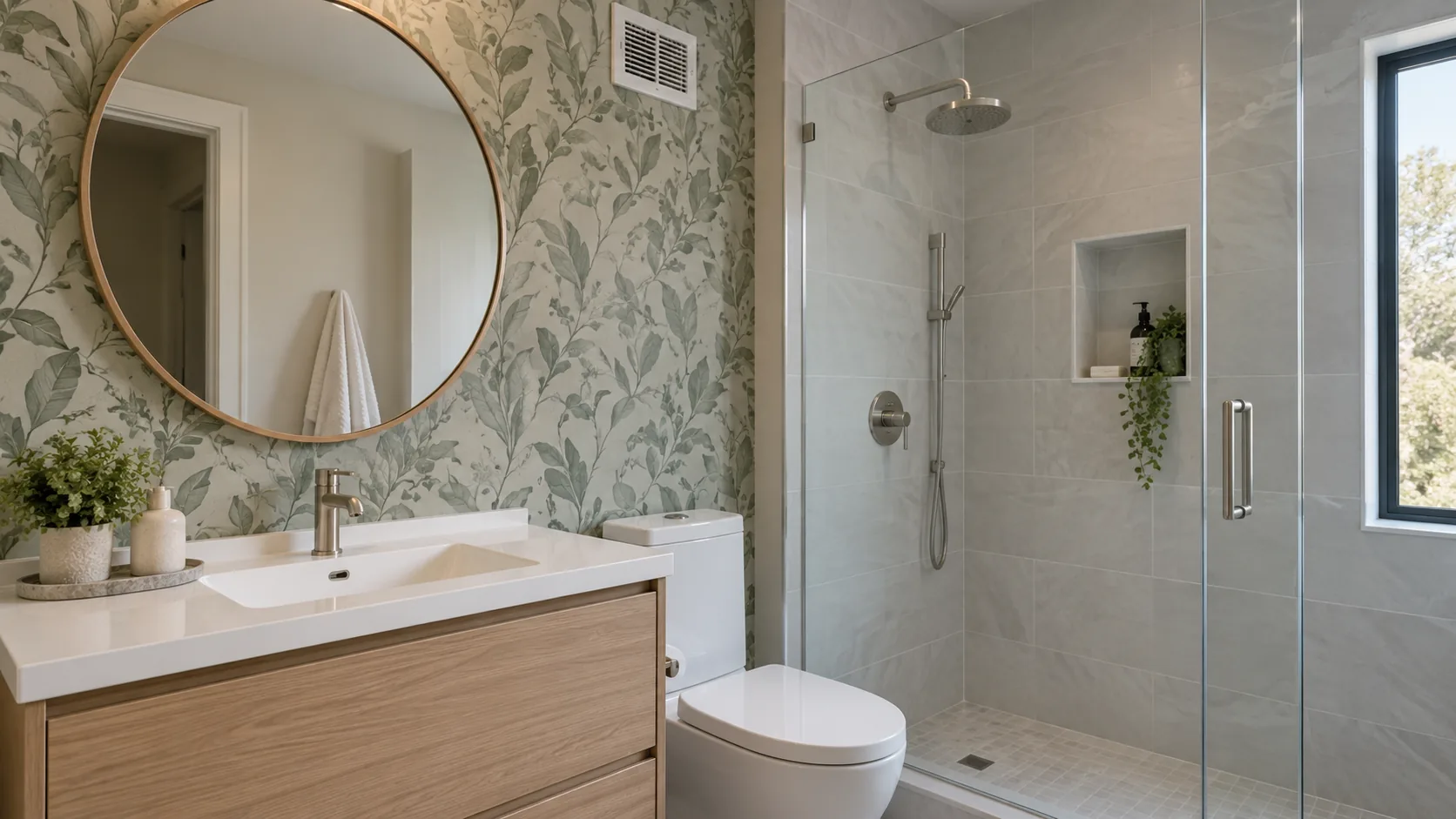
Yes, on a ventilated wall away from direct shower spray and standing water. The face shrugs off light splashes and wipes clean. The weak points are the edges, seams, adhesive and backing, which can’t take persistent wetting.
So put it behind a dining area, or on a bathroom wall separate from the shower. Inside the shower, use tile or a panel system designed for direct water, with properly sealed joints.
The EPA’s mold guidance recommends drying wet materials within 24–48 hours and controlling moisture at its source. Run the fan, fix leaks first, then redecorate. The preservative in wallpaper paste protects the paste in its tub; it does nothing for moisture after installation.
Use an adhesive and preparation system that suits the backing. And on an exterior wall that keeps getting condensation or damp, find the cause and make sure the wall can still dry before covering it in low-permeability vinyl.
How Do You Hang and Remove Vinyl Wallpaper?
On a clean, dry, smooth and sound wall, using the preparation and adhesive specified for that backing. Repair holes, remove grease and loose paint, and prime if the system calls for it. Pasted, prepasted and peel-and-stick products each have their own instructions.
Here’s what one real adhesive requires. ROMAN PRO-880’s June 6, 2023 technical sheet calls for room temperature above 50°F and undiluted use for Type II and III coverings; lightweight and prepasted materials can take up to one pint of water per gallon. It covers up to approximately 330 square feet per gallon, depending on the wall and covering.
For fabric-backed vinyl on bare drywall, the same sheet says no primer is needed and gives strippability after six weeks of cure, for that combination specifically. Whatever you hang, an installer quoted in Angi’s comparison recommends leaving unpacked wallpaper in the room for at least 24 hours first.
Removal depends on the label. “Strippable” comes off dry in one layer with little residue; “peelable” means the decorative face comes away and leaves the backing on the wall, which you then remove with the adhesive before refinishing. Benjamin Moore’s removal tutorial allows one to two working days for a standard 12-by-12-foot room.
Where Does a PVC-Free Silicone Wall Film Fit?
If you want a decorated wall without PVC, a factory-finished panel is another route. Puremorfilm makes silicone-faced decorative film for wall panels; our wall film contains no PVC, uses a No DOP formulation and is formaldehyde-free. It’s laminated flat onto panels with PUR adhesive.
The silicone surface is inherently flame-retardant; higher grades up to UL 94 V-0 are available on request. In the manufacturer’s laboratory tests, coffee, red wine, soy sauce and lipstick left for 24 hours at 25°C wiped off with no obvious change.
It also holds its size. SGS tested a submitted film sample on August 26, 2026: after 600 minutes at 100°C and 14 hours of recovery at room temperature, length changed by 0.06% and width by 0.10%.
We mainly supply rolls and can supply film-faced panels on request. Our decorative wall film is a paint-free finish with a silicone functional face, distinct from PVC, melamine, PP and PETG decorative faces. It isn’t for floors, shower floors, cooktop countertops or anything walked on.
Compare the panel routes in the guide to wall panel materials.
Explore the decorative wall film for panel facing.
Is Vinyl Wallpaper Right for Your Room?
Choose solid vinyl where walls get touched and cleaned a lot; choose lighter paper or nonwoven where they don’t and you prefer the look. Either way, check the full construction and labels, and keep ordinary wallpaper out of the shower.
| Room or condition | Useful starting point | What needs checking |
|---|---|---|
| Busy hallway or children’s room | Scrubbable solid vinyl | Face rating and adhesive compatibility |
| Ventilated kitchen or bathroom dry wall | Suitable washable vinyl | Splash limits, ventilation and seams |
| Low-contact bedroom or study | Coated paper or nonwoven | Actual coating, breathability and removal label |
| Temporary rental accent | Compatible peel-and-stick vinyl | Lease permission and underlying paint condition |
| Damp exterior wall in a humid climate | Resolve moisture before covering | Wall drying route and product permeability |
| Shower enclosure | A dedicated tile or shower-panel system | Waterproofing and installed joints |
- Identify the face and backing, then decide whether the room needs a washable or scrubbable surface.
- Check moisture exposure and the adhesive system before selecting a covering. Keep ordinary wallpaper outside the shower.
- Compare actual roll coverage, preparation and removal requirements before buying.
For a factory-finished wall-panel alternative, contact us with the room, approximate dimensions and the texture you want.
Frequently Asked Questions
Does vinyl wallpaper look shiny?
No, not necessarily. Vinyl wallpaper comes in matte as well as shinier finishes; Urbanwalls’ standard adhesive vinyl is matte, and its textured option looks like canvas. Check a sample, because “vinyl” says nothing about gloss.
What is vinyl commonly used for?
Vinyl, or PVC, is a plastic used in pipes, flooring, window frames and wallcoverings, as well as medical tubing, electrical products and packaging, according to the Vinyl Institute. In wallpaper, it’s the decorative face on a backing.
Is vinyl wallpaper waterproof?
No. Ordinary vinyl wallpaper resists water on its face, but water can get in at the seams and edges and reach the backing and adhesive. Keep it away from surfaces the shower hits directly.
What is vinyl wallpaper called?
Depending on construction, solid vinyl, paper-backed vinyl, fabric-backed vinyl or PVC wallpaper. “Vinyl-coated paper” is a lighter category and may actually have an acrylic coating, so check the material description.
How much does vinyl wallpaper cost?
Vinyl wallpaper materials average $0.75–$1.70 per square foot or $20–$50 per roll in HomeGuide’s September 2025 guide. Roll size, construction and design change the price, installation and preparation are extra, and heavy fabric-backed products need their own quote.