
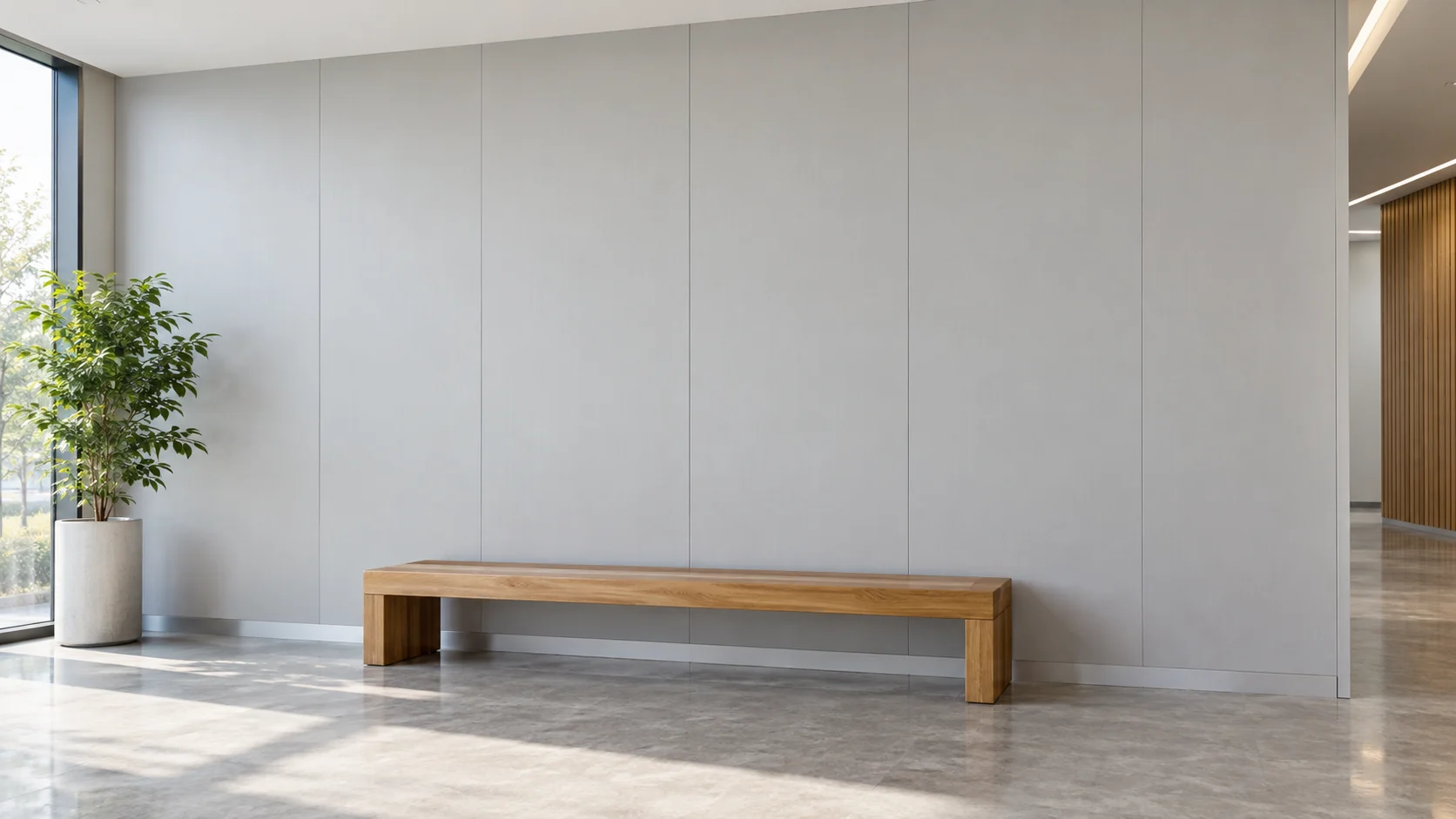
PVC wall panels pros and cons depend on the construction and installation: a finished, moisture-tolerant face can reduce decorating work and simplify wiping, while heat exposure, variable impact resistance, visible joints and replacement access limit the choice. Wet areas also need suitable backing, sealed interfaces and system details.
What are the main advantages and disadvantages of PVC wall panels?
The main advantage is a finished, moisture-tolerant face; the main drawbacks are heat sensitivity, impact strength that varies by product, and the extra detailing joints and edges need.
| Decision check | Advantage | Disadvantage or buying consideration |
|---|---|---|
| View the finished face | Colour and texture arrive on the panel | Repeating patterns, gloss and visible trims may look less convincing in a large area |
| Locate water exposure | PVC is used in applications that handle water and chemicals | Corners, penetrations and the backing still need a suitable wet-area design |
| Check handling and layout | Large pieces reduce the number of small units to position | Large pieces need access, support and accurate cutting around fittings |
| Identify likely knocks | The chosen compound and profile can suit ordinary interior use | Thin skins, unsupported areas and exposed edges need scrutiny where knocks are likely |
| Match finish and cleaning | A smooth face gives you accessible surfaces to wipe | Deep grooves and incompatible cleaners can complicate maintenance |
| Plan replacement access | Individual panels can form a replaceable facing | Adhesive, interlocking edges and discontinued patterns may complicate replacement |
PVC is polyvinyl chloride, also called vinyl. ECVM’s PVC overview describes it as a thermoplastic processed with additives to produce compounds for different applications, including pipes and wall coverings. The exposed finish and complete panel still need their own cleaning instructions.
Start with the room’s toughest exposure. A reception feature wall, a shower enclosure and a corridor that carts bump into ask very different things of the same material name.
To compare panels with the other wall finish categories, see the types of wall coverings.
How do hollow panels differ from solid sheets and faced boards?
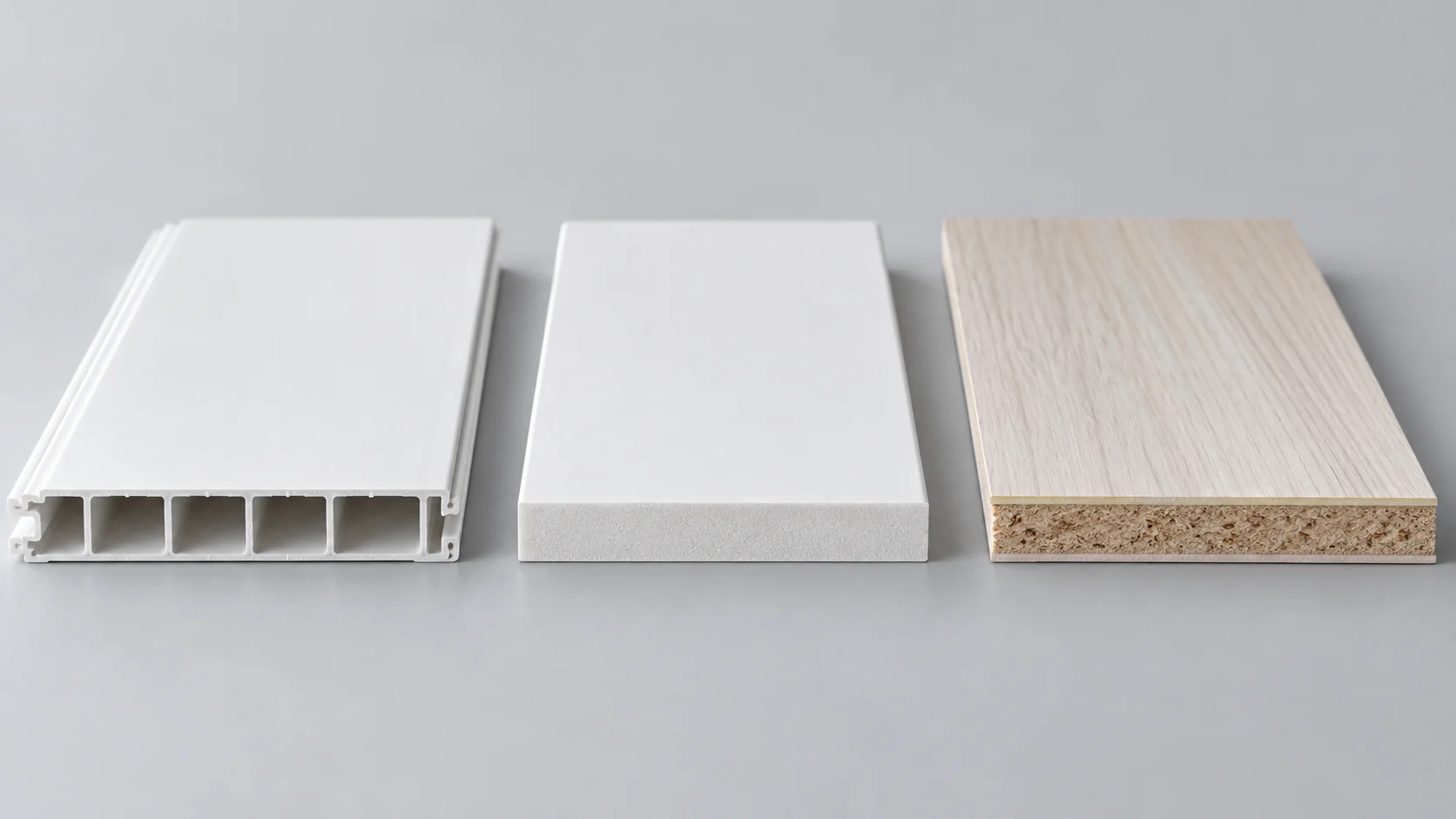
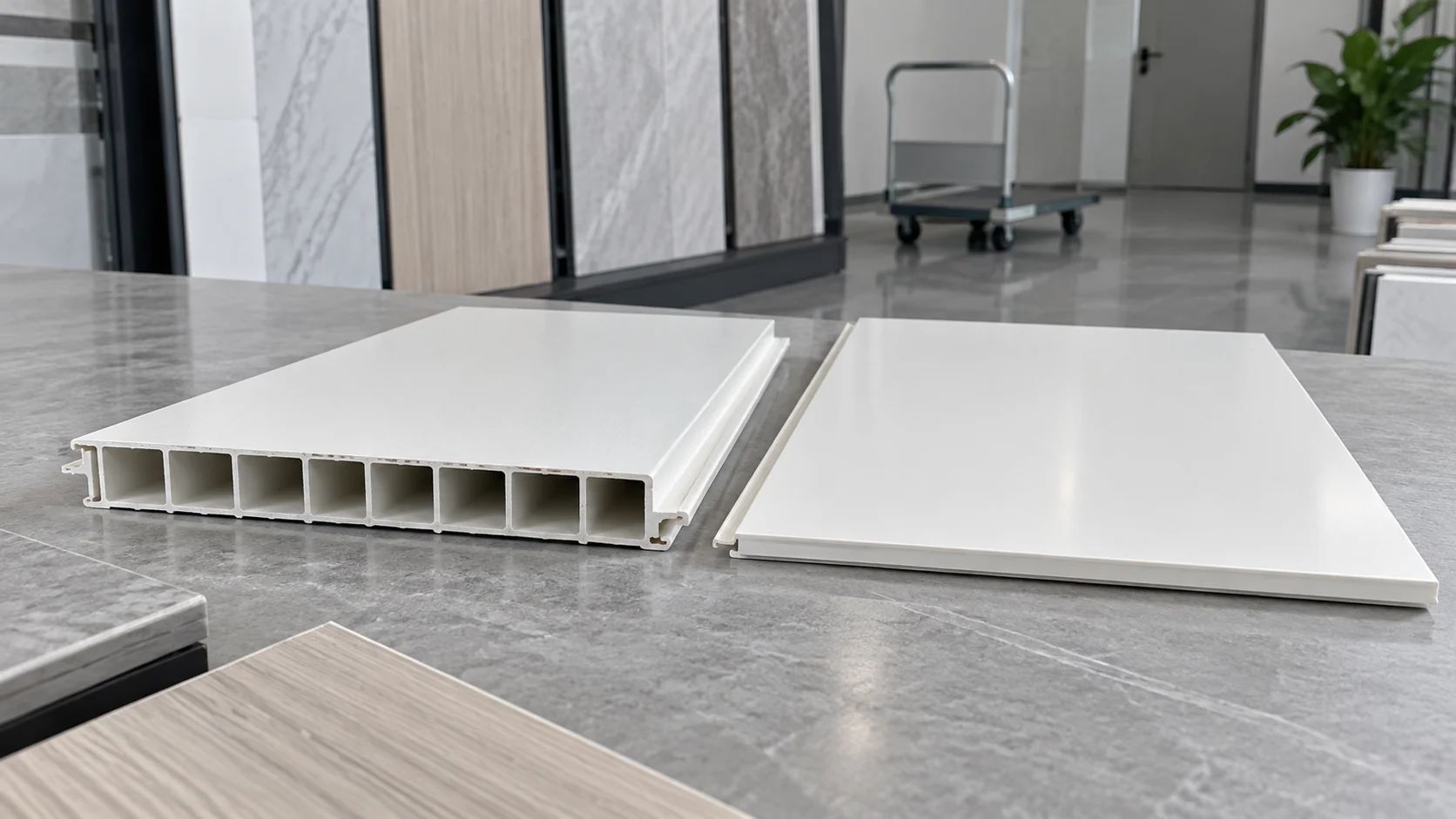
By what’s inside. Hollow panels have open chambers between their faces, solid sheets have a continuous plastic section, and faced boards put a decorative surface on a different core.
Look at a cut edge instead of a woodgrain or stone-effect photo. A hollow profile shows chambers and ribs; a sheet shows a continuous section, which may be compact or foamed; a laminate shows a facing bonded to its board. Those differences tell you what needs support and what a damaged edge will expose.
Nominal thickness can mislead. A thick hollow profile and a thinner compact sheet have different cross-sections, so thickness can’t rank them for impact or fixings. Note the face, section and proposed backing when you compare samples. A towel rail or shelf needs a fixing route into a support that can carry it, and a nice decorative face tells you little about that.
Rigid PVC also differs from soft vinyl coverings. PVC is naturally rigid at room temperature, and plasticisers make it flexible. Check which construction and compound you are buying before you borrow claims from a soft covering for a rigid panel.
Our laminated MDF explanation shows how a decorative face and a wood-based board do different jobs. The cut edge tells you what sits under a PVC-looking surface.
Are PVC wall panels suitable for bathrooms and other wet areas?
Yes, when the system you choose covers the water it will actually see, including its joints, penetrations and backing.
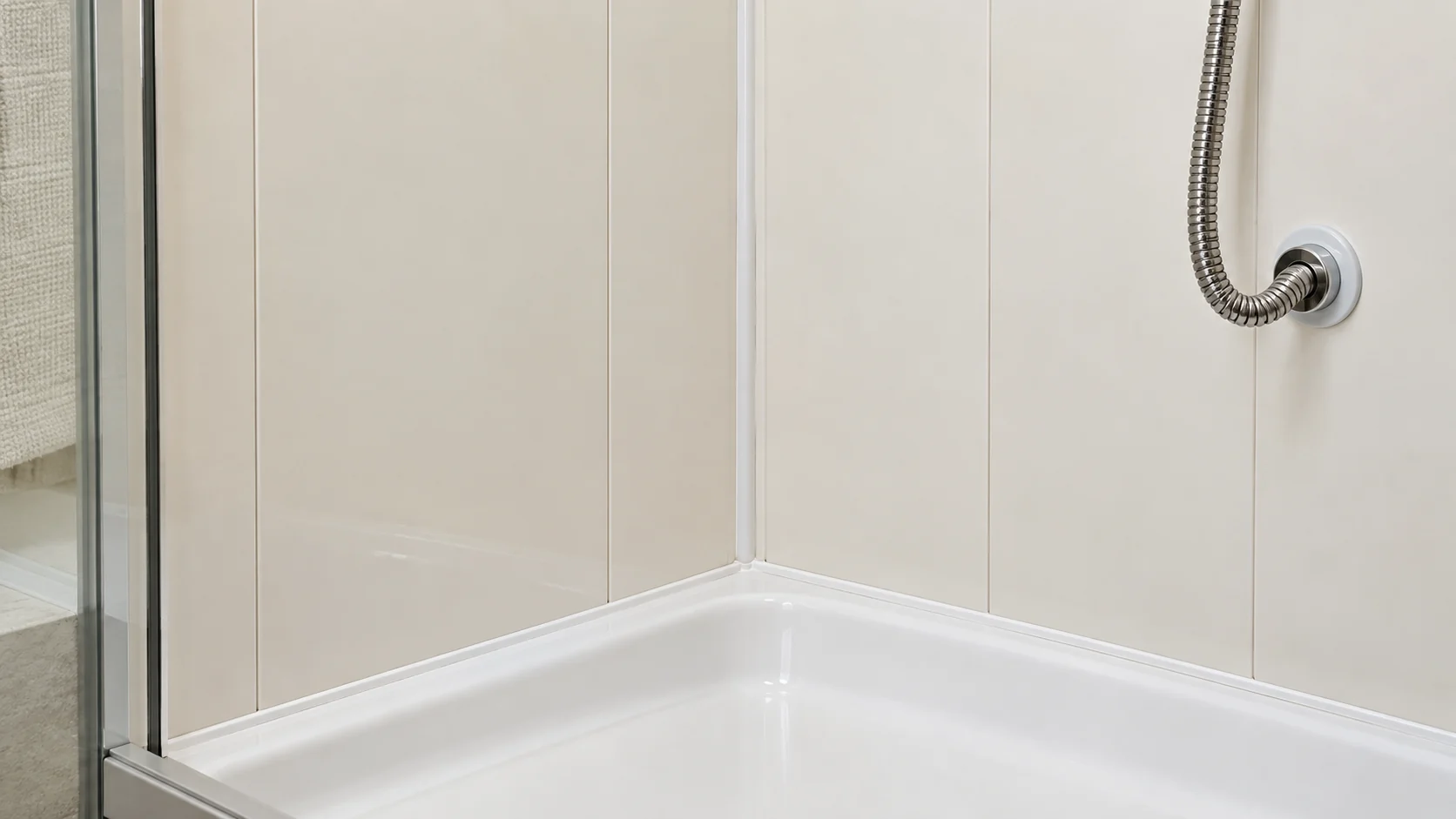
Trace where the water goes. On an open wall beside a basin, splashes hit the face and lower edge. Inside a shower, water also reaches corners, pipe openings, fittings and the joint with the tray. Ask for the system’s details for those spots; a dry-room decorative panel with matching trim tells you far less than a documented shower-wall system.
Investigate an existing damp wall before you cover it. Moisture control is central to controlling mold, and growth can hide behind paneling. Covering stains only changes what you can see; fixing the leak and checking the backing deals with the moisture.
So a dry substrate and a sound water-management design matter more than the word “waterproof.” Include the base junction and access for future plumbing work in your review, because a neat face can hide a failed joint behind a fitting.
If you are weighing PVC against a decorative wood-based board, read whether MDF is waterproof before trusting a moisture-resistant board with sustained wetting. Settle the wet-area construction first, then choose its finish.
What should you expect from appearance and cleaning?
A convincing colour or texture, with cleaning set by the exposed finish and the room’s routine.
View a joined sample in the room’s own light. A small sample can hide a repeated vein, a visible joint or a reflection that becomes distracting across a full wall. Look along the surface as well as straight at it. Raised profiles also create recesses a flat sample can’t show, so judge the design together with the cleaning it will need.
Find out whether the face is bare plastic, a printed coating or a bonded decorative layer, because a cleaner that suits one can mark another. PVC resists many chemicals but is vulnerable to certain solvents, and a printed or laminated face adds another material for the cleaner to touch.
Before you buy, get a care sheet naming the finish and the permitted cleaners, and compare it with what the room already uses. That matters most where staff use disinfectants or degrease often, as in a café kitchen: a product with a documented cleaning routine is easier to specify than one simply called “easy-clean.”
For a separate facing option, see the decorative film for wall panels.
How should you judge heat resistance and impact damage?
Use PVC where documented product use matches the heat and impact the wall will see, and switch to a dedicated lining around strong heat sources or constant hard knocks.
PVC is a thermoplastic, so heat can soften it, as ECVM’s material overview explains. Beside a stove, heater or other concentrated heat source, use a lining specified for that appliance location and its clearances, and keep ordinary decorative cladding out of that zone unless its documentation covers the use. A ceramic or metal face also needs a suitable backing and installation detail; swapping the visible material alone doesn’t settle the clearances.
For impact, compare evidence for the section you will actually install. The D5420 falling-weight test ranks flat, rigid plastic specimens by the energy needed to crack or break them under set conditions, so read any impact claim with its specimen, test method and support arrangement.
A corridor with trolleys needs a panel or wall-protection system tested for that service, with protected corners. On a quiet feature wall, finish quality and joint appearance may matter more. Hollow profiles deserve a close look wherever a sharp object could strike the face between ribs; a cut sample shows the construction, and the test shows the performance.
Check the replacement sequence too. Pulling out one damaged panel is a very different job from dismantling an interlocked run.
What do fire, indoor-air and recycling claims really tell you?
Much less than the evidence behind them. Fire reports, emissions data and a working recovery route tell you more than calling a PVC panel “fireproof,” “non-toxic” or “eco-friendly.”
For fire, match the report to the proposed face, thickness, backing and mounting. ASTM E84 measures comparative surface flame spread and smoke development under its set exposure. Fire resistance of a separating wall is an assembly question that needs assembly evidence, so choose a documented wall construction when the project calls for a rated partition, and have the project team confirm which finish classification applies to the room and exit route.
Indoor air depends on everything installed together. Finishes, adhesives, sealants and composite wood are all possible sources of indoor emissions. For an occupied room, ask for emissions evidence that names the panel or facing, and pick adhesives and sealants whose application and ventilation instructions fit. A resin name, or the absence of one additive, can’t describe the emissions of the whole installation.
PVC can be recycled, but local acceptance decides what happens to your old panels. The Vinyl Institute’s recycling directory lets you search by location and product type. Before you specify recycled content or plan end-of-life recovery, find a facility that accepts the actual material, coatings and adhesive residue included.
When should you consider wood, MDF, FRP, acrylic or tile?
Wood or MDF for a dry decorative wall, FRP or acrylic systems for documented cleaning and exposure needs, and tile where a hard mineral finish suits the design.
| Alternative | Reason to consider it | What to compare with the PVC proposal |
|---|---|---|
| Solid wood or veneer | Real wood grain and a finish selected for the intended room | Wood movement, finish maintenance, edge detailing and repair access |
| MDF with a decorative face | A flat, consistently finished dry-interior panel | Core grade, exposed edges, fixing support and moisture exposure |
| FRP panel system | A fibre-reinforced polymer option worth evaluating for service interiors | Documented cleaning compatibility, joints, fire evidence and impact testing |
| Acrylic panel system | A particular colour, gloss or visual depth | Scratch care, support, wet-area details and replacement method |
| Ceramic or porcelain tile system | A hard mineral face and a familiar modular layout | Backing, joints, grout maintenance, cutting and installed labour |
| Painted drywall | A continuous dry-room finish with repainting access | Preparation, cleaning needs, damage repair and complete installed cost |
FRP is fibre-reinforced polymer, in which the reinforcement and resin work together. WPC is wood-plastic composite, a wood component mixed with thermoplastic, and its constituents and processing shape the result. Wood reinforcement can stiffen a continuous plastic matrix, but judge that benefit in the finished profile with its intended backing and exposure.
For a wood-look decision, our wood veneer versus laminate comparison covers real wood and manufactured decorative faces. Keep that choice tied to the room’s exposure instead of picking a whole wall from a grain photo.
Compare quotes for the same finished area, with preparation, trims, joints, adhesive, access and disposal included. A low panel price can be wiped out by major backing repairs or an awkward replacement route.
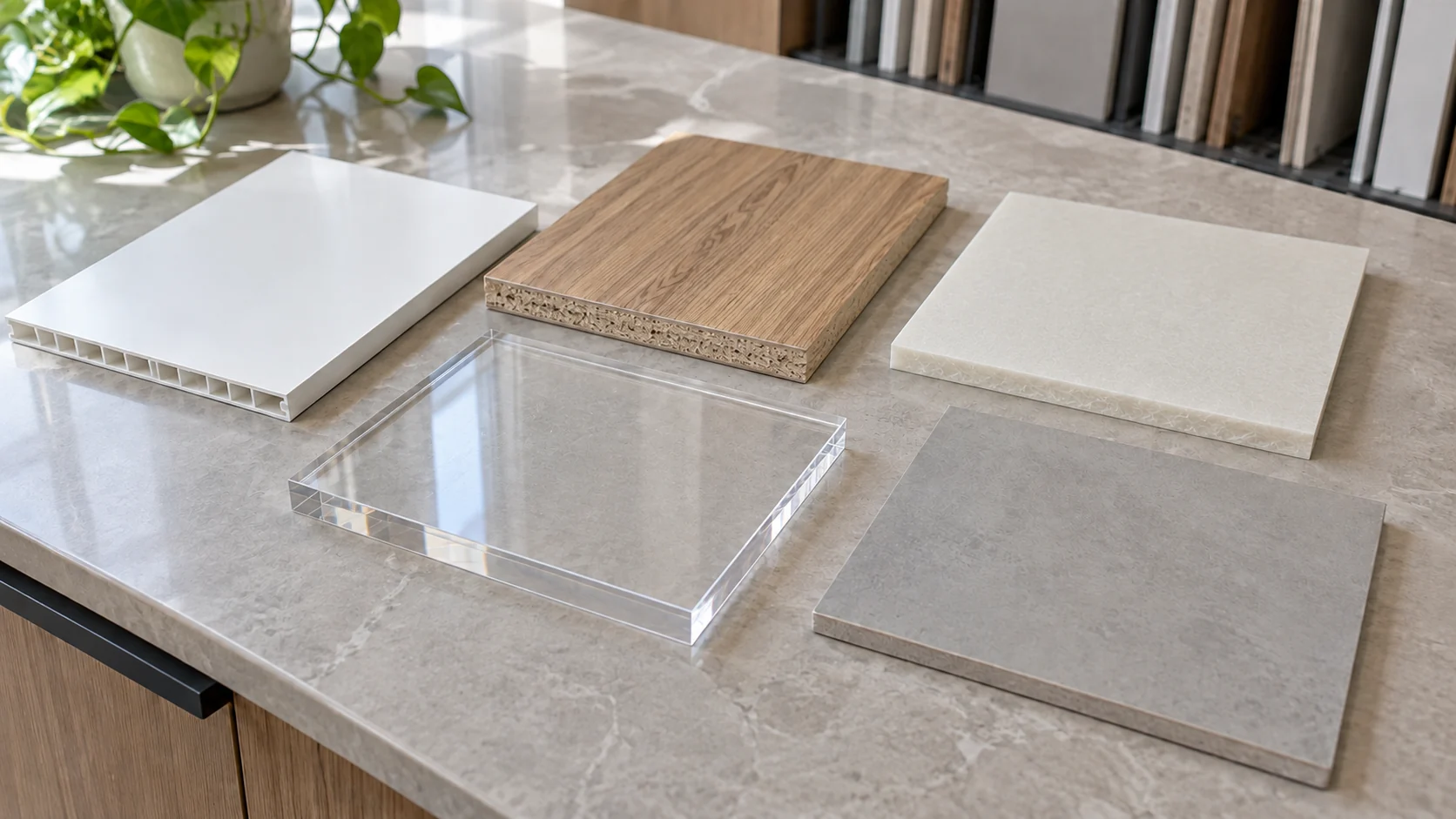
The wall panel materials comparison covers the wider shortlist.
Can you install PVC wall panels yourself?
Yes, many interlocking PVC wall panel and cladding systems are designed for DIY installation, which is one of their main advantages over tile. The usual steps are:
- Check the wall. It should be sound, flat and dry. Fix leaks or damp first; panels hide moisture problems rather than solve them.
- Choose the fixing method the maker specifies, typically battens with clips or screws, or a compatible panel adhesive on a flat wall.
- Cut with simple tools. A fine-tooth saw or a sharp utility knife is usually enough; cut openings for sockets and pipes before fitting.
- Leave expansion gaps at ceilings, floors and corners, because PVC expands and contracts with temperature, and cover them with the system’s trims.
- Seal wet areas at trims, joints and around fittings with the sealant the maker recommends.
Follow the manufacturer’s instructions for the specific panel, and for commercial or rental spaces check local fire and building rules before installing.
What should go into a PVC wall-panel purchase specification?
The exact construction, exposed finish, installation details and evidence for the room’s hardest exposures, all before you compare prices.
| Item | What to specify | Why |
|---|---|---|
| Panel identity | Product reference, compound category and hollow, compact, foamed or faced construction | Keeps quotations tied to the same physical product |
| Visible finish | Colour, texture, gloss, pattern layout and joined-sample appearance | Makes joints and repeated designs reviewable before installation |
| Support and attachments | Backing, fixing route and support for wall accessories | Connects the facing with the parts carrying the loads |
| Wet-area details | Intended location, corners, penetrations and base junction | Addresses the routes water can take through the completed wall |
| Heat and impact exposure | Actual location and relevant product or assembly evidence | Links selection to the service conditions |
| Fire and emissions evidence | Report identity, specimen construction and proposed installation materials | Makes the evidence applicable to the submitted construction |
| Maintenance and repair | Finish-specific care, compatible cleaning and panel replacement sequence | Establishes how the wall will be maintained after handover |
| Recovery and cost | Accepted waste route and price for the complete installed scope | Allows comparable commercial and disposal decisions |
Take units and tolerances from the chosen product’s drawings wherever dimensions control the installation. The useful figure is the one that answers your layout question: coverage width for quantities, total build-up for clearances, or fastening position for support. Thickness alone answers none of them.
If you are comparing a fabricated faced board with a PVC profile, our MDF lamination guide explains the bonded-board route. Price and check it as a separate proposal, especially at edges and openings.
Where does our silicone surface film fit in this decision?
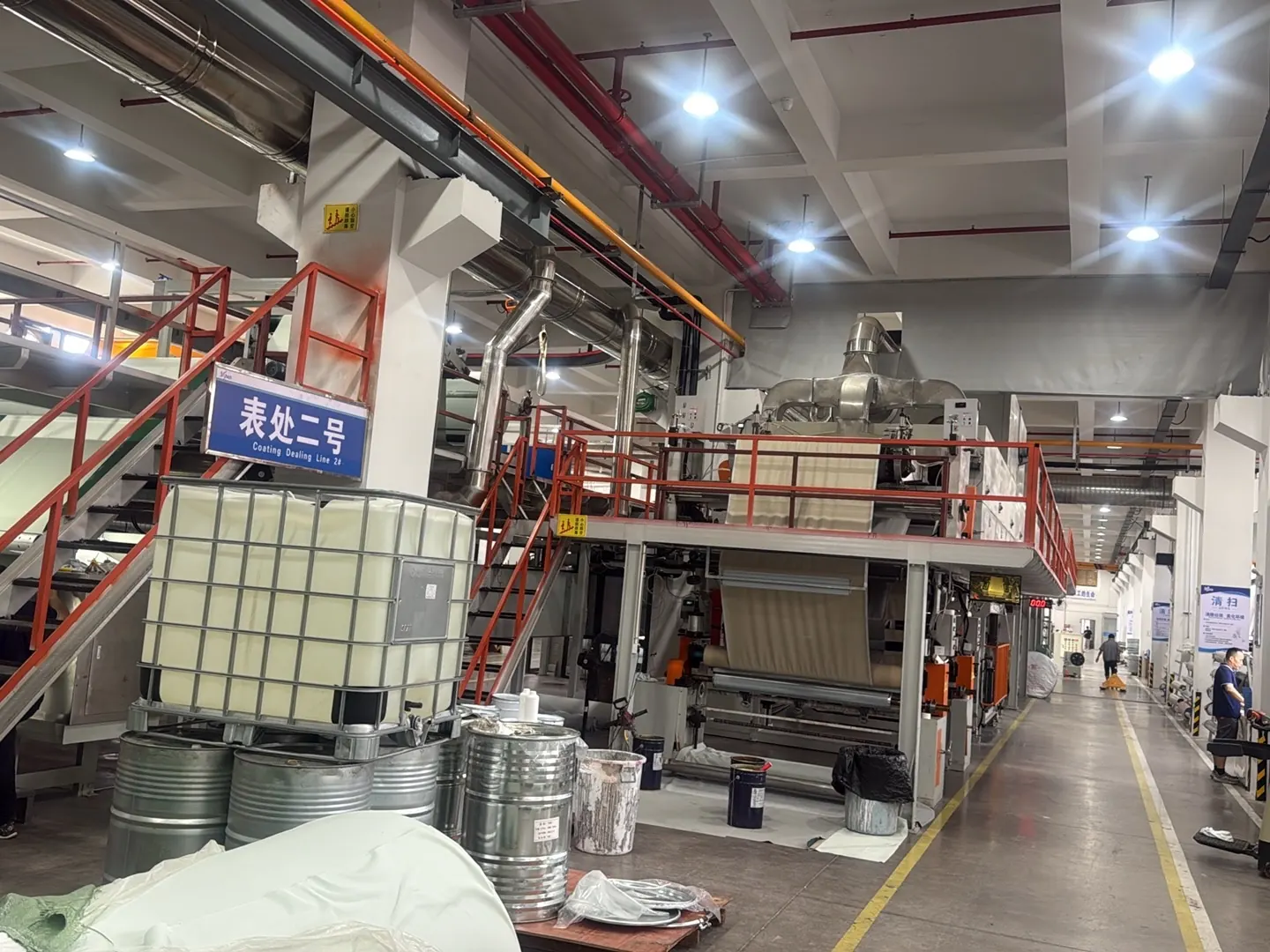
As a non-PVC face for flat wall boards. Puremorfilm makes decorative film with a silicone functional surface, and our wall film contains no PVC, uses a No DOP formulation and is formaldehyde-free. Assess the board and adhesive separately. Flame-retardant properties are standard for the film; a required fire rating needs evidence for the proposed grade and complete panel construction. In the manufacturer’s laboratory tests, coffee, red wine and soy sauce left on the surface for 24 hours at 25°C wiped off with no obvious change. An SGS Taber abrasion test on the submitted film sample (ASTM D4060-25, CS-10 wheels, 1,000 g per wheel, 60 rpm) found only slight matting after 2,000 cycles. Apply this result only to the tested film sample under those conditions; evaluate the assembled wall separately.
We mainly supply rolls, with film-faced boards on request, for PUR flat lamination onto flat boards. The film is unsuitable for floors, worktops, stove tops, shower floors and other walked-on areas. It is a new paint-free facing, a different surface from PVC, melamine, PP and PETG. The decorative wall film and wood grain decorative film pages show the range.
Which wall-panel choice should you make for your room?
A documented PVC system for an ordinary interior, a complete wet-area system for direct water, and a purpose-specified lining wherever heat or repeated hard impact drives the decision.
- Dry decorative wall: compare PVC’s finish and joints with wood, MDF and painted drywall.
- Shower: select the water-management construction before the pattern.
- Service corridor: prioritize relevant impact evidence and local replacement access.
To talk through the room, board and finish you have in mind, contact us.
Frequently Asked Questions
Is PVC wall cheaper than drywall?
No, not automatically. Compare the same finished area with preparation, finishing, trims, adhesive, labour and disposal included; comparing sheet prices alone can point you the wrong way.
Which is better, PVC or WPC?
A documented PVC wet-area system for a wet wall; WPC for a dry wall where a wood-filled profile’s stiffness helps the design. A WPC system with documented wet-area details can also go on the wet-wall shortlist, so compare the finished section, support and moisture evidence.
What are the disadvantages of using wall panels?
Visible joints, extra cutting around fittings, added wall thickness and harder replacement of a single damaged panel. PVC can also soften under heat and needs impact evidence for busy areas.
Are PVC wall panels suitable for bathrooms?
Yes, when the system supports the bathroom exposure. A shower needs details for the backing, corners, penetrations and base junction, and any existing damp has to be fixed before it is covered.
Are PVC wall panels easy to maintain?
Yes, smooth PVC wall panels are generally easy to wipe clean. Deep profiles, grooves and incompatible cleaners make upkeep harder, so follow the care routine for your finish.
Are PVC wall panels any good?
Yes, for the right room. PVC wall panels are good value for bathrooms, utility rooms, garages and commercial back-of-house walls because they are waterproof on the face, quick to install and easy to wipe clean. They are less suitable where you want a premium look, near strong heat, or where knocks are frequent, because the plastic can dent, scratch or warp.