
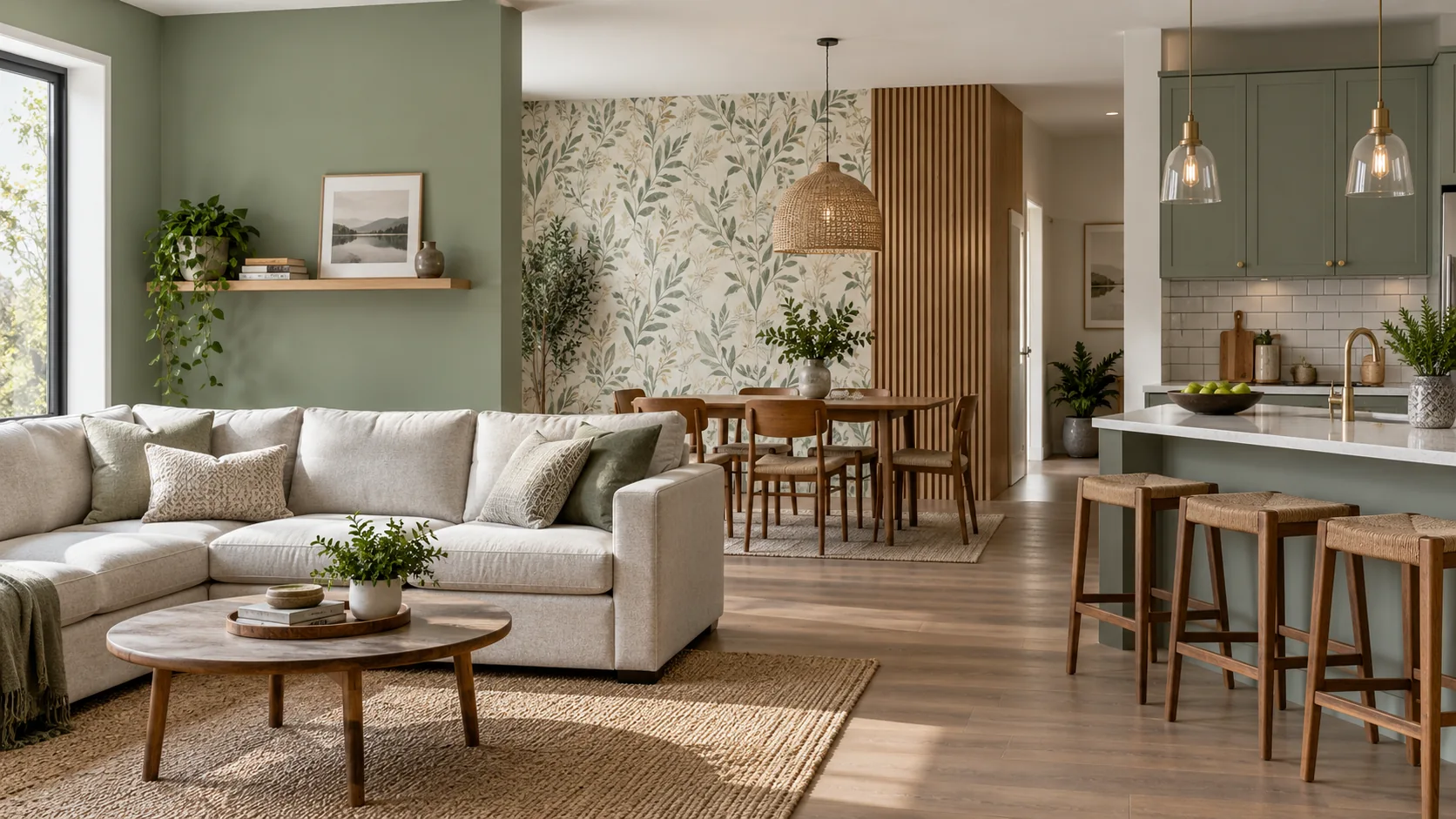
The main types of wall coverings are paint, wallpaper, wall panels, tile and stone, and fabric or acoustic panels. For a dry room, Angi’s July 2026 comparison suggests repainting every three to five years versus around 15 years for traditional wallpaper. A hallway that collects handprints needs a different finish from a sheltered bedroom feature wall.
Start with the room’s moisture, contact and cleaning, then choose the appearance. Wallpaper includes paper, non-woven, vinyl, grasscloth and self-adhesive constructions; panels can combine a decorative face with a different core. This guide covers interior walls. Exterior siding needs a separate weather-resistant construction.
| Type | What it is | Best for | Think twice when |
|---|---|---|---|
| Paint | A coating applied to a prepared wall | Changing color and making local repairs | You want deep texture or a printed scene |
| Paper, non-woven or grasscloth wallpaper | A decorative sheet with a backing | Pattern and texture on sheltered walls | Frequent scrubbing or water will reach the face |
| Vinyl wallcovering | A vinyl face or coating on a backing | Wipeable patterns in busy rooms | The location receives direct shower spray |
| Peel-and-stick wallpaper | A sheet with pressure-sensitive adhesive | A temporary accent on a compatible surface | The wall is textured, damp or poorly bonded |
| Wood and MDF panels | Timber or a wood-based core with a finish | Relief, framed designs and coordinated millwork | Moisture reaches vulnerable edges |
| PVC and other plastic panels | Manufactured sheets or profiles | Finished surfaces with a defined care routine | Heat or hard impacts exceed the product’s intended use |
| Tile and stone | Individual hard pieces fixed to a backing | Wet-area systems and mineral textures | Joint cleaning or disruptive replacement is unwelcome |
| Fabric and acoustic panels | Textile-faced or other absorptive constructions | Softer appearance and reduced room reflections | You need to stop sound through a shared wall |
| Film-faced panels | A decorative film bonded onto board | Repeatable color and texture on flat panels | You need an unsupported film to act as a wall system |
What counts as a wall covering?
A wall covering is the visible finish added to a wall: a coating, a decorative sheet, a fixed panel or a tile-and-stone finish. The choice changes what you see, touch and clean.
Think of a wall in layers. Paint forms a coating on the prepared surface. Wallpaper adds a decorative sheet and adhesive. Paneling brings a face, a core or profile, and a fixing arrangement. Tile brings individual pieces, joints and a backing designed for their location. A wood-look surface could therefore be timber, a printed panel or a wallpaper pattern, with very different edges and installation work.
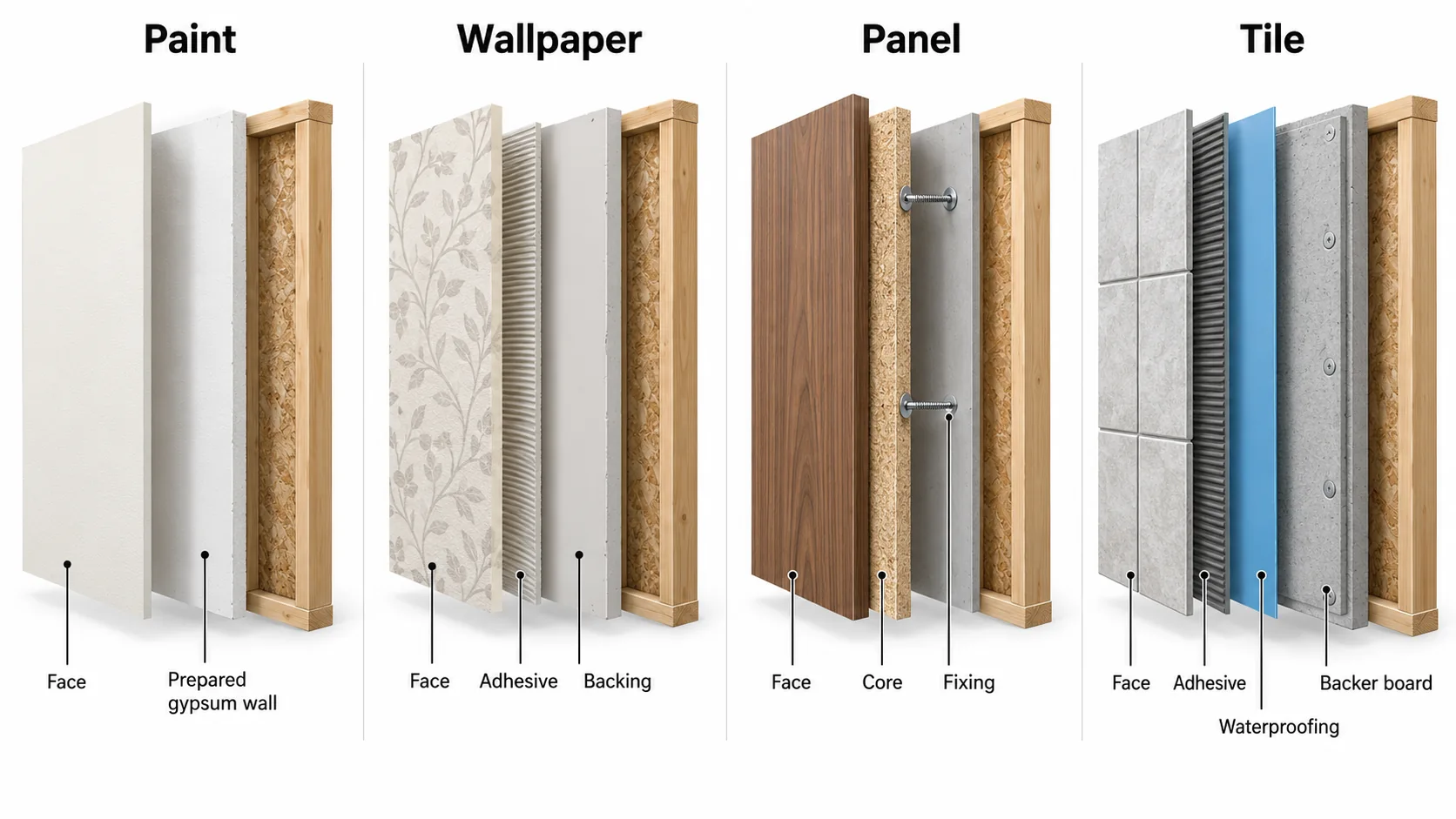
The finish also has to fit the construction behind it. A shower needs a water-managed assembly; a room-separating wall needs the appropriate construction for privacy. Fire resistance works the same way: the rating belongs to the specified assembly, not to the face you see.
For a living-room update, pick the surface effect first, then look at an edge and a joint. They show whether you are buying a coating, a sheet or a panel, and what a future repair will look like.
When is paint the best wall covering?
Paint, whenever you want cheap color changes, easy DIY work and a wall you can touch up in one spot. It keeps the wall simple and lets furniture, art and lighting do the decorating.
The material gap is wide. Angi’s July 31, 2026 comparison lists about $0.12 per square foot for DIY paint materials against $1–$5 for wallpaper materials. Preparation, tools and hired labor come on top of both.
Sheen changes the result too. A low sheen hides small wall flaws; a shinier one shows every patch under side light. Flat finishes and finishes made for frequent cleaning suit different rooms, so use a paint labeled for kitchens or bathrooms where steam and splashes are daily.
Hiring a wallpaper installer moves the job into another budget: $4–$10 per square foot, materials included, in HomeGuide’s September 2, 2025 estimate. Our wallpaper vs paint comparison sets the two side by side on cost, lifespan and repairs.
Which types of wallpaper can you choose from?
Paper, non-woven, vinyl and woven grasscloth or textile, each sold unpasted, prepasted or self-adhesive. The pattern name tells you nothing about cleaning or removal; the face, backing and adhesive do.
Paper carries the print. Non-woven is a backing made from bonded fibers. Grasscloth and other woven faces add real fibers and variation, so save them for a bedroom or dining-room accent that nobody needs to scrub. Vinyl is the washable route, covered in the next section.
Read the label before you buy. Prepasted sheets are activated with water, unpasted ones need separate adhesive and self-adhesive ones need neither, in the Wallcoverings Association’s label definitions. Removal terms differ too: a peelable product leaves its backing on the wall, while a strippable one comes away with little residue. Backing constructions explain much of that difference.
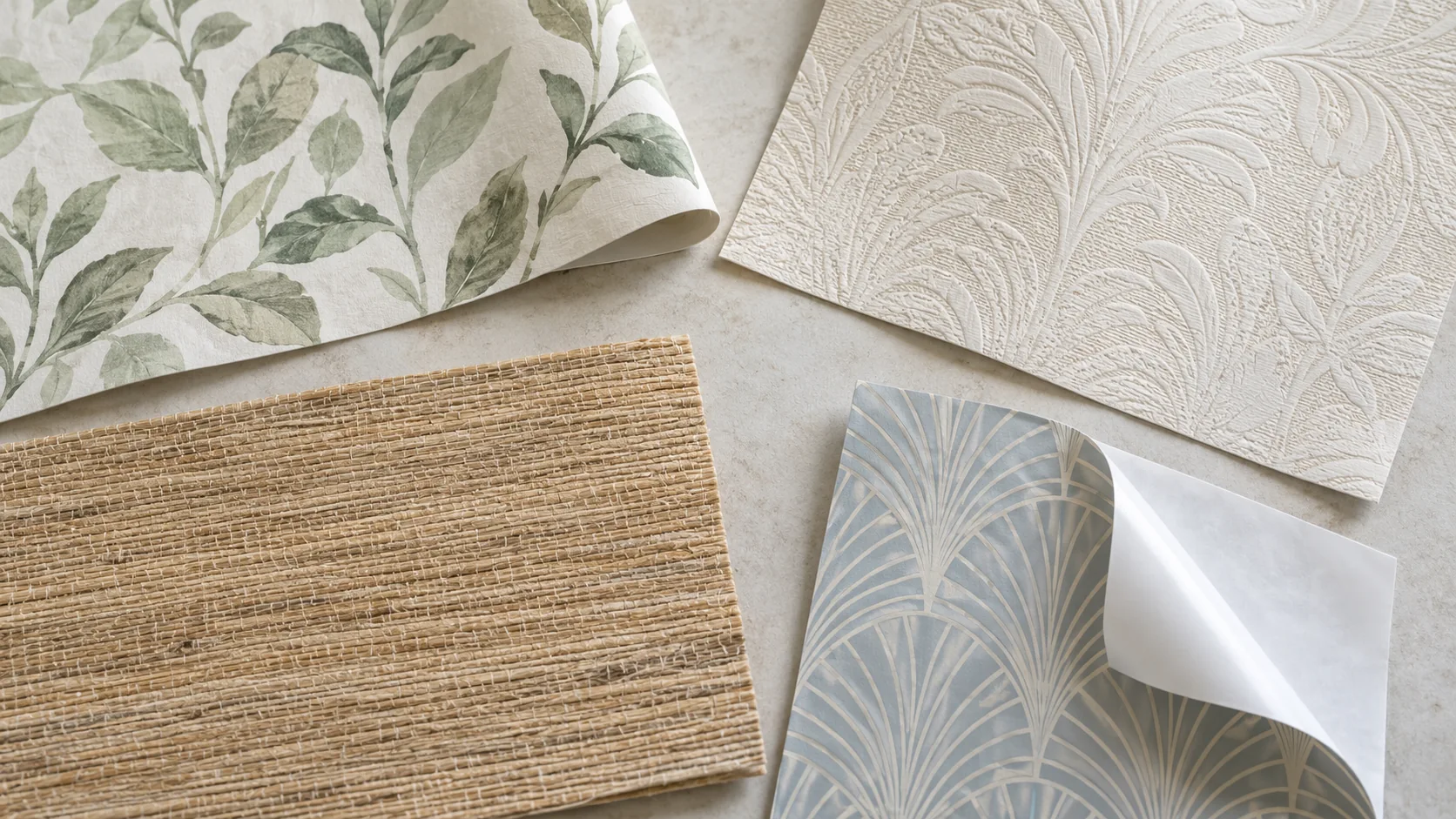
Peel-and-stick suits a temporary accent on a smooth, sound wall, such as a rental bedroom. It typically lasts about five years and lifts at the edges more readily than pasted paper, in an August 4, 2026 comparison. Try a sample on the actual wall first, including taking it off, if you need the paint underneath to survive.
For a closer comparison of the face materials and backings, read our guide to types of wallpaper.
Is vinyl wallpaper the right choice for busy walls?
Yes, for walls that collect handprints and need regular wiping, as long as the spot stays out of direct shower spray.
The decorative face is PVC, commonly called vinyl, on a paper or fabric backing. Solid sheet vinyl laminated to that backing is very durable; a vinyl coating sprayed onto paper is a lighter build. That is why two rolls with similar patterns can carry different care labels.
Check the cleaning label on the actual roll. Washable means it takes occasional sponging; scrubbable means it takes a brush and detergent, by the same label definitions. A breakfast nook is fine with the first. A narrow hallway by a child’s coat hooks is better served by the second, plus some protection from knocks.
The face wipes clean, but seams and corners are where trouble starts. Fix any damp in the wall before hanging it, and in a busy room pick a pattern whose joins still look right up close. Our guide to vinyl wallpaper covers the layer types, where it works and its care limits.
Which wall panel materials should you compare?
Five families: wood-based, plastic or composite, mineral, metal or glass, and acoustic. Within each, separate the visible face from the core behind it, because the face sets the look and the core sets how the panel copes with moisture and fixings.
Wood and wood-based panels are useful starting points for dry decorative rooms. Solid timber gives natural variation; faced boards offer a chosen surface over a manufactured core. MDF, for example, combines wood fibers with a bonding system and has a smooth, uniform face, according to the Composite Panel Association. Paint, veneer or a decorative film can create very different appearances on that core.
Plastic and composite panels arrive as finished sheets or hollow profiles. Mineral panels, metal and glass bring other looks and other fixing needs. Fabric-faced acoustic panels are chosen for measured sound absorption.
At a doorway, compare the finished thickness, the exposed edge and the step to the next wall. A handsome face with a clumsy corner is harder to live with than a plain panel that joins cleanly. The wall panel materials guide compares each family and the evidence each use needs.
Which wall paneling styles are most popular?
Beadboard wainscoting, shiplap, board and batten, wood slats, picture-frame molding and sculptural panels. Pick the pattern for the wall’s proportions and furniture, then a material that suits the room.
Beadboard gives a repeated narrow groove and is often used below a rail. Shiplap creates long horizontal or vertical lines. Board and batten makes a broader grid, while slim slats emphasize direction. Picture-frame molding outlines panels on a wall, and sculptural designs use relief and shadow to create a stronger feature.
Those names describe patterns, not materials. A framed wall might be painted MDF trim; a slatted look might be timber, a faced board or a polymer profile. A printed imitation looks different again at the edge and under side light, so decide whether you want real depth or just the pattern.
For a small bedroom, sketch the bed, switches and panel lines together. For a hallway, look at how the pattern meets door casings and turns a corner. This avoids a narrow leftover strip in a prominent place. The wall paneling ideas guide develops these styles with room examples and color decisions.
Are MDF wall panels a good wall covering?
Yes, on dry interior walls, where its smooth, uniform face takes paint or a decorative facing and machines cleanly into grooves, frames and matching trim.
Painted or factory-faced, the edges, cutouts and joints decide how it ages. A lower wall beside a sink or along the mop route needs more care at those details than a bedroom feature wall, because that is where water gets in.
Moisture-resistant grades exist for humid rooms, but a grade name does not make a shower enclosure. For ordinary decoration, start with a dry, sound wall and fixings suited to the panel’s weight.
In the US, look for the TSCA Title VI label that covered composite wood products carry for formaldehyde emissions. Our MDF wall panels pros and cons guide covers the benefits, limits and the rooms where it works.
When do PVC wall panels make sense?
When you want a factory-finished face that wipes clean and needs no painting on site, in a room without strong heat or hard knocks.
The family includes hollow profiles, solid sheets and boards with a separate decorative face. A hollow section fixes and dents differently from a solid one, so look at a cut end of each sample, not just the face.
FRP, or fiber-reinforced polymer, is a separate plastic-panel family often used in utility and service rooms that need frequent cleaning. Where carts and bags hit the wall, dedicated protection does the job: the federal guide specification for wall and door protection lists protective panels, corner guards and wall guards for those zones.
Near a stove, settle the heat clearances before choosing any plastic facing. In a hallway, think about knocks at the corners. In a bathroom, look at how joints and pipe openings are sealed. The PVC wall panels pros and cons guide explains the profile types and where the limits bite.
When are tile and stone worth the extra work?
When you want a hard mineral face, a detailed tiled pattern or the finish of a shower built as a proper wet-area system, and you accept more preparation, more joints and a harder job if it ever has to come out.
Small tiles follow a detailed pattern; large ones cut the number of visible joints. In a shower, the tile is only the top layer: cement board behind it is water resistant but not waterproof, so it needs a fluid-applied waterproofing or a draining barrier.
Cement grout is porous and can absorb stains, so it needs sealing and regular cleaning, especially around a basin or shower. That joint upkeep is part of owning a tiled wall.
For a stone look on a dry feature wall, compare real stone with stone-look panels at the edge and across the pattern repeat; the colors can match while the constructions differ completely. For a bathroom, the bathroom wall panels vs tiles comparison weighs cost, installation time and upkeep.
Which wall coverings help with noise?
Tested absorptive panels, such as fabric-faced or slatted designs on a porous backing, cut echo inside a room. They do little for voices coming through a shared wall; that needs work on the partition and doors.
An echoing home office needs absorption on the walls where sound bounces. A television heard in the next bedroom is a different problem: absorbing sound in a room and blocking it between rooms are separate strategies.
The face, porous backing, air gap and mounting work together. ASTM C423 measures absorption in a reverberation room, so ask for a report on the same build you will install. Covering an absorptive face with another decorative layer changes that build.
Once the acoustic job is clear, choose the look: fabric panels make a soft feature beside a desk, slats tie in with wood furniture. Keep the face reachable for dusting and the vents and outlets usable. Our hotel wall panels guide goes further into absorption and room-to-room privacy evidence.
Where do film-faced wall panels fit?
On flat interior walls where you want the same color and texture panel after panel. Puremorfilm makes decorative film with a silicone functional surface that is laminated flat onto board, so the wall goes up as factory-finished panels.
The silicone surface is inherently flame-retardant, with higher grades up to UL 94 V-0 available on request. Our wall film contains no PVC and uses a No DOP formulation. In the manufacturer’s laboratory tests, coffee, red wine and soy sauce left at 25°C for 24 hours wiped off with no obvious change, which matters on a dining or hallway wall that gets splashed and touched.
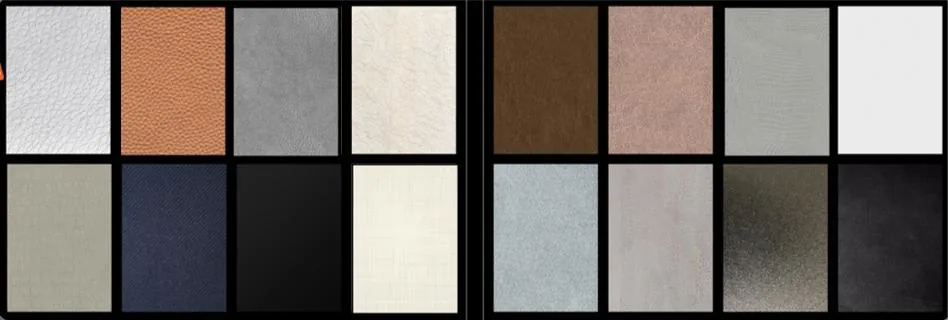
More than 100 colors are available, and texture and gloss can be customized. We mainly supply rolls, with film-faced boards available on request, using PUR flat lamination. This paint-free silicone functional face differs from PVC, melamine, PP and PETG decorative faces.
It belongs on flat wall panels, not on floors, stovetop surfaces or shower floors. The decorative wall film page shows the color range and the roll and panel options.
Which wall covering should you choose for each room?
Paint for easy color changes, wallpaper for pattern, paneling for physical detail, and a complete wet-area system wherever water reaches the wall. Add acoustic panels where the room echoes.
| Room or location | Start with | What can change the choice |
|---|---|---|
| Living room or bedroom | Paint, wallpaper or a decorative panel feature | Desired pattern, relief, lighting and furniture position |
| Hallway | A finish with a suitable cleaning routine | Contact at hooks, corners and narrow passing points |
| Kitchen away from cooking heat | A wipeable coating or wallcovering | Actual grease, splashes and equipment clearances |
| Bathroom outside the shower | A finish intended for the room’s humidity and splashes | Ventilation, drying and vulnerable edges |
| Shower wall | A complete enclosure system in panels or tile | Backing, waterproofing, joints and penetrations |
| Home office or media room | Decorative finishes plus tested absorption where needed | Echo inside the room versus noise from next door |
Settle the construction before the color. A wallpaper, a finished board and a tile layout each bring their own joints, edges and replacement work. Then look at a sample in the room’s own light, next to the floor and trim, with a seam or corner showing.
For a flat wall-panel project, bring the room, wall condition and desired surface effect when you contact us.
All articles in this wall covering guide
- Paint and wallpaper: Wallpaper vs paint; What is vinyl wallpaper.
- Panel construction: Wall panel materials; MDF wall panels pros and cons; PVC wall panels pros and cons.
- Panel design: Wall paneling ideas.
Frequently Asked Questions
What is decorative wall paneling called?
Wainscoting when it covers the lower wall; paneling or wall cladding are broader names. Beadboard, shiplap and board and batten describe particular patterns or profiles.
What is woven wallpaper?
Woven wallpaper is a wallcovering whose visible face is made of interlaced natural or textile fibers, usually on a backing. Grasscloth is one example. Non-woven wallpaper uses bonded fibers and is a different construction.
What is protective wall covering?
A protective wall covering is a facing intended to take contact and wear at the wall surface. Rigid protective sheets, wall panels, corner guards and crash rails serve different contact zones; a decorative pattern alone gives no impact rating.
What is the plastic wall covering called?
Usually vinyl wallcovering for a flexible PVC-faced sheet, or PVC paneling for a rigid sheet or profile. FRP is a separate fiber-reinforced plastic panel family.
How much does wallpaper installation cost?
About $4–$10 per square foot installed, materials and labor included, in HomeGuide’s September 2, 2025 national estimate. It is a planning range, not a quote; wall repairs, stripping old paper and pattern matching push the price up.