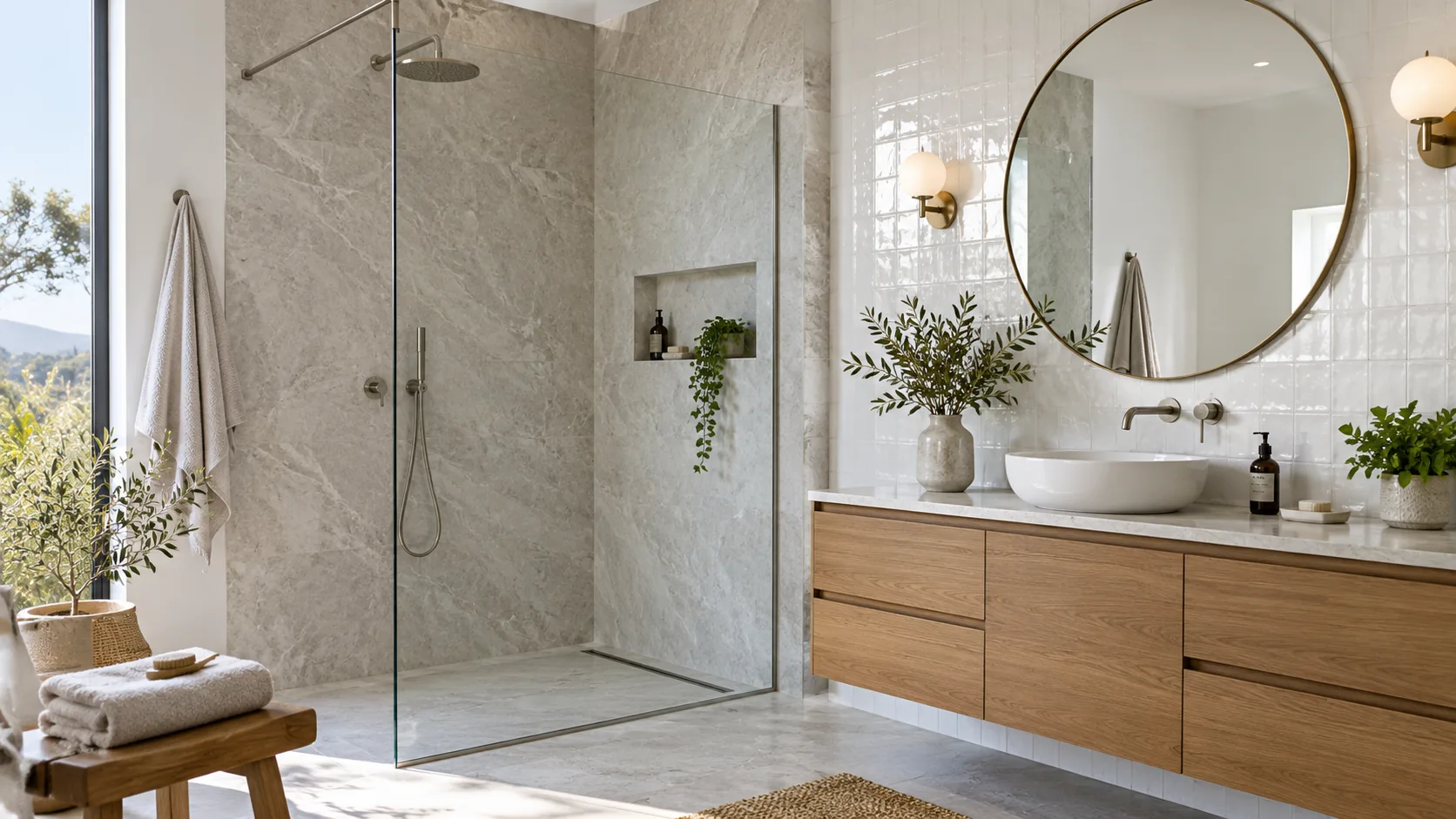
Bathroom wall panels vs tiles is usually a tradeoff between a faster, cheaper fit and more design choice with a longer life. In published US estimates, a professionally installed standard three-wall shower-panel system runs $800–$5,500 at Block Renovation, while a shower-tiling project runs $1,800–$5,000 at Angi. The two ranges cover different work, so compare quotes for your own walls, prep and waterproofing before you decide.
What Is the Difference Between Bathroom Wall Panels and Tiles?
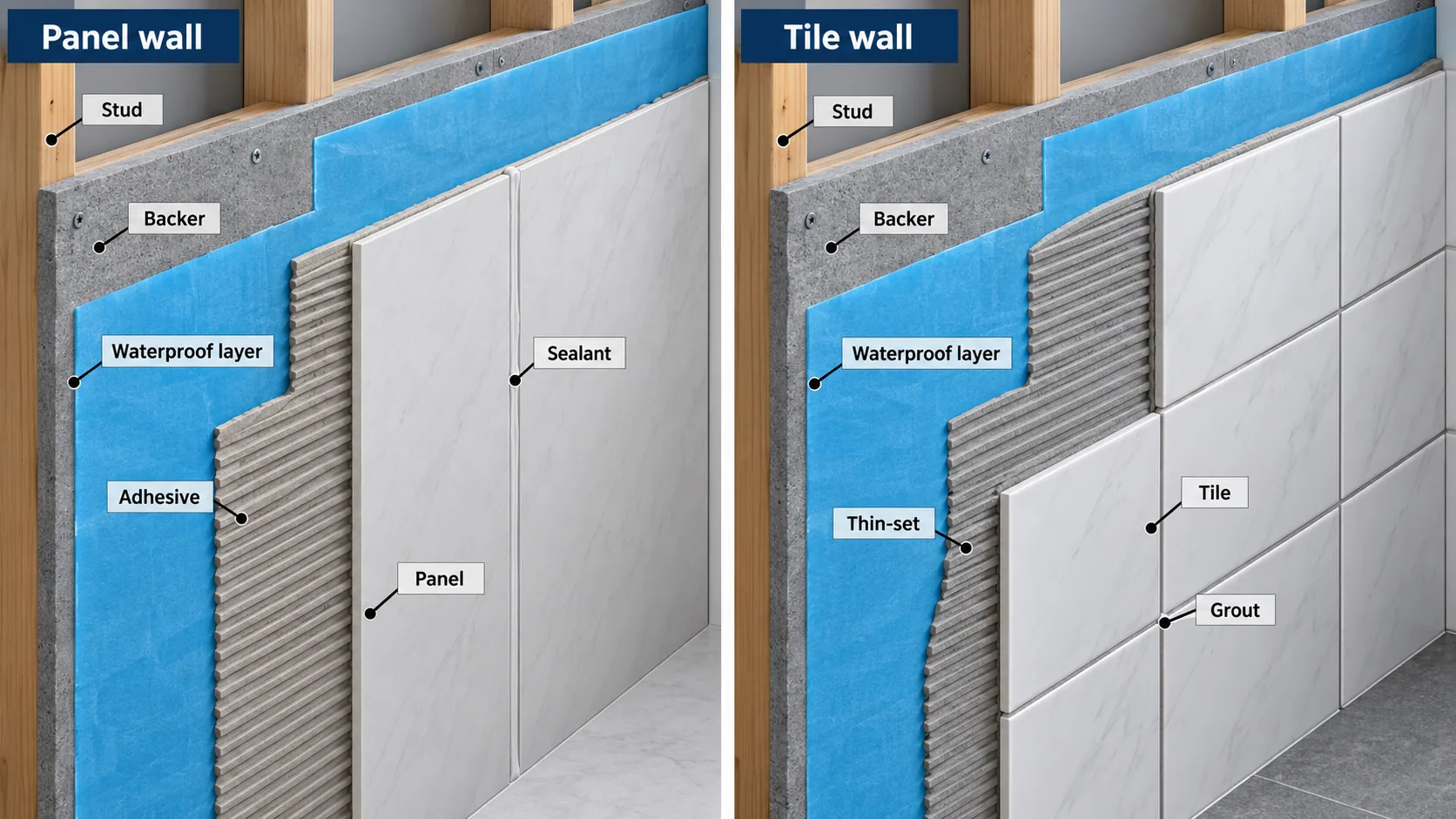
Panels cover the wall in a few large prefabricated sheets; tile builds it up from many small pieces set in mortar or adhesive. That one difference drives most of the others. Panels meet at sealed joints or joining profiles. Tile has grout between every piece, plus flexible movement joints where walls change direction.
Wet-area panels come in PVC, acrylic, fiberglass-reinforced plastic and solid surface, all made for shower exposure. Decorative panels meant for dry walls are a different product. Tile comes in ceramic, porcelain and stone, and each absorbs water, cleans and needs sealing differently.
| Decision point | Shower wall panels | Tile |
|---|---|---|
| Surface units | Large prefabricated sheets | Individual ceramic, porcelain or stone pieces |
| Joints | Sealed seams or system-specific profiles | Grout plus appropriate flexible movement joints |
| Installation | Usually faster on a prepared wall | More setting-out, cutting, setting and grouting |
| Published US project estimates | $800–$5,500 for a standard three-wall surround | $1,800–$5,000 for shower tiling; different scope |
| Water management | Designed panel system, sealed details and suitable substrate | Suitable tile assembly with waterproofing and drainage details |
| Cleaning | Large faces and fewer joints | Easy-clean faces; grout also needs attention |
| Local damage | May require replacing a large panel | A matching individual tile may be replaceable |
| Expected life | Varies by material, installation and care | Often longer than lower-cost plastic panels |
| Design | Large stone-like faces or printed patterns | Many sizes, shapes, grout colors and layouts |
| Covering sound old tile | Possible with an approved compatible system | Also possible in suitable conditions |
QS Supplies’ comparison estimates that one acrylic or PVC panel covers roughly the area of 30 tiles, though that depends on the sizes involved. The US prices in the table come from Block Renovation and Angi; the cost section below explains what each covers.
To compare panels with the other wall finish categories, see the types of wall coverings.
What Are Bathroom Wall Panels Made Of?
Most budget shower panels are PVC or acrylic; solid surface, laminate, glass and stone-faced panels cost more and look different. Whatever you pick, it has to be approved for the wet exposure it will get. Decorative wood-based panels sold for living rooms belong outside shower enclosures.
PVC is light and economical but can warp or discolor near heat, according to the renovation guide. Acrylic is the familiar shower-surround material, and fiberglass-reinforced plastic is another plastic option. Solid surface gives a heavier, continuous face and suits a renovation you want to last.
Laminate on a wood core lives or dies by its edges and joints. Our MDF water-resistance explanation shows why a face layer can’t protect every route into an ordinary MDF core. A purpose-built shower product is judged as a whole system, sealed edges and fittings included.
For the broader categories, see our wall panel materials guide; if PVC is on your shortlist, our PVC wall panels pros and cons go deeper. Decide where the panel goes first, then pick the finish.
Which Is Cheaper, Wall Panels or Tiles?
Basic PVC or acrylic panels usually cost less up front, but premium panels can match or beat the price of an ordinary tile job. The published ranges below price different scopes of work, so use them to sanity-check quotes rather than to declare a winner.
| Project or material | Published US estimate | Scope and source |
|---|---|---|
| Professional shower tiling | $1,800–$5,000; average about $2,700 | Angi, updated July 9, 2026; tiling project with varying area |
| Ceramic tile installed | $10–$25/sq ft | Angi; includes installation |
| Porcelain tile installed | $15–$50/sq ft | Angi; includes installation |
| Complete shower-panel system | $800–$5,500 | Block, modified August 11, 2026; standard three-wall shower |
| PVC panel materials | $150–$600 | Block’s material-selection estimate |
| Acrylic panel materials | $400–$900 | Materials only for a surround |
| Laminate panel materials | $500–$1,200 | Material-selection estimate |
| Solid-surface panel materials | $700–$2,000 | Material-selection estimate |
| Glass panels | $1,000–$3,000+ | Block specifies a custom surround |
| Stone-veneer panel materials | $1,500–$4,000+ | Material-selection estimate |
The installed ceramic and porcelain prices already include labor, so don’t add its separate $10–$15 per square foot labor figure on top. Its shower-tiling range can include floors as well as walls, and the cost guide notes bigger projects can pass $10,000, so it isn’t a like-for-like match for a panel surround.
The renovation guide’s $800–$5,500 panel figure covers removing old material, preparing walls, installing and sealing the panels, and finishing the edges, with labor alone at $500–$1,500 depending on location and complexity. A new shower base, moved plumbing or a glass door are extra.
So the fair comparison is two quotes with the same scope: removal, wall repairs, waterproofing, area, fittings and finishing. Igloo, a UK panel supplier, says panels can cost about a third as much in a small bathroom; treat that as a seller’s claim, not a US price.
Which Is Faster and Easier to Install?
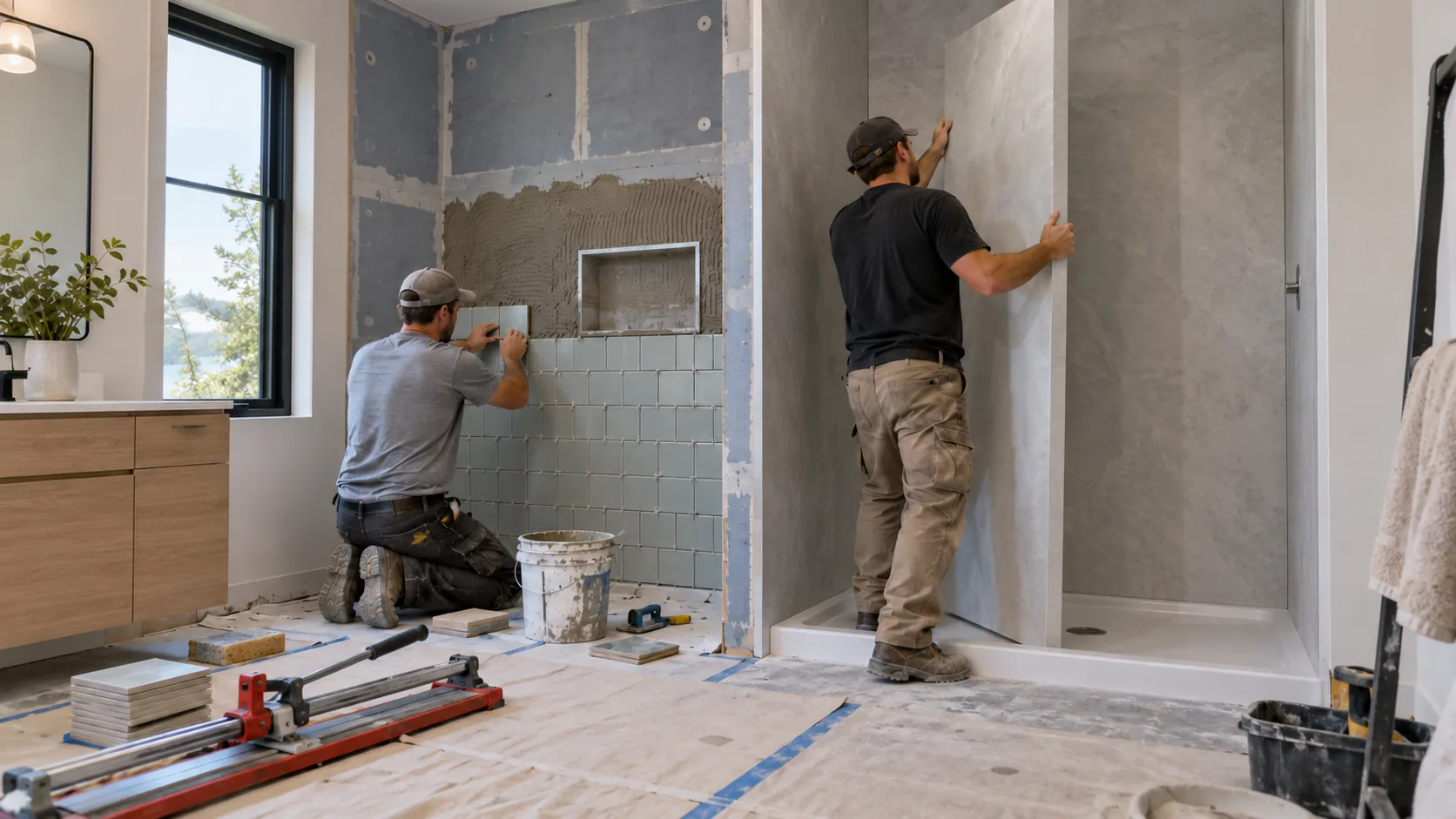
Panels, by a long way: a few large sheets replace days of setting and grouting. QS Supplies puts panel fitting at one to two hours against up to two days for tiling. Demolition, wall repairs and curing time come on top of either, and they often decide when you can shower again.
Both need the right backing. The PNNL/DOE backer-board guide, updated in 2022, recommends cement board or an approved moisture-resistant equivalent behind tiled and jointed enclosures. Cement board resists water but doesn’t stop it; a waterproofing layer or drainage plane does that job. Seamless one-piece enclosures are an exception and can use a qualifying paper-faced backer.
Sealant timing is easy to get wrong. GE Advanced Silicone 2 Kitchen & Bath’s August 2025 sheet allows water after 30 minutes only for a bead no larger than 3/16 inch, at 65°F or warmer and at least 50% relative humidity; otherwise it needs eight hours. Full cure typically takes 24 hours at 73°F and 50% relative humidity, longer for deeper beads or cooler, drier rooms.
That 30-minute figure is for the sealant only. The panel adhesive and the rest of the enclosure follow the panel system’s own instructions, just as tile needs its setting and grouting time before the shower goes back into use.
Can You Put Wall Panels Over Existing Tiles?
Yes, if the old tile is sound, flat, clean and compatible with the panel adhesive. It’s one of the main reasons people choose panels: the panel comparison describes it as a standard renovation route, and it skips the messiest part of the job. The catch is extra wall thickness around taps, trims and the shower edge.
“Sound” has a specific meaning. The Ceramic Tile Education Foundation’s overlay discussion cites ANSI A108.02 section 4.1.1: structurally sound, clean, dry and free of oily or waxy films. In the commercial steam room it describes, cracks and unknown conditions underneath meant the old tile had to come off.
Loose tiles, movement, cracks that keep coming back, damp stains or an active leak all need investigating before you cover anything. A new face over failed work just hides the problem.
Tile over tile is possible too, with the right preparation and bonding system. Either way, check that shower fittings can extend and seal against the thicker wall; if they can’t, the old finish has to come off.
Which Handles Water and Mold Better?
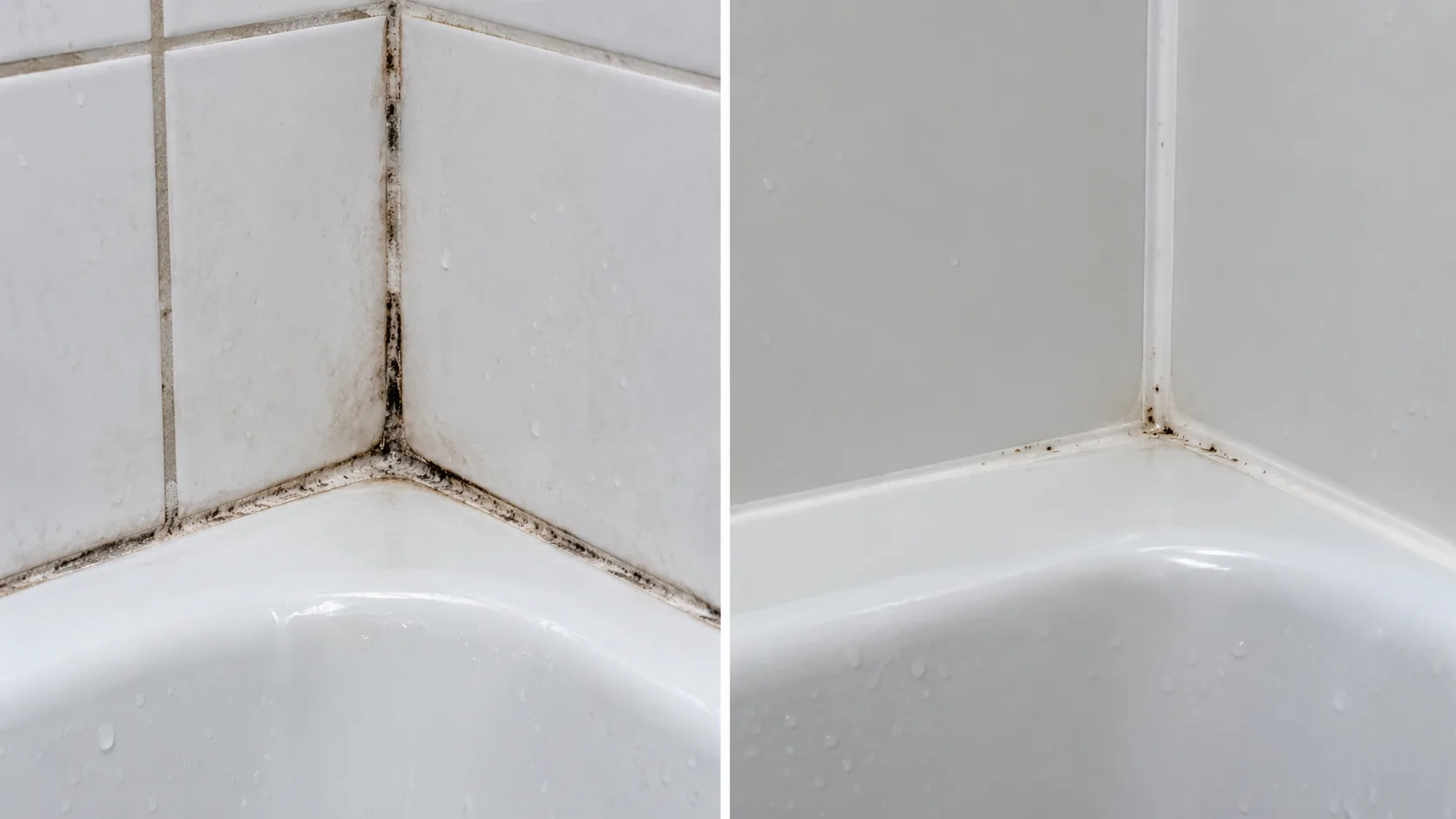
Neither, on its own. Both need a properly built wet-area system. Panels have far fewer grout lines, which makes cleaning easier, but their seams, corners and fittings still need watertight detailing. Tile and cement grout aren’t waterproof by themselves either.
Grout is the weak spot on the tile side. The Tile Council of North America’s grout advice describes cement grout as porous and recommends sealing it for stain resistance; epoxy grout stains far less. Low-absorption porcelain doesn’t seal the joints between tiles.
Some panel sellers, including the panel-comparison and Igloo guides, claim panels prevent mold. The EPA’s household guidance is more useful: control moisture, and dry leaks or spills within 24–48 hours, which prevents mold in most cases. Run the fan after showers and check sealant joints, whatever the wall is made of.
The damage that matters is often out of sight. Water behind a panel or tile can soak backing, framing and adhesive while the visible face looks fine, so fix the leak and the failed details before resealing or refacing.
Are Wall Panels Easier to Clean and Maintain Than Tiles?
Yes. Panels are mostly one smooth face with a few seams; tile adds grout to every cleaning session. Warm soapy water and a soft cloth handle most panels, according to the panel comparison, but follow your panel’s own care instructions.
For grout, TCNA recommends an alkaline cleaner and warns against acidic, oil-based or wax-based products. Sealed cement grout keeps its color longer; epoxy grout resists stains on its own. Corners and joints still need a look either way.
The routine is the same for both: rinse off soap residue before it builds up, dry what you can, and while you’re cleaning, watch for split sealant, open profiles or loose tiles. Igloo suggests regrouting every few years, though how often you’ll need it depends on the grout and how the joints hold up.
Keep the product names of your panel finish or tile and grout. A replacement tile from a new batch may not match, and a damaged panel usually means replacing a whole sheet.
Which Lasts Longer and Looks Better?
Tile usually outlasts cheaper plastic panels; good solid-surface or stone-faced panels can come close. The panel comparison expects wet-wall panels to need replacing after about 10–15 years and says tile can outlast them. The renovation guide says high-quality solid-surface or stone-veneer panels can last as long as tile with correct installation and care.
They fail in different ways. Tile can chip under a hard knock, but you can often replace one piece. A deep scratch on a panel can mean replacing the whole sheet, and cheap PVC can discolor near heat.
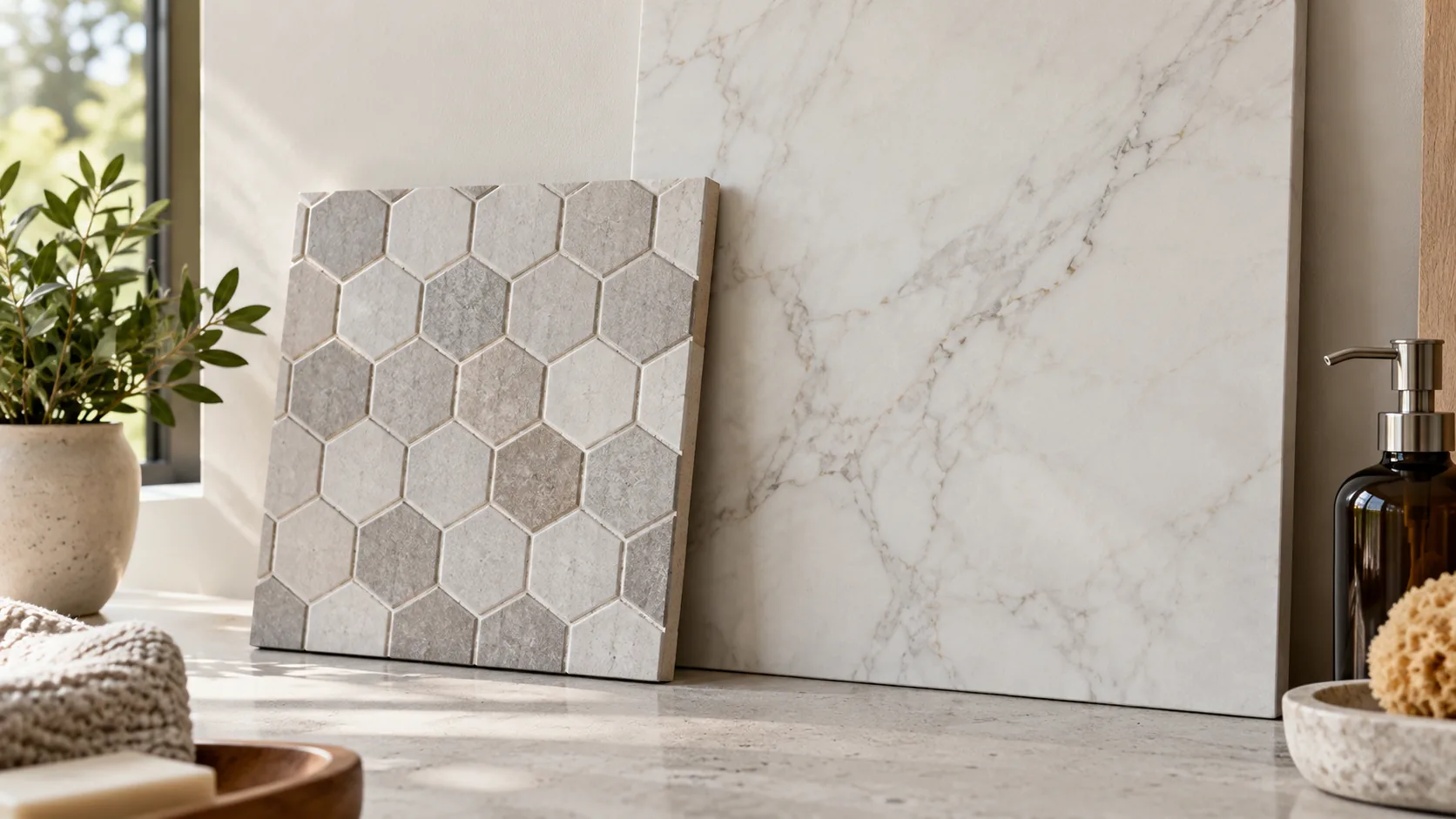
On looks, tile wins on choice: sizes, shapes, colors, laying patterns, even grout color. The Orientbell comparison leans on exactly that variety. Panels win on calm: broad stone-like or printed faces with few visible joints.
If a particular mosaic or pattern is the point of the room, choose tile. If you want a big uninterrupted surface and a short installation, choose panels. Which looks more expensive comes down to the specific finish, the trims and the workmanship.
Where Does Silicone-Faced Film Fit in a Bathroom?
Outside the shower. Puremorfilm makes decorative film with a silicone functional surface for furniture and wall panels, and in a bathroom it belongs on vanity cabinets, storage and dry-area walls. The film is laminated flat onto panels with PUR adhesive; we mainly supply rolls, with film-faced panels available on request.
The silicone surface is inherently flame-retardant, and higher grades up to UL 94 V-0 are available on request. The film uses a No DOP formulation and is formaldehyde-free, and our wall film contains no PVC. In the manufacturer’s laboratory tests, coffee, red wine, soy sauce and lipstick left for 24 hours at 25°C wiped off with no obvious surface change.
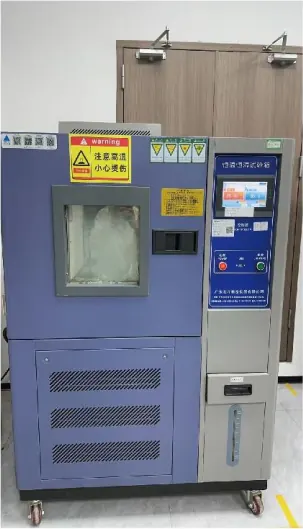
For a humid room, the relevant data is in worked examples described in the patent application: the film showed no delamination or blistering after 500 hours at 85°C and 85% relative humidity, or after 12 hours in boiling water. Those results describe the film construction, not a waterproof shower wall.
Our decorative wall film is a paint-free finish with a silicone functional face, distinct from PVC, melamine, PP and PETG decorative faces. It isn’t for floors, shower floors, cooktop countertops or anything walked on. For vanities, see our furniture decorative film; our laminated MDF explanation covers the panel core underneath.
Compare the wider wall panel materials shortlist for each wall location.
For a dry-area panel facing, see the wall-panel surface film.
Should You Choose Wall Panels or Tiles?
Choose an approved shower-panel system for a quick, simple fit and fewer joints to clean; choose tile for detailed layouts and the longest life, if you’re willing to look after the grout. Premium solid-surface panels sit in between. The condition of your existing walls can change either plan.
| Your priority | Starting choice | Condition that matters |
|---|---|---|
| Lower initial budget and shorter fitting time | PVC or acrylic shower panels | Complete approved wet-area system and matched quote |
| Long-term renovation with a specific pattern | Tile | Sound substrate, waterproofing and grout care |
| Sound old tiles with an appearance update | Compatible overlay panels | Adhesive approval, existing waterproofing and fitting depth |
| Frequent cleaning and fewer joints | Large shower panels | Accessible, maintainable sealed seams |
| More substantial panel material | Solid surface | Installed cost and correct maintenance |
| Vanity storage or a dry-area decorative wall | A suitable finished furniture or wall panel | Position outside the shower and appropriate core |
- Mark which walls get direct shower spray and which are dry areas.
- Get matched quotes that cover preparation, waterproofing, installation and finishing.
- Weigh the layout you want against joint maintenance and how repairs would work.
For a decorative finish on vanities or dry-area walls, contact us with the room dimensions, where the panels will go (inside or outside the shower), your preferred color or texture, and whether you need film or finished panels.
Frequently Asked Questions
What are the disadvantages of wall panels?
They usually don’t last as long as tile, offer fewer layout options, and a damaged spot can mean replacing a whole sheet. Every joint and fitting depends on a good seal, and PVC can warp or discolor near heat. QS suggests replacement after about 10–15 years, though material and care change that.
Are PVC wall panels better than tiles?
No, not overall. PVC panels win on price and installation speed; tile wins on design choice and lifespan. Both need a suitable backing and proper water management, so choose by what matters most in your bathroom and the full installed cost.
Does panelling damage walls?
No, not when a compatible system is installed correctly for its intended use. Problems come from poor bonding, failed joints or moisture trapped behind the panels, so deal with any existing damp before fitting.
What is the best material for slab shower walls?
Solid surface, if the budget allows; acrylic is the common mid-price choice and PVC the economical one. Block notes that high-quality solid-surface panels can approach tile’s lifespan with correct installation and care. Check that the system is approved for wet areas.
Which is cheaper, tiles or panels?
Basic panels are usually cheaper up front, but the published ranges overlap: Block estimates $800–$5,500 for a standard three-wall panel system, and Angi lists $1,800–$5,000 for shower tiling, for different scopes of work. Premium stone-faced or solid-surface panels can cost more than basic tile.