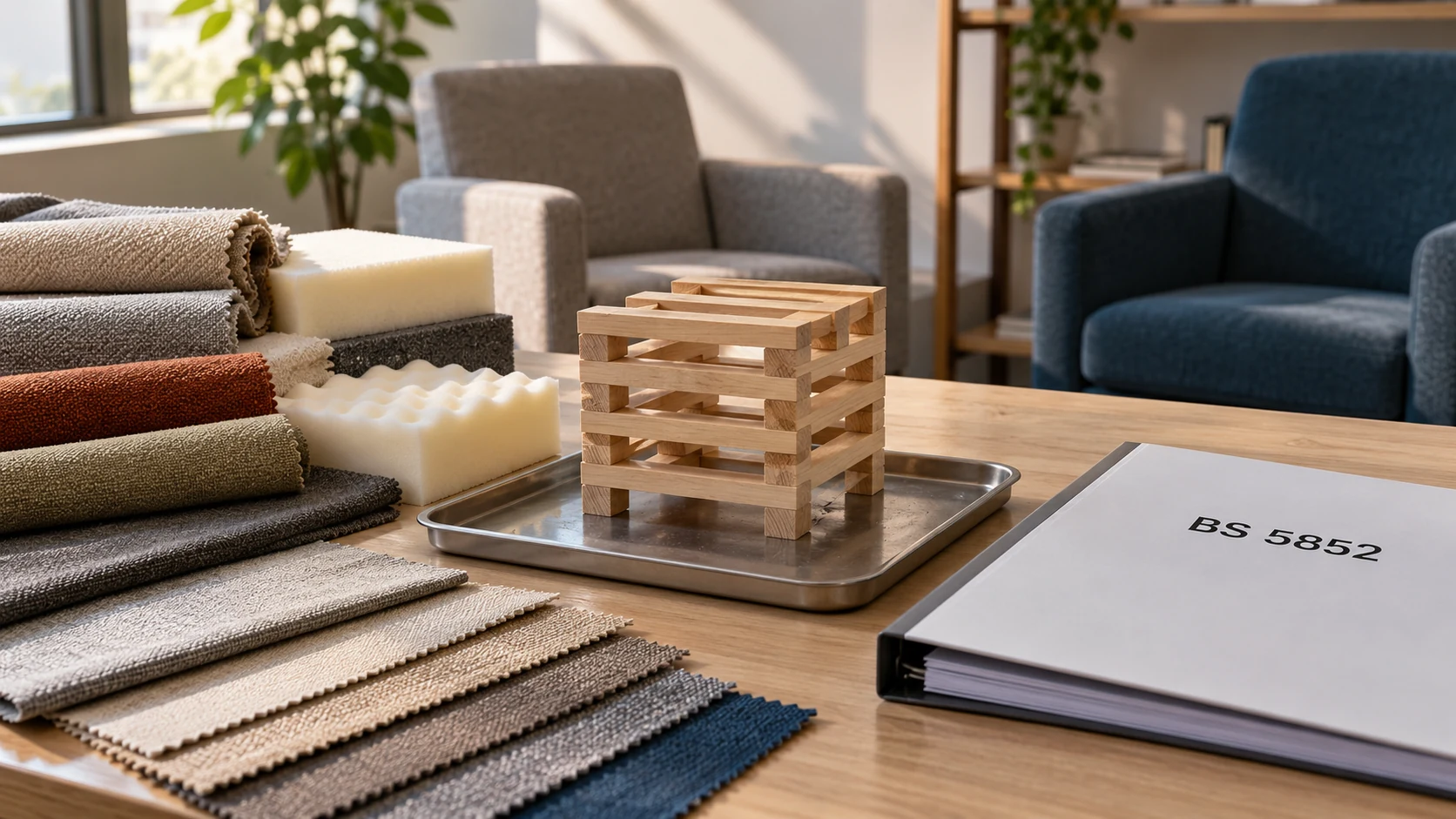
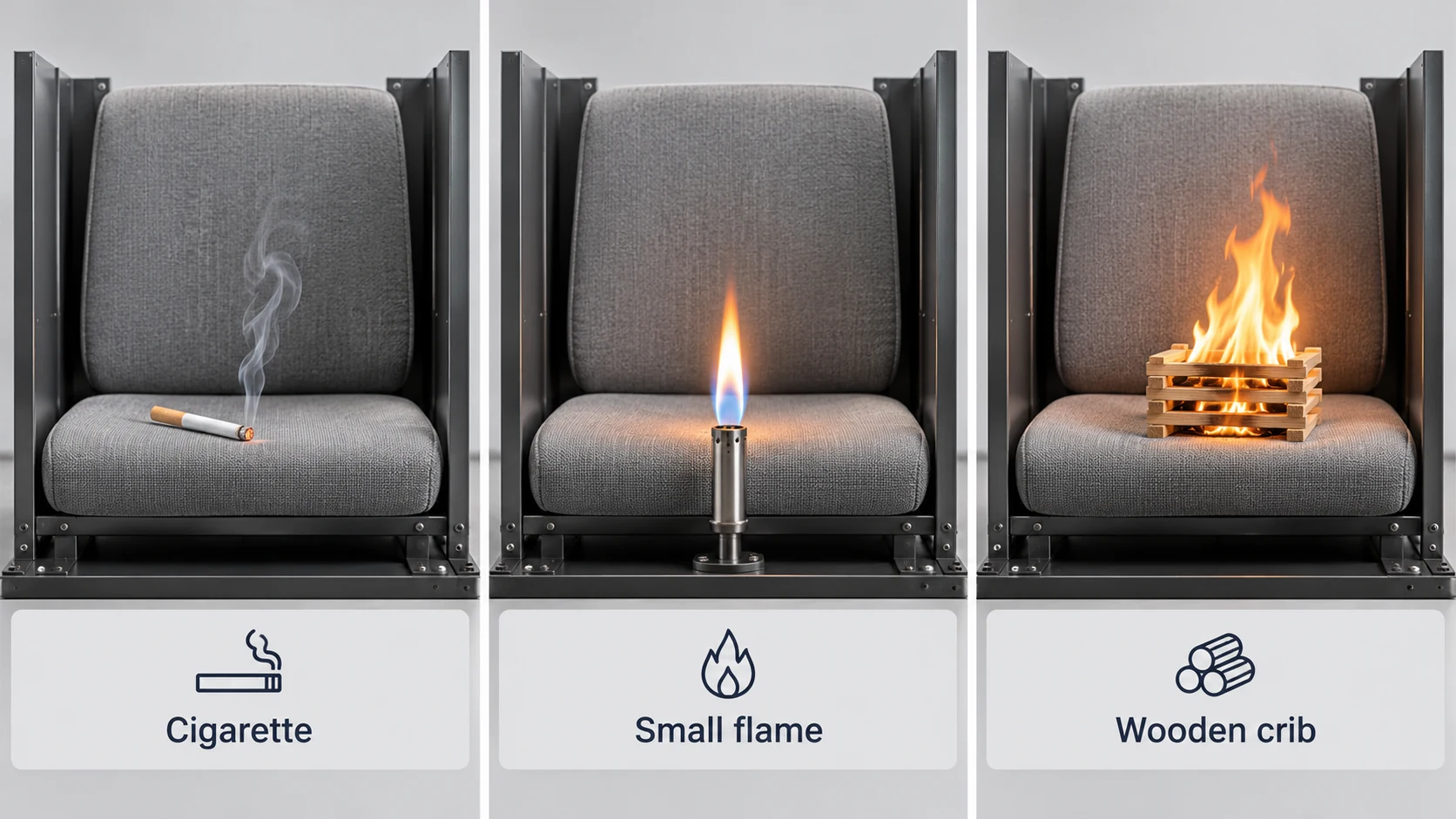
BS 5852 is a British method for assessing how easily upholstered seating ignites under specified smouldering and flaming exposures. A cigarette, a small butane flame or a burning wooden crib is applied to a cover-and-filling combination or a complete seat. The result belongs to the tested construction and ignition source, not to a fabric name.
For furniture makers and project buyers, the next question is which requirement calls for that test. UK domestic furniture rules, non-domestic seating specifications and US upholstery requirements use different routes, so a purchasing specification needs more than “BS 5852 fabric.”
What is BS 5852, and how does the test work?
BS 5852 provides methods for testing the ignitability of upholstery material combinations or complete seating. It describes test exposures and assessment; the requirement to use a particular method comes from the applicable rule or specification.
The BSI public scope for BS 5852:2006 identifies smouldering cigarettes and specified flaming sources, including butane flames and wooden cribs. Its public listing identifies the edition as current, published on March 31, 2006, replacing the withdrawn 1990 edition.
| Ignition-source description | What is applied | How to read the description |
|---|---|---|
| Source 0 | Smouldering cigarette | A smouldering exposure |
| Source 1 | Match-equivalent butane flame | A small flaming exposure |
| Source 5 | Specified wooden crib | A larger flaming exposure tested with the stated upholstery combination |
| Source 7 | Larger specified wooden crib | A more demanding source used within the relevant specification route |
The source descriptions are explained in the FIRA 2011 technical guide. That guide dates from 2011, so check the edition your report and project specification actually require.
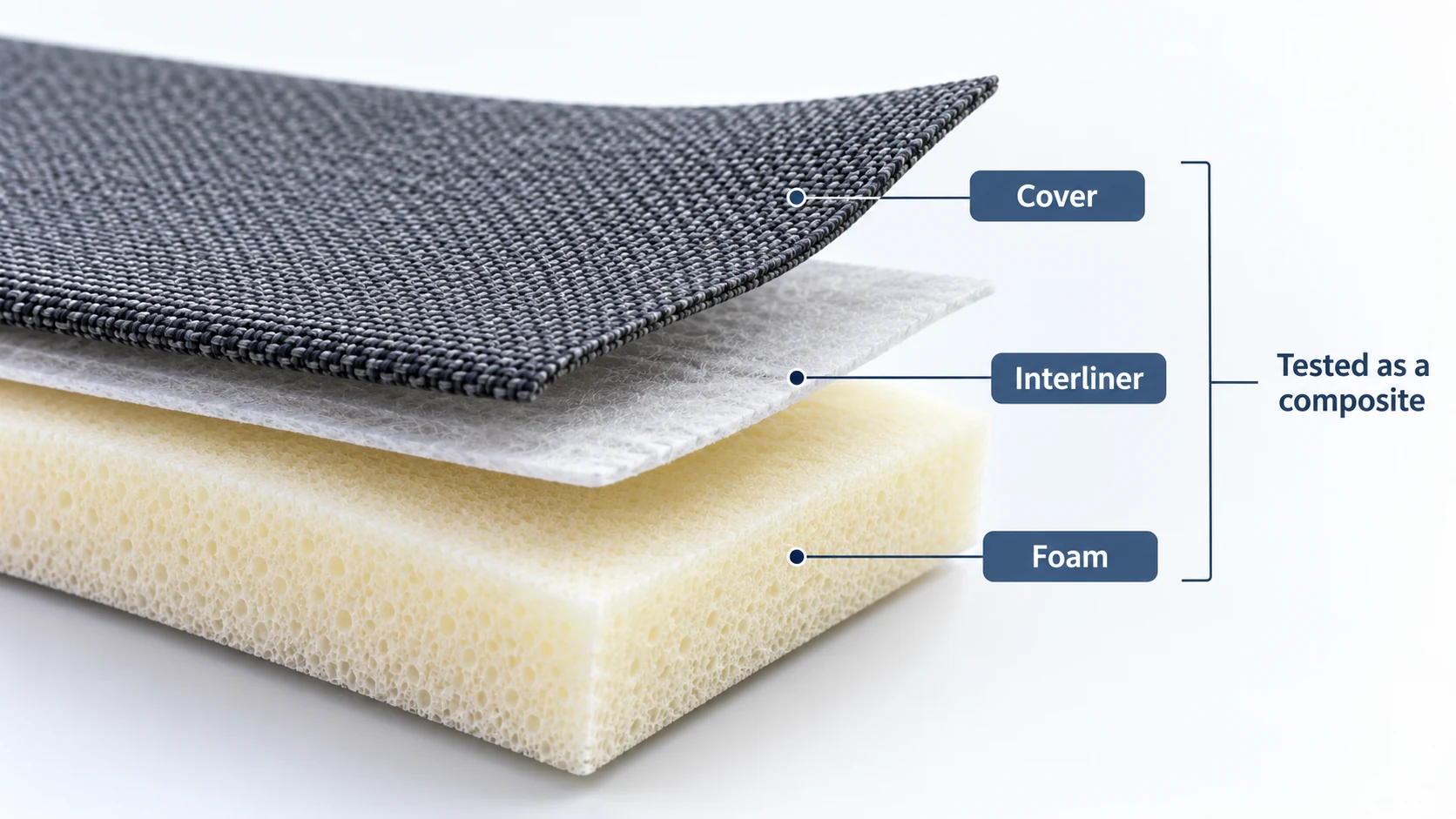
For a sofa factory, the useful output is a result tied to the submitted cover, filling and any interliner. An isolated phrase on a swatch card leaves those test conditions unspecified.
Is BS 5852 a legal requirement or just a test method?
BS 5852 is a test method; the applicable regulation or project specification determines which version and exposure are required. UK domestic furniture rules and non-domestic seating specifications refer to different arrangements.
The Furniture and Furnishings (Fire) (Safety) Regulations 1988, as amended, refer to BS 5852 Part 1:1979 and Part 2:1982 in their definitions and scheduled test procedures. Each test applies only within its own product and material scope, and the 2006 edition does not replace the older parts the regulations name.
For non-domestic seating, BS 7176:2007+A1:2011 specifies ignition resistance according to the fire-hazard environment and draws on BS 5852 and EN 1021 methods. Its scope excludes domestic seating and transport seating. In England and Wales, the non-domestic premises fire-safety framework places responsibilities on the premises’ responsible person, which is why the venue assessment belongs in the specification discussion.
The 2025 amending regulations took effect on October 30, 2025. They excluded specified infant products and removed display-label requirements, while retaining permanent-label provisions. They did not replace the cigarette, match, interliner or water-soaking technical clauses discussed here. Ordinary sofa specifications should therefore be checked against the current consolidated text, without assuming all children’s furniture or all labels were excluded.
What does “Crib 5” mean, and when is it needed?
Crib 5 means ignition source number 5: a specified small wooden crib, about 65 mm high, ignited using a small quantity of alcohol.
The testing explanation describes its use for the medium-hazard route in BS 7176, in addition to the lower-hazard cigarette and match-equivalent tests. The crib exposure is applied to the cover and filling combination. The laboratory’s source 5 crib listing independently identifies the source as a wooden crib for furniture ignition testing.
The domestic regulations also use a source 5 crib in the prescribed Schedule 1 Part I test for PU foam in slab or cushion form, with the specified covering arrangement. Other foam types and finished chairs follow different procedures.
For a buyer offered “Crib 5 fabric,” request the tested filling and any interliner as well as the source and method. If the supplier’s result uses a different foam from the one in your sofa, establish whether the report covers the offered construction before accepting it as project evidence.
Which BS 7176 hazard level applies to offices, hotels and hospitals?
The hazard level follows the intended environment and its fire-risk assessment, not the furniture’s appearance. BS 7176 distinguishes low, medium, high and very high hazard, with different test requirements.
The examples below follow the laboratory’s published explanation of BS 7176:2007+A1:2011. The required hazard category comes from the venue assessment.
| Hazard level | Example locations in the explanation | Test route described |
|---|---|---|
| Low | Offices, schools and museums | EN 1021-1 cigarette and EN 1021-2 match-equivalent tests |
| Medium | Hotel bedrooms, restaurants, public buildings and hospitals | The lower-hazard tests plus source 5 under BS 5852:2006 |
| High | Sleeping accommodation in certain hospital wards or hostels; offshore installations | The lower-hazard tests plus source 7 |
| Very high | Prison cells | The source and relevant BS 5852 section are determined within the specification route |
For the low-hazard route, the explanation describes two cigarette applications and three match-flame applications. It also notes hospital guidance calling for medium or high hazard according to location. An individual ward’s conditions therefore matter more than a blanket instruction saying “hospital seating.”
A chair moved from a quiet meeting room into a sleeping or care setting may face a different specification even though its upholstery has not changed. Keep the intended location on the furniture schedule and recheck the hazard requirement whenever the use changes.
A hotel material schedule can include both upholstered seats and rigid furniture. The hotel casegoods material discussion addresses the latter; the upholstery needs its own tested construction and fire specification. For senior living interiors, connect the seating location with the venue’s assessment before selecting the required evidence.
Why does the cover and filling combination matter?
Changing the cover, filling or interliner can change ignition behavior, so acceptance needs to follow the actual upholstery combination. A report for one assembly should not automatically travel with the fabric into a different seat construction.
Preconditioning is part of that evidence. For BS 7176, the published laboratory explanation describes mandatory water soaking and line drying for cover fabrics. The domestic regulations separately prescribe water-soaking treatment for specified chemically flame-retardant-treated materials and test situations. Those are distinct requirements and should retain their own references in the report.
The domestic interliner route also has composition conditions. Regulation 8 allows the relevant exception with a qualifying Schedule 3 interliner for specified cover materials containing at least 75% by weight of cotton, flax, viscose, modal, silk or wool, used alone or together, and not coated with polyurethane. The exception is limited to these cover compositions and a qualifying interliner.
During sampling, record the submitted cover and foam together, not just a loose face swatch. If the seat factory proposes a different foam or an added backing, compare it with the assembly named in the report. This matters most when one visible fabric runs across several cushion builds: the evidence must show which combinations were tested.
For coated upholstery, including silicone leather and PU leather, obtain the actual composition and tested arrangement. The material name does not settle whether a particular statutory exception applies. Keep the cover, foam and interliner descriptions together through sampling and any later material substitution.
Is BS 5852 the same as CAL 117 or EN 1021?
No. These methods and specifications use different exposures and test arrangements, so their reports answer different questions.
| Method or reference | Exposure described | What to identify in the evidence |
|---|---|---|
| BS 5852 | Smouldering cigarette and specified flaming sources, including wooden cribs | Edition, section, source and upholstery combination or complete seat |
| EN 1021-1 and EN 1021-2 | Cigarette and match-equivalent ignition sources | The relevant part, test combination and role within the project specification |
| TB 117-2013 / US Part 1640 | Cigarette smolder exposure for component assemblies | Tested component, accepted bulletin edition and construction route |
The June 2013 US bulletin explicitly states that its methods do not assess open-flame exposure. The federal upholstery FAQ explains how its component and barrier routes fit the US requirement. A result from that smolder procedure cannot serve as evidence for a separately specified wooden-crib exposure.
The same care applies to an ASTM E84 Class A report, which concerns a building-material test. For a project buying seating and interior finishes together, name the required test for each component.
What should a BS 5852 test report show before you accept it?
The report should identify the actual cover, interliner and filling, the method edition, the ignition source and any preconditioning. Those details let a buyer connect the result to the construction being offered.
| Item | What to specify or record | Why it helps |
|---|---|---|
| Cover | Accurate product code, color, backing and composition | Identifies the fabric submitted for testing |
| Filling and interliner | Exact products and the tested assembly | Retains the combination behind the result |
| Requirement | Standard edition, relevant section and required hazard category or statutory schedule | Connects the test to the purchase specification |
| Ignition source | The specified source or sources | Avoids treating all BS 5852 results as interchangeable |
| Preconditioning | Water-soaking and drying procedure where applicable | Shows how the specimen was prepared |
| Outcome | Recorded result and the construction it covers | Separates a tested assembly from a general material claim |
| Document record | Laboratory, date, reference and supporting descriptions | Makes the evidence checkable |
Retesting also deserves a place in the agreement. The published BS 7176 explanation describes retesting every 2,500 units, or 20,000 meters of fabric for predictive tests, or monthly, whichever is more practical. A change of specification or supplier also triggers a retest; lower production quantities are exempt, and a color change alone is not a trigger.
A broader supplier evaluation checklist can help keep the report, approved sample and offered construction aligned. Resolve missing assembly information before treating a brief “Crib 5” statement as the completed document review.
Puremorfilm is preparing a silicone leather range for upholstered furniture. We welcome project buyers who want to learn about progress, discuss the target market and seating specification or register interest in future samples. Share the intended hazard category, where specified, and the proposed filling and interliner arrangement so the discussion can focus on the evidence the project requests. Once samples exist, any fire evidence you request should name the exact upholstery combination you plan to use.
Which fire test does your upholstery project need?
Start with the market and intended use, then identify the required test version, ignition source and construction. The short label “BS 5852” leaves too much of that decision open.
- For UK domestic furniture within the regulations, identify the applicable statutory tests and material conditions in the current amended text.
- For UK non-domestic seating, establish the BS 7176 hazard specification through the venue’s assessment and request its corresponding test evidence.
- For US indoor upholstered furniture, identify the applicable TB 117-2013 route under Part 1640.
- If the purchase specification only names BS 5852, resolve the source, section and tested combination before approving the material.
The required evidence can then follow the product through sampling and production changes. A report tied to the actual cover, foam and interliner provides a clear starting point for that review.
For an upcoming upholstery project, contact us with the country of use, venue type and specified hazard category, plus the proposed cover, filling and interliner construction.
Frequently Asked Questions
What is BS5852 standard?
BS 5852 is a British method for assessing the ignitability of upholstered seating under specified smouldering and flaming sources. A result identifies the tested construction and source.
How to tell if a couch has flame retardant?
A performance test result does not identify which flame-retardant chemicals, if any, were added. Request the manufacturer’s composition information and check any applicable chemical-disclosure labelling.
How to check flammability?
Relevant labels and a laboratory report for the actual upholstery combination provide the appropriate evidence to review. Only a suitably equipped laboratory should conduct the specified ignition test.
What does furniture need to comply with?
The market and intended use identify the relevant route: the amended domestic furniture regulations for in-scope UK domestic products, the specified contract-seating requirements for non-domestic projects, or Part 1640 for in-scope US indoor upholstery.
How often should BS 5852 tests be carried out?
BS 7176 sets the frequency: retest by production volume or monthly, and whenever the specification or supplier changes. BS 5852 itself, as a method, sets no retest schedule.