
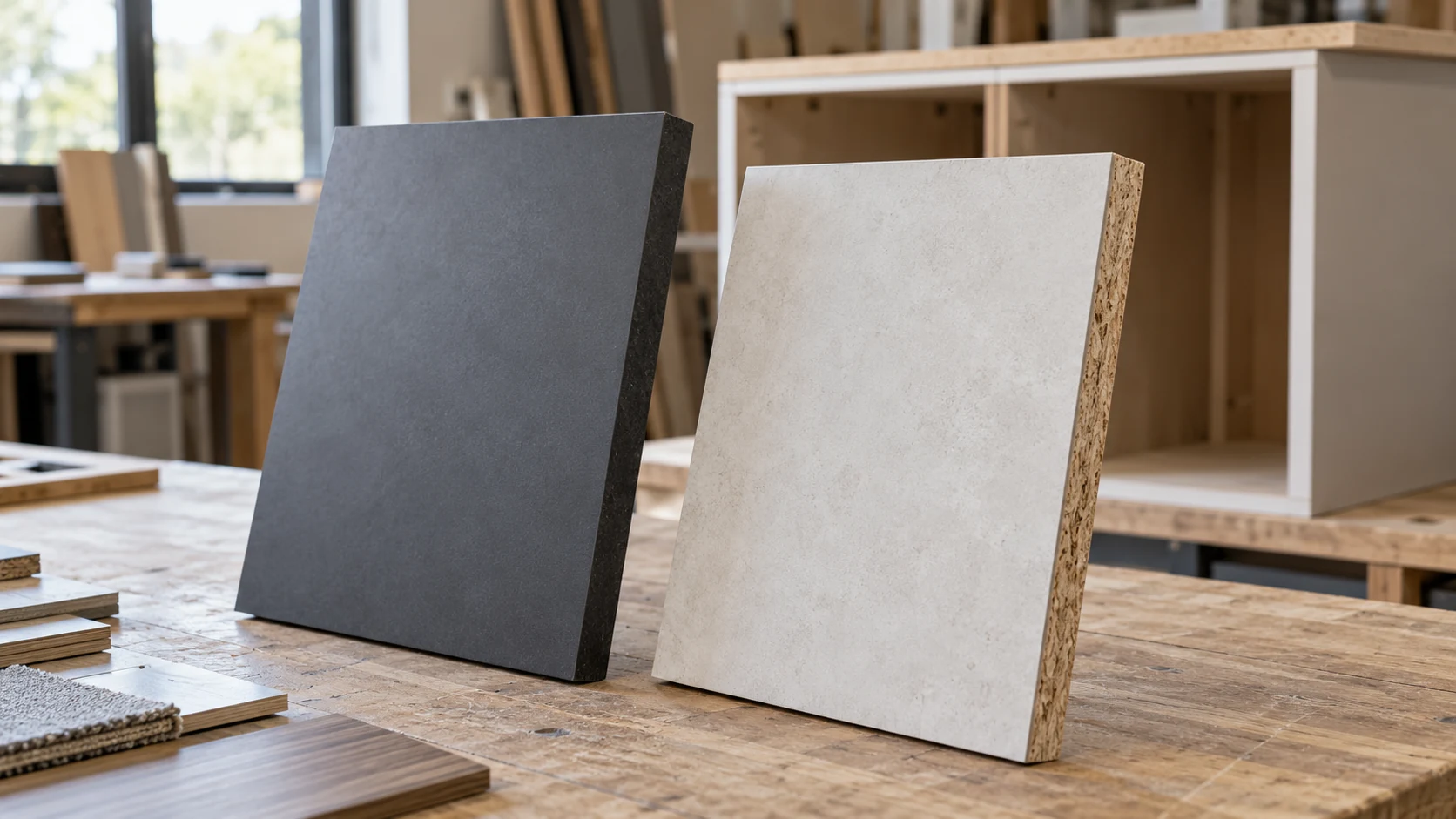
For compact laminate vs HPL, choose compact laminate for exposed solid edges and wet-use partitions; choose thin HPL bonded to a suitable board for many cabinet fronts and furniture panels. Compact laminate is a solid-sheet format within the HPL family. Thickness, grade and supports determine how either finished component carries load.
Last Updated: 2026-10-24
Compact laminate vs HPL: what is the difference?
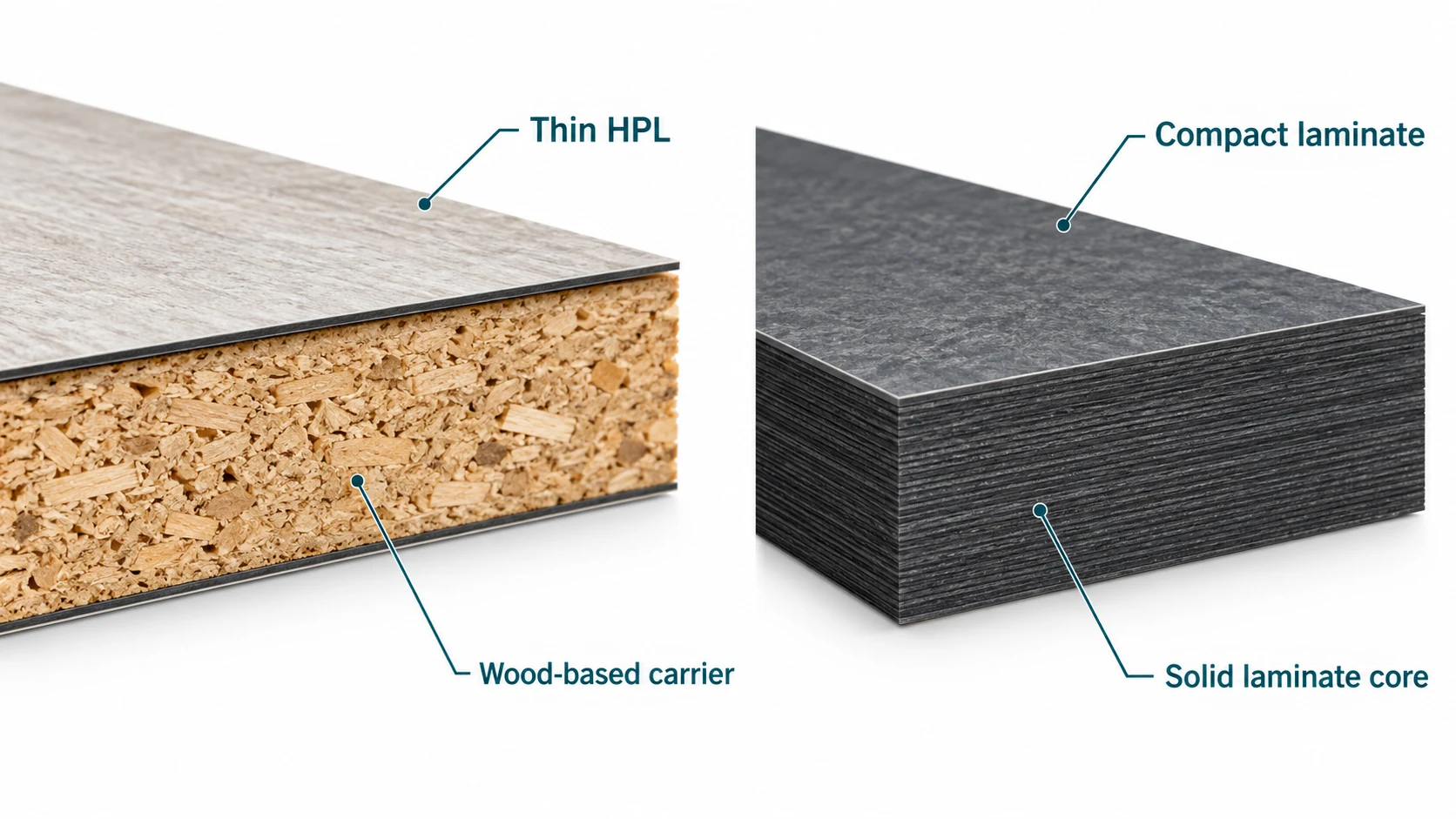
Compact laminate carries its laminate structure through the sheet; thin HPL gets its supporting thickness from another board. HPL means high-pressure laminate; compact is one format within that family.
The BSI EN 438 series distinguishes sheets below 2 mm intended for bonding to supporting substrates from compact laminates of 2 mm and greater. Those classifications describe the material supplied. A finished worktop can be much thicker because its decorative sheet is attached to a wood-based carrier.
The silicone column describes a surface film bonded to a separately selected board. Compare that route for flat furniture fronts and wall panels; the worktop and wet-partition choices remain between the specified HPL and compact constructions.
| Selection dimension | Thin HPL bonded to a carrier | Compact laminate | Silicone film (facing only) |
|---|---|---|---|
| Construction and composition | A thin resin-impregnated paper laminate bonded to a supporting board | A solid laminate section made from consolidated resin-impregnated layers | Silicone functional face on PET support film, PUR flat-laminated to a separate board |
| What gives it thickness? | The supporting board beneath the decorative sheet | The laminate sheet itself | The core supplies panel thickness and support; film is a facing only |
| What does a cut edge reveal? | A separate carrier requiring an appropriate edge detail | A dense laminate section that can be machined as an exposed edge | The selected core and edge treatment; a film face does not create a solid laminate edge |
| Scratch and surface wear | Select the documented surface grade; a separate carrier does not set the face scratch rating | Select the documented surface grade; a thicker solid section alone does not establish better scratch resistance | SGS 2H pencil sample result described below; no comparative HPL scratch ranking is established |
| Where can moisture cause trouble? | Open joints, cutouts and damaged edges can expose the carrier | The sheet resists water, but joints, fixings and surrounding construction still need attention | Core grade, bonding and exposed edges remain separate; the film does not make the panel waterproof |
| Forming and edge treatment | Special postforming HPL grades can form curved edges using the specified process | Machine the required profile into the sheet edge and follow the selected grade’s fabrication instructions | PUR flat lamination onto flat board faces; shaped fronts need a separately qualified facing process |
| Heat and chemicals | Use grade-specific surface limits and a compatible adhesive and carrier | Use grade-specific surface limits; solid construction does not establish resistance to every hot object or reagent | Film dimensional-change evidence is stated below; worktops, countertops and stovetops are excluded |
| How is it supported? | The carrier and its supporting structure carry the load | Support requirements change with thickness, load and dimensions | The selected board and supporting structure carry the load; no standalone sheet or span rating |
| Finished-part cost | Include the laminate, carrier, bonding, balancing construction, cutouts and edge finish | Include sheet thickness, tool wear, machined edges and any supporting frame | Include film, board, PUR lamination, backing and edges; quote the same finished part rather than film alone |
| Where is it useful? | Cabinet fronts, furniture panels, counters and desks | Partitions, exposed-edge panels, wet-use surfaces and suitable worktops | Flat furniture fronts and wall panels in vertical or low-wear use; not worktops, floors or shower floors |
An edge sample answers this question faster than a photograph. Look at the cross-section, including the underside, before comparing thicknesses. A thick-looking front edge can conceal a different construction behind it. Our melamine and laminate comparison explains another common naming mix-up; CPL vs HPL addresses a different distinction in laminate production and use.
What is compact laminate, and how is it made?
Compact laminate is a dense sheet made by consolidating resin-impregnated layers under heat and pressure. Conventional constructions use kraft-paper layers through the core and decorative surface layers for the visible finish.
Adding core layers creates a thicker laminate section instead of relying on a particleboard or MDF carrier. The exposed edge can therefore become part of the design. Depending on the particular product, that edge may contrast with the decorative face; a solid section does not promise that its color matches the face.
The EN 438-4 scope covers interior compact laminates. Exterior compact belongs to a separate part of the series. A bathroom partition and an outdoor façade can share the compact label while needing different grades and installation details.
That distinction helps when a quotation simply says “HPL board.” Establish whether it describes a thin decorative sheet, an already faced composite panel or a compact sheet. The layers in laminate explain why those products arrive at the same visual result through different constructions.
Which handles water better, compact laminate or HPL?
Compact is usually the more useful construction when water can reach an exposed edge, because the edge contains laminate rather than an exposed wood-based carrier. A thin HPL face protects the broad surface of a composite panel, while its cutouts and edge details determine how well the carrier stays protected.
For a sink surround, examine the cutout and joint details as closely as the visible top. For a partition, examine its floor clearance and fixing arrangement. Water-resistant material makes those details easier to manage; it cannot make an open joint in the surrounding construction disappear. The difference between ordinary and moisture-resistant MDF grades also matters when a thin HPL face is bonded to a wood-based board.
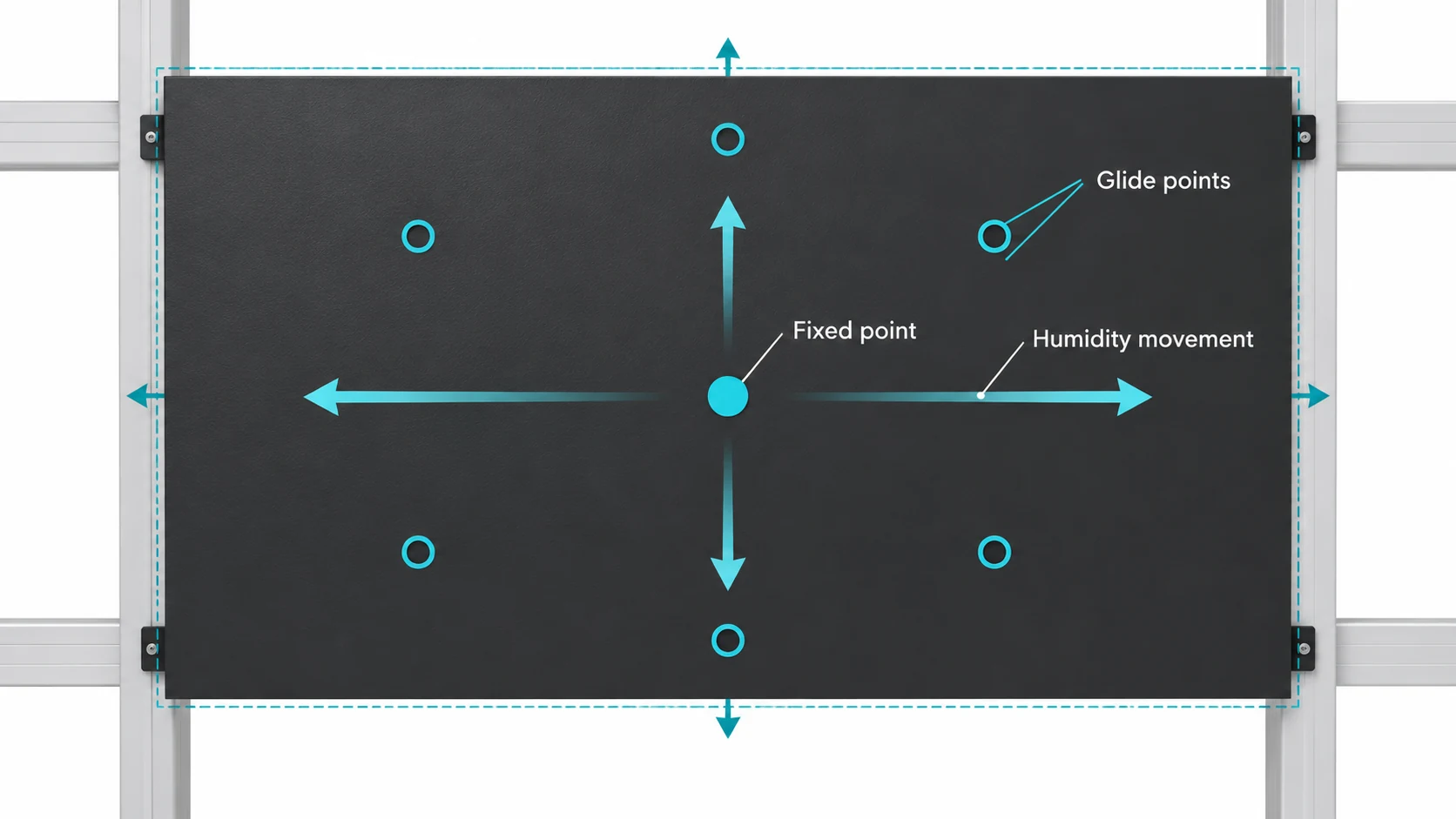
Compact still moves with changes in humidity. ICDLI’s June 2017 processing guide, pages 11–12 says lengthwise dimensional change is typically about half the crosswise change. A metal support responds to temperature while the laminate responds to relative humidity, so the two can move differently.
For mechanically attached wall panels or partitions, this makes the fixing detail part of the material choice. The guide illustrates fixed and sliding points to accommodate movement. Its bonding guidance also allows movement and keeps joined sheets in the same running direction. Use these principles to check movement in an installation drawing.
A tight fixing at every point can restrain the movement the design needs to accommodate. Discuss that detail while selecting the panel, particularly for a tall partition or a panel mounted on metal. Our article on panel warping explains how restraint and unequal exposure affect flatness in panel constructions.
How thick does compact laminate need to be to support itself?
Thickness above 5 mm is described as usually self-supporting in the 2017 industry guidance, but the support arrangement still has to suit the load and panel size. The compact classification starts below that point, which is why buying by the material name can lead to a poorly supported shelf or work surface.
The same guide, page 4, gives these distinctions:
| Thickness described in the guide | Supporting arrangement |
|---|---|
| Below 3 mm | Typically bonded to a rigid support |
| Up to 5 mm in self-supporting applications | Rigid supports at closer spacings |
| Greater than 5 mm | Usually self-supporting, with thickness selected for the purpose |
| Greater than 8 mm | Suitable for larger horizontal areas with more widely spaced supports |
These are 2017 processing recommendations, not a span table, but they show when a proposal needs more work: a slim compact sheet cannot automatically replace a much thicker composite shelf between the same supports.
For a long table, a heavily loaded shelf or a workbench carrying equipment, assess the clear opening, support positions and expected load together. A supporting frame may preserve the desired slim appearance while carrying the load. For a vertical panel, fixings and stability become the more immediate questions. Treat the finished section and supporting structure as one selection.
Which is more durable for worktops, tables and workbenches?
Compact has a practical advantage where damage or moisture would otherwise expose a separate carrier; surface wear still needs to be assessed for the particular grade. A solid edge and a hard-wearing decorative face answer different kinds of damage.
A chip at the front edge of a composite top can reveal its carrier and create an opening that needs repair. A compact edge continues through the laminate section, although it can still be chipped or damaged. On the broad face, a knife, dragged tool or repeated abrasion can mark either construction. A cutting mat or other appropriate working protection is therefore useful where the activity itself attacks the surface.
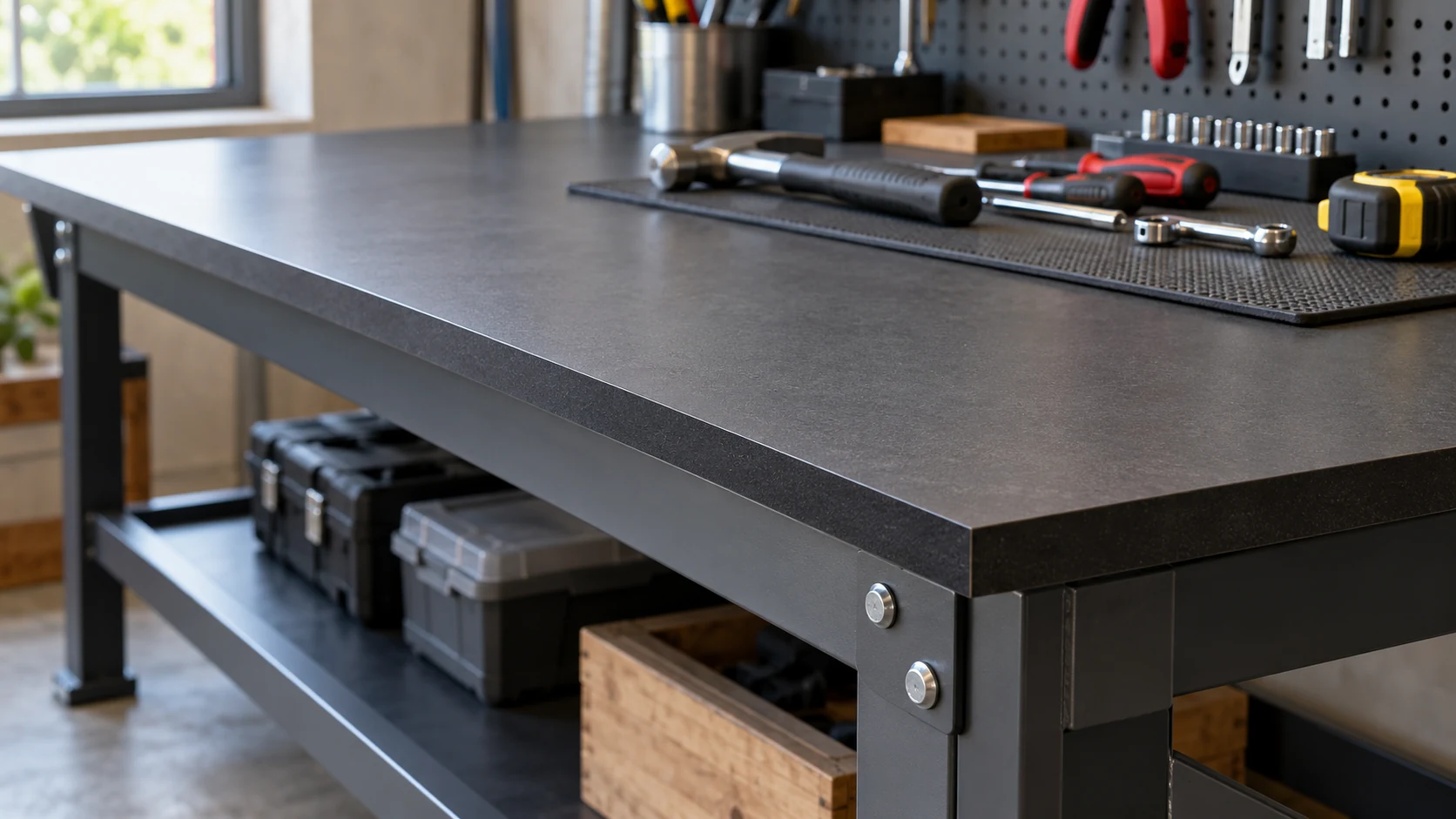
A workshop bench and a dining table also put different demands on the top. The workshop may need resistance to its actual chemicals, repeated tool contact and concentrated loads. The dining table needs an appropriate support structure, cleanable joints and a finish that suits daily use. A general “durable” description cannot settle all of those choices.
When comparing test results, match the test method, loading and reported endpoint. An abrasion resistance test describes a wear mechanism; it does not directly tell you how a cut edge will respond to a dropped tool. For heat and chemicals, use the selected grade’s documented limits.
Where does each fit in kitchens, bathrooms, partitions and labs?
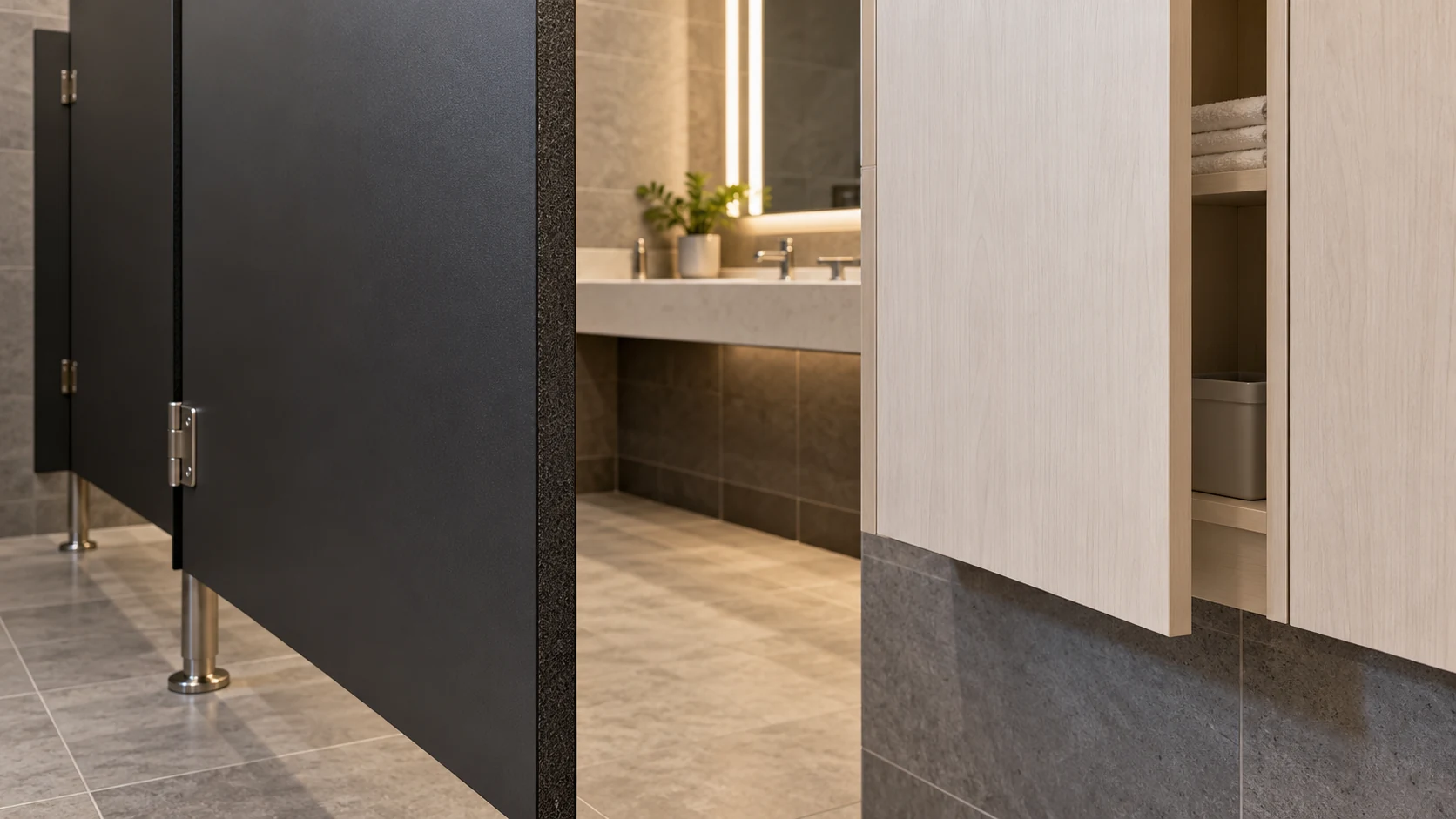
Compact is a strong candidate for exposed-edge wet-use panels and partitions; thin HPL on a suitable carrier remains useful for cabinet fronts, furniture and many dry interior panels. The room name helps identify the exposure, but the component’s job makes the final choice.
In a bathroom, a partition faces a different combination of wet cleaning, exposed edges and fixings from a protected vanity side panel. In a kitchen, a cabinet front and a worktop face different loads and standing-water risks. Avoid carrying a recommendation for one component across the whole room.
For laboratory or workshop furniture, start with the actual exposure. Chemical resistance is a grade-specific requirement. A compact panel’s solid construction is useful, but it does not establish compatibility with every reagent or cleaning product. Similarly, exterior use needs an exterior grade and an installation designed for that exposure.
For commercial furniture, replacement access can matter as much as the original finish. A detachable top or panel can be renewed without dismantling the whole fixture. Our comparison of retail fixture materials develops that serviceability decision across different fixture parts.
How do cost and fabrication differ?
Thin HPL adds a carrier, bonding and edge finishing to the job; compact moves more of the material and machining work into the laminate sheet itself. Compare those complete routes when checking the cost.
An inexpensive decorative sheet is only part of a composite top. The carrier, balancing construction, cutouts, edges and installation remain on the bill. Compact can simplify an exposed-edge design, while its thickness and machining requirements affect the material and fabrication cost. A design needing additional supports can change the comparison again.
A useful comparison starts with the same finished dimensions, openings and installation conditions. Include the support structure and completed edge detail on both sides. This avoids comparing a bare compact sheet with a finished composite top, or treating the price of a decorative sheet as the price of an installed surface.
The 2017 processing guide also notes increased tool wear when machining thicker compact sheets. That is a fabrication cost to allow for, especially on a job with many openings or finished edges.
Where does a silicone-faced decorative film fit?
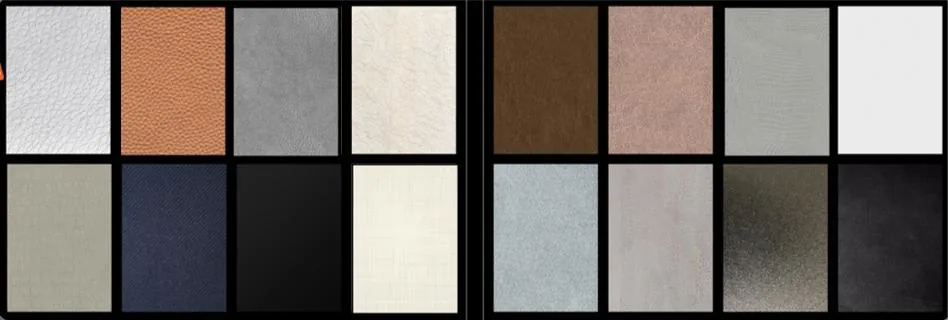
Puremorfilm makes decorative film with a silicone functional face on a PET support film for PUR flat lamination to a suitable board. The board supplies the supporting structure. Our leather-like surface has some give and is intended for vertical and low-wear furniture or wall surfaces, excluding worktops, all countertops, stovetops, floors, shower floors and other walked-on areas.
An SGS-tested film sample showed no visible scratches from a 2H pencil at 500 gf and 45°, with three lines longer than 20 mm. Comparing this sample with a selected HPL or compact surface requires the same test method and conditions.
In a separate SGS film-sample test, length and width changed by 0.06% and 0.10% after 100°C for 600 minutes followed by 14 hours of room-temperature recovery. This measures film dimensional stability, not an assembled panel’s service temperature or permission for hot cookware. We supply film rolls, with film-faced panels quoted per project. Explore our furniture decorative film for flat fronts and furniture panels.
Compact laminate or HPL: which should you choose?
Choose the construction that solves the component’s actual problem: water at an exposed edge, a required span, a particular working surface or a decorative front. Then compare finished assemblies of the same size.
| Your main requirement | Direction to consider |
|---|---|
| Exposed solid edge or wet-use partition | Compact in an appropriate grade and thickness |
| Shelf or table spanning between supports | Either route with a supporting design matched to the load |
| Decorative cabinet front or dry wall panel | Thin facing bonded to a suitable supporting board |
| Laboratory or demanding workshop top | Grade-specific chemical and surface evidence, plus a designed support arrangement |
Bring two details to any discussion: the cross-section and the support arrangement. Then plan for moisture movement in the installation, not just water resistance in the material.
For a flat furniture or wall-facing project, contact us with the intended component, panel dimensions, support arrangement and moisture exposure so we can discuss the facing route.
Frequently Asked Questions
What is a compact laminate worktop?
A compact laminate worktop is a working surface made from a thick laminate sheet with the laminate construction continuing through its section. Its thickness, supports and grade must suit the use; the word compact does not specify an allowable span.
What does “HPL sheet” mean?
An HPL sheet is a high-pressure decorative laminate made from resin-impregnated layers. In a quotation, the term often describes a thin facing intended for bonding to a carrier, so distinguish the sheet from a completed panel.
Which laminate is best for a house?
Thin HPL on an appropriate carrier suits many dry cabinet and furniture parts; compact is useful for exposed solid edges and wet-use components. For a worktop, compare the completed edge, joint and support details as well as the face.
Is HPL board waterproof?
No, the HPL label does not make every finished board waterproof. A water-resistant decorative face can sit over a vulnerable wood-based carrier, while compact offers a solid water-resistant section that still moves with humidity.
What is HPL compact?
HPL compact is compact high-pressure laminate: a dense laminate sheet that supplies the panel section without a separate wood-based carrier. It belongs to the HPL family and comes in thicknesses that need different support arrangements.