
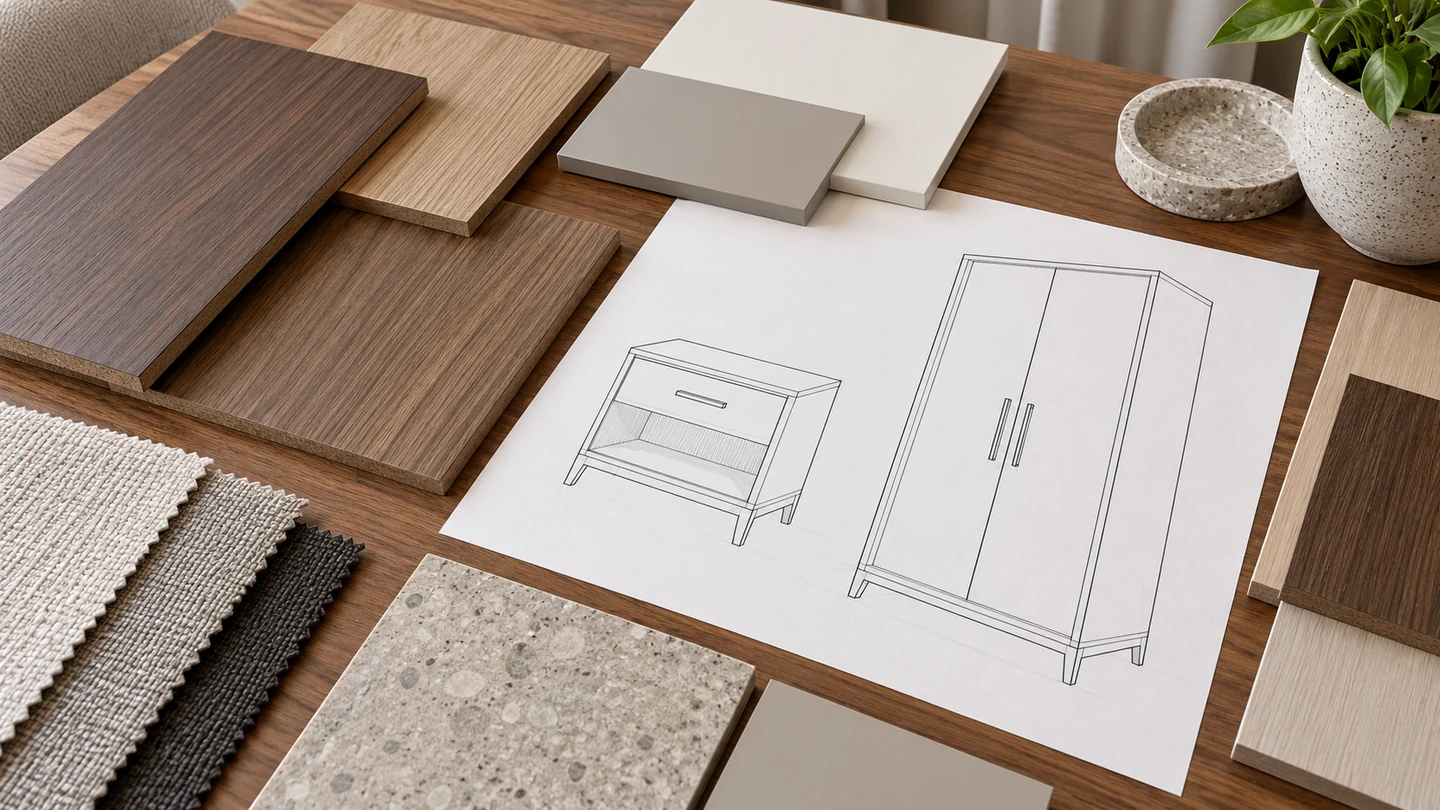
Hotel casegoods materials should be chosen part by part: a top tested for heat, spills and wear on desks and nightstands, tough edges wherever luggage strikes, and sealed edges and joints where wet swimwear lands. A wipe-clean face is not a moisture plan: the USDA Wood Handbook notes that wax additions of 0.5%–1% in particleboard and fiberboard can delay liquid-water uptake for a limited time.
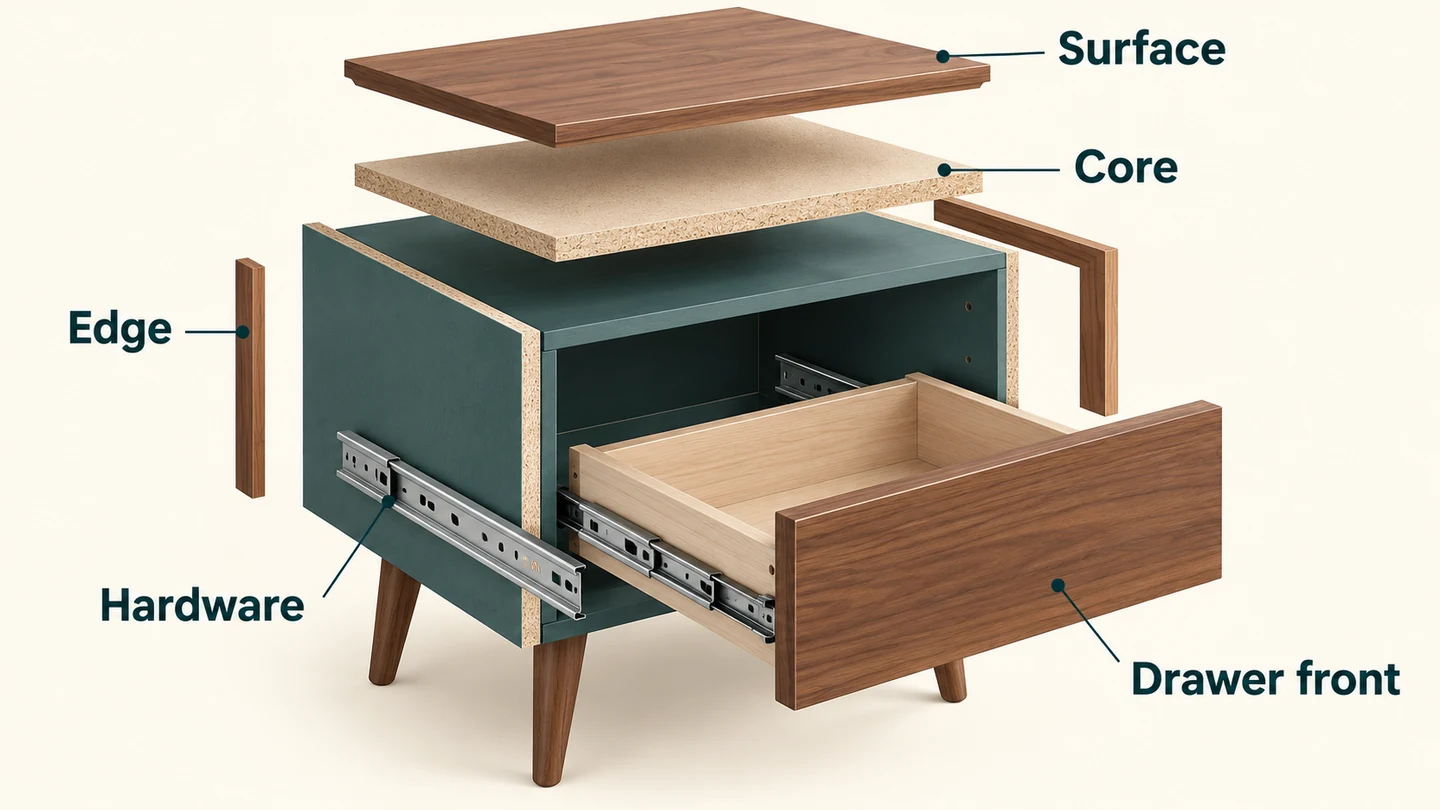
Compare the complete construction of each piece, including surface, core, edges, joints and hardware, and then the cost of keeping it in service across the rooms where it will be used.
What are hotel casegoods made of?
Hotel casegoods are the hard furniture in a guest room, such as wardrobes, desks, nightstands, drawer units and luggage benches. A typical panel-based piece combines a decorative face, a wood-based core, finished edges and hardware.
The surface name covers only part of the piece. Two desks sold as “laminate” can have different faces, board grades, edge treatments and repair options, so ask for the construction of each component, as you would for any commercial interior application, before comparing quotations.
| Surface | Construction | Candidate locations | Repair question |
|---|---|---|---|
| HPL | A separate laminate bonded to a supporting panel | Tops, fronts and sides, using a suitable grade | Can a damaged top or facing be replaced? |
| TFL | Resin-impregnated decorative paper fused directly to a board | Fronts, sides and cabinet interiors | Are matching replacement panels available? |
| Wood veneer | A thin wood face, usually protected with a finish | Visible fronts and protected tops | Can the finish be repaired without a color patch? |
| Painted board | A coating system on a prepared core | Fronts and other specified parts | Is a matching repair coating available? |
| Solid wood | Wood forms the component rather than a thin face | Parts designed to accommodate movement | Can joints and finish be repaired? |
| Decorative film | A supplied facing bonded to a supporting panel | Locations within the facing’s verified application | Can the front or panel be replaced? |
Compare those construction routes with the grades and repair options actually offered for the furniture.
Which guest-room parts deserve the closest damage checks?
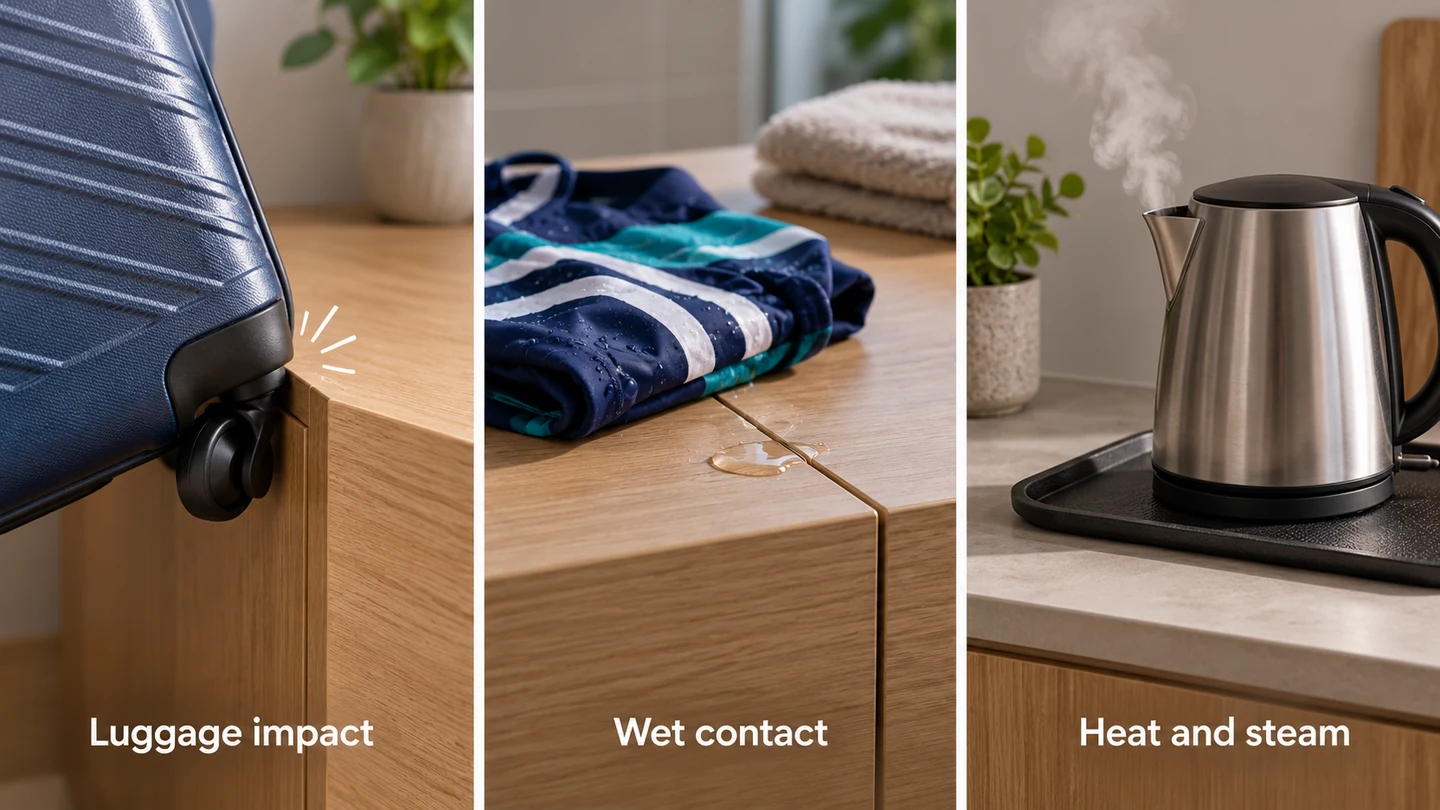
Check exposed edges, horizontal tops, drawer fronts and joints near wet items first. Each faces a different kind of contact, so photograph and classify the damage before you pick a replacement material.
A suitcase strikes a corner or drags across a luggage bench. Water from a wet swimsuit sits against a joint. Cleaning liquid keeps reaching the bottom edge of a door. A hot object can mark a finish even where the core and joinery are sound.
Record the contact and the failed component separately. “The laminate failed” is too broad when the real problem is a broken corner, an open edge joint or a swollen core, and a tougher face will not help a piece whose drawer slides have loosened.
A 2018 British contract-furniture guide points to exposed shelf edges, cabinet fittings and solid-wood drawers that move in air-conditioned rooms. Use those examples to direct inspection, then check the luggage bench against the bags and loads it will actually take.
Which surfaces suit tops, fronts and cabinet interiors?
Horizontal tops need a surface with documented resistance to the expected contacts; fronts and interiors allow a wider choice, provided the whole panel and its hardware suit the use.
General-purpose HPL can go on horizontal and vertical surfaces, and special grades address higher wear or chemical exposure, as the CPA HPL guide describes. Specify the grade and the supporting construction, not just “HPL”.
| Part | Candidate construction | Evidence to compare |
|---|---|---|
| Desk or nightstand top | Suitable HPL grade or a verified protected veneer top | Heat, liquid, wear and cleaning exposure |
| Luggage bench | A top and edges designed for baggage contact | Impact, scratching, attachment and load |
| Wardrobe door | Faced panel with matched hinges and fixings | Door size, mass, hardware rating and face durability |
| Drawer front or side | TFL, HPL, veneer, paint or suitable film | Contact, cleaning and replacement availability |
| Cabinet interior or shelf | A suitable faced board and supported shelf | Load, span, fixings and edge condition |
The difference between melamine and laminate faces shapes the first choice. For a desk top beside the kettle, compare the actual laminate construction with the heat and spills it will see.

How do edges, joints and hardware affect service life?
They need specifications of their own, because a good face cannot hold a loose fitting together or protect an exposed board edge. Inspect the proposed piece at corners, holes and connections as well as across its broad surfaces.
The same contract-furniture guide recommends additional hinge support on wardrobe doors and extra concealed support for shelves that carry heavy equipment. It gives no hinge count for every wardrobe; choose the number and placement from the door size, mass and hardware documentation.
For a shelf holding a safe or minibar fridge, verify the load, span, board construction and fixings together. Drawer bottoms and their attachments also need checking against the expected load.
The MDF edge-banding guide explains why the edge is a separate construction decision. Ask how the supplier will keep the face-to-edge appearance and replace damaged parts. Surface tests and whole-piece strength tests answer different questions, so keep both in the approval record.
Why are hotel furniture finishes scratching so fast?
Hotel furniture finishes scratch quickly when the exposed surface is poorly matched to luggage, cleaning and repeated guest use. Grit trapped under bags or cloths can abrade a top, while carts damage edges and corners. Separate abrasion, sharp scratches and impact before changing materials; each failure needs a different response.
| Damage pattern | Material or detail to assess | Change worth testing |
|---|---|---|
| Fine marks across luggage tops | A surface grade intended for repeated horizontal wear | Compare an appropriate HPL grade or other qualified top finish using the same wear test. |
| Scuffed drawer and wardrobe fronts | The actual paint, veneer coating or film topcoat | Trial the finish with the housekeeping method and a clean cloth. |
| Chipped corners or torn edges | Edge construction and the route taken by luggage or carts | Change the edge detail or add a separate protection element. |
| Damage repeats after cleaning | Grit, abrasive tools or incompatible chemicals | Remove loose particles first and validate the approved cleaner on a sample. |
HPL grade guidance distinguishes uses and surface performance. Keep scratch and abrasion evidence separate in the cabinet surface durability test comparison; neither is an impact rating.
How should luggage, wet items and hot objects be assessed?
Assess impact, cold liquids, wet heat and dry contact heat separately. A kettle area alone can involve a hot base, steam and spilled water, so the object’s name does not point to a single test.
For indoor TFL panels, CPA 5-25, dated May 1, 2025, rates impact, light, scratching, staining and abrasion as separate properties. Its large-ball impact test is optional, and its scope covers specified wood-based TFL panels and excludes flooring.
BS EN 12720 assesses rigid furniture surfaces against cold liquids, BS EN 12721 against wet heat and BS EN 12722 against dry heat. Their scopes cover finished furniture or matching test panels and exclude leather and textiles, so match each exposure to its own method and report.
For luggage, state the actual contact when you review panel impact resistance. For housekeeping, compare the chemicals you use with the chemical-resistance test conditions. A tray or heat pad under the kettle belongs in the room’s use plan, but the top beneath it still needs evidence for the contact it will get.
Why do coastal and pool hotels need moisture planning?
Because liquid water and humid air reach the whole panel construction, not just the face. A face that wipes clean does not stop moisture entering an unfinished edge, a fixing hole or an open joint.
The USDA’s 2021 Wood Handbook, Chapter 11 explains that wax additions of 0.5%–1% in particleboard and fiberboard delay liquid-water absorption for a limited time and have practically no effect on water-vapor sorption (printed page 11–6). Its plywood discussion on page 11–7 describes comparatively limited edge swelling and irreversible thickness swelling.
So a water-repellent additive and a moisture-tolerant construction are different choices. Review the core, exposed edges, joints, holes and the room conditions together; one ingredient does not define a cabinet.
The waterproofing assessment for MDF explains short contact versus sustained exposure. Note whether the furniture will meet wet swimwear, frequent spills, damp cleaning or constantly humid air; that record gives the manufacturer a real exposure to design and test against, instead of a vague request for “coastal grade”.
Which tests and documents should a supplier provide?
Ask for evidence that identifies the proposed surface, supporting panel and whole-piece construction, with each report linking a real exposure to a tested specimen and an observable result.
| Item to request | What to specify | Why it matters |
|---|---|---|
| Surface report | Material grade, exposure, method, conditions and result | A test name without a specimen and endpoint is incomplete |
| TFL-panel evidence | Relevant CPA 5-25 properties and any optional tests | Not every reported property is compulsory |
| Heat and liquid evidence | Appropriate BS EN 12720, 12721 or 12722 method | Cold liquid, wet heat and dry heat are different exposures |
| Storage-unit evidence | Relevant ANSI/BIFMA X5.9-2019 assessment | Addresses the storage unit rather than its face alone |
| Desk or table evidence | Relevant ANSI/BIFMA X5.5-2021 assessment | Connects the report to the furniture type |
| Composite-wood documentation | Applicable TSCA Title VI information | A facing’s data cannot replace core or finished-good obligations |
| Replacement plan | Parts, finishes, identification and support route | Repairs depend on obtaining compatible components |
The BIFMA standards overview lists separate standards for storage units and for desks and tables, and the EPA’s composite-wood guidance sets out the material and finished-good scope. The cabinet surface test guide shows how to read the surface evidence alongside them. For seating specified alongside casegoods, see the separate guides to US upholstery smolder testing and UK upholstery ignition testing.
When is refinishing better than replacing casegoods?
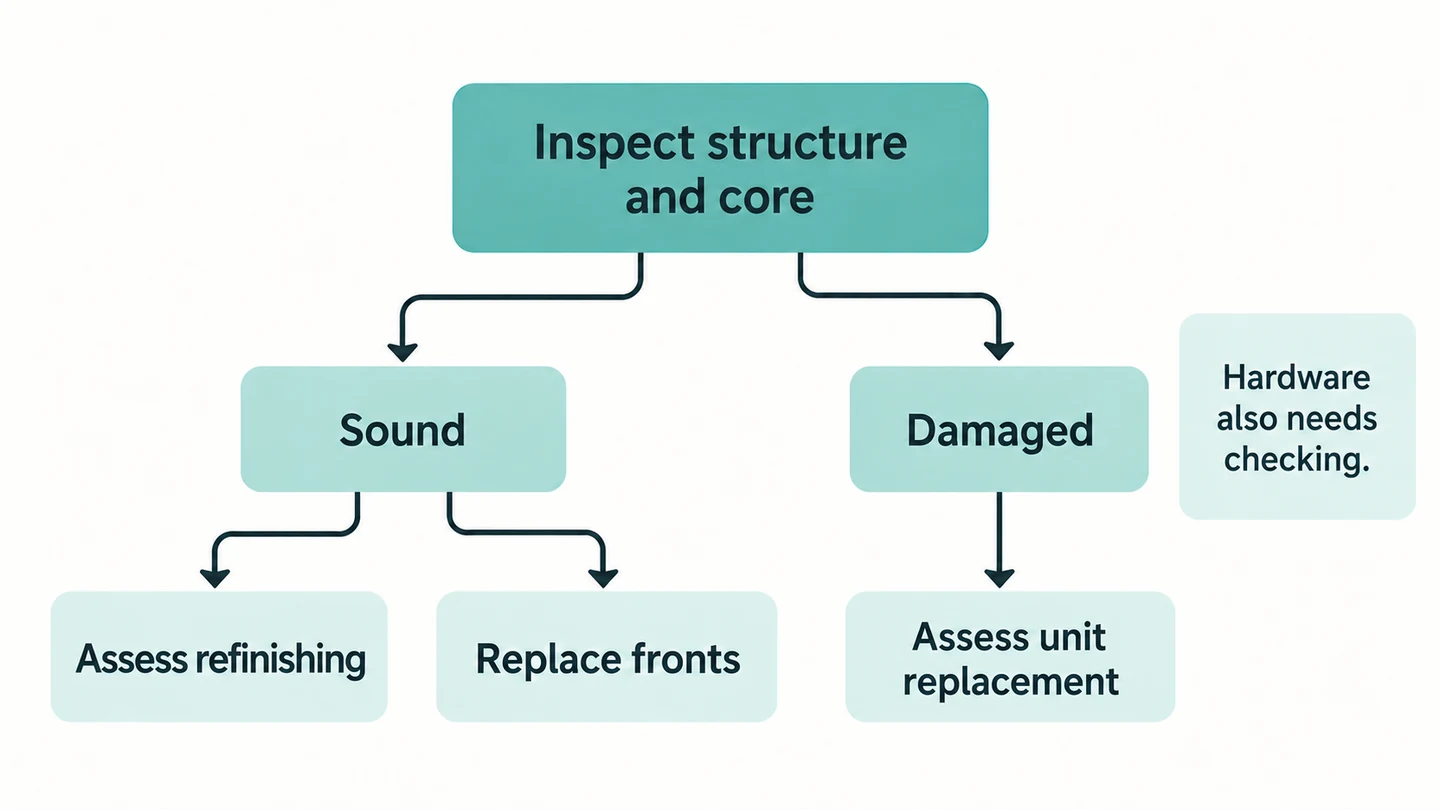
Refinish when the structure and core are sound and a compatible repair is practical; replace the damaged components or the unit when swelling, broken joints, unsuitable hardware or unavailable parts make repair poor value.
Inspect structure first, then the core, hardware and face. A new finish will not restore a swollen panel or a failing connection. If the cabinet body is still serviceable, price new doors, drawer fronts or a new top against repairing the existing face.
Compare costs on the same scope. For repair, include parts, labor, transport, room downtime and expected further maintenance. For replacement, include the new furniture, removal, delivery, installation and downtime. Get project quotations for both routes; a cheap material can be outweighed by handling and repeated room closures.
There is no well-supported universal replacement interval for hotel casegoods, so set inspection and replacement from the condition record and the hotel’s refurbishment plan. Confirm that touch-up finishes and identifiable spare parts will stay available, because a repairable design is little use if the part cannot be sourced.
Where does silicone-faced film fit in this selection?
Puremorfilm makes decorative film with a silicone functional surface for PUR flat lamination onto board. For the vertical furniture faces considered here, such as wardrobe doors and drawer fronts, evaluate the film alongside the proposed core and edges.
Supply is mainly in rolls, with laminated panels available on request. Our silicone surface is inherently flame-retardant, with higher grades up to UL 94 V-0 available on request. In the manufacturer’s laboratory tests, coffee, red wine and soy sauce held at 25°C for 24 hours wiped off with no obvious change. We use a No DOP formulation.
This is a paint-free facing, distinct from PVC, melamine, PP and PETG decorative faces. The hotel casegoods film page explains the application, and the furniture decorative film page describes the supplied facing. Floors, cooking worktops, shower floors and other walked-on areas are excluded, and film results do not establish a complete cabinet’s performance.
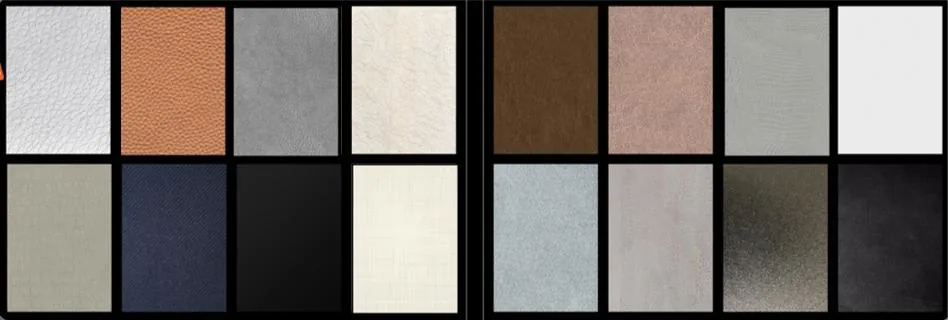
Which hotel casegoods materials should you specify?
Specify the construction for each furniture part, then approve its evidence and repair route.
- For tops, select a surface tested against the expected heat, liquids and wear.
- Near luggage, specify impact-conscious surfaces and edges.
- For moving parts, match the hardware to the door or drawer load.
- In humid rooms, assess the core, joints, holes and edge treatment together.
Keep the approved sample, part description and report together, and record a replacement identifier for each door, drawer front, top and fitting the hotel expects to service. Then the maintenance team can order the right part instead of another “wood effect laminate”.
For a vertical furniture-facing enquiry, contact us with the furniture parts, existing core and edge construction, cleaning exposure and whether the cabinet bodies will be retained.
Frequently Asked Questions
What does “case goods” mean?
Casegoods are hard, non-upholstered furniture such as cabinets, desks, nightstands and drawer units; in a hotel room, they are the furniture other than seating and bedding.
What should a designer know about the difference between domestic and contract specifications?
Contract specifications cover how furniture is built and used in a commercial setting, including joints, edges, hardware and surfaces. Check the evidence for each component, because products sold as “contract” furniture do not all perform the same.
What should the designer consider in relation to durability, fit for purpose?
Whether the whole piece suits its use: face, core, edges, fixings and moving parts, judged against the room’s impact, heat, moisture, cleaning and load.
How does the manufacturer handle quality control within its company and factory?
The supplier’s quality-control plan should identify checks on incoming materials, dimensions, construction and finished furniture, and the records available for the proposed order.
When communicating with a supplier what should designers be asking?
Designers should ask about comparable casegoods projects, the standard drawer-box construction, the panel fixing method, how furniture is packed and the warranty terms, then request test evidence for the actual parts.