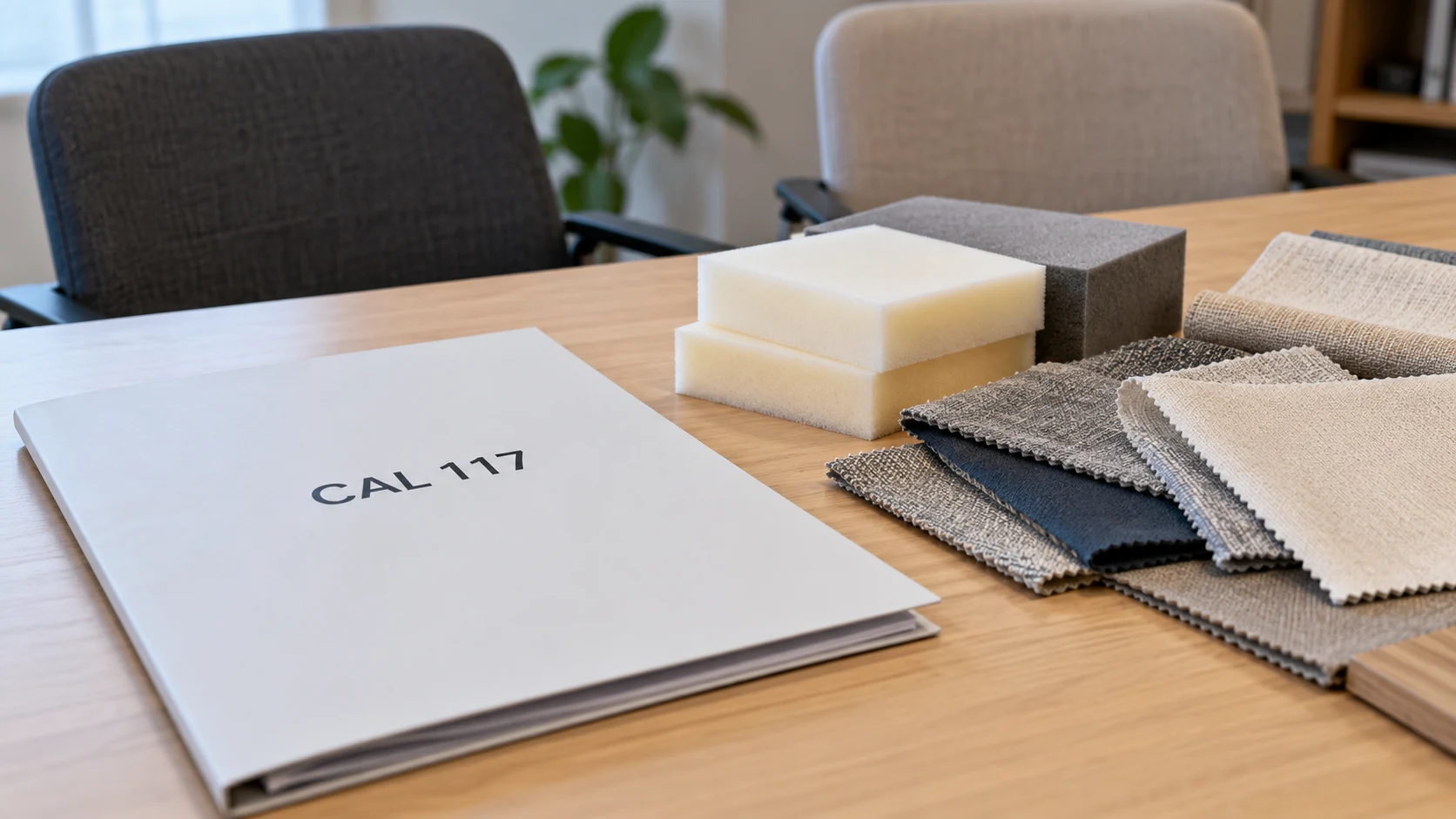
CAL 117 commonly means California Technical Bulletin 117-2013, a smolder-resistance test for upholstery cover fabrics, barriers, fillings and decking. It exposes small seat-and-back material assemblies to a lit cigarette. Since June 25, 2021, the same bulletin has formed the US federal flammability standard for upholstered furniture under 16 CFR Part 1640.
For furniture makers and buyers, the practical task is to connect that requirement to the actual components in a seat. A material name, a chemical disclosure and a finished-furniture label each provide different information.
What is CAL 117, and what does TB 117-2013 test?
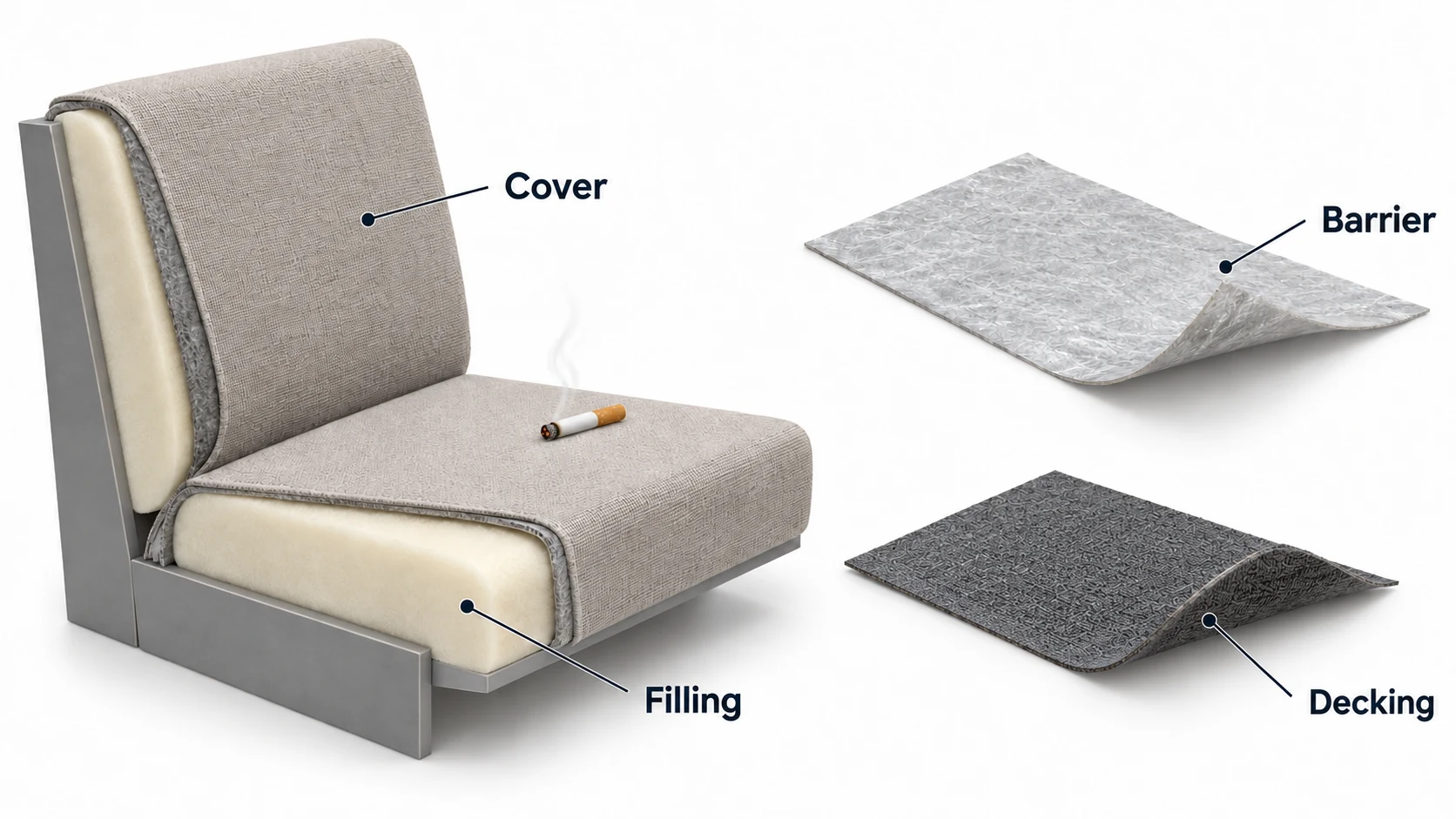
TB 117-2013 tests resistance to ignition from a smoldering cigarette through separate methods for the principal upholstery components. It does not test the furniture’s response to an open-flame exposure.
The June 2013 bulletin sets out the four component methods. The small test assembly represents specified seat-and-back conditions so the laboratory can assess the submitted materials consistently.
| Component | What the method addresses | How it fits the seat |
|---|---|---|
| Cover fabric | Smolder resistance of the upholstery covering | The exposed material surrounding the upholstered structure |
| Barrier | Smolder resistance of an interliner | A qualifying barrier can form part of an accepted construction route |
| Resilient filling | Smolder resistance of filling materials | Foam or other resilient filling beneath the cover |
| Decking | Smolder resistance of decking material | The relevant upholstered-furniture platform material, where present |
The current method differs from the earlier bulletin that shared its number. When you request documents, ask for TB 117-2013 by its full name and check that the report names the component it tested.
For a sofa program, list the components before you review supplier paperwork, so a cover-fabric report is not mistaken for evidence on the foam or decking.
How does the smolder test work, and what counts as a fail?
For the cover-fabric method, a specimen fails if it continues smoldering after 45 minutes, develops a vertical char length greater than 1.8 inches (45 mm), or transitions to flaming. These are the cover method’s criteria, not a set of universal limits for every component.
Section 1.4 of the bulletin uses three initial specimens. Passing all three supports a pass; if more than one fails, the material fails. If only one fails, a further three specimens are tested, and all of those must pass for the material to pass.
The laboratory applies these rules to produce a pass or fail result. A summary that only says “tested” tells you nothing about the outcome.
If you are approving a new cover, ask for the result and the specimen identification. Foam, barriers and decking have their own sections and criteria, so do not copy the cover limits into their specifications.
Is CAL 117 a federal requirement now?
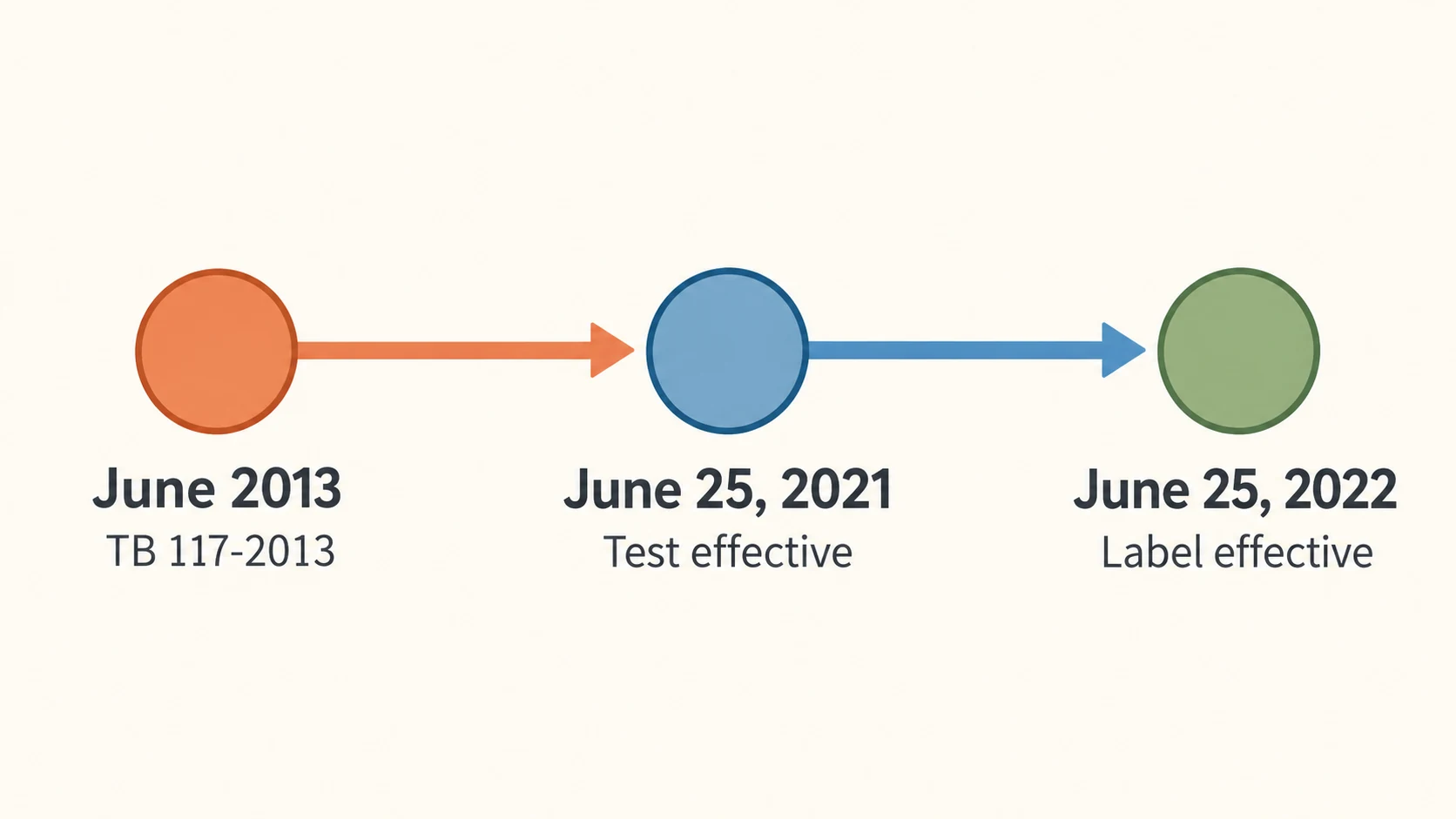
Yes. The federal rule incorporates the June 2013 version of TB 117-2013, and the test requirement and permanent-label requirement took effect on different dates.
The CPSC upholstered-furniture FAQ identifies June 25, 2021 as the effective date of the standard and June 25, 2022 as the effective date of the permanent certification-label requirement. A document describing only the earlier transition period can therefore mislead a buyer reviewing furniture supplied today.
The edition matters too. The January 2019 bulletin only changed the bureau name on the cover, so either version is accepted. A later California revision would not become part of Part 1640 without new federal rulemaking.
The incorporation is recorded in 16 CFR Part 1640. If the lab report, supplier declaration and your purchase specification cite different bulletin dates, check whether they point to the same accepted content before you reject or accept the paperwork.
Importers should run this check at the sample stage. It is cheaper than finding out at final inspection that the label artwork is out of date or the material certificate does not address the federal rule.
Which furniture does CAL 117 cover, and are beds included?
Part 1640 covers upholstered furniture intended for indoor use, while mattresses follow separate mattress flammability standards. Sofa beds, futons and separately sold cushions need to be considered according to their construction and intended use.
The federal definition of upholstered furniture excludes mattresses from the upholstered-furniture definition and identifies 16 CFR Parts 1632 and 1633 for mattresses. Where a futon or sofa-bed mattress detaches, the mattress is likely subject to the mattress standards and the remaining furniture to Part 1640. A permanently attached mattress can bring the whole product within the upholstered-furniture rule.
Cushions also turn on intended use. Small decorative throw pillows sold separately and not intended for seating fall outside the rule. Separately sold cushions intended for indoor seating may fall within it. Cushions and pads intended solely for outdoor use have a stated exemption.
An “indoor/outdoor” range needs a closer look than a cushion made only for outdoor use. Make sure the product description, design and intended use all match the scope decision; the retail category alone does not settle it.
For a furniture factory with both sofas and sofa beds, classify the products before commissioning tests and labels. The shared upholstery fabric does not make the finished products identical for regulatory purposes.
What do the labels show, and do they reveal flame retardants?
The federal permanent label states compliance with the upholstered-furniture flammability requirements; it does not disclose whether flame-retardant chemicals were added. California has a separate disclosure requirement under SB-1019.
The required federal wording is “Complies with U.S. CPSC requirements for upholstered furniture flammability.” The federal label requirement explains that the statement must be securely attached as a permanent label. A hangtag or zip tie does not qualify as permanent. The federal statement can be added to the relevant existing California label or provided separately.
You do not need a General Certificate of Conformity to show compliance with Part 1640, but other rules that apply to the same furniture can require one. Ask which requirement each supplier document is meant to cover.
| Label | What it tells you | What to check |
|---|---|---|
| Federal permanent label | Compliance with the upholstered-furniture flammability rule | The required English statement above, securely attached to the furniture |
| California disclosure label, where applicable | Whether flame-retardant chemicals were added | The SB-1019 disclosure and the manufacturer’s composition information |
The CPSC labeling FAQ explains that the federal statement supplements applicable California labeling. A smolder-test pass does not establish whether flame-retardant chemicals were added.
Indoor emissions are a separate question again: the furniture off-gassing explanation covers them, and a smolder result says nothing about them.
Can a cover that fails still be used, and how do barriers help?
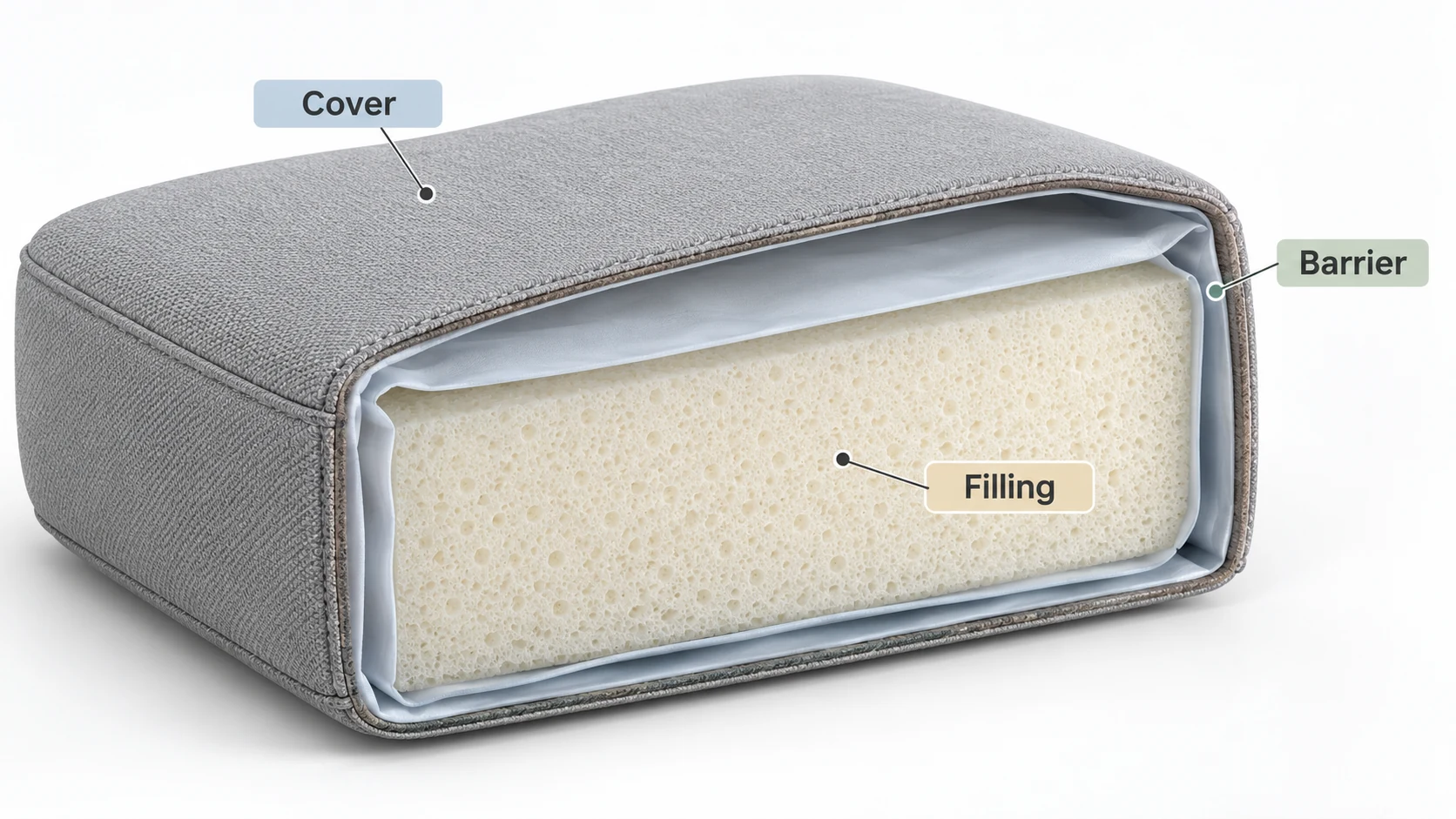
Yes. A cover that fails its cover-fabric test can be used through the bulletin’s qualifying barrier route. The barrier itself must pass the relevant test and be used in the required arrangement around the filling.
The federal explanation of Sections 2.1 and 3.1 describes how a passing barrier can permit use of a failing cover or filling. It must fully encase the resilient filling, subject to the limited arrangements for non-reversible and non-detachable seating cushions described in the bulletin. Decking, where present, still needs to pass its own method.
So a failed cover result does not rule out a new sofa cover. It means you need a correctly specified barrier with its own passing result, fitted the way the bulletin requires; a loose extra layer does not count.
Changing between silicone leather and PU leather also requires reviewing the new cover and the upholstery arrangement. The coating chemistry gives you no result for either.
What should a furniture maker or buyer ask for in test reports?
Ask for identifiable component reports and an upholstery construction that corresponds to them. The cover, barrier, filling and decking evidence should be traceable to the materials actually used.
| Item | What to specify or record | Why it helps |
|---|---|---|
| Material identity | Exact component code, colour, backing and specimen description | Connects the report to the offered material |
| Bulletin and method | Accepted TB 117-2013 edition and the relevant component section | Identifies what was tested |
| Construction route | Passing cover and filling, or the appropriate passing-barrier arrangement | Shows how the evidence fits the seat |
| Barrier details | Material identity and its arrangement around the filling | Prevents a report from being detached from the required construction |
| Decking | Its identity and result, where present | Keeps this component within the review |
| Laboratory document | Laboratory, date, reference and recorded result | Makes the source and outcome checkable |
| Label | The permanent federal statement and other applicable disclosures | Connects test evidence with finished-product documentation |
The federal FAQ recommends keeping records at least as long as the product stays in production. Keep the sample description and relevant supplier documents together so later substitutions can be assessed against the same evidence.
An ASTM E84 Class A report concerns a different building-material test and cannot replace an upholstery smolder report. Document checks also fit into a broader supplier evaluation process, especially when a declaration refers to an unspecified material grade.
Puremorfilm supplies silicone decorative film for vertical and low-wear furniture and wall faces, with film-faced panels quoted per project. The furniture decorative film page covers these flat-facing applications; the film is unsuitable for floors, countertops, stovetops and other walked-on areas. For projects combining casegoods with upholstered seating, keep the facing-film specification separate from the seat’s cover, filling and barrier evidence. To discuss a flat-facing project, share the panel dimensions and intended use.
CAL 117, CAL 133 or BS 5852: which one does your project need?
For US indoor upholstered furniture within Part 1640, start with TB 117-2013. If a project specification names CAL 133 or BS 5852, treat it as a separate test; a CAL 117 result does not cover it.
| Test | Ignition source | Test object and scope |
|---|---|---|
| TB 117-2013 | Smoldering cigarette | Specified component assemblies on small seat-and-back mock-ups |
| TB 133, January 1991; archived | Open flame from a square propane gas burner | Complete seating or a full-scale mock-up representative of the actual construction |
| BS 5852:2006 | Smoldering cigarette and specified flaming sources | Upholstery material combinations or complete seating, with the ignition source identified |
The original TB 133 was developed for public-occupancy seating. California removed its TB 133 requirement effective January 22, 2019, according to the official approval notice, and the bureau now lists the bulletin in its archive. A particular contract or other applicable requirement can still name it, so establish what that project actually requests.
The BS 5852 public scope also makes the tested combination and ignition exposure relevant. For a hotel program, coordinate the seating specification with the wider hotel furniture material schedule, while retaining separate evidence for each type of component.
To discuss an upcoming upholstery project, contact us with the target market, standards named in the specification and proposed cover, filling and barrier construction.
Frequently Asked Questions
What is CAL 117?
CAL 117 is the common name for TB 117-2013, the California upholstery smolder-resistance bulletin incorporated into the US federal upholstered-furniture rule. A report should identify the full bulletin designation and tested component.
Are beds considered upholstered furniture?
No single classification covers every bed component. Mattresses are excluded from Part 1640 and follow separate mattress standards; a sofa bed with a permanently attached mattress may instead fall within the upholstered-furniture rule.
How to tell if a couch has flame retardant?
A flammability compliance label alone does not reveal whether flame-retardant chemicals were added. Check the applicable California disclosure label and the manufacturer’s composition statement for that separate question.
What is BS5852 standard?
BS 5852 is a British method for assessing ignition of upholstered seating under specified smoldering and flaming exposures. Its result identifies a material combination or seat and the ignition source used.
Does a sofa sold in the US need to meet CAL 117?
Yes, a sofa within the indoor upholstered-furniture rule must meet its TB 117-2013 requirements. The scope and stated exemptions still need to be checked for the actual product.