
ASTM E84 Class A means a tested construction scored a flame spread index of 0–25 and a smoke-developed index of 0–450, the Class A band the 2024 International Building Code uses for interior wall and ceiling finishes. E84 is the test method; the code supplies the classification. And the result belongs to the construction that went into the tunnel, including its substrate, adhesive, thickness and mounting.
So when you select a finish, read the two numbers first, then check what was tested and where the finish will go.
What does ASTM E84 Class A mean?
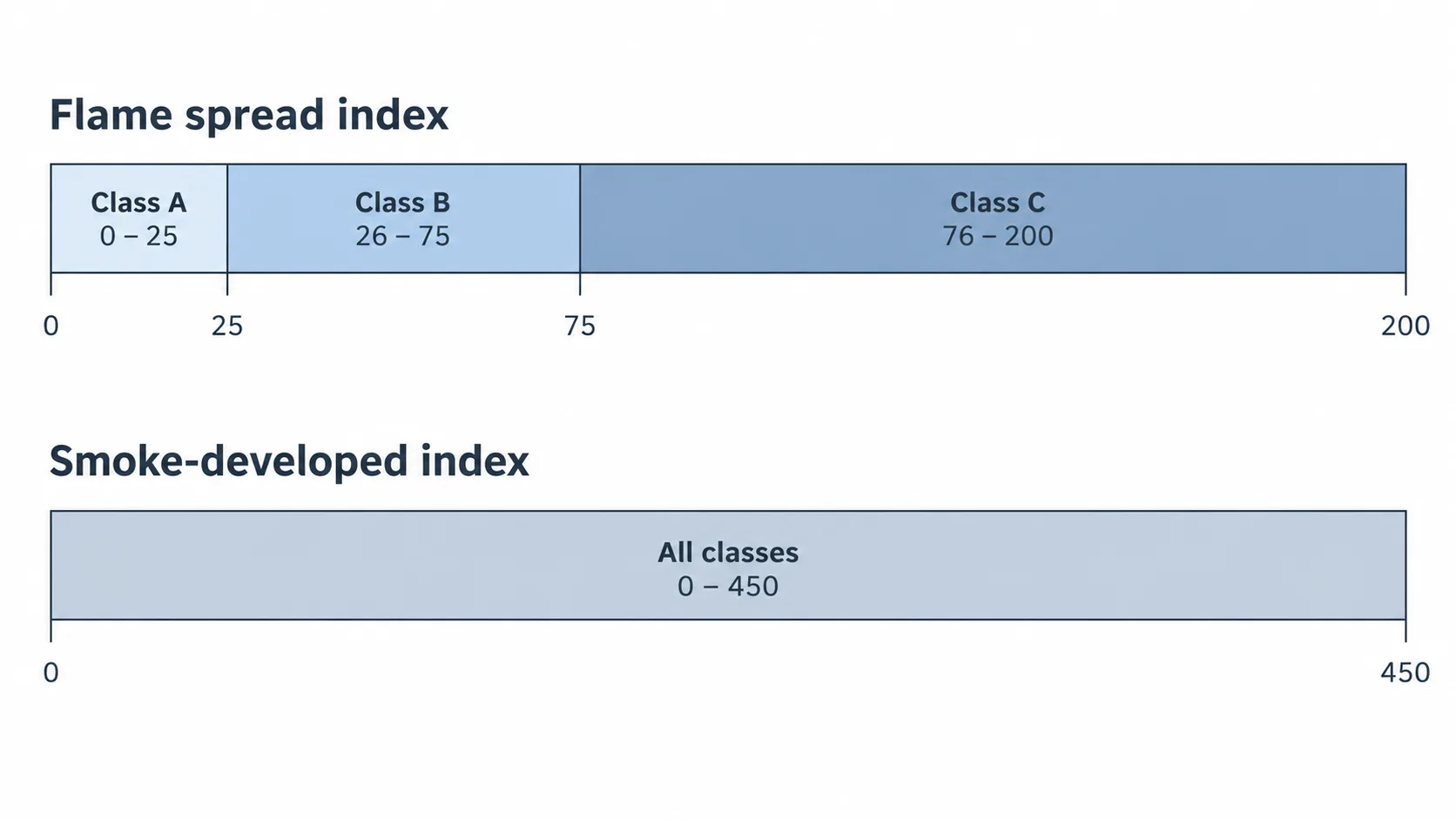
Class A means both indices fall inside the band: FSI 0–25 and SDI 0–450. Section 803.1.2 of the 2024 IBC groups interior finishes into three classes from the tunnel-test results.
| Class | Flame spread index, FSI | Smoke-developed index, SDI |
|---|---|---|
| A | 0–25 | 0–450 |
| B | 26–75 | 0–450 |
| C | 76–200 | 0–450 |
The endpoints count. An FSI of 25 is still Class A for flame spread, while 26 drops to Class B, and the smoke result has to qualify as well. A report that gives only the flame-spread number cannot tell you the class.
The test itself reports two indices and nothing more. “Tested to E84” names the method without giving the outcome, and the standards body issues no Class A certificates for products. Ask for the report, or the certification record, behind any Class A claim.
When you compare wall panel materials, write the class next to the tested construction and the intended location, so the result stays tied to the panel you will actually receive.
The same habit of matching a result to the tested construction applies to surface wear; see cabinet surface durability testing.
What does a flame spread index of 25 tell you?
An FSI of 25 is the top of the Class A flame-spread band. It is a comparative index; it measures neither a percentage burned nor a speed in feet per minute.
The test compares a material’s surface burning with select-grade red oak and fiber-cement board under the same controlled exposure, and the laboratory calculates the index from the flame-front record using the standard’s procedure. Dividing distance by time gives you a different quantity.
A January 1983 National Bureau of Standards report, printed page 3, spells out that the index does not indicate a flame-spread rate. Use it for the concept; a new test follows the current method.
Take two illustrative results, FSI 20 and FSI 25. Both meet the Class A flame-spread range if their smoke results also qualify, but the second sits right on the boundary. Neither number tells you what happens after a change of substrate or bonding system, so a substitution needs its own evidence.
Why should you read the smoke-developed index separately?
Because a low flame-spread result says nothing reliable about smoke. The test method treats the two as separate measurements with no necessary relationship between them.
The Class A smoke band runs to 450. Some locations use a 25/50 requirement instead: FSI no higher than 25 and SDI no higher than 50. A finish can sit comfortably in Class A and still miss that tighter smoke limit.
The 2019 explanation of products in air-handling spaces applies 25/50 to materials exposed to the airflow in ceiling-cavity plenums used for supply, return or exhaust air. That context matters, because ordinary walls outside the plenum fall under the general class rules.
For a panel proposed inside a return-air plenum, read the actual SDI, not just the class. Write the project requirement as two values so whoever checks the report can compare each one directly.
How does the Steiner tunnel test produce the two indices?
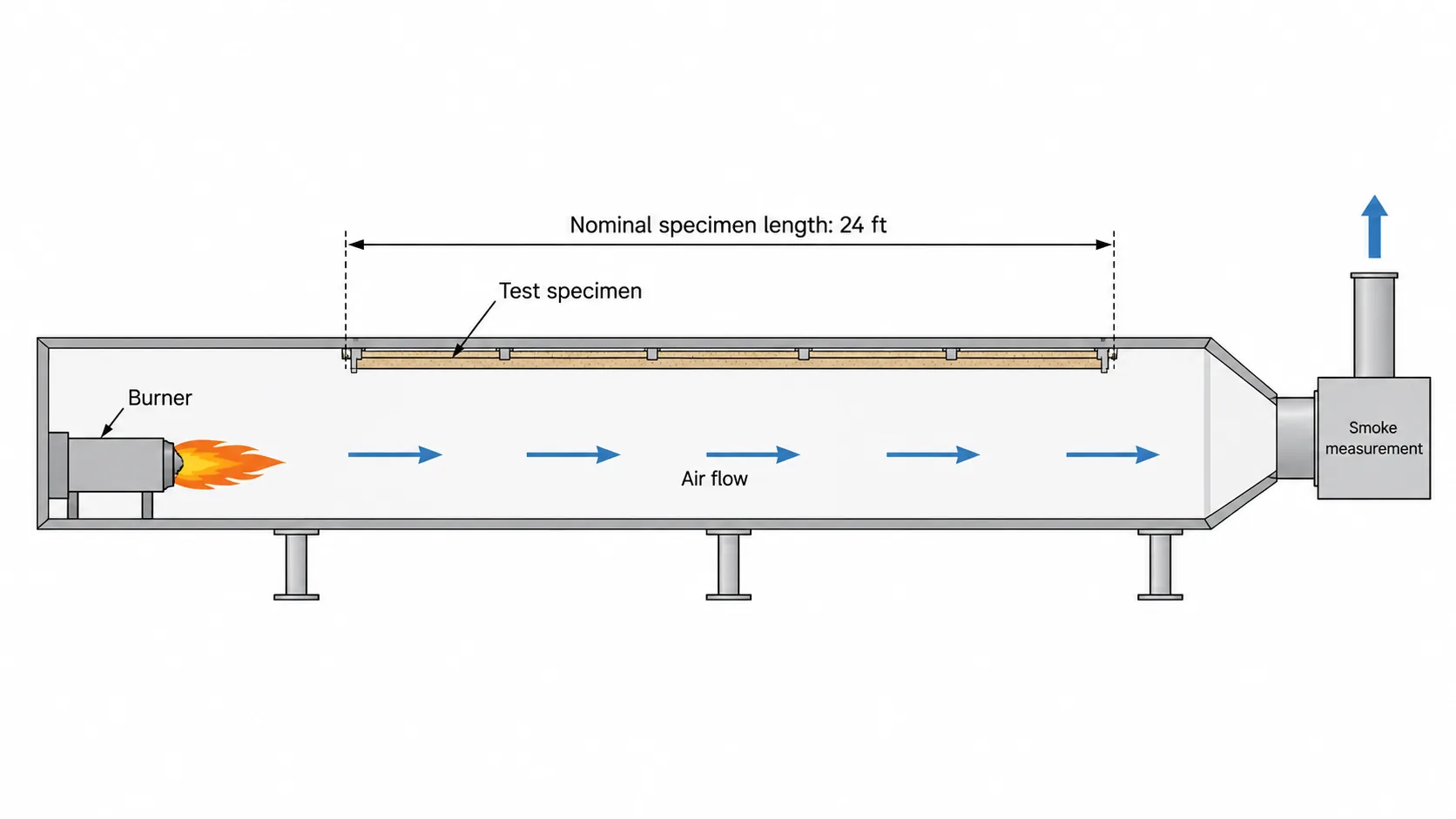
The test mounts a nominal 24 ft (7.32 m) by 20 in (508 mm) specimen face down at the tunnel ceiling and exposes it to controlled fire and airflow for 10 minutes. The burner is set so that flame travels the full length of a red-oak reference specimen in 5½ minutes.
ASTM E84-26a’s public scope and significance describe the specimen, the exposure and the limits. Flame-front observations feed the FSI; smoke measurement in the exhaust feeds the SDI.
The specimen may support itself, use added supports or be secured from the back. Supports under the specimen can lower the flame-spread result. A material that melts, drips or delaminates can also post a low index that is hard to compare with one that stays in place.
Both points matter when you read a report: a facing that falls away leaves something else exposed to the flame. Check the recorded behavior and the mounting before you treat two numbers as comparable.
The method does not measure heat passing through the surface, and FSI alone cannot classify a material as noncombustible. Where a project calls for the extended 30-minute tunnel test, the scope points to E2768, which you name separately in the specification.
How are ASTM E84 and UL 723 related?
They are two Steiner tunnel standards that report the same two indices, and the code accepts either one for interior-finish classification. That shared role is the relationship; it does not make every report or certification interchangeable.
The Steiner tunnel overview covers the testing and certification side. A laboratory test report records one submitted specimen and its result. A Classification or listing adds a defined certification scope, marking and continuing follow-up inspections.
Check which kind of evidence your specification asks for. A supplier may hold a test report without a listed product, or a listing that covers only certain constructions. The document title, product designation and certification record show which claim you actually have.
UL 94 is a different family of small-scale tests for plastics, and it produces no tunnel indices. An hourly fire-resistance test answers yet another question. Name the required method in the finish schedule so a similar-sounding fire test is not swapped in during purchasing.
Why do the substrate, adhesive and mounting change the result?
The tunnel tests the whole submitted construction, so changing one layer or the mounting can change the result. Individual component values neither represent the finished composite nor add up to it, as the guidance on certified composite products explains.
The code separates factory-made wood-based laminated products from facings applied to wood substrates on site. E2579-23b sets specimen preparation and mounting for the factory-made group. E2404-22 covers textile, paper, polymeric and other wall or ceiling coverings, including site-applied facings, and sends factory wood-based laminates to the other standard.
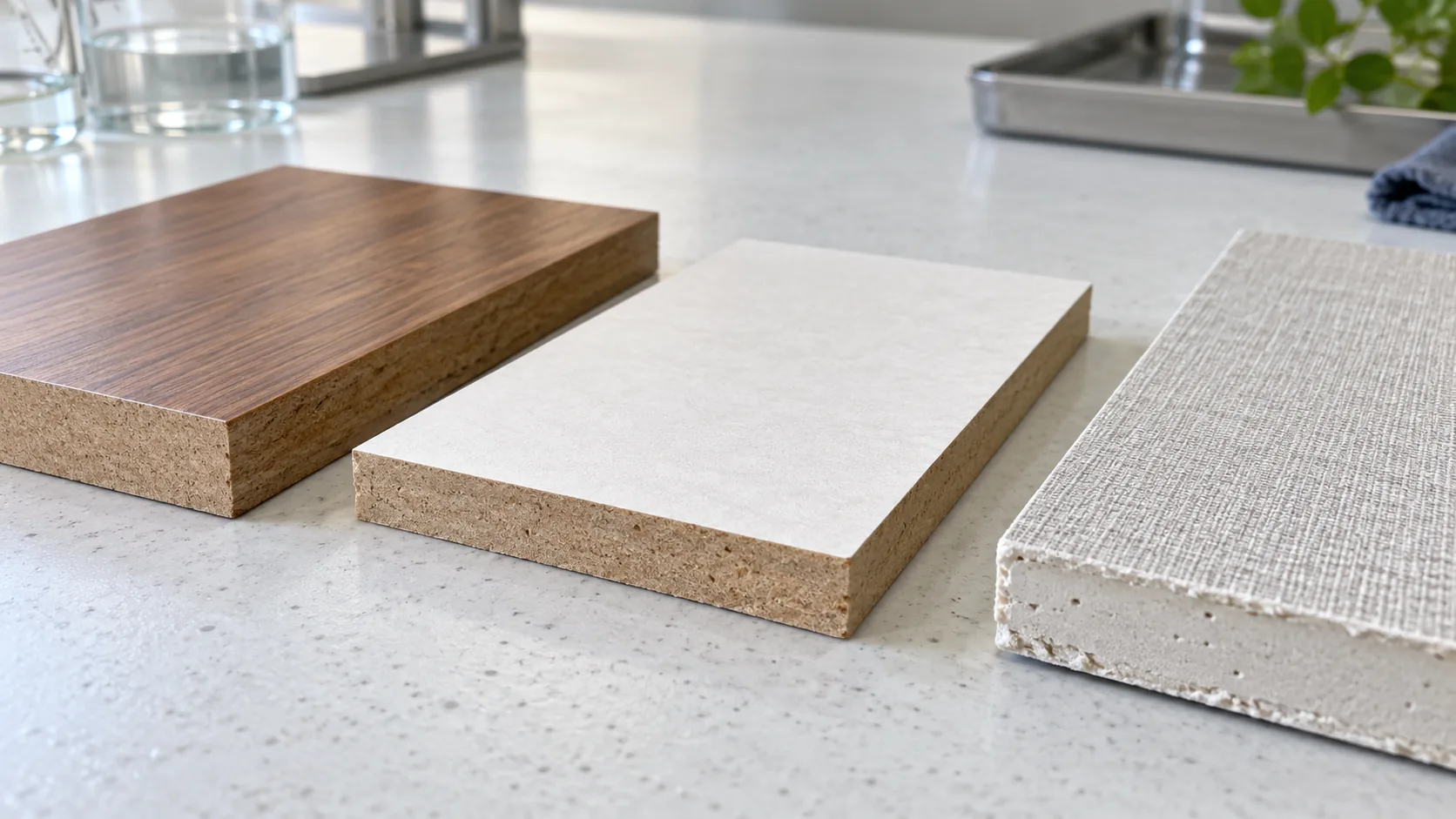
For a film-faced panel, describe the face, adhesive, core, thickness and installation together. A report on the loose film tells you about the loose film; the film-and-board panel needs evidence of its own. The panel lamination adhesive guide and how to laminate MDF explain the bonding side.
The same check applies whether the supplier calls the product a laminate, a decorative panel or a wall finish. For the difference between a panel’s surface-burning class and a whole wall’s hourly rating, see hotel wall panels.
Which details should you check in an E84 test report?
Check that the tested construction is the product you are buying, then read both results. This checklist comes from the public scopes and the construction guidance above; treat it as a reading aid, not a complete list of the report fields the standard requires.
| Item | What to specify or verify | Why |
|---|---|---|
| Document identity | Laboratory, report number, date and complete pages | Connects the claim to an identifiable test |
| Method | Standard and edition accepted for the project | Confirms the required test basis |
| Facing | Product code, material, thickness and covered appearance range | Identifies the supplied surface |
| Substrate | Core material and thickness | Defines the backing in the test |
| Adhesive | Product and application recorded for the test | Identifies the bonding construction |
| Mounting | Supports, fasteners and preparation method | Lets you compare with the installation |
| Results | Separate FSI and SDI values | Supports both classification checks |
| Observations | Melting, dripping, delamination or other behavior | Helps you interpret the indices |
| Evidence scope | Single test or certification with follow-up | Shows what the document supports |
The current edition is E84-26a, updated April 15, 2026, and older editions still turn up in search results. Compare a report’s edition with the adopted code and the project specification; age alone does not decide acceptance.
Carry the product identity from the report into the quotation, including any approved variations. If the supplier proposes a different core or adhesive, settle that before you order. The cabinet surface durability test guide covers the wider habit of matching a claim to its test object and conditions.
Does a Class A result meet every interior-finish rule?
No. The required class changes with occupancy, location and sprinkler protection, and the code allows other test routes. A Class A tunnel result also leaves the other construction requirements to check.
Take the base B, E, M and R-1 row in 2024 IBC Table 803.13. For exit stairways and passageways, corridors, and rooms, it reads A/B/C in nonsprinklered buildings and B/C/C in sprinklered ones. Under that row, a corridor in a sprinklered office building can use a Class C finish, subject to the footnotes.
Read the footnotes with the row. Footnote m requires Class A or B in ambulatory-care corridors, and the sprinkler and exit-stair notes add their own conditions.
The same chapter lets a wall or ceiling finish tested to NFPA 286 and meeting section 803.1.1.1’s acceptance criteria be used where tunnel-based Class A is required. That route has its own pass criteria and produces a different kind of evidence.
Use the code edition your jurisdiction has adopted and the finish’s actual location. For the difference from hourly fire resistance, see restaurant wall panels.
Where does a silicone-faced decorative film fit?
A silicone-faced film is one layer of the panel, so its burning behavior is judged inside the panel construction that gets tested. Puremorfilm makes decorative wall film with a silicone functional surface for wall and furniture panels.
The silicone surface is inherently flame-retardant, and higher grades up to UL 94 V-0 are available on request; that plastics rating gives a panel no E84 class. In the manufacturer’s laboratory tests, coffee, red wine and soy sauce left on the surface for 24 hours at 25°C wiped off with no obvious change. The film is PVC-free and uses a No DOP formulation.
We supply film rolls for panel makers to flat-laminate with PUR adhesive, and we provide technical guidance when you start. For the material layers, see PET vs PVC decorative film.
Our film is a new paint-free finish built on a silicone functional face, distinct from PVC, melamine, PP and PETG decorative faces.
How can you tell whether a Class A report fits your project?
A report fits when the tested construction, both indices and the accepted test basis all meet the requirement for that location. Close any gap before the class goes into a purchase decision.
| Project check | Decision |
|---|---|
| Location and required class identified | Compare with that location’s requirement in the adopted code |
| Facing, core, thickness, adhesive and mounting match | Continue the review within the report’s scope |
| Both indices meet the limits | Record each value, including any tighter smoke limit |
| Edition and evidence type meet the specification | Keep the accepted report or certification record |
| Construction or scope differs | Get evidence for the proposed construction, or test it |
Describe the accepted construction clearly in the specification and purchase order. A later substitution then triggers the same comparison, and the report stays tied to what gets installed.
To discuss a film-faced panel, contact us with the substrate, thickness, adhesive, installation location and required finish class.
Frequently Asked Questions
What is the ASTM E84 equivalent to?
UL 723 is the closest equivalent: a Steiner tunnel method the code accepts alongside E84 for interior-finish classification. UL 94 and ASTM E119 are different tests.
What does a flame spread rating of 25 mean?
A flame spread index of 25 is the highest score that still counts as Class A for flame spread. The smoke-developed index must also be 450 or lower.
How to calculate flame spread rate?
You don’t; the laboratory calculates the flame spread index from the flame-front record under the standard. It is a comparative index, so distance divided by time will not reproduce it.
Is UL 723 the same as ASTM E84?
No. They are separate standards for the same type of tunnel test, and the code accepts either. Whether a given report is accepted still depends on the construction and the project.
Is ASTM E84 mandatory?
No. It becomes a requirement when the adopted code or the project specification calls for it, sometimes with an accepted alternative such as NFPA 286.