
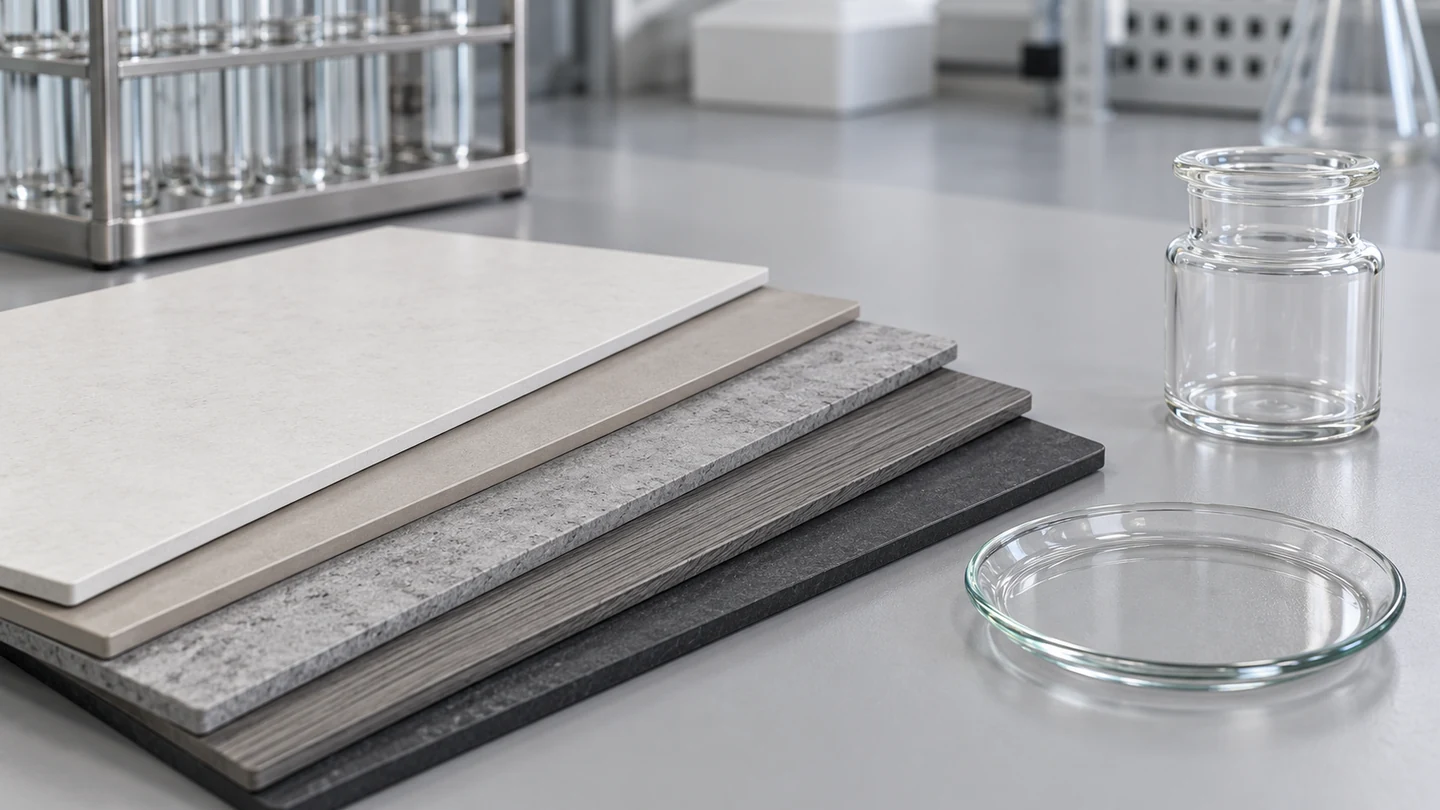
A chemical resistance test for laminate puts measured reagents on a prepared panel, leaves them for a set time, cleans the surface and rates what changed. The SEFA laboratory methods use 49 reagents: plastic-laminate casework gets one hour of contact, laboratory work surfaces get a full 24 hours, both at 23 ± 2°C. Each rating applies only to that reagent, concentration and schedule, so a general claim that a surface is “chemical resistant” tells you much less than the individual results.
A cabinet face and a laboratory bench meet very different spills. Pick evidence for the finished material and the exposure it will see, then read the chemical-by-chemical results. A good result against one cleaner says nothing about a different reagent or a hot, prolonged spill.
How does a chemical resistance test for laminate work?
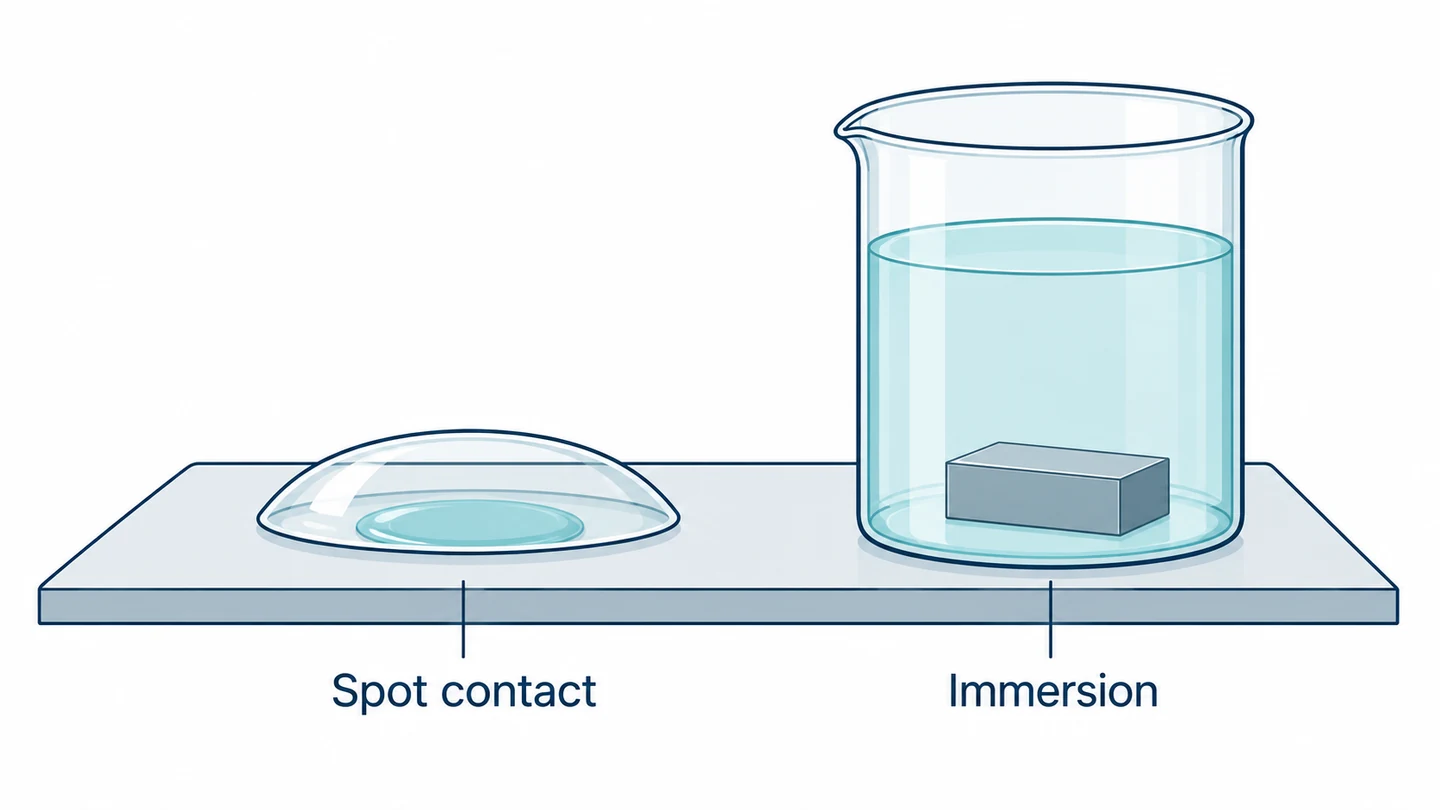
Testing staff place reagents on the surface under controlled conditions, leave them for a fixed time, clean them off and rate the surface for appearance or condition. However, a spot test and a full-immersion test expose a specimen differently, so read their results individually. The ASTM D543 plastics practice covers both immersion and wet-patch or wiping exposures, chosen to reflect the material’s intended use.
For laboratory furniture, two SEFA documents set the spot procedures. The SEFA 8-PL-2026 casework method, section 8.1, covers plastic-laminate casework. The SEFA 3-2020 work-surface method, section 2.1, covers laboratory work surfaces. Their contact schedules are not interchangeable.
| Method context | Contact approach | Exposure and assessment conditions | Result |
|---|---|---|---|
| SEFA 8-PL, plastic-laminate casework | Covered spot contact, with separate volatile and nonvolatile approaches | One-hour contact at 23 ± 2°C; clean, then assess after a further 24-hour recovery under the stated conditions | Individual surface-change ratings |
| SEFA 3, laboratory work surface | Covered spot contact, with separate volatile and nonvolatile approaches | 24-hour contact at 23 ± 2°C; clean, rinse and dry as specified | Individual surface-effect ratings |
| Supplier immersion example discussed below | Testing staff immerse a resin specimen in the liquid | Product-specific preparation, temperature and exposure schedule | That supplier’s own scale |
For example, in a school science room, check whether a report covers the worktop or the cabinet face beneath it. The same word “laminate” can hide a different test object, and a cabinet’s chemical result says nothing about its joints, hardware or structure.
Which reagents and contact methods do SEFA tests use?
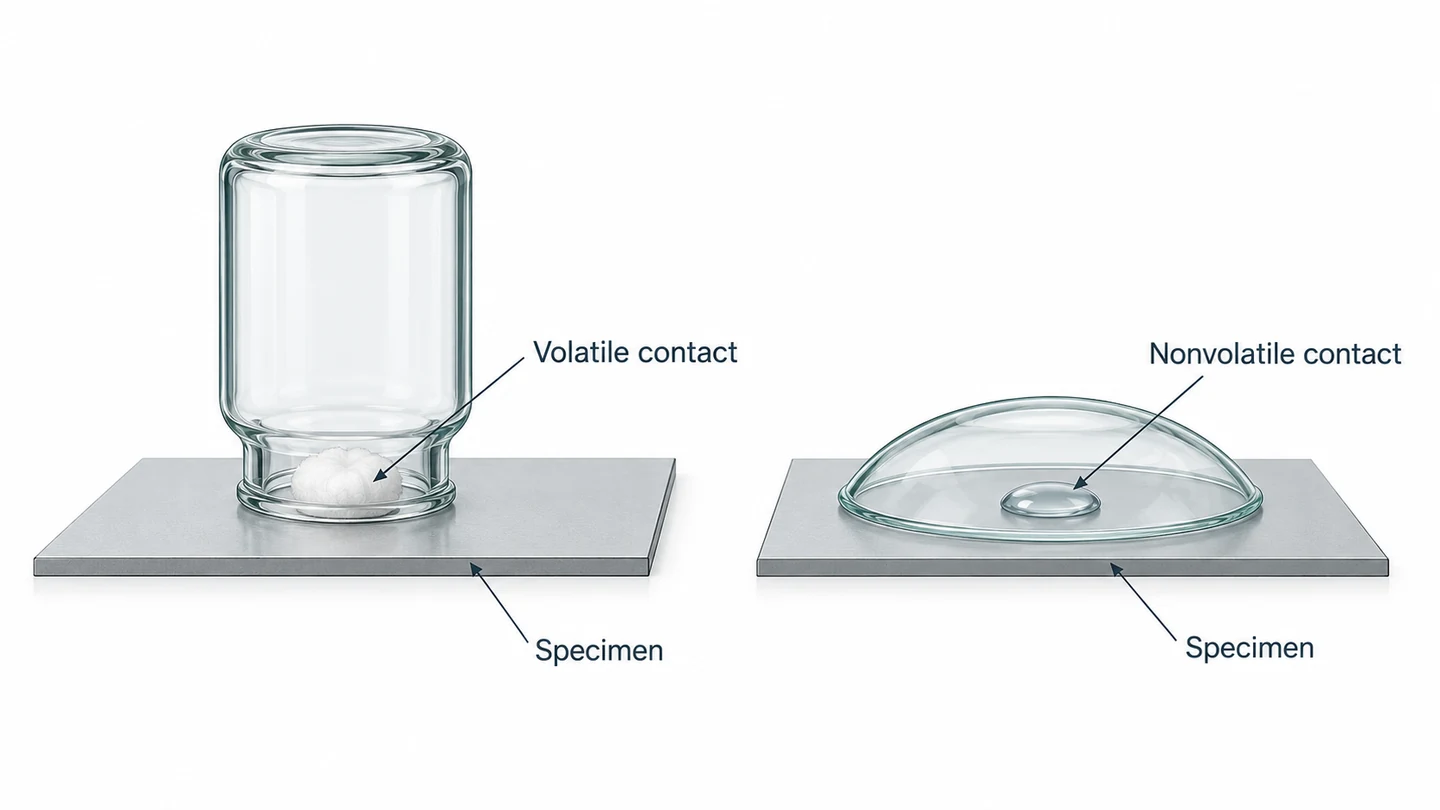
SEFA splits its 49 reagents into volatile and nonvolatile liquids: volatile ones sit on a wetted cotton ball under an inverted container, and nonvolatile ones go down as five drops under a watch glass. First, for casework, testing staff condition the panel before any reagent touches it.
The casework procedure, section 8.1.2 conditions the panel for 48 hours at the stated room temperature and 50 ± 5% relative humidity before testing.
Similarly, the work-surface method follows the same split with its own details. Its watch glass is 25 mm across, against 24 mm in the casework document. In addition, the cleaning differs: casework uses water, detergent, naphtha and a deionized-water rinse, while work surfaces get water, detergent, isopropyl alcohol and a distilled-water rinse.
However, these are laboratory procedures for trained testing staff, not stain-removal steps for a home. Handling these reagents in a kitchen adds risk and still would not reproduce an accredited comparison. For everyday care, the kitchen-cabinet cleaning guide is the better place to start.
Also, the broader cabinet surface durability test guide covers household chemical exposure alongside the other surface tests. A laboratory reagent list helps specify a demanding project; daily care still has to suit the actual finish and cleaner.
What are the chemical contact times?
One hour on plastic-laminate casework under SEFA 8-PL, and a full day on laboratory work surfaces under SEFA 3. The casework panel then rests after cleaning before staff rate it, and that recovery is a separate stage, not extra contact time.
So keep contact, cleaning and evaluation apart when you read a report. A rating taken straight after wiping and one taken after recovery can look different, and neither means the surface held the liquid for the total elapsed time.
That difference reflects how people use each surface. For example, on a bench, a spill can sit unnoticed under equipment for hours; a cabinet face usually takes a splash that someone wipes sooner. For a project, compare the standard’s schedule with the exposure your staff and cleaning routine will actually create.
How do you read a 0–3 chemical resistance rating?
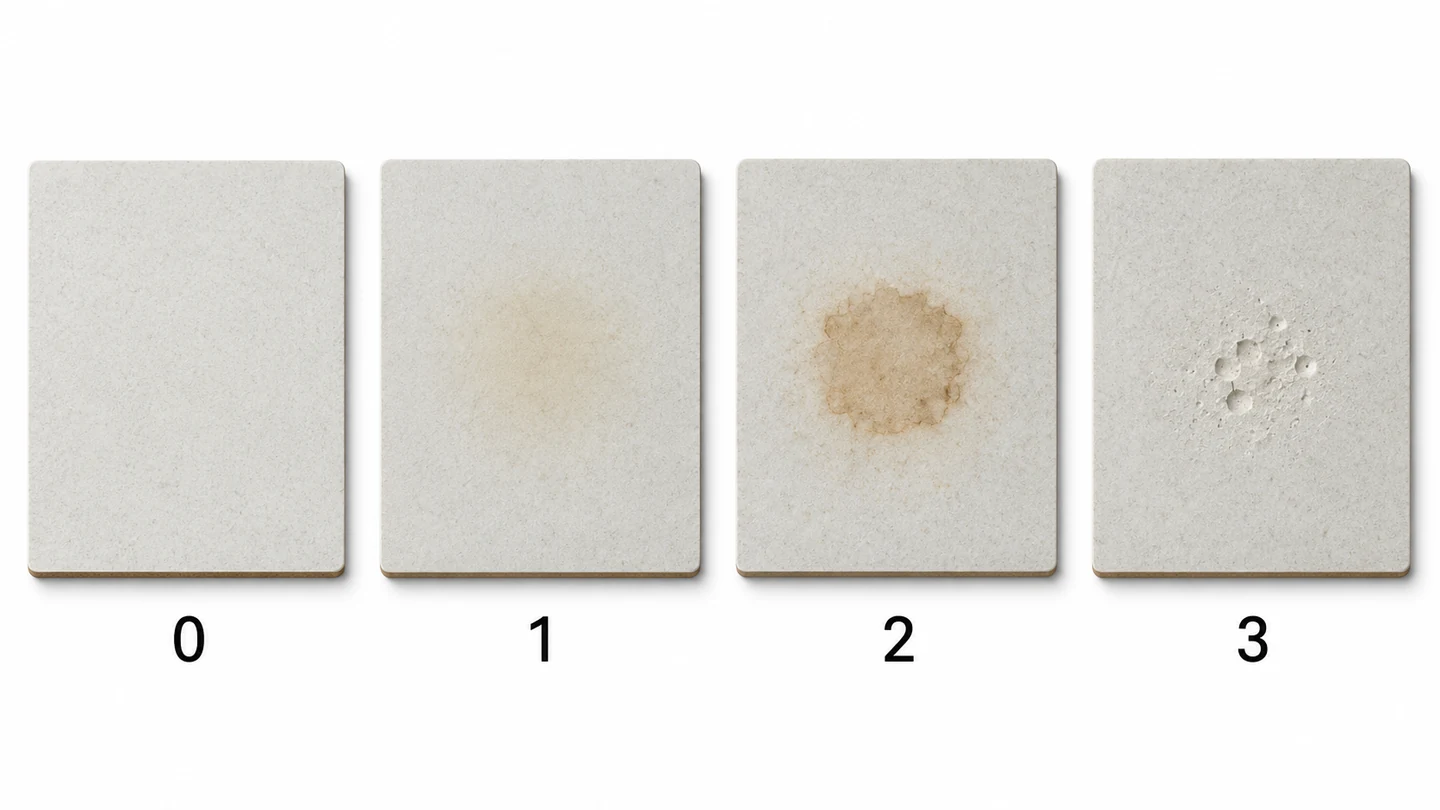
In both SEFA scales, 0 is the best result and 3 is the most severe listed change. The wording behind each level differs between the casework and work-surface documents, so read the description, not just the number.
| Level | Casework scale description | Work-surface scale description |
|---|---|---|
| 0 | No visible change | No effect |
| 1 | Slight discoloration or loss of gloss | Excellent; limited visible effect under the stated description |
| 2 | Slight surface etching or severe staining | Good; a more evident effect under the stated description |
| 3 | Pitting, cratering, swelling or coating erosion | Fair; objectionable discoloration or etching |
However, both documents allow no more than four Level 3 results across the reagent set. A surface can therefore meet the acceptance limit even when a few chemicals leave severe marks, so look at which ones scored 3 before treating it as right for your room.
For example, a report full of unaffected spots looks reassuring, yet one poor result may be the chemical used at your station every day. Therefore, keep the project-wide acceptance limit separate from the practical question of whether that one reagent belongs on the chosen surface.
Why can an immersion rating differ from a spot-test rating?
Because immersion soaks the whole specimen while a covered spot test touches one face, and the two systems also define their scales differently. As a result, the specimen, schedule and rating definitions together decide what a number means.
One resin-flooring supplier’s published scale shows the contrast. The supplier casts 30 × 30 mm specimens at the product’s specified thickness, cures them for seven days and fully immerses them at 20–25°C. It rates them 0, 1, 3 or 5, and 5 is the best: long-term contact without significant deterioration.
In contrast, that scale ignores discoloration if the specimen stays intact, whereas the SEFA scales count a color change even when the sample holds together. A higher number means a better result on one scale and a worse one on the other, so check the scale direction first.
For example, the same supplier gives one solvent-free epoxy example for 10% sulfuric acid: 5 at 20°C and 0 at 100°C. This example shows temperature sensitivity in that supplier’s product.
Therefore, for a cleaning cupboard or a laboratory bench, translate each rating into its written description before comparing materials, and keep a brief splash and sustained immersion as separate cases.
Do temperature and concentration change the result?
Yes. A chemical-resistance result belongs to the tested concentration and temperature, and changing either can change how the material responds. Record both alongside the chemical name and the exposure schedule.
ASTM D543-21, sections 4.1–4.3, lists concentration, temperature, contact and duration among the conditions needed to relate a plastics test to real use. A dilute cleaner at room temperature is a different exposure from a hotter or stronger preparation, so the test matrix must name the actual formulation or concentration rather than relying on an acid, alcohol or disinfectant label.
Therefore, for hot cleaning, look for compatibility evidence at the intended temperature as well as for the cleaner. A room-temperature chemical test does not settle whether the surface suits a hot vessel or a heated process; dry heat and thermal shock are separate questions.
Similarly, for routine wiping, match the working solution and a realistic contact time to the available report, and recheck the match if the cleaner’s formulation changes. That keeps a test result tied to the exposure it measured.
Which laminate surfaces suit chemical-heavy rooms?
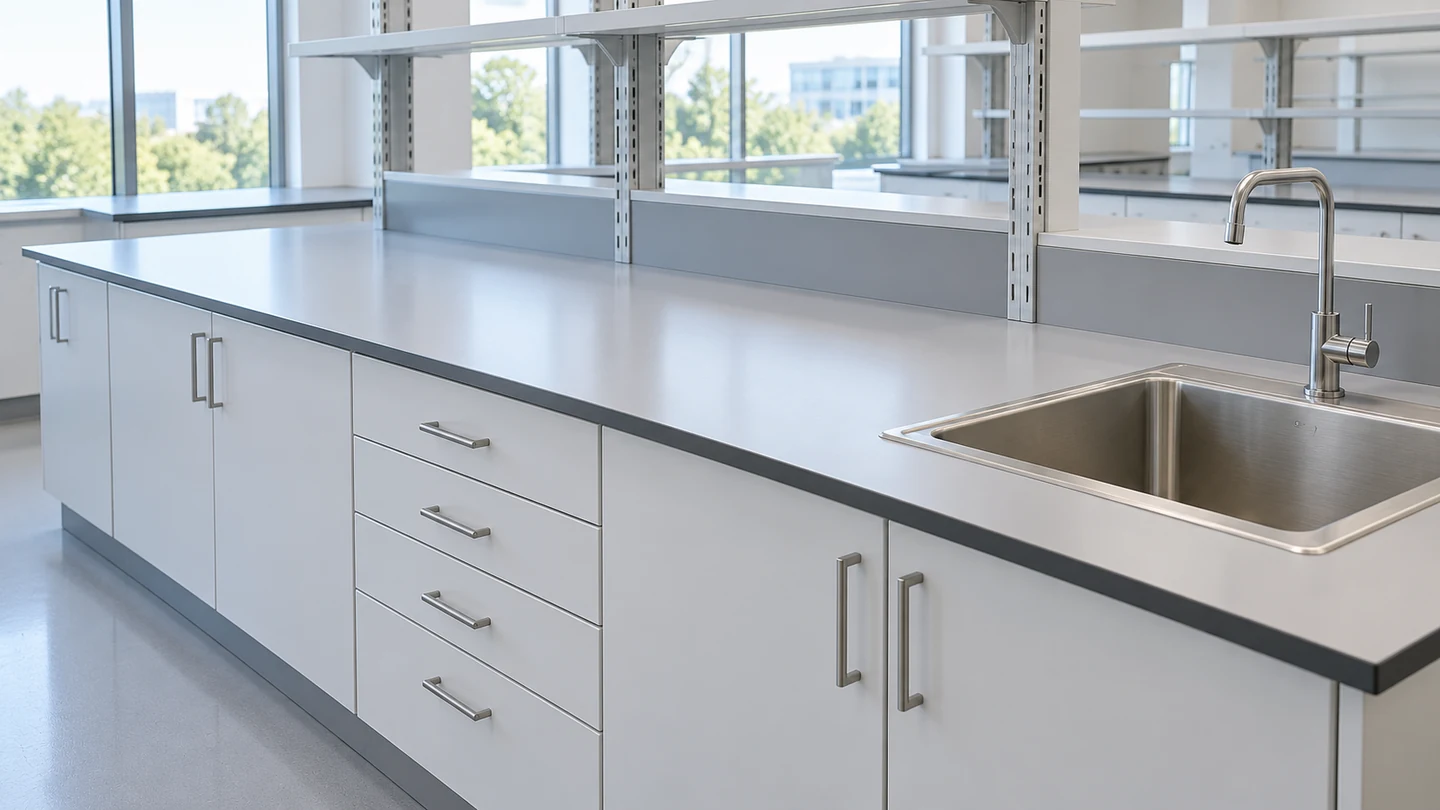
For a bench that sees laboratory reagents, use a work surface that meets the SEFA 3 chemical acceptance limit, whether that is epoxy resin, phenolic, stainless steel, ceramic or a high-pressure laminate grade tested to it. For a chemistry bench, use a grade with that report.
SEFA 3 describes these laboratory work-surface families, and its HPL description is melamine-impregnated surface paper pressed over phenolic-impregnated kraft layers, with a back ready for bonding to a substrate. That construction identifies the test specimen; it does not rank every grade against every chemical. The melamine vs laminate explanation helps you tell these decorative-surface families apart before you read a product report.
The room decides the evidence. For example, in a chemistry laboratory, start from the actual reagents and the worktop’s test results. In a teaching room, think about the experiments, supervision and cleanup routine. At a nurse station, the disinfectant wiped on every shift matters more than an extreme reagent that never reaches it.
In addition, heat and mechanical use need their own check. A stand holding hot equipment, an exposed edge or a sink junction can demand more than a flat-face spot test shows, whichever material family you choose.
What should a chemical resistance report include?
First, it should name the tested construction, the standard and edition, the exposure conditions and a result for every reagent. A one-line pass without those details gives you too little information to check suitability for your actual use.
First, look for the panel or worktop identity, the face and core materials, reagent names and concentrations, contact method, temperature, contact time, cleaning, recovery and the rating scale. The report should also name the testing organization and say how this test supports any wider compliance statement.
Also, the current casework document requires verification by a SEFA-approved independent third party, with its submission documentation. That laboratory status belongs beside the individual results, and the chemical test is only one part of the full casework standard.
The supplier evaluation checklist helps keep those records tied to the exact grade offered. If a hospital brief also mentions antimicrobial surfaces, assess that claim on its own: killing microbes and resisting the disinfectant used on a surface are different properties.
Finally, a useful report shows the chemical that performs poorly as clearly as the ones that perform well. For repeat cleaning, the concentration and exposure sequence deserve as much attention as the headline result.
Where does a silicone-faced furniture film fit?
Puremorfilm makes decorative film with a silicone functional surface for flat-laminated furniture and wall panels. It is not a SEFA-tested laboratory worktop material, and we do not claim SEFA results for it. In the manufacturer’s laboratory tests, coffee, red wine, ice cream, soy sauce and lipstick left on the film for 24 hours at 25°C wiped away with no obvious change. The silicone surface is inherently flame-retardant, with higher grades up to UL 94 V-0 available on request.
We use a No DOP formulation, and the film is formaldehyde-free. Supply is mainly rolls for PUR flat lamination, with film-faced panels available on request. This newer paint-free decorative surface uses silicone functionality, distinct from PVC, melamine, PP and PETG faces.
The furniture decorative film and hygienic wall panel film pages cover those panel uses. Whatever cleaning system you choose still needs its own compatibility evidence.
How should you compare chemical resistance results?
Compare the same chemicals under the same conditions first, then read the scale and each effect against your intended use. A bigger number or a longer elapsed time means little until the method is clear.
| Comparison point | Decision it supports |
|---|---|
| Same surface grade and construction | Whether the evidence concerns the offered material |
| Same reagent and concentration | Whether the chemical exposure is comparable |
| Same contact, temperature and evaluation stage | Whether the schedule addresses the intended use |
| Same scale direction and effect descriptions | Whether the reported outcomes mean the same thing |
| Appropriate laboratory and complete documentation | Whether the result can support the project requirement |
For a furniture or wall-panel finish, contact us with the application, the chemicals or cleaners you expect to use and the exposure conditions you need assessed.
Frequently Asked Questions
Does temperature affect chemical resistance?
Yes. A result measured at room temperature can change when the same material meets a heated chemical, so read the tested temperature together with concentration, contact time and the material grade.
Is discolouration counted as chemical damage?
No, not always. The supplier’s immersion scale accepts discoloration when the specimen stays intact, while the SEFA scales count visible color change from Level 1 upward.
How are chemical resistance ratings tested?
The test exposes a prepared specimen to a reagent by a spot or immersion method for a set time and temperature, then rates the change after cleaning on that method’s own scale.
What does a chemical resistance rating of 5 mean?
On the 0/1/3/5 immersion scale, 5 means long-term contact without significant deterioration. The SEFA scales run the other way, with 0 best and 3 the most severe effect.
How heat resistant are laminate countertops?
High-pressure laminate on SEFA 8-PL casework must show no change in color or surface finish after the NEMA LD 3 boiling-water test. It does not show that a laminate countertop can take a hot pan, hotplate or sterilizer, which need their own evidence.