
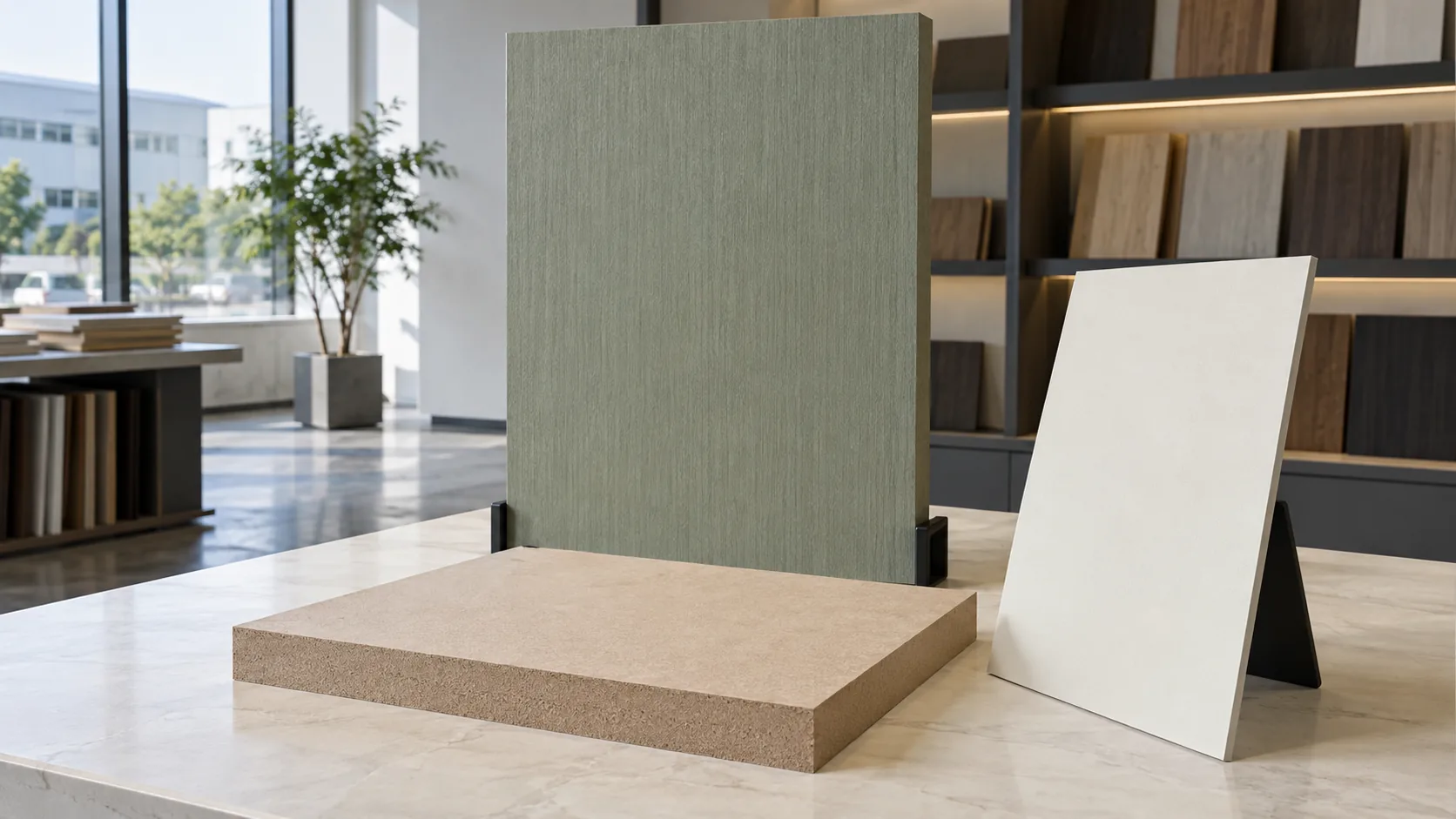
Melamine and laminate are both resin-paper surfaces, but they are made differently. Melamine, also called TFL (thermally fused laminate), is a decor paper soaked in melamine resin and fused straight onto MDF or particleboard. Laminate usually means HPL (high-pressure laminate): a thicker, multi-layer sheet pressed separately and then glued to a board. HPL is tougher against wear and impact and costs more; melamine is cheaper and is the normal choice for cabinet boxes, shelves and everyday flat doors.
For office furniture, melamine-faced TFL is the default for cabinet bodies, shelves and routine flat doors; choose suitably graded HPL laminate for heavily used desk tops. HPL also lets you select the face and core separately. Matching wear, stain and impact results must support the supplied grade.
Are melamine and laminate different materials?
They are related: both are decorative laminates, but TFL arrives already bonded to its board, while HPL is made as a separate sheet and glued on later. Melamine is the resin, not the board. Either face can sit on MDF or particleboard.
| Dimension | Melamine-faced TFL | HPL-faced panel |
|---|---|---|
| Construction | Décor paper fused directly to the core; supplied as a faced board | Separate multi-layer resin-paper sheet bonded to a selected board |
| Office cabinet bodies and routine flat doors | Default route when a suitable ready-faced decor and grade exist; no separate face-bonding step at the shop | Suitable, but the extra bonding and trimming must earn their cost in the specified face/core build |
| Heavily used desk tops | A declared higher-wear TFL grade is a candidate; ordinary TFL must not inherit that grade | Start with a horizontal or high-wear grade intended for the use; the name HPL alone supplies no test result |
| Scratch, stain and impact evidence | Grade-specific reports decide; large-ball impact is optional under CPA 5-25 | Grade-specific reports decide; compare the same method and endpoint, not unlike cycle counts |
| Rounded edge or routed door | Cut edges need edging; the pre-fused paper does not wrap a routed recess | A suitable postforming grade can follow a controlled curved edge; ordinary HPL does not cover a deeply routed face |
| Moisture at edges and holes | The face does not waterproof exposed chipboard or MDF; detailing and core grade govern the assembly | The face does not waterproof exposed chipboard or MDF; bond, back and edge detailing remain necessary |
| Completed-part cost | Ready-faced board removes the separate face-bonding stage; add machining, edging and rejects | Add the selected core, front/back sheets, adhesive, bonding, trimming and rejects before comparing price |
With TFL, decorative paper is fused to the board to make a finished panel ready for machining, and it comes in textured and gloss finishes as well as smooth (TFL description). So melamine doesn’t have to mean plain smooth white.
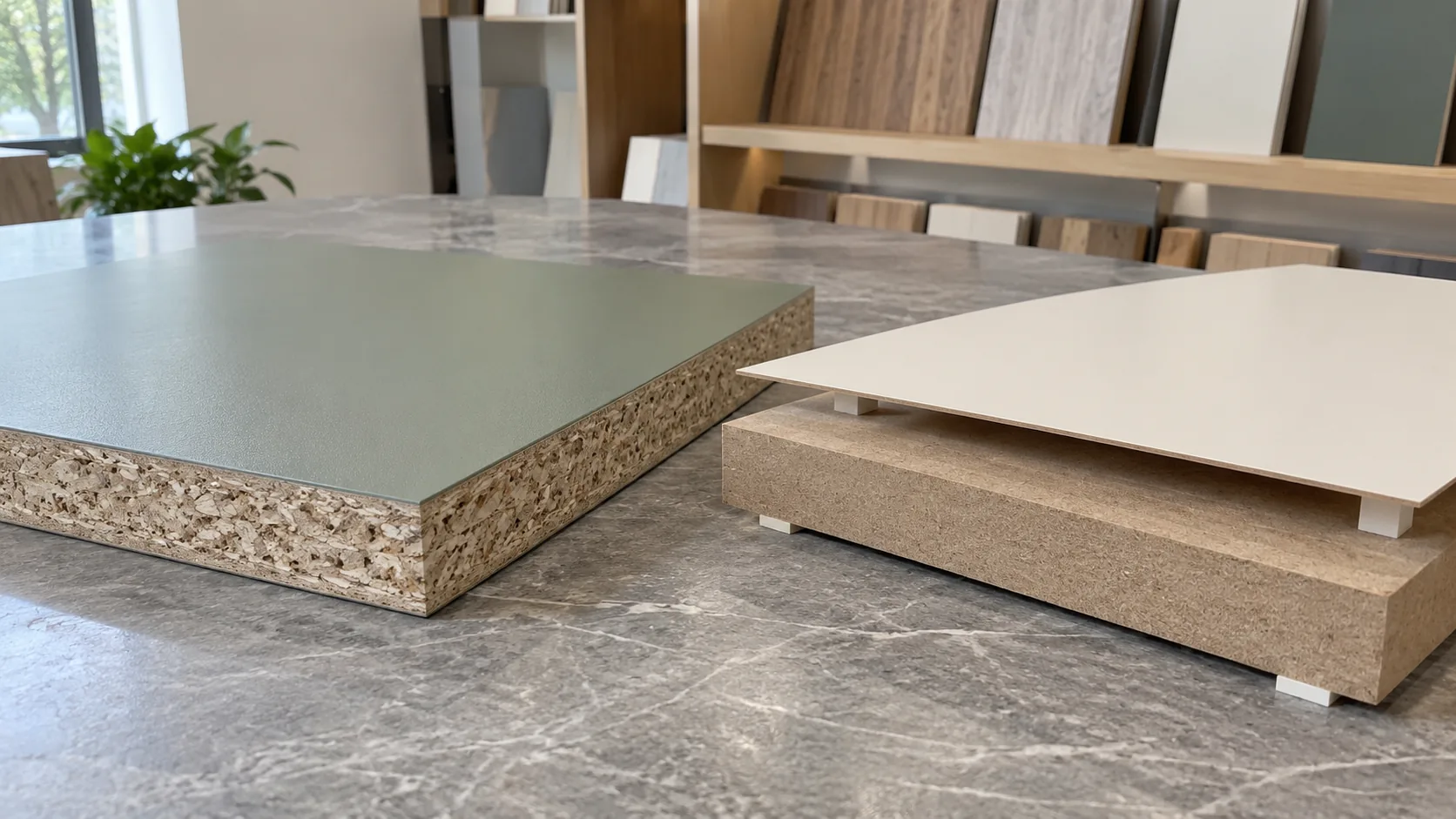
HPL is layered from resin-treated kraft papers and a decor sheet. Its face tells you nothing about the board it ends up on. A thick HPL-faced door can be a thin facing sheet over whatever core the maker chose.
The laminated MDF explanation shows how core and face combine in a finished panel. On a purchase order, name both. “Melamine”, “laminate” and a decor code on their own leave the board grade, thickness and remaining work open.
The decorative laminate overview places these two constructions alongside thermofoil, decorative films and veneer.
Melamine vs laminate at a glance
| What you care about | Melamine (TFL) | Laminate (HPL) |
|---|---|---|
| Construction | Resin-soaked decor paper fused to the board in one press | Several resin-paper layers pressed into a sheet, then glued to the board |
| Scratch and wear resistance | Good for everyday use | Better; grades are made for worktops and heavy use |
| Impact and chipping | Edges and corners chip more easily | Thicker face resists knocks better |
| Moisture | Face resists splashes; exposed edges and holes let water reach the core | Same rule: the face is water-resistant, the core is not |
| Shapes | Flat panels with separate edge banding | Flat panels; postforming grades can wrap a rounded edge |
| Price | Lower, because the face is applied when the board is made | Higher, because the sheet and the bonding are extra steps |
| Typical uses | Cabinet boxes, shelves, wardrobes, flat doors | Countertops, desk tops, high-wear doors and commercial furniture |
Do not confuse melamine board with melamine foil or paper foil: a foil is a thinner printed paper with a topcoat that is glued to the board, and it is usually lighter-duty than both. See our guide to finish foil.
Melamine vs HPL for office furniture: desks, doors and cabinet bodies
For office furniture, use melamine (TFL) for cabinet bodies, shelves, pedestals and normal flat doors, and use HPL for desk tops, reception counters and meeting tables that take daily wear, stains and knocks. Melamine keeps the cost down on the many vertical and interior parts; HPL earns its higher price on the horizontal surfaces people work on.
| Office component | Usual choice | Why | What to ask for |
|---|---|---|---|
| Desk tops, workstations, reception counters, meeting tables | HPL, horizontal grade | Highest wear, scratch, stain and impact demands on a horizontal surface | A horizontal general-purpose grade (for example NEMA LD 3 HGS) and wear, stain and impact results for the exact product |
| Cabinet bodies, shelves, pedestals, wardrobe interiors | Melamine (TFL) | Ready-faced board, low cost, enough wear resistance for storage | Board grade, thickness, edge banding on all exposed edges |
| Cabinet doors and drawer fronts | Melamine for normal use; HPL in high-traffic or shared offices | Fronts take handling and bumps, but less wear than a desk top | Matching decor between TFL bodies and HPL fronts, and edge thickness |
| Edges of desks and counters | Thick PVC or ABS edge banding, or a postformed HPL edge | Edges take the knocks from chairs and bags | Edge thickness and bond quality, especially on corners |
Which office desk surface is most scratch resistant?
Among common office desk surfaces, a horizontal-grade HPL is usually the most scratch- and wear-resistant choice at a normal furniture budget, ahead of melamine (TFL), painted MDF and most decorative films. A textured or matte HPL hides fine marks better than a smooth or glossy one. Compare products on the same test method, such as NEMA LD 3 or EN 438 wear and scratch results, rather than on category names, and avoid low-wear films or foils on desk tops.
How do TFL and HPL change the production route?
TFL is the default for flat cabinet parts when a ready-faced board in the right decor exists. HPL makes sense when you need to pick the face and core separately, or need a postforming grade for a curved edge.
General-purpose HPL is typically 0.71–1.22 mm thick (HPL guidance). That is the facing sheet only. Compact laminate, other grades and the finished door thickness are different numbers.
With TFL, the paper is fused to the board at the panel mill. A cabinet shop buys the faced board and goes straight to cutting, drilling and edging. A shop buying HPL sheets also needs the core, adhesive, back sheet, bonding equipment and trimming.
Postforming bends a laminate around a controlled edge, like the rounded front of a countertop. A routed recess across a cabinet door is a different shape altogether. The part drawing tells you which one your fabrication route has to make.
Making the HPL sheet and bonding it to MDF are two separate steps, each with its own process spec, and the adhesive you choose sets the bonding conditions. Our MDF lamination guide covers that process and the whole panel build.
How should you compare wear, scratches and stains?
Start with a horizontal or high-wear HPL grade for a heavily used desk top, then compare a declared high-wear TFL candidate on matching methods and endpoints. For routine cabinet fronts and interiors, ready-faced TFL often removes an unnecessary bonding stage. A door edge that takes knocks still needs its own edge and impact evidence.
The May 2025 CPA 5-25 TFL standard, Table 1 and its notes, sets performance classes. Class 3 requires WP greater than 150 in the standard’s modified wear method, which it ties to institutional or commercial high-wear use. WP is the point where the pattern or color wears through. An HPL abrasion result reports its own endpoint.
| Property | What to compare | What the result answers |
|---|---|---|
| Wear | Method, endpoint and declared grade result | Resistance in the stated wear test |
| Scratches | Scratch method and reported threshold or classification | The specified scratch response |
| Stains | Test agents, exposure and assessment | Response to those agents under the stated conditions |
| Impact | Whether the required impact test was performed | Performance in that specific test and construction |
Large-ball impact is optional in the standard, so a panel that meets the standard may have no impact result at all. Ask which tests and classes the supplied panel carries before you write the standard into an order.
TFL wear classes and HPL reports can use different intervals and endpoints. Dividing one cycle count by the other gives you a durability multiplier that doesn’t exist.
Pick evidence for the part in question. A wardrobe side gets brushed by clothes, a desk top gets elbows and coffee cups, and a shelf gets things slid across it. Our kitchen cabinet materials guide sets the surface choice beside the core, hardware and assembly.
What makes a finished cabinet resist moisture?
A core made for the exposure, plus edges, holes and joints that keep water out. The face alone doesn’t make a cabinet waterproof, and both TFL and HPL leave raw board exposed wherever you cut or drill.
The Composite Panel Association’s dimensional-stability bulletin, pages 3–4, explains how panels move with moisture and why balanced construction matters. The face and the wood-based core can react differently as humidity changes, and the back sheet affects how flat the panel stays.
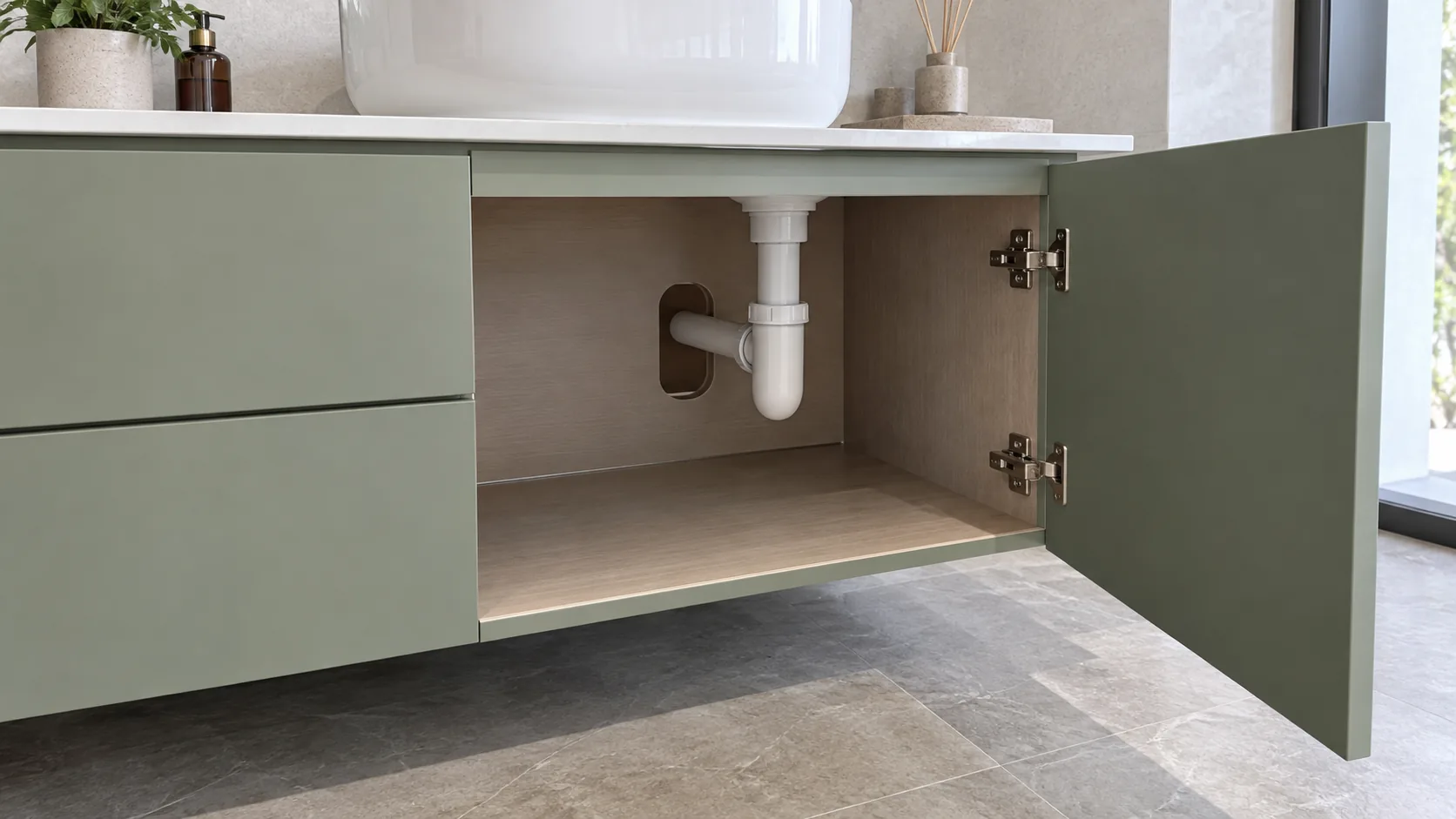
A bathroom vanity puts every weak point in one box: pipe cutouts, a bottom edge near a damp floor, hinge recesses and joints at the back. A clean front can hide a swollen cut edge. After a leak, inspect the whole cabinet, not the door.
The core can be MDF, particleboard or plywood in a grade made for those conditions. Even a moisture-resistant core still needs the right finish and detailing. For fiberboard, the MDF water-resistance guide explains the gap between humid-room service and direct wetting.
Panels can also be damaged before assembly, in transport and storage. Keep them dry and in the specified conditions. Once a part has swollen, covering it up won’t bring the board back to size.
How should you compare completed-part cost?
Compare the total cost of accepted parts made to the same drawing and look. A TFL quote already includes the face. An HPL sheet price still leaves the core, back, adhesive and bonding to be paid for, so the two sheet prices aren’t comparable.
For HPL, add the core, front and back sheets, adhesive, bonding labor, trimming and handling. For TFL, take the faced panel and add cutting, drilling, edging and assembly. Put both quotes on the same delivery and acceptance basis.
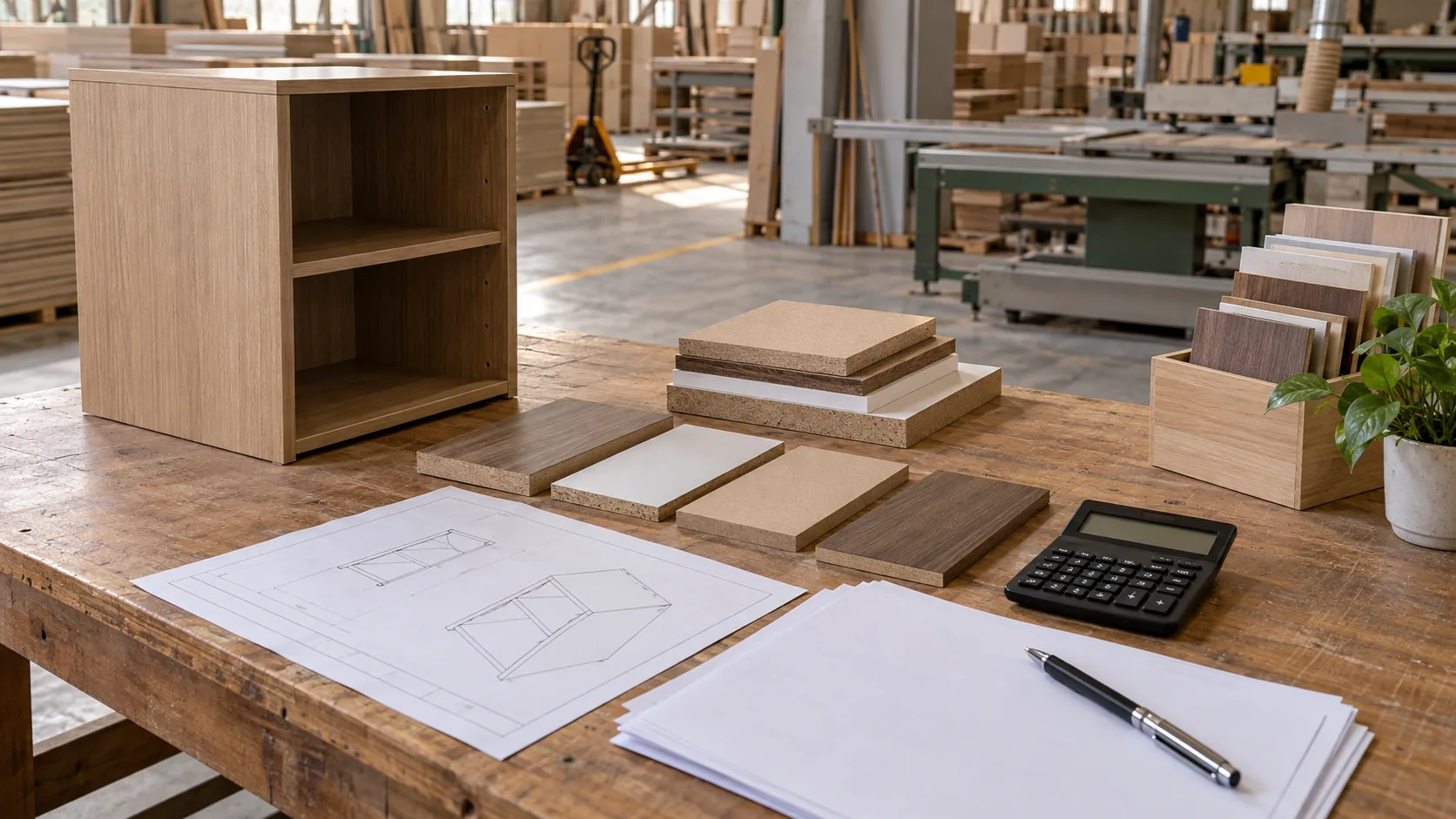
Count offcuts and rejected parts as well as the area you buy. A low sheet price can cost more per accepted part when cutting yield falls. Grain direction, nesting, visible-face rules and damaged areas all cut usable material without changing the sheet size.
Divide the whole batch cost by the accepted quantity. Keep material, processing, delivery and rework as separate lines so that a revised quote shows exactly what changed.
The core changes machining, weight and fixing work too. The MDF and particleboard comparison covers those differences, and the MDF and plywood guide covers the layered option. Cost those effects on the real part instead of adding a percentage for a material name.
What should a finished-panel order specify?
The core, the full face and back build, the geometry, and the performance results for both the incoming panel and the finished part. A sheet standard covers the board as supplied; a cabinet needs tighter fit than that.
| Item | What to specify | Why it matters |
|---|---|---|
| Core | Product, grade, thickness and service conditions | Identifies the substrate behind the finish |
| Facing | TFL or HPL route, decor, texture and gloss | Defines the actual surface to be purchased |
| Back and edges | Back construction, exposed-edge finish and cutout details | Describes the complete part rather than its front |
| Geometry | Current drawing, holes, recesses and finished tolerances | Determines fit during assembly |
| Performance | Required property, method, class and actual report | Makes surface comparisons inspectable |
| Production scope | Faced sheets, bonded blanks or completed parts | Records supplied and remaining operations |
| Acceptance | Incoming checks, finished appearance and lot records | Connects deliveries to the agreed construction |
Table 2 of the same standard (dimensional requirements) specifies flatness of less than 3 mm/m for panels with TFL on both faces. That requirement does not apply to single-sided TFL and is not a finished-cabinet machining tolerance. Hole locations, finished sizes and permissible door warp belong on your component drawing and acceptance agreement.
For doors and cabinet sides, the drawing sets its own fit rules: hole positions, edge finish and how much board is left around each fitting. Agree how you will inspect those before the batch goes into assembly.
Log any change of decor, core or facing grade as a revision with a decision attached. Two colors with similar names can have different textures and gloss. The delivery record should trace the received panels back to the order, approved substitutions included.
Melamine vs laminate for kitchen cabinets: which is better?
For most kitchens, the practical answer is both: melamine for the cabinet boxes and shelves, and either melamine or HPL for the doors depending on how hard they are used. Melamine doors are a sound budget choice for flat fronts that are wiped and handled normally. HPL is worth paying for on doors and drawer fronts near the sink, dishwasher and cooking area, in rentals and in homes with children or pets, because it takes knocks and scrubbing better.
In either case the edges decide how long the cabinets last. Ask for well-bonded edge banding on all exposed edges, sealed hinge holes, and a moisture-resistant core under the sink.
Where does silicone decorative film fit this choice?
A silicone decorative film offers another flat furniture face, with its own bond and panel specification rather than an inherited TFL or HPL grade.
Puremorfilm manufactures silicone decorative film in China with a silicone functional face on PET support. We supply rolls without self-adhesive backing for PUR flat lamination to board, or silicone laminated panels quoted per project. The intended uses are vertical or low-wear furniture fronts, cabinet doors and wall panels. Floors, all countertops, cooktops, shower floors and other walked-on areas are excluded; this option is not proposed here as a desk-top facing.
One relevant abrasion result comes from SGS report SZIN2608002405PL04. Under ASTM D4060-25 with CS-10 wheels, 1,000 g per wheel and 60 rpm, the submitted film sample showed slight matting after 2,000 cycles, without concentrated scratches, substrate exposure or coating peeling. This film result is neither a TFL wear class nor a ranking against HPL tested by another method.
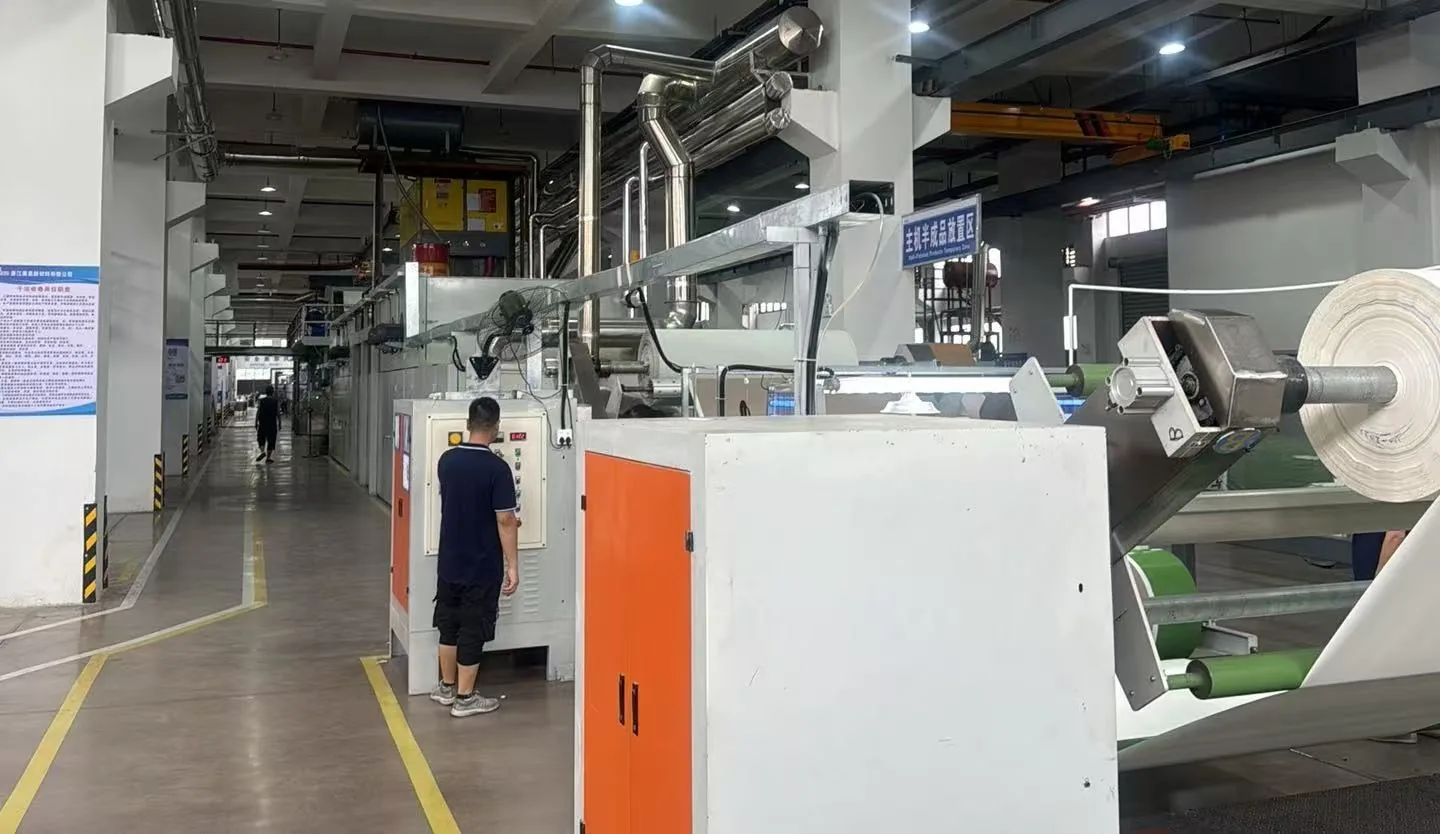
Furniture and wall film rolls start at 500 m. Laminated panels are 1220 × 2440 mm with a minimum of 200 sheets and are quoted per project. Use the actual board, bond, back and edge build when you evaluate an office cabinet front.
Learn more about silicone decorative film and its flat-panel supply options. Bring your part drawing and service conditions to a sample discussion.
Which facing route should you choose for the project?
TFL for ready-faced flat cabinet work; an HPL grade when you need a separately chosen face or a postformed edge. The grade you receive, and the finished part, decide what either route delivers.
| Office component | Main surface demand | Selection direction |
|---|---|---|
| Cabinet bodies and interiors | Repeat flat parts and routine storage wear | Choose a suitable ready-faced TFL grade; its face-bonding stage is already complete |
| Busy desk tops and reception work surfaces | Wear, stains and impact on a horizontal part | Start with the specified horizontal/high-wear HPL; accept a TFL alternative only with relevant matching evidence |
| Flat tactile cabinet fronts | Touch and finish, with limited surface wear | Evaluate silicone-faced film on PET with PUR flat lamination; keep the stated exclusions |
For a silicone-faced flat cabinet front, contact Puremorfilm with the panel build and service conditions. We can discuss film rolls for a PUR line or laminated panels quoted per project. Keep desk-top selection tied to the separately specified work-surface grade.
Frequently Asked Questions
Is melamine suitable for a batch of office cabinets?
Yes. A suitable melamine-faced TFL grade is a practical starting choice for flat cabinet bodies, shelves and routine doors. Specify the core, edges and relevant wear or stain grade; assess heavily used desk tops separately.
Is laminate always more durable than melamine?
No. HPL includes horizontal and high-wear grades, while TFL also has declared wear classes. Compare the supplied grades for the actual scratch, stain, wear or impact requirement using matching methods and endpoints.
Does a laminate face make MDF waterproof?
No. Water can enter cut edges, holes and joints and swell the core. Choose a core intended for the exposure and detail those openings; a sound face alone cannot protect the whole cabinet.
Is melamine usually cheaper to process than separate HPL?
Yes. Suitable ready-faced TFL avoids a separate face-bonding stage at the cabinet shop. The saving can change with decor availability, cutting yield, edge work, core choice and the completed-part scope.
Can ordinary melamine replace a specified worktop-grade HPL?
No. A generic melamine panel supplies no evidence that it meets the specified worktop performance. A proposed TFL substitution needs the relevant wear, stain, impact and finished-edge evidence for that application.