

Hospitality procurement is how a hotel or restaurant buys the goods and services it needs, from recurring food and linen orders to furniture, fixtures and equipment (FF&E) for a renovation. For hotel FF&E, compare quotes against the same approved specification, with delivery, unloading, installation and supporting records clearly assigned.
A furniture price means little without its scope. An order for the right cabinet can still leave the project team arranging unloading, storage or distribution to the guest rooms. The purchasing record should connect the approved item with the goods received and the work each party has agreed to perform.
What does hospitality procurement cover?
Hospitality procurement covers recurring operating purchases and project purchases for new or renovated spaces. The distinction affects what is bought, who approves it and which records the team needs to keep.
Operating purchases include food, linens, housekeeping supplies and maintenance items. A hotel needs reliable replenishment and consistent quality for those orders. Project purchasing includes FF&E and operating supplies and equipment (OS&E) associated with opening or changing a property.
TRG International’s procurement overview discusses the wider operating context. In an FF&E project, the purchasing team also works with the designer’s specification, quantities, approved finishes and the sequence in which rooms become ready to receive goods.
Use separate purchasing lines for the work and materials that need separate decisions. Casegoods, wall panels, loose furniture, accessories and installation services can have different approval and delivery requirements. Keep those responsibilities visible when an owner, designer, procurement firm and fabricator are all involved.
The goal is a purchase that meets the intended quality, cost and delivery requirements. Sustainability statements also need evidence tied to the actual products ordered. A general supplier description should lead to a specific question in the bid, rather than becoming an assumed property of every item.
How does the hospitality procurement process work?
Define the requirement, seek proposals or quotes, evaluate suppliers, agree terms, issue purchase orders and inspect what arrives. Complete the purchasing record by matching the invoice with the purchase order and receiving record.
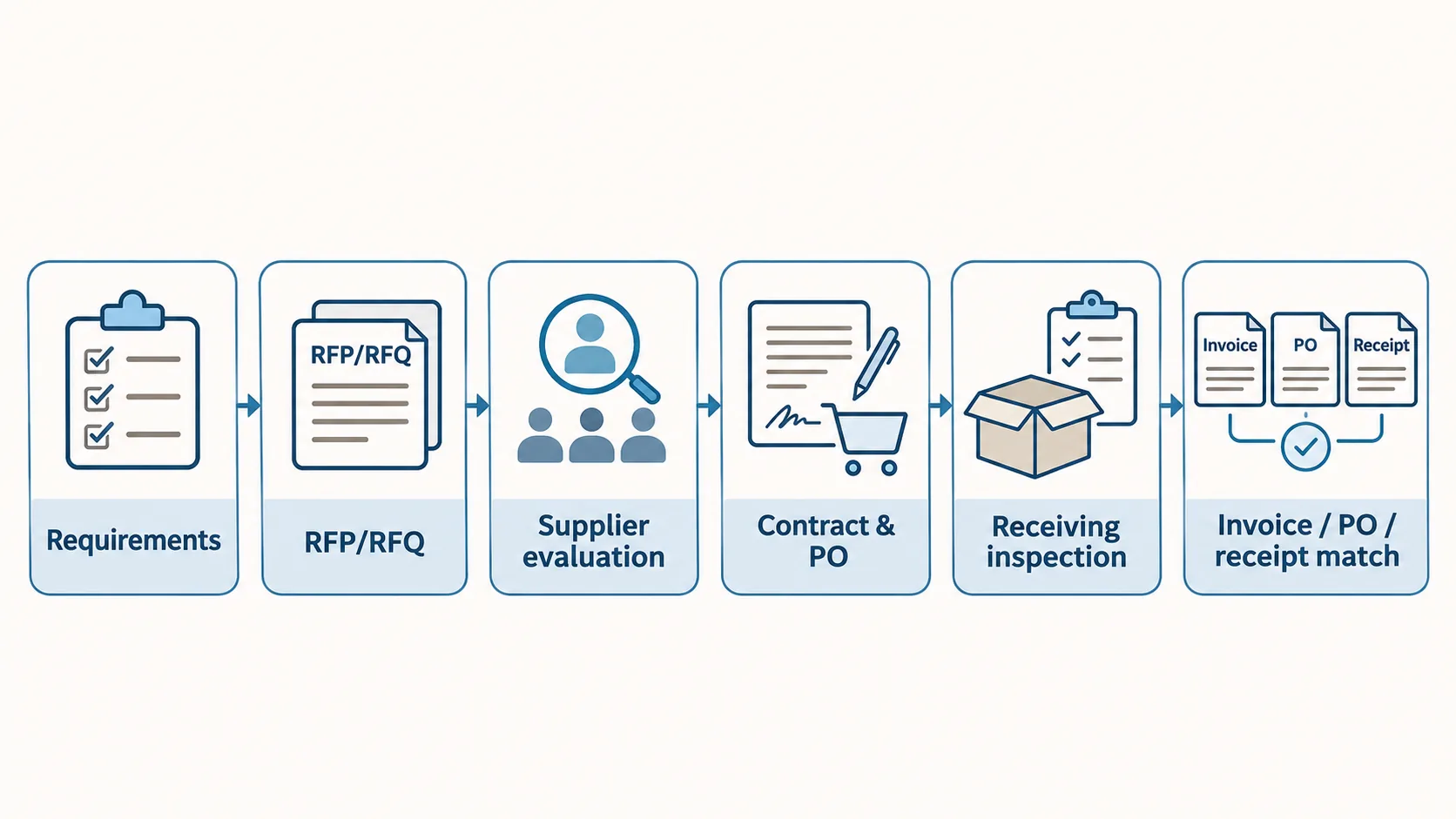
Mekari’s hospitality procurement process describes these activities, including supplier evaluation and receiving checks. Use the sequence to assign decisions for your own project. It is a purchasing framework, with the exact approvals set by the owner and contracts.
| Step | Record produced | Decision to assign |
|---|---|---|
| Define the requirement | Specification, quantities and scope | Who approves the item being bought |
| Request proposals or quotes | RFP or RFQ with the same item references | Who answers bidder questions |
| Evaluate suppliers | Comparison of price, quality, reliability and inclusions | Who recommends and selects the supplier |
| Agree terms and release the order | Contract and purchase order | Who may commit the project to the purchase |
| Receive the goods | Count, inspection record and discrepancy report | Who receives and reports problems |
| Match the payment records | Invoice, purchase order and receipt | Who confirms the payment conditions are met |
An RFP asks for a proposal against a defined requirement. An RFQ asks for a price against the stated scope. Whichever document you use, give bidders the same specification revision and record answers that change what is included.
Use the supplier evaluation checklist for the wider supplier review.
If purchasing software is used, keep its item references consistent with the approved drawings and documents. The team still needs a named person to approve a substitution, answer a delivery question and resolve a mismatch.
How do you keep FF&E bids tied to the approved specification?
Make every bidder quote the same item code, specification revision, sample reference, quantities and included services. Compare the resulting scopes before deciding which price offers the better fit for the project.
Approved specification
Put the approved finish or sample identity beside the item reference in the enquiry and order. The team should be able to trace the delivered cabinet or panel back to that line. An approval date and revision help when samples or drawings change during bidding.
Use the interior finish schedule to maintain finish references. Where fabrication drawings are part of the purchase, keep their status clear through the millwork submittal process. Send the accepted revision and keep superseded attachments out of the order set.
Inclusions
Ask bidders to identify what their price includes. Use the following illustrative checklist to record the terms each bidder includes.
| Item | What to specify in the order | Why it changes comparison |
|---|---|---|
| Goods | Item code, quantity, specification and sample reference | Keeps the quoted product tied to the approval |
| Packaging | Agreed protection and identification requirements | Affects handling and identifying goods on arrival |
| Freight and delivery | Agreed delivery basis and named destination | Defines the delivery being priced |
| Unloading | The party, location and equipment responsibility | Connects the truck arrival with the receiving plan |
| Temporary storage | Who provides it and under what agreed conditions | Keeps an early shipment from becoming an unassigned task |
| Distribution to rooms | Whether internal movement and room placement are included | Distinguishes arrival at the property from room placement |
| Installation and debris | Named installation and removal responsibilities | Makes site work visible beside the material supply |
| Replacements or spare parts | Agreed items, quantities and order references | Avoids assuming an unstated allowance |
Record an offered alternative on its own line, with its changed scope and approval status. A lower price that omits work the project still requires needs to be compared with the cost and responsibility for that work.
What does a delivery term like DAP or DPU actually cover?
Under DAP the seller delivers at the named place without unloading the goods; under DPU the seller unloads them there. If the parties choose an Incoterms rule, specify the named place and edition alongside the remaining site-work responsibilities.
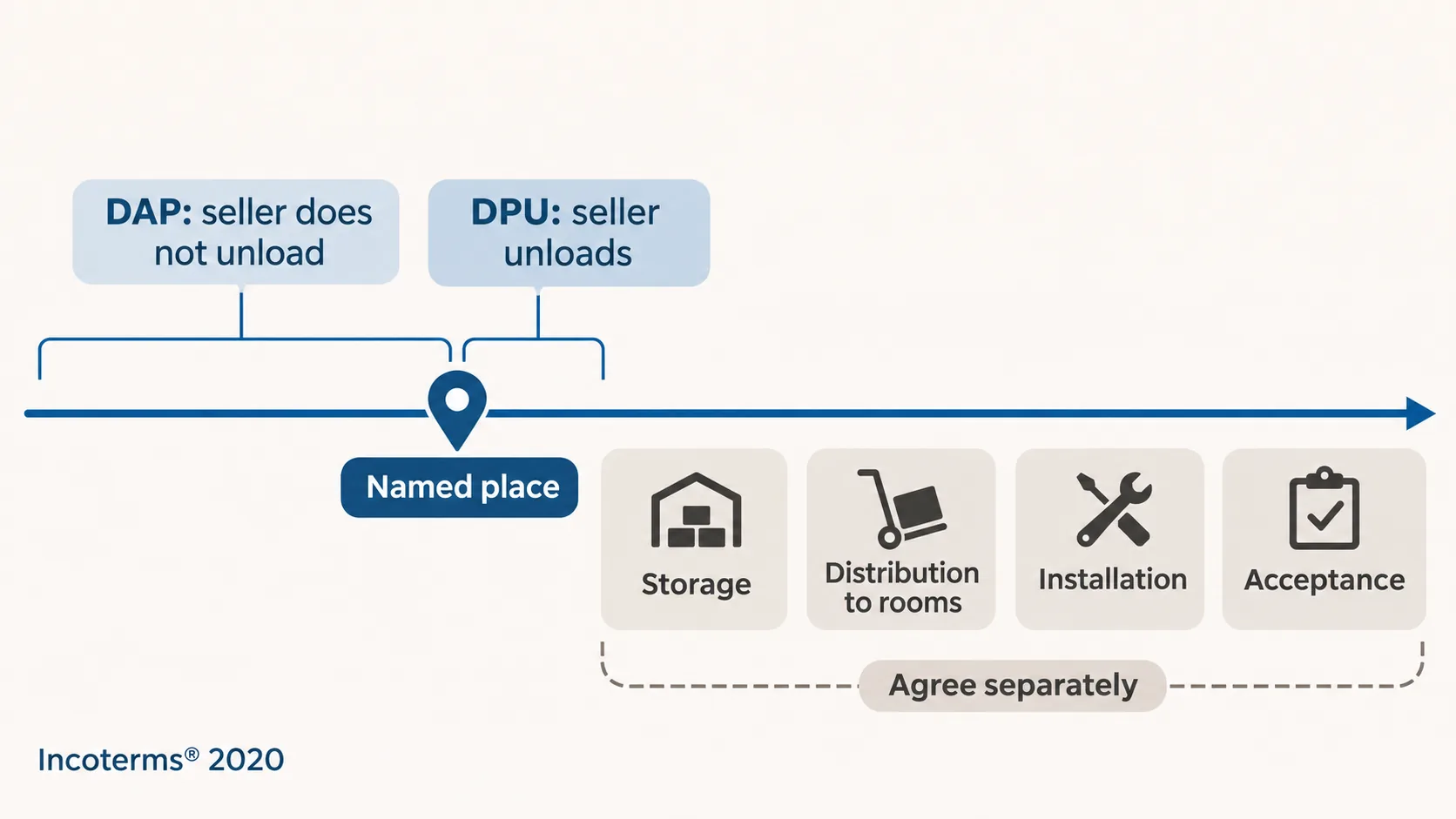
The ICC’s Incoterms overview explains that the rules clarify the tasks, costs and risks involved in delivering goods from sellers to buyers. Its Incoterms 2020 explanation identifies the unloading difference between DAP and DPU. That difference matters when comparing a hotel delivery price.
| Chosen term (Incoterms 2020) | Unloading at the named place | Agree separately for the hotel project |
|---|---|---|
| DAP | Seller delivers without unloading | Buyer’s unloading arrangement, subsequent storage, room distribution and installation |
| DPU | Seller unloads at the named place | Subsequent storage, room distribution, installation and acceptance arrangements |
Write the place precisely enough for the parties to plan the delivery. A property address, receiving location and unloading arrangement need to work together. Identify constraints with the receiving team before treating an offered delivery scope as complete.
Keep ownership, payment and quality acceptance in the sales contract. In a guest article published by ICC Academy, Baldev Bhinder explains that ownership and risk are different questions and that Incoterms do not replace the broader sales agreement. The article is the author’s interpretation, not ICC rule text.
Assign installation and the hotel’s acceptance procedure explicitly. A delivery record can confirm goods reached a location while leaving the project team with unresolved installation or finish issues.
How should FF&E deliveries be received and accepted?
Count and inspect deliveries against the purchase order, document damage or mismatches and keep arrival checks separate from installed-work acceptance. Give the receiving team the order references and an agreed route for reporting discrepancies.

Start with the item identification and quantities. Match labels and records to the actual order, then record visible condition. Photographs and a clear discrepancy description help the purchasing team discuss the specific goods involved.
For an item with a decorative finish, compare the delivered finish identity with the approved sample and order line. A similar-looking surface with a different code should go through the project’s substitution decision. Keep the relevant sample available to the people carrying out that check.
Record who will resolve each discrepancy and the next agreed action. The person signing for arrival may have a different responsibility from the person approving the installed casegoods. Reflect that distinction in the receiving and installation records.
Match the invoice, purchase order and receipt before confirming payment under the agreed terms. The hotel renovation checklist covers the wider room-handback context; connect that process to the purchasing evidence for the FF&E being installed.
How can a hotel check an FSC or other sourcing claim?
Ask for a product-specific sourcing claim and the seller’s supporting records, then check the certificate’s validity and relevant scope. For an FSC-claimed wood product, connect the claim to the item actually being purchased.
The FSC chain-of-custody information explains the certification’s role. Its current approved FSC-STD-40-004 V3-1 standard, effective September 1, 2021, sets requirements for certified or applicant organisations. Those obligations do not require every hotel buyer to become certified.
The standard’s clauses 2.2 and 2.3 address supplier validity, product-group scope and checks of the material and its accompanying information. Clauses 5.1 and 5.3 address sales and delivery information. For a hotel buying an FSC-claimed item, these provisions support a focused request:
- Identify the product and quantity covered by the claim.
- Obtain the relevant claim and supplier certificate code in the permitted sales or delivery documentation.
- Check certificate validity and the product scope using the official database.
- Keep the claim-bearing documents linked to the purchasing line.
Clause 5.7 permits clearly linked supplementary information with permission from the certification body. Clause 5.8 addresses custom-manufactured products sold using service invoices and linked supplementary documentation. Check the supplier’s permitted arrangement, including the connection between sales and supplementary records.
Keep the claim within its subject. Forestry sourcing evidence does not establish fire performance, emissions or a whole-room environmental outcome. The discussion of LEED material selection helps separate different evidence requests.
Where does silicone-faced film fit in a hotel FF&E package?
Puremorfilm provides decorative film with a silicone functional surface for fabricators finishing flat casegoods faces and wall panels. This paint-free surface differs from PVC, melamine, PP and PETG decorative faces. Material supply is mainly rolls, with film-faced panels on request and PUR flat lamination.

Its silicone surface is inherently flame-retardant; higher grades up to UL 94 V-0 are available on request for the film surface, not the casegoods or wall. In the manufacturer’s laboratory tests, coffee, red wine and soy sauce left for 24 hours at 25°C showed no obvious change after wiping. The formulation is No DOP.
There are 100+ existing patterns, with texture and gloss customisation on request. Free samples let the fabricator connect a hotel casegoods film selection with the approved purchasing line. With its leather-like feel and some elasticity, the film is not for floors, stovetop counters, shower floors or other walked-on areas. We supply the material; procurement, freight and installation responsibilities need their own project arrangements.
Who should handle each part of hotel FF&E procurement?
Assign specification, purchasing, receiving and installation decisions to named parties in the project agreement. A procurement firm may coordinate several of these tasks, with the service contract defining its scope.
| Task | Typical party to identify | Record to retain |
|---|---|---|
| Specification and finish approval | Designer and the project’s approving party | Approved specification, drawing and sample references |
| Supplier selection and order release | Owner or appointed procurement team | Bid comparison, approvals and purchase order |
| Delivery and receiving | Vendor and named receiving team | Delivery basis, receipt and discrepancy record |
| Installation and final acceptance | Parties assigned by the contract | Installation check and acceptance record |
A hospitality procurement-services guide describes the range of work firms may undertake. Use an agreed scope of service to decide what the appointed firm will actually handle.
We can provide material samples for the flat casegoods or panel faces in that specification. Bring the purchasing line, approved sample reference and fabricator’s details when you contact us.
Frequently Asked Questions
What does RFP stand for in the hospitality industry?
RFP stands for request for proposal. It asks suppliers to explain how they will meet a defined requirement and on what proposed commercial basis. Give bidders the same specification and record changes to the scope.
What is supply chain in hospitality?
The hospitality supply chain is the network of suppliers, transport, receiving and services that brings goods into a hotel or restaurant. Procurement forms part of that network by defining purchases and agreeing them with suppliers.
What services are provided by the procurement firms?
Procurement firms commonly offer sourcing, bidding, purchase-order administration, budget tracking, logistics and quality checks. The firm’s contract determines which of those services are included and who retains each approval.
Can procurement companies help minimize waste and reduce costs?
Yes, clearer specifications and coordinated orders can reduce avoidable over-ordering and rework. The outcome depends on the project and agreed service. Compare the firm’s actual scope and records without assuming a universal savings percentage.
Does a procurement company only offer services for the hospitality sector?
No, procurement firms may serve several sectors. Ask about relevant hospitality FF&E work and the specific services offered for your project. The service agreement should identify the work you are appointing the firm to perform.