
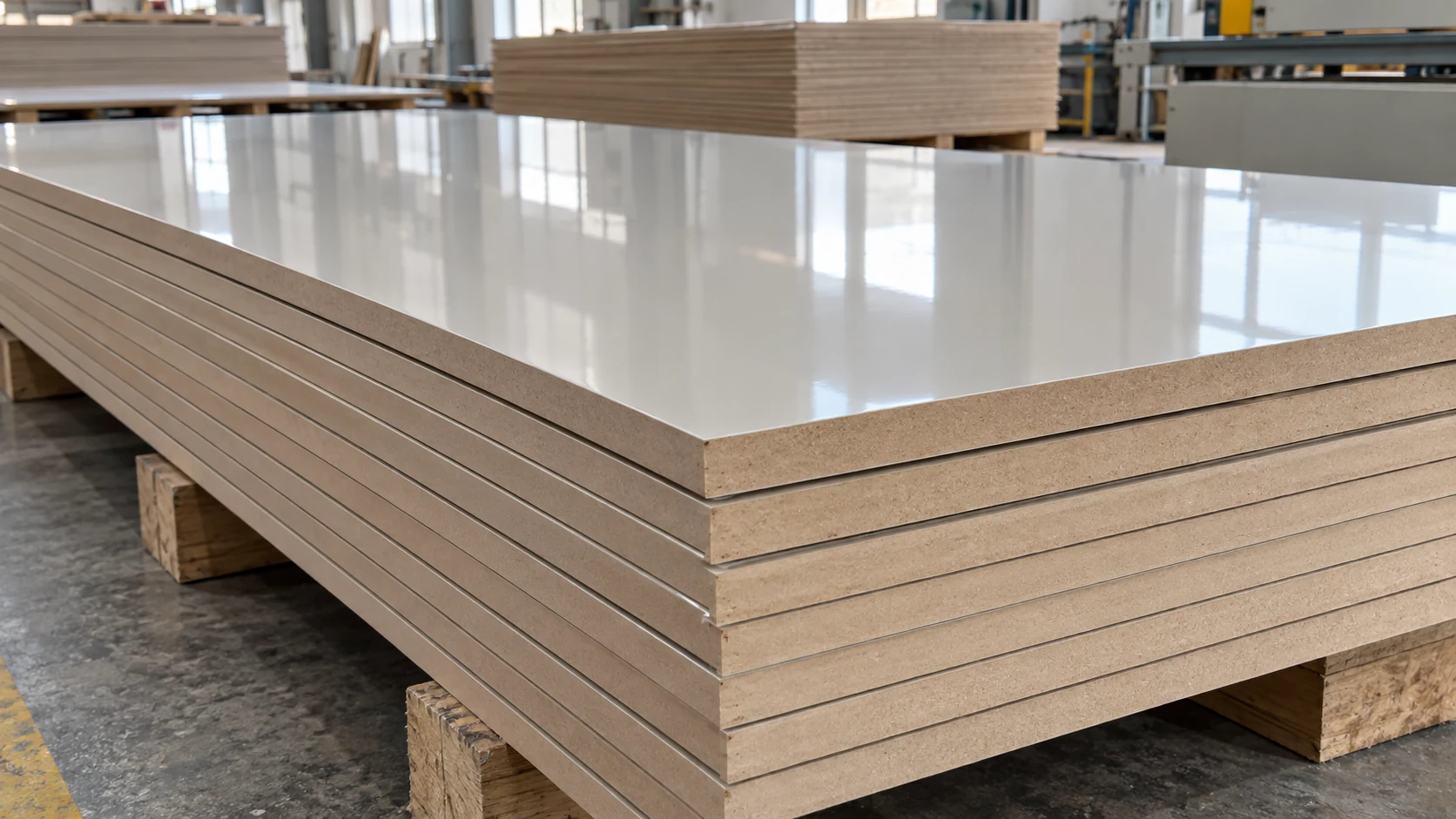
PUR adhesive for PET film lamination bonds a PET-backed decorative film to a board through initial cooling and subsequent moisture cure. Select a flat-lamination grade for the actual film back, board and coating-to-press interval, then qualify appearance and adhesion on that construction. Working temperature, coat weight and cure release belong to the chosen grade.
What Does PET Film Lamination Mean, and Where Does PUR Fit?
Two different jobs: flexible packaging made from films and paper, or decorative PET film bonded to a rigid panel. The materials, adhesive forms and machines differ, so a number from one route doesn’t carry over to the other.
In furniture production, a flat-lamination line presses a decorative film onto a board such as MDF or particleboard. In packaging, a roll-to-roll laminator combines flexible layers that later become pouches and wrappers. Both can use polyurethane chemistry, but substrate porosity, glue application and curing are very different.
| Decision | Flexible packaging lamination | Decorative film on a rigid board |
|---|---|---|
| Specimen | Two flexible webs; winding and film-to-film cure are part of the construction. | A flexible decorative facing bonded to MDF, particleboard or another qualified rigid core. |
| Equipment priority | Web-to-web coating and winding matched to the packaging adhesive. | Smooth roll coating, uniform board support and contact without a damaged face. |
| Parameter source | The packaging adhesive grade and its converting instructions. | The named flat-lamination grade’s TDS and the board-line qualification. |
| Transfer of settings | No automatic transfer to a rigid-board line. | Do not borrow packaging temperature, deposit or speed to fill a missing panel setting. |
Packaging figures are omitted here because a fast roll-to-roll converting line does not define the process window for PET film on MDF.
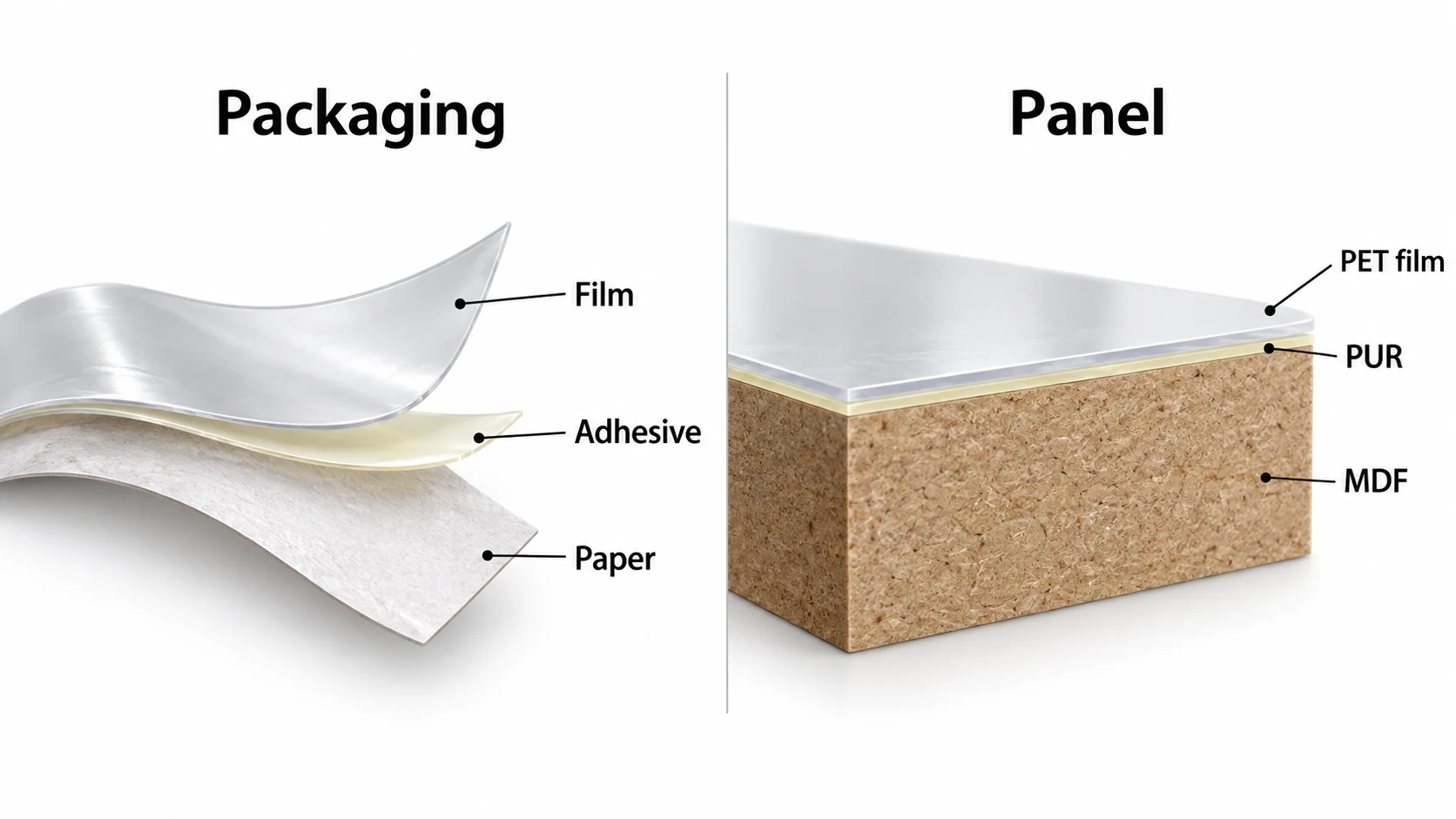
For panel adhesives beyond PUR, the panel-lamination adhesive overview covers the other routes. Everything below is about decorative panels.
For the full sequence from board preparation to bonding and inspection, see how to laminate MDF.
What Is PUR Adhesive, and How Does It Cure?
A one-component, moisture-reactive polyurethane hot melt: heat makes it coatable, cooling gives initial grip, and moisture then crosslinks it into its final bond.
The Chemix Guru explanation, published in 2019 and revised in 2021, describes a 100%-solids, solvent-free, isocyanate-terminated adhesive. That is the basic difference from solvent-based lamination, where removing solvent is part of the process, so reactive PUR needs no long drying tunnel.
The example grade cures with moisture into a virtually thermoset polymer. The moisture comes from the board, the air or both. So initial tack, the time you have to assemble the bond, and full cure are three different stages. A panel that can move down the line is not necessarily ready for machining or testing.
That moisture reaction is also why cured PUR doesn’t soften again like ordinary hot melt, and why panel-adhesive makers highlight its resistance to heat, moisture and steam on decorative panels. You still pick the grade for your own assembly and its exposure.
For an MDF construction, the laminated-MDF explanation separates the decorative face, adhesive and board, which helps you see which layer you are choosing or testing.
Why Is PUR Used to Bond PET Film to MDF and Particleboard?
Because the cured bond stands up to heat and moisture, and because it lays down a smooth adhesive layer under thin decorative films. On a visible panel, both the bond and the surface appearance count.
KLEIBERIT’s May 2025 flat-lamination product guide covers MDF and particleboard faced with foils including PET, ABS and PMMA. It explains that the slightest unevenness shows through thin decor, so the adhesive has to go on smoothly, and it ties heat, moisture and steam resistance to how the finished panel is used, which matters most for kitchen and bathroom furniture.
A film can look flat before bonding and still show a glue-line defect afterward. Glue particles, uneven application or a rough board stand out on a reflective face. Check the face appearance alongside bond strength; strength alone doesn’t make a panel acceptable.
The example grade lists fiberboard, particleboard and PET foils among its application materials. That is a useful maker’s example, not proof that every thin high-gloss PET and MDF pairing is already qualified. The MDF-versus-particleboard comparison helps you describe the board for a line trial.
How Do You Choose a PUR Grade for PET Film?
By assembly timing, initial grip and how the film looks and springs back. Then qualify the grade on your actual board, using equipment built for reactive hot melts.
- Match the available open time to the interval from coating through placement and pressing. The bond must be assembled within the usable window under the actual conditions.
- Match initial holding strength to the film’s tendency to spring back or recover its shape. A decorative foil with high memory forces can need a different grade from a compliant thin film.
- For high-gloss or transparent faces, select a grade explicitly described for smoothness or transparency. Judge the appearance on the bonded panel.
- For thin foils, consider grades described for low application quantities, then establish the deposit for that construction.
- Verify reactive-hotmelt equipment compatibility, substrate cleanliness and the trial’s finished appearance before setting the production specification.
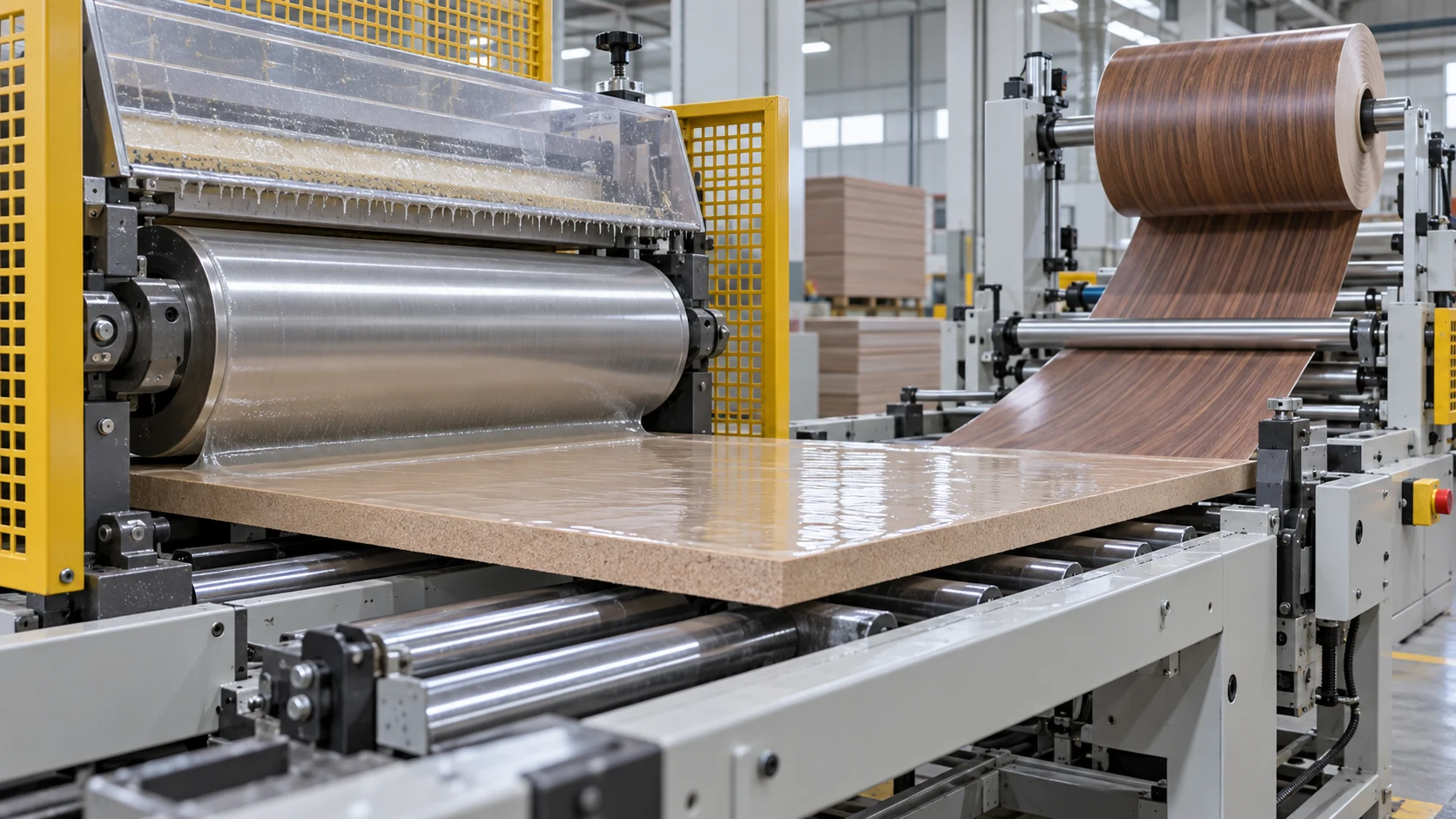
The KLEIBERIT flat-lamination guide distinguishes grades for high-gloss smoothness, transparent foils, thin films and high recovery forces. Its open-time column is measured at 20°C; its viscosity temperatures are measurement conditions. Select the intended grade, then obtain the grade-specific processing sheet.
Its 120°C and 140°C columns are the temperatures at which viscosity was measured, not operating limits. The open times are at the table’s stated temperature, so expect different numbers in a cold or hot plant.
Before bonding, remove oil, grease, dust and other contamination. If the film back needs a treatment or primer, it has to suit that specific film and adhesive; the sources here give no general dyne level for PET. The MDF lamination process covers broader panel preparation.
Can the same PUR adhesive bond decorative paper and PET film?
Yes, a PUR grade can cover both decorative paper and PET when its technical data sheet lists those materials and trials confirm the actual assemblies. Approval for a paper-faced board does not automatically qualify a PET-faced board. Match the selected grade to each facing’s bonding side, board surface and processing window.
The 5013GP technical data sheet lists paper and PET among its facing materials and ties deposition to substrate porosity. When changing the facing, ask the adhesive supplier to confirm the grade and coating conditions, then check adhesion and finished appearance on that construction. Keep the coating units and cure conditions with each trial.
What Settings Does a PUR Flat-Lamination Production Line Use?
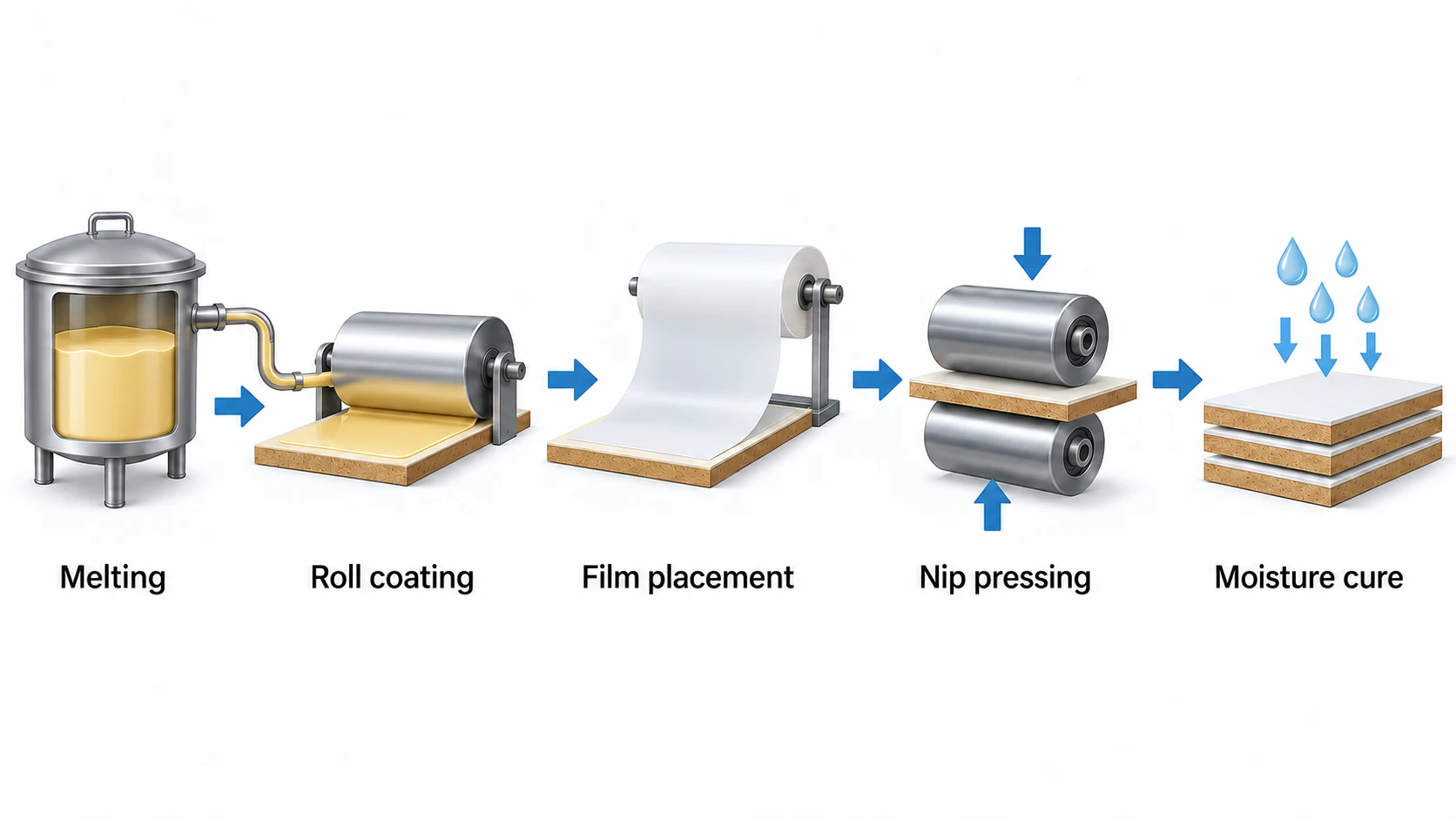
Melt, roll-coat, place and press the film, then let it moisture-cure. Take all your settings from one named grade instead of mixing packaging, textile and panel sources.
The TECHNOMELT PUR 5013GP September 2025 TDS names PET foils on substrates including fiberboard and particleboard, and gives this example.
| Item | Published value or condition | Meaning for this grade |
|---|---|---|
| Working temperature | 250–290°F | Approximately 121–143°C by conversion |
| Open time | About 1–2 minutes | Varies with ambient temperature and substrate thermal conductivity |
| Roll-coated deposition | 8–20 g/ft² | Approximately 86–215 g/m² by conversion; varies with substrate porosity |
| Viscosity at 250°F | Approximately 12,000 mPa·s | Measurement at the stated temperature |
| Viscosity at 290°F | Approximately 6,000 mPa·s | Measurement at the stated temperature |
| Storage | 60–95°F, dry area | Unopened packaging has a listed six-month shelf life |
| Opened container | Use completely after opening | The sheet instructs against resealing |
Watch the coat-weight unit: grams per square foot and grams per square metre give very different numbers. The conversions above only change units, and the substrate-porosity condition still applies. The deposit is a published example for this grade. Other thin-foil grades can specify a different deposit; qualify the chosen grade rather than extending this range.
The sheet gives no line speed, nip pressure, dwell time, full-cure period or humidity setting. Work those out with your adhesive supplier through line trials, and don’t treat a short assembly window as full cure.
Record the machine identifier and roller arrangement, measured material temperature, actual coating-to-contact time, deposit with units, speed, contact settings and cure age for each trial. Adjust one suspected variable within the maker’s permitted window, then compare an intact control. Use the five-defect lamination troubleshooting table when the symptom is a bubble, orange peel, wrinkle, delamination or edge lift.
For acceptance, define the finished assembly and its condition at testing; the ASTM D903 peel method below is a named comparative route. The PET-versus-PVC decorative film comparison helps you describe the film before you set processing conditions.
How Do You Test a PUR-Laminated PET Panel?
Peel-test the cured bond with a defined method and inspect the finished face against the look the project needs. Run heat and moisture checks that match where the panel will be used.
ASTM D903-98(2025) covers comparative peel or stripping characteristics of adhesive bonds, with set specimen preparation, temperature and machine speed. It gives you a method, not a pass value for decorative PET panels, so your specification needs the tested assembly and an agreed acceptance limit.
Record where the sample failed as well as the force. A break inside the film, at the adhesive interface or inside the board points to different parts of the construction, and a value measured inside a multilayer film says nothing about the film-to-board bond.
Inspect high-gloss faces for flatness, bubbles and visible glue particles, and look closely at edges, where lifting usually starts first.
Test final bond properties only after full cure. The example grade’s sheet gives no release time, so record the conditioning and release decision from your own trial. For kitchen or bathroom parts, the MDF moisture discussion explains why the board and exposed edges belong in the assessment.
What Should a PET Film Lamination Specification Include?
The actual film, board, adhesive and processing conditions, plus the test and appearance requirements, so a later run reproduces the qualified construction and not just the word PUR.
| Item | What to specify | Why |
|---|---|---|
| Film | PET construction, thickness, width and bonding-side treatment | Identifies the actual foil and interface |
| Substrate | MDF, particleboard or other board, surface condition and moisture condition | Describes the supporting material and coating surface |
| Adhesive | Grade and dated TDS | Connects every setting with one product |
| Application | Coating method, deposit and explicit units | Prevents confusing g/ft² with g/m² |
| Thermal settings | Grade-specific working conditions | Keeps process and viscosity-test temperatures distinct |
| Assembly | Coating-to-press interval and qualified speed | Connects open time with the actual line |
| Cure and testing | Conditioning, release criteria, ASTM D903 where applicable | Defines what was tested and when |
| Safety | SDS, ventilation and equipment compatibility | Makes the handling requirements part of the process |
| Completed panel | Face appearance and backing or balancing arrangement | Addresses the finished construction |
Solvent-free doesn’t mean no safety controls. The example grade contains isocyanate and must run only in equipment built for reactive hot melts. Its TDS requires forced ventilation over the melter and applicator, and an ongoing industrial-hygiene program with plans for ventilation failure and MDI monitoring.
Keep those conditions with the grade’s SDS. A cabinet material choice describes the finished product; the lamination specification describes how its face and board are joined.
Where Does a Silicone-Surface PET Film Fit?
Puremorfilm manufactures silicone decorative film in China with a silicone functional face on a PET support. We supply rolls without self-adhesive backing for PUR flat lamination to boards, or silicone laminated panels quoted per project. Use the current product for furniture fronts, cabinet doors, wall panels and other vertical or low-wear faces; exclude floors, countertops and stovetops.
The bond inside the supplied film and the PUR joint added by your laminating line are separate. In worked examples described in the patent application, a 125 μm BOPET construction reached at least 3 N/15 mm in a 180° peel test. This is an interlayer result for the film construction, not an acceptance value for film bonded to MDF; qualify that joint on the actual adhesive and board.
Standard furniture and wall-film rolls start at 500 m per design. Laminated panels are 1220 × 2440 mm and start at 200 sheets per design; the core and facing configuration are quoted per project. Compare the furniture decorative film and wall-film application with your component.
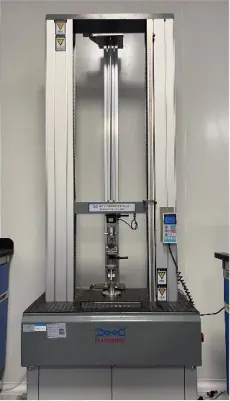
Illustrative equipment image; not a record of testing this finished panel.
Which PUR Setup Should You Start With?
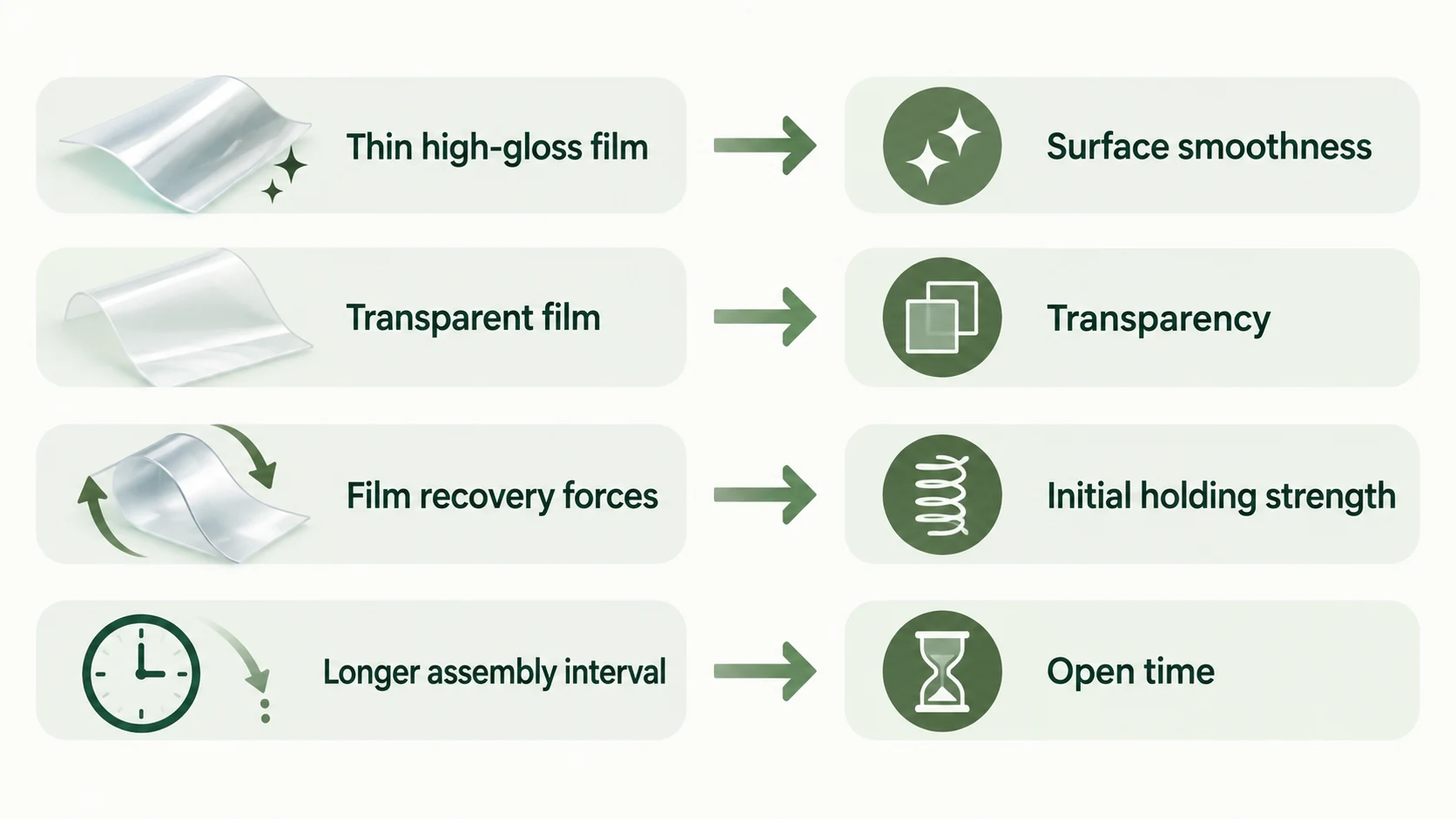
A grade that fits your film and the time between gluing and pressing, qualified for appearance and bond strength on the real panel. Use the published example only as a reference for its own grade.
| Situation | Starting selection |
|---|---|
| Thin high-gloss PET face | A grade described for smoothness and the appropriate deposit |
| Transparent film | A grade explicitly intended for transparency |
| Film with strong recovery forces | A grade described for high initial holding strength |
| Longer coating-to-press interval | An open-time window matching the actual assembly conditions |
| Humid or warm service | Evaluation of the cured completed assembly under the intended exposure |
Line trials on your own film and board are still needed. For a decorative-panel construction, bring the film thickness, substrate, line speed and current PUR grade when you contact us.
Frequently Asked Questions
What is PUR adhesive?
PUR adhesive is a one-component reactive polyurethane hot melt that cures with moisture. Flat-lamination grades bond decorative films to wood-based panels.
How does PU laminating adhesive work?
Solvent-based PU adhesive bonds as the solvent leaves and the polymer reacts; reactive PUR hot melt goes on molten and then cures with moisture.
Is PUR adhesive solvent-free?
Yes. The example grade still contains isocyanate and needs the ventilation and handling controls in its TDS and SDS.
What materials can film lamination adhesive bond?
Fiberboard, particleboard and plywood, with thermoplastic foils such as PET, vinyl and acrylics, plus paper and HPL, according to one named flat-lamination grade.
Can cured PUR adhesive be melted again?
No, moisture-cured PUR doesn’t remelt. The example maker’s cleaning instructions soften cured residue with a suitable solvent before removal, under the stated safety conditions.